recommended oil Citroen BERLINGO MULTISPACE RHD 2015 2.G Owner's Manual
[x] Cancel search | Manufacturer: CITROEN, Model Year: 2015, Model line: BERLINGO MULTISPACE RHD, Model: Citroen BERLINGO MULTISPACE RHD 2015 2.GPages: 276, PDF Size: 12.21 MB
Page 19 of 276
17
Limit the causes of excess consumption
Spread loads throughout the vehicle; place the heaviest
items in the bottom of the boot, as close as possible to the
rear
seats.
Limit
the loads carried in the vehicle and reduce wind
resistance
(roof bars, roof rack, bicycle carrier, trailer...).
Use
a roof box in preference.
Remove
roof bars and roof racks after use.
At
the end of winter, remove snow tyres and refit your
summer
tyres.
Observe the recommendations on maintenance
Check the tyre pressures regularly, when cold, referring to the label in the door aperture, driver's side.
Carry
out this check in particular:
-
before
a long journey,
-
at each change of season,
-
after
a long period out of use.
d
on't forget the spare wheel and the tyres on any trailer or
caravan.
Have
your vehicle serviced regularly (engine oil, oil filter,
air
filter, passenger compartment filter...) and observe the
schedule
of operations recommended in the maintenance
and
warranty guide.
With
a Blue HDi Diesel engine, if the SCR system is
faulty
your vehicle becomes polluting; go to a CITROËN
dealer
or a qualified workshop without delay to have the
emissions
of nitrous oxides brought back to the legal level.
When refuelling, do not continue after the third cut-off of
the
nozzle to avoid any overflow.
At
the wheel of your new vehicle, it is only after the first
1
800 miles (3 000 kilometres) that you will see the fuel
consumption
settle down to a consistent average.
2
EcO-drIVInG
Motoring & Environment
Page 32 of 276
Berlingo_2_VP_en_Chap03_Pret-a-partir_ed02-2014
30
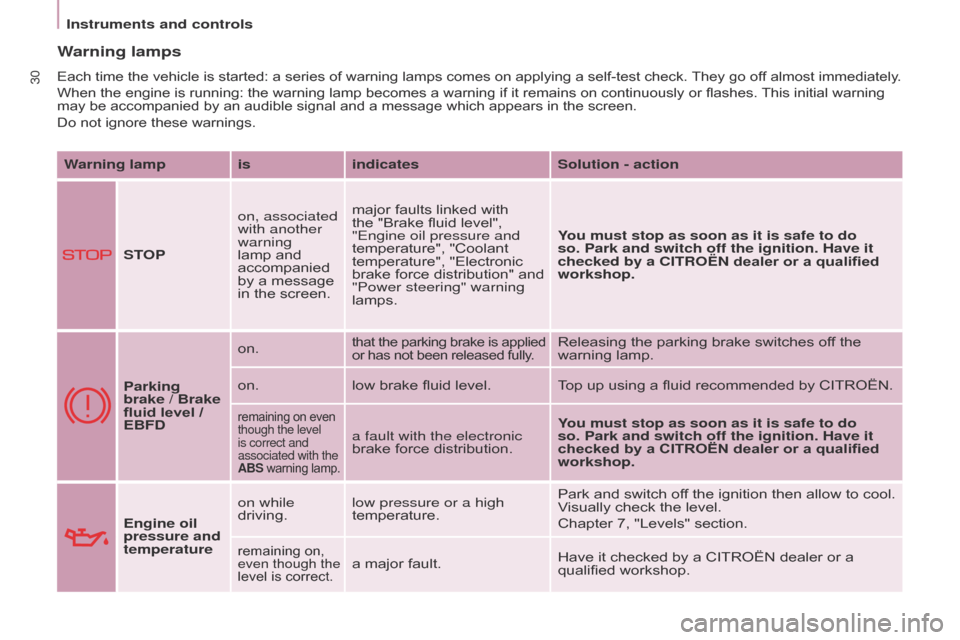
Warning lamps
Each time the vehicle is started: a series of warning lamps comes on applying a self-test check. They go off almost immediately.
When the engine is running: the warning lamp becomes a warning if it remains on continuously or flashes.
This
initial warning
may
be accompanied by an audible signal and a message which appears in the screen.
Do
not ignore these warnings.
Warning lamp is indicatesSolution - action
S t
OP on, associated
with another
warning
lamp
and
accompanied
by
a message
in
the screen.major
faults linked with
the
"Brake fluid level",
"Engine oil pressure and
temperature",
"Coolant
temperature",
"Electronic
brake
force distribution" and
"Power steering" warning
lamps.Y
ou must stop as soon as it is safe to do
so. Park and switch off the ignition. Have it
checked by a
c I tr OË n dealer or a qualified
workshop.
Parking
brake / Brake
fluid level /
EBF
d
on.that the parking brake is applied or
has not been released fully.Releasing the parking brake switches off the warning lamp.
on. low
brake
fluid
level. Top up using a fluid recommended by CITROËN.
remaining on even though the level
is correct and
associated with the
ABS
warning
lamp.
a fault with the electronic
brake force distribution. You must stop as soon as it is safe to do
so. Park and switch off the ignition. Have it
checked by a CITROËN dealer or a qualified
workshop.
Engine oil
pressure and
temperature on while
driving.
low pressure or a high
temperature. Park
and switch off the ignition then allow to cool.
V
isually check the level.
Chapter
7, "Levels" section.
remaining on, even though the
level is correct.a major fault. Have it checked by a CITROËN dealer or a qualified
workshop.
Instruments and controls
Page 111 of 276

ABS
ABS
109
Berlingo_2_VP_en_Chap05_Securite_ed02-2014
AntI-LOcK BrAKInG SYStEM
(ABS - EBF d )
The ABS and EBFD (electronic brake force
distribution) systems improve the
stability
and manoeuvrability of your
vehicle
on braking, in particular on
poor
or slippery surfaces.
The
ABS
prevents locking of the
wheels, the EBF
d provides control of
the
braking pressure wheel by wheel.If
this warning lamp comes on,
accompanied by an
audible
signal and a message
in the screen, it indicates a
malfunction
of the
ABS
which
could result in a loss of control of the
vehicle
on braking.
If
this warning lamp comes
on,
together with the brake
and
STOP
warning lamps,
accompanied
by an audible
signal
and a message in the
screen,
it indicates a malfunction of
the
electronic brake force distribution
which could result in a loss of control of
the
vehicle on braking.
EMErGEncY BrAKInG
ASSIS t
A
nc E SYS t EM (EBA)
In an emergency, this system enables the optimum braking pressure to be
reached
more quickly, press the pedal
firmly
without releasing it.
It is triggered by the speed at which the
brake
pedal is activated.
This
alters the resistance of the brake
pedal
under your foot.
To prolong the operation of the
emergency
braking assistance system:
keep
your foot on the brake pedal.
Good practice
The anti-lock braking system comes into operation automatically when
there
is a risk of wheel lock. It does not
reduce
the braking distance.
o
n very slippery surfaces (ice, oil,
etc...)
the
ABS
may increase the
braking
distance. When braking in
an
emergency, do not hesitate to
press
the brake pedal firmly, without
releasing the pressure, even on a
slippery surface, you will then be able
to
continue to manoeuvre the vehicle
to
avoid an obstacle.
Normal
operation of the
ABS
may be
felt
by slight vibration of the brake
pedal.
When changing wheels (tyres
and
rims), ensure that these are
recommended
by CITROËN. Stop as soon as it is safe to do so.
In both cases, contact a CITR
o Ë n
dealer
or a qualified workshop.
driving safely
SaFETY
5
Page 140 of 276

Berlingo_2_VP_en_Chap06_Accessoire_ed02-2014
138
The fitting of electrical equipment or accessories which are not
recommended by CITROËN may
result in a failure of your vehicle's
electronic
system. Please note this
specific
warning.
Y
ou are advised
to contact a dealer to be shown the
range
of recommended equipment or
accessories.
d
epending on the country in which
the
vehicle is sold, it is compulsory
to have a high visibility vest, warning
triangle and spare bulbs available in
the
vehicle. "Active Fleet
d ata" telematic unit
Connected directly to the heart of the
vehicle
(multiplexed network: "Full
CAN"),
the telematic unit, by means of
a
"ready to use" service, permits the
sending
in real time of information
such
as:
-
distance travelled,
-
distance
remaining before the next
service,
-
warnings and faults (oil level,
coolant
level, oil temperature,
coolant
temperature, etc...).
This
enables "Fleet" managers
to
optimise the monitoring and
management
of their professional
vehicles.
d
epending on country, contact a
CITROËN dealer
for more information.
Equipment
Page 145 of 276
Berlingo_2_VP_en_Chap07_Verification_ed02-2014
143
LEVELSOil change
This must be carried out at the intervals specified in the
manufacturer's
servicing schedule.
Ask
for
advice
from
a
CITROËN
dealer
.
Remove
the dipstick before filling.
Check
the level after filling (never
exceed
the max mark).
Refit
the oil filler cap before closing the
bonnet.
changing the brake fluid
The brake fluid must be changed at the intervals stated, according to the
manufacturer's servicing schedule.
Use
fluids recommended by the
manufacturer
, which meet the DOT4
standard.
The
level must be between the MIN
and
MAX marks on the reservoir.
If
fluid has to be added frequently,
this
indicates a fault which must be
checked
by a CITROËN dealer or
a
qualified workshop as soon as
possible.
Warning lamps
If you have to remove / refit
the engine style cover , handle it
with
care to avoid damaging the
fixing
clips.
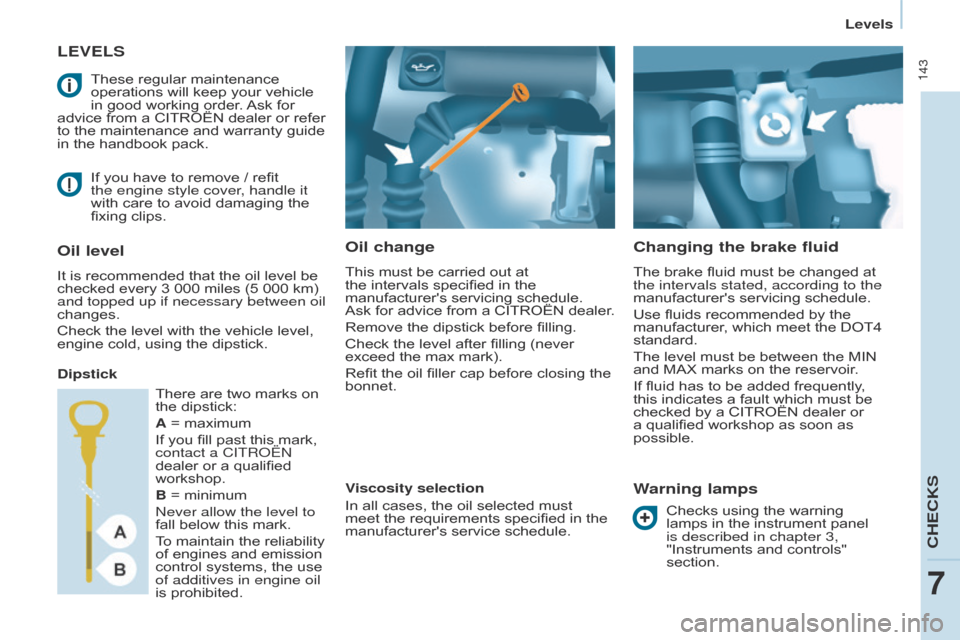
Oil level
It is recommended that the oil level be checked every 3 000 miles (5 000 km)
and topped up if necessary between oil
changes.
Check
the level with the vehicle level,
engine
cold, using the dipstick.
d
ipstick
Viscosity selection
In
all cases, the oil selected must
meet
the requirements specified in the
manufacturer's
service schedule.
These
regular maintenance
operations
will keep your vehicle
in
good working order.
Ask
for
advice
from a CITROËN dealer or refer
to
the maintenance and warranty guide
in
the handbook pack.
Checks using the warning
lamps
in the instrument panel
is described in chapter 3,
"Instruments
and controls"
section.
There
are two marks on
the
dipstick:
A
= maximum
If
you fill past this mark,
contact a CITR
o Ë n
dealer
or a qualified
workshop.
B
= minimum
n
ever allow the level to
fall
below this mark.
To
maintain the reliability
of
engines and emission
control
systems, the use
of additives in engine oil
is
prohibited.
Levels
CHECkS
7
Page 146 of 276
Berlingo_2_VP_en_Chap07_Verification_ed02-2014
144
cooling system
Only use the fluid recommended by the manufacturer.
Otherwise,
you risk seriously damaging
your
engine.
When
the engine is warm, the
temperature
of the coolant is controlled
by
the engine fan.
As
this fan can
operate
with the ignition key removed
and
because the cooling system is
pressurised, wait for at least one hour
after the engine has stopped before
carrying
out any work.
Slacken
the cap by 1/4 of a turn to
release the pressure to prevent any
risk
of scalding. When the pressure
has
dropped, remove the cap and top
up
the level with coolant.
If
fluid has to be added frequently,
this
indicates a fault which must be
checked
by a CITROËN dealer as
soon
as possible.
Power steering fluid level
The vehicle must be parked on level ground with the engine cold. Unscrew
the cap integrated with the gauge and
check
the level which must be between
the
MIN and MAX marks. In
order to regenerate the filter, you are advised to drive at a speed higher
than
40 mph (60 km/h) for at least five minutes
as soon as possible, when
traffic
conditions permit (until the
message
disappears and the service
warning
lamp goes off).
d
uring regeneration of the particle
emission
filter, the noise of a relay
operating
may be heard under the
dashboard.
If
the message is still displayed and
if
the service warning lamp remains
on, contact a CITR
o Ë n dealer or a
qualified
workshop.
topping up
The
level
must
be
between
the
MIN
and
MAX
marks
on
the
expansion
bottle.
If
more
than
1
litre
of
fluid
is
required
to
top
up
the
level,
have
the
system
checked
by
a
CITROËN
dealer
or
a
qualified
workshop.
Screenwash and headlamp
wash level
For best quality cleaning and for your safety , we would advise that you use
products
of the CITROËN range.
For
optimum cleaning and to avoid
freezing,
this fluid must not be topped
up
or replaced with plain water.
Capacity
of the screenwash reservoir:
approximately
3 litres.
If
your vehicle is fitted with headlamp
washers, the capacity of the reservoir
is
6 litres.
diesel additive level
( d iesel with particle
emission filter)
topping up
This additive must be topped up by
a
CITROËN dealer or a qualified
workshop
without delay.
Waste products
avoid prolonged contact of used oil
with the skin.
Brake
fluid is harmful to health and
very
corrosive.
Do
not dispose of used oil, brake fluid
or coolant into drains or into the ground
but into the containers dedicated to this
use at a CITR
o Ë n dealer (France) or
an
authorised waste disposal site.
The
minimum
level
of
this
additive
is indicated by lighting of the service
warning
lamp,
accompanied
by
an
audible
signal
and
a
message
in
the
screen.
When this occurs with the engine
running it is due to the start of
saturation
of
the
particle
emission
filter
(exceptionally prolonged urban type
driving
conditions:
low
speed,
long
traffic
jams,
...).
Levels
Page 148 of 276
Berlingo_2_VP_en_Chap07_Verification_ed02-2014
146
Bleeding water from the diesel
filter Manual gearbox
Have the level checked in accordance with the
manufacturer's servicing schedule.
Only use products recommended by CITRo Ë n or products
of
equivalent quality and
specification.
In
order to optimise the operation
of
units as important as the braking
system,
CITROËN selects and offers
specific
products.
In
order to avoid damaging the
electrical units, high pressure washing
to
clean the engine compartment is
strictly
prohibited.
After
washing the vehicle dampness,
or
in
winter, ice may form on the brake
discs
and pads: braking efficiency may
be
reduced. Make some light brake
applications to dry and de-ice the
brakes.
If
this
warning
lamp
comes
on,
bleed
the
filter.
Otherwise
bleed
regularly
each
time
the
engine
oil
is
changed.
H
d
i engines use advanced
technology.
All
work
requires
special training, which is assured
by
a
CITROËN
dealer.
Depending
on
country
of
sale.
To drain the water, unscrew the bleed
screw
located
on
the
filter.
o
perate until all of the water no longer
flows
in
the
transparent
pipe,
then
tighten
the
bleed
screw.
checks