brake CITROEN C-ZERO DAG 2017 Handbook (in English)
[x] Cancel search | Manufacturer: CITROEN, Model Year: 2017, Model line: C-ZERO DAG, Model: CITROEN C-ZERO DAG 2017Pages: 174, PDF Size: 4.56 MB
Page 61 of 174

59
C-Zero_en_Chap05_securite_ed01-2016
Automatic operation
of brake lamps
The brake lamps come on automatically when
you release the accelerator pedal.
This does not happen in all cases and depends
on the rate of deceleration.
Hazard warning lamps
Visual warning with all of the direction
indicators flashing to alert other road users to a
vehicle breakdown, towing or accident.
F
P
ress this button, all of the direction
indicators flash.
They can operate with the ignition off.
Horn
F Press the central part of the steering wheel.
5
Safety
Page 65 of 174

63
C-Zero_en_Chap05_securite_ed01-2016
Braking assistance systems
Anti-lock braking system
and electronic brake force
distributionGroup of supplementary systems which help
you to obtain optimum braking in complete
safety in emergency situations:
-
a
nti-lock braking system (ABS),
-
e
lectronic brake force distribution (EBFD),
-
e
mergency braking assistance (EBA).
When braking in an emergency, press
very firmly without releasing the
pressure.
Activation
The anti-lock braking system comes into
operation automatically when there is a risk of
wheel lock.
Normal operation of the ABS may make itself
felt by slight vibration of the brake pedal.
Linked systems which improve the stability and
manoeuvrability of your vehicle when braking,
in particular on poor or slippery sur faces.
5
Safety
Page 66 of 174

64
C-Zero_en_Chap05_securite_ed01-2016
You must stop as soon as it is safe to do so.
Contact a CITROËN dealer or a qualified
workshop. Vehicle movingIllumination of these two
warning lamps indicates a
malfunction of the electronic
brake force distribution
which could result in a loss of control of the
vehicle on braking.
You MUST stop as soon as it is safe to do so.
Contact a CITROËN dealer or a qualified
workshop.
When replacing wheels (tyres and rims),
ensure that they conform to the manufacturer's
recommendations.
Emergency braking assistance
System which, in an emergency, enables you
to obtain the optimum braking pressure more
quickly, thus reducing the stopping distance.
Activation
It is triggered by the speed at which the brake
pedal is pressed.
The effect of this is a reduction in the
resistance of the pedal and an increase in
braking efficiency.
When braking in an emergency, press
firmly without releasing the pressure.
Operating fault
Vehicle stationary
The warning lamp comes on for a few
seconds when the ignition is switched
on (ON position). If it does not go off or
does not come on, contact a CITROËN
dealer or a qualified workshop.Illumination of this warning lamp
indicates a malfunction of the anti-
lock braking system, which could
result in a loss of control of the
vehicle when braking.
Contact a CITROËN dealer or a qualified
workshop. Fixed illumination of this warning
lamp indicates a malfunction of
the anti-lock braking system which
could result in a loss of control of the
vehicle on braking.
Safety
Page 67 of 174

65
C-Zero_en_Chap05_securite_ed01-2016
Anti-slip regulation (ASR)
and electronic stability
programme (ESP)
Trajectory control systems
Deactivation
In exceptional conditions (starting a vehicle
which is bogged down, stuck in snow, on soft
ground, etc.), it may be advisable to deactivate
the ASR and ESP systems to regain grip.
F
P
ress this button button, located on
the dashboard (driver's side), until the
corresponding symbol appears in the
instrument panel screen.
Activation
These systems are activated automatically
each time the vehicle is started.
They come into operation in the event of a grip
or trajectory problem. The display of this symbol indicates
that the ASR and ESP systems are
deactivated.
Reactivation
These systems are not reactivated automatically.
F
P ress this button again to reactivate them
manually.
The symbol going off in the instrument panel
indicates the reactivation of the ASR and ESP
systems.
The anti-slip regulation (also known as Traction
Control) optimises traction to limit wheel spin,
by acting on the brakes of the driving wheels
and on the engine.
The electronic stability programme acts on the
brake of one or more wheels and on the engine
to keep the vehicle on the trajectory required
by the driver, within the limits of the laws of
physics.
This is indicated by flashing of this
symbol in the instrument panel. The ASR /ESP systems should not
encourage the driver to take extra risks
or drive at high speed.
The correct functioning of these
systems depends on observation of
the manufacturer's recommendations
regarding the wheels (tyres and rims),
the braking components, the electronic
components and the assembly
and repair procedures used by the
CITROËN dealer network.
After an impact, have these systems
checked by a CITROËN dealer or a
qualified workshop.
Operating fault
The display of this message
in the instrument panel
indicates a malfunction of
these systems.
Contact a CITROËN dealer or a qualified
workshop to have the ASR /ESP systems
checked.
Excessive wheel spin may cause
damage to the differential of
your
vehicle.
5
Safety
Page 68 of 174

66
C-Zero_en_Chap05_securite_ed01-2016
Engine brake reduction indicator lamp
Your vehicle is equipped with a system for the
recovery of energy during deceleration which
uses the engine brake.
It recovers into the traction battery some of the
energy generated when the vehicle slows down
(e.g. on a long descent) to improve the range
of the battery and so the distance that can be
travelled between charges.
When the traction battery has been charged
fully and for the first few miles (or kilometres) of
use of the vehicle, the engine brake is reduced
temporarily.We therefore recommend that you anticipate
your braking as much as possible: use the
brake pedal to slow down or stop the vehicle.
This indicator lamp flashes on the
instrument panel, inviting you to
adapt your driving accordingly. The braking power is never reduced
while the indicator lamp is flashing.
Safety
Page 89 of 174

87
C-Zero_en_Chap06_conduite_ed01-2016
A few driving recommendations
Observe the driving regulations at all times and
remain vigilant whatever the traffic conditions.
Pay close attention to the traffic and keep your
hands on the wheel so that you are ready to
react at any time to any eventuality.
In difficult weather, drive smoothly, anticipate
the need to brake and increase the distance
from other vehicles.If you are obliged to drive through water:
-
c
heck that the depth of water does not
exceed 15 cm, taking account of waves
that might be generated by other users.
-
d
rive as slowly as possible; do not exceed
6 mph (10 km/h).
On leaving the flooded road, as soon as
circumstances allow, make several light brake
applications to dry the brake discs and pads.
If in doubt on the state of your vehicle, contact
a CITROËN dealer or a qualified workshop.Important!
Driving on flooded roads
We strongly advise against driving on flooded
roads, as this could cause serious damage
to the motor and the gearbox as well as the
electrical systems of your vehicle. Never drive with the parking brake
applied - Risk of overheating and
damage to the braking system!
Never leave a vehicle unsupervised
with the motor switched on. If you
have to leave your vehicle with the
motor switched on, apply the parking
brake and place the drive selector in
position
N or P
.
6
Driving
Page 90 of 174

88
C-Zero_en_Chap06_conduite_ed01-2016
Starting - stopping the vehicle
- Position 1: LOCK The steering is locked.
-
P
osition 2: ACC
T
he ancillaries (radio, 12 V socket, etc.)
can be used.
-
P
osition 3: ON
I
gnition on.
-
P
osition 4: S TA R T
"
Ready" lamp on.
M
otor ready to drive the vehicle.
Ignition switch
F Check that the drive selector is in position P.
F
I
nsert the key in the ignition switch.
F
T
urn the key to position 4 (S TA R T ) .
StartingStopping
F Stop the vehicle.
F
K eep your foot on the brake pedal.
F
P
lace the drive selector in position P .
F
A
pply the parking brake.
F
T
urn the key to position 1 (LOCK) .
F
R
emove the key from the ignition switch.
F
H
old it in this position for a few
seconds until the " RE ADY " lamp
comes on accompanied by an
audible signal.
F
R
elease the key.
T
he key returns automatically to
position
3
(ON) . Do not attach any heavy objects to the
key as this could weigh down on it when
in the ignition switch and cause a fault.
If you use the ancillaries for a prolonged
period (with the key in the ACC
position), you risk discharging the 12 V
battery. Starting your vehicle will then
no longer be possible. Be aware.
Driving
Page 91 of 174

89
C-Zero_en_Chap06_conduite_ed01-2016
Parking brake
Applying
F Pull the parking brake lever fully up to immobilise your vehicle.
When parking on a slope, direct your
wheels against the kerb, apply the
parking brake, place the drive selector
in position P and switch off the ignition.
Releasing
F Pull the parking brake lever up slightly, press the release button then lower the
lever fully.
When the vehicle is being driven, if
the parking brake is still on or has
not been fully released, this warning
lamp comes on.
6
Driving
Page 92 of 174
90
C-Zero_en_Chap06_conduite_ed01-2016
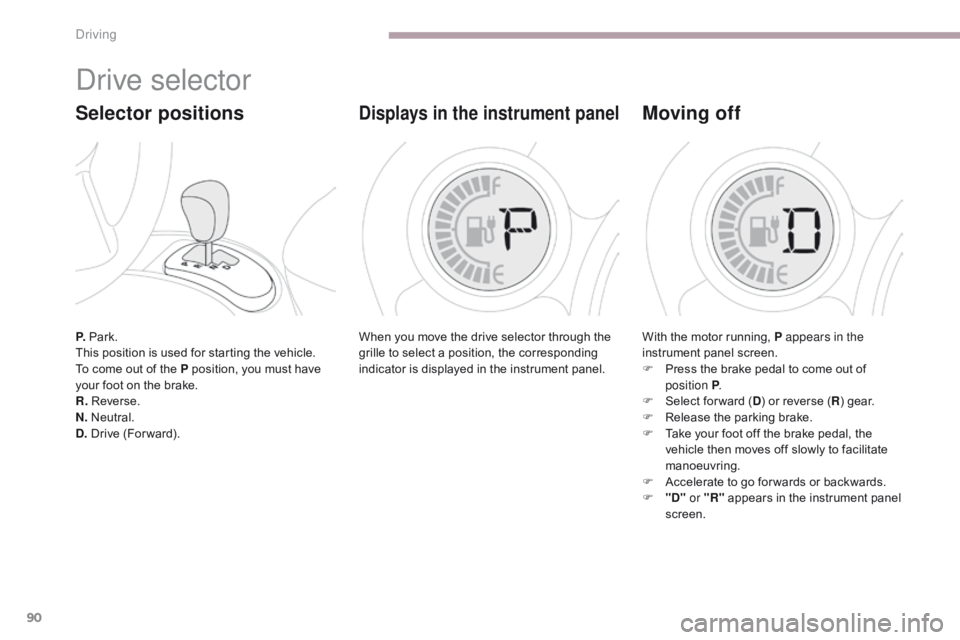
P. Park.
This position is used for starting the vehicle.
To come out of the P position, you must have
your foot on the brake.
R. Reverse.
N. Neutral.
D. Drive (For ward).
Drive selector
Selector positions
When you move the drive selector through the
grille to select a position, the corresponding
indicator is displayed in the instrument panel.
Displays in the instrument panel
With the motor running, P appears in the
instrument panel screen.
F
P
ress the brake pedal to come out of
position P .
F
S
elect for ward ( D) or reverse ( R) gear.
F
R
elease the parking brake.
F
T
ake your foot off the brake pedal, the
vehicle then moves off slowly to facilitate
manoeuvring.
F
A
ccelerate to go for wards or backwards.
F
"
D" or "R" appears in the instrument panel
screen.
Moving off
Driving
Page 93 of 174

91
C-Zero_en_Chap06_conduite_ed01-2016
To tow your vehicle, the drive selector
must be in position N.
For more information on Towing the
vehicle , refer to the corresponding
section.
Parking the vehicle
To stop the motor, you must select position P .
You must apply the parking brake to immobilise
the vehicle.
To remove the key from the ignition switch, the
drive selector must be in position P .
6
Driving