ignition Citroen C1 2014 1.G Owner's Guide
[x] Cancel search | Manufacturer: CITROEN, Model Year: 2014, Model line: C1, Model: Citroen C1 2014 1.GPages: 256, PDF Size: 5.63 MB
Page 97 of 256
95
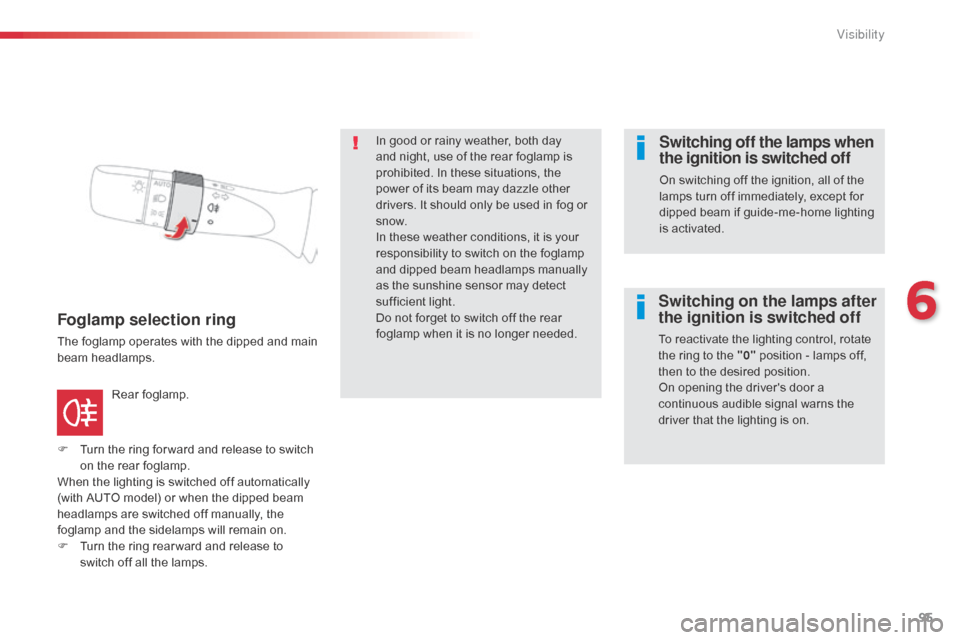
Foglamp selection ring
The foglamp operates with the dipped and main
beam headlamps.
F
T
urn the ring for ward and release to switch
on the rear foglamp.
When the lighting is switched off automatically
(with AUTO model) or when the dipped beam
headlamps are switched off manually, the
foglamp and the sidelamps will remain on.
F
T
urn the ring rear ward and release to
switch off all the lamps. Rear foglamp. In good or rainy weather, both day
and night, use of the rear foglamp is
prohibited. In these situations, the
power of its beam may dazzle other
drivers. It should only be used in fog or
snow.
In these weather conditions, it is your
responsibility to switch on the foglamp
and dipped beam headlamps manually
as the sunshine sensor may detect
sufficient light.
Do not forget to switch off the rear
foglamp when it is no longer needed.
Switching off the lamps when
the ignition is switched off
On switching off the ignition, all of the
lamps turn off immediately, except for
dipped beam if guide-me-home lighting
is activated.
Switching on the lamps after
the ignition is switched off
To reactivate the lighting control, rotate
the ring to the "0"
position - lamps off,
then to the desired position.
On opening the driver's door a
continuous audible signal warns the
driver that the lighting is on.
6
Visibility
Page 99 of 256

97
Manual guide-me-home
lighting*
Temporarily keeping the dipped beam
headlamps on after the vehicle's ignition
has been switched off makes the exit of the
vehicle's occupants easier when the light is
p o o r.
Switching on
F Place the lighting control stalk in the "lighting off " or "AUTO" position.
F
W
ith the ignition off, "flash" the headlamps
using the lighting control stalk.
The lighting comes on for about 30 seconds.
Switching off
The manual guide-me-home lighting switches
off immediately if you.
-
f
lash the headlamps again,
-
p
lace the lighting control stalk in another
position,
-
s
witch the ignition on.
* Depending on version.
6
Visibility
Page 105 of 256
103
Under-inflation detection
The system monitors the pressures in the four
tyres, once the vehicle is moving.
It compares the information given by the four
wheel speed sensors with reference values,
which must be reinitialised ever y time the
tyre pressures are adjusted or a wheel
changed.
The system triggers an alert as soon as it
detects a drop in the inflation pressure of one
or more tyres.
The under-inflation detection system
does not replace the vigilance or the
responsibility of the driver.
This system does not avoid the need to
check the tyre pressures (including the
spare wheel) every month as well as
before a long journey.
Driving with under-inflated tyres impairs
road holding, extends braking distances
and causes premature tyre wear,
particularly under arduous condition
(high loading, high speed, long journey).
System which automatically checks the pressures of the tyres while driving.
The inflation pressures defined for
your vehicle can be found on the tyre
pressure label.
See the "Identification markings"
section.
Tyre pressures should be checked
when the tyres are "cold" (vehicle
stopped for 1 hour or after a journey of
less than 6 miles (10 km) at moderate
speeds).
Other wise (when hot), add 0.3 bar to
the pressures shown on the label. Driving with under-inflated tyres
increases fuel consumption.
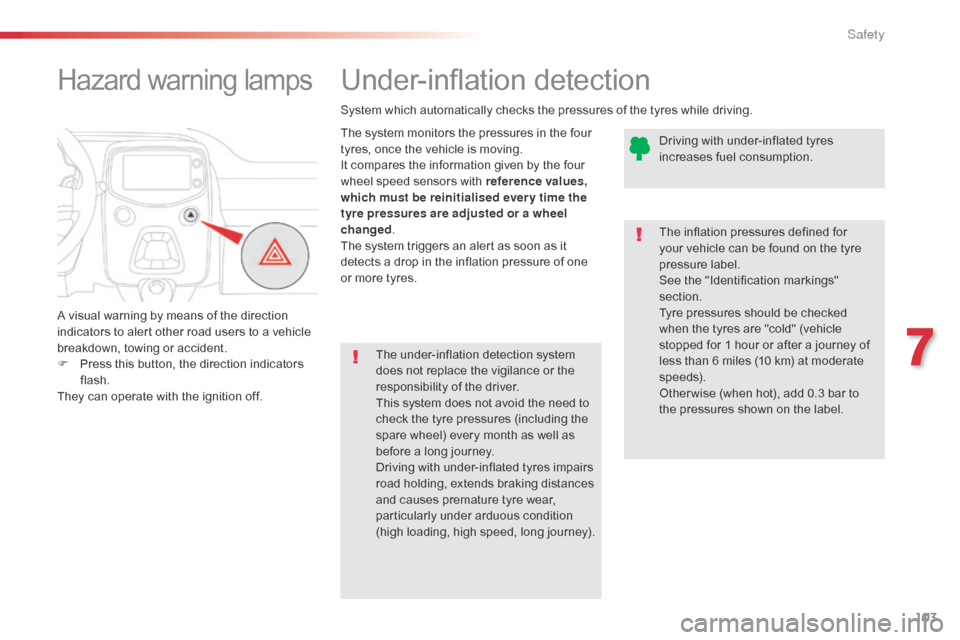
Hazard warning lamps
A visual warning by means of the direction
indicators to alert other road users to a vehicle
breakdown, towing or accident.
F
P
ress this button, the direction indicators
flash.
They can operate with the ignition off.
7
Safety
Page 107 of 256
105
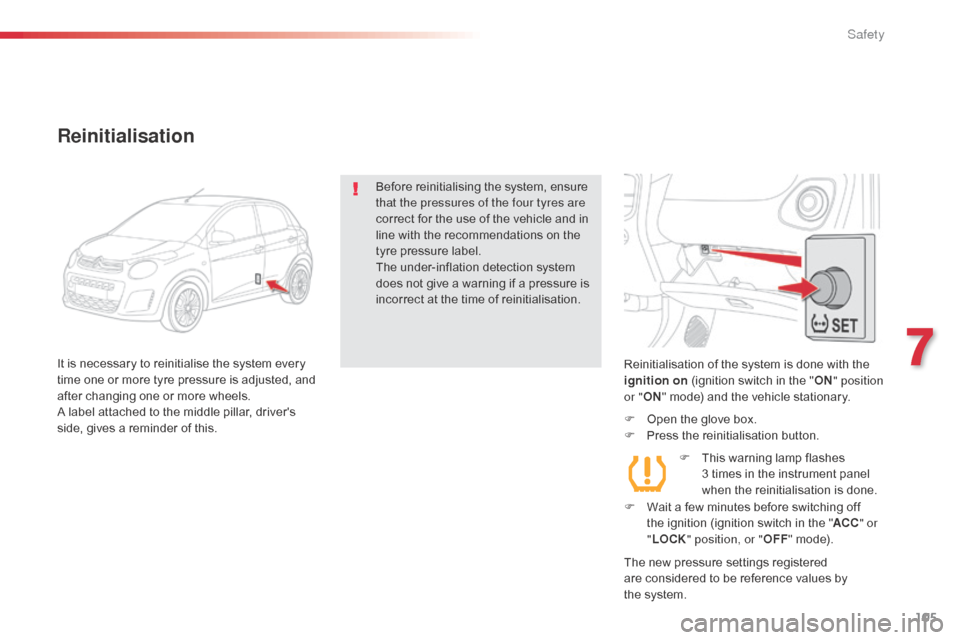
Reinitialisation of the system is done with the
ignition on (ignition switch in the " ON" position
or " ON" mode) and the vehicle stationary.
F
O
pen the glove box.
F
P
ress the reinitialisation button.
The new pressure settings registered
are considered to be reference values by
the
system.
Reinitialisation
Before reinitialising the system, ensure
that the pressures of the four tyres are
correct for the use of the vehicle and in
line with the recommendations on the
tyre pressure label.
The under-inflation detection system
does not give a warning if a pressure is
incorrect at the time of reinitialisation.
It is necessary to reinitialise the system every
time one or more tyre pressure is adjusted, and
after changing one or more wheels.
A label attached to the middle pillar, driver's
side, gives a reminder of this. F
T
his warning lamp flashes
3
times in the instrument panel
when the reinitialisation is done.
F
W
ait a few minutes before switching off
the ignition (ignition switch in the " ACC" or
" LOCK " position, or " OFF" mode).
7
Safety
Page 112 of 256
110
Seat belts
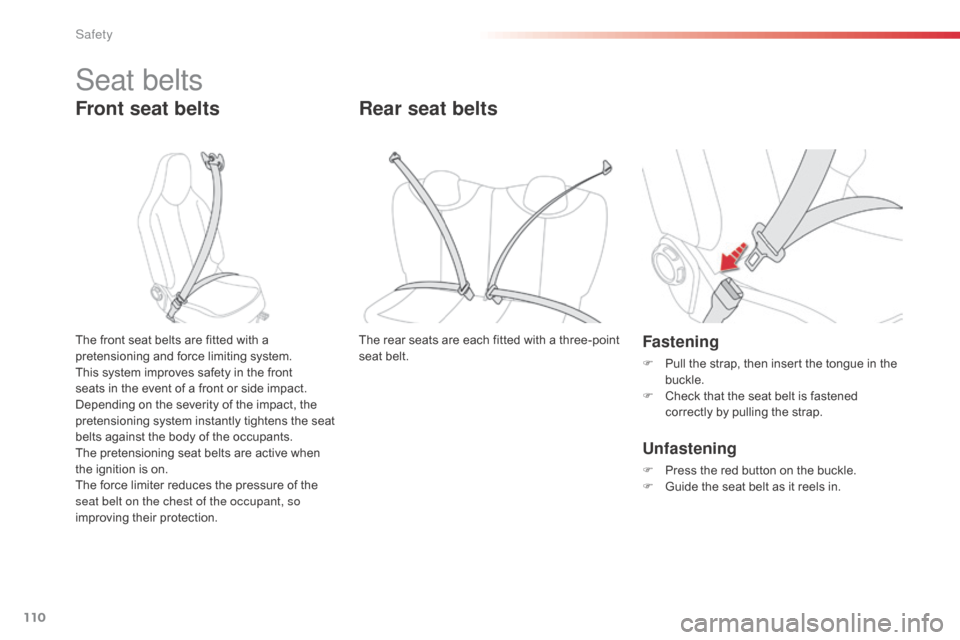
Front seat belts
Fastening
F Pull the strap, then insert the tongue in the buckle.
F
C
heck that the seat belt is fastened
correctly by pulling the strap.
The front seat belts are fitted with a
pretensioning and force limiting system.
This system improves safety in the front
seats in the event of a front or side impact.
Depending on the severity of the impact, the
pretensioning system instantly tightens the seat
belts against the body of the occupants.
The pretensioning seat belts are active when
the ignition is on.
The force limiter reduces the pressure of the
seat belt on the chest of the occupant, so
improving their protection.
Rear seat belts
The rear seats are each fitted with a three-point
seat belt.
Unfastening
F Press the red button on the buckle.
F
G uide the seat belt as it reels in.
Safety
Page 115 of 256
113
Airbags
System designed to contribute towards the
safety of the occupants in the event of violent
collisions. The airbags supplement the action
of the force-limiting seat belts.
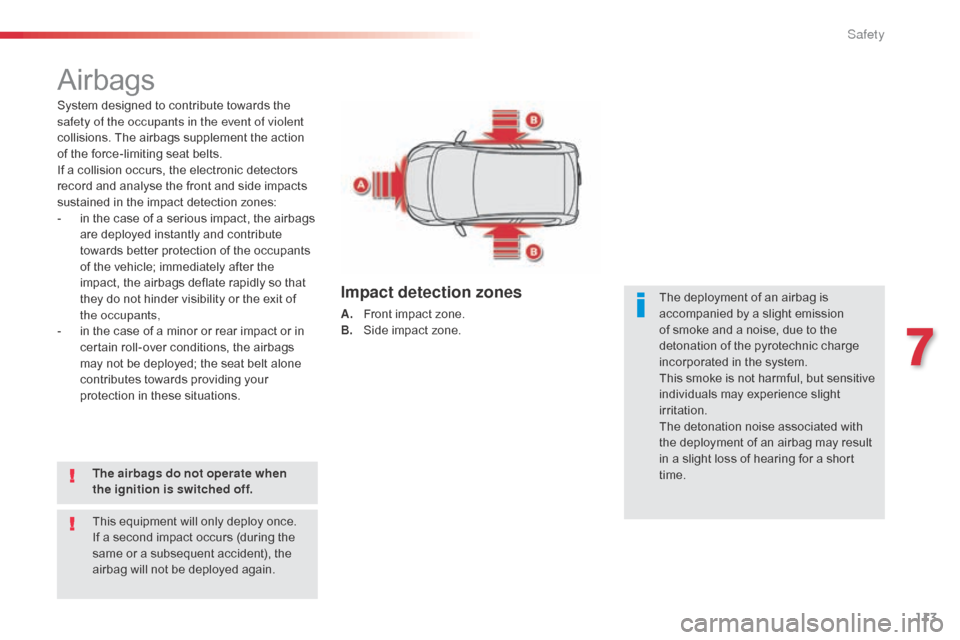
If a collision occurs, the electronic detectors
record and analyse the front and side impacts
sustained in the impact detection zones:
-
i
n the case of a serious impact, the airbags
are deployed instantly and contribute
towards better protection of the occupants
of the vehicle; immediately after the
impact, the airbags deflate rapidly so that
they do not hinder visibility or the exit of
the
occupants,
-
i
n the case of a minor or rear impact or in
certain roll-over conditions, the airbags
may not be deployed; the seat belt alone
contributes towards providing your
protection in these situations.
The airbags do not operate when
the
ignition is switched off. The deployment of an airbag is
accompanied by a slight emission
of smoke and a noise, due to the
detonation of the pyrotechnic charge
incorporated in the system.
This smoke is not harmful, but sensitive
individuals may experience slight
irritation.
The detonation noise associated with
the deployment of an airbag may result
in a slight loss of hearing for a short
time.
This equipment will only deploy once.
If a second impact occurs (during the
same or a subsequent accident), the
airbag will not be deployed again.
Impact detection zones
A. Front impact zone.
B. S ide impact zone.
7
Safety
Page 116 of 256
114
Deactivating the passenger's
front airbag
Only the passenger's front airbag can be
deactivated.
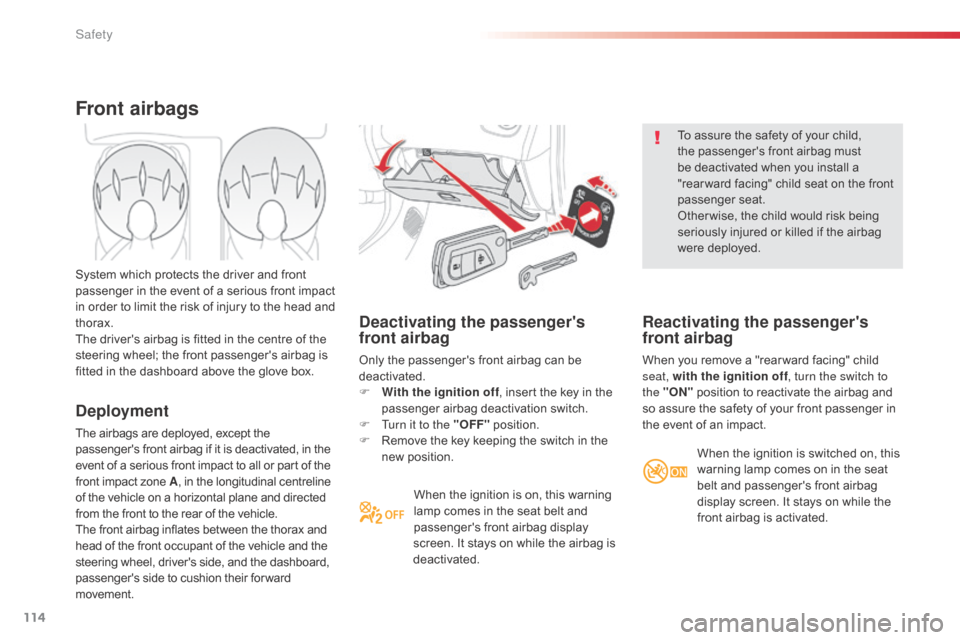
F
W
ith the ignition off , insert the key in the
passenger airbag deactivation switch.
F
T
urn it to the "OFF" position.
F
R
emove the key keeping the switch in the
new position.
When the ignition is on, this warning
lamp comes in the seat belt and
passenger's front airbag display
screen. It stays on while the airbag is
deactivated. To assure the safety of your child,
the passenger's front airbag must
be deactivated when you install a
"rear ward facing" child seat on the front
passenger seat.
Other wise, the child would risk being
seriously injured or killed if the airbag
were deployed.
Reactivating the passenger's
front airbag
When you remove a "rear ward facing" child
seat, with the ignition off
, turn the switch to
the "ON" position to reactivate the airbag and
so assure the safety of your front passenger in
the event of an impact.
Front airbags
Deployment
The airbags are deployed, except the
passenger's front airbag if it is deactivated, in the
event of a serious front impact to all or part of the
front impact zone A , in the longitudinal centreline
of the vehicle on a horizontal plane and directed
from the front to the rear of the vehicle.
The front airbag inflates between the thorax and
head of the front occupant of the vehicle and the
steering wheel, driver's side, and the dashboard,
passenger's side to cushion their for ward
movement. System which protects the driver and front
passenger in the event of a serious front impact
in order to limit the risk of injury to the head and
thorax.
The driver's airbag is fitted in the centre of the
steering wheel; the front passenger's airbag is
fitted in the dashboard above the glove box.
When the ignition is switched on, this
warning lamp comes on in the seat
belt and passenger's front airbag
display screen. It stays on while the
front airbag is activated.
Safety
Page 135 of 256
133
Child lock
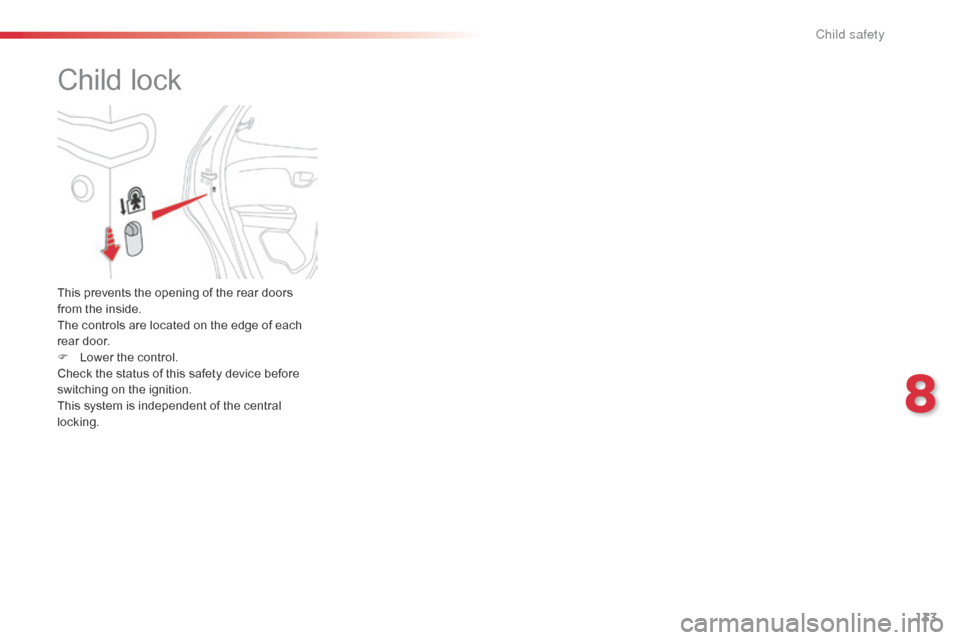
This prevents the opening of the rear doors
from the inside.
The controls are located on the edge of each
rear door.
F
L
ower the control.
Check the status of this safety device before
switching on the ignition.
This system is independent of the central
locking.
8
C
Page 136 of 256
134
Fuel tank
Low fuel levelRefuelling
When the low fuel level is reached,
this warning lamp comes on and the
last bar flashes, accompanied by an
audible signal.
You have approximately 5 litres remaining.
In certain driving conditions and depending on the
engine, the distance which can be travelled with the
fuel remaining may be less than 30 miles (50 km).
When the frequency of the flashing increases, you
have approximately 3 litres remaining .
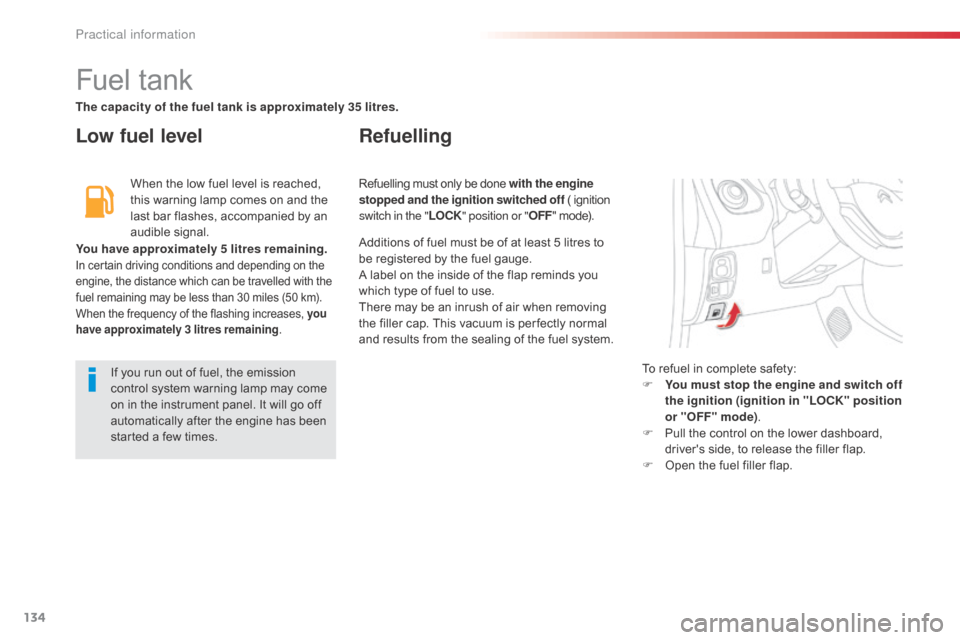
To refuel in complete safety:
F
Y ou must stop the engine and switch off
the ignition (ignition in "LOCK" position
or "OFF" mode) .
F
P
ull the control on the lower dashboard,
driver's side, to release the filler flap.
F
O
pen the fuel filler flap.
If you run out of fuel, the emission
control system warning lamp may come
on in the instrument panel. It will go off
automatically after the engine has been
started a few times. Refuelling must only be done with the engine
stopped and the ignition switched off
( ignition
switch in the " LOCK" position or " OFF" mode).
The capacity of the fuel tank is approximately 35 litres.
Additions of fuel must be of at least 5 litres to
be registered by the fuel gauge.
A label on the inside of the flap reminds you
which type of fuel to use.
There may be an inrush of air when removing
the filler cap. This vacuum is per fectly normal
and results from the sealing of the fuel system.
Practical information
Page 139 of 256
137
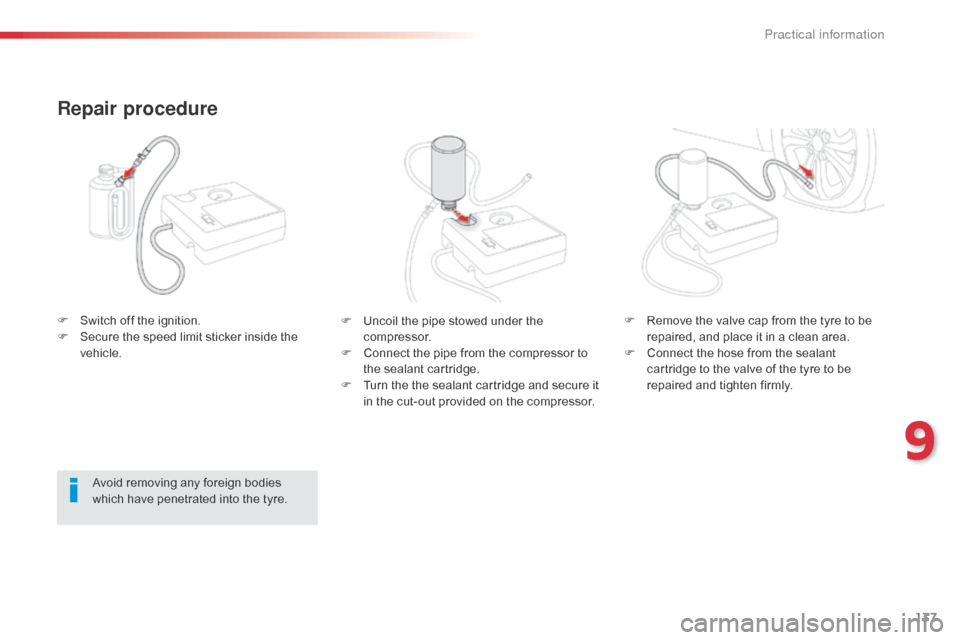
F Uncoil the pipe stowed under the compressor.
F
C
onnect the pipe from the compressor to
the sealant cartridge.
F
T
urn the the sealant cartridge and secure it
in the cut-out provided on the compressor.
Repair procedure
Avoid removing any foreign bodies
which have penetrated into the tyre. F
R
emove the valve cap from the tyre to be
repaired, and place it in a clean area.
F
C
onnect the hose from the sealant
cartridge to the valve of the tyre to be
repaired and tighten firmly.
F
S
witch off the ignition.
F
S
ecure the speed limit sticker inside the
vehicle.
9
Practical information