ESP Citroen C1 2015 1.G User Guide
[x] Cancel search | Manufacturer: CITROEN, Model Year: 2015, Model line: C1, Model: Citroen C1 2015 1.GPages: 271, PDF Size: 7.18 MB
Page 59 of 271

57
C1_en_Chap03_confort_ed01-2015
For maximum cooling or heating of the
cabin, it is possible to go beyond the
minimum 14 or maximum 28 value.
F
P
ress the temperature adjustment
button down or up until "LO" or
"HI" is displayed.
A setting around 21
gives optimum comfort.
However, depending on your requirements, a
setting between 18 and 24 is normal.
On entering the vehicle, if the interior is very
cold or hot, there is no need to change the
value displayed in order to reach the required
level of comfort. The system corrects the
temperature difference automatically and as
quickly as possible.
Temperature adjustment
F Press this button downward to reduce the value and upward to
increase it.
The value indicated in the screen corresponds
to a level of comfort and not to a temperature in
degrees Celsius or Fahrenheit.
Air flow adjustment
F Press this button to increase air
f low.
The air flow symbol, the fan, fills progressively. F
P
ress this button to decrease air
f low.
Air distribution adjustment
- the centre and side air vents,
- t he centre vent, side air vents and
footwells,
-
t
he footwells,
-
t
he windscreen and footwells,
-
t
he centre vent, side air vents and
windscreen,
-
t
he windscreen. F
P
ress this button repeatedly to
direct the air to:
Air intake / Air recirculation
Avoid prolonged recirculation of interior
air (risk of condensation or deterioration
of the air quality). F
P
ressing this buttons isolates the
passenger compartment from the
outside air.
T
he air recirculation symbol is
displayed.
Air recirculation enables the passenger
compartment to be isolated from exterior odours
and smoke.
Press this button again or press the "AUTO"
button to resume automatic management of the
intake of air. The air recirculation symbol goes off.
3
Comfort
Page 81 of 271
79
System which reduces fuel consumption by recommending the most appropriate gear.
Gear shift indicator
Operation
Example:
- Y ou are in third gear.
-
Y
ou press the accelerator pedal.
-
T
he system may suggest that you engage
a higher gear.
Depending on the driving situation and your
vehicle's equipment, the system may advise
you to change gear.
The gear engagement recommendations must
not be considered compulsory. In fact, the
configuration of the road, the amount of traffic
and safety remain determining factors when
choosing the best gear. Therefore, the driver
remains responsible for deciding whether or not
to follow the advice given by the system.
This function cannot be deactivated.
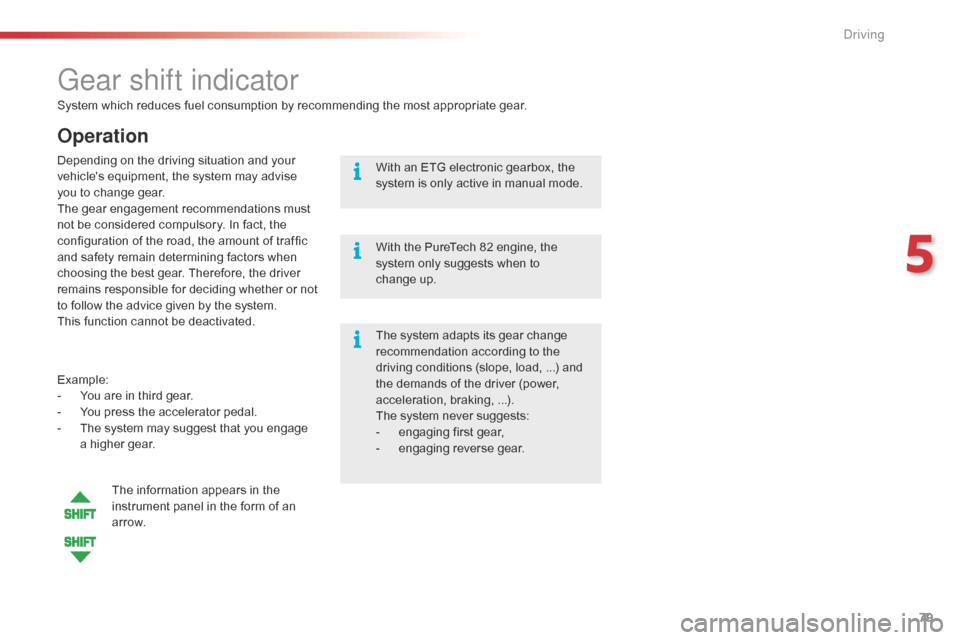
The information appears in the
instrument panel in the form of an
ar row. The system adapts its gear change
recommendation according to the
driving conditions (slope, load,
...) and
the demands of the driver (power,
acceleration, braking,
...).
The system never suggests:
-
e
ngaging first gear,
-
enga
ging reverse gear.
With an ETG electronic gearbox, the
system is only active in manual mode.
With the PureTech 82 engine, the
system only suggests when to
change
up.
5
Driving
Page 96 of 271
94
C1_en_Chap06_visibilite_ed01-2015
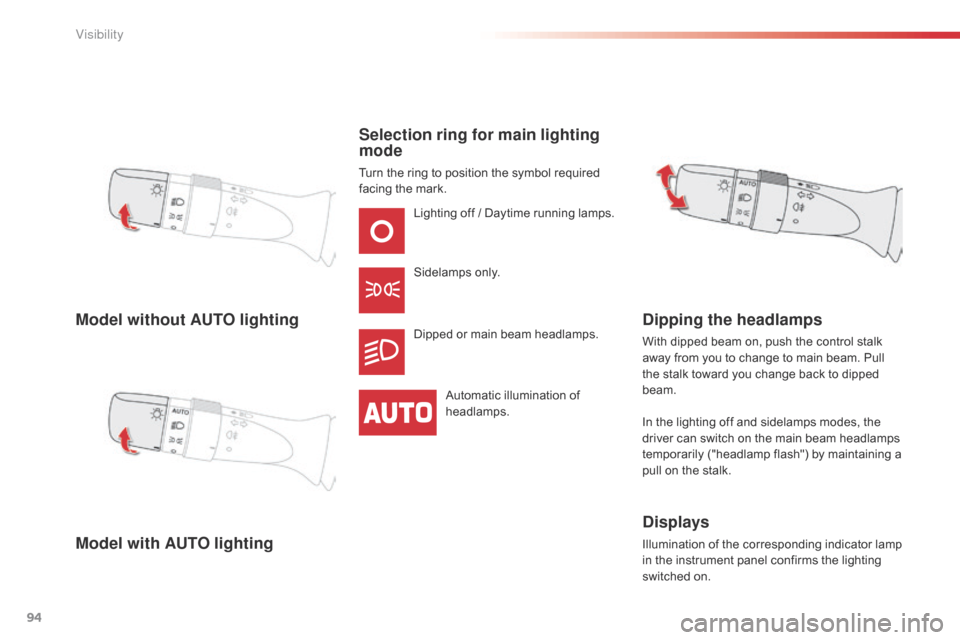
Model without AUTO lighting
Model with AUTO lightingSelection ring for main lighting
mode
Turn the ring to position the symbol required
facing the mark.
Lighting off / Daytime running lamps.
Sidelamps only.
Dipped or main beam headlamps.
Automatic illumination of
headlamps.
Dipping the headlamps
With dipped beam on, push the control stalk
away from you to change to main beam. Pull
the stalk toward you change back to dipped
beam.
In the lighting off and sidelamps modes, the
driver can switch on the main beam headlamps
temporarily ("headlamp flash") by maintaining a
pull on the stalk.
Displays
Illumination of the corresponding indicator lamp
in the instrument panel confirms the lighting
switched on.
Visibility
Page 97 of 271
95
C1_en_Chap06_visibilite_ed01-2015
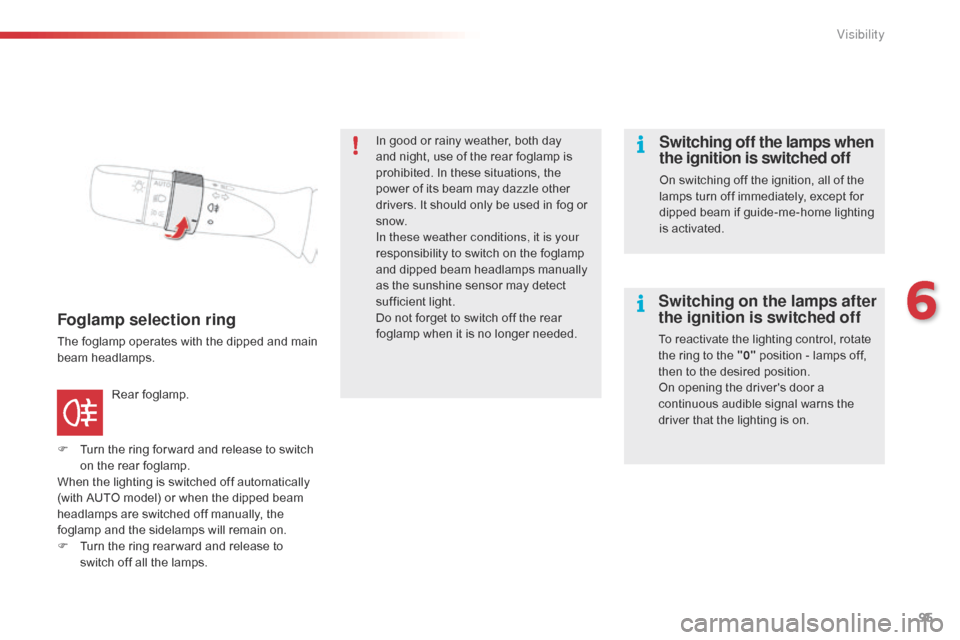
Foglamp selection ring
The foglamp operates with the dipped and main
beam headlamps.
F
T
urn the ring for ward and release to switch
on the rear foglamp.
When the lighting is switched off automatically
(with AUTO model) or when the dipped beam
headlamps are switched off manually, the
foglamp and the sidelamps will remain on.
F
T
urn the ring rear ward and release to
switch off all the lamps. Rear foglamp. In good or rainy weather, both day
and night, use of the rear foglamp is
prohibited. In these situations, the
power of its beam may dazzle other
drivers. It should only be used in fog or
snow.
In these weather conditions, it is your
responsibility to switch on the foglamp
and dipped beam headlamps manually
as the sunshine sensor may detect
sufficient light.
Do not forget to switch off the rear
foglamp when it is no longer needed.
Switching off the lamps when
the ignition is switched off
On switching off the ignition, all of the
lamps turn off immediately, except for
dipped beam if guide-me-home lighting
is activated.
Switching on the lamps after
the ignition is switched off
To reactivate the lighting control, rotate
the ring to the "0"
position - lamps off,
then to the desired position.
On opening the driver's door a
continuous audible signal warns the
driver that the lighting is on.
6
Visibility
Page 110 of 271
108
C1_en_Chap07_securite_ed01-2015
Active City Brake
Active City Brake is a driving assistance system that aims to avoid a frontal collision or reduce the speed of an impact if the driver does not react or
reacts too late (brake application too late).This system is designed to improve
driving safety.
It remains the driver's responsibility to
continuously monitor the state of the
traffic and to assess the distances and
relative speeds of other vehicles.
Active City Brake can in no
circumstances replace the need for
vigilance on the part of the driver.
Never look at the laser sensor through
an optical instrument (magnifying glass,
microscope...) at a distance of less than
10 centimetres: risk of eye injury.
Automatic braking occurs later than if
done by the driver, so as to intervene
only when there is a high risk of
collision.
Principle
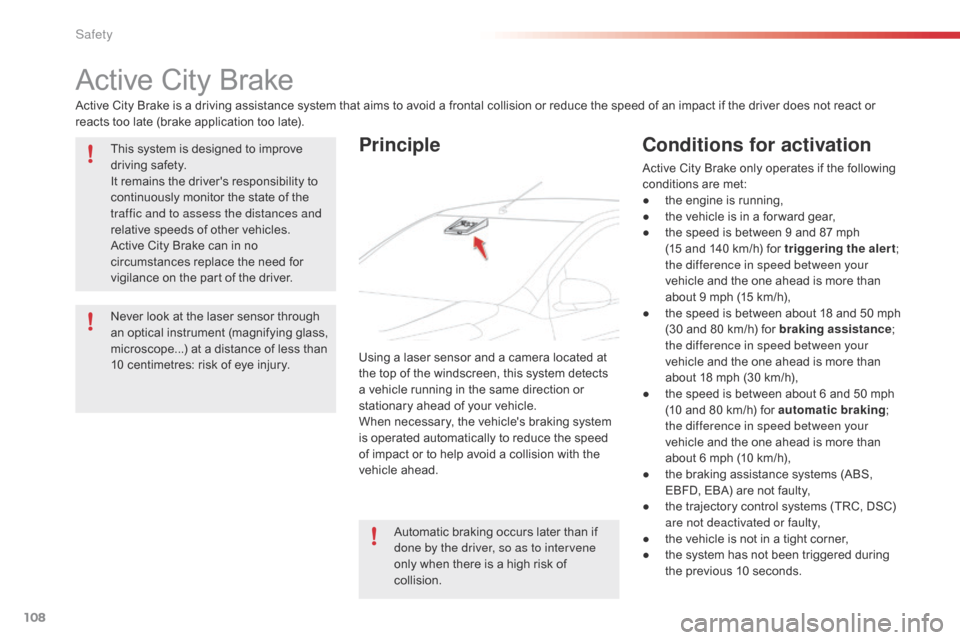
Using a laser sensor and a camera located at
the top of the windscreen, this system detects
a vehicle running in the same direction or
stationary ahead of your vehicle.
When necessary, the vehicle's braking system
is operated automatically to reduce the speed
of impact or to help avoid a collision with the
vehicle ahead.
Conditions for activation
Active City Brake only operates if the following
conditions are met:
●
t
he engine is running,
●
t
he vehicle is in a for ward gear,
●
t
he speed is between 9 and 87 mph
(15
and 140 km/h) for triggering the alert ;
the difference in speed between your
vehicle and the one ahead is more than
about 9
mph (15 km/h),
●
t
he speed is between about 18 and 50 mph
(30 and 80 km/h) for braking assistance ;
the difference in speed between your
vehicle and the one ahead is more than
about 18 mph (30 km/h),
●
t
he speed is between about 6 and 50 mph
(10 and 80 km/h) for automatic braking ;
the difference in speed between your
vehicle and the one ahead is more than
about 6 mph (10 km/h),
●
t
he braking assistance systems (ABS,
EBFD, EBA) are not faulty,
●
t
he trajectory control systems (TRC, DSC)
are not deactivated or faulty,
●
t
he vehicle is not in a tight corner,
●
t
he system has not been triggered during
the previous 10 seconds.
Safety
Page 120 of 271
118
C1_en_Chap07_securite_ed01-2015
Lateral airbags
Deployment
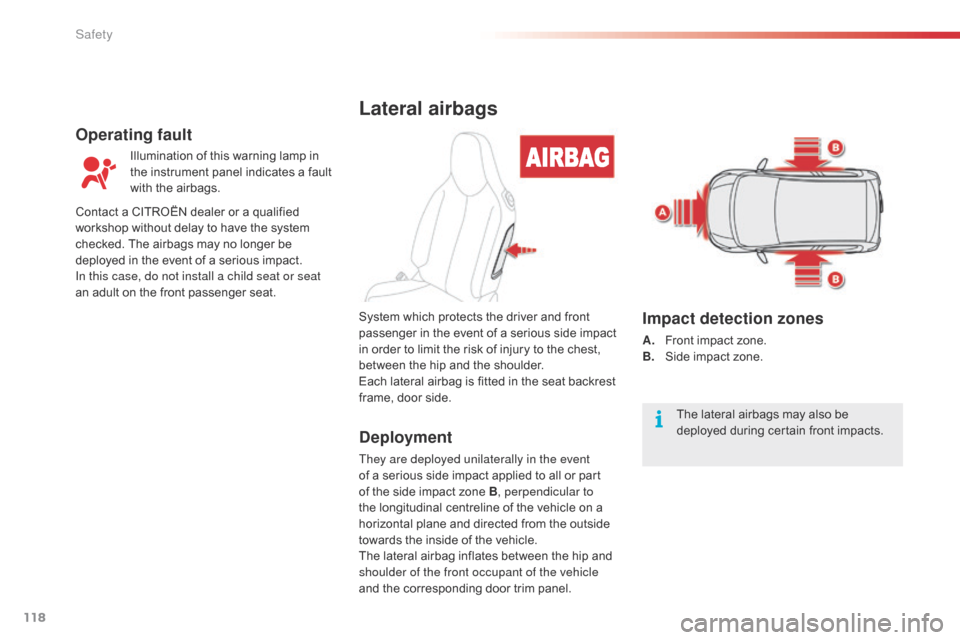
They are deployed unilaterally in the event
of a serious side impact applied to all or part
of the side impact zone B, perpendicular to
the longitudinal centreline of the vehicle on a
horizontal plane and directed from the outside
towards the inside of the vehicle.
The lateral airbag inflates between the hip and
shoulder of the front occupant of the vehicle
and the corresponding door trim panel. System which protects the driver and front
passenger in the event of a serious side impact
in order to limit the risk of injury to the chest,
between the hip and the shoulder.
Each lateral airbag is fitted in the seat backrest
frame, door side.
Impact detection zones
A. Front impact zone.
B. S ide impact zone.
Operating fault
Illumination of this warning lamp in
the instrument panel indicates a fault
with the airbags.
Contact a CITROËN dealer or a qualified
workshop without delay to have the system
checked. The airbags may no longer be
deployed in the event of a serious impact.
In this case, do not install a child seat or seat
an adult on the front passenger seat.
The lateral airbags may also be
deployed during certain front impacts.
Safety
Page 121 of 271
119
C1_en_Chap07_securite_ed01-2015
In the event of a minor impact or bump
on the side of the vehicle or if the
vehicle rolls over, the airbags may not
be deployed.
In the event of a rear or front collision,
none of the lateral airbags is deployed.
System which contributed towards the
improved protection of the driver and
passengers in the event of a serious side
impact in order to limit the risk of injury to the
side of the head.
Each curtain airbag is built into the pillars and
the upper passenger compartment area.
Curtain airbags
Deployment
It is deployed at the same time as the
corresponding lateral airbag in the event of
a serious side impact applied to all or part
of the side impact zone B
, perpendicular to
the longitudinal centreline of the vehicle on a
horizontal plane and directed from the outside
towards the inside of the vehicle.
The curtain airbag inflates between the front or
rear occupant of the vehicle and the windows. If this warning lamp comes on in the
instrument panel, contact a CITROËN
dealer or a qualified workshop to have
the system checked. The airbags may
no longer be deployed in the event of
a serious impact.
Operating fault
7
Safety
Page 127 of 271
125
AR
BG
НИКОГА НЕ инсталирайте детско столче на седалка с АКТИВИРАНА предна ВЪЗДУШНА ВЪЗГЛАВНИЦ А. Това може да причини
СМЪРТ или СЕРИОЗНО НАРАНЯВАНЕ на детето.
CSNIKDY neumisťujte dětské zádržné zařízení orientované směrem dozadu na sedadlo chráněné AKTIVOVANÝM čelním AIRBAGEM. Hrozí
nebezpečí SMRTI DÍTĚTE nebo VÁ ŽNÉHO ZR ANĚNÍ.
DABrug ALDRIG en bagudvendt barnestol på et sæde, der er beskyttet af en AKTIV AIRBAG. BARNET risikerer at blive ALVORLIGT
K VÆSTET eller DR ÆBT.
DEMontieren Sie auf einem Sitz mit AKTIVIERTEM Front-Airbag NIEMALS einen Kindersitz oder eine Babyschale entgegen der Fahr trichtung,
das Kind könnte schwere oder sogar tödliche Verletzungen erleiden.
ELΜη χρησιμοποιείτε ΠΟΤΕ παιδικό κάθισμα με την πλάτη του προς το εμπρός μέρος του αυτοκινήτου, σε μια θέση που προστατεύεται από
ΜΕΤΩΠΙΚΟ αερόσακο που είναι ΕΝΕΡΓΟΣ. Αυτό μπορεί να έχει σαν συνέπεια το ΘΑΝΑΤΟ ή το ΣΟΒΑΡΟ ΤΡΑΥΜΑΤΙΣΜΟ του ΠΑΙΔΙΟΥ
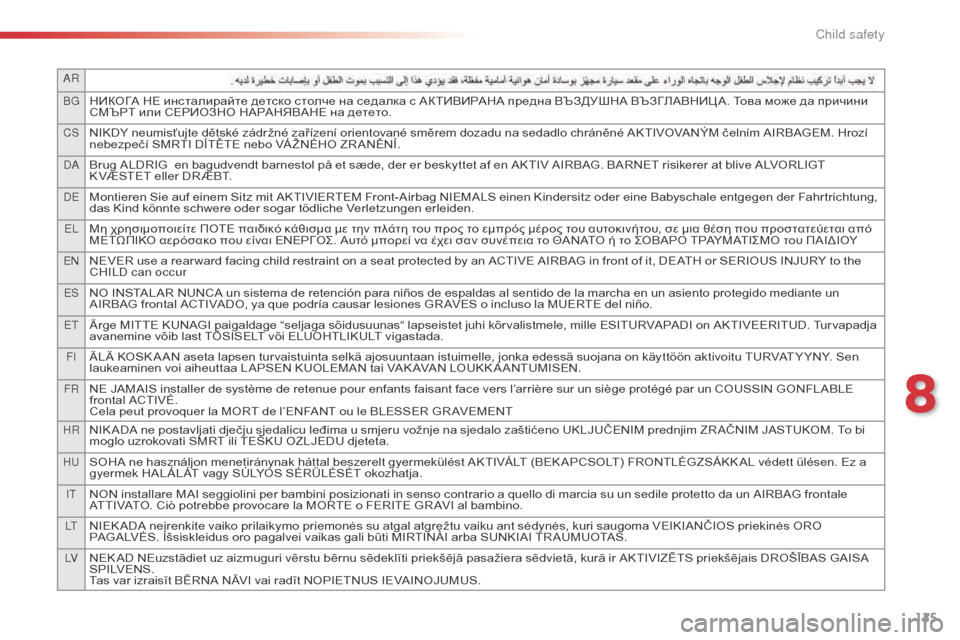
ENNEVER use a rear ward facing child restraint on a seat protected by an ACTIVE AIRBAG in front of it, DEATH or SERIOUS INJURY to the
CHILD can occur
ESNO INSTALAR NUNCA un sistema de retención para niños de espaldas al sentido de la marcha en un asiento protegido mediante un
AIRBAG frontal ACTIVADO, ya que podría causar lesiones GR AVES o incluso la MUERTE del niño.
ETÄrge MITTE KUNAGI paigaldage “seljaga sõidusuunas“ lapseistet juhi kõr valistmele, mille ESITURVAPADI on AKTIVEERITUD. Tur vapadja
avanemine võib last TÕSISELT või ELUOHTLIKULT vigastada.
FIÄLÄ KOSK A AN aseta lapsen tur vaistuinta selkä ajosuuntaan istuimelle, jonka edessä suojana on käyttöön aktivoitu TURVAT Y YNY. Sen
laukeaminen voi aiheuttaa LAPSEN KUOLEMAN tai VAK AVAN LOUKK A ANTUMISEN.
FRNE JAMAIS installer de système de retenue pour enfants faisant face vers l’arrière sur un siège protégé par un COUSSIN GONFLABLE
frontal ACTIVÉ.
Cela peut provoquer la MORT de l’ENFANT ou le BLESSER GR AVEMENT
HRNIK ADA ne postavljati dječju sjedalicu leđima u smjeru vožnje na sjedalo zaštićeno UKLJUČENIM prednjim ZR AČNIM JASTUKOM. To bi
moglo uzrokovati SMRT ili TEŠKU OZLJEDU djeteta.
HUSOHA ne használjon menetiránynak háttal beszerelt gyermekülést AKTIVÁLT (BEK APCSOLT) FRONTLÉGZSÁKK AL védett ülésen. Ez a
gyermek HALÁLÁT vagy SÚLYOS SÉRÜLÉSÉT okozhatja.
ITNON installare MAI seggiolini per bambini posizionati in senso contrario a quello di marcia su un sedile protetto da un AIRBAG frontale
ATTIVATO. Ciò potrebbe provocare la MORTE o FERITE GR AVI al bambino.
LTNIEK ADA neįrenkite vaiko prilaikymo priemonės su atgal atgręžtu vaiku ant sėdynės, kuri saugoma VEIKIANČIOS priekinės ORO
PAGALVĖS. Išsiskleidus oro pagalvei vaikas gali būti MIRTINAI arba SUNKIAI TR AUMUOTAS.
LVNEK AD NEuzstādiet uz aizmuguri vērstu bērnu sēdeklīti priekšējā pasažiera sēdvietā, kurā ir AKTIVIZĒTS priekšējais DROŠĪBAS GAISA
S P I LV E N S .
Tas var izraisīt BĒRNA NĀVI vai radīt NOPIETNUS IEVAINOJUMUS.
C1_en_Chap08_securite-enfants_ed01-2015
8
Child safety
Page 157 of 271
155
C1_en_Chap09_info-pratiques_ed01-2015
Before changing a fuse, it is necessary to:
F i mmobilise the vehicle and switch off the
ignition,
F
s
witch off all electrical consumers,
F
i
dentify the failed fuse using the fuse
allocation tables and diagrams in the
following pages,
F
i
dentify and correct the cause of the
problem.
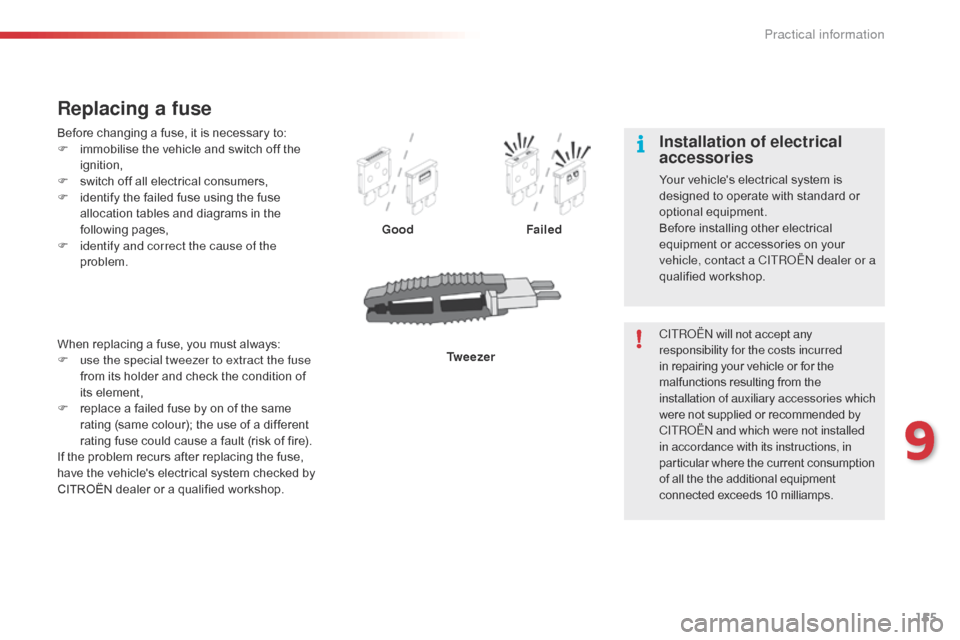
Replacing a fuse
Good Failed
Tw e e z e r
When replacing a fuse, you must always:
F
u
se the special tweezer to extract the fuse
from its holder and check the condition of
its element,
F
r
eplace a failed fuse by on of the same
rating (same colour); the use of a different
rating fuse could cause a fault (risk of fire).
If the problem recurs after replacing the fuse,
have the vehicle's electrical system checked by
CITROËN dealer or a qualified workshop. CITROËN will not accept any
responsibility for the costs incurred
in repairing your vehicle or for the
malfunctions resulting from the
installation of auxiliary accessories which
were not supplied or recommended by
CITROËN
and which were not installed
in accordance with its instructions, in
particular where the current consumption
of all the the additional equipment
connected exceeds 10 milliamps.
Installation of electrical
accessories
Your vehicle's electrical system is
designed to operate with standard or
optional equipment.
Before installing other electrical
equipment or accessories on your
vehicle, contact a CITROËN dealer or a
qualified workshop.
9
Practical information
Page 158 of 271
156
C1_en_Chap09_info-pratiques_ed01-2015
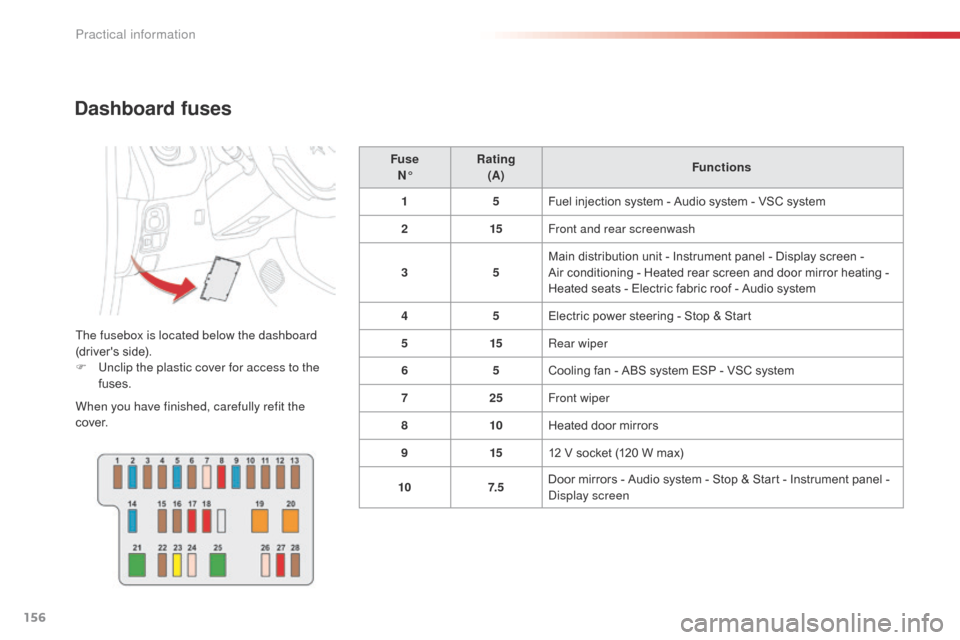
Dashboard fuses
The fusebox is located below the dashboard
(driver's side).
F
U
nclip the plastic cover for access to the
fuses.
When you have finished, carefully refit the
c ove r. Fuse
N° Rating
(A) Functions
1 5Fuel injection system - Audio system - VSC system
2 15Front and rear screenwash
3 5Main distribution unit - Instrument panel - Display screen -
Air conditioning - Heated rear screen and door mirror heating -
Heated seats - Electric fabric roof - Audio system
4 5Electric power steering - Stop & Start
5 15Rear wiper
6 5Cooling fan - ABS system ESP - VSC system
7 25Front wiper
8 10Heated door mirrors
9 1512 V socket (120 W max)
10 7. 5Door mirrors - Audio system - Stop & Start - Instrument panel -
Display screen
Practical information