Gear Citroen C1 2015 1.G Owner's Guide
[x] Cancel search | Manufacturer: CITROEN, Model Year: 2015, Model line: C1, Model: Citroen C1 2015 1.GPages: 271, PDF Size: 7.18 MB
Page 83 of 271
81
Stop & Start (VTi 68 S&S engine)
Operation
Going into engine STOP mode
This indicator lamp comes on in the
instrument panel and the engine
goes into standby automatically:
-
w
hen stationary, in neutral, and you
release the clutch pedal.
Never refuel with the engine in STOP
mode; you must switch off the ignition
with the button. For smoother operation, during
parking manoeuvres STOP mode is
not available for a few seconds after
coming out of reverse gear.
STOP mode does not affect the
vehicle's systems, such as for example,
braking, power steering...
Special cases: STOP mode not
available
STOP mode is not invoked principally when:
- t he driver's door is open,
-
t
he driver's seat belt is not fastened,
-
t
he engine is needed to maintain a
comfortable temperature in the passenger
compartment,
-
d
emisting is active,
-
s
ome special conditions (battery charge,
engine temperature, braking assistance,
vehicle stopped on a steep gradient, high
altitude...) where the engine is needed to
assure control of a system.
The Stop & Start
system puts the engine temporarily into standby - STOP mode - during stops in the traffic (red lights, traffic jams, or other...).
The
engine restarts automatically - START mode - as soon as you want to move off. The restart takes place instantly, quickly and silently.
Per fect for urban use, the Stop & Start system reduces fuel consumption and exhaust emissions as well as the noise level when stationary.
Stop & Start time counters
A partial time counter counts the periods in
STOP mode during a journey.
It is displayed in the trip computer once the
Stop & Start acts.
Press one of the screen management buttons
to return to the previous display.
A global time counter counts the periods in
STOP mode since the last reset.
When it is displayed, press one of the screen
management buttons to reset the counter.
5
Driving
Page 92 of 271
90
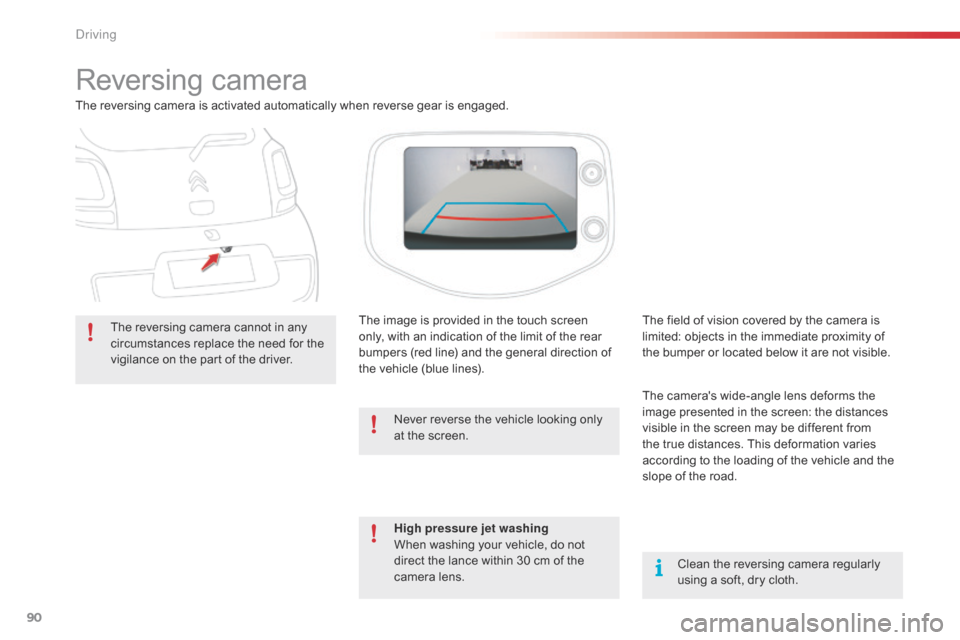
Reversing camera
The reversing camera is activated automatically when reverse gear is engaged.The reversing camera cannot in any
circumstances replace the need for the
vigilance on the part of the driver. The image is provided in the touch screen
only, with an indication of the limit of the rear
bumpers (red line) and the general direction of
the vehicle (blue lines).
Clean the reversing camera regularly
using a soft, dry cloth.
The field of vision covered by the camera is
limited: objects in the immediate proximity of
the bumper or located below it are not visible.
The camera's wide-angle lens deforms the
image presented in the screen: the distances
visible in the screen may be different from
the true distances. This deformation varies
according to the loading of the vehicle and the
slope of the road.
High pressure jet washing
When washing your vehicle, do not
direct the lance within 30 cm of the
camera lens. Never reverse the vehicle looking only
at the screen.
Driving
Page 110 of 271
108
C1_en_Chap07_securite_ed01-2015
Active City Brake
Active City Brake is a driving assistance system that aims to avoid a frontal collision or reduce the speed of an impact if the driver does not react or
reacts too late (brake application too late).This system is designed to improve
driving safety.
It remains the driver's responsibility to
continuously monitor the state of the
traffic and to assess the distances and
relative speeds of other vehicles.
Active City Brake can in no
circumstances replace the need for
vigilance on the part of the driver.
Never look at the laser sensor through
an optical instrument (magnifying glass,
microscope...) at a distance of less than
10 centimetres: risk of eye injury.
Automatic braking occurs later than if
done by the driver, so as to intervene
only when there is a high risk of
collision.
Principle
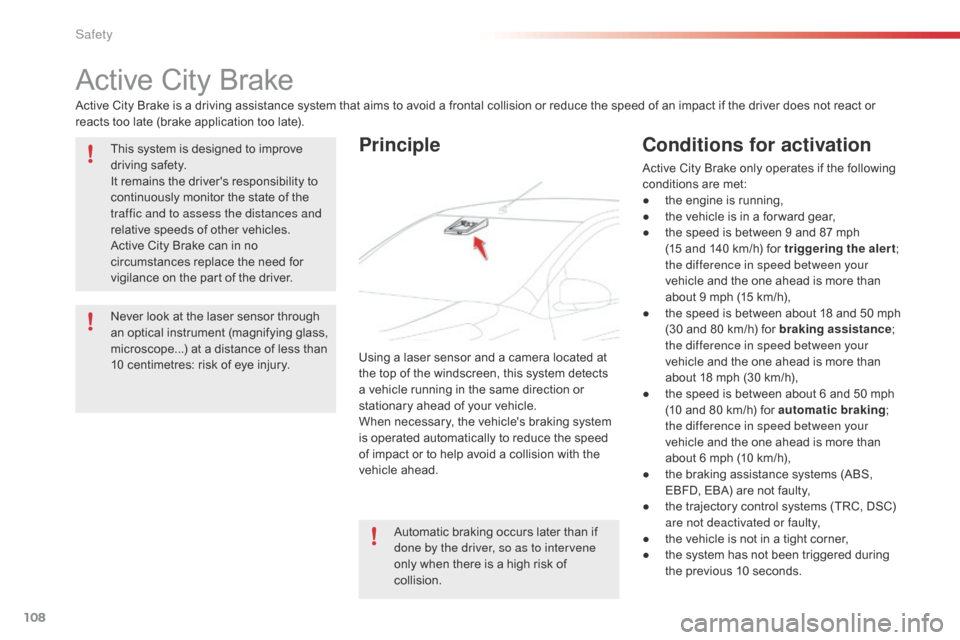
Using a laser sensor and a camera located at
the top of the windscreen, this system detects
a vehicle running in the same direction or
stationary ahead of your vehicle.
When necessary, the vehicle's braking system
is operated automatically to reduce the speed
of impact or to help avoid a collision with the
vehicle ahead.
Conditions for activation
Active City Brake only operates if the following
conditions are met:
●
t
he engine is running,
●
t
he vehicle is in a for ward gear,
●
t
he speed is between 9 and 87 mph
(15
and 140 km/h) for triggering the alert ;
the difference in speed between your
vehicle and the one ahead is more than
about 9
mph (15 km/h),
●
t
he speed is between about 18 and 50 mph
(30 and 80 km/h) for braking assistance ;
the difference in speed between your
vehicle and the one ahead is more than
about 18 mph (30 km/h),
●
t
he speed is between about 6 and 50 mph
(10 and 80 km/h) for automatic braking ;
the difference in speed between your
vehicle and the one ahead is more than
about 6 mph (10 km/h),
●
t
he braking assistance systems (ABS,
EBFD, EBA) are not faulty,
●
t
he trajectory control systems (TRC, DSC)
are not deactivated or faulty,
●
t
he vehicle is not in a tight corner,
●
t
he system has not been triggered during
the previous 10 seconds.
Safety
Page 145 of 271

143
C1_en_Chap09_info-pratiques_ed01-2015
Changing a wheel
F As far as possible, immobilise the vehicle on level, stable, non-slippery ground.
F
A
pply the parking brake.
F
S
witch off the ignition (" OFF" mode for
vehicles fitted with "Keyless Entry and
Starting").
F
E
ngage first gear or reverse for a manual
gearbox, position N for an ETG electronic
gearbox.
Parking the vehicle
Procedure for replacing a wheel by the spare wheel using the tools supplied with the vehicle.
F
I
f necessary, chock the wheel diagonally
opposite the wheel to be changed.
F
Y
ou must ensure that the occupants leave
the vehicle and wait in a safe location.
9
Practical information
Page 159 of 271
157
C1_en_Chap09_info-pratiques_ed01-2015
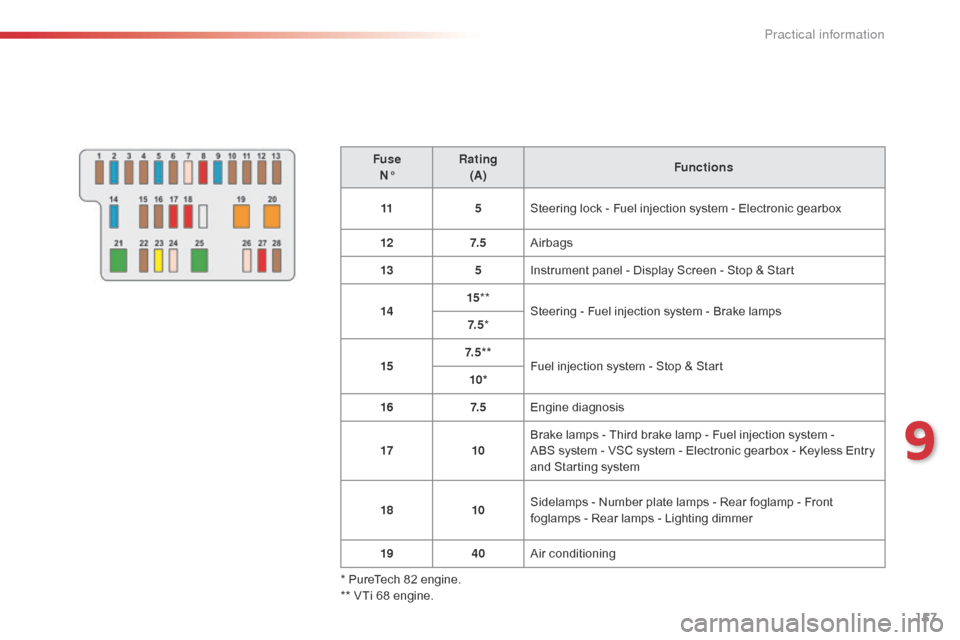
FuseN° Rating
(A) Functions
11 5Steering lock - Fuel injection system - Electronic gearbox
12 7. 5Airbags
13 5Instrument panel - Display Screen - Stop & Start
14 15
**
Steering - Fuel injection system - Brake lamps
7. 5 *
15 7. 5 * *
Fuel injection system - Stop & Start
10*
16 7. 5Engine diagnosis
17 10Brake lamps - Third brake lamp - Fuel injection system -
ABS system - VSC system - Electronic gearbox - Keyless Entry
and Starting system
18 10Sidelamps - Number plate lamps - Rear foglamp - Front
foglamps - Rear lamps - Lighting dimmer
19 40Air conditioning
* PureTech 82 engine.
** VTi 68 engine.
9
Practical information
Page 160 of 271
158
C1_en_Chap09_info-pratiques_ed01-2015
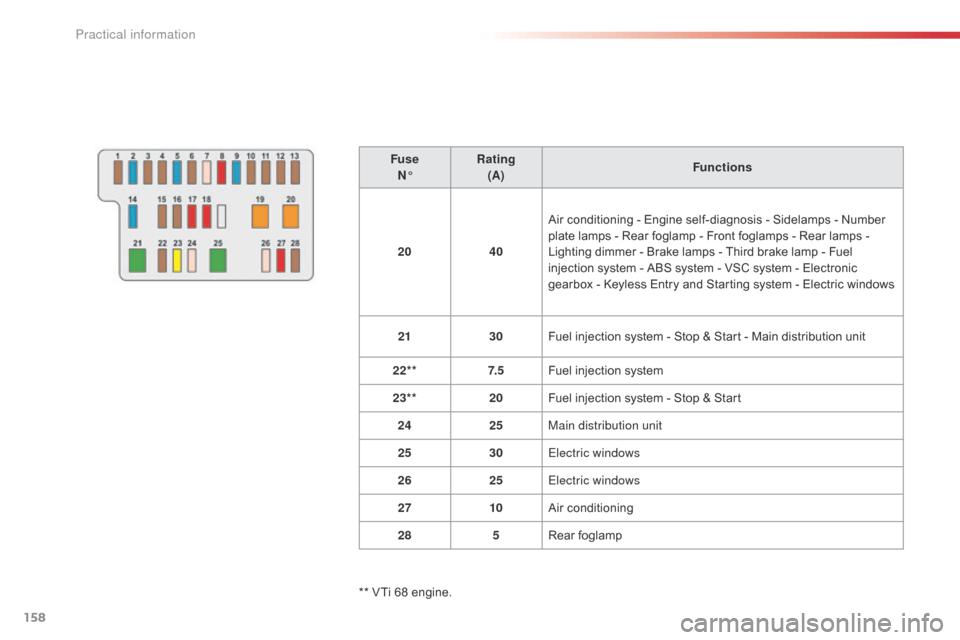
FuseN° Rating
(A) Functions
20 40Air conditioning - Engine self-diagnosis - Sidelamps - Number
plate lamps - Rear foglamp - Front foglamps - Rear lamps
-
Lighting dimmer - Brake lamps - Third brake lamp - Fuel
injection system - ABS system - VSC system - Electronic
gearbox - Keyless Entry and Starting system - Electric windows
21 30Fuel injection system - Stop & Start - Main distribution unit
22** 7. 5Fuel injection system
23** 20Fuel injection system - Stop & Start
24 25Main distribution unit
25 30Electric windows
26 25Electric windows
27 10Air conditioning
28 5Rear foglamp
** VTi 68 engine.
Practical information
Page 162 of 271
160
C1_en_Chap09_info-pratiques_ed01-2015
** VTi 68 engine.Fuse
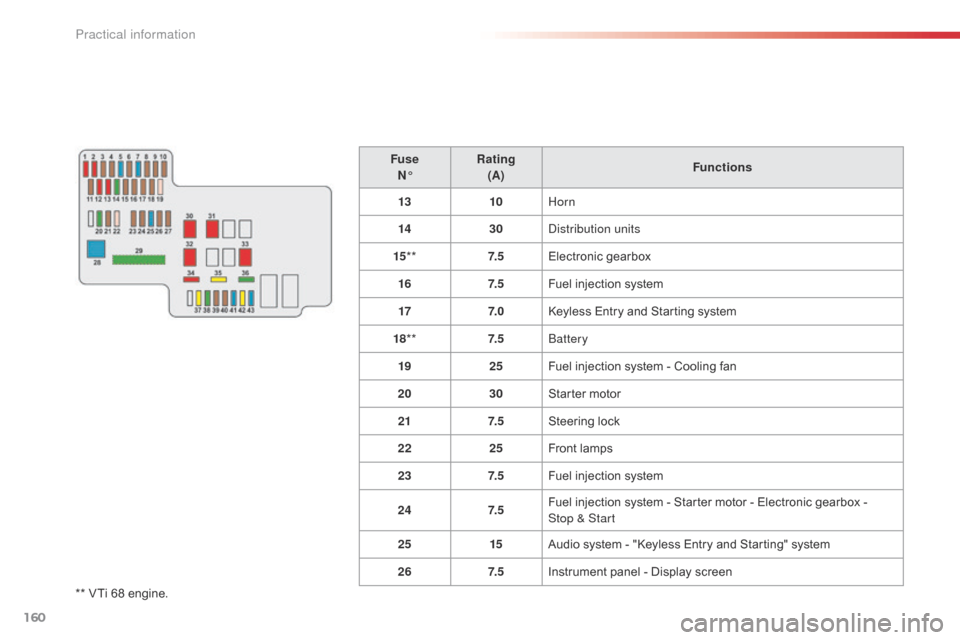
N° Rating
(A) Functions
13 10Horn
14 30Distribution units
15 ** 7. 5Electronic gearbox
16 7. 5Fuel injection system
17 7. 0Keyless Entry and Starting system
18 ** 7. 5Battery
19 25Fuel injection system - Cooling fan
20 30Starter motor
21 7. 5Steering lock
22 25Front lamps
23 7. 5Fuel injection system
24 7. 5Fuel injection system - Starter motor - Electronic gearbox -
Stop & Start
25 15Audio system - "Keyless Entry and Starting" system
26 7. 5Instrument panel - Display screen
Practical information
Page 163 of 271

161
C1_en_Chap09_info-pratiques_ed01-2015
FuseN° Rating
(A) Functions
27 7. 5VSC system
28 60Passenger compartment fusebox
29** 125***Heated rear screen and door mirror heating - Heated seats
-
Electric fabric roof - ABS system - VSC system - Cooling fan
-
Front foglamps - LED daytime running lamps
30 50
Electronic gearbox
40 Stop & Start
31 50Power steering
32 50*
Cooling fan
30
40
33 50ABS system - VSC system
34 10Spare fuse
* PureTech 82 engine.
** VTi 68 engine.
***
T
his fuse must be replaced only by a
CITROËN dealer or a qualified workshop.
9
Practical information
Page 165 of 271
163
C1_en_Chap09_info-pratiques_ed01-2015
12 V battery
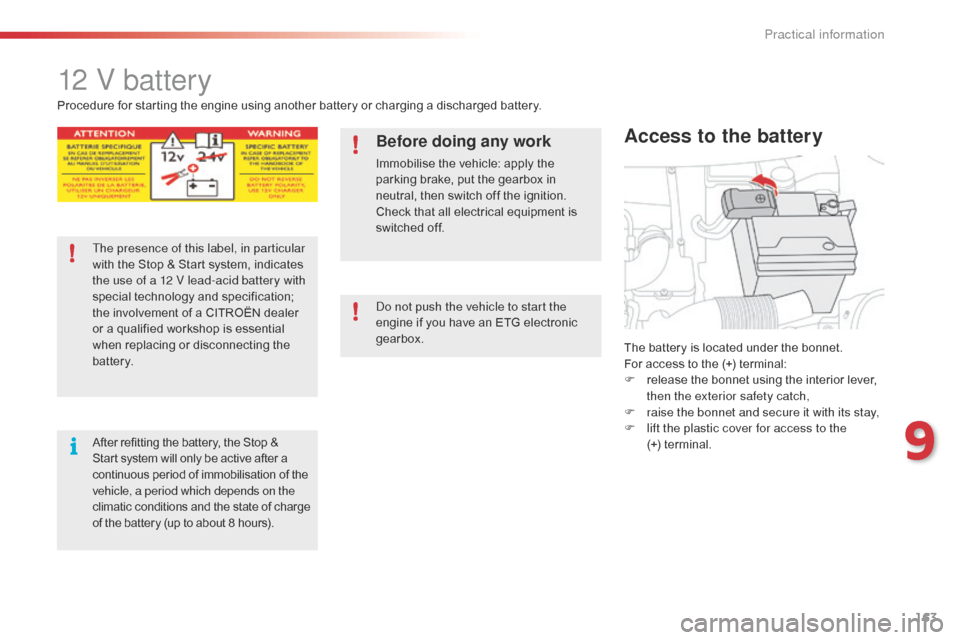
The battery is located under the bonnet.
For access to the (+) terminal:
F
r
elease the bonnet using the interior lever,
then the exterior safety catch,
F
r
aise the bonnet and secure it with its stay,
F
l
ift the plastic cover for access to the
(+) terminal.
Access to the battery
Procedure for starting the engine using another battery or charging a discharged battery.
Before doing any work
Immobilise the vehicle: apply the
parking brake, put the gearbox in
neutral, then switch off the ignition.
Check that all electrical equipment is
switched off.
The presence of this label, in particular
with the Stop & Start system, indicates
the use of a 12 V lead-acid battery with
special technology and specification;
the involvement of a CITROËN dealer
or a qualified workshop is essential
when replacing or disconnecting the
battery.
After refitting the battery, the Stop &
Start system will only be active after a
continuous period of immobilisation of the
vehicle, a period which depends on the
climatic conditions and the state of charge
of the battery (up to about 8 hours).
Do not push the vehicle to start the
engine if you have an ETG electronic
gearbox.
9
Practical information
Page 169 of 271
167
C1_en_Chap09_info-pratiques_ed01-2015
Towing the vehicle
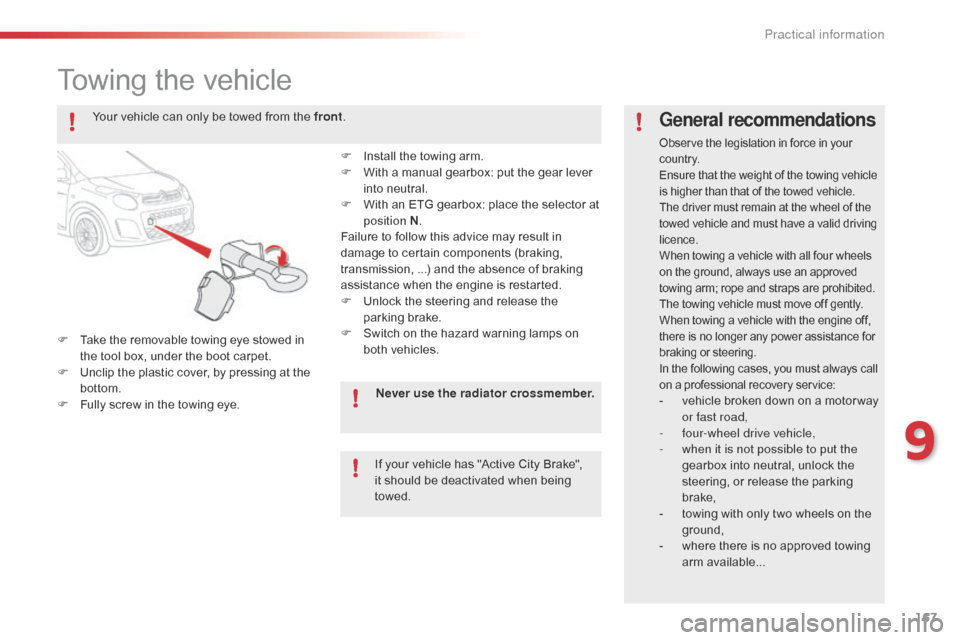
F Take the removable towing eye stowed in the tool box, under the boot carpet.
F
U
nclip the plastic cover, by pressing at the
bottom.
F
F
ully screw in the towing eye.
General recommendations
Observe the legislation in force in your
c o unt r y.
Ensure that the weight of the towing vehicle
is higher than that of the towed vehicle.
The driver must remain at the wheel of the
towed vehicle and must have a valid driving
licence.
When towing a vehicle with all four wheels
on the ground, always use an approved
towing arm; rope and straps are prohibited.
The towing vehicle must move off gently.
When towing a vehicle with the engine off,
there is no longer any power assistance for
braking or steering.
In the following cases, you must always call
on a professional recovery service:
- vehicle broken down on a motor way or fast road,
-
f
our-wheel drive vehicle,
-
w
hen it is not possible to put the
gearbox into neutral, unlock the
steering, or release the parking
brake,
-
t
owing with only two wheels on the
ground,
-
w
here there is no approved towing
arm available...
Your vehicle can only be towed from the front
.
F
I
nstall the towing arm.
F
W
ith a manual gearbox: put the gear lever
into neutral.
F
W
ith an ETG gearbox: place the selector at
position N .
Failure to follow this advice may result in
damage to certain components (braking,
transmission, ...) and the absence of braking
assistance when the engine is restarted.
F
U
nlock the steering and release the
parking brake.
F
S
witch on the hazard warning lamps on
both vehicles.
Never use the radiator crossmember.
If your vehicle has "Active City Brake",
it should be deactivated when being
towed.
9
Practical information