ignition Citroen C1 2015 1.G Owner's Guide
[x] Cancel search | Manufacturer: CITROEN, Model Year: 2015, Model line: C1, Model: Citroen C1 2015 1.GPages: 271, PDF Size: 7.18 MB
Page 89 of 271

87
Speed limiter (VTi 68 engine)
System which prevents the vehicle from exceeding the speed programmed by the driver.
The speed limiter is switched on manually:
this can be done whatever the speed of the
vehicle. However, if you are driving at less than
20 mph (30 km/h), the programmed speed will
be fixed at 20 mph (30 km/h).
The speed limiter is paused by operation of the
control.
The programmed speed can be exceeded
temporarily by pressing the accelerator firmly
beyond the point of resistance.
To return to the programmed speed, simply
release the accelerator pedal until the vehicle
returns to the programmed speed limit.
The programmed limit speed is erased
when switching off the ignition.
Steering mounted controls
The controls are grouped together on this
control stalk at the steering wheel.
1.
S
peed limiter on / off: by pressing the end
of the control stalk.
2.
P
rogramming the speed, then
D
ecrease the setting: by pushing the
control stalk down.
3.
R
estore speed limiter
I
ncrease the setting: by pushing the control
stalk up.
4.
P
ause speed limiter: by pulling the control
stalk towards you.
Displays in the instrument
panel
The information is grouped together in the
instrument panel screen.
5.
S
peed limiter on / pause indication.
6.
S
peed value setting.
The speed limiter cannot, in any
circumstances, replace the need to
observe speed limits, nor can it replace the
need for vigilance on the part of the driver.
If you choose to display other information
(trip A for example), the speed limiter
information is automatically displayed again
after about 6
seconds.
5
Driving
Page 94 of 271
92
Deactivation
Operating fault
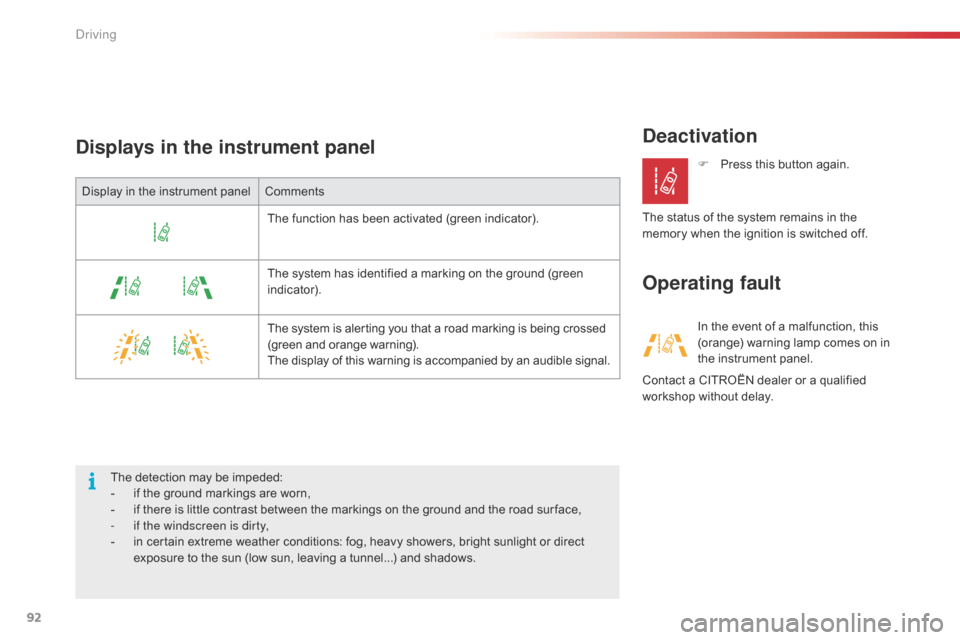
Displays in the instrument panel
Display in the instrument panel
Comments
The function has been activated (green indicator).
The system has identified a marking on the ground (green
indicator).
The system is alerting you that a road marking is being crossed
(green and orange warning).
The display of this warning is accompanied by an audible signal.
The detection may be impeded:
-
i
f the ground markings are worn,
-
i
f there is little contrast between the markings on the ground and the road sur face,
-
i
f the windscreen is dirty,
-
i
n certain extreme weather conditions: fog, heavy showers, bright sunlight or direct
exposure to the sun (low sun, leaving a tunnel...) and shadows. F
P
ress this button again.
The status of the system remains in the
memory when the ignition is switched off.
In the event of a malfunction, this
(orange) warning lamp comes on in
the instrument panel.
Contact a CITROËN dealer or a qualified
workshop without delay.
Driving
Page 97 of 271
95
C1_en_Chap06_visibilite_ed01-2015
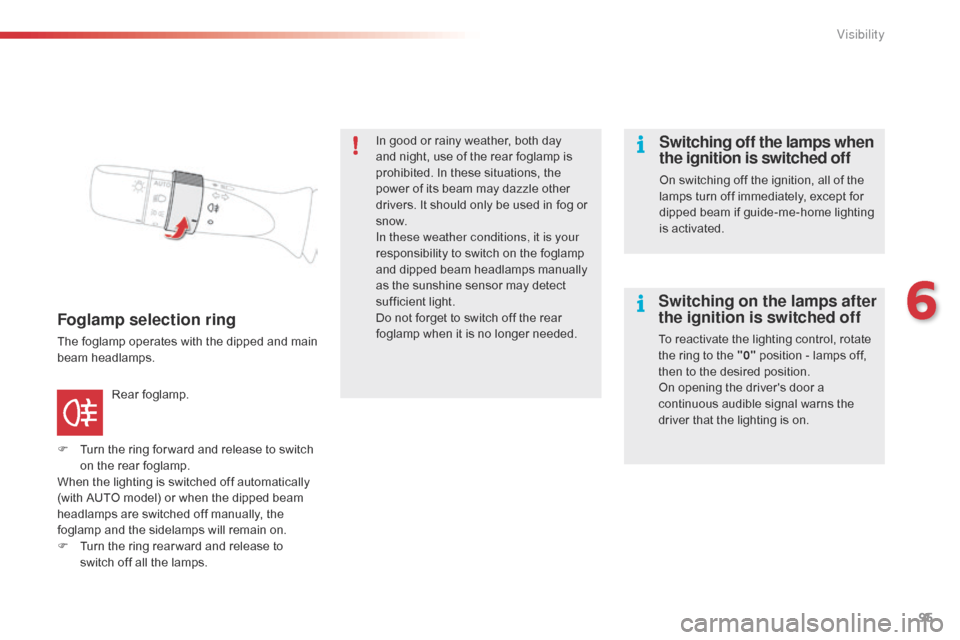
Foglamp selection ring
The foglamp operates with the dipped and main
beam headlamps.
F
T
urn the ring for ward and release to switch
on the rear foglamp.
When the lighting is switched off automatically
(with AUTO model) or when the dipped beam
headlamps are switched off manually, the
foglamp and the sidelamps will remain on.
F
T
urn the ring rear ward and release to
switch off all the lamps. Rear foglamp. In good or rainy weather, both day
and night, use of the rear foglamp is
prohibited. In these situations, the
power of its beam may dazzle other
drivers. It should only be used in fog or
snow.
In these weather conditions, it is your
responsibility to switch on the foglamp
and dipped beam headlamps manually
as the sunshine sensor may detect
sufficient light.
Do not forget to switch off the rear
foglamp when it is no longer needed.
Switching off the lamps when
the ignition is switched off
On switching off the ignition, all of the
lamps turn off immediately, except for
dipped beam if guide-me-home lighting
is activated.
Switching on the lamps after
the ignition is switched off
To reactivate the lighting control, rotate
the ring to the "0"
position - lamps off,
then to the desired position.
On opening the driver's door a
continuous audible signal warns the
driver that the lighting is on.
6
Visibility
Page 99 of 271
97
C1_en_Chap06_visibilite_ed01-2015
Manual guide-me-home
lighting*
Temporarily keeping the dipped beam
headlamps on after the vehicle's ignition has
been switched off makes the exit of the vehicle's
occupants easier when the light is poor.
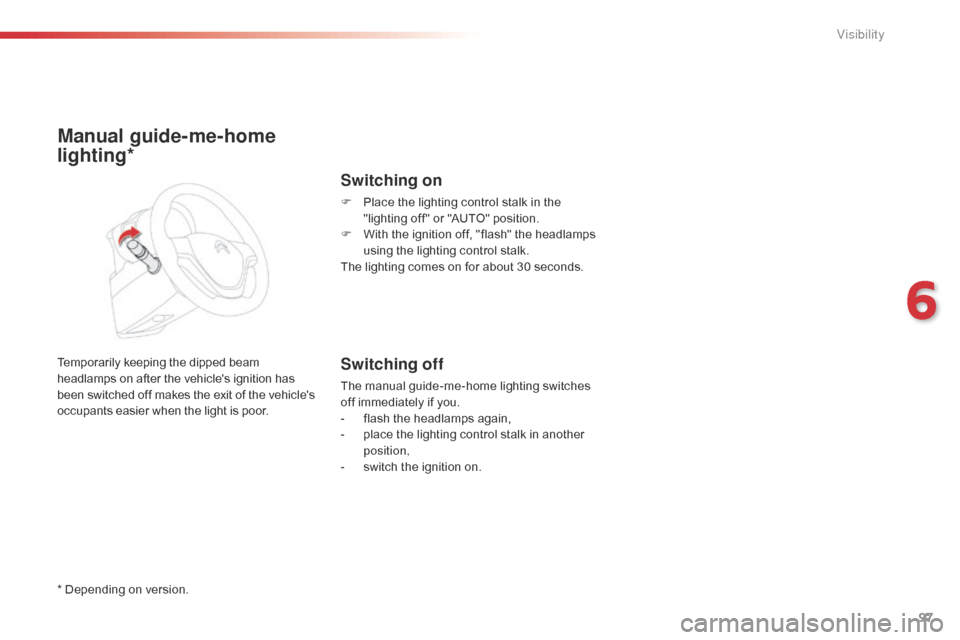
Switching on
F Place the lighting control stalk in the "lighting off " or "AUTO" position.
F
W
ith the ignition off, "flash" the headlamps
using the lighting control stalk.
The lighting comes on for about 30 seconds.
Switching off
The manual guide-me-home lighting switches
off immediately if you.
-
f
lash the headlamps again,
-
p
lace the lighting control stalk in another
position,
-
s
witch the ignition on.
* Depending on version.
6
Visibility
Page 104 of 271
102
C1_en_Chap07_securite_ed01-2015
Under-inflation detection
The system monitors the pressures in the four
tyres, once the vehicle is moving.
It compares the information given by the four
wheel speed sensors with reference values,
which must be reinitialised ever y time the
tyre pressures are adjusted or a wheel
changed.
The system triggers an alert as soon as it
detects a drop in the inflation pressure of one
or more tyres. The under-inflation detection system
does not replace the need for vigilance
on the part of the driver.
This system does not avoid the need to
check the tyre pressures (including the
spare wheel) every month as well as
before a long journey.
Driving with under-inflated tyres impairs
road holding, extends braking distances
and causes premature tyre wear,
particularly under arduous condition
(high loading, high speed, long journey).
System which automatically checks the pressures of the tyres while driving.
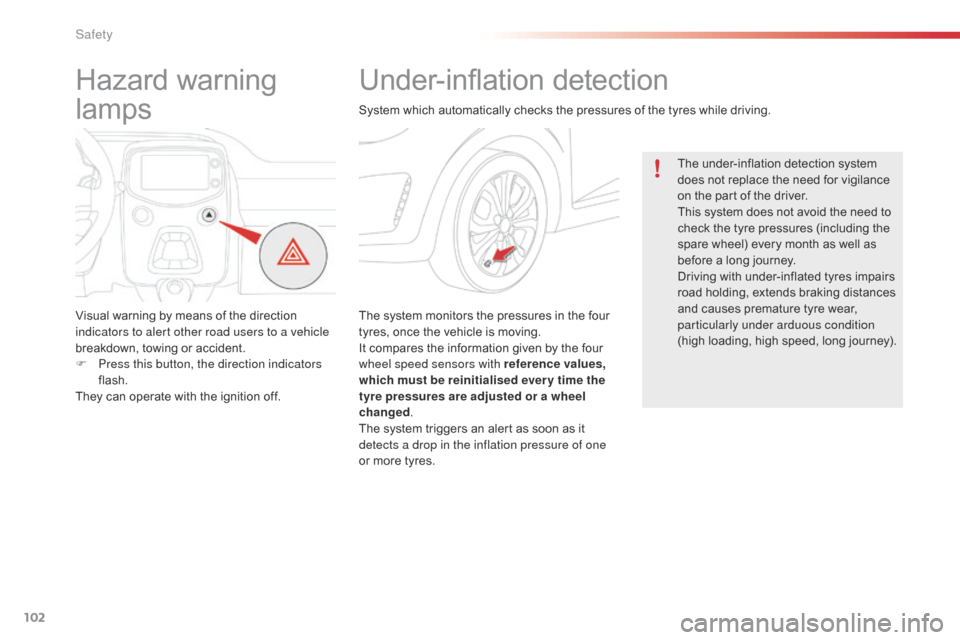
Hazard warning
lamps
Visual warning by means of the direction
indicators to alert other road users to a vehicle
breakdown, towing or accident.
F
P
ress this button, the direction indicators
flash.
They can operate with the ignition off.
Safety
Page 106 of 271
104
C1_en_Chap07_securite_ed01-2015
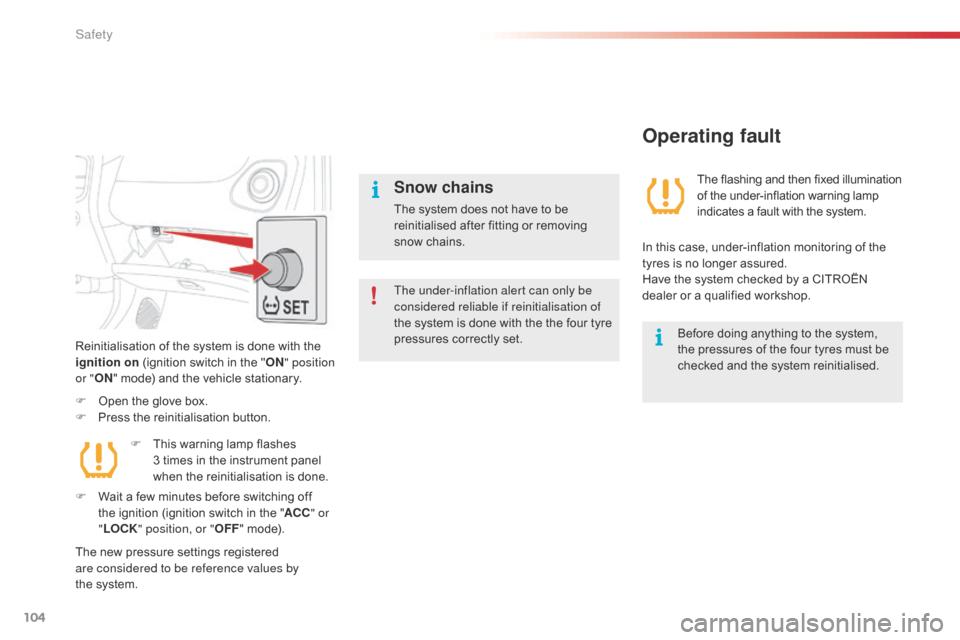
Reinitialisation of the system is done with the
ignition on (ignition switch in the " ON" position
or " ON" mode) and the vehicle stationary.
F
O
pen the glove box.
F
P
ress the reinitialisation button.
The new pressure settings registered
are considered to be reference values by
the
system. F
T
his warning lamp flashes
3
times in the instrument panel
when the reinitialisation is done.
F
W
ait a few minutes before switching off
the ignition (ignition switch in the " ACC" or
" LOCK " position, or " OFF" mode).
Operating fault
The flashing and then fixed illumination
of the under-inflation warning lamp
indicates a fault with the system.
In this case, under-inflation monitoring of the
tyres is no longer assured.
Have the system checked by a CITROËN
dealer or a qualified workshop.
Before doing anything to the system,
the pressures of the four tyres must be
checked and the system reinitialised.
The under-inflation alert can only be
considered reliable if reinitialisation of
the system is done with the the four tyre
pressures correctly set.Snow chains
The system does not have to be
reinitialised after fitting or removing
snow chains.
Safety
Page 112 of 271
110
C1_en_Chap07_securite_ed01-2015
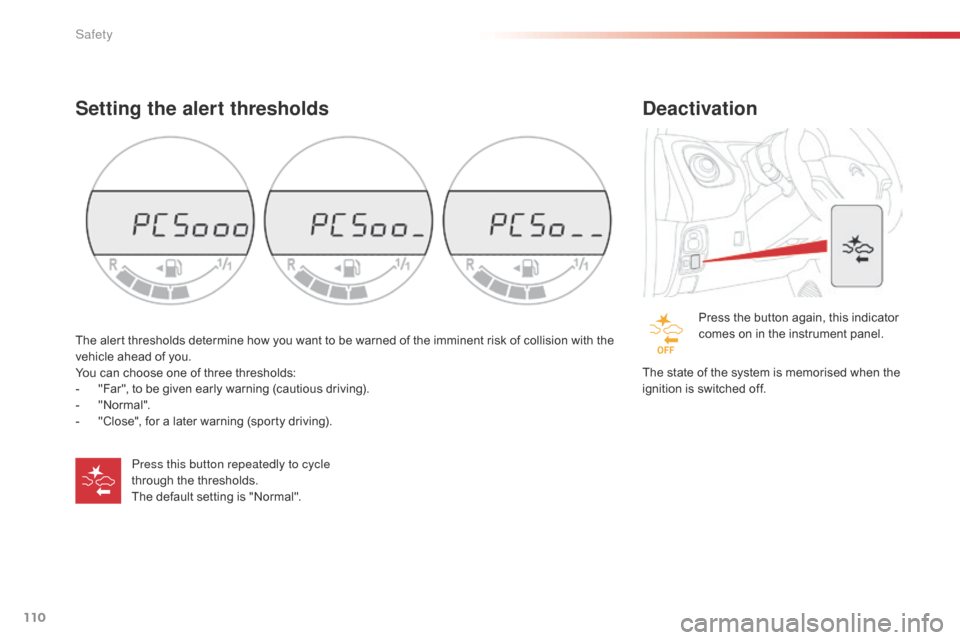
Setting the alert thresholds
Press this button repeatedly to cycle
through the thresholds.
The default setting is "Normal".
The alert thresholds determine how you want to be warned of the imminent risk of collision with the
vehicle ahead of you.
You can choose one of three thresholds:
-
"
Far", to be given early warning (cautious driving).
-
"
Normal".
-
"
Close", for a later warning (sporty driving).
Deactivation
Press the button again, this indicator
comes on in the instrument panel.
The state of the system is memorised when the
ignition is switched off.
Safety
Page 115 of 271

113
C1_en_Chap07_securite_ed01-2015
Seat belts
Front seat belts
Fastening
F Pull the strap, then insert the tongue in the buckle.
F
C
heck that the seat belt is fastened
correctly by pulling the strap.
The front seat belts are fitted with a
pretensioning and force limiting system.
This system improves safety in the front
seats in the event of a front or side impact.
Depending on the severity of the impact, the
pretensioning system instantly tightens the seat
belts against the body of the occupants.
The pretensioning seat belts are active when
the ignition is on.
The force limiter reduces the pressure of the
seat belt on the chest of the occupant, so
improving their protection.
Rear seat belts
The rear seats are each fitted with a three-point
seat belt.
Unfastening
F Press the red button on the buckle.
F
G uide the seat belt as it reels in.
7
Safety
Page 118 of 271
116
C1_en_Chap07_securite_ed01-2015
Airbags
Designed to contribute towards the safety of
the occupants in the event of violent collisions.
The airbags supplement the action of the force-
limiting seat belts.
If a collision occurs, the electronic detectors
record and analyse the front and side impacts
sustained in the impact detection zones:
-
i
n the case of a serious impact, the airbags
are deployed instantly and contribute
towards better protection of the occupants
of the vehicle; immediately after the impact,
the airbags deflate rapidly so that they
do not hinder visibility or the exit of the
occupants,
-
i
n the case of a minor or rear impact or in
certain roll-over conditions, the airbags
may not be deployed; the seat belt alone
contributes towards providing your
protection in these situations.
The airbags do not operate when the
ignition is switched off. The deployment of an airbag is
accompanied by a slight emission
of smoke and a noise, due to the
detonation of the pyrotechnic charge
incorporated in the system.
This smoke is not harmful, but sensitive
individuals may experience slight
irritation.
The detonation noise associated with
the deployment of an airbag may result
in a slight loss of hearing for a short
time.
This equipment will only deploy once.
If a second impact occurs (during the
same or a subsequent accident), the
airbag will not be deployed again.
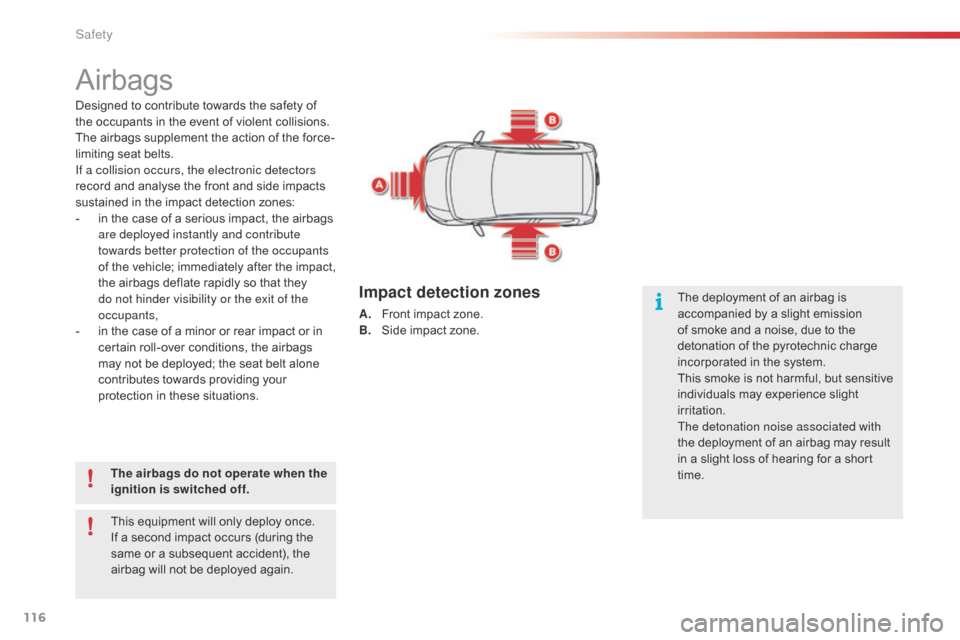
Impact detection zones
A. Front impact zone.
B. S ide impact zone.
Safety
Page 119 of 271
117
C1_en_Chap07_securite_ed01-2015
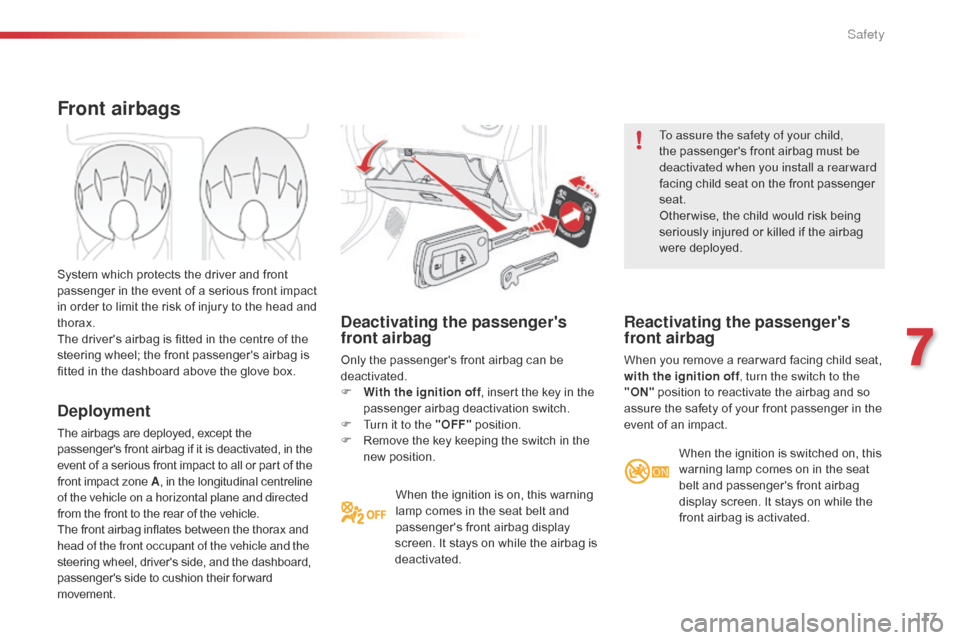
Deactivating the passenger's
front airbag
Only the passenger's front airbag can be
deactivated.
F
W
ith the ignition off , insert the key in the
passenger airbag deactivation switch.
F
T
urn it to the "OFF" position.
F
R
emove the key keeping the switch in the
new position.
When the ignition is on, this warning
lamp comes in the seat belt and
passenger's front airbag display
screen. It stays on while the airbag is
deactivated. To assure the safety of your child,
the passenger's front airbag must be
deactivated when you install a rear ward
facing child seat on the front passenger
seat.
Other wise, the child would risk being
seriously injured or killed if the airbag
were deployed.
Reactivating the passenger's
front airbag
When you remove a rear ward facing child seat,
with the ignition off
, turn the switch to the
"ON" position to reactivate the airbag and so
assure the safety of your front passenger in the
event of an impact.
Front airbags
Deployment
The airbags are deployed, except the
passenger's front airbag if it is deactivated, in the
event of a serious front impact to all or part of the
front impact zone A , in the longitudinal centreline
of the vehicle on a horizontal plane and directed
from the front to the rear of the vehicle.
The front airbag inflates between the thorax and
head of the front occupant of the vehicle and the
steering wheel, driver's side, and the dashboard,
passenger's side to cushion their for ward
movement. System which protects the driver and front
passenger in the event of a serious front impact
in order to limit the risk of injury to the head and
thorax.
The driver's airbag is fitted in the centre of the
steering wheel; the front passenger's airbag is
fitted in the dashboard above the glove box.
When the ignition is switched on, this
warning lamp comes on in the seat
belt and passenger's front airbag
display screen. It stays on while the
front airbag is activated.
7
Safety