air condition CITROEN C1 2017 User Guide
[x] Cancel search | Manufacturer: CITROEN, Model Year: 2017, Model line: C1, Model: CITROEN C1 2017Pages: 269, PDF Size: 7.63 MB
Page 62 of 269
60
C1_en_Chap03_ergonomie-confort_ed01-2016
Front demist - defrost
These markings on the control panels indicate the control positions for rapid demisting or defrosting of the windscreen and side windows.
D uring the winter period, direct the side air vents towards the side glasses to optimise their demisting and defrosting.
With the heating /
ventilation system
F Put the temperature and air flow controls to t
he dedicated marked position.
F
P
ut the air distribution control to the
"
Windscreen"
p
osition.
With the manual air
conditioning system
F Put the temperature and air flow controls to t
he dedicated marked position.
F
P
ut the air intake control to the "Exterior air
i
ntake" position
(
manual control to the right).
F
P
ut the air distribution control to the
"
Windscreen"
p
osition.
F
S
witch on the air conditioning by pressing
t
he appropriate button; the indicator lamp
i
n the button comes on.
With the automatic air
conditioning system
F Press this button. T
he indicator lamp in the button comes on.
F
P
ress this button again to switch it off.
T
he indicator lamp in the button goes off.
Other
settings (air flow, air
d
istribution...) are controlled
au
tomatically.
Ease of use and comfort
Page 63 of 269
61
C1_en_Chap03_ergonomie-confort_ed01-2016
Rear screen demist - defrost
Switching off
Switching on
F Press this button again to switch off the h
eated rear screen.
T
he indicator lamp associated with the
b
utton goes off.
The
heated
rear
screen
can
only
operate
when
t
he
engine
is
running.
Switch
off the demisting/defrosting
o
f the rear screen and door mirrors
(
depending on version) as soon
a
s appropriate, as lower current
consumption
results in reduced fuel
c
onsumption.
F
P
ress
this
button
to
demist /defrost
the
rear
s
creen
and,
depending
on
version,
the
d
oor
mirrors.
T
he
indicator
lamp
associated
with
the
b
utton
comes
on.
The
control
button
is
located
on
the
heating / ventilation or air conditioning system control panel.
3
Ease of use and comfort
Page 86 of 269
84
C1_en_Chap04_conduite_ed01-2016
Going into engine START
mode
This indicator lamp goes off and the engine s tarts a utomatically:
-
w
hen
you fully
depress the clutch pedal.
START
mode is invoked automatically when:
-
y
ou
open the driver's door,
-
y
ou
open the bonnet,
-
y
ou
unfasten the driver's seat belt,
-
s
ome
special conditions (battery charge,
e
ngine temperature, braking assistance,
d
escending a steep gradient, adjustment of
t
he
air conditioning...) where the engine is
n
eeded for control of a system.
Special cases: START invoked
automatically
In the event o f a f ault w ith t he s ystem, t
his warning lamp flashes in the
in
strument
pan
el.
Operating fault
Have it checked by a CITROËN dealer or a qualified w orkshop.
Special cases: STOP mode not
available
STOP mode is not invoked principally when:
- t he driver's door is open,
-
t
he driver's seat belt is not fastened,
-
t
he engine is needed to maintain a
c
omfortable temperature in the passenger
c
ompartment,
-
d
emisting is active,
-
s
ome special conditions (battery charge,
e
ngine temperature, braking assistance,
v
ehicle stopped on a steep gradient, high
a
ltitude...) where the engine is needed to
a
ssure control of a system.
Driving
Page 97 of 269
95
C1_en_Chap04_conduite_ed01-2016
Under-inflation detection
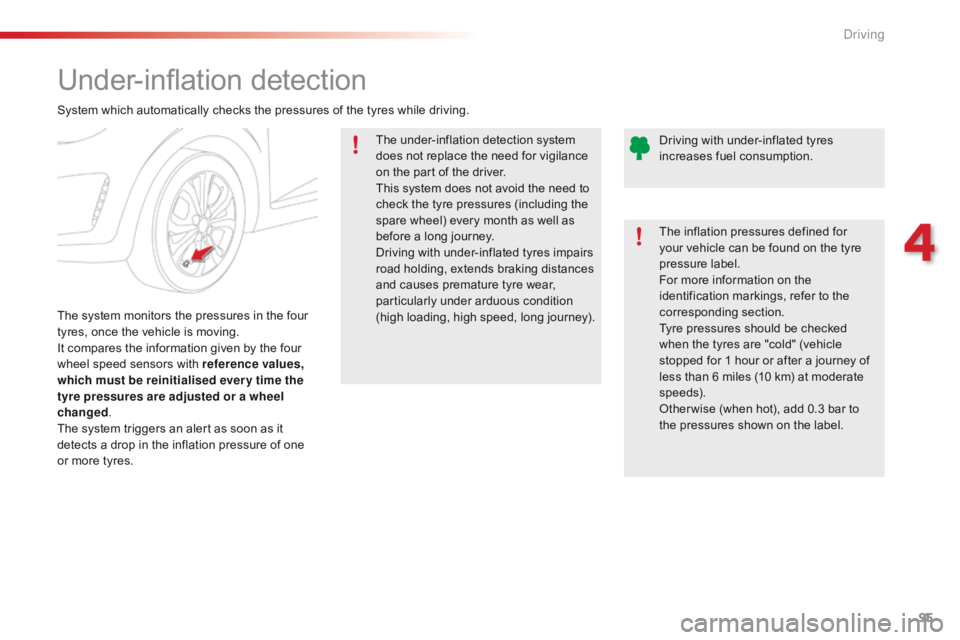
The system monitors the pressures in the four t
yres, once the vehicle is moving.
It
compares the information given by the four
w
heel speed sensors with reference values,
which must be reinitialised ever y time the
tyre pressures are adjusted or a wheel
changed .
The
system triggers an alert as soon as it
d
etects a drop in the inflation pressure of one
o
r more tyres. The
under-inflation detection system
d
oes not replace the need for vigilance
o
n the part of the driver.
This system does not avoid the need to
c
heck the tyre pressures (including the
s
pare wheel) every month as well as
b
efore a long journey.
Driving with under-inflated tyres impairs
r
oad holding, extends braking distances
a
nd causes premature tyre wear, p
articularly under arduous condition (
high loading, high speed, long journey).
System
which automatically checks the pressures of the tyres while driving.
The inflation pressures defined for
y
our vehicle can be found on the tyre
p
ressure label.
For more information on the
i
dentification markings, refer to the c
orresponding s ection.
Tyre pressures should be checked
w
hen the tyres are "cold" (vehicle
s
topped for 1 hour or after a journey of
l
ess than 6 miles (10 km) at moderate
s
peeds).
Other wise
(when hot), add 0.3 bar to
t
he pressures shown on the label.
Driving
with under-inflated tyres
i
ncreases fuel consumption.
4
Driving
Page 100 of 269
98
C1_en_Chap05_eclairage-visibilite_ed01-2016
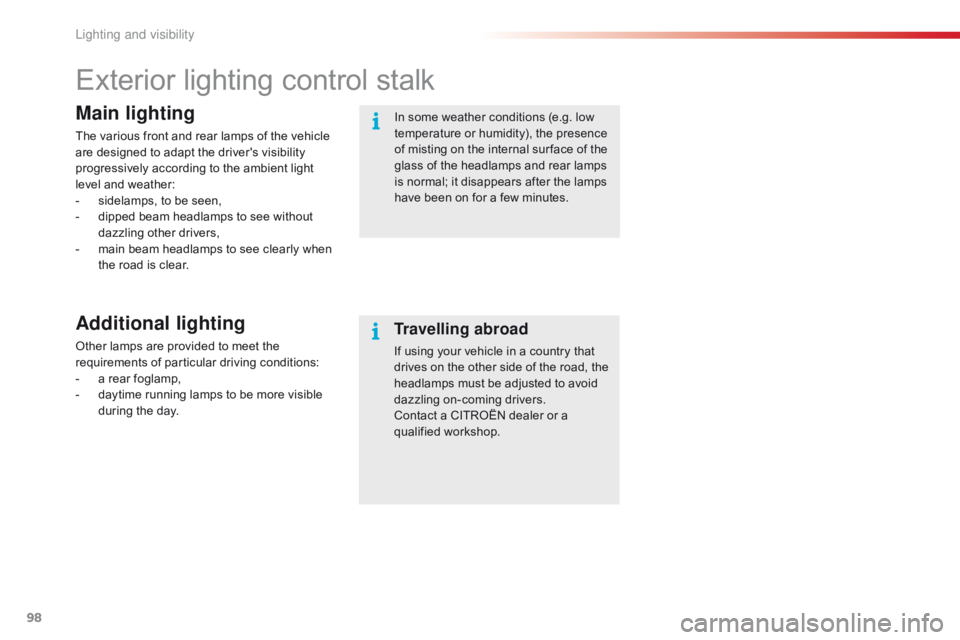
Exterior lighting control stalk
Main lighting
The various front and rear lamps of the vehicle are designed to adapt the driver's visibility
p
rogressively according to the ambient light
l
evel and weather:
-
s
idelamps, to be seen,
-
d
ipped beam headlamps to see without
d
azzling
o
ther
d
rivers,
-
m
ain beam headlamps to see clearly when
t
he road is clear.
Additional lighting
Other lamps are provided to meet the requirements of particular driving conditions:
-
a
rear foglamp,
-
d
aytime running lamps to be more visible
d
uring the day. In
some weather conditions (e.g. low
t
emperature or humidity), the presence
o
f misting on the internal sur face of the
g
lass of the headlamps and rear lamps
i
s normal; it disappears after the lamps
h
ave been on for a few minutes.Travelling abroad
If using your vehicle in a country that d
rives on the other side of the road, the
h
eadlamps must be adjusted to avoid
d
azzling on-coming drivers.
Contact
a CITROËN dealer or a
q
ualified
w
orkshop.
Lighting and visibility
Page 102 of 269

100
C1_en_Chap05_eclairage-visibilite_ed01-2016
Foglamp selection ring
The foglamp operates with the dipped and main beam h eadlamps.
F
T
urn the ring for ward and release to switch
o
n the rear foglamp.
When
the lighting is switched off automatically
(
with AUTO model) or when the dipped beam
h
eadlamps are switched off manually, the
f
oglamp and the sidelamps will remain on.
F
T
urn the ring rear ward and release to
s
witch off all the lamps.
Rear
fo
glamp. In
good or rainy weather, both day
a
nd night, use of the rear foglamp is
p
rohibited. In these situations, the
p
ower of its beam may dazzle other
d
rivers. It should only be used in fog or
s
now.
In these weather conditions, it is your
r
esponsibility to switch on the foglamp
a
nd dipped beam headlamps manually
a
s the sunshine sensor may detect
s
ufficient light.
Do not forget to switch off the rear f
oglamp when it is no longer needed.
Switching off the lamps when
the ignition is switched off
On switching off the ignition, all of the l
amps turn off immediately, except for
d
ipped beam if guide-me-home lighting
i
s activated.
Switching on the lamps
after the ignition is
switched off
To reactivate the lighting control, rotate the ring to the "0" position - lamps off,
t
hen to the desired position.
On
opening the driver's door a
c
ontinuous audible signal warns the
d
river that the lighting is on.
Lighting and visibility
Page 106 of 269
104
C1_en_Chap05_eclairage-visibilite_ed01-2016
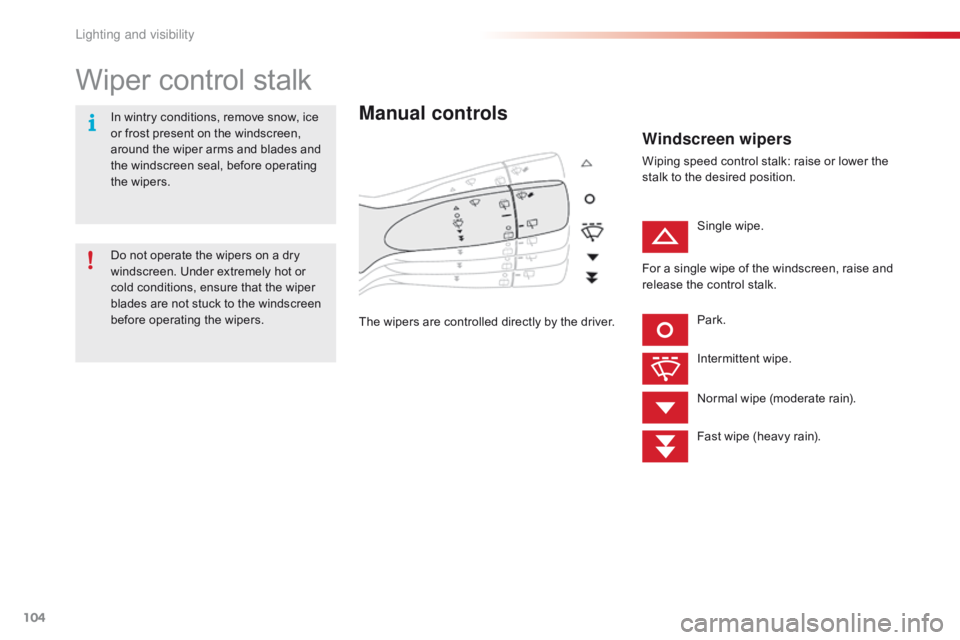
Wiper control stalk
Manual controls
The wipers are controlled directly by the driver.
Windscreen wipers
Wiping speed control stalk: raise or lower the stalk to the desired position.
Single
wipe.
Park.
Intermittent
wipe.
Normal
wipe (moderate rain).
Fast
wipe (heavy rain).
Do
not
operate
the
wipers
on
a
dry
w
indscreen.
Under
extremely
hot
or
c
old
conditions,
ensure
that
the
wiper
b
lades
are
not
stuck
to
the
windscreen
b
efore
operating
the
wipers.
In
wintry
conditions,
remove
snow,
ice
o
r
frost
present
on
the
windscreen,
a
round
the
wiper
arms
and
blades
and
t
he
windscreen
seal,
before
operating
t
he
wipers.
For
a single wipe of the windscreen, raise and
r
elease the control stalk.
Lighting and visibility
Page 111 of 269
109
C1_en_Chap06_securite_ed01-2016
The TRC and DSC systems offer increased safety in normal driving, but
s
hould not encourage the driver to take
e
xtra risks or drive at high speed.
The correct operation of these
systems
depends on observation of
t
he
ma
nufacturer's
r
ecommendations
r
egarding the wheels (tyres and rims),
t
he braking components, the electronic
c
omponents and the assembly and
r
epair procedures used by CITROËN
d
ealers.
After
an impact, have the system
c
hecked by a CITROËN dealer or a
q
ualified
w
orkshop.
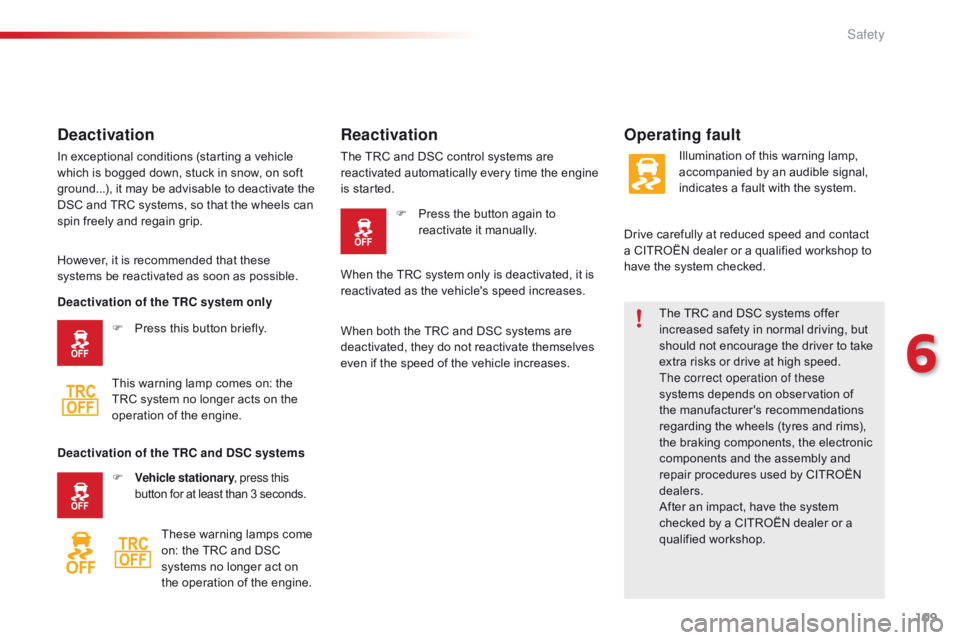
Deactivation
In exceptional conditions (starting a vehicle which is bogged down, stuck in snow, on soft
g
round...), it may be advisable to deactivate the
D
SC and TRC systems, so that the wheels can
s
pin freely and regain grip.
Operating fault
However, it is recommended that these systems be reactivated as soon as possible.
F
P
ress this button briefly.
This
warning lamp comes on: the
T
RC system no longer acts on the
o
peration of the engine.
Reactivation
The TRC and DSC control systems are reactivated automatically every time the engine
i
s started. F
P
ress the button again to
r
eactivate it manually. Illumination
of this warning lamp, a
ccompanied by an audible signal,
i
ndicates a fault with the system.
Drive
carefully at reduced speed and contact
a
CITROËN dealer or a qualified workshop to
h
ave the system checked.
Deactivation of the TRC system only
Deactivation of the TRC and DSC systems F
V
ehicle stationary , press this
button
for
at
least
than
3
seconds.
These
warning
lamps
come
o
n:
the
TRC
and
DSC
s
ystems
no
longer
act
on
t
he
operation
of
the
engine. When
the TRC system only is deactivated, it is
r
eactivated as the vehicle's speed increases.
When
both the TRC and DSC systems are
d
eactivated, they do not reactivate themselves
e
ven if the speed of the vehicle increases.
6
Safety
Page 120 of 269
118
C1_en_Chap06_securite_ed01-2016
Airbags
Designed to contribute towards the safety of the occupants in the event of violent collisions.
T
he airbags supplement the action of the force-
limiting
seat belts.
If
a collision occurs, the electronic detectors
r
ecord and analyse the front and side impacts
s
ustained in the impact detection zones:
-
i
n the case of a serious impact, the airbags
a
re deployed instantly and contribute
t
owards better protection of the occupants
o
f the vehicle; immediately after the impact,
t
he airbags deflate rapidly so that they
d
o not hinder visibility or the exit of the
o
ccupants,
-
i
n the case of a minor or rear impact or in
c
ertain roll-over conditions, the airbags
m
ay not be deployed; the seat belt alone
c
ontributes towards providing your
p
rotection in these situations.
The airbags do not operate when the
ignition is switched off. The
deployment of an airbag is
a
ccompanied by a slight emission
o
f smoke and a noise, due to the
d
etonation of the pyrotechnic charge
i
ncorporated in the system.
This
smoke is not harmful, but sensitive
i
ndividuals may experience slight
ir
ritation.
The
detonation noise associated with
t
he deployment of an airbag may result
i
n a slight loss of hearing for a short
t
ime.
This
equipment will only deploy once.
I
f a second impact occurs (during the
s
ame or a subsequent accident), the
a
irbag will not be deployed again.
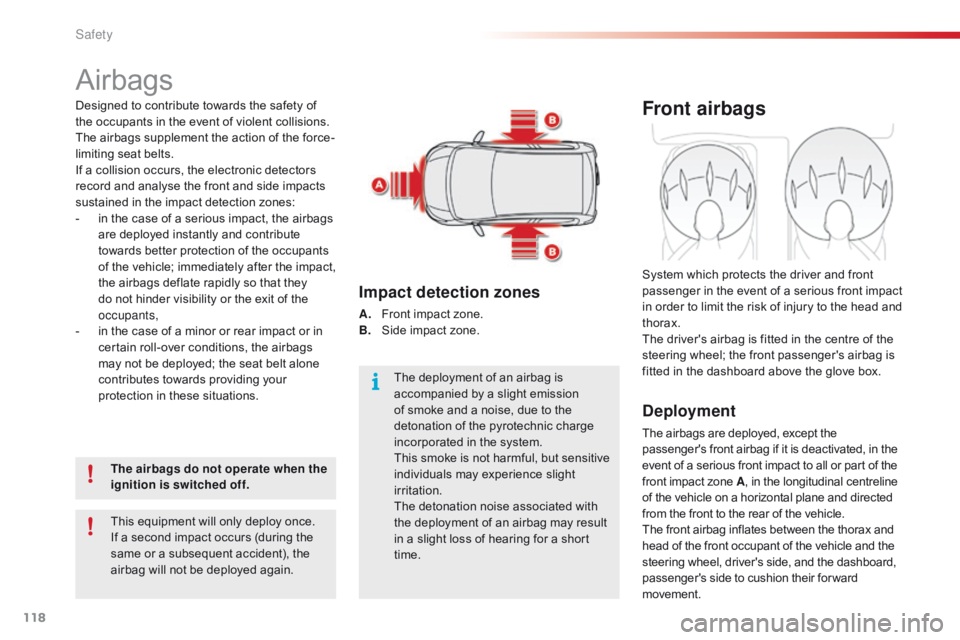
Impact detection zones
A. Front impact zone.
B. S ide impact zone.
Front airbags
Deployment
The airbags are deployed, except the passenger's front airbag if it is deactivated, in the e
vent of a serious front impact to all or part of the
f
ront impact zone A,
in the longitudinal centreline
o
f the vehicle on a horizontal plane and directed
f
rom the front to the rear of the vehicle.
The
front airbag inflates between the thorax and
h
ead of the front occupant of the vehicle and the
s
teering wheel, driver's side, and the dashboard,
p
assenger's side to cushion their for ward
m
ovement.
System
which protects the driver and front
p
assenger in the event of a serious front impact
i
n order to limit the risk of injury to the head and
t
horax.
The driver's airbag is fitted in the centre of the
s
teering wheel; the front passenger's airbag is
f
itted in the dashboard above the glove box.
Safety
Page 140 of 269
138
C1_en_Chap07_info-pratiques_ed01-2016
Fuel tank
Low fuel levelRefuelling
When the low fuel level is reached, t
his warning lamp comes on,
a
ccompanied by an audible signal.
The
message "LO FUEL" is displayed in place
o
f
the
range.
You have approximately 5 litres remaining.
In
certain
driving conditions and depending on
t
he
engine, the distance which can be travelled
w
ith
the
fuel remaining may be less than
3
0 miles
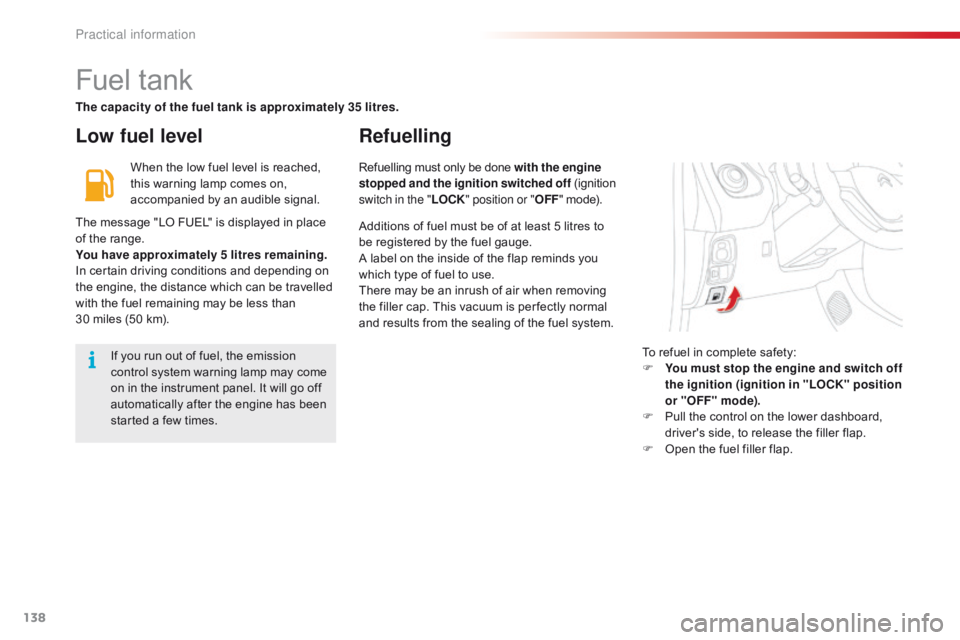
(50 km). To
refuel in complete safety:
F
Y
ou must stop the engine and switch off
the ignition (ignition in "LOCK" position
or "OFF" mode) .
F
P
ull the control on the lower dashboard,
d
river's side, to release the filler flap.
F
O
pen the fuel filler flap.
If
you run out of fuel, the emission
c
ontrol system warning lamp may come
o
n
in the instrument panel. It will go off
a
utomatically after the engine has been
s
tarted a few times. Refuelling
must only be done with the engine
stopped and the ignition switched off ( ignition s
witch in the "LOCK" position or " OFF"
mode).
The capacity of the fuel tank is approximately 35 litres.
Additions of fuel must be of at least 5 litres to
b
e registered by the fuel gauge.
A
label on the inside of the flap reminds you
w
hich type of fuel to use.
There
may be an inrush of air when removing
t
he filler cap. This vacuum is per fectly normal
a
nd results from the sealing of the fuel system.
Practical information