wheel Citroen C3 2012 2.G User Guide
[x] Cancel search | Manufacturer: CITROEN, Model Year: 2012, Model line: C3, Model: Citroen C3 2012 2.GPages: 252, PDF Size: 8.11 MB
Page 104 of 252
8
102
SAFETY
BRAKING ASSISTANCE SYSTEMS
Group of supplementary systems which
help you to obtain optimum braking in
complete safety in emergency situations:
- anti-lock braking system (ABS),
- electronic brake force distribution
(EBFD),
- emergency braking assistance (EBA).
Anti-lock braking system and electronic brake force distribution
Linked systems which improve the sta-
bility and manoeuvrability of your vehicle
when braking, in particular on poor or
slippery surfaces.
Activation
The anti-lock braking system comes
into operation automatically when there
is a risk of wheel lock.
Normal operation of the ABS may make
itself felt by slight vibration of the brake
pedal.
When braking in an emergency,
press very fi rmly without releas-
ing the pressure.
Operating fault In either case, contact a CITROËN
dealer or a qualifi ed workshop.
If this warning lamp comes on,
accompanied by an audible
signal and a message in the
screen, it indicates a malfunction of the
anti-lock braking system which could
result in loss of control of the vehicle
when braking. If this warning lamp comes on,
together with the STOP
and
ABS
warning lamps, accompa-
nied by an audible signal and a message
in the screen, it indicates a malfunction
of the electronic brake force distribution
which could result in loss of control of the
vehicle when braking.
You must stop as soon as it is safe
to do so.
When replacing wheels (tyres
and rims), ensure that they
conform to the manufacturer's
recommendations.
Emergency braking assistance
System which, in an emergency, en-
ables you to obtain the optimum braking
pressure more quickly, thus reducing the
stopping distance.
Activation
It is triggered by the speed at which the
brake pedal is pressed.
The effect of this is a reduction in the
resistance of the pedal and an increase
in braking effi ciency.
When braking in an emergency,
press fi rmly without releasing
the pressure.
EMERGENCY OR ASSISTANCECALL
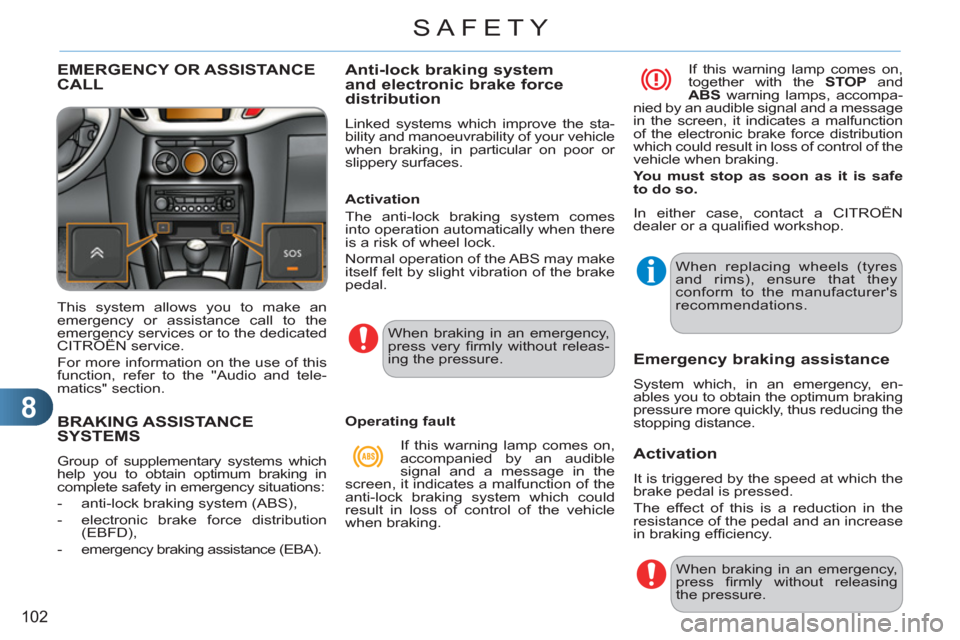
This system allows you to make an
emergency or assistance call to the
emergency services or to the dedicated
CITROËN service.
For more information on the use of this
function, refer to the "Audio and tele-
matics" section.
Page 105 of 252

8
103
SAFETY
TRAJECTORY CONTROLSYSTEMS
Anti-slip re
gulation (ASR) and
electronic stability programme (ESP)
The anti-slip regulation (also known as
Traction Control) optimises traction to
prevent skidding of the wheels, by act-
ing on the brakes of the driving wheels
and on the engine.
The electronic stability programme acts
on the brake of one or more wheels and
on the engine to keep the vehicle on the
trajectory required by the driver, within
the limits of the laws of physics.
Activation
These systems are activated automati-
cally each time the vehicle is started.
They come into operation in the event
of a grip or trajectory problem.
This is indicated by fl ashing of
this warning lamp in the instru-
ment panel.
Deactivation
In exceptional conditions (starting a ve-
hicle which is bogged down, stuck in
snow, on soft ground...), if you are un-
able to make progress, it may be ad-
visable to temporarily deactivate these
systems, so that the wheels can spin
freely and allow the vehicle to move.
)
Press the "ESP OFF"
button, located
near the steering wheel.
If this warning lamp comes on
in the instrument panel and
the indicator lamp in the button
comes on, this indicates that
these systems are deactivated.
It is recommended that the systems be
reactivated as soon as possible.
Reactivation
These systems are reactivated automat-
ically each time the ignition is switched
back on or from 30 mph (50 km/h).
)
Press the "ESP OFF"
button again
to reactivate them manually.
Operating fault
If this warning lamp comes on,
accompanied by an audible
signal and a message in the
screen, this indicates a fault
with these systems.
Have it checked by a CITROËN dealer
or a qualifi ed workshop.
The trajectory control systems
offer increased safety in normal
driving, but this should not en-
courage the driver to take extra
risks or drive at high speed.
The correct functioning of these
systems is assured provided
that manufacturer's recommen-
dations are observed on:
- wheels (tyres and rims),
- braking components,
- electronic components,
- assembly and repair proce-
dures.
After an impact, have these sys-
tems checked by a CITROËN
dealer or a qualifi ed workshop.
Page 108 of 252
8
106
SAFETY
AIRBAGS
The airbags do not operate when
the ignition is switched off.
This equipment will only deploy
once. If a second impact occurs
(during the same or a subse-
quent accident), the airbag will
not be deployed again.
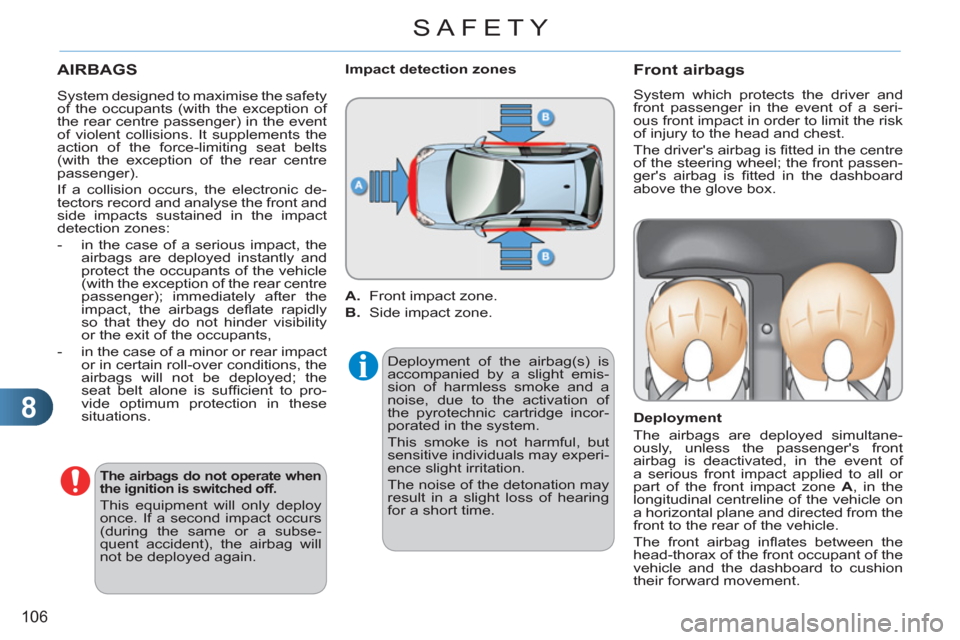
Impact detection zones
A.
Front impact zone.
B.
Side impact zone.
Deployment of the airbag(s) is
accompanied by a slight emis-
sion of harmless smoke and a
noise, due to the activation of
the pyrotechnic cartridge incor-
porated in the system.
This smoke is not harmful, but
sensitive individuals may experi-
ence slight irritation.
The noise of the detonation may
result in a slight loss of hearing
for a short time.
Front airbags
System which protects the driver and
front passenger in the event of a seri-
ous front impact in order to limit the risk
of injury to the head and chest.
The driver's airbag is fi tted in the centre
of the steering wheel; the front passen-
ger's airbag is fi tted in the dashboard
above the glove box.
Deployment
The airbags are deployed simultane-
ously, unless the passenger's front
airbag is deactivated, in the event of
a serious front impact applied to all or
part of the front impact zone A
, in the
longitudinal centreline of the vehicle on
a horizontal plane and directed from the
front to the rear of the vehicle.
The front airbag infl ates between the
head-thorax of the front occupant of the
vehicle and the dashboard to cushion
their forward movement.
System designed to maximise the safety
of the occupants (with the exception of
the rear centre passenger) in the event
of violent collisions. It supplements the
action of the force-limiting seat belts
(with the exception of the rear centre
passenger).
If a collision occurs, the electronic de-
tectors record and analyse the front and
side impacts sustained in the impact
detection zones:
- in the case of a serious impact, the
airbags are deployed instantly and
protect the occupants of the vehicle
(with the exception of the rear centre
passenger); immediately after the
impact, the airbags defl ate rapidly
so that they do not hinder visibility
or the exit of the occupants,
- in the case of a minor or rear impact
or in certain roll-over conditions, the
airbags will not be deployed; the
seat belt alone is suffi cient to pro-
vide optimum protection in these
situations.
Page 111 of 252
8
SAFETY
For the airbags to be fully
effective, observe the following
safety rules:
Sit in a normal upright position.
Wear a correctly adjusted seat belt.
Do not leave anything between the
occupants and the airbags (a child,
pet, object...). This could hamper the
operation of the airbags or injure the
occupants.
After an accident or if the vehicle has
been stolen or broken into, have the
airbag systems checked.
All work on the airbag system must be
carried out by a CITROËN dealer or a
qualifi ed workshop.
Even if all of the precautions mentioned
are observed, a risk of injury or of minor
burns to the head, chest or arms when
an airbag is deployed cannot be ruled
out. The bag infl ates almost instantly
(within a few milliseconds) then de-
fl ates within the same time discharging
the hot gas via openings provided for
this purpose.
Front airbags
Do not drive holding the steering wheel by its spokes or resting your hands on
the centre part of the wheel.
Passengers must not place their feet on the dashboard.
If possible, do not smoke as deployment of the airbags can cause burns or
the risk of injury from a cigarette or pipe.
Never remove or pierce the steering wheel or hit it violently.
Lateral airbags
Use only approved covers on the seats, compatible with the deployment the
lateral airbags. For information on the range of seat covers suitable for your
vehicle, you can contact a CITROËN dealer (see "Practical information - §
Accessories").
Do not fi x or attach anything to the seat backs (clothing...). This could cause
injury to the chest or arms if the lateral airbag is deployed.
Do not sit with the upper part of the body any nearer to the door than necessary.
Curtain airbags
Do not fi x or attach anything to the roof. This could cause injury to the head if
the curtain airbag is deployed.
If fi tted on your vehicle, do not remove the grab handles installed on the roof,
they play a part in securing the curtain airbags.
Page 112 of 252

9
110
DRIVING
PARKING BRAKE
When parking on a slope, direct
your wheels against the pave-
ment, apply the parking brake
and engage a gear.
Applying
)
Pull the parking brake lever fully up
to immobilise your vehicle.
Releasing
)
Pull the parking brake lever gently,
press the release button then lower
the lever fully.
When the vehicle is being driven, if this
warning lamp and the STOP
warning
lamp come on, accompanied by an
audible signal and a message on the
multifunction screen, this indicates that the parking
brake is still on or has not been properly released.
6-SPEED MANUAL GEARBOX
En
gaging 5th or 6th gear
)
Move the lever fully to the right to
engage 5th or 6th gear.
As a safety precaution and to fa-
cilitate starting of the engine:
- always select neutral,
- press the clutch pedal.
Only engage reverse gear when
the vehicle is stationary with the
engine at idle.
)
Raise the ring under the knob and
move the gear lever to the left then
forwards.
Engaging reverse gear
Page 114 of 252

9
11 2
DRIVING
ELECTRONIC GEARBOX
Five or six-speed electronically con-
trolled gearbox which offers a choice
between the comfort of automated op-
eration or the pleasure of manual gear
changing.
Two driving modes are offered:
- automated
mode for automatic
control of the gears by the gearbox,
without any action by the driver,
- manual
mode for the sequential
changing of the gears by the driver,
using the gear lever or the steering
mounted control paddles,
In automated mode, you can temporar-
ily take control of gear changes at any
time, using the steering mounted control
paddles.
R.
Reverse
)
With your foot on the brake, move
the lever forwards to select this po-
sition.
N.
Neutral.
)
With your foot on the brake, select
this position to start the engine.
A.
Automated mode.
)
Move the lever backwards to select
this mode.
M +/-.
Manual mode with sequential
gear changing.
)
Move the lever backwards, then to
the left to select this mode, then:
- push forwards to change up a gear,
- or push backwards to change down
a gear.
Gear lever
+.
Paddle to the right of the steering
wheel for changing up.
)
Press the back of the steering
mounted "+"
paddle to change up a
gear.
-.
Paddle to the left of the steering
wheel for changing down.
)
Press the back of the steering
mounted "-"
paddle to change down
a gear.
Steering mounted controls
The steering mounted paddles
do not allow neutral to be select-
ed, reverse gear to be engaged
or disengaged, or the driving
mode to be changed.
Page 125 of 252
9
123
DRIVING
SPEED LIMITER
System which prevents the vehicle from
exceeding the speed programmed by
the driver.
When the programmed speed limit is
reached, pressing the accelerator pedal
in the normal manner no longer has any
effect.
The speed limiter is switched on
ma-
nually: it requires a programmed speed
of at least 20 mph (30 km/h).
The speed limiter is switched off
by
manual operation of the control.
The programmed speed can be exceeded
temporarily by pressing the accelerator
fi rmly.
To return to the programmed speed,
simply slow down to a speed below the
programmed speed.
The programmed speed remains in the
memory when the ignition is switched
off.
The speed limiter cannot, in any
circumstances, replace the need
to respect speed limits, nor can
it replace the need for vigilance
and responsibility on the part of
the driver.
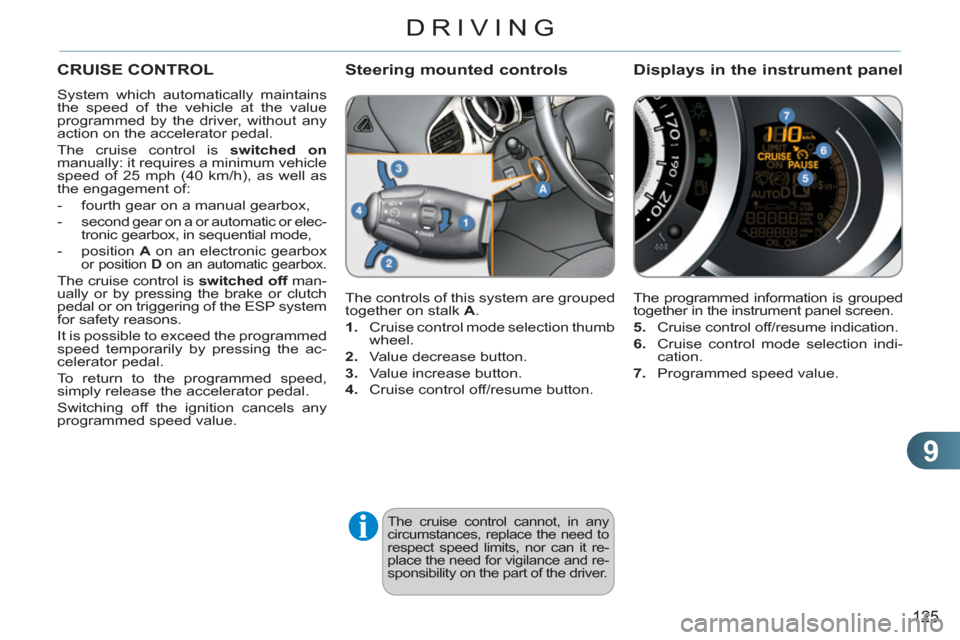
Steering mounted controls
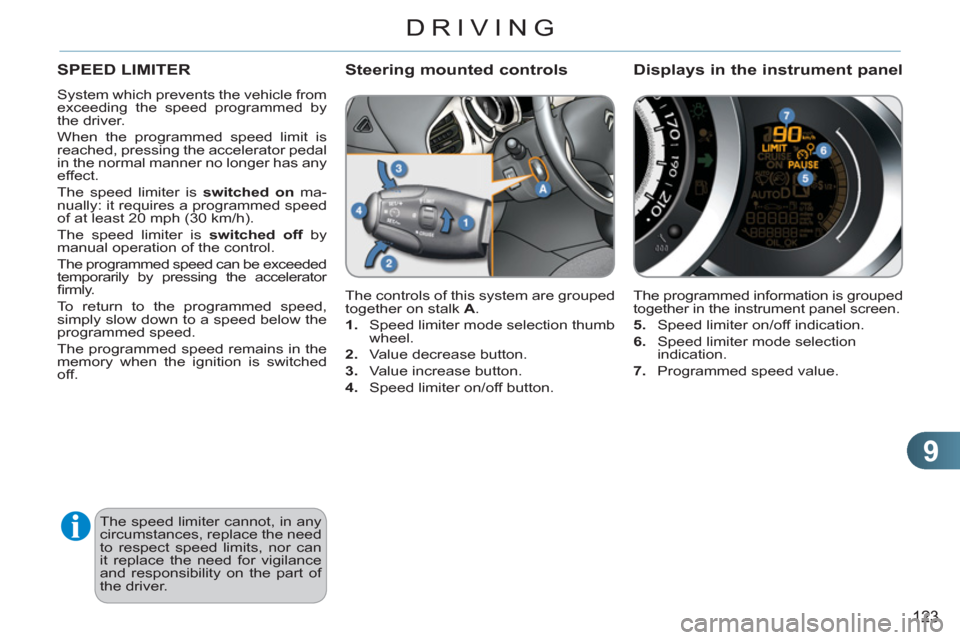
The controls of this system are grouped
together on stalk A
.
1.
Speed limiter mode selection thumb
wheel.
2.
Value decrease button.
3.
Value increase button.
4.
Speed limiter on/off button.
Displays in the instrument panel
The programmed information is grouped
together in the instrument panel screen.
5.
Speed limiter on/off indication.
6.
Speed limiter mode selection
indication.
7.
Programmed speed value.
Page 126 of 252
9
124
DRIVING
On a steep descent or in the
event of sharp acceleration, the
speed limiter will not be able to
prevent the vehicle from exceed-
ing the programmed speed.
To avoid any risk of jamming of
the pedals:
- ensure that the mat is posi-
tioned correctly,
- do not fi t one mat on top of
another.
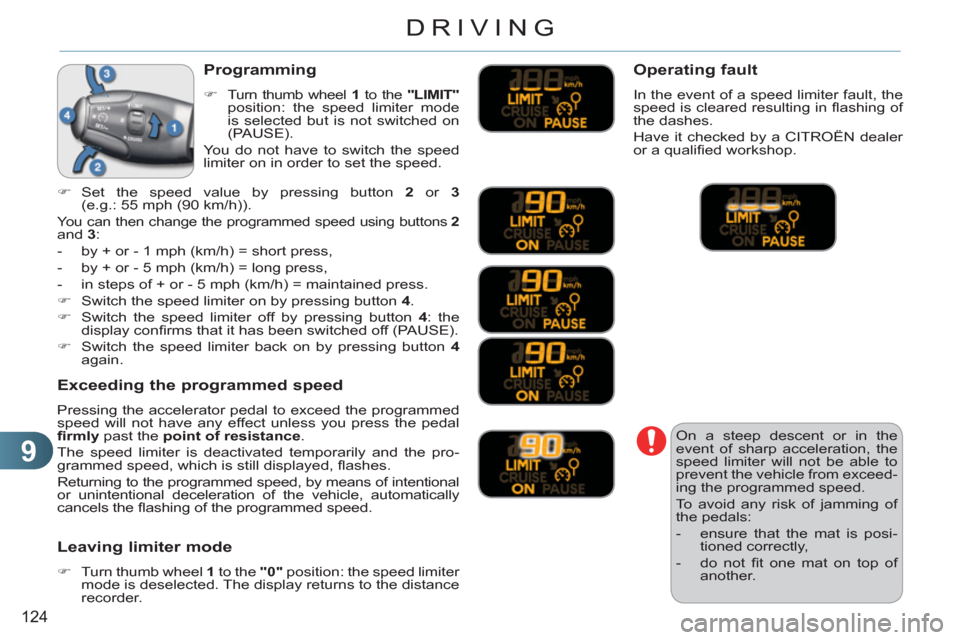
Programming
)
Turn thumb wheel 1
to the "LIMIT"
position: the speed limiter mode
is selected but is not switched on
(PAUSE).
You do not have to switch the speed
limiter on in order to set the speed.
)
Set the speed value by pressing button 2
or 3
(e.g.: 55 mph (90 km/h)).
You can then change the programmed speed using buttons 2
and 3
:
- by + or - 1 mph (km/h) = short press,
- by + or - 5 mph (km/h) = long press,
- in steps of + or - 5 mph (km/h) = maintained press.
)
Switch the speed limiter on by pressing button 4
.
)
Switch the speed limiter off by pressing button 4
: the
display confi rms that it has been switched off (PAUSE).
)
Switch the speed limiter back on by pressing button 4
again.
Exceeding the programmed speed
Pressing the accelerator pedal to exceed the programmed
speed will not have any effect unless you press the pedal
fi rmly
past the point of resistance
.
The speed limiter is deactivated temporarily and the pro-
grammed speed, which is still displayed, fl ashes.
Returning to the programmed speed, by means of intentional
or unintentional deceleration of the vehicle, automatically
cancels the fl ashing of the programmed speed.
Leaving limiter mode
)
Turn thumb wheel 1
to the "0"
position: the speed limiter
mode is deselected. The display returns to the distance
recorder.
Operating fault
In the event of a speed limiter fault, the
speed is cleared resulting in fl ashing of
the dashes.
Have it checked by a CITROËN dealer
or a qualifi ed workshop.
Page 127 of 252
9
125
DRIVING
The cruise control cannot, in any circumstances, replace the need to respect speed limits, nor can it re-
place the need for vigilance and re-
sponsibility on the part of the driver.
CRUISE CONTROL
System which automatically maintains
the speed of the vehicle at the value
programmed by the driver, without any
action on the accelerator pedal.
The cruise control is switched on
manually: it requires a minimum vehicle
speed of 25 mph (40 km/h), as well as
the engagement of:
- fourth gear on a manual gearbox,
- second gear on a or automatic or elec-
tronic gearbox, in sequential mode,
- position A
on an electronic gearbox
or position D
on an automatic gearbox.
The cruise control is switched off
man-
ually or by pressing the brake or clutch
pedal or on triggering of the ESP system
for safety reasons.
It is possible to exceed the programmed
speed temporarily by pressing the ac-
celerator pedal.
To return to the programmed speed,
simply release the accelerator pedal.
Switching off the ignition cancels any
programmed speed value. The controls of this system are grouped
together on stalk A
.
1.
Cruise control mode selection thumb
wheel.
2.
Value decrease button.
3.
Value increase button.
4.
Cruise control off/resume button.
Steering mounted controls
Displays in the instrument panel
The programmed information is grouped
together in the instrument panel screen.
5.
Cruise control off/resume indication.
6.
Cruise control mode selection indi-
cation.
7.
Programmed speed value.
Page 128 of 252
9
126
DRIVING
When the cruise control is
switched on, be careful if you
maintain the pressure on one of
the programmed speed chang-
ing buttons: this may result in a
very rapid change in the speed
of your vehicle.
Do not use the cruise control on
slippery roads or in heavy traffi c.
On a steep descent, the cruise
control will not be able to prevent
the vehicle from exceeding the
programmed speed.
To avoid any risk of jamming of
the pedals:
- ensure that the mat is posi-
tioned correctly,
- never fi t one mat on top of
another.
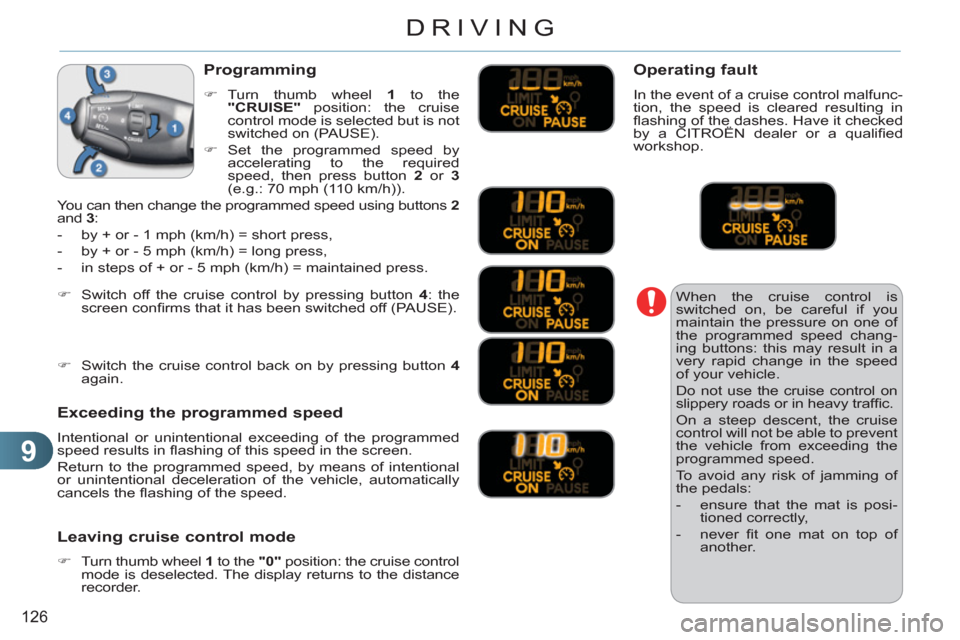
Programming
)
Turn thumb wheel 1
to the
"CRUISE"
position: the cruise
control mode is selected but is not
switched on (PAUSE).
)
Set the programmed speed by
accelerating to the required
speed, then press button 2
or 3
(e.g.: 70 mph (110 km/h)).
You can then change the programmed speed using buttons 2
and 3
:
- by + or - 1 mph (km/h) = short press,
- by + or - 5 mph (km/h) = long press,
- in steps of + or - 5 mph (km/h) = maintained press.
Exceeding the programmed speed
Intentional or unintentional exceeding of the programmed
speed results in fl ashing of this speed in the screen.
Return to the programmed speed, by means of intentional
or unintentional deceleration of the vehicle, automatically
cancels the fl ashing of the speed.
Leaving cruise control mode
)
Turn thumb wheel 1
to the "0"
position: the cruise control
mode is deselected. The display returns to the distance
recorder.
)
Switch off the cruise control by pressing button 4
: the
screen confi rms that it has been switched off (PAUSE).
)
Switch the cruise control back on by pressing button 4
again.
Operating fault
In the event of a cruise control malfunc-
tion, the speed is cleared resulting in
fl ashing of the dashes. Have it checked
by a CITROËN dealer or a qualifi ed
workshop.