Temperature Citroen C3 2012 2.G Owner's Guide
[x] Cancel search | Manufacturer: CITROEN, Model Year: 2012, Model line: C3, Model: Citroen C3 2012 2.GPages: 252, PDF Size: 8.11 MB
Page 122 of 252
9
120
DRIVING
Going into engine START mode
The "ECO"
warning lamp goes
off and the engine starts:
- with a manual gearbox
, when you
depress the clutch pedal,
- with a 5-speed or 6-speed elec-
tronic gearbox
:
●
gear lever in position A
or M
, when
you release the brake pedal,
●
or gear lever in position N
and the
brake pedal released, when you
move the gear lever to position A
or M
,
●
or when you engage reverse gear.
Special cases: START invoked
automatically
For reasons of safety and for your com-
fort, START mode is invoked automati-
cally when:
- you open the driver's door,
- you unfasten the driver's seat belt,
- the speed of the vehicle exceeds
7 mph (11 km/h) with the electronic
gearbox system,
- some special conditions (battery
charge, engine temperature, brak-
ing assistance, ambient tempera-
ture...) where the engine is needed
for control of a system.
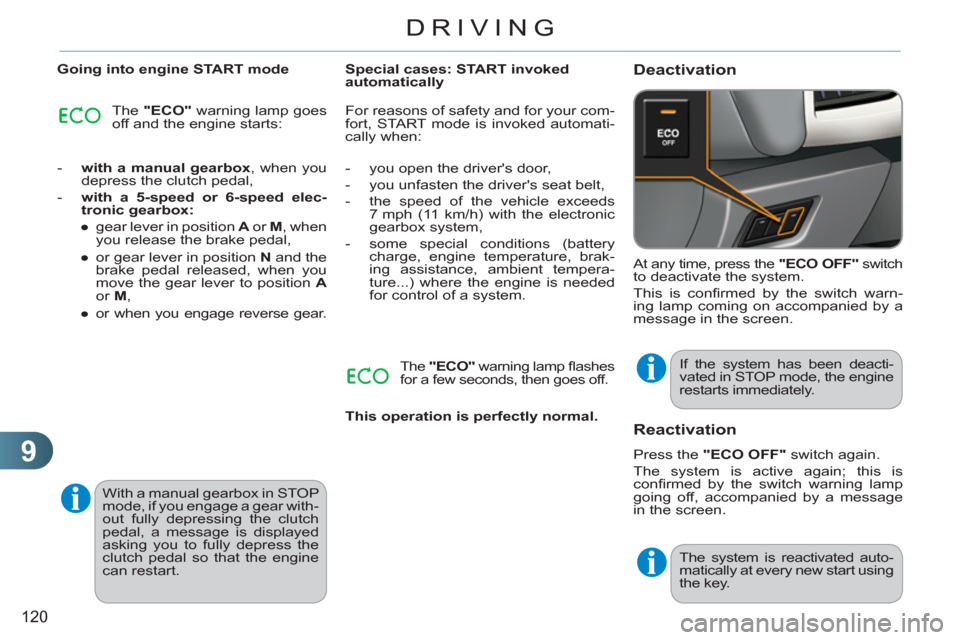
Deactivation
At any time, press the "ECO OFF"
switch
to deactivate the system.
This is confi rmed by the switch warn-
ing lamp coming on accompanied by a
message in the screen.
If the system has been deacti-
vated in STOP mode, the engine
restarts immediately.
Reactivation
Press the "ECO OFF"
switch again.
The system is active again; this is
confi rmed by the switch warning lamp
going off, accompanied by a message
in the screen.
The system is reactivated auto-
matically at every new start using
the key.
The "ECO"
warning lamp fl ashes
for a few seconds, then goes off.
This operation is perfectly normal.
With a manual gearbox in STOP
mode, if you engage a gear with-
out fully depressing the clutch
pedal, a message is displayed
asking you to fully depress the
clutch pedal so that the engine
can restart.
Page 135 of 252
10
133
CHECKS
CHECKING LEVELS
Check all of these levels regularly and
top them up if necessary, unless other-
wise indicated.
If a level drops signifi cantly, have the
corresponding system checked by a
CITROËN dealer or a qualifi ed work-
shop.
Oil level
The reading will only be correct
if the vehicle is on level ground
and the engine has been off for
more than 30 minutes.
The check is carried out either when the igni-
tion is switched on using the oil level indicator
in the instrument panel, or using the dipstick.
Engine oil change
Refer to the servicing booklet for details
of the interval for this operation.
In order to maintain the reliability of the
engine and emission control system,
the use of additives in the engine oil is
prohibited.
Oil grade
The oil must be suitable for your engine
and conform to the manufacturer's rec-
ommendations.
The brake fl uid level should be
close to the "MAX" mark. If it is
not, check the brake pad wear.
Changing the fl uid
Refer to the servicing booklet for details
of the interval for this operation.
Fluid specifi cation
The brake fl uid must conform to the
manufacturer's recommendations and
meet the DOT4 standard.
Coolant level
The coolant level should be
close to the "MAX" mark but
should never exceed it.
When the engine is warm, the
temperature of the coolant is regulated
by the fan. This can operate with the igni-
tion off.
On vehicles which are fi tted with a par-
ticle emission fi lter, the fan may oper-
ate after the vehicle has been switched
off, even if the engine is cold.
In addition, as the cooling system is
pressurised, wait at least one hour after
switching off the engine before carrying
out any work. To avoid any risk of scalding, unscrew
the cap by two turns to allow the pres-
sure to drop. When the pressure has
dropped, remove the cap and top up
the level.
Changing the coolant
The coolant does not have to be changed.
Fluid specifi cation
The coolant must conform to the manu-
facturer's recommendations.
Screenwash fluid level
Top up the level when neces-
sary.
Fluid specifi cation
For optimum cleaning and to avoid
freezing, this fl uid must not be topped
up or replaced with plain water.
Take care when carrying out
checks under the bonnet as
some parts of the engine can be
very hot (risk of burns).
It is normal to top up the engine
oil between services. CITROËN
recommends that you check the
oil level and top up if necessary,
every 3 000 miles (5 000 kilome-
tres).
Page 165 of 252
11
163
PRACTICAL INFORMATION
We recommend the use of genu-
ine CITROËN towbars and their
harnesses that have been tested
and approved from the design
stage of your vehicle, and that
the fi tting of the towbar is en-
trusted to a CITROËN dealer or
a qualifi ed workshop.
If the towbar is not fi tted by a
CITROËN dealer, it is impera-
tive that it is fi tted in accordance
with the vehicle manufacturer's
instructions.
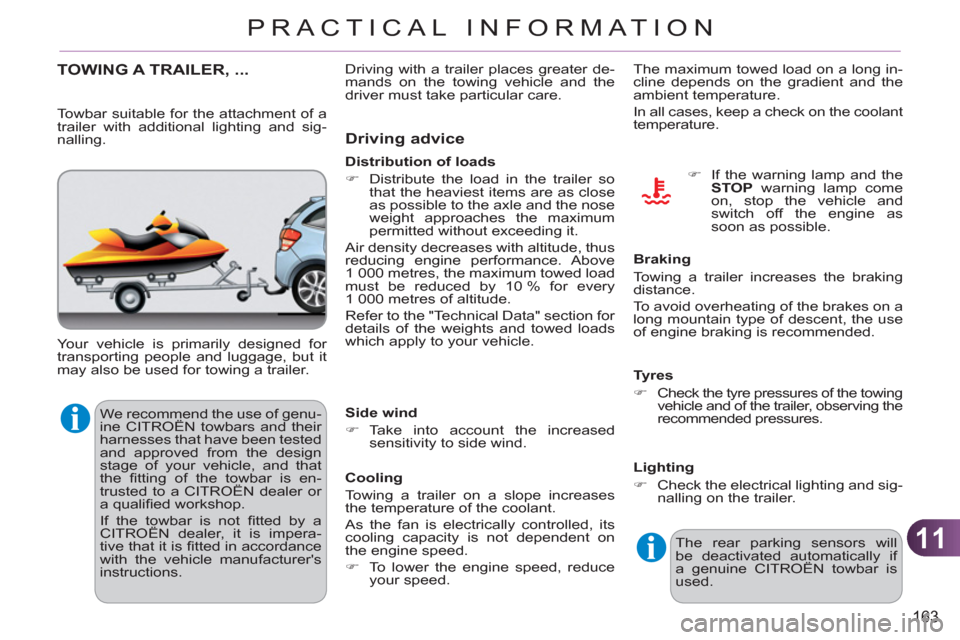
TOWING A TRAILER, ...
The rear parking sensors will
be deactivated automatically if
a genuine CITROËN towbar is
used.
Towbar suitable for the attachment of a
trailer with additional lighting and sig-
nalling.
Your vehicle is primarily designed for
transporting people and luggage, but it
may also be used for towing a trailer. Driving with a trailer places greater de-
mands on the towing vehicle and the
driver must take particular care.
Driving advice
Distribution of loads
)
Distribute the load in the trailer so
that the heaviest items are as close
as possible to the axle and the nose
weight approaches the maximum
permitted without exceeding it.
Air density decreases with altitude, thus
reducing engine performance. Above
1 000 metres, the maximum towed load
must be reduced by 10 % for every
1 000 metres of altitude.
Refer to the "Technical Data" section for
details of the weights and towed loads
which apply to your vehicle.
Side wind
)
Take into account the increased
sensitivity to side wind.
Cooling
Towing a trailer on a slope increases
the temperature of the coolant.
As the fan is electrically controlled, its
cooling capacity is not dependent on
the engine speed.
)
To lower the engine speed, reduce
your speed. The maximum towed load on a long in-
cline depends on the gradient and the
ambient temperature.
In all cases, keep a check on the coolant
temperature.
)
If the warning lamp and the
STOP
warning lamp come
on, stop the vehicle and
switch off the engine as
soon as possible.
Braking
Towing a trailer increases the braking
distance.
To avoid overheating of the brakes on a
long mountain type of descent, the use
of engine braking is recommended.
Tyres
)
Check the tyre pressures of the towing
vehicle and of the trailer, observing the
recommended pressures.
Lighting
)
Check the electrical lighting and sig-
nalling on the trailer.
Page 170 of 252
12
168
TECHNICAL DATA
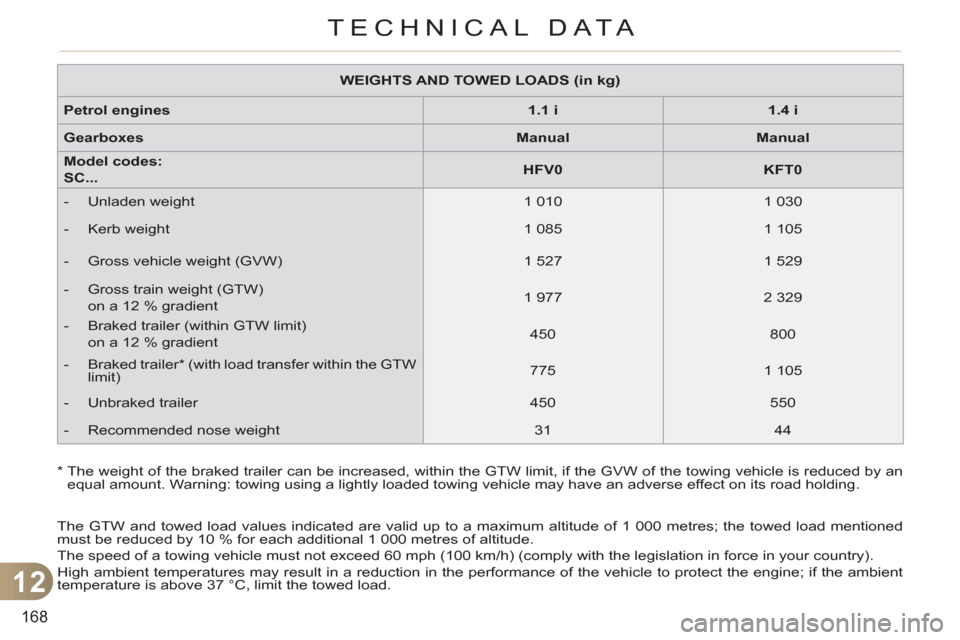
WEIGHTS AND TOWED LOADS (in kg)
Petrol engines
1.1 i
1.4 i
Gearboxes
Manual
Manual
Model codes:
SC...
HFV0
KFT0
- Unladen weight
1 010
1 030
- Kerb weight
1 085
1 105
- Gross vehicle weight (GVW)
1 527
1 529
- Gross train weight (GTW)
on a 12 % gradient
1 977
2 329
- Braked trailer (within GTW limit)
on a 12 % gradient
450
800
- Braked trailer * (with load transfer within the GTW
limit)
775
1 105
- Unbraked trailer
450
550
- Recommended nose weight
31
44
*
The weight of the braked trailer can be increased, within the GTW limit, if the GVW of the towing vehicle is reduced by an
equal amount. Warning: towing using a lightly loaded towing vehicle may have an adverse effect on its road holding.
The GTW and towed load values indicated are valid up to a maximum altitude of 1 000 metres; the towed load mentioned
must be reduced by 10 % for each additional 1 000 metres of altitude.
The speed of a towing vehicle must not exceed 60 mph (100 km/h) (comply with the legislation in force in your country).
High ambient temperatures may result in a reduction in the performance of the vehicle to protect the engine; if the ambient
temperature is above 37 °C, limit the towed load.
Page 171 of 252
12
169
TECHNICAL DATA
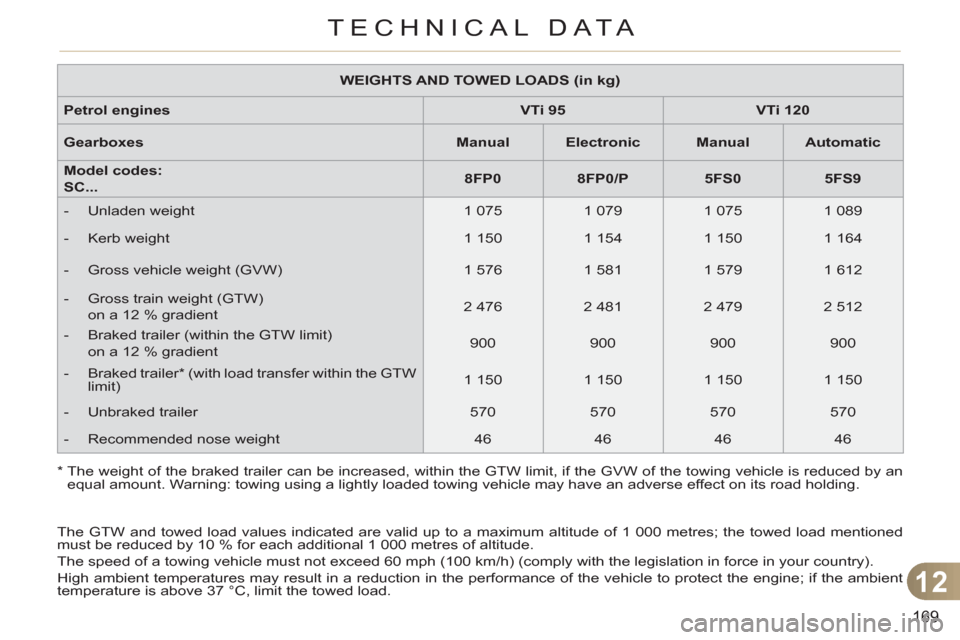
*
The weight of the braked trailer can be increased, within the GTW limit, if the GVW of the towing vehicle is reduced by an
equal amount. Warning: towing using a lightly loaded towing vehicle may have an adverse effect on its road holding.
The GTW and towed load values indicated are valid up to a maximum altitude of 1 000 metres; the towed load mentioned
must be reduced by 10 % for each additional 1 000 metres of altitude.
The speed of a towing vehicle must not exceed 60 mph (100 km/h) (comply with the legislation in force in your country).
High ambient temperatures may result in a reduction in the performance of the vehicle to protect the engine; if the ambient
temperature is above 37 °C, limit the towed load.
WEIGHTS AND TOWED LOADS (in kg)
Petrol engines
VTi 95
VTi 120
Gearboxes
Manual
Electronic
Manual
Automatic
Model codes:
SC...
8FP0
8FP0/
P
5FS0
5FS9
- Unladen weight
1 075
1 079
1 075
1 089
- Kerb weight
1 150
1 154
1 150
1 164
- Gross vehicle weight (GVW)
1 576
1 581
1 579
1 612
- Gross train weight (GTW)
on a 12 % gradient
2 476
2 481
2 479
2 512
- Braked trailer (within the GTW limit)
on a 12 % gradient
900
900
900
900
- Braked trailer * (with load transfer within the GTW
limit)
1 150
1 150
1 150
1 150
- Unbraked trailer
570
570
570
570
- Recommended nose weight
46
46
46
46
Page 173 of 252
12
171
TECHNICAL DATA
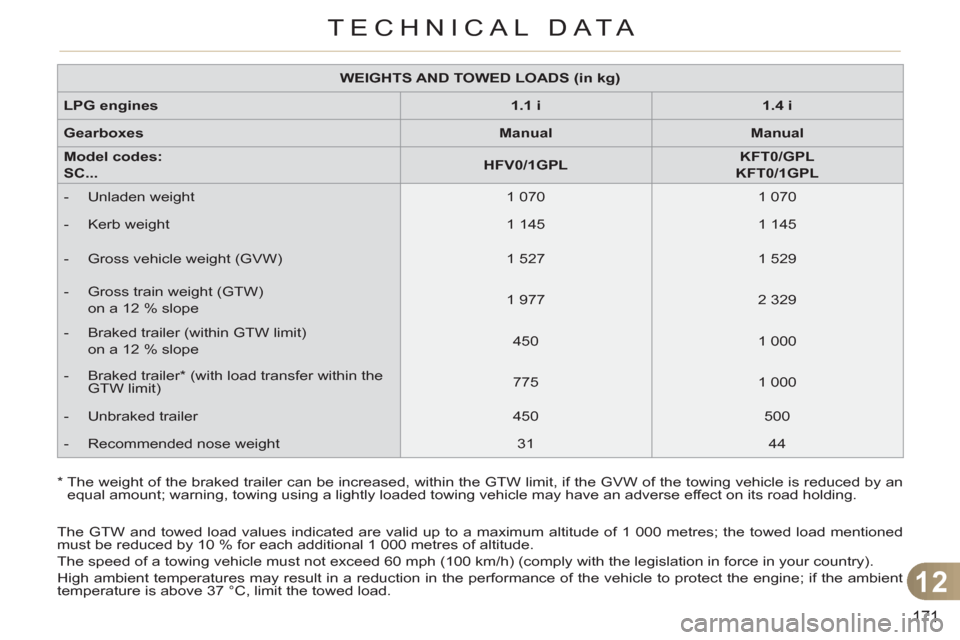
WEIGHTS AND TOWED LOADS (in kg)
LPG engines
1.1 i
1.4 i
Gearboxes
Manual
Manual
Model codes:
SC...
HFV0/1GPL
KFT0/GPL
KFT0/1GPL
- Unladen weight
1 070
1 070
- Kerb weight
1 145
1 145
- Gross vehicle weight (GVW)
1 527
1 529
- Gross train weight (GTW)
on a 12 % slope
1 977
2 329
- Braked trailer (within GTW limit)
on a 12 % slope
450
1 000
- Braked trailer * (with load transfer within the
GTW limit)
775
1 000
- Unbraked trailer
450
500
- Recommended nose weight
31
44
*
The weight of the braked trailer can be increased, within the GTW limit, if the GVW of the towing vehicle is reduced by an
equal amount; warning, towing using a lightly loaded towing vehicle may have an adverse effect on its road holding.
The GTW and towed load values indicated are valid up to a maximum altitude of 1 000 metres; the towed load mentioned
must be reduced by 10 % for each additional 1 000 metres of altitude.
The speed of a towing vehicle must not exceed 60 mph (100 km/h) (comply with the legislation in force in your country).
High ambient temperatures may result in a reduction in the performance of the vehicle to protect the engine; if the ambient
temperature is above 37 °C, limit the towed load.
Page 176 of 252
12
174
TECHNICAL DATA
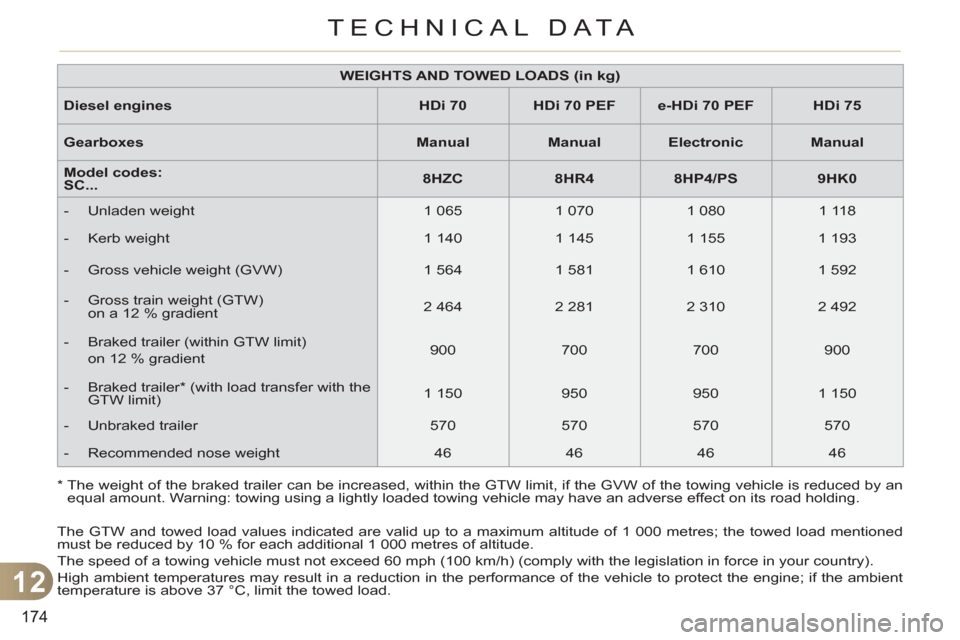
The GTW and towed load values indicated are valid up to a maximum altitude of 1 000 metres; the towed load mentioned
must be reduced by 10 % for each additional 1 000 metres of altitude.
The speed of a towing vehicle must not exceed 60 mph (100 km/h) (comply with the legislation in force in your country).
High ambient temperatures may result in a reduction in the performance of the vehicle to protect the engine; if the ambient
temperature is above 37 °C, limit the towed load.
WEIGHTS AND TOWED LOADS (in kg)
Diesel engines
HDi 70
HDi 70 PEF
e-HDi 70 PEF
HDi 75
Gearboxes
Manual
Manual
Electronic
Manual
Model codes:
SC...
8HZC
8HR4
8HP4/PS
9HK0
- Unladen weight
1 065
1 070
1 080
1 118
- Kerb weight
1 140
1 145
1 155
1 193
- Gross vehicle weight (GVW)
1 564
1 581
1 610
1 592
- Gross train weight (GTW)
on a 12 % gradient
2 464
2 281
2 310
2 492
- Braked trailer (within GTW limit)
on 12 % gradient
900
700
700
900
- Braked trailer * (with load transfer with the
GTW limit)
1 150
950
950
1 150
- Unbraked trailer
570
570
570
570
- Recommended nose weight
46
46
46
46
*
The weight of the braked trailer can be increased, within the GTW limit, if the GVW of the towing vehicle is reduced by an
equal amount. Warning: towing using a lightly loaded towing vehicle may have an adverse effect on its road holding.
Page 177 of 252
12
175
TECHNICAL DATA
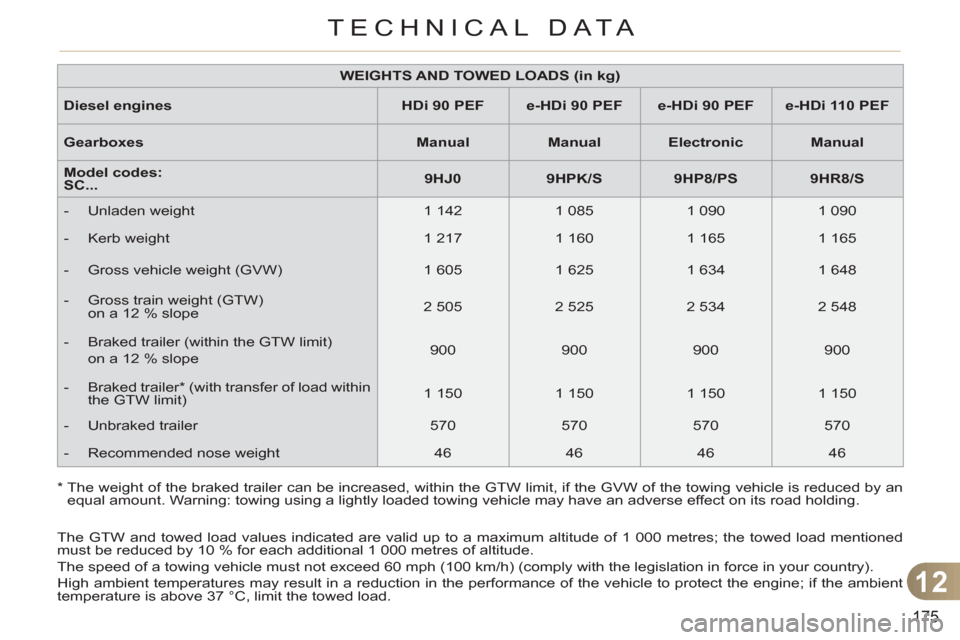
The GTW and towed load values indicated are valid up to a maximum altitude of 1 000 metres; the towed load mentioned
must be reduced by 10 % for each additional 1 000 metres of altitude.
The speed of a towing vehicle must not exceed 60 mph (100 km/h) (comply with the legislation in force in your country).
High ambient temperatures may result in a reduction in the performance of the vehicle to protect the engine; if the ambient
temperature is above 37 °C, limit the towed load. *
The weight of the braked trailer can be increased, within the GTW limit, if the GVW of the towing vehicle is reduced by an
equal amount. Warning: towing using a lightly loaded towing vehicle may have an adverse effect on its road holding.
WEIGHTS AND TOWED LOADS (in kg)
Diesel engines
HDi 90 PEF
e-HDi 90 PEF
e-HDi 90 PEF
e-HDi 110 PEF
Gearboxes
Manual
Manual
Electronic
Manual
Model codes:
SC...
9HJ0
9HPK/S
9HP8/PS
9HR8/S
- Unladen weight
1 142
1 085
1 090
1 090
- Kerb weight
1 217
1 160
1 165
1 165
- Gross vehicle weight (GVW)
1 605
1 625
1 634
1 648
- Gross train weight (GTW)
on a 12 % slope
2 505
2 525
2 534
2 548
- Braked trailer (within the GTW limit)
on a 12 % slope
900
900
900
900
- Braked trailer * (with transfer of load within
the GTW limit)
1 150
1 150
1 150
1 150
- Unbraked trailer
570
570
570
570
- Recommended nose weight
46
46
46
46
Page 210 of 252
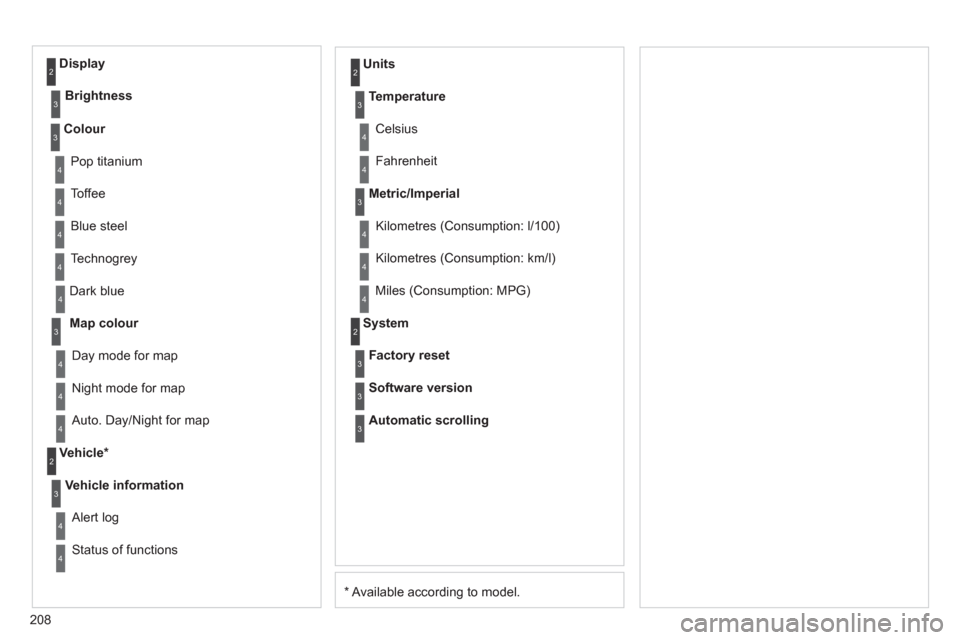
208
* Available according to model. D
ark blue
Map colour
Ni
ght mode for map
Units
Da
y mode for map
Vehicle *
Vehicle information
Alert log
Status of functions
Temperature
Celsius
F
ahrenheit
Metric/Imperial
Kilometres (Consumption: l/100)
Kilometres
(Consumption: km/l)
Miles
(Consumption: MPG)
System
Auto. Day/Night for map Factor
y reset
Software version
Automatic scrolling
3
4
4
2
4
3
4
4
2
3
4
4
3
4
4
4
2
4
3
3
3
Colour
Pop titanium
T
offee
Bl
ue steel
Techno
grey
3
4
4
4
4
Display
Brightness
2
3
Page 236 of 252
234
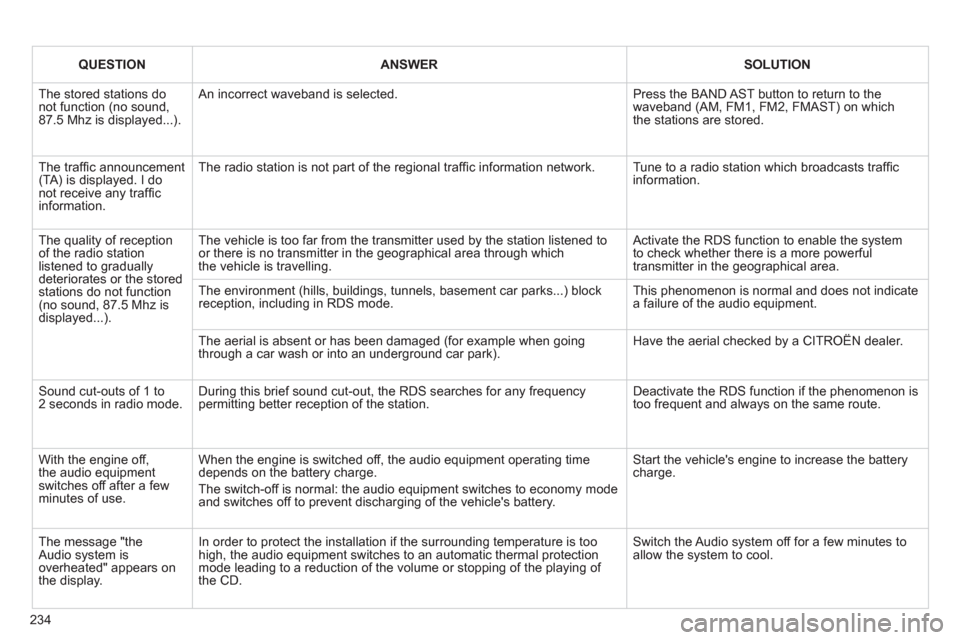
QUESTIONANSWERSOLUTION
The stored stations donot function (no sound, 87.5 Mhz is displayed...).
An incorrect waveband is selected.
Press the BAND AST button to return to the waveband (AM, FM1, FM2, FMAST) on which the stations are stored.
The traffi c announcement(TA) is displayed. I donot receive any traffi c information.
The radio station is not part of the regional traffi c information network.
Tune to a radio station which broadcasts traffi c information.
The quality of receptionof the radio station listened to graduallydeteriorates or the stored stations do not function(no sound, 87.5 Mhz is displayed...).
The vehicle is too far from the transmitter used by the station listened to or there is no transmitter in the geographical area through whichthe vehicle is travelling.
Activate the RDS function to enable the system to check whether there is a more powerful transmitter in the geographical area.
The environment (hills, buildings, tunnels, basement car parks...) block reception, including in RDS mode. This phenomenon is normal and does not indicate a failure of the audio equipment.
The aerial is absent or has been damaged (for example when goingthrough a car wash or into an underground car park).
Have the aerial checked by a CITROËN dealer.
Sound cut-outs of 1 to2 seconds in radio mode.During this brief sound cut-out, the RDS searches for any frequency permitting better reception of the station.
Deactivate the RDS function if the phenomenon is too frequent and always on the same route.
With the engine off, the audio equipment switches off after a few minutes of use.
When the engine is switched off, the audio equipment operating timedepends on the battery charge.
The switch-off is normal: the audio equipment switches to economy mode and switches off to prevent discharging of the vehicle's battery.
Start the vehicle's engine to increase the batterycharge.
The message "the Audio system is overheated" appears on the display.
In order to protect the installation if the surrounding temperature is toohigh, the audio equipment switches to an automatic thermal protectionmode leading to a reduction of the volume or stopping of the playing of the CD.
Switch the Audio system off for a few minutes to allow the system to cool.