battery Citroen C3 2014 2.G User Guide
[x] Cancel search | Manufacturer: CITROEN, Model Year: 2014, Model line: C3, Model: Citroen C3 2014 2.GPages: 284, PDF Size: 9.01 MB
Page 124 of 284
122
C3_en_Chap09_Conduite_ed01-2014
C3_en_Chap09_Conduite_ed01-2014
Operating faultMaintenance
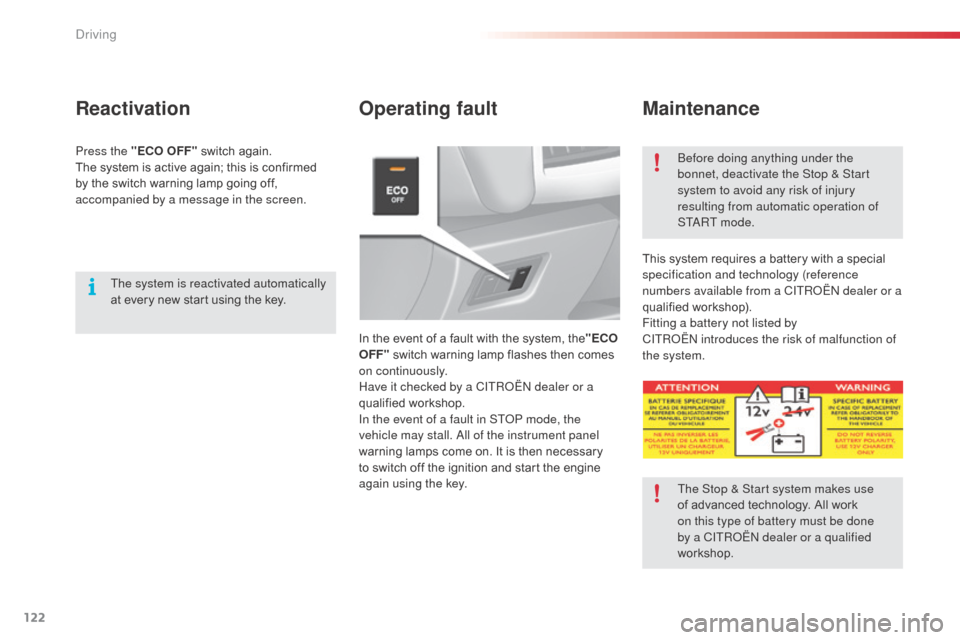
In the event of a fault with the system, the "ECO
OFF" switch warning lamp flashes then comes
on continuously.
Have it checked by a CITR
oËn
dealer or a
qualified workshop.
In the event of a fault in ST
oP m
ode, the
vehicle may stall.
a
l
l of the instrument panel
warning lamps come on. It is then necessary
to switch off the ignition and start the engine
again using the key. This system requires a battery with a special
specification and technology (reference
numbers available from a CITR
oËn
dealer or a
qualified workshop).
Fitting a battery not listed by
CITRoËn introduces the risk of malfunction of
the system.
Press the "ECO OFF" switch again.
The system is active again; this is confirmed
by the switch warning lamp going off,
accompanied by a message in the screen.
be
fore doing anything under the
bonnet, deactivate the Stop & Start
system to avoid any risk of injury
resulting from automatic operation of
S T a
R
T m o d e .
The system is reactivated automatically
at every new start using the key.
The Stop & Start system makes use
of advanced technology. All work
on this type of battery must be done
by a CITR
oËn
dealer or a qualified
workshop.
Reactivation
driving
Page 141 of 284
139
according to your version of instrument panel, the start of
saturation of the particle emissions filter is indicated by:
- fixed illumination of the particle emissions filter warning lamp,
accompanied by an audible signal,
or
-
t
emporary illumination of
the service warning lamp,
as s
oon as the traffic conditions permit, regenerate
the filter by driving at a speed of at least 40
mph
(60
km/h) until the warning lamp goes off.
If the warning lamp stays on, refer to the "Additive
level" section.
Checks
12 V battery
The battery does not require any maintenance.
However, check that the terminals are clean
and correctly tightened, particularly in summer
and winter.
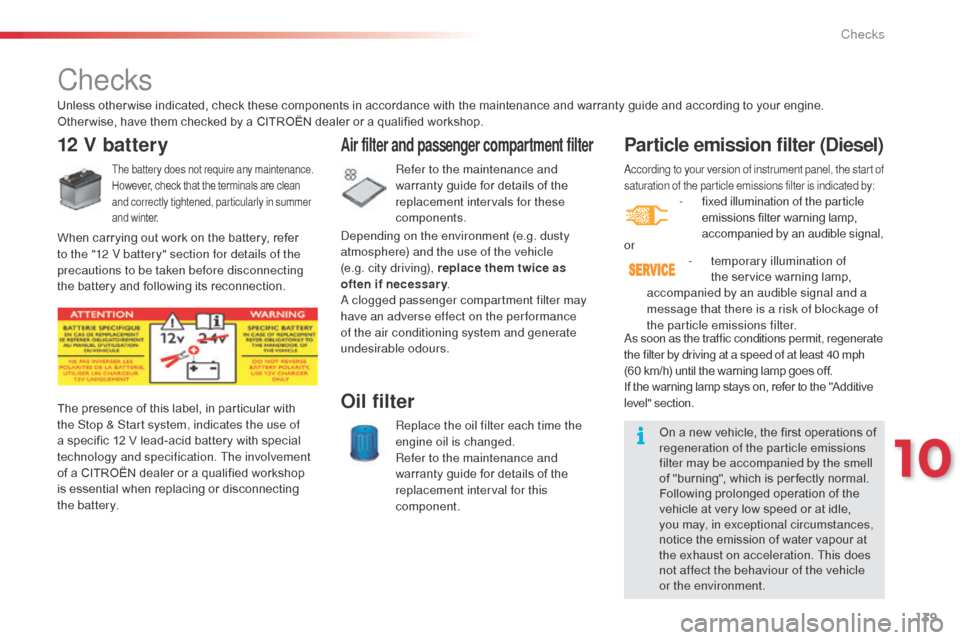
The presence of this label, in particular with
the Stop & Start system, indicates the use of
a specific 12
V lead-acid battery with special
technology and specification. The involvement
of a CITROËN dealer or a qualified workshop
is essential when replacing or disconnecting
the battery. When carrying out work on the battery, refer
to the "12 V battery" section for details of the
precautions to be taken before disconnecting
the battery and following its reconnection. Unless other wise indicated, check these components in accordance with the maintenance and warranty guide and according to your engine.
Other wise, have them checked by a CITROËN dealer or a qualified workshop.
On a new vehicle, the first operations of
regeneration of the particle emissions
filter may be accompanied by the smell
of "burning", which is per fectly normal.
Following prolonged operation of the
vehicle at very low speed or at idle,
you may, in exceptional circumstances,
notice the emission of water vapour at
the exhaust on acceleration. This does
not affect the behaviour of the vehicle
or the environment.
Particle emission filter (Diesel)
accompanied by an audible signal and a
message that there is a risk of blockage of
the particle emissions filter.
Air filter and passenger compartment filter
Refer to the maintenance and
warranty guide for details of the
replacement intervals for these
components.
de
pending on the environment (e.g. dusty
atmosphere) and the use of the vehicle
(e.g. city driving), replace them twice as
often if necessar y .
a c
logged passenger compartment filter may
have an adverse effect on the per formance
of the air conditioning system and generate
undesirable odours.
Replace the oil filter each time the
engine oil is changed.
Refer to the maintenance and
warranty guide for details of the
replacement interval for this
component.
Oil filter
10
Checks
Page 166 of 284
164
C3_en_Chap11_Info-pratiques_ed01-2014
Engine compartment
fusebox
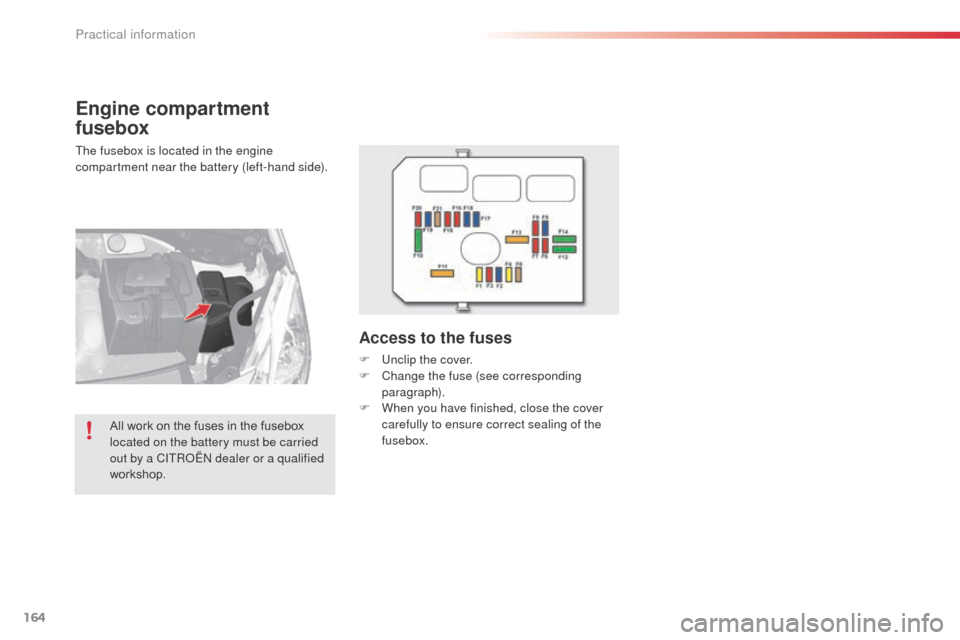
The fusebox is located in the engine
compartment near the battery (left-hand side).
Access to the fuses
F Unclip the cover.
F C hange the fuse (see corresponding
paragraph).
F
W
hen you have finished, close the cover
carefully to ensure correct sealing of the
fusebox.
All work on the fuses in the fusebox
located on the battery must be carried
out by a CITR
oËn
dealer or a qualified
workshop.
Practical information
Page 170 of 284
168
C3_en_Chap11_Info-pratiques_ed01-2014
battery
Access to the battery
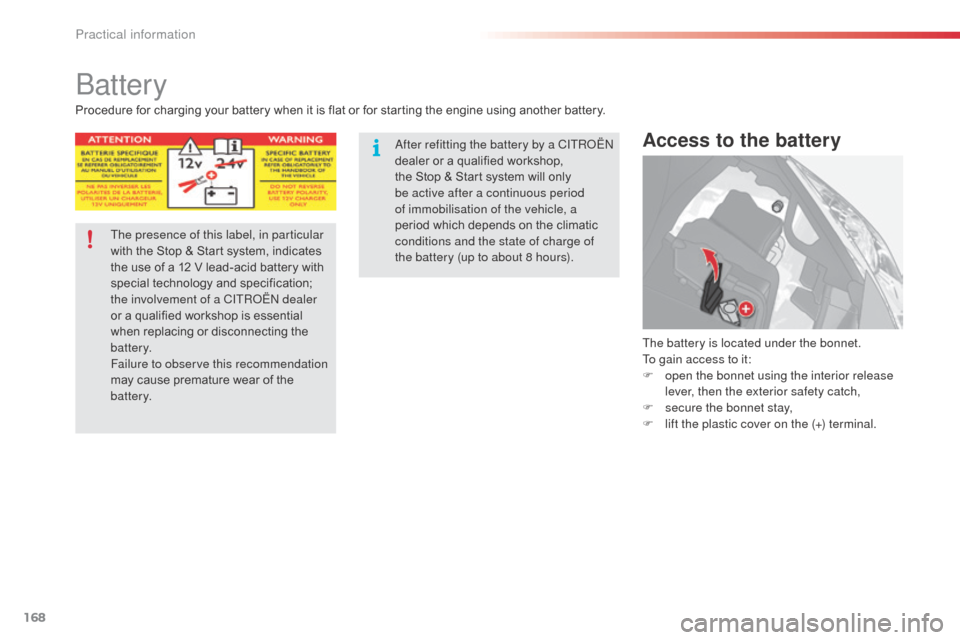
The battery is located under the bonnet.
To gain access to it:
F
o
pen the bonnet using the interior release
lever, then the exterior safety catch,
F
s
ecure the bonnet stay,
F
l
ift the plastic cover on the (+) terminal.
The presence of this label, in particular
with the Stop & Start system, indicates
the use of a 12 V lead-acid battery with
special technology and specification;
the involvement of a CITR
oËn
dealer
or a qualified workshop is essential
when replacing or disconnecting the
battery.
Failure to observe this recommendation
may cause premature wear of the
battery.
af
ter refitting the battery by a CITR
oËn
dealer or a qualified workshop,
the Stop
& Start system will only
be active after a continuous period
of immobilisation of the vehicle, a
period which depends on the climatic
conditions and the state of charge of
the battery (up to about 8
hours).
Procedure for charging your battery when it is flat or for starting the engine using another battery.
Practical information
Page 171 of 284
169
C3_en_Chap11_Info-pratiques_ed01-2014
Starting using another
batteryCharging the battery using
a battery charger
When the battery on your vehicle is discharged,
the engine can be started using a slave battery
(external or on another vehicle) and jump leads. F
F ollow the instructions for use provided by
the manufacturer of the charger.
First check that the slave battery has a nominal
voltage of 12 V and a capacity at least equal to
that of the discharged battery.
do n
ot try to start the engine by connecting a
battery charger.
Do not disconnect the (+) terminal when the
engine is running.
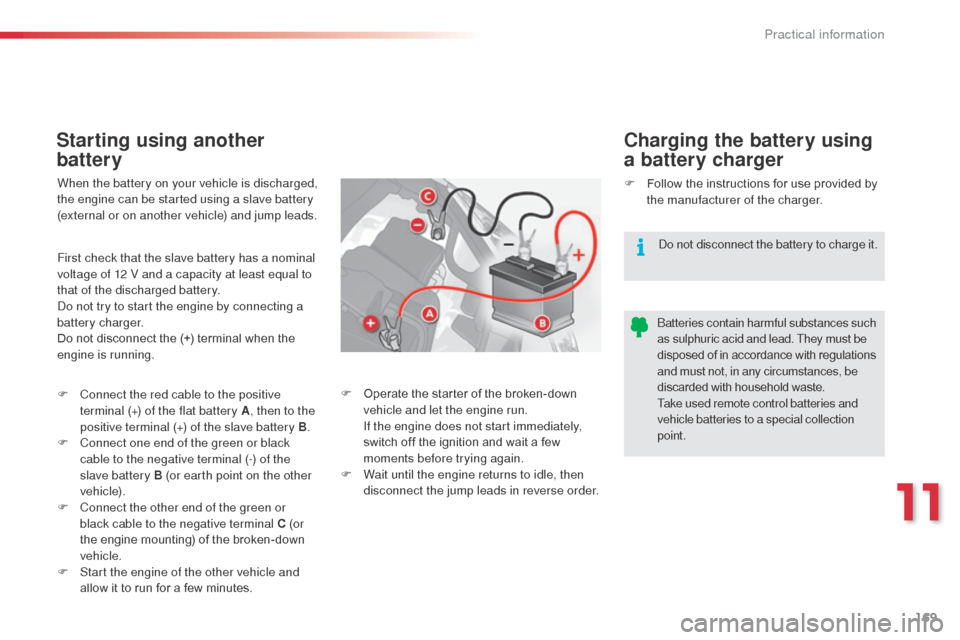
F
C
onnect the red cable to the positive
terminal (+) of the flat battery A , then to the
positive terminal (+) of the slave battery B.
F
C
onnect one end of the green or black
cable to the negative terminal (-) of the
slave battery B (or earth point on the other
vehicle).
F
C
onnect the other end of the green or
black cable to the negative terminal C (or
the engine mounting) of the broken-down
vehicle.
F
S
tart the engine of the other vehicle and
allow it to run for a few minutes.
do n
ot disconnect the battery to charge it.
F
O
perate the starter of the broken-down
vehicle and let the engine run.
I
f the engine does not start immediately,
switch off the ignition and wait a few
moments before trying again.
F
W
ait until the engine returns to idle, then
disconnect the jump leads in reverse order.
ba
tteries contain harmful substances such
as sulphuric acid and lead. They must be
disposed of in accordance with regulations
and must not, in any circumstances, be
discarded with household waste.
Take used remote control batteries and
vehicle batteries to a special collection
point.
11
Practical information
Page 172 of 284
170
C3_en_Chap11_Info-pratiques_ed01-2014
Protect your eyes and face before
handling the battery.
al
l operations on the battery must be
carried out in a well ventilated area
away from naked flames and sources
of sparks, so as to avoid the risk of
explosion and fire.
Do not try to charge a frozen battery;
the battery must first be thawed out to
avoid the risk of explosion. If the battery
has been frozen, before charging have
it checked by a CITR
oËn
dealer or a
qualified workshop who will check that
the internal components have not been
damaged and the casing is not cracked,
which could cause a leak of toxic and
corrosive acid.
do n
ot reverse the polarity and use only
a 12 V charger.
Do not disconnect the terminals while
the engine is running.
Do not charge the batteries without
disconnecting the terminals first.
Wash your hands after wards.do n ot push the vehicle to start the
engine if you have an electronic
gearbox or automatic gearbox.
Some functions are not available if the
battery is not sufficiently charged.
Practical information
Page 173 of 284
171
C3_en_Chap11_Info-pratiques_ed01-2014
Energy economy mode
Exiting economy mode
These functions are reactivated automatically
the next time the vehicle is driven.
F
I
n order to resume the use of these
functions immediately, start the engine and
let it run for a few minutes.
The time available to you will then be double
the period for which the engine is left running.
However, this period will always be between
five and thirty minutes.
Switching to economy mode
once this period has elapsed, a message
appears on the multifunction screen indicating
that the vehicle has switched to economy mode
and the active functions are put on standby.
a
flat battery prevents the engine from
starting (refer to the corresponding
paragraph).
If the telephone is being used at the
same time on the eMyWay audio
navigation system, it will be interrupted
after 10 minutes.
System which manages the period of use of
certain functions to conserve a sufficient level
of charge in the battery.
af
ter the engine has stopped, you can
still use functions such as the audio
equipment, windscreen wipers, dipped
beam headlamps, courtesy lamps, etc. for a
maximum combined period of thirty minutes.
System which manages the use of certain
functions according to the level of charge
remaining in the battery.
When the vehicle is being driven, the load
reduction function temporarily deactivates
certain functions, such as the air conditioning,
the heated rear screen...
The deactivated functions are reactivated
automatically as soon as conditions permit.
Load reduction mode
This period may be greatly reduced if
the battery is not fully charged.
11
Practical information
Page 180 of 284
178
C3_en_Chap11_Info-pratiques_ed01-2014
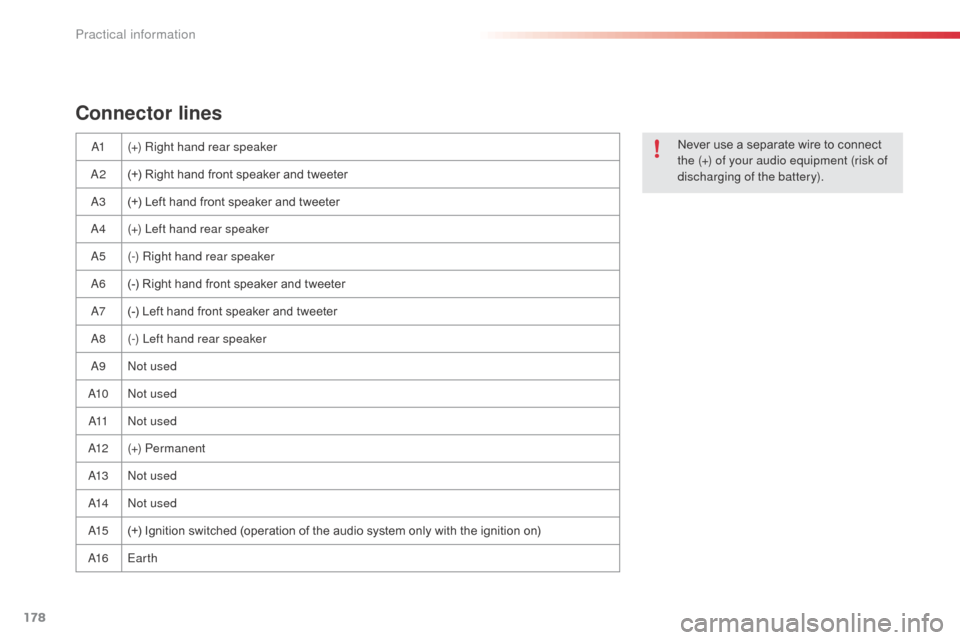
Connector lines
a1(+) Right hand rear speaker
a2(
+) Right hand front speaker and tweeter
a
3 (+) Left hand front speaker and tweeter
a
4 (+) Left hand rear speaker
a
5 (-) Right hand rear speaker
a
6 (-) Right hand front speaker and tweeter
a7 (
-) Left hand front speaker and tweeter
a
8 (-) Left hand rear speaker
a
9
no
t used
a
10
no
t used
a11no
t used
a
12 (+) Permanent
a
13
no
t used
a
14
no
t used
a
15 (+) Ignition switched (operation of the audio system only with the ignition on)
a
16 Earth Never use a separate wire to connect
the (+) of your audio equipment (risk of
discharging of the battery).
Practical information
Page 196 of 284
194
C3_en_Chap13a_bTa_ed01-2014
EMERGENCY OR ASSIST ANCE CALL
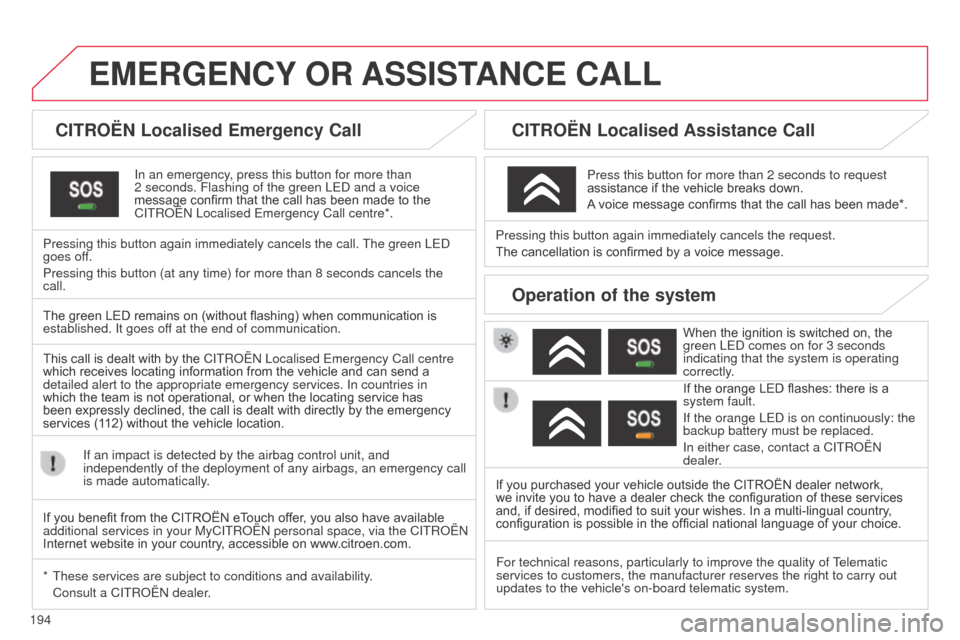
CITROËN Localised Emergency Call
In an emergency, press this button for more than
2
seconds. Flashing of the green LE d and a voice
message confirm that the call has been made to the
C
ITR o Ë n Localised Emergency Call centre*.
Pressing this button again immediately cancels the call. The green LE
d
goes off.
Pressing this button (at any time) for more than 8 seconds cancels the\
call.
CITROËN Localised Assistance Call
When the ignition is switched on, the
green LE d comes on for 3 seconds
indicating that the system is operating
correctly.
If the orange LED flashes: there is a
system fault.
If the orange LE
d is on continuously: the
backup battery must be replaced.
In either case, contact a CITR
o Ë n
dealer.
Pressing this button again immediately cancels the request.
The cancellation is confirmed by a voice message.
Press this button for more than 2 seconds to request
assistance if the vehicle breaks down.
A voice message confirms that the call has been made*.
Operation of the system
The green LED remains on (without flashing) when communication is
established. It goes off at the end of communication.
This call is dealt with by the
C
ITR o Ë n Localised Emergency Call centre
which receives locating information from the vehicle and can send a
detailed alert to the appropriate emergency services. In countries in
which the team is not operational, or when the locating service has
been expressly declined, the call is dealt with directly by the emergency
services (112) without the vehicle location.
If an impact is detected by the airbag control unit, and
independently of the deployment of any airbags, an emergency call
is made automatically.
*
These services are subject to conditions and availability
.
Consult a CITR
o Ë n dealer. If you purchased your vehicle outside the CITROËN dealer network,
we invite you to have a dealer check the configuration of these services
and, if desired, modified to suit your wishes. In a multi-lingual country
,
configuration is possible in the official national language of your choice.
For technical reasons, particularly to improve the quality of Telematic
services to customers, the manufacturer reserves the right to carry out \
updates to the vehicle's on-board telematic system.
If you benefit from the CITROËN eTouch offer, you also have available
additional services in your MyCITR
o Ë n personal space, via the CITR o Ë n
Internet website in your country, accessible on www.citroen.com.
Page 197 of 284
195
C3_en_Chap13b_RT6-2-8_ed01-2014
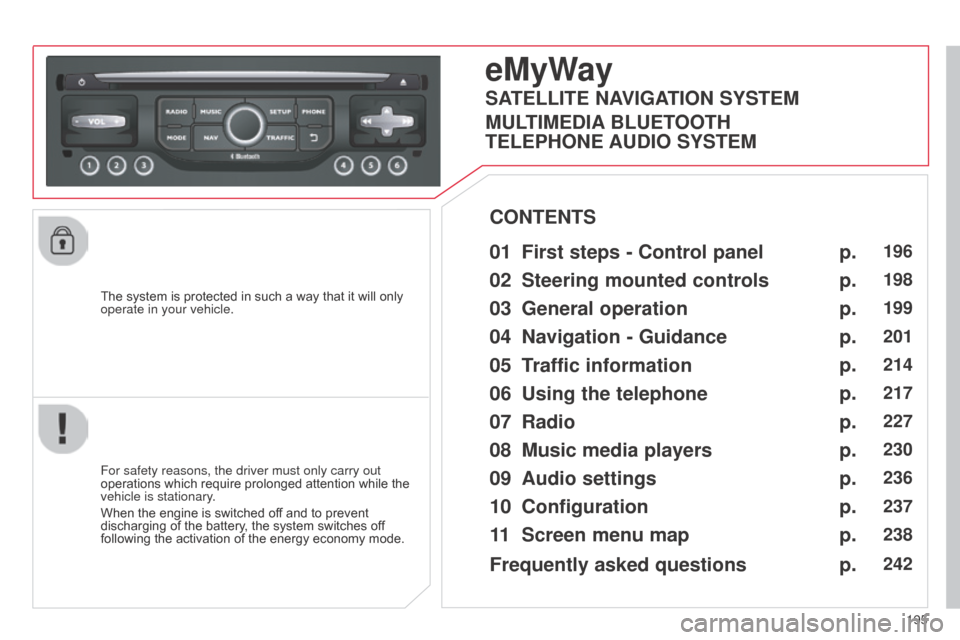
The system is protected in such a way that it will only
operate in your vehicle.
eMyWay
01 First steps - Control panel
For safety reasons, the driver must only carry out
operations which require prolonged attention while the
vehicle is stationary.
When the engine is switched off and to prevent
discharging of the battery, the system switches off
following the activation of the energy economy mode.
CONTENTS
02
Steering mounted
controls
03
General operation
04
Navigation
- Guidance
05
T
raffic information
06
Using
the telephone
07
Radio
08
Music media players
09
Audio
settings
10
Configuration
11
Screen menu
map p.
p.
p.
p.
p.
p.
p.
p.
p.
p.
p.
196
198
199
201
214
217
227
230
236
237
238
SATELLITE NAVIGATION SYSTEM
MULTIMEDIA BLUETOOTH
TELEPHONE AUDIO SYSTEM
Frequently asked questions p.
242