air con Citroen C3 2014 2.G Owner's Guide
[x] Cancel search | Manufacturer: CITROEN, Model Year: 2014, Model line: C3, Model: Citroen C3 2014 2.GPages: 284, PDF Size: 9.01 MB
Page 49 of 284

47
C3_en_Chap03_Confort_ed01-2014
Scented air freshenerSystem permitting the diffusion of a fragrance in the passenger compartment in accordance with
your requirements, by means of the adjustment dial and the various fragrance cartridges available.
This dial is located on the dashboard.
It allows you to adjust the intensity of diffusion
of the fragrance.
F
T
urn the dial to the right to permit diffusion
of the fragrance.
F
T
urn the dial to the left to stop diffusion of
the fragrance.
Leave the central vents open.
Fragrance cartridge
Removing the cartridge
F Press the dial and turn it a quarter of a turn anti-clockwise.
F
R
emove the cartridge.
F
R
efit its sealing case.
Fitting the cartridge
F Remove the cartridge from the sealing case.
F
I
nstall the cartridge (flower at top left).
F
P
ress the dial and turn it a quarter of a turn
clockwise.
as a s
afety precaution, do not carry
out any action on the cartridge while
driving.do n
ot dismantle the cartridges.do n
ot attempt to refill the fragrance
diffuser or the cartridges.
Avoid all contact with the skin and eyes.
ke
ep out of reach of children and
animals.
do n
ot discard the original cartridge as
this serves as a plug when no fragrance
cartridge is in use.
In order to preserve the service life of
the cartridge, turn the dial fully to the left
when you no longer wish to diffuse the
fragrance in the passenger compartment.
The intensity of diffusion of the
fragrance may depend on the
ventilation or air conditioning settings.
Adjustment dial
This cartridge can be removed easily. The
first time it is used, replace the plug with a real
cartridge.
You can change it at any time and store it in the
sealed case which keeps it closed once it has
been opened.
You can obtain different fragrance cartridges
from a CITR
oËn
dealer or a qualified
workshop.
3
Comfort
Page 58 of 284

56
C3_en_Chap04_ouvertures_ed01-2014
Lost keys
Go to a CITROËN dealer with the vehicle's registration document, your personal
identification documents and if possible the key code label.
The CITROËN dealer will be able to look up the key code and the transponder code
required to order a new key.
Remote control
The high frequency remote control is a sensitive system; do not operate it while it is in your
pocket as there is a possibility that it may unlock the vehicle, without you being aware of it.
do n
ot repeatedly press the buttons of your remote control out of range and out of sight of
your vehicle. You run the risk of stopping it from working and the remote control would have
to be reinitialised.
No remote control can operate when the key is in the ignition switch, even when the ignition
is switched off, except for reinitialisation.
Locking the vehicle
Driving with the doors locked may make access to the passenger compartment by the emergency
services more difficult in an emergency.
as a s
afety precaution, never leave children alone in the vehicle, except for a very short period.
In all cases, it is essential to remove the key from the ignition switch when leaving the vehicle.
Anti-theft protection
Do not make any modifications to the electronic engine immobiliser system; this could
cause malfunctions.
When purchasing a second-hand vehicle
Have the pairing of all of the keys in your possession checked by a CITRoËn dealer, to
ensure that only your keys can be used to open and start the vehicle. Do not throw the remote control
batteries away, they contain metals
which are harmful to the environment.
Take them to an approved collection
point.
access
Page 65 of 284
63
C3_en_Chap04_ouvertures_ed01-2014
Fuel tank
Low fuel level
When the fuel tank minimum level is
reached this warning lamp comes on
on the instrument panel. When it first
comes on there remains approximately
5 litres of fuel in the tank.
Filling
a label affixed to the inside of the flap reminds
y ou of the type of fuel to be used depending on
your engine.
ad
ditions of fuel must be of at least 7 litres, in
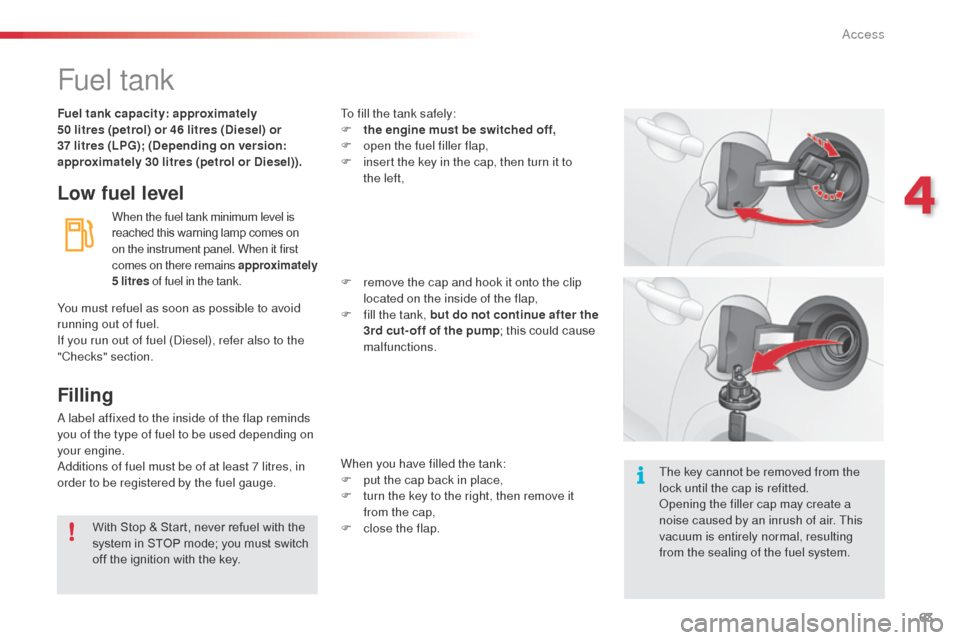
order to be registered by the fuel gauge. To fill the tank safely:
F
t
he engine must be switched off,
F
o
pen the fuel filler flap,
F
i
nsert the key in the cap, then turn it to
the left,
F
r
emove the cap and hook it onto the clip
located on the inside of the flap,
F
f
ill the tank, but do not continue after the
3rd cut- off of the pump ; this could cause
malfunctions.
When you have filled the tank:
F
p
ut the cap back in place,
F
t
urn the key to the right, then remove it
from the cap,
F
c
lose the flap.
You must refuel as soon as possible to avoid
running out of fuel.
If you run out of fuel (
di
esel), refer also to the
"Checks" section. Fuel tank capacity: approximately
50 litres (petrol) or 46 litres (Diesel) or
37
litres (LPG); (Depending on version:
approximately 30 litres (petrol or Diesel)).
With Stop & Start, never refuel with the
system in STOP mode; you must switch
off the ignition with the key. The key cannot be removed from the
lock until the cap is refitted.
op
ening the filler cap may create a
noise caused by an inrush of air. This
vacuum is entirely normal, resulting
from the sealing of the fuel system.
4
access
Page 80 of 284

78
C3_en_Chap06_amenagement_ed01-2014
Sun visor Illuminated glove
box
This can be used to hold a water bottle.
Its lid has a location for storing the vehicle's
handbook pack.
F
T
o open the glove box, raise the handle.
It is lit when the lid is opened.
It houses the front passenger's airbag
deactivation switch A.
de
pending on your vehicle version, it provides
access to the ventilation nozzle B, distributing
the same conditioned air as the vents in the
passenger compartment.
Centre armrestComfort and storage system for the driver and
front passenger.
F
F
or access to the closed storage box, lift
the lever to open the lid.
F
F
or access to the open storage box below
the armrest, lift the complete armrest
towards the rear.
These can be used for portable devices (mobile
phone, MP3 player...) which can be connected
to the US
b
port / auxiliary socket or charged
from the 12 V socket in the centre console.
Version with Zenith windscreen
Refer to the "Familiarisation - Zenith
windscreen" section.
Version without Zenith windscreen
The sun visors are fitted with a courtesy mirror,
with concealing flap for the driver and a ticket /
card holder. Component which protects against sunlight
from the front or the side.
Storage
Fittings
Page 87 of 284

85
C3_en_Chap07_Securite-enfants_ed01-2014
"Forward facing"
When a "for ward facing" child seat is installed
on the front passenger seat, adjust the
vehicle's seat to the intermediate longitudinal
position with seat backrest straightened and
leave the passenger's front airbag activated.
"Rearward facing"
When a "rear ward facing" child seat is installed
on the front passenger seat , adjust the seat to
the intermediate longitudinal position, with the
backrest straightened.
The passenger's front airbag must be
deactivated. Otherwise, the child would
risk being seriously injured or killed if the
airbag were to inflate . Passenger seat adjusted to the intermediate
longitudinal position.
Ensure that the seat belt is correctly
tensioned.
For child seats with a support leg,
ensure that the support leg is in stable
contact with the floor. If necessary,
adjust the passenger seat.
Child seat in the front*
* The rules on carrying children are specific to each country. Refer to the current legislation
in your country before installing a child seat
on this seat.
7
Child safety
Page 88 of 284

86
C3_en_Chap07_Securite-enfants_ed01-2014
Passenger airbag OFF
Never install a rear ward facing child
restraint system on a seat protected by
an active front airbag. This could cause
the death of the child or serious injury.For information on deactivating the
passenger's front airbag, refer to the
"
air
bags" section.
deactivating the passenger's front airbag
The warning label present on both sides of the
passenger's sun visor repeats this advice. In
line with current legislation, the following tables
contain this warning in all of the languages
required.
Child safety
Page 89 of 284

aR
b
G
НИКОГА НЕ инсталирайте детско столче на седалка с АКТИВИРАНА предна ВЪЗДУШНА ВЪЗГЛАВНИЦ А. Това може да причини
СМЪРТ или СЕРИОЗНО НАРАНЯВАНЕ на детето.
CSNIKDY neumisťujte dětské zádržné zařízení orientované směrem dozadu na sedadlo chráněné AKTIVOVANÝM čelním AIRBAGEM. Hrozí
nebezpečí SMRTI DÍTĚTE nebo VÁ ŽNÉHO ZR ANĚNÍ.
dabrug aLdR IG en bagudvendt barnestol på et sæde, der er beskyttet af en akT IV aI Rb aG . baRnE T risikerer at blive aL VoR LIGT kV
ÆSTET eller dR ÆbT .
dEMontieren Sie auf einem Sitz mit akT IVIERTEM Front-ai rbag nI EMaL S einen ki ndersitz oder eine ba byschale entgegen der Fahr trichtung,
das Kind könnte schwere oder sogar tödliche Verletzungen erleiden.
ELΜη χρησιμοποιείτε ΠΟΤΕ παιδικό κάθισμα με την πλάτη του προς το εμπρός μέρος του αυτοκινήτου, σε μια θέση που προστατεύεται από
ΜΕΤΩΠΙΚΟ αερόσακο που είναι ΕΝΕΡΓΟΣ. Αυτό μπορεί να έχει σαν συνέπεια το ΘΑΝΑΤΟ ή το ΣΟΒΑΡΟ ΤΡΑΥΜΑΤΙΣΜΟ του ΠΑΙΔΙΟΥ
EnNEVER use a rear ward facing child restraint on a seat protected by an ACTIVE AIRBAG in front of it, DEATH or SERIOUS INJURY to the
CHILd can occur
ESno InSTaLaR nUnCa un sistema de retención para niños de espaldas al sentido de la marcha en un asiento protegido mediante un
AIRBAG frontal ACTIVADO, ya que podría causar lesiones GR AVES o incluso la MUERTE del niño.
ETÄrge MITTE kUn aG I paigaldage "seljaga sõidusuunas" lapseistet juhi kõrvalistmele, mille ESITURVaPa dI on akTI VEERITUd. Turvapadja
avanemine võib last TÕSISELT või ELUoH TLIkU LT vigastada.
FIÄLÄ koSka an aseta lapsen tur vaistuinta selkä ajosuuntaan istuimelle, jonka edessä suojana on käyttöön aktivoitu TURVaT Y YnY . Sen
laukeaminen voi aiheuttaa LaP SEn kUoL EMa n tai Va k aVa n LoUk k a anT UMISEn.
FRNE JAMAIS installer de système de retenue pour enfants faisant face vers l’arrière sur un siège protégé par un COUSSIN GONFLABLE
frontal ACTIVÉ.
Cela peut provoquer la MORT de l’ENFANT ou le BLESSER GR AVEMENT
HRNIK ADA ne postavljati dječju sjedalicu leđima u smjeru vožnje na sjedalo zaštićeno UKLJUČENIM prednjim ZR AČNIM JASTUKOM. To bi
moglo uzrokovati SMRT ili TEŠKU OZLJEDU djeteta.
HUSOHA ne használjon menetiránynak háttal beszerelt gyermekülést AKTIVÁLT (BEK APCSOLT) FRONTLÉGZSÁKK AL védett ülésen. Ez a
gyermek HALÁLÁT vagy SÚLYOS SÉRÜLÉSÉT okozhatja.
ITnon installare MaI seggiolini per bambini posizionati in senso contrario a quello di marcia su un sedile protetto da un aI Rb aG f rontale aT
TIVaTo. C iò potrebbe provocare la MoR TE o FERITE GRaV I al bambino.
LTNIEK ADA neįrenkite vaiko prilaikymo priemonės su atgal atgręžtu vaiku ant sėdynės, kuri saugoma VEIKIANČIOS priekinės ORO
PAGALVĖS. Išsiskleidus oro pagalvei vaikas gali būti MIRTINAI arba SUNKIAI TR AUMUOTAS.
LVNEK AD NEuzstādiet uz aizmuguri vērstu bērnu sēdeklīti priekšējā pasažiera sēdvietā, kurā ir AKTIVIZĒTS priekšējais DROŠĪBAS GAISA
S P I LV EnS.
Tas var izraisīt BĒRNA NĀVI vai radīt NOPIETNUS IEVAINOJUMUS.
87
C3_en_Chap07_Securite-enfants_ed01-2014
7
Child safety
Page 96 of 284
94
C3_en_Chap07_Securite-enfants_ed01-2014
The chest part of the seat belt must be
positioned on the child's shoulder without
touching the neck.
Ensure that the lap part of the seat belt
passes correctly over the child's thighs.
CITR
oËn
recommends the use of a booster
seat which has a back, fitted with a seat belt
guide at shoulder level.
as a s
afety precaution, do not leave:
-
a c
hild or children alone and
unsupervised in a vehicle,
-
a c
hild or an animal in a vehicle which
is exposed to the sun, with the windows
closed,
-
t
he keys within reach of children inside
the vehicle.
To prevent accidental opening of the doors
and rear windows, use the "Child lock".
Take care not to open the rear windows by
more than one third.
To protect young children from the rays of
the sun, fit side blinds on the rear windows.
Children at the front Installing a booster seat
The legislation on carrying children on the
front passenger seat is specific to each
country. Refer to the legislation in force in
your country.
Deactivate the passenger airbag when a
"rear ward-facing" child seat is installed on
the front seat.
Other wise, the child would risk being
seriously injured or killed if the airbag were
to inflate.For optimum installation of the "for ward-
facing" child seat, ensure that the back of
the child seat is as close as possible to the
backrest of the vehicle's seat, in contact if
possible.
You mst remove the head restraint before
installing a child seat with backrest to a
passenger seat.
Ensure that the head restraint is stored or
attached securely to prevent it from being
thrown around the vehicle in the event of
sharp braking. Refit the head restraint when
the child seat is removed.
The incorrect installation of a child seat in a
vehicle compromises the child's protection in
the event of an accident.
Ensure that there is no seat belt or seat belt
buckle under the child seat, as this could
destabilise it.
Remember to fasten the seat belts or the
child seat harnesses keeping the slack
relative to the child's body to a minimum,
even for short journeys.
When installing a child seat using the seat
belt, ensure that the seat belt is tightened
correctly on the child seat and that it secures
the child seat firmly on the seat of your
vehicle. If your passenger seat is adjustable,
move it for wards if necessary.
At rear seating positions, always leave
sufficient space between the front seat and:
-
a "
rear ward facing" child seat,
-
t
he child's feet for a child seat fitted
"forward facing".
To do this, move the front seat for wards
and, if necessary, move its backrest into the
upright position.
advice on child seats
Child safety
Page 100 of 284

98
C3_en_Chap08_Securite_ed01-2014
Tyre under-inflation detection
System which automatically checks the pressure of the tyres while driving.
The system monitors the pressures on the four
tyres, once the vehicle is moving.
It compares the information given by the four
wheel speed sensors with reference values,
which must be reinitialised ever y time the
tyre pressures are adjusted or a wheel
changed.
The system triggers an alert as soon as it
detects a drop in the inflation pressure of one
or more tyres. The under-inflation detection system
does not replace the vigilance or the
responsibility of the driver.
This system does not avoid the need to
check the tyre pressures (including the
spare wheel) every month as well as
before a long journey.
Driving with under-inflated tyres impairs
road holding, extends braking distances
and causes premature tyre wear,
particularly under arduous condition
(high loading, high speed, long journey).The inflation pressures defined for
your vehicle can be found on the tyre
pressure label.
See the "Identification markings"
section.
Tyre pressures should be checked
when the tyres are "cold" (vehicle
stopped for 1 hour or after a journey of
less than 6 miles (10 km) at moderate
speeds).
Other wise (when hot), add 0.3 bar to
the pressures shown on the label.
Driving with under-inflated tyres
increases fuel consumption.
Safety
Page 105 of 284
103
C3_en_Chap08_Securite_ed01-2014
Trajectory control systems
Anti-slip regulation (ASR)
and dynamic stability
control (DSC)
The anti-slip regulation (also known as traction
control) optimises traction to prevent skidding
of the wheels, by acting on the brakes of the
driving wheels and on the engine.
The electronic stability control acts on the brake
of one or more wheels and on the engine to
keep the vehicle on the trajectory required by
the driver, within the limits of the laws of physics.
Activation
These systems are activated automatically
each time the vehicle is started.
They come into operation in the event of a grip
or trajectory problem.This is indicated by flashing of this
warning lamp in the instrument panel.
Deactivation
In exceptional conditions (starting a vehicle
which is bogged down, stuck in snow, on soft
ground...), if you are unable to make progress,
it may be advisable to temporarily deactivate
these systems, so that the wheels can spin
freely and allow the vehicle to move.
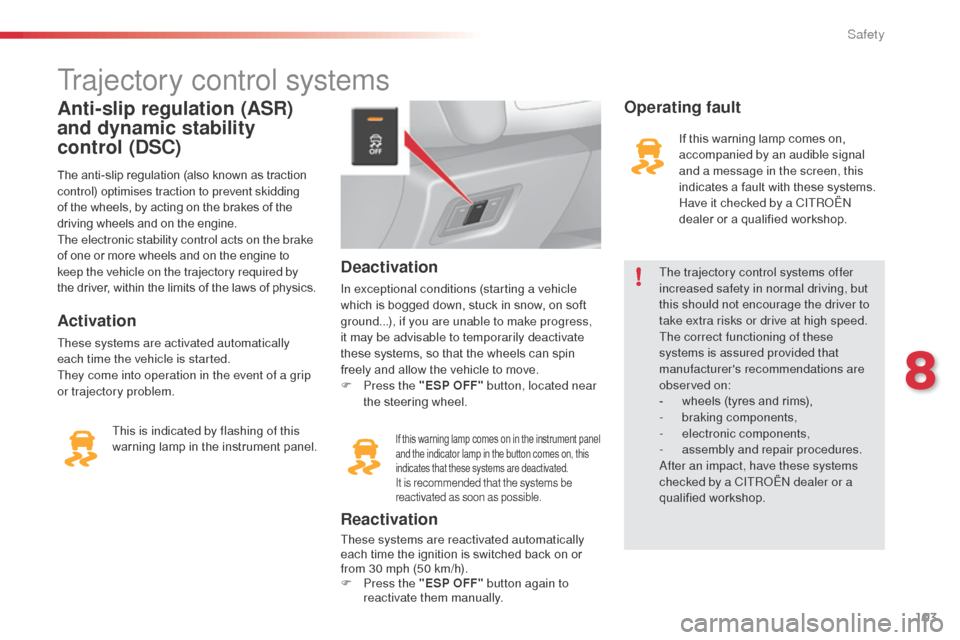
F
P
ress the "ESP OFF" button, located near
the steering wheel.
If this warning lamp comes on in the instrument panel
and the indicator lamp in the button comes on, this
indicates that these systems are deactivated.
It is recommended that the systems be
reactivated as soon as possible.
Reactivation
These systems are reactivated automatically
each time the ignition is switched back on or
from 30 mph (50 km/h).
F
P
ress the "ESP OFF" button again to
reactivate them manually.
Operating fault
If this warning lamp comes on,
accompanied by an audible signal
and a message in the screen, this
indicates a fault with these systems.
Have it checked by a CITR
oËn
dealer or a qualified workshop.
The trajectory control systems offer
increased safety in normal driving, but
this should not encourage the driver to
take extra risks or drive at high speed.
The correct functioning of these
systems is assured provided that
manufacturer's recommendations are
observed on:
-
w
heels (tyres and rims),
-
b
raking components,
-
el
ectronic components,
-
a
ssembly and repair procedures.
af
ter an impact, have these systems
checked by a CITR
oËn
dealer or a
qualified workshop.
8
Safety