diesel CITROEN C3 2021 User Guide
[x] Cancel search | Manufacturer: CITROEN, Model Year: 2021, Model line: C3, Model: CITROEN C3 2021Pages: 450, PDF Size: 10.11 MB
Page 34 of 450
32
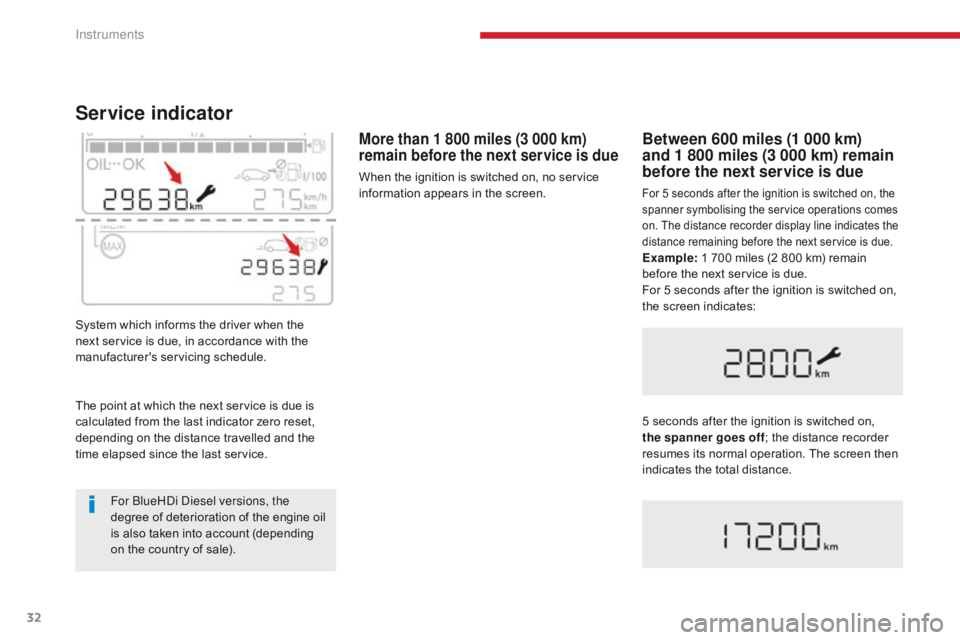
Service indicator
System which informs the driver when the
next service is due, in accordance with the
manufacturer's servicing schedule.
More than 1 800 miles (3 000 km)
remain before the next service is due
When the ignition is switched on, no service
information appears in the screen.
Between 600 miles (1 000 km)
and 1 800 miles (3 000 km) remain
before the next service is due
For 5 seconds after the ignition is switched on, the
spanner symbolising the service operations comes
on. The distance recorder display line indicates the
distance remaining before the next service is due.
Example: 1 700 miles (2 800 km) remain
before the next service is due.
For 5 seconds after the ignition is switched on,
the screen indicates:
5 seconds after the ignition is switched on,
the spanner goes off ; the distance recorder
resumes its normal operation. The screen then
indicates the total distance.
The point at which the next service is due is
calculated from the last indicator zero reset,
depending on the distance travelled and the
time elapsed since the last service.
For BlueHDi Diesel versions, the
degree of deterioration of the engine oil
is also taken into account (depending
on the country of sale).
Instruments
Page 35 of 450
33
B618_en_Chap01_Instruments-de-bord_ed01-2016
Service overdue
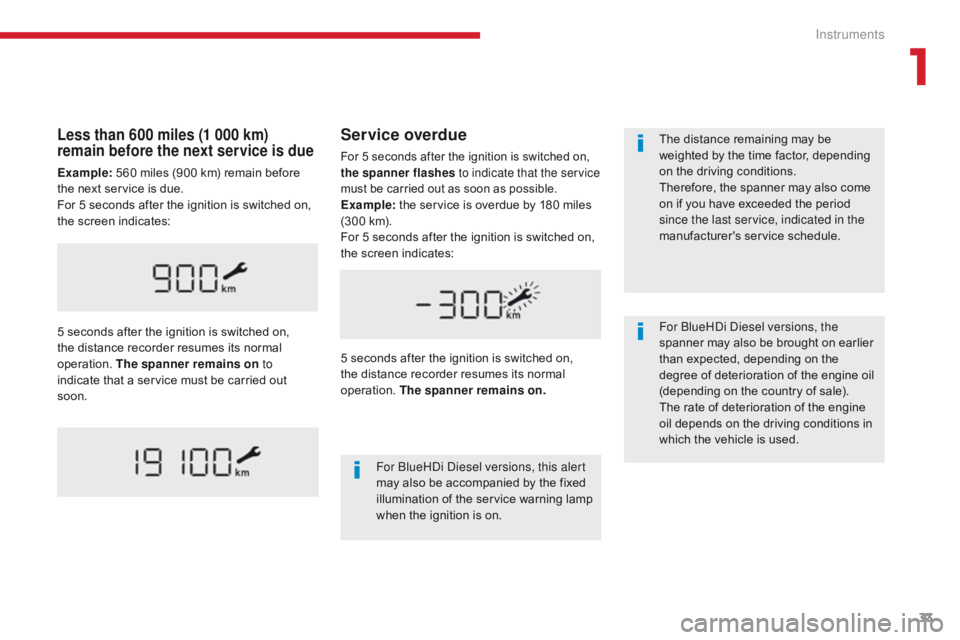
For 5 seconds after the ignition is switched on,
the spanner flashes to indicate that the service
must be carried out as soon as possible.
Example: the service is overdue by 180 miles
(300 km).
For 5 seconds after the ignition is switched on,
the screen indicates:
For BlueHDi Diesel versions, this alert
may also be accompanied by the fixed
illumination of the service warning lamp
when the ignition is on.
5 seconds after the ignition is switched on,
the distance recorder resumes its normal
operation.
The spanner remains on .The distance remaining may be
weighted by the time factor, depending
on the driving conditions.
Therefore, the spanner may also come
on if you have exceeded the period
since the last service, indicated in the
manufacturer's service schedule.
Less than 600 miles (1 000 km)
remain before the next service is due
Example:
560 miles (900 km) remain before
the next service is due.
For 5 seconds after the ignition is switched on,
the screen indicates:
5 seconds after the ignition is switched on,
the distance recorder resumes its normal
operation. The spanner remains on to
indicate that a service must be carried out
soon. For BlueHDi Diesel versions, the
spanner may also be brought on earlier
than expected, depending on the
degree of deterioration of the engine oil
(depending on the country of sale).
The rate of deterioration of the engine
oil depends on the driving conditions in
which the vehicle is used.
1
Instruments
Page 38 of 450
36
AdBlue® range indicators
These range indicators are present only on
BlueHDi Diesel versions.
Once the AdBlue
® tank is on reserve or after
detection of a fault with the SCR emissions
control system, when the ignition is switched
on, an indicator displays an estimate of the
distance that can be covered, the range, before
engine starting is prevented. Pressing this button will temporarily
display the remaining range with the
message "AdBlue: range greater than
1 500 miles" and, depending on the
level in the AdBlue tank, followed by
a message indicating that you can
top up with at least 10 litres.
The engine start prevention system
required by regulations is activated
automatically once the AdBlue
® tank is
e m pt y.
In the event of the risk of non-starting related to a lack of AdBlue®
Remaining range greater than 1 500 miles (2 400 km )
When switching on the ignition, there is no
automatic display of range in the instrument
panel.
Instruments
Page 155 of 450
153
B618_en_Chap06_conduite_ed01-2016
Anti-theft protection
Electronic engine immobiliser
The keys contain an electronic chip which has
a secret code. When the ignition is switched
on, this code must be recognised in order for
starting to be possible.
This electronic engine immobiliser locks the
engine management system a few minutes
after the ignition is switched off and prevents
starting of the engine by anyone who does not
have the key.For reasons of safety and theft protection,
do not leave your electronic key in the
vehicle, even when you are close to it.
It is recommended that you keep it on
your person.
In the event of a malfunction, you are informed
by a message in the instrument panel screen.
In this case, your vehicle does not start; contact
a CITROËN dealer if required.
Starting / Switching off the engine with the key
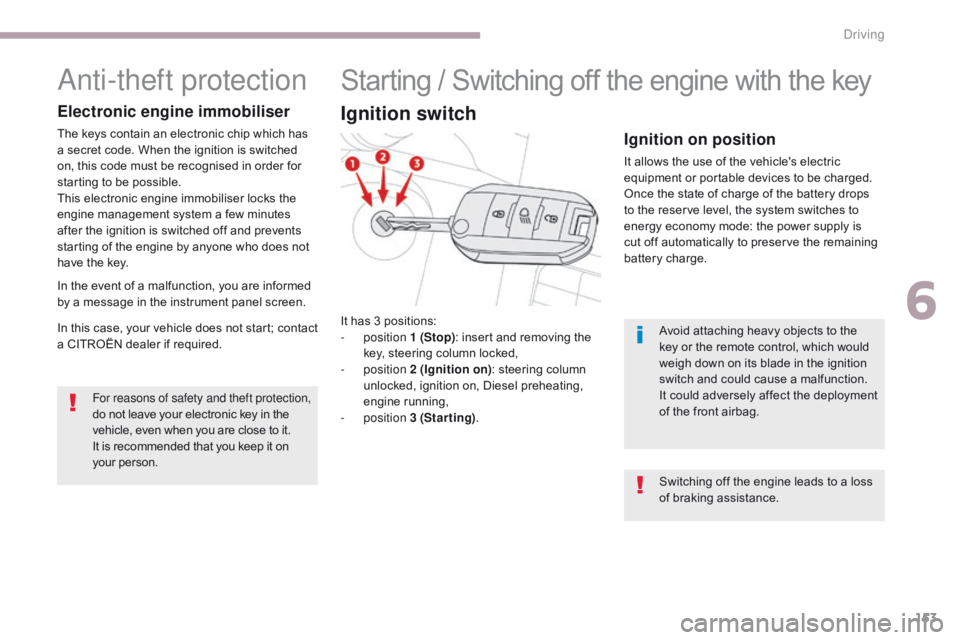
It has 3 positions:
-
position 1 (Stop): insert and removing the
key, steering column locked,
-
position 2 (Ignition on) : steering column
unlocked, ignition on, Diesel preheating,
engine running,
-
position 3 (Starting) .
Ignition switch
Switching off the engine leads to a loss
of braking assistance.
Ignition on position
It allows the use of the vehicle's electric
equipment or portable devices to be charged.
Once the state of charge of the battery drops
to the reserve level, the system switches to
energy economy mode: the power supply is
cut off automatically to preserve the remaining
battery charge.
Avoid attaching heavy objects to the
key or the remote control, which would
weigh down on its blade in the ignition
switch and could cause a malfunction.
It could adversely affect the deployment
of the front airbag.
6
Driving
Page 156 of 450
154
B618_en_Chap06_conduite_ed01-2016
F With a Diesel engine, turn the key to position 2 , ignition on, to operate the
engine pre-heating system.
Wait until this warning lamp goes off in the
instrument panel then operate the starter
motor by turning the key to position
3
without pressing the accelerator pedal,
until the engine starts. Once the engine is
running, release the key.
In wintry conditions, the warning lamp
can stay on for a longer period. When
the engine is hot, the warning lamp
does not come on. In temperate conditions, do not leave
the engine at idle to warm up but move
off straight away and drive at moderate
speed.
Never leave the engine running in
an enclosed area without adequate
ventilation: internal combustion
engines emit toxic exhaust gases,
such as carbon monoxide. Danger of
intoxication and death!
In very severe wintry conditions
(temperatures below -23°C), to ensure
the correct operation and durability of
the mechanical components of your
vehicle, engine and gearbox, it is
necessary to leave the engine running
for 4 minutes before moving off.
If the engine does not start straight
away, switch off the ignition. Wait a
few moments before operating the
starter motor again. If the engine does
not start after several attempts, do not
keep trying: you risk damaging the
starter motor or the engine. Contact
a CITROËN dealer or a qualified
workshop.
Starting the engine
With the parking brake applied and the gearbox
in neutral or position N
or P:
F
d
epress the clutch pedal fully (manual
gearbox),
or
F
p
ress the brake pedal firmly (automatic
gearbox),
F
i
nsert the key into the ignition switch; the
system recognises the code,
F
u
nlock the steering column by simultaneously
turning the steering and the key.
In certain cases, you may have to apply
more force to the steering (wheels on
full lock, for example).
F
W
ith a petrol engine, operate the starter
motor by turning the key to position 3
without pressing the accelerator pedal,
until the engine starts. Once the engine is
running, release the key.
Driving
Page 158 of 450
156
B618_en_Chap06_conduite_ed01-2016
Starting / Switching off the engine with Keyless Entry and
Starting
Starting the engine
F With a manual gearbox, put the gear lever
into neutral.
F
W
ith the electronic key inside the vehicle,
fully depress the clutch pedal.
or
F
W
ith an automatic gearbox , place the
gear selector at position P or N .
F
W
ith the electronic key inside the vehicle,
fully depress the brake pedal. If one of the starting conditions is not met,
a reminder message is displayed in the
instrument panel.
In some circumstances, it is necessary
to turn the steering wheel slightly while
pressing the "
START/STOP " button to
assist unlocking of the steering column; a
message warns you when this is needed. The presence of the "Keyless Entry
and Starting" electronic key in the
recognition zone is essential.
If the electronic key is not detected in
this zone, a message is displayed.
Move the electronic key into this zone
so that the engine can be started.
If there is still a problem, refer to the
"Key not detected - Back-up starting"
section.
F
B
riefly press the "
S TA R T/
STOP " button while maintaining
pressure on the pedal until the
engine starts.
The steering column unlocks and the engine
starts.
For Diesel engines , in temperatures below
zero and/or with a cold engine, the engine will
not start until the pre-heater warning lamp has
gone off.
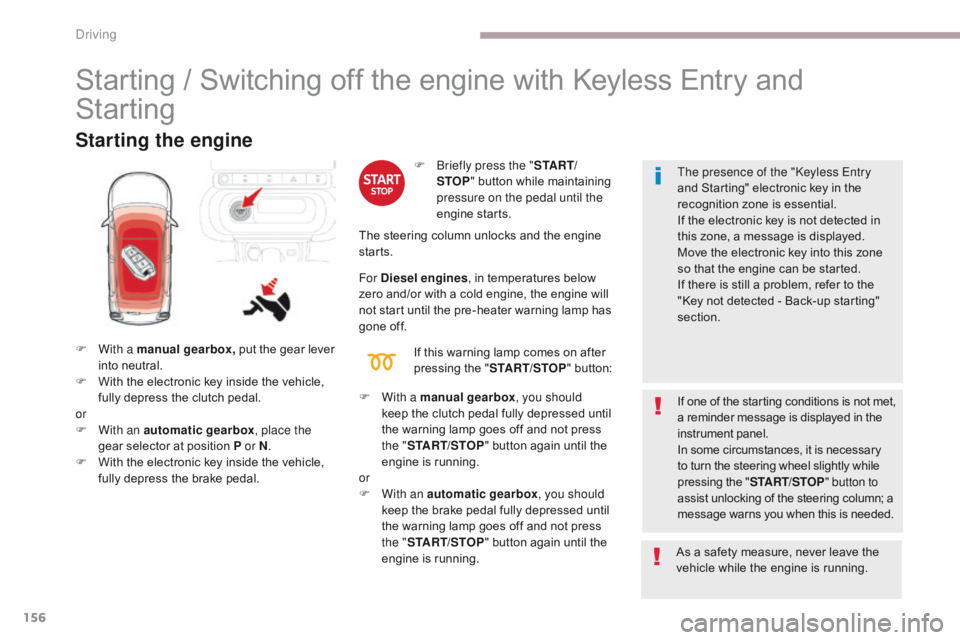
If this warning lamp comes on after
pressing the " START/STOP " button:
F
W
ith a manual gearbox, you should
keep the clutch pedal fully depressed until
the warning lamp goes off and not press
the
"START/STOP " button again until the
engine is running.
or
F
W
ith an automatic gearbox, you should
keep the brake pedal fully depressed until
the warning lamp goes off and not press
the " START/STOP " button again until the
engine is running. As a safety measure, never leave the
vehicle while the engine is running.
Driving
Page 167 of 450
165
B618_en_Chap06_conduite_ed01-2016
Gear efficiency indicator*
* Depending on engine. System which reduces fuel consumption by recommending the most appropriate gear.
Operation
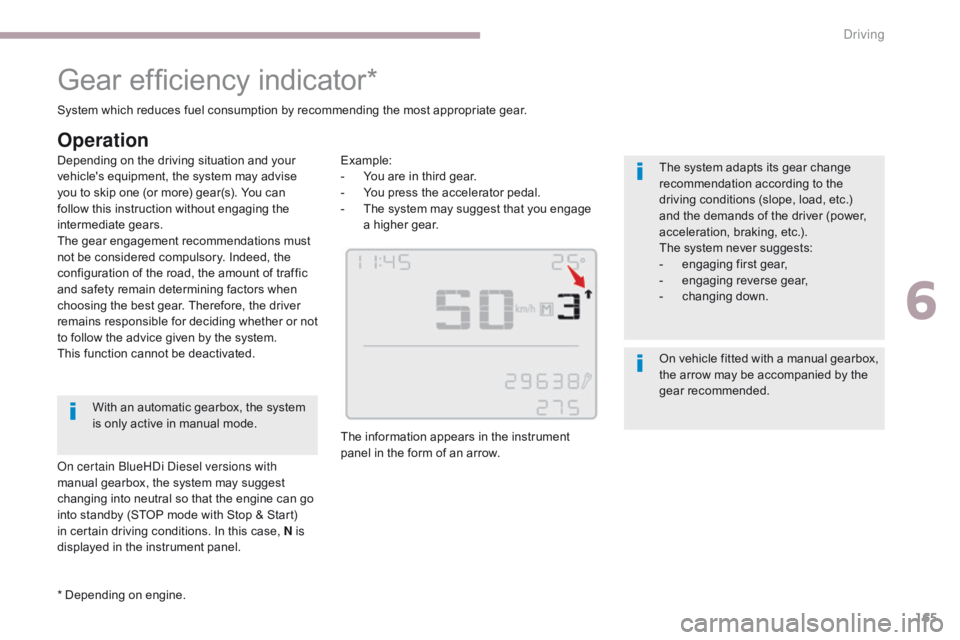
Example:
- Y ou are in third gear.
-
Y
ou press the accelerator pedal.
-
T
he system may suggest that you engage
a higher gear.
The information appears in the instrument
panel in the form of an arrow. The system adapts its gear change
recommendation according to the
driving conditions (slope, load, etc.)
and the demands of the driver (power,
acceleration, braking, etc.).
The system never suggests:
-
e
ngaging first gear,
-
enga
ging reverse gear,
-
c
hanging down.
With an automatic gearbox, the system
is only active in manual mode.
On certain BlueHDi Diesel versions with
manual gearbox, the system may suggest
changing into neutral so that the engine can go
into standby (STOP mode with Stop & Start)
in certain driving conditions. In this case, N is
displayed in the instrument panel. Depending on the driving situation and your
vehicle's equipment, the system may advise
you to skip one (or more) gear(s). You can
follow this instruction without engaging the
intermediate gears.
The gear engagement recommendations must
not be considered compulsory. Indeed, the
configuration of the road, the amount of traffic
and safety remain determining factors when
choosing the best gear. Therefore, the driver
remains responsible for deciding whether or not
to follow the advice given by the system.
This function cannot be deactivated. On vehicle fitted with a manual gearbox,
the arrow may be accompanied by the
gear recommended.
6
Driving
Page 198 of 450
196
B618_en_Chap07_info-pratiques_ed01-2016
Fuel tank
Capacity of the tank:
- Pe trol: approximately 45 litres.
-
D
iesel: approximately 42 or 50 litres (depending on version).
Low fuel level Refuelling
When the low fuel level is reached,
this warning lamp in the instrument
panel comes on, accompanied by
an audible warning, a message and
the last bar of the fuel gauge flashes
in red.
To refuel in complete safety:
F
Y
ou must switch off the engine.
F
O
pen the filler flap.
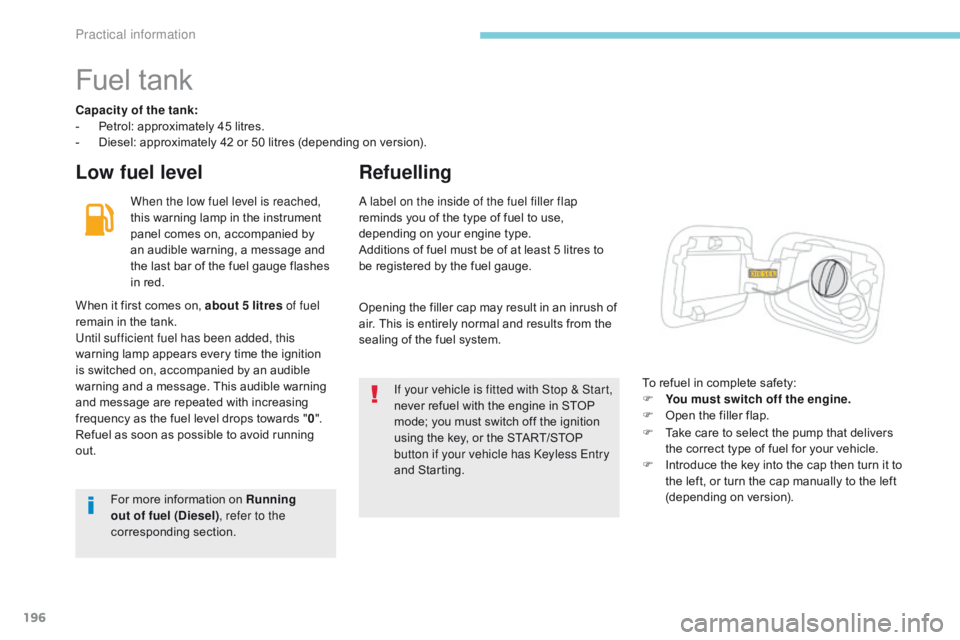
A label on the inside of the fuel filler flap
reminds you of the type of fuel to use,
depending on your engine type.
Additions of fuel must be of at least 5 litres to
be registered by the fuel gauge.
When it first comes on, about 5 litres of fuel
remain in the tank.
Until sufficient fuel has been added, this
warning lamp appears every time the ignition
is switched on, accompanied by an audible
warning and a message. This audible warning
and message are repeated with increasing
frequency as the fuel level drops towards " 0".
Refuel as soon as possible to avoid running
out. Opening the filler cap may result in an inrush of
air. This is entirely normal and results from the
sealing of the fuel system.
If your vehicle is fitted with Stop & Start,
never refuel with the engine in STOP
mode; you must switch off the ignition
using the key, or the START/STOP
button if your vehicle has Keyless Entry
and Starting.
For more information on Running
out of fuel (Diesel) , refer to the
corresponding section. F
T
ake care to select the pump that delivers
the correct type of fuel for your vehicle.
F
I
ntroduce the key into the cap then turn it to
the left, or turn the cap manually to the left
(depending on version).
Practical information
Page 200 of 450
198
B618_en_Chap07_info-pratiques_ed01-2016
Misfuel prevention (Diesel)*
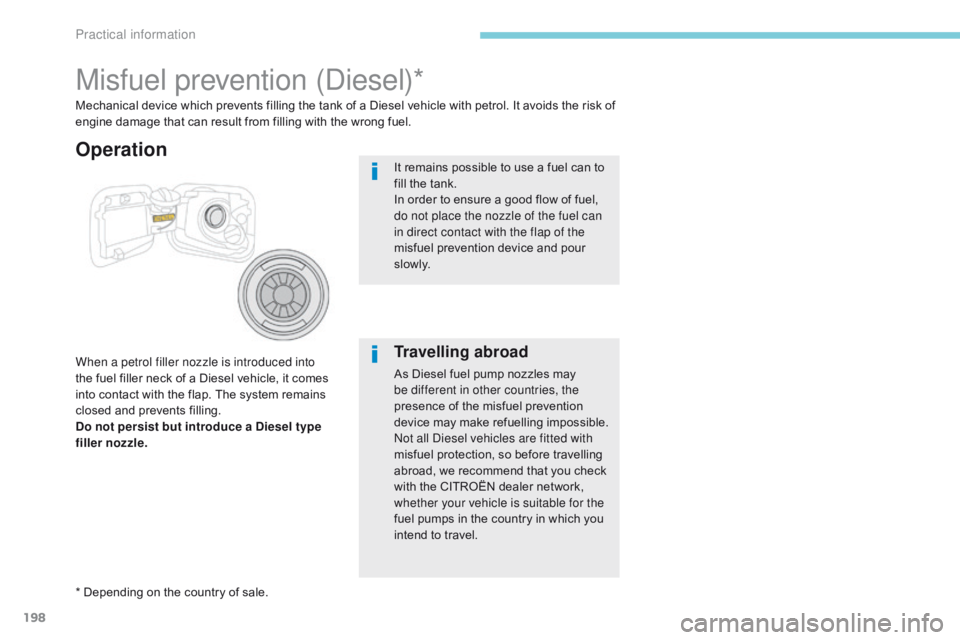
When a petrol filler nozzle is introduced into
the fuel filler neck of a Diesel vehicle, it comes
into contact with the flap. The system remains
closed and prevents filling.
Do not persist but introduce a Diesel type
filler nozzle.
* Depending on the country of sale. Mechanical device which prevents filling the tank of a Diesel vehicle with petrol. It avoids the risk of
engine damage that can result from filling with the wrong fuel.It remains possible to use a fuel can to
fill the tank.
In order to ensure a good flow of fuel,
do not place the nozzle of the fuel can
in direct contact with the flap of the
misfuel prevention device and pour
s l ow l y.Travelling abroad
As Diesel fuel pump nozzles may
be different in other countries, the
presence of the misfuel prevention
device may make refuelling impossible.
Not all Diesel vehicles are fitted with
misfuel protection, so before travelling
abroad, we recommend that you check
with the CITROËN dealer network,
whether your vehicle is suitable for the
fuel pumps in the country in which you
intend to travel.
Operation
Practical information
Page 201 of 450
199
B618_en_Chap07_info-pratiques_ed01-2016
Fuel used for petrol engines
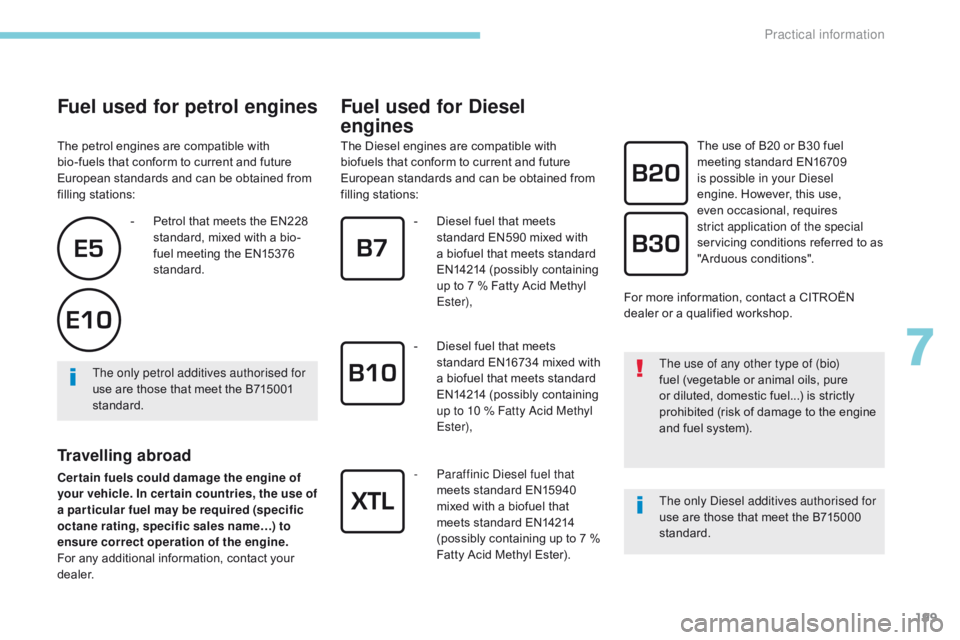
The petrol engines are compatible with
bio-fuels that conform to current and future
European standards and can be obtained from
filling stations:
Fuel used for Diesel
engines
The Diesel engines are compatible with
biofuels that conform to current and future
European standards and can be obtained from
filling stations:
-
Pe
trol that meets the EN228
standard, mixed with a bio-
fuel meeting the EN15376
standard. -
D
iesel fuel that meets
standard EN590 mixed with
a biofuel that meets standard
EN14214 (possibly containing
up to 7 % Fatty Acid Methyl
Ester), The use of B20 or B30 fuel
meeting standard EN16709
is possible in your Diesel
engine. However, this use,
even occasional, requires
strict application of the special
servicing conditions referred to as
"Arduous conditions".
-
D
iesel fuel that meets
standard EN16734 mixed with
a biofuel that meets standard
EN14214 (possibly containing
up to 10 % Fatty Acid Methyl
Ester),
-
P
araffinic Diesel fuel that
meets standard EN15940
mixed with a biofuel that
meets standard EN14214
(possibly containing up to 7 %
Fatty Acid Methyl Ester). The use of any other type of (bio)
fuel (vegetable or animal oils, pure
or diluted, domestic fuel...) is strictly
prohibited (risk of damage to the engine
and fuel system).
The only petrol additives authorised for
use are those that meet the B715001
standard. For more information, contact a CITROËN
dealer or a qualified workshop.
The only Diesel additives authorised for
use are those that meet the B715000
standard.
Travelling abroad
Cer tain fuels could damage the engine of
your vehicle. In cer tain countries, the use of
a par ticular fuel may be required (specific
octane rating, specific sales name…) to
ensure correct operation of the engine.
For any additional information, contact your
dealer.
7
Practical information