Engines CITROEN C3 2021 Owners Manual
[x] Cancel search | Manufacturer: CITROEN, Model Year: 2021, Model line: C3, Model: CITROEN C3 2021Pages: 450, PDF Size: 10.11 MB
Page 5 of 450
.
B618_en_Chap00a_sommaire_ed01-2016
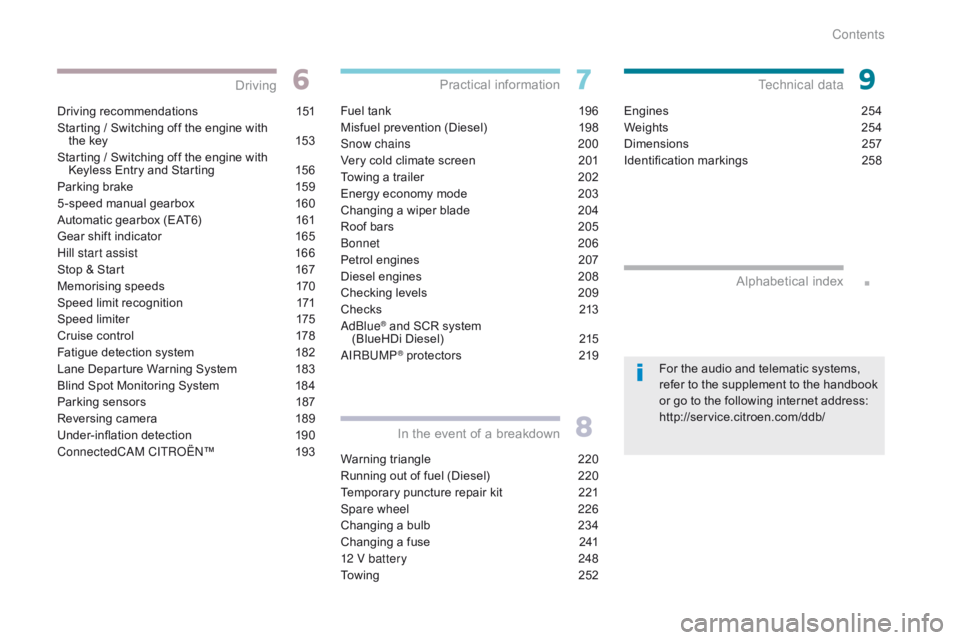
Driving recommendations 151
Starting / Switching off the engine with the key
1
53
Starting / Switching off the engine with Keyless Entry and Starting
1
56
Parking brake
1
59
5 -speed manual gearbox
1
60
Automatic gearbox (EAT6)
1
61
Gear shift indicator
1
65
Hill start assist
1
66
Stop & Start
1
67
Memorising speeds
1
70
Speed limit recognition
1
71
Speed limiter
1
75
Cruise control
1
78
Fatigue detection system
1
82
Lane Departure Warning System
1
83
Blind Spot Monitoring System
1
84
Parking sensors
1
87
Reversing camera
1
89
Under-inflation detection
1
90
ConnectedCAM C
ITROËN
™ 19
3
Driving
Fuel tank 196
Misfuel prevention (Diesel)
1
98
Snow chains
2
00
Very cold climate screen
2
01
Towing a trailer
2
02
Energy economy mode
2
03
Changing a wiper blade
2
04
Roof bars
2
05
Bonnet
206
Petrol engines
2
07
Diesel engines
2
08
Checking levels
2
09
Chec ks
2
13
AdBlue
® and SCR system
(BlueHDi Diesel) 2 15
AIRBUMP
® protectors 2 19
Practical information
Warning triangle 2 20
Running out of fuel (Diesel)
2
20
Temporary puncture repair kit
2
21
Spare wheel
2
26
Changing a bulb
2
34
Changing a fuse
2
41
12 V battery
2
48
To w i n g
2
5 2
In the event of a breakdown
Engines 254
Weights
2
54
Dimensions
2
57
Identification markings
2
58
Technical data
Alphabetical index
For the audio and telematic systems,
refer to the supplement to the handbook
or go to the following internet address:
http://service.citroen.com/ddb/
Contents
Page 10 of 450
8
B618_en_Chap00b_vue-ensemble_ _ed01-2016
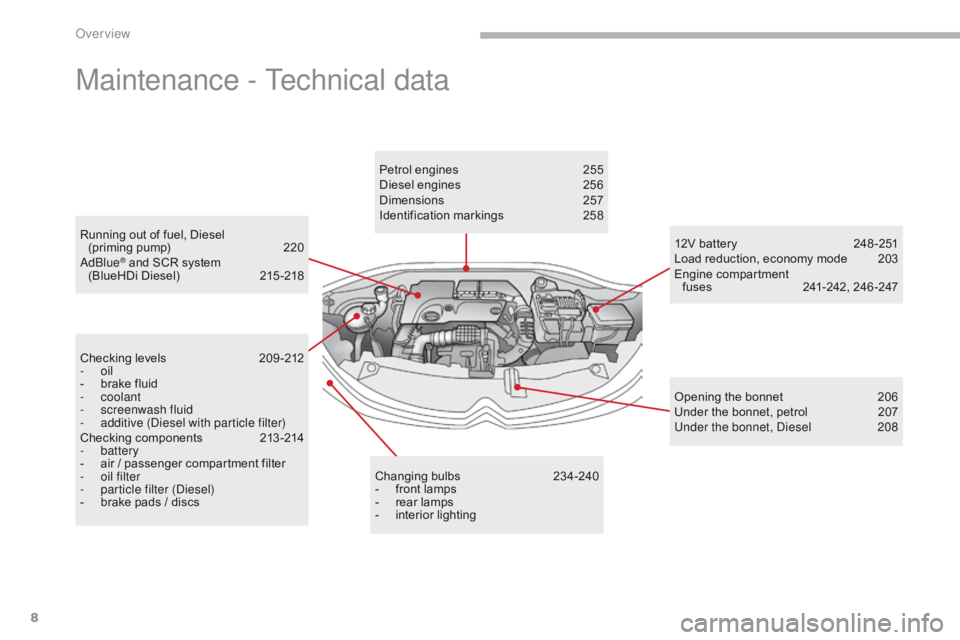
Running out of fuel, Diesel (priming pump) 2 20
AdBlue
® and SCR system
(BlueHDi Diesel) 2 15 -218
Maintenance - Technical data
Checking levels 2 09 -212
- oil
-
b
rake fluid
-
coolant
-
s
creenwash fluid
-
a
dditive (Diesel with particle filter)
Checking components
2
13 -214
-
battery
-
a
ir / passenger compartment filter
-
o
il filter
-
p
article filter (Diesel)
-
b
rake pads / discs Changing bulbs
2
34-240
-
f
ront lamps
-
r
ear lamps
-
i
nterior lighting
Petrol engines
2
55
Diesel engines
2
56
Dimensions
2
57
Identification markings
2
58
Opening the bonnet
2
06
Under the bonnet, petrol
2
07
Under the bonnet, Diesel
2
08
12V battery
2
48 -251
Load reduction, economy mode
2
03
Engine compartment
fuses
24
1-242, 246 -247
Over view
Page 31 of 450
29
B618_en_Chap01_Instruments-de-bord_ed01-2016
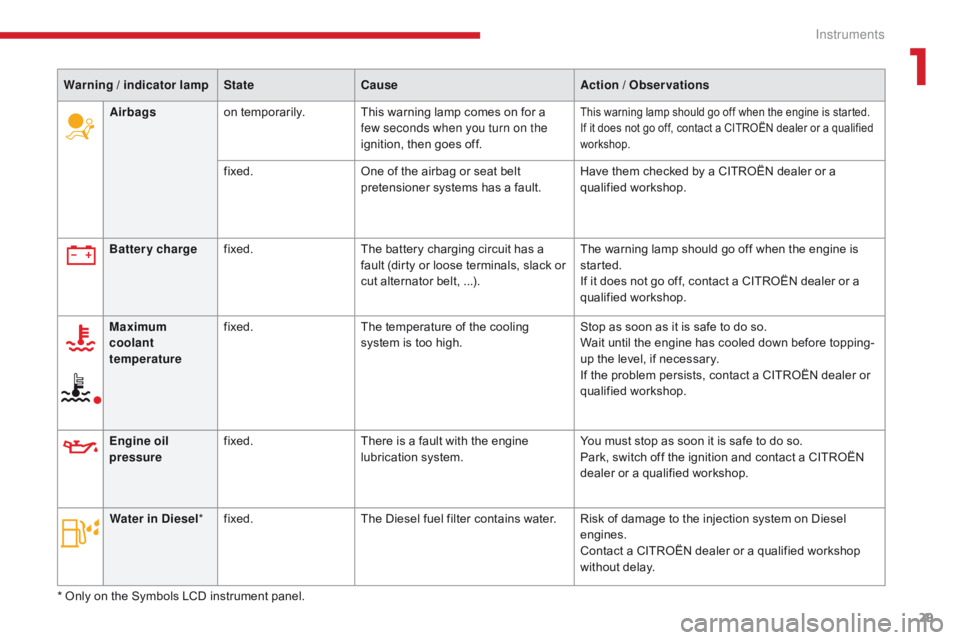
Engine oil
pressurefixed.
There is a fault with the engine
lubrication system. You must stop as soon it is safe to do so.
Park, switch off the ignition and contact a CITROËN
dealer or a qualified workshop.
Battery charge
fixed. The battery charging circuit has a
fault (dirty or loose terminals, slack or
cut alternator belt, ...).
The warning lamp should go off when the engine is
started.
If it does not go off, contact a CITROËN dealer or a
qualified workshop.
Maximum
coolant
temperature fixed.
The temperature of the cooling
system is too high. Stop as soon as it is safe to do so.
Wait until the engine has cooled down before topping-
up the level, if necessary.
If the problem persists, contact a CITROËN dealer or
qualified workshop.
Warning / indicator lamp
StateCause Action / Observations
Water in Diesel *fixed. The Diesel fuel filter contains water. Risk of damage to the injection system on Diesel
engines.
Contact a CITROËN dealer or a qualified workshop
without delay.
Airbags
on temporarily. This warning lamp comes on for a
few seconds when you turn on the
ignition, then goes off.
This warning lamp should go off when the engine is started.
If it does not go off, contact a CITROËN dealer or a qualified
workshop.
fixed.One of the airbag or seat belt
pretensioner systems has a fault. Have them checked by a CITROËN dealer or a
qualified workshop.
* Only on the Symbols LCD instrument panel.
1
Instruments
Page 156 of 450
154
B618_en_Chap06_conduite_ed01-2016
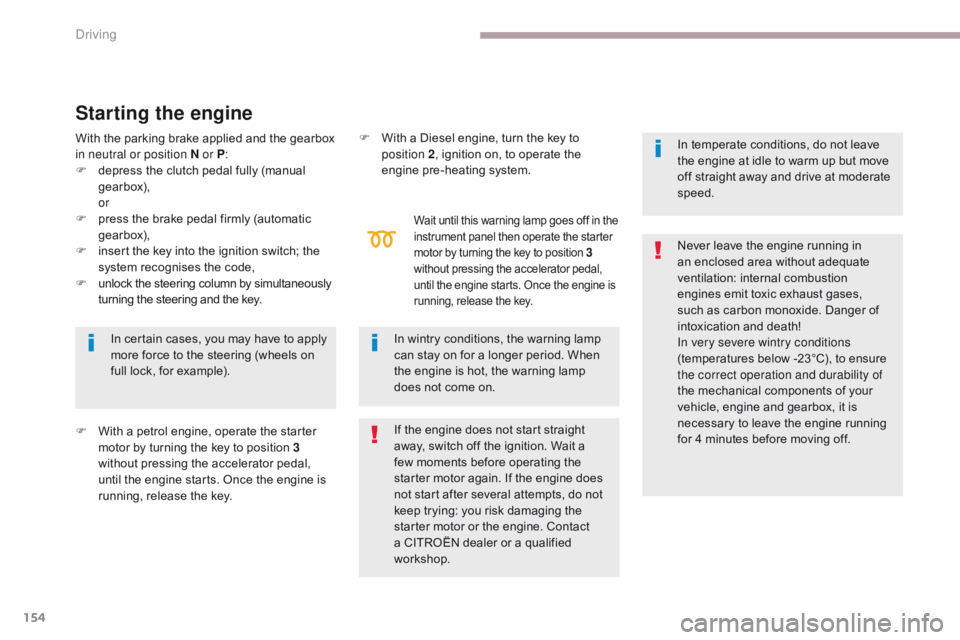
F With a Diesel engine, turn the key to position 2 , ignition on, to operate the
engine pre-heating system.
Wait until this warning lamp goes off in the
instrument panel then operate the starter
motor by turning the key to position
3
without pressing the accelerator pedal,
until the engine starts. Once the engine is
running, release the key.
In wintry conditions, the warning lamp
can stay on for a longer period. When
the engine is hot, the warning lamp
does not come on. In temperate conditions, do not leave
the engine at idle to warm up but move
off straight away and drive at moderate
speed.
Never leave the engine running in
an enclosed area without adequate
ventilation: internal combustion
engines emit toxic exhaust gases,
such as carbon monoxide. Danger of
intoxication and death!
In very severe wintry conditions
(temperatures below -23°C), to ensure
the correct operation and durability of
the mechanical components of your
vehicle, engine and gearbox, it is
necessary to leave the engine running
for 4 minutes before moving off.
If the engine does not start straight
away, switch off the ignition. Wait a
few moments before operating the
starter motor again. If the engine does
not start after several attempts, do not
keep trying: you risk damaging the
starter motor or the engine. Contact
a CITROËN dealer or a qualified
workshop.
Starting the engine
With the parking brake applied and the gearbox
in neutral or position N
or P:
F
d
epress the clutch pedal fully (manual
gearbox),
or
F
p
ress the brake pedal firmly (automatic
gearbox),
F
i
nsert the key into the ignition switch; the
system recognises the code,
F
u
nlock the steering column by simultaneously
turning the steering and the key.
In certain cases, you may have to apply
more force to the steering (wheels on
full lock, for example).
F
W
ith a petrol engine, operate the starter
motor by turning the key to position 3
without pressing the accelerator pedal,
until the engine starts. Once the engine is
running, release the key.
Driving
Page 158 of 450
156
B618_en_Chap06_conduite_ed01-2016
Starting / Switching off the engine with Keyless Entry and
Starting
Starting the engine
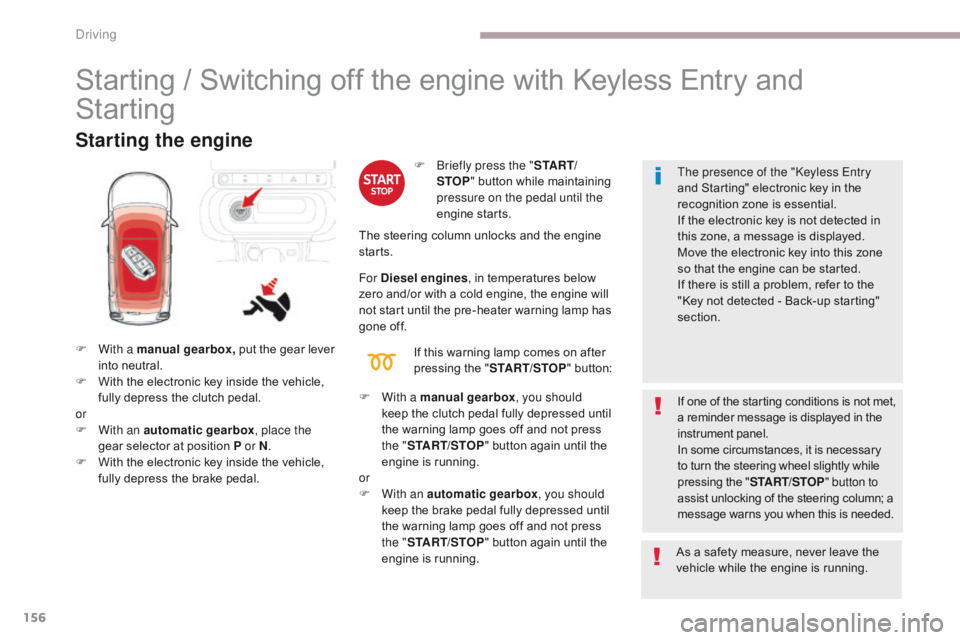
F With a manual gearbox, put the gear lever
into neutral.
F
W
ith the electronic key inside the vehicle,
fully depress the clutch pedal.
or
F
W
ith an automatic gearbox , place the
gear selector at position P or N .
F
W
ith the electronic key inside the vehicle,
fully depress the brake pedal. If one of the starting conditions is not met,
a reminder message is displayed in the
instrument panel.
In some circumstances, it is necessary
to turn the steering wheel slightly while
pressing the "
START/STOP " button to
assist unlocking of the steering column; a
message warns you when this is needed. The presence of the "Keyless Entry
and Starting" electronic key in the
recognition zone is essential.
If the electronic key is not detected in
this zone, a message is displayed.
Move the electronic key into this zone
so that the engine can be started.
If there is still a problem, refer to the
"Key not detected - Back-up starting"
section.
F
B
riefly press the "
S TA R T/
STOP " button while maintaining
pressure on the pedal until the
engine starts.
The steering column unlocks and the engine
starts.
For Diesel engines , in temperatures below
zero and/or with a cold engine, the engine will
not start until the pre-heater warning lamp has
gone off.
If this warning lamp comes on after
pressing the " START/STOP " button:
F
W
ith a manual gearbox, you should
keep the clutch pedal fully depressed until
the warning lamp goes off and not press
the
"START/STOP " button again until the
engine is running.
or
F
W
ith an automatic gearbox, you should
keep the brake pedal fully depressed until
the warning lamp goes off and not press
the " START/STOP " button again until the
engine is running. As a safety measure, never leave the
vehicle while the engine is running.
Driving
Page 199 of 450
197
B618_en_Chap07_info-pratiques_ed01-2016
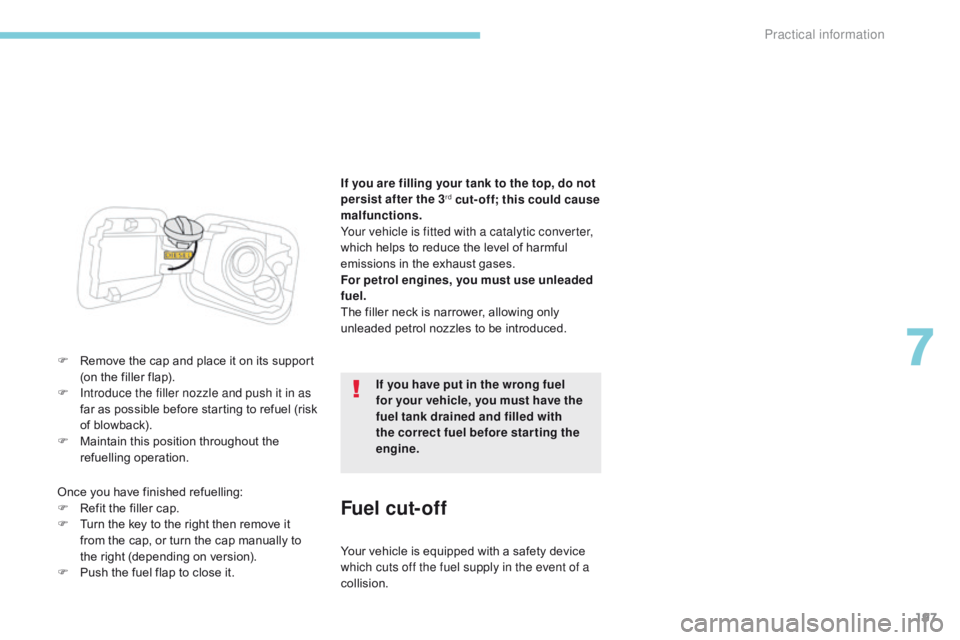
F Remove the cap and place it on its support (on the filler flap).
F
I
ntroduce the filler nozzle and push it in as
far as possible before starting to refuel (risk
of blowback).
F
M
aintain this position throughout the
refuelling operation.
Once you have finished refuelling:
F
R
efit the filler cap.
F
T
urn the key to the right then remove it
from the cap, or turn the cap manually to
the right (depending on version).
F
P
ush the fuel flap to close it. If you are filling your tank to the top, do not
persist after the 3
rd cut-off
; this could cause
malfunctions.
Your vehicle is fitted with a catalytic converter,
which helps to reduce the level of harmful
emissions in the exhaust gases.
For petrol engines, you must use unleaded
fuel.
The filler neck is narrower, allowing only
unleaded petrol nozzles to be introduced.
Your vehicle is equipped with a safety device
which cuts off the fuel supply in the event of a
collision.
Fuel cut- of f
If you have put in the wrong fuel
for your vehicle, you must have the
fuel tank drained and filled with
the correct fuel before star ting the
engine.
7
Practical information
Page 201 of 450
199
B618_en_Chap07_info-pratiques_ed01-2016
Fuel used for petrol engines
The petrol engines are compatible with
bio-fuels that conform to current and future
European standards and can be obtained from
filling stations:
Fuel used for Diesel
engines
The Diesel engines are compatible with
biofuels that conform to current and future
European standards and can be obtained from
filling stations:
-
Pe
trol that meets the EN228
standard, mixed with a bio-
fuel meeting the EN15376
standard. -
D
iesel fuel that meets
standard EN590 mixed with
a biofuel that meets standard
EN14214 (possibly containing
up to 7 % Fatty Acid Methyl
Ester), The use of B20 or B30 fuel
meeting standard EN16709
is possible in your Diesel
engine. However, this use,
even occasional, requires
strict application of the special
servicing conditions referred to as
"Arduous conditions".
-
D
iesel fuel that meets
standard EN16734 mixed with
a biofuel that meets standard
EN14214 (possibly containing
up to 10 % Fatty Acid Methyl
Ester),
-
P
araffinic Diesel fuel that
meets standard EN15940
mixed with a biofuel that
meets standard EN14214
(possibly containing up to 7 %
Fatty Acid Methyl Ester). The use of any other type of (bio)
fuel (vegetable or animal oils, pure
or diluted, domestic fuel...) is strictly
prohibited (risk of damage to the engine
and fuel system).
The only petrol additives authorised for
use are those that meet the B715001
standard. For more information, contact a CITROËN
dealer or a qualified workshop.
The only Diesel additives authorised for
use are those that meet the B715000
standard.
Travelling abroad
Cer tain fuels could damage the engine of
your vehicle. In cer tain countries, the use of
a par ticular fuel may be required (specific
octane rating, specific sales name…) to
ensure correct operation of the engine.
For any additional information, contact your
dealer.
7
Practical information
Page 209 of 450
207
B618_en_Chap07_info-pratiques_ed01-2016
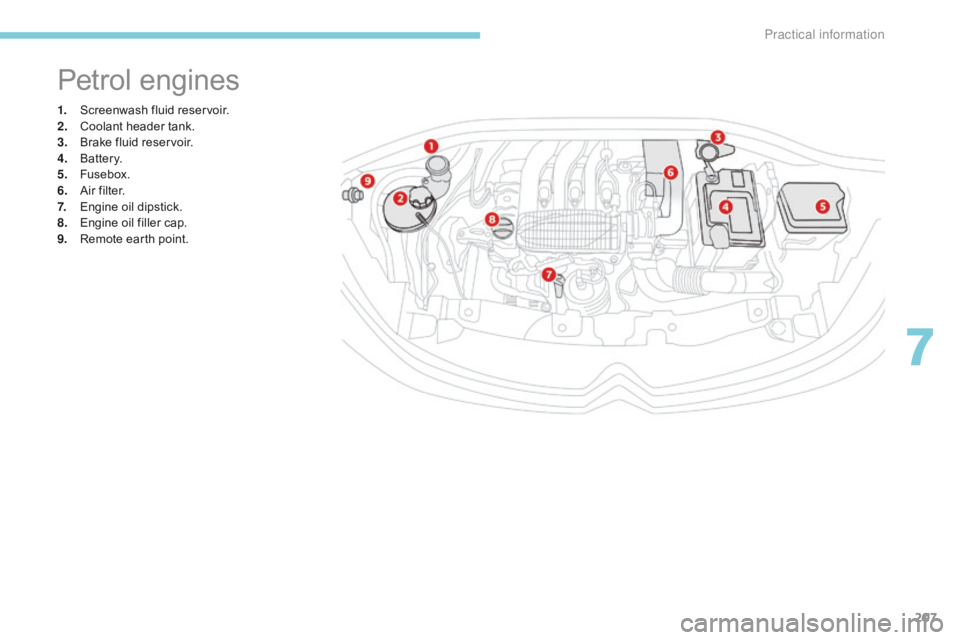
1. Screenwash fluid reservoir.
2. Coolant header tank.
3.
B
rake fluid reservoir.
4.
B
attery.
5.
F
usebox.
6.
A
ir filter.
7.
E
ngine oil dipstick.
8.
E
ngine oil filler cap.
9.
R
emote earth point.
Petrol engines
7
Practical information
Page 210 of 450
208
B618_en_Chap07_info-pratiques_ed01-2016
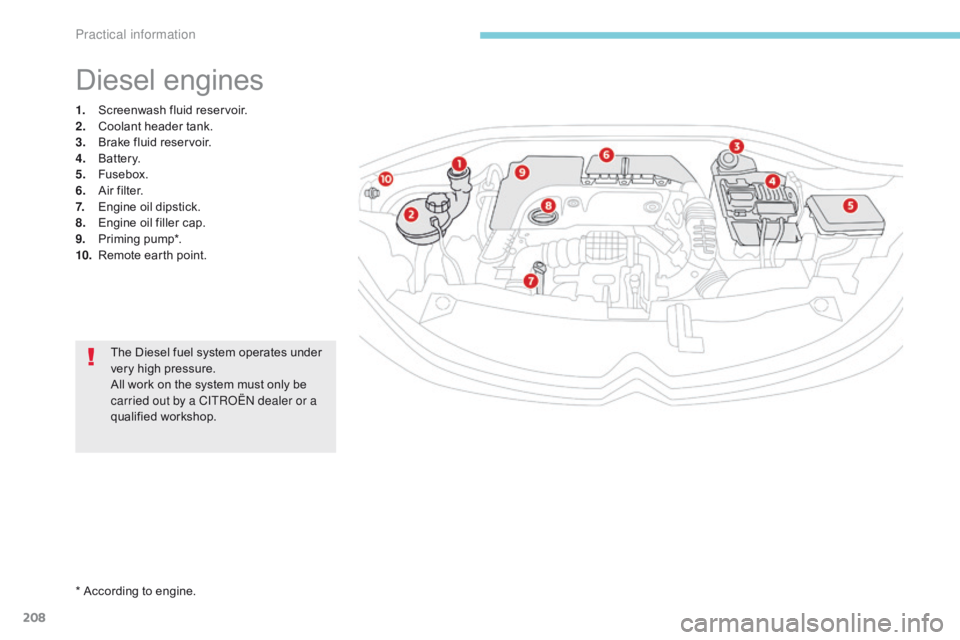
1. Screenwash fluid reservoir.
2. Coolant header tank.
3.
B
rake fluid reservoir.
4.
B
attery.
5.
F
usebox.
6.
A
ir filter.
7.
E
ngine oil dipstick.
8.
E
ngine oil filler cap.
9.
P
riming pump*.
10.
R
emote earth point.
Diesel engines
* According to engine. The Diesel fuel system operates under
very high pressure.
All work on the system must only be
carried out by a CITROËN dealer or a
qualified workshop.
Practical information
Page 217 of 450
215
B618_en_Chap07_info-pratiques_ed01-2016
AdBlue® and SCR system
for BlueHDi Diesel engines
To assure respect for the environment and
conformity with the new Euro 6 emissions
standard, without adversely affecting the
per formance or fuel consumption of Diesel
engines, CITROËN has taken the decision to
equip its vehicles with an effective system that
associates SCR (Selective Catalytic Reduction)
with a particle filter (FAP) for the treatment of
exhaust gases.
SCR system
Using a fluid called AdBlue® containing urea, a
catalytic converter turns up to 85% of nitrogen
oxides (NOx) into nitrogen and water, which are
harmless to health and the environment. Once the AdBlue
® tank is empty, a
s
ystem required by regulations prevents
starting of the engine.
If the SCR
system is faulty, the level
of emissions from your vehicle will no
longer meet the Euro 6 standard: your
vehicle becomes polluting.
In the event of a confirmed fault
with the SCR system, you must go
to a CITROËN dealer or a qualified
workshop as soon as possible: after
a running distance of 650 miles
(1
100 km), a system will be triggered
automatically to prevent engine starting.
In either case, a range indicator gives
you the distance you can travel before
the vehicle is immobilised.
The AdBlue® is held in a special tank with
a capacity of about 15 litres: this provides
a driving range of about 11 000 miles
(18
000
km). An alert is triggered automatically
to warn you when the reserve level is
reached: you can then drive about 1 500 miles
(2
400
km) before the tank is empty.
Freezing of the AdBlue
®
AdBlue® freezes at temperatures below
around -11°C.
The SCR system includes a heater
for the AdBlue
® tank, allowing you
to continue driving in all weather
conditions.
7
Practical information