wheel CITROEN C3 2022 User Guide
[x] Cancel search | Manufacturer: CITROEN, Model Year: 2022, Model line: C3, Model: CITROEN C3 2022Pages: 450, PDF Size: 10.11 MB
Page 53 of 450
51
B618_en_Chap01_Instruments-de-bord_ed01-2016
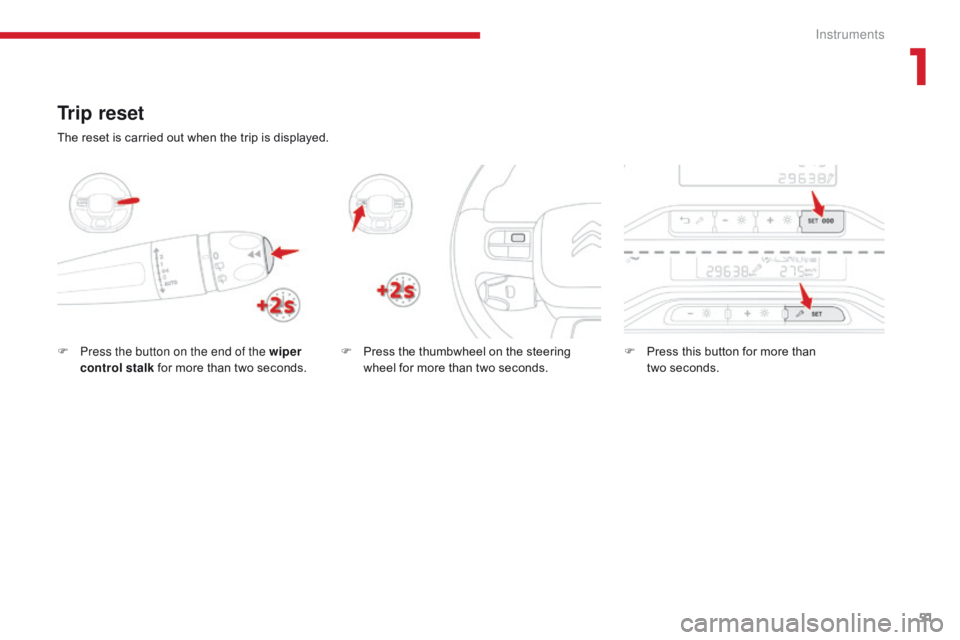
Trip reset
F Press the button on the end of the wiper control stalk for more than two seconds. F
P ress the thumbwheel on the steering
wheel for more than two seconds. F
P ress this button for more than
two seconds.
The reset is carried out when the trip is displayed.
1
Instruments
Page 80 of 450
78
B618_en_Chap03_Ergonomie-et-confort_ed01-2016
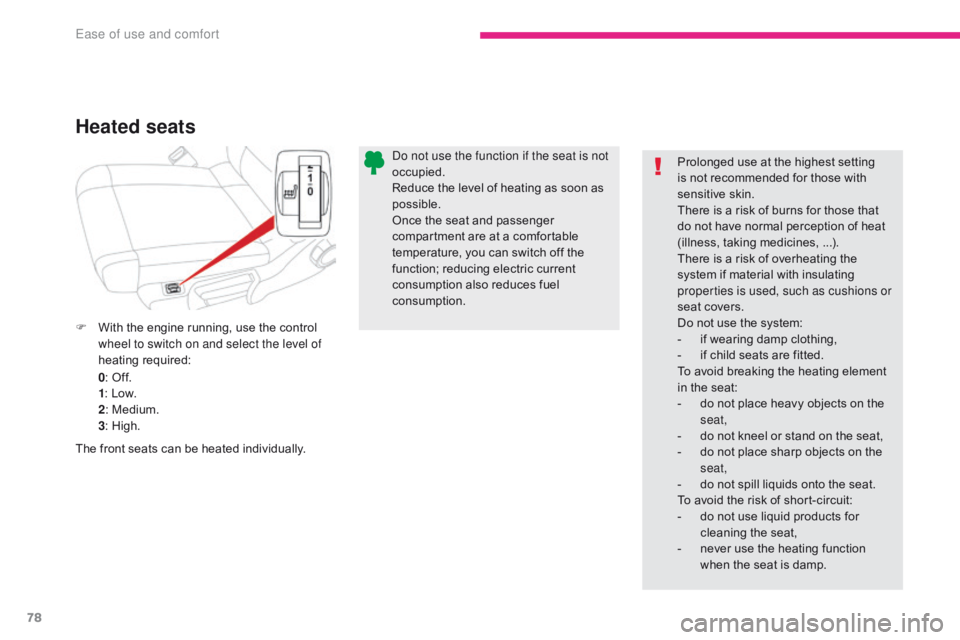
Heated seats
F With the engine running, use the control wheel to switch on and select the level of
heating required:
0: Off.
1 : Low.
2 : Medium.
3 : High. Do not use the function if the seat is not
occupied.
Reduce the level of heating as soon as
possible.
Once the seat and passenger
compartment are at a comfortable
temperature, you can switch off the
function; reducing electric current
consumption also reduces fuel
consumption.
Prolonged use at the highest setting
is not recommended for those with
sensitive skin.
There is a risk of burns for those that
do not have normal perception of heat
(illness, taking medicines, ...).
There is a risk of overheating the
system if material with insulating
properties is used, such as cushions or
seat covers.
Do not use the system:
-
i f wearing damp clothing,
-
i
f child seats are fitted.
To avoid breaking the heating element
in the seat:
-
d
o not place heavy objects on the
seat,
-
d
o not kneel or stand on the seat,
-
d
o not place sharp objects on the
seat,
-
d
o not spill liquids onto the seat.
To avoid the risk of short-circuit:
-
d
o not use liquid products for
cleaning the seat,
-
n
ever use the heating function
when the seat is damp.
The front seats can be heated individually.
Ease of use and comfort
Page 84 of 450
82
B618_en_Chap03_Ergonomie-et-confort_ed01-2016
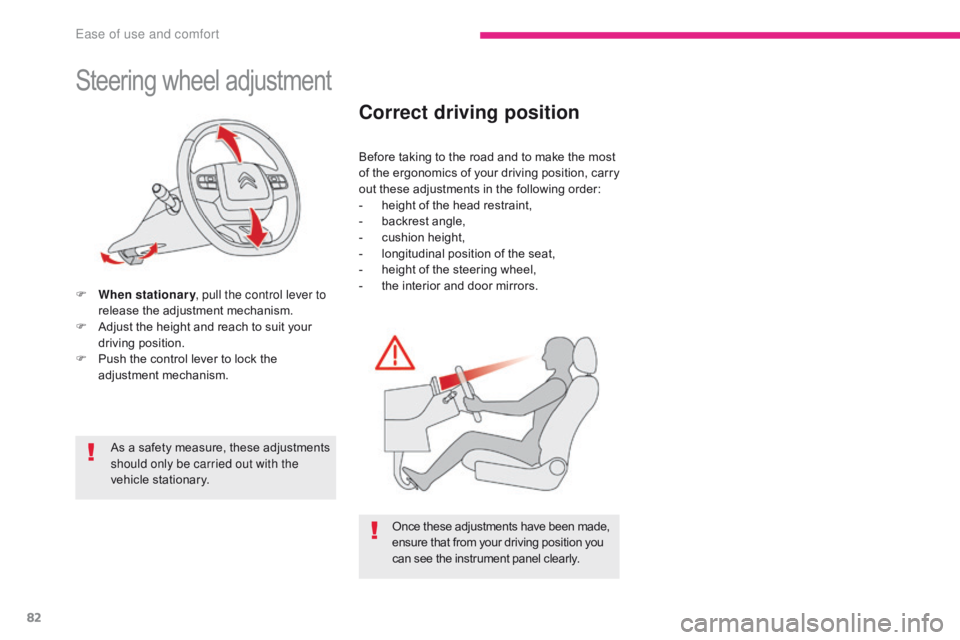
Steering wheel adjustment
F When stationary, pull the control lever to
release the adjustment mechanism.
F
A
djust the height and reach to suit your
driving position.
F
P
ush the control lever to lock the
adjustment mechanism.
As a safety measure, these adjustments
should only be carried out with the
vehicle stationary.
Correct driving position
Before taking to the road and to make the most
of the ergonomics of your driving position, carry
out these adjustments in the following order:
-
h
eight of the head restraint,
-
b
ackrest angle,
-
c
ushion height,
-
l
ongitudinal position of the seat,
-
h
eight of the steering wheel,
-
t
he interior and door mirrors.
Once these adjustments have been made,
ensure that from your driving position you
can see the instrument panel clearly.
Ease of use and comfort
Page 88 of 450
86
B618_en_Chap03_Ergonomie-et-confort_ed01-2016
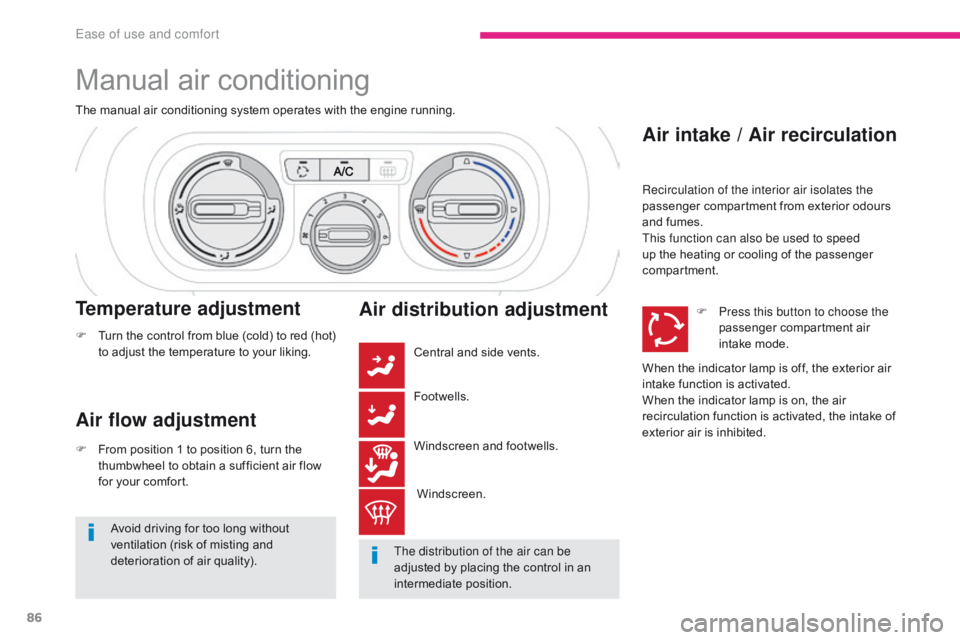
Manual air conditioning
The manual air conditioning system operates with the engine running.
Air flow adjustment
F From position 1 to position 6, turn the thumbwheel to obtain a sufficient air flow
for your comfort.
F
T
urn the control from blue (cold) to red (hot)
to adjust the temperature to your liking.
Air distribution adjustment
Central and side vents.
Windscreen.
Footwells.
Windscreen and footwells.
The distribution of the air can be
adjusted by placing the control in an
intermediate position.
Avoid driving for too long without
ventilation (risk of misting and
deterioration of air quality).
Temperature adjustment Air intake / Air recirculation
Recirculation of the interior air isolates the
passenger compartment from exterior odours
and fumes.
This function can also be used to speed
up the heating or cooling of the passenger
compartment.
F
P
ress this button to choose the
passenger compartment air
intake mode.
When the indicator lamp is off, the exterior air
intake function is activated.
When the indicator lamp is on, the air
recirculation function is activated, the intake of
exterior air is inhibited.
Ease of use and comfort
Page 104 of 450
102
B618_en_Chap03_Ergonomie-et-confort_ed01-2016
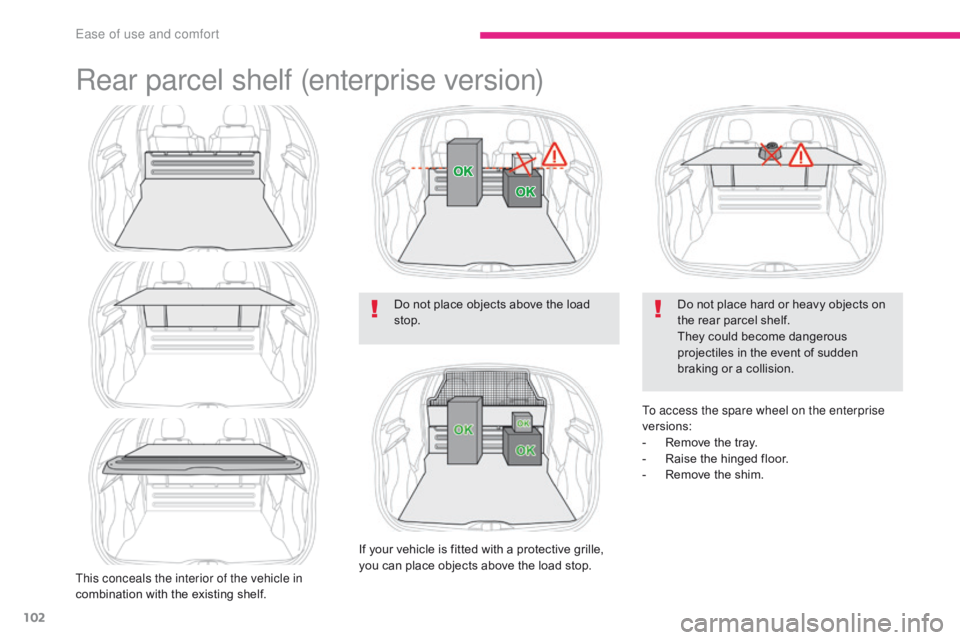
Rear parcel shelf (enterprise version)
This conceals the interior of the vehicle in
combination with the existing shelf.Do not place objects above the load
stop.
If your vehicle is fitted with a protective grille,
you can place objects above the load stop. Do not place hard or heavy objects on
the rear parcel shelf.
They could become dangerous
projectiles in the event of sudden
braking or a collision.
To access the spare wheel on the enterprise
versions:
-
R
emove the tray.
-
R
aise the hinged floor.
-
R
emove the shim.
Ease of use and comfort
Page 120 of 450
118
B618_en_Chap05_securite_ed01-2016
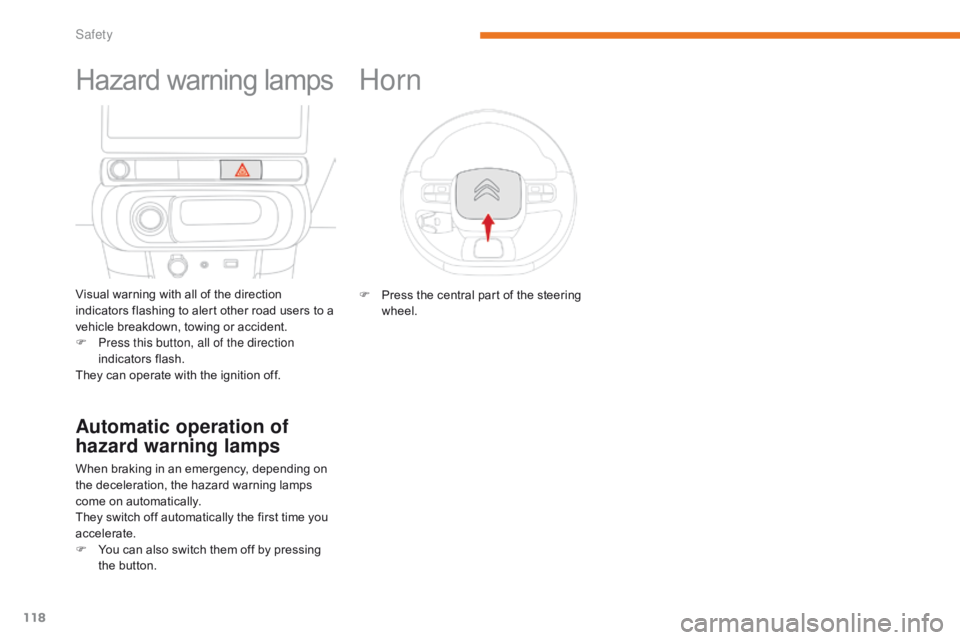
Hazard warning lamps
Visual warning with all of the direction
indicators flashing to alert other road users to a
vehicle breakdown, towing or accident.
F
P
ress this button, all of the direction
indicators flash.
They can operate with the ignition off.
Automatic operation of
hazard warning lamps
When braking in an emergency, depending on
the deceleration, the hazard warning lamps
come on automatically.
They switch off automatically the first time you
accelerate.
F
Y
ou can also switch them off by pressing
the button.
Horn
F Press the central part of the steering wheel.
Safety
Page 125 of 450
123
B618_en_Chap05_securite_ed01-2016
Electronic stability control (ESC) incorporating the following systems:
- a nti-lock braking system (ABS) and electronic brake force distribution (EBFD),
-
e
mergency braking assistance (EBA),
-
w
heel anti-slip regulation (ASR) or traction control,
-
d
ynamic stability control (DSC).
Electronic stability control (ESC)
Definitions
Anti-lock braking system (ABS)
and electronic brake force
distribution (EBFD)
This system improves the stability and
manoeuvrability of your vehicle when braking
and contributes towards improved control on
corners, in particular on poor or slippery road
surfaces.
The ABS prevents wheel lock in the event of
emergency braking.
The EBFD manages the braking pressure
wheel by wheel.
Emergency braking assistance
(EBA)
In an emergency, this system enables you to
reach the optimum braking pressure more
quickly and therefore reduce the stopping
distance.
It is triggered according to the speed at which
the brake pedal is pressed. This is felt by a
reduction in the resistance of the pedal and an
increase in the effectiveness of the braking.
Anti-slip regulation (ASR)
The ASR system (also known as Traction
Control) optimises traction in order to limit
wheel slip by acting on the brakes of the driving
wheels and on the engine. It also improves
the directional stability of the vehicle on
acceleration.
Dynamic stability control (DSC)
If there is a difference between the path
followed by the vehicle and that required by
the driver, the DSC monitors each wheel and
automatically acts on the brake of one or more
wheels and on the engine to return the vehicle
to the required path, within the limits of the laws
of physics.
5
Safety
Page 126 of 450
124
B618_en_Chap05_securite_ed01-2016
When this warning lamp comes on,
coupled with the STOP and ABS warning
lamps, accompanied by an audible signal
and a message, it indicates that there
is a fault with the electronic brake force
distribution (EBFD).
Anti-lock braking system (ABS) and electronic brake force
distribution (EBFD)
The fixed illumination of this warning
lamp indicates that there is a fault
with the ABS.
The vehicle retains conventional
braking. Drive carefully at moderate
speed. When changing wheels (tyres and
rims), ensure that these are approved
for your vehicle.
Normal operation of the ABS may make
itself felt by slight vibrations of the brake
pedal.
In emergency braking, press ver y
firmly and maintain this pressure.
You must stop as soon as it is safe to do so.
In both cases, have the system checked by a
CITROËN dealer or a qualified workshop as
soon as possible.
Safety
Page 127 of 450
125
B618_en_Chap05_securite_ed01-2016
Anti-slip regulation (ASR)
After an impact, have the system
checked by a CITROËN dealer or a
qualified workshop.
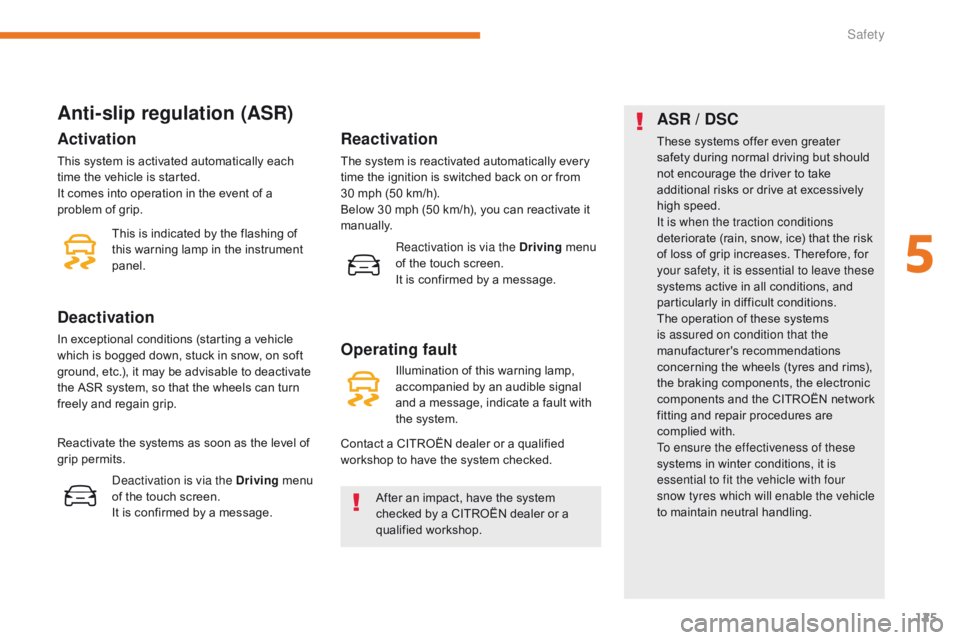
Activation
This system is activated automatically each
time the vehicle is started.
It comes into operation in the event of a
problem of grip.
Deactivation
In exceptional conditions (starting a vehicle
which is bogged down, stuck in snow, on soft
ground, etc.), it may be advisable to deactivate
the ASR system, so that the wheels can turn
freely and regain grip.This is indicated by the flashing of
this warning lamp in the instrument
panel.Operating fault
Reactivate the systems as soon as the level of
grip permits.
Deactivation is via the Driving menu
of the touch screen.
It is confirmed by a message.
Reactivation
The system is reactivated automatically every
time the ignition is switched back on or from
30
mph (50 km/h).
Below 30 mph (50 km/h), you can reactivate it
manually.
Reactivation is via the Driving menu
of the touch screen.
It is confirmed by a message.
Illumination of this warning lamp,
accompanied by an audible signal
and a message, indicate a fault with
the system.
Contact a CITROËN dealer or a qualified
workshop to have the system checked.
ASR / DSC
These systems offer even greater
safety during normal driving but should
not encourage the driver to take
additional risks or drive at excessively
high speed.
It is when the traction conditions
deteriorate (rain, snow, ice) that the risk
of loss of grip increases. Therefore, for
your safety, it is essential to leave these
systems active in all conditions, and
particularly in difficult conditions.
The operation of these systems
is assured on condition that the
manufacturer's recommendations
concerning the wheels (tyres and rims),
the braking components, the electronic
components and the CITROËN network
fitting and repair procedures are
complied with.
To ensure the effectiveness of these
systems in winter conditions, it is
essential to fit the vehicle with four
snow tyres which will enable the vehicle
to maintain neutral handling.
5
Safety
Page 132 of 450
130
B618_en_Chap05_securite_ed01-2016
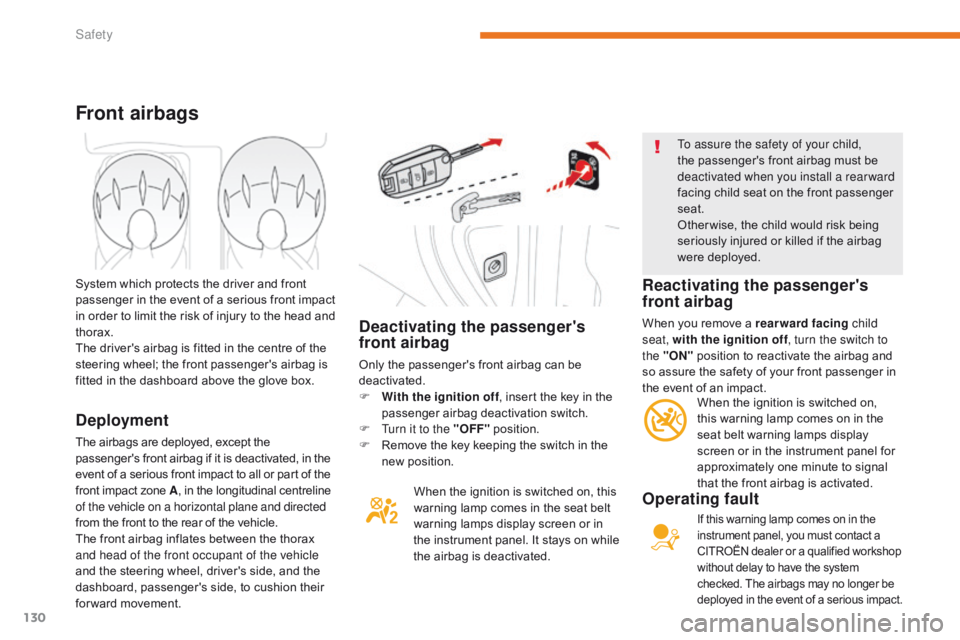
Deactivating the passenger's
front airbag
Only the passenger's front airbag can be
deactivated.
F
W
ith the ignition off , insert the key in the
passenger airbag deactivation switch.
F
T
urn it to the "OFF" position.
F
R
emove the key keeping the switch in the
new position.
When the ignition is switched on, this
warning lamp comes in the seat belt
warning lamps display screen or in
the instrument panel. It stays on while
the airbag is deactivated. To assure the safety of your child,
the passenger's front airbag must be
deactivated when you install a rear ward
facing child seat on the front passenger
seat.
Other wise, the child would risk being
seriously injured or killed if the airbag
were deployed.
Reactivating the passenger's
front airbag
When you remove a rearward facing
child
seat, with the ignition off , turn the switch to
the "ON" position to reactivate the airbag and
so assure the safety of your front passenger in
the event of an impact.
Front airbags
Deployment
The airbags are deployed, except the
passenger's front airbag if it is deactivated, in the
event of a serious front impact to all or part of the
front impact zone A , in the longitudinal centreline
of the vehicle on a horizontal plane and directed
from the front to the rear of the vehicle.
The front airbag inflates between the thorax
and head of the front occupant of the vehicle
and the steering wheel, driver's side, and the
dashboard, passenger's side, to cushion their
for ward movement. System which protects the driver and front
passenger in the event of a serious front impact
in order to limit the risk of injury to the head and
thorax.
The driver's airbag is fitted in the centre of the
steering wheel; the front passenger's airbag is
fitted in the dashboard above the glove box.
When the ignition is switched on,
this warning lamp comes on in the
seat belt warning lamps display
screen or in the instrument panel for
approximately one minute to signal
that the front airbag is activated.
Operating fault
If this warning lamp comes on in the
instrument panel, you must contact a
CITROËN dealer or a qualified workshop
without delay to have the system
checked. The airbags may no longer be
deployed in the event of a serious impact.
Safety