battery CITROEN C3 2023 User Guide
[x] Cancel search | Manufacturer: CITROEN, Model Year: 2023, Model line: C3, Model: CITROEN C3 2023Pages: 104, PDF Size: 2.38 MB
Page 58 of 104

56
In the event of a breakdown
RelayColourRating (A) Functions
MINI Grey 40Accessory load (HVAC Blower/Washer)
MAXI Grey 70ECM Power
12 V battery
Lead-acid starter batteries
These batteries contain harmful
substances (sulphuric acid and lead).
They must be disposed at authorized dealer/
battery shop in accordance with regulations
and must never under any circumstances be
discarded with household waste.
Take used remote control batteries and
vehicle batteries to a special collection point.
Protect your eyes and face before
handling the battery.
Use goggles and gloves while working with
the battery. Diluted sulphuric acid spilled from
battery can cause blindness or severe burns.
Flush eyes or body with ample water and get
medical care immediately if suffered.
Keep batteries out of the reach of children.
All operations on the battery must be carried
out in a well ventilated area and away from
naked flames and sources of sparks, so as to
avoid any risk of explosion or fire.
Wash your hands afterwards.
If the battery fails (after warranty
coverage), replace it with a battery of the
same specification as the one used in the
vehicle.
Access to the battery
The battery is located under the bonnet.
Naturally Aspirated engine version
(+) Positive terminal.
(-) Negative terminal.
Turbo engine version
(+) Positive terminal.
(-) Negative terminal.
A remote earth point is located near the battery.
Starting using another
battery
If the vehicle's battery is flat/drain/discharged,
the engine can be started using a backup battery
(either external or from another vehicle) and
jump leads or using a battery booster.
Never start the engine by connecting a
battery charger.
Never use a 24
V or higher battery booster.
Check beforehand that the backup battery
has a nominal voltage of 12
V and a capacity
Page 59 of 104
57
In the event of a breakdown
8at least equal to that of the discharged
battery.
The two vehicles must not be in contact with
each other.
Switch off all electricity-consuming equipment
on both vehicles (audio system, wipers,
lighting, etc.).
Make sure that the jump leads are well away
from the engine’s moving parts (fan, belt,
etc.).
Do not disconnect the (+) terminal while the
engine is running.
During jump start, extra care should be taken
to ensure right terminals are connected. If
terminal connections are reversed, it will
lead to failure of alternator & other electrical,
electronic components.
Never power electrical or electronic
components directly from battery terminals
as it will lead to poor battery charging, poor
performance of components and battery
sensor malfunction, which will impact fuel
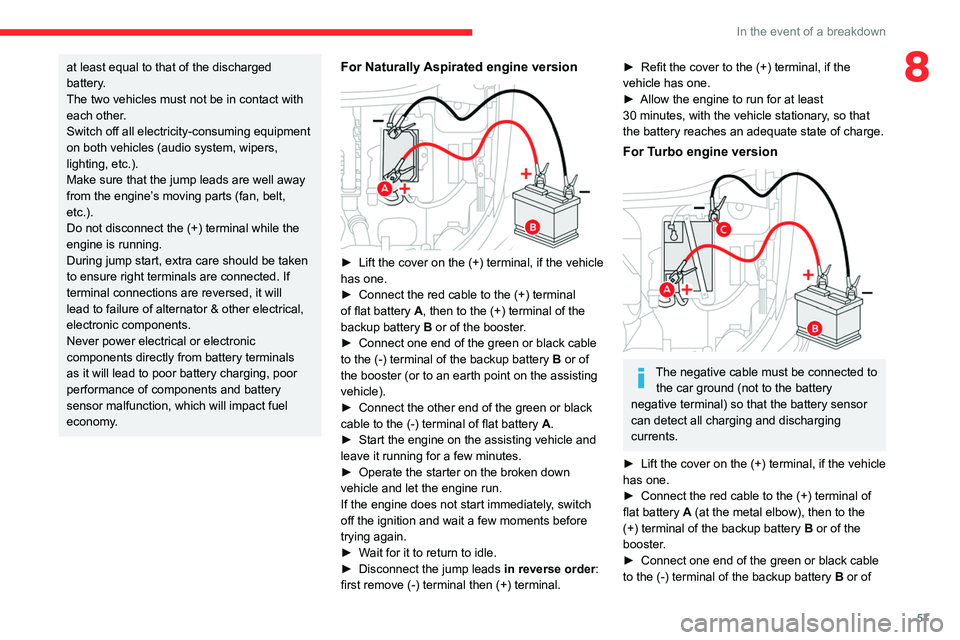
economy. For Naturally Aspirated engine version
► Lift the cover on the (+) terminal, if the vehicle
has one.
►
Connect the red cable to the (+) terminal
of flat battery
A, then to the (+) terminal of the
backup battery
B or of the booster.
►
Connect one end of the green or black cable
to the (-) terminal of the backup battery
B or of
the booster (or to an earth point on the assisting
vehicle).
►
Connect the other end of the green or black
cable to the (-) terminal of flat battery
A.
►
Start the engine on the assisting vehicle and
leave it running for a few minutes.
►
Operate the starter on the broken down
vehicle and let the engine run.
If the engine does not start immediately
, switch
off the ignition and wait a few moments before
trying again.
►
W
ait for it to return to idle.
►
Disconnect the jump leads in reverse order:
first remove (-) terminal then (+) terminal.
► Refit the cover to the (+) terminal, if the
vehicle has one.
►
Allow the engine to run for at least
30
minutes, with the vehicle stationary, so that
the battery reaches an adequate state of charge.
For Turbo engine version
The negative cable must be connected to the car ground (not to the battery
negative terminal) so that the battery sensor
can detect all charging and discharging
currents.
►
Lift
the cover on the (+) terminal, if the vehicle
has one.
►
Connect the red cable to the (+) terminal of
flat battery
A (at the metal elbow), then to the
(+) terminal of the backup battery
B or of the
booster.
►
Connect one end of the green or black cable
to the (-) terminal of the backup battery
B or of
Page 60 of 104

58
In the event of a breakdown
the booster (or to an earth point on the assisting
vehicle).
►
Connect the other end of the green or black
cable to the earth point
C
on the broken down
vehicle.
►
Start the engine on the assisting vehicle and
leave it running for a few minutes.
►
Operate the starter on the broken down
vehicle and let the engine run.
If the engine does not start immediately
, switch
off the ignition and wait a few moments before
trying again.
►
W
ait for it to return to idle.
►
Disconnect the jump leads in reverse order:
first remove (-) terminal then (+) terminal..
►
Refit the cover to the (+) terminal, if the
vehicle has one.
►
Allow the engine to run for at least
30
minutes, with the vehicle stationary, so that
the battery reaches an adequate state of charge.
Driving immediately without having
reached a sufficient level of charge may
affect some of the vehicle's functionalities.
Disconnecting/removing the
battery
In order to maintain an adequate state of charge
for starting the engine, it is recommended that
the battery be disconnected if the vehicle is
taken out of service for a long period.
Before disconnecting the battery: ►
Close all openings (doors, boot, windows).
►
Switch off all electrical consumers (audio
system, wipers, lighting, etc.).
►
Switch off the ignition and wait for 4
minutes.
Naturally Aspirated engine version
Turbo engine version
►
Disconnect the negative cable.
►
Disconnect the positive cable.
► Remove the mounting bracket if you need to
remove the battery .
Be careful not to cause accidental short
circuits between the positive and
negative battery terminals.
Do not allow smoking, sparks or flames
around fuel or the battery.
After reconnection
After reconnecting the battery, turn on the
ignition and wait 1 minute before starting the
engine, to enable the electronic systems to
initialise.
If minor problems nevertheless persist following
this operation, contact a CITROËN dealer.
Referring to the relevant section, initialise or
reset certain equipment:
–
Date and time.
–
Preset radio stations.
Towing the vehicle
General recommendations
Observe the legislation in force in the
country where you are driving.
Ensure that the weight of the towing vehicle is
higher than that of the towed vehicle.
The driver must remain at the wheel of the
towed vehicle and must have a valid driving
licence.
Page 64 of 104
62
10" Touch Screen
10" Touch Screen
Multimedia audio system
The functions and settings described may vary according to the vehicle version
and configuration.
Driving while distracted can result in loss
of vehicle control, crash and injury. We
strongly recommend that you use extreme
caution when using any device that may take
your focus off the road.
Your primary responsibility is the safe
operation of your vehicle.
We recommend against the use of any hand-
held device while driving and encourage
the use of voice-operated systems when
possible.
Make sure you are aware of all applicable
local laws that may affect the use of electronic
devices while driving.
For safety reasons and because they
require sustained attention by the driver,
the following operations must be carried out
with the vehicle stationary and the ignition on:
–
Pairing the smartphone with the system in
Bluetooth® mode.
–
Connection to the Apple CarPlay® or
Android Auto applications.
–
Using the smartphone.
– Changing the system settings and
configuration.
Some functions are not accessible when
driving.
Overheating
In very hot conditions, operation may be
limited to protect the system (e.g. volume may
be reduced). A warning message is displayed
on the screen.
The system will resume normal operation
when the temperature in the passenger
compartment has dropped.
The system is protected in such a way that it will only operate in the vehicle.
For more information about smartphones
and OS compatibility, refer to the
following website:
https://citroen.in/citroen-connectivity
General information
Getting to know your
system
The system allows you to interact with a variety
of features using the touch screen and voice
commands. By integrating with your Bluetooth
®-enabled
phone, the touch screen provides easy
interaction with audio, multimedia, navigation,
and your phone's compatible applications.
Your system is equipped with a feature that
allows you to access and control audio features
for 60 minutes after you switch the ignition off
(until the doors are locked using the remote
control).
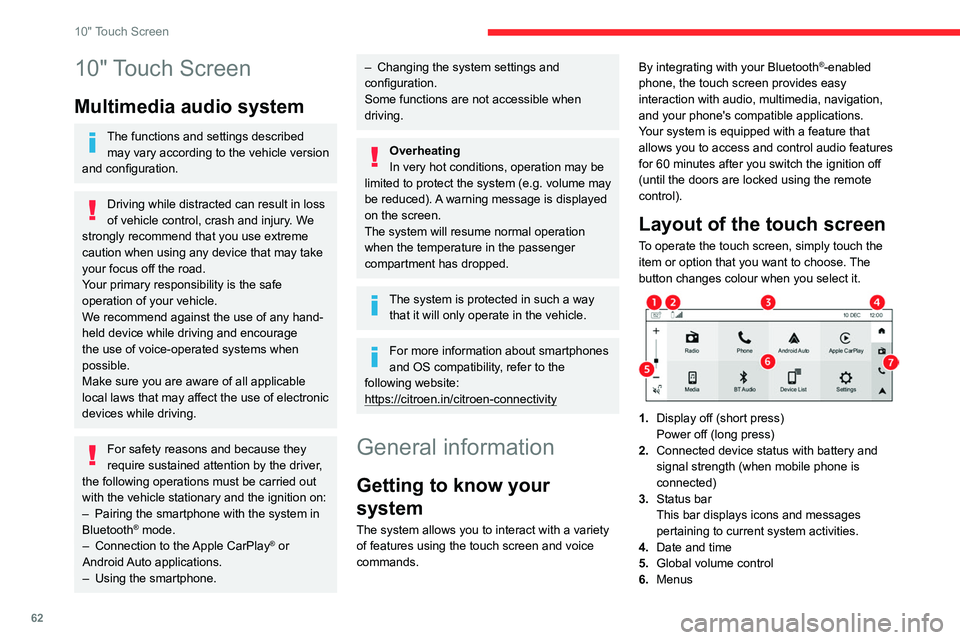
Layout of the touch screen
To operate the touch screen, simply touch the
item or option that you want to choose. The
button changes colour when you select it.
1. Display off (short press)
Power off (long press)
2. Connected device status with battery and
signal strength (when mobile phone is
connected)
3. Status bar
This bar displays icons and messages
pertaining to current system activities.
4. Date and time
5. Global volume control
6. Menus
Page 72 of 104
70
Alphabetical index
A
ABS 23
Adjusting headlamps
20
Adjusting seat
14
Adjusting the air distribution
17
Adjusting the air flow
17
Adjusting the headlamp beam height
20
Adjusting the height and reach of
the steering wheel
15
Adjusting the temperature
17
Advice on care and maintenance
41
Advice on driving
4, 31
Airbags
26–27
Airbags, front
26–27
Air conditioning
16–17
Air conditioning, manual
17
Air intake
18
Air vents
16
Anti-lock braking system (ABS)
23
Antitheft / Immobiliser
10
B
Battery, 12 V 39, 56, 58
Battery, remote control
10
Bodywork
41
Bonnet
35–36
Boot
11
Brake discs
40
Brake lamps
47
Brakes 40
Bulbs
45
Bulbs (changing)
45–47
C
Capacity, fuel tank 35
Cap, fuel filler
35
Care of the bodywork
41
Central locking
9–10
Changing a bulb
45–47
Changing a fuse
48, 51
Changing a wheel
42
Changing the remote control battery
10
Checking the levels
37–38
Checks
37, 39–41
Checks, routine
39–40
Child lock
30
Children
25
Children (safety)
30
Child seats
25, 28–29
Child seats, conventional
29
Cleaning (advice)
41
Closing the boot
11
Control, emergency boot release
11
Control, emergency door
10
Control stalk, lighting
20
Control stalk, wipers
21
Courtesy lamp
47
Courtesy lamps
19
D
Dimensions 60
Dipstick
37
Direction indicators (turn signals)
20, 46–47
Doors
11
Driving
31
Driving economically
4
E
EBFD 23
Eco-driving (advice)
4
Electric windows
12
Electronic brake force distribution (EBFD)
23
Emergency warning lamps
23
Engine
35–36, 41
Engine compartment
37
Engine, petrol
60
Engines
60
Environment
10
F
Filling the fuel tank 35
Filter, air
40
Filter, oil
40
Filter, passenger compartment
16, 40
Fitting a wheel
43–44
Fittings, boot
19
Page 74 of 104

72
Alphabetical index
P
Pads, brake 40
Paint
41
Parking sensors, audible and visual
33
Parking sensors, rear
33
Plates, identification
60
Port, USB
18
Pressures, tyres
40, 61
Pre-tensioning (seat belts)
25
Protecting children
26–28
Puncture
42
R
Recirculation, air 18
Reminder, lighting on
20
Remote control
9–10
Removing a wheel
43–44
Replacing bulbs
45–47
Replacing fuses
48
Replacing the air filter
40
Replacing the oil filter
40
Replacing the passenger compartment
filter
40
Reservoir, screenwash
38
Reversing lamps
47
Roof rack
41
S
Safety, children 26–28
Screenwash
21
Screenwash, front
21
Seat belts
24–25
Seats, front
14
Seats, rear
15–16
Serial number, vehicle
60
Servicing
7, 39, 40–41
Sidelamps
47
Starting the engine
31
Starting the vehicle
31–32
Starting using another battery
56
Stay, engine bonnet
36
Steering wheel (adjustment)
15
Stopping the vehicle
31–32
Storage
18
Suspension
40
Switch, ignition
31
Switching off the engine
31
T
Tables of engines 60
Tables of fuses
48, 51
Tank, fuel
35
Technical data
60
Temperature, coolant
7
Tools
42
Towing
58–59
Trip computer 7–8
Tyres
40, 61
U
Unlocking 9
Unlocking from the inside
10
Unlocking the doors
10
V
Ventilation 16
W
Warning and indicator lamps 5
Warning lamp, driver's seat belt not
fastened
25
Warning lamps
5
Warning lamp, seat belts
25
Warnings and indicators
5
Washing (advice)
41
Wheel, spare
40, 42–44
Wipers
21
Wipers, windscreen
21
Page 75 of 104

73
TABLE OF CONTENTS
What is this chapter and How to use it? ........................................................................\
.........
WARRANTY SECTION
CITROËN Contractual Warranty Certificate ........................................................................\
...
Standard W arranty ........................................................................\
.........................................
Battery W
arranty ........................................................................\
..............................................
Replacement Part Warranty
........................................................................\
...........................
Coupons
........................................................................\
.........................................................
MAINTENANCE SECTION
Maintenance ........................................................................\
....................................................
Scheduled Maintenance ........................................................................\
.................................
Maintenance Schedule
........................................................................\
...................................
Service Record
........................................................................\
...............................................
CITROËN ASSISTANCE
Maintenance and Warranty
Page 79 of 104
77
12VIN:
MODEL:OWNER NAME
& ADDRESS
VARIANT:
COLOUR:
ENGINE NO:
CONTACT NO:
KEY NO: E-mail ID:
INVOICE DATE: SELLING
DEALER NAME
& CODE
ODOMETER READING
KM
REGISTRATION NO:
BATTERY MAKE: DEALER
SHOWROOM
ADDRESS &
CONTACT NO.
(STAMP)
BATTERY NO:
BATTERY BATCH:
TYPE MAKE BATCH CODE
Front Right
CONTACT NO.
FOR SERVICE
APPOINTMENT
& SUPPORT
Front left
Rear Right Rear Left Spare
Maintenance and Warranty
Page 82 of 104
80
BATTERY WARRANTY
Terms & Conditions for Battery Warranty
• Battery originally installed on a new CITROËN vehicle is warranted
by the battery manufacturer.
•
Batteries are warranted against all defects in material and workmanship.\
Liability under this Battery W
arranty is limited to making good of defects
arising solely from the use of faulty material or workmanship during
manufacture and developing under proper use.
•
The Battery W
arranty is VALID only if the battery is properly used and
checked regularly as per the maintenance schedule at the service
stations of the CITROËN Authorised Dealers during the New Vehicle
Warranty Period.
•
This Battery warranty does not cover damage to the battery caused by
faulty electrical systems, irregular servicing, negligent maintenance,
wilful abuse or destruction by fire, collision or theft.
•
This Battery W
arranty is NOT VALID if the battery under complaint has
been opened or tampered with in any manner whatsoever. It should be
returned to the nearest CITROËN Authorised Dealer complete with the
electrolyte. The CITROËN Authorised Dealer has the option either to
rectify the defect in the battery or replace the battery.
•
Breakage of container and cover does not come under the purview of
this Battery W
arranty.
•
T
o and fro transportation charges of the battery under complaint will be \
borne by the customer.
•
The liability under this Battery W
arranty will cease on the transfer of
the battery to any person other than the original purchaser of the new
Citroën vehicle or to any vehicle other than that on which the battery
was originally fitted.
Battery Installation and General Maintenance
Although the battery is made as robust and durable as possible, the following must be observed to get maximum performance from the
battery.
•
The battery must be fitted firmly in the battery cradle, so that no undue
vibration or straining occurs.
•
Connecting cables should have adequate current carrying capacity and
be long enough to prevent straining of the battery terminals. It must be\
ensured that correct polarities (plus to plus and minus to minus) are \
connected.
•
T
erminals should be brushed clean before connecting and coated
immediately afterwards with pure petroleum jelly and NOT grease.
•
Battery top should be clean and dry
.
Maintenance and Warranty
Page 94 of 104

92
MAINTENANCE
Necessity of maintenance
Your CITROËN vehicle has been manufactured using the latest technology
and under the strictest quality control standards. It is also designed t\
o
minimize maintenance requirements with longer service intervals to save \
you both time and money.
However, scheduled maintenance is necessary to ensure your CITROËN
vehicle operates properly and efficiently for the reasons listed below:
Lubricants:
Your CITROËN vehicle uses various kinds of oils and fluids, including
engine oil, transmission fluid, differential fluid, battery fluid, and engine
coolant. These oils and fluids play very important roles, such as lubricating
and cooling the vehicle and preventing rust. Periodically they need to b\
e
properly refilled or replaced.
Rubber parts:
Hoses, belts and boots use rubber parts, which are bound to crack when
worn out. They need to be replaced with new ones if they should wear out.
Normal deterioration
Vehicles are equipped with many parts for which it is impossible to avoid\
normal wear and tear. These parts include: tires, brake pads, clutch
disc, etc. They are indispensable for basic vehicle functions and must be
replaced regularly.
Maintenance services at CITROËN Authorised Dealers
A CITROËN Authorised Dealer has factory-trained technicians and genuine
CITROËN parts to service your vehicle properly. For expert advice and
quality service, visit a CITROËN Authorised Dealer.
Inadequate, incomplete or insufficient servicing may result in operational
problems with your vehicle that could lead to vehicle damage, an acciden\
t,
or personal injury.
We appreciate your understanding of the importance of these instructions,\
and we look forward to servicing your vehicle at CITROËN Authorised
Dealers.Failure to perform scheduled maintenance may result in
reduced vehicle performance or possible breakdowns,
as well as exclusion from warranty coverage
WARNING!
Maintenance and Warranty