fuel CITROEN C3 2023 User Guide
[x] Cancel search | Manufacturer: CITROEN, Model Year: 2023, Model line: C3, Model: CITROEN C3 2023Pages: 104, PDF Size: 2.38 MB
Page 55 of 104

53
In the event of a breakdown
8Fuse No.ColourRating (A) Functions
FF03 Red 10Horn
FF04 Green 30ECM Loads (Ignition Coil
/ Injectors / Fuel Pump)
FF05 Blue 15ECM Loads (Canister Valve
/ O2 Sensors)
FF06 Ta n 5ECM Loads (VVT Valve)
FF07 Yellow 20ECM Power Supply
FF08 Ta n 5Radiator Fan Relay Coil Supply
FS01 Black 80Cabin Fuse Box Loads (CFB-1)
FS02 Yellow 60Electric Power Steering (EPS) Motor
FS03 Green 40ABS Motor
FS04 Green 40Radiator Fan
FS05 Green 40Accessory Load (HVAC Blower/Washer)
FF Green 30Service
FF Blue 15Service
FF Red 10Service
Relay ColourRating (A) Functions
MICRO Brown 20HVAC Compressor
MICRO Brown 20Horn
MICRO Brown 20Starter Solenoid
MICRO Grey 35ECM Main
Page 56 of 104

54
In the event of a breakdown
Engine fuse cum relay box turbo
Fuse No.ColourRating (A) Functions
FF01 Green 30ABS ECU
FF02 Red 10HVAC Compressor
FF03 Red 10Horn
FF04 Green 30ECM Loads (Ignition Coil
/ Fuel Pump)
FF05 Blue 15ECM Loads (Canister Valve
/ O2 Sensors)
FF06 Blue 15ECM Loads (VVT
/ Thermostat / Oil Pump Valve)
FF07 Yellow 20ECM Power Supply & Injectors
FF08 Ta n 5Radiator Fan Relay Coil Supply
FS01 Black 80Cabin Fuse Box Loads (CFB-1)
FS02 Yellow 60Electric Power Steering (EPS) Motor
FS03 Green 40ABS Motor
FS04 Yellow 60Radiator Fan
FS05 Green 40Accessory Load (HVAC Blower/Washer)
FF Green 30Service
FF Blue 15Service
FF Red 10Service
Relay ColourRating (A) Functions
MICRO Brown 20HVAC Compressor
MICRO Brown 20Horn
MICRO Brown 20Starter Solenoid
MICRO Grey 35ECM Main
Page 59 of 104
57
In the event of a breakdown
8at least equal to that of the discharged
battery.
The two vehicles must not be in contact with
each other.
Switch off all electricity-consuming equipment
on both vehicles (audio system, wipers,
lighting, etc.).
Make sure that the jump leads are well away
from the engine’s moving parts (fan, belt,
etc.).
Do not disconnect the (+) terminal while the
engine is running.
During jump start, extra care should be taken
to ensure right terminals are connected. If
terminal connections are reversed, it will
lead to failure of alternator & other electrical,
electronic components.
Never power electrical or electronic
components directly from battery terminals
as it will lead to poor battery charging, poor
performance of components and battery
sensor malfunction, which will impact fuel
economy. For Naturally Aspirated engine version
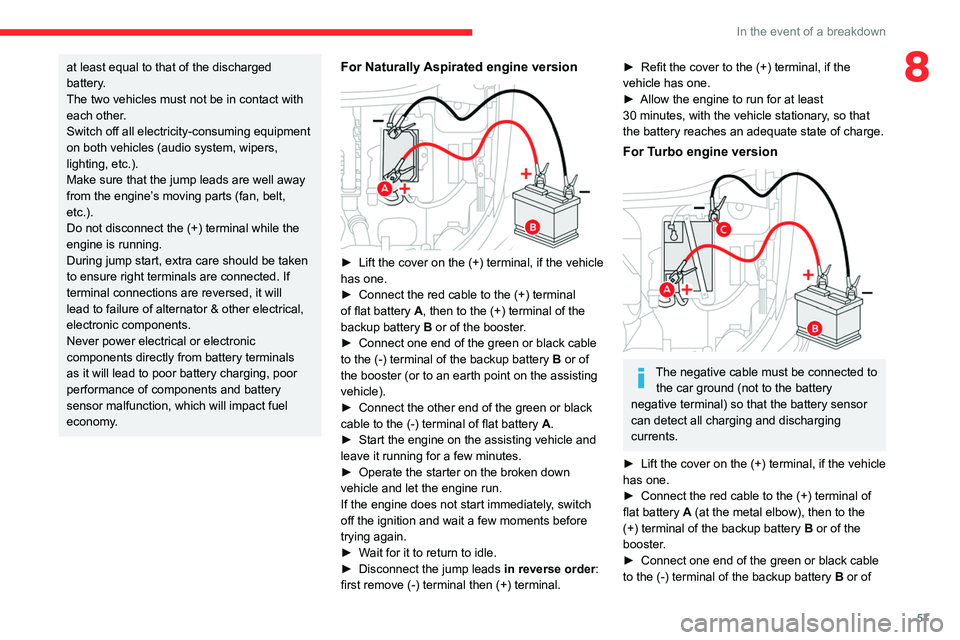
► Lift the cover on the (+) terminal, if the vehicle
has one.
►
Connect the red cable to the (+) terminal
of flat battery
A, then to the (+) terminal of the
backup battery
B or of the booster.
►
Connect one end of the green or black cable
to the (-) terminal of the backup battery
B or of
the booster (or to an earth point on the assisting
vehicle).
►
Connect the other end of the green or black
cable to the (-) terminal of flat battery
A.
►
Start the engine on the assisting vehicle and
leave it running for a few minutes.
►
Operate the starter on the broken down
vehicle and let the engine run.
If the engine does not start immediately
, switch
off the ignition and wait a few moments before
trying again.
►
W
ait for it to return to idle.
►
Disconnect the jump leads in reverse order:
first remove (-) terminal then (+) terminal.
► Refit the cover to the (+) terminal, if the
vehicle has one.
►
Allow the engine to run for at least
30
minutes, with the vehicle stationary, so that
the battery reaches an adequate state of charge.
For Turbo engine version
The negative cable must be connected to the car ground (not to the battery
negative terminal) so that the battery sensor
can detect all charging and discharging
currents.
►
Lift
the cover on the (+) terminal, if the vehicle
has one.
►
Connect the red cable to the (+) terminal of
flat battery
A (at the metal elbow), then to the
(+) terminal of the backup battery
B or of the
booster.
►
Connect one end of the green or black cable
to the (-) terminal of the backup battery
B or of
Page 60 of 104

58
In the event of a breakdown
the booster (or to an earth point on the assisting
vehicle).
►
Connect the other end of the green or black
cable to the earth point
C
on the broken down
vehicle.
►
Start the engine on the assisting vehicle and
leave it running for a few minutes.
►
Operate the starter on the broken down
vehicle and let the engine run.
If the engine does not start immediately
, switch
off the ignition and wait a few moments before
trying again.
►
W
ait for it to return to idle.
►
Disconnect the jump leads in reverse order:
first remove (-) terminal then (+) terminal..
►
Refit the cover to the (+) terminal, if the
vehicle has one.
►
Allow the engine to run for at least
30
minutes, with the vehicle stationary, so that
the battery reaches an adequate state of charge.
Driving immediately without having
reached a sufficient level of charge may
affect some of the vehicle's functionalities.
Disconnecting/removing the
battery
In order to maintain an adequate state of charge
for starting the engine, it is recommended that
the battery be disconnected if the vehicle is
taken out of service for a long period.
Before disconnecting the battery: ►
Close all openings (doors, boot, windows).
►
Switch off all electrical consumers (audio
system, wipers, lighting, etc.).
►
Switch off the ignition and wait for 4
minutes.
Naturally Aspirated engine version
Turbo engine version
►
Disconnect the negative cable.
►
Disconnect the positive cable.
► Remove the mounting bracket if you need to
remove the battery .
Be careful not to cause accidental short
circuits between the positive and
negative battery terminals.
Do not allow smoking, sparks or flames
around fuel or the battery.
After reconnection
After reconnecting the battery, turn on the
ignition and wait 1 minute before starting the
engine, to enable the electronic systems to
initialise.
If minor problems nevertheless persist following
this operation, contact a CITROËN dealer.
Referring to the relevant section, initialise or
reset certain equipment:
–
Date and time.
–
Preset radio stations.
Towing the vehicle
General recommendations
Observe the legislation in force in the
country where you are driving.
Ensure that the weight of the towing vehicle is
higher than that of the towed vehicle.
The driver must remain at the wheel of the
towed vehicle and must have a valid driving
licence.
Page 62 of 104
60
Technical data
Engines technical data
The engine characteristics are given in the
vehicle's registration document, as well as in
sales brochures.
The maximum power corresponds to the value type-approved on a test bed, under
conditions defined as per AIS 137 (Part 5).
For more information, contact a CITROËN
dealer.
Engine EB2NA
engine EB2ADTM
engine
Gearbox MA5
(Manual
5-speed) MB6
(Manual
6-speed)
Cubic capacity 1 199 cc 1 199 cc
Max. power 60 kW at 5750 rpm81 kW at
5500 rpm
Fuel BSVI
Commercial Gasoline Fuel BSVI
Commercial Gasoline Fuel
Curb weight L1-939 kg L2-964 kgL2-1035 Kg
Dimensions (mm)
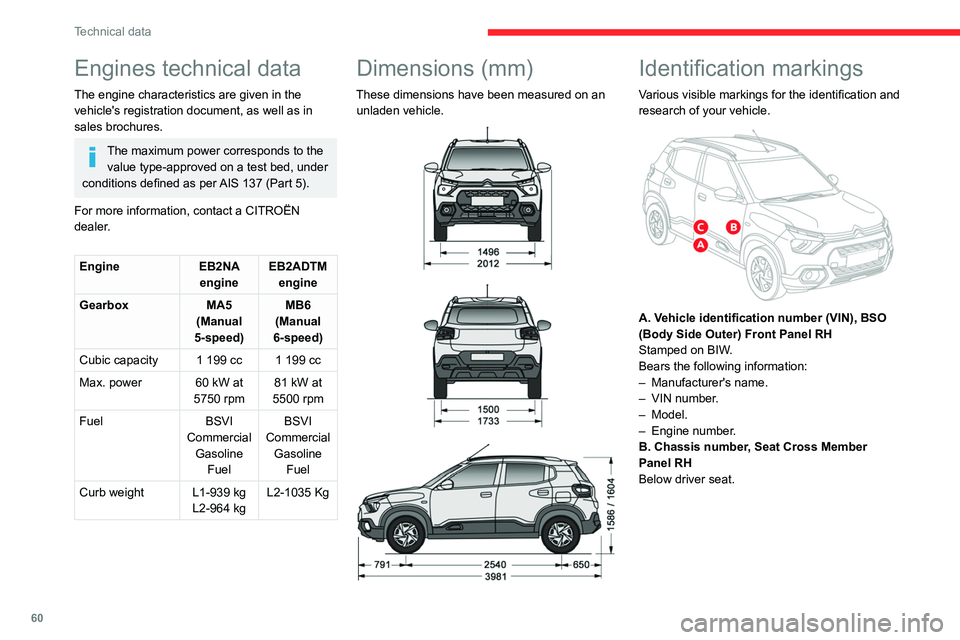
These dimensions have been measured on an
unladen vehicle.
Identification markings
Various visible markings for the identification and
research of your vehicle.
A. Vehicle identification number (VIN), BSO
(Body Side Outer) Front Panel RH
Stamped on BIW.
Bears the following information:
–
Manufacturer's name.
–
VIN number
.
–
Model.
–
Engine number
.
B. Chassis number, Seat Cross Member
Panel RH
Below driver seat.
Page 72 of 104
70
Alphabetical index
A
ABS 23
Adjusting headlamps
20
Adjusting seat
14
Adjusting the air distribution
17
Adjusting the air flow
17
Adjusting the headlamp beam height
20
Adjusting the height and reach of
the steering wheel
15
Adjusting the temperature
17
Advice on care and maintenance
41
Advice on driving
4, 31
Airbags
26–27
Airbags, front
26–27
Air conditioning
16–17
Air conditioning, manual
17
Air intake
18
Air vents
16
Anti-lock braking system (ABS)
23
Antitheft / Immobiliser
10
B
Battery, 12 V 39, 56, 58
Battery, remote control
10
Bodywork
41
Bonnet
35–36
Boot
11
Brake discs
40
Brake lamps
47
Brakes 40
Bulbs
45
Bulbs (changing)
45–47
C
Capacity, fuel tank 35
Cap, fuel filler
35
Care of the bodywork
41
Central locking
9–10
Changing a bulb
45–47
Changing a fuse
48, 51
Changing a wheel
42
Changing the remote control battery
10
Checking the levels
37–38
Checks
37, 39–41
Checks, routine
39–40
Child lock
30
Children
25
Children (safety)
30
Child seats
25, 28–29
Child seats, conventional
29
Cleaning (advice)
41
Closing the boot
11
Control, emergency boot release
11
Control, emergency door
10
Control stalk, lighting
20
Control stalk, wipers
21
Courtesy lamp
47
Courtesy lamps
19
D
Dimensions 60
Dipstick
37
Direction indicators (turn signals)
20, 46–47
Doors
11
Driving
31
Driving economically
4
E
EBFD 23
Eco-driving (advice)
4
Electric windows
12
Electronic brake force distribution (EBFD)
23
Emergency warning lamps
23
Engine
35–36, 41
Engine compartment
37
Engine, petrol
60
Engines
60
Environment
10
F
Filling the fuel tank 35
Filter, air
40
Filter, oil
40
Filter, passenger compartment
16, 40
Fitting a wheel
43–44
Fittings, boot
19
Page 73 of 104
71
Alphabetical index
Fittings, interior 18
Flap, fuel filler
35
Flashing indicators
20, 46
Fluid, brake
38
Fluid, engine coolant
38
Folding the rear seats
15–16
Fuel
4
Fuel consumption
4
Fuel level, low
35
Fuel (tank)
35
Fusebox, dashboard
48
Fusebox, engine compartment
48, 51
Fuses
48, 51
G
Gauge, fuel 35
Gearbox, manual
32, 40
Gear lever, manual gearbox
32
Gear shift indicator
33
Glove box
18
H
Hazard warning lamps 23
Headlamps (adjustment)
20
Headlamps, dipped beam
46
Headlamps, halogen
20, 45
Headlamps, main beam
46
Heating
16
Hooks 19
Horn
23
I
Indicator, coolant temperature 7
Indicators, direction
20, 46
Indicator, service
7
Inflating tyres
40, 61
Instrument panels
5
J
Jack 42
Jump starting
56
K
Key 9–10
Key with remote control
9, 31
L
Labels, identification 60
Lamps, rear
47
LEDs - Light-emitting diodes
46–47
Level, brake fluid
38
Level, engine coolant
7, 38
Level, engine oil 37
Levels and checks
37–38
Level, screenwash fluid
21, 38
Light-emitting diodes - LEDs
46–47
Lighting, exterior
20
Lighting, interior
19
Locating your vehicle
9
Locking
9
Locking from the inside
10
Locking the doors
10
M
Maintenance (advice) 41
Maintenance, routine
39
Map reading lamps
19
Markings, identification
60
Mirrors, door
15
O
Obstacle detection 33
Oil change
37
Oil consumption
37
Oil, engine
37
On-board tools
42
Opening the bonnet
35–36
Opening the boot
11
Opening the doors
11
Page 74 of 104

72
Alphabetical index
P
Pads, brake 40
Paint
41
Parking sensors, audible and visual
33
Parking sensors, rear
33
Plates, identification
60
Port, USB
18
Pressures, tyres
40, 61
Pre-tensioning (seat belts)
25
Protecting children
26–28
Puncture
42
R
Recirculation, air 18
Reminder, lighting on
20
Remote control
9–10
Removing a wheel
43–44
Replacing bulbs
45–47
Replacing fuses
48
Replacing the air filter
40
Replacing the oil filter
40
Replacing the passenger compartment
filter
40
Reservoir, screenwash
38
Reversing lamps
47
Roof rack
41
S
Safety, children 26–28
Screenwash
21
Screenwash, front
21
Seat belts
24–25
Seats, front
14
Seats, rear
15–16
Serial number, vehicle
60
Servicing
7, 39, 40–41
Sidelamps
47
Starting the engine
31
Starting the vehicle
31–32
Starting using another battery
56
Stay, engine bonnet
36
Steering wheel (adjustment)
15
Stopping the vehicle
31–32
Storage
18
Suspension
40
Switch, ignition
31
Switching off the engine
31
T
Tables of engines 60
Tables of fuses
48, 51
Tank, fuel
35
Technical data
60
Temperature, coolant
7
Tools
42
Towing
58–59
Trip computer 7–8
Tyres
40, 61
U
Unlocking 9
Unlocking from the inside
10
Unlocking the doors
10
V
Ventilation 16
W
Warning and indicator lamps 5
Warning lamp, driver's seat belt not
fastened
25
Warning lamps
5
Warning lamp, seat belts
25
Warnings and indicators
5
Washing (advice)
41
Wheel, spare
40, 42–44
Wipers
21
Wipers, windscreen
21
Page 80 of 104

78
STANDARD WARRANTY
CITROËN New Vehicle Warranty
PCA Automobiles India Private Limited (hereinafter called “PAIPL”),
warrants that each new CITROËN vehicle sold shall be free from any
defects in material and workmanship, under normal use and maintenance,
subject to the following terms and conditions.
New Vehicle Warranty Period
This warranty (“New Vehicle Warranty“) shall exist for a period of
24 months or 40,000 kilometres, from the date of delivery whichever
is earlier (“New Vehicle Warranty Period”). This warranty is transferable
to subsequent owner for the remaining New Vehicle Warranty Period.
This warranty is applicable only in India and not transferable to any ot\
her
country.
What is covered?
Except as provided in “What is not covered?” hereof, our Authorised
Dealers shall either repair or replace, any CITROËN genuine part that is
acknowledged by PAIPL to be defective in material or workmanship within
the New Vehicle Warranty Period stipulated above, at no cost to the owner
of the CITROËN vehicle for parts or labour. Such defective parts which
have been replaced will become the property of PAIPL.
What is not covered?
This warranty shall not apply to:
• Normal maintenance services, including without limitation, cleaning and
polishing, minor adjustments, engine tuning, oil/ fluid changes, filters
replenishment, fastener retightening, wheel balancing, wheel alignment
and tyre rotation etc.
•
Replacement of parts as a result of normal wear and tear such as spark
plugs, belts, brake pads and linings, clutch disc/facing, filters, wiper
blades, bulbs, fuses, etc. •
Any vehicle on which the odometer reading has been altered so that
mileage cannot be accurately determined.
What is not covered?
Damage or failure resulting from:
• Negligence of proper maintenance as required in the chapter
.
• Misuse, abuse, accident, theft, flooding or fire.
•
Use of improper or insufficient fuel, fluids or lubricants.
•
Use of parts other than CITROËN Genuine Parts.
•
Any device and/or accessories not supplied by P
AIPL.
•
Modifications, alterations, tampering or improper repair
.
•
Parts used in applications of which they were not designed or not
approved by P
AIPL.
•
Slight irregularities not recognised as affecting quality or function of the
vehicle or parts, such as slight noise or vibrations, or items considere\
d
characteristic of the vehicle.
•
Airborne, fallout, industrial fallout, acid rain, hail and wind storms, \
or
other
Acts of God.
•
Paint scratches, dents or similar paint or body damage.
•
Action of road elements (sand, gravel, dust or road debris) which resu\
lts
in stone chipping of paint or glass.
•
Incidental or consequential damages, including without limitation, loss \
of
time, inconvenience, loss of use of vehicle or commercial loss.
•
This warranty is the entire warranty given by P
AIPL for CITROËN
vehicles and no dealer or its or his agent or employee is authorised
to extend or enlarge this warranty and no dealer or its or his agent or \
employee is authorised to make any oral warranty on PAIPL behalf.
•
P
AIPL reserves the right to make any change in design or make any
improvement on the vehicle at any time without any obligation to make
the same change on vehicles previously sold.
•
P
AIPL reserves the right for the final decision in all warranty matters.
Maintenance and Warranty
Page 83 of 104

81
REPLACEMENT PART WARRANTY
PAIPL warrants that each new CITROËN genuine replacement part
purchased from and installed by CITROËN Authorised Dealer shall be
free from any defects in material or workmanship, under normal use and
maintenance, subject to the following terms and conditions.
Replacement Parts Warranty Period
This warranty (“Parts Warranty”) shall exist for a period of 1 Year or until
the vehicle has been driven for a distance of 10,000 Kilometres from
the date of installation of replacement part by CITROËN Authorised Dealer,
whichever occurs first (“Parts Warranty Period”).
What is covered?
Our Authorised Dealers shall either repair or replace, any CITROËN
genuine part (except the cases listed in “What is not covered?” below),
that is acknowledged by PAIPL to be defective in material or workmanship
within the Parts Warranty Period stipulated above, after examinations
carried out to confirm that none of the original settings have been
tampered with, at no cost to the owner of the CITROËN vehicle for parts
or labour. Such defective parts which have been replaced will become the
property of PAIPL.
What is not covered?
This Parts Warranty shall not apply to:
• Normal maintenance services of parts such as brake cleaning,
adjustment or replacement (i.e. spark plugs that are oil fouled, lead
fouled, or which fail due to the use of low grade fuel).
•
Parts that fail due to abuse, misuse, neglect, alteration or accident or\
which have been improperly lubricated or repaired.
•
Parts used in applications for which they were not designed or approved \
by P
AIPL.
•
Failure due to normal wear of parts. •
Direct or indirect failures caused by misuse and improper maintenance
of vehicle.
•
Any vehicle on which the odometer reading has been altered so that
mileage cannot be accurately determined.
•
Incidental or consequential damages, including without limitation, loss \
of
time, inconvenience, loss of use of vehicle or commercial loss.
This Parts W
arranty is the entire warranty given by PAIPL for CITROËN
replacement parts and no dealer or its or his agent or employee is
authorised to extend or enlarge this warranty and no dealer or its or hi\
s
agent or employee is authorised to make any oral warranty on PAIPL
behalf. PAIPL reserves the right for the final decision in all warranty
matters.
Owner’s Responsibility:
• Proper use, maintenance and care of the vehicle in accordance with the
instructions contained in the Owner ’s Manual.
•
Retention of maintenance service records. It may be necessary for the
customer to show that the required maintenance has been performed,
as specified in the Owner
’s Manual.
•
Retention of the customer
’s copy of the original repair order and its
invoice/bill against which the part was replaced.
•
Delivery of the vehicle during regular service business hours to the
same CITROËN
Authorised Dealer who had sold and installed the
replacement part.
•
In order to maintain the validity of this Parts W
arranty, the vehicle must
be serviced by CITROËN authorised workshop in accordance to the
Owner’s Manual.
Maintenance and Warranty