wheel CITROEN C3 2023 User Guide
[x] Cancel search | Manufacturer: CITROEN, Model Year: 2023, Model line: C3, Model: CITROEN C3 2023Pages: 104, PDF Size: 2.38 MB
Page 29 of 104
27
Safety
5Non-inflation conditions
1. Low speed front collisionsThe airbags may not deploy if the collision is
not severe and below the design threshold
intensity. The force of impact is less in this
case and much of the protection during low
speed crash is provided by seat belts, if
properly worn.
2. Rear collisions Frontal airbags are not designed to deploy
when there is a rear crash, since the
occupants tend to move backwards. In this
case, the airbags will not provide any benefit
to cushion the force of impact.
3. Side collisions Frontal airbags may not deploy during side
crash, since the occupant moves sideways.
4. Angled collisions Airbags may not deploy if the angle of
collision is beyond 30 degrees with the
head-on vehicle or the rigid wall or curb or
pole.
5. Roll over collisions Frontal airbags may not deploy in roll over
conditions, as the occupant moves sideways
or rolls. Important to wear seat belts in this
case, to avoid floating inside the vehicle and
risk serious injuries.
6. Speed breakers & pot holes Airbags may not deploy when crossing speed
breakers even at high speed or when vehicle
drops into pot hole or ditch drop.7. Curb hitsThe airbag may not deploy when the vehicle
hits the curbs.
8. Pedestrian impact Airbags will not inflate when the vehicle hits
the pedestrian.
Malfunction
If this warning lamp comes on in the
instrument panel, you must contact a
CITROËN dealer to have the system checked.
The airbags may not be deployed in the event of
a serious impact.
Advice
For the airbags to be fully effective,
observe the safety recommendations
below.
Adopt a normal upright sitting position.
Fasten the seat belt ensuring it is correctly
positioned and adjusted.
Do not leave anything between the occupants
and the airbags (a child, pet, object, etc.), nor
fix or attach anything close to or in the way of
the airbag release trajectory; this could cause
injuries during their deployment.
Never modify the original definition of your
vehicle, particularly in the area directly around
the airbags.
After an accident or if the vehicle has been
stolen, have the airbag systems checked.
All work on the airbag systems must only be
performed by a CITROËN dealer.
Even if all of the precautions mentioned
are observed, a risk of injury or of minor
burns to the head, chest or arms cannot be
ruled out when an airbag is deployed. The
airbag inflates almost instantly (within a few
milliseconds) then deflates within the same
time discharging the hot gas via openings
provided for this purpose.
Do not drive holding the steering wheel
by its spokes or resting your hands on
the centre part of the wheel.
Passengers must not place their feet on the
dashboard.
Do not smoke as deployment of the airbags
can cause burns or the risk of injury from a
cigarette or pipe.
Never remove or pierce the steering wheel or
hit it violently.
Do not fix or attach anything to the steering
wheel or dashboard, as this could cause
injuries when the airbags are deployed.
Page 33 of 104
31
Driving
6Driving recommendations
► Observe the driving regulations and remain
vigilant whatever the traffic conditions.
►
Monitor your environment and keep your
hands on the wheel to be able to react to
anything that may happen any time.
►
Drive smoothly
, anticipate the need for
braking and maintain a longer safety distance,
especially in bad weather.
►
Stop the vehicle to carry out operations that
require close attention (such as adjustments).
►
During long trips, take a break every two
hours.
Important!
Never leave the engine running in a
closed space without sufficient
ventilation. Internal combustion engines emit
toxic exhaust gases such as carbon
monoxide. Danger of poisoning and death!
In severe wintry conditions, let the engine
run for 4 minutes before moving off, to
ensure the correct operation and durability of
the mechanical components of your vehicle
(engine and gearbox).
Never drive with the parking brake
applied . Risk of overheating and
damage to the braking system!
Do not park the vehicle or leave the
engine running on a flammable
surface (dry grass, dead leaves, etc.). The
exhaust system of your vehicle is very hot,
even several minutes after the engine stops.
Risk of fire!
Never leave a vehicle unattended with
the engine running. If you have to leave
your vehicle with the engine running, apply
the parking brake and put the gearbox into
neutral.
Never leave children inside the vehicle
unsupervised.
On flooded roads
We strongly advise against driving on flooded
roads, as this could cause serious damage to
the engine or gearbox, as well as to the electrical
systems of your vehicle.
If you have to drive on a flooded road:
► drive as slowly as possible without stalling. In
all cases, do not exceed 10
km/h,►
do not stop and do not switch off the engine.
On leaving the flooded road, as soon as safety
conditions allow
, make several light brake
applications to dry the brake discs and pads.
If in doubt about the state of your vehicle,
contact a CITROËN dealer.
Starting / Switching off the
engine
Key ignition switch
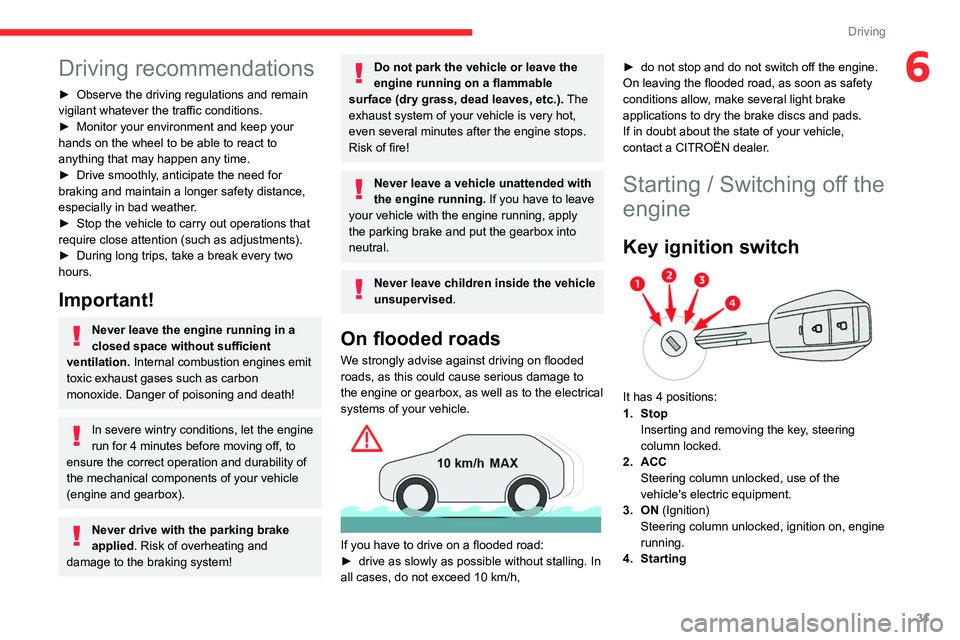
It has 4 positions:
1. Stop Inserting and removing the key, steering
column locked.
2. ACC Steering column unlocked, use of the
vehicle's electric equipment.
3. ON (Ignition) Steering column unlocked, ignition on, engine
running.
4. Starting
Page 34 of 104

32
Driving
Avoid attaching heavy objects to the key or the remote control. It would weigh
down on its shaft in the ignition switch and
could cause a malfunction.
Ignition on position
It allows the use of the vehicle's electric
equipment or portable devices to be charged.
Starting the engine
With the parking brake applied:
► Place the gear lever in neutral then fully
depress the clutch pedal.
►
Insert the key into the ignition switch; the
system recognises the code.
►
Unlock
the steering column by simultaneously
turning the steering wheel and the key.
In certain cases, you may have to apply
significant force to move the steering
wheel (wheels on full lock, for example).
►
Operate the starter motor by turning the key
to position
3 without pressing the accelerator
pedal, until the engine starts. Once the engine
starts, release the key.
After a cold start, preheating the catalytic converter can cause noticeable engine
vibrations for anything up to 2 minutes while
stationary with the engine running
(accelerated idle speed).
If the engine does not start straight away,
switch off the ignition. Wait a few
seconds before operating the starter motor
again. If the engine does not start after a few
attempts, do not keep trying - risk of
damaging the starter motor, the battery and
the engine.
Contact a CITROËN dealer.
In mild conditions, do not leave the
engine at idle to warm up but move off
straight away and drive at moderate speed.
5-speed manual gearbox
Engaging reverse gear
► Fully depress the clutch pedal.
► Push the gear lever fully to the right, then
backwards.
Only engage reverse gear when the
vehicle is stationary with the engine at
idle.
As a safety precaution and to facilitate starting the engine:
–
Always select neutral.
–
Depress the clutch pedal.
6-speed manual gearbox
Engaging 5th or 6th gear
► Move the gear selector fully to the right to
engage 5th or 6th gear.
Failure to follow this instruction could
cause permanent damage to the gearbox
(inadvertent engagement of 3
rd or 4th gear).
Engaging reverse gear
► Raise the ring under the knob and move the
gear selector to the left, then forwards.
Page 42 of 104
40
Practical information
The battery electrolyte must be filled. If the level
is found to be below the “MIN” level line, add
distilled water to the “MAX” level line.
For more information on the precautions
to take before any work on the 12 V
battery, refer to the corresponding section.
Passenger compartment
filter
Depending on the environment and the
use of the vehicle (e.g. dusty atmosphere,
city driving), change it twice as often, if
necessary .
A clogged passenger compartment filter
can adversely affect air conditioning
system performance and generate
undesirable odours.
Air filter
Depending on the environment and the
use of the vehicle (e.g. dusty atmosphere,
city driving), change it twice as often, if
necessary .
Oil filter
Change the oil filter each time the engine
oil is changed.
Manual gearbox
The gearbox does not require any
maintenance (no oil change).
Brake pads
Brake wear depends on the style of
driving, particularly in the case of vehicles
used in town, over short distances. It may be
necessary to have the condition of the brakes
checked, even between vehicle services.
Unless there is a leak in the circuit, a drop in the
brake fluid level indicates that the brake pads
are worn.
After washing the vehicle, moisture, or in wintry conditions, ice can form on the
brake discs and pads: braking efficiency may
be reduced. Gently dab the brakes to dry and
defrost them.
Brake disc and drum wear
For information on checking brake disc
and drum wear, contact a CITROËN
dealer.
Wheels and tyres
The inflation pressure of all tyres, including the spare wheel, must be
checked on "cold” tyres.
The pressures indicated on the tyre pressure
label are valid for "cold" tyres. If you have driven
for more than 10 minutes or more than 10
kilometres at over 50 km/h, add 0.3 bar (30 kPa)
to the values indicated on the label.
Under-inflation increases fuel
consumption. Non-compliant tyre
pressure causes premature wear on tyres and
has an adverse effect on the vehicle's road
holding - risk of an accident!
Driving with worn or damaged tyres reduces the
braking and road holding performance of the
vehicle. It is recommended to regularly check the
condition of the tyres (tread and sidewalls) and
wheel rims as well as the presence of the valves.
When the wear indicators no longer appear set
back from the tread, the depth of the grooves is
less than 1.6 mm; it is imperative to replace the
tyres.
Using different size wheels and tyres from those
specified can affect the lifetime of tyres, wheel
rotation, ground clearance, the speedometer
reading and have an adverse effect on road
holding.
Fitting different tyres on the front and rear axles
can cause ABS and EBFD systems to mistime.
Shock absorbers
It is not easy for drivers to detect when
shock absorbers are worn. Nevertheless,
the shock absorbers have a major impact on
road-holding and braking performance.
For your safety and driving comfort, it is
important to have them regularly checked by a
CITROËN dealer.
Page 44 of 104

42
In the event of a breakdown
Tool kit
Set of tools supplied with the vehicle.
Accessing the tools
The tools are located under the boot floor carpet,
with the spare wheel.
List of tools
1.Jack
To raise the vehicle.
2.Jack handle
3. Wheel wrench
To remove the wheel bolts.
4. Removable towing eye
For more information on Towing the vehicle
and using the removable towing eye, refer to the
corresponding section.
These tools are specific to the vehicle and may vary according to the level of
equipment.
Do not use them for any other purpose.
The jack must only be used to change a wheel with a damaged or punctured tyre.
Do not use any jack other than the one
supplied with the vehicle.
If the vehicle does not have its original jack,
contact a CITROËN dealer.
The jack does not require any maintenance.
Spare wheel
Access to the spare wheel
The spare wheel is installed in the boot, under
the floor carpet.
Removing the spare wheel
► Rotate the fixing screw to unlock the spare
wheel.
►
Lift the spare wheel towards you from the
rear
.
►
T
ake the wheel out of the boot.
Removing the jack
► Rotate the fixing screw to unlock the jack on
one end.
►
T
ilt the jack towards the right and lift it from
the rear.
Page 45 of 104

43
In the event of a breakdown
8Removing a wheel
Parking the vehicle
Immobilise the vehicle where it does
not obstruct traffic: the ground must be level,
stable and non-slippery.
With a manual gearbox, engage first gear to
lock the wheels, apply the parking brake and
switch off the ignition.
Check for the fixed illumination of the parking
brake indicator lamps in the instrument panel.
The occupants must get out of the vehicle
and wait where they are safe.
If necessary, place a chock under the wheel
diagonally opposite the wheel to be changed.
Never go underneath a vehicle raised using a
jack; use an axle stand.
Wheel with wheel trim
When removing the wheel , first remove
the wheel trim by pulling at the valve aperture.
When refitting the wheel , refit the wheel
trim, starting by placing its aperture in line
with the valve and then pushing it into place
all round its edge with the palm of your hand.
Wheel nuts removing pattern
► Loosen the nuts on the wheel in diagonal
sequence. Do not remove wheel nuts.
► Slacken the bolts using the wheel wrench 3
only.
► Place the foot of jack 1 on the ground and
ensure that it is directly below the front A or
rear
B jacking point on the underbody, whichever
is closest to the wheel to be changed.
► Extend jack 1 with the jack handle 2 and
wheel wrench 3 until its head comes into contact
with jacking point
A
or B; contact area A or B
on the vehicle must be properly inserted into the
central part of the head of the jack.
►
Raise the vehicle until there is sufficient
space between the wheel and the ground to
admit the spare (not punctured) wheel easily
.
Page 46 of 104

44
In the event of a breakdown
Ensure that the jack is stable. If the
ground is slippery or loose, the jack may
slip or collapse - risk of injury!
Take care to position the jack strictly at
one of the jacking points
A
or B under the
vehicle, ensuring that the head of the jack is
centred under the contact area of the vehicle.
Otherwise, there is a risk of damage to the
vehicle and/or of the jack collapsing - risk of
injury!
► Remove the bolts and store them in a clean
place.
►
Remove the wheel.
Fitting a wheel
► Fit the wheel on the hub.
► Screw in the bolts by hand as far as possible.
►
Pre-tighten the bolts using the wheel wrench
3
only.
► Lower the vehicle again fully .
► Fold jack 1 and remove it.
► Tighten the bolts using the wheel wrench 3
only.
►
Refit the bolt cover (depending on
equipment).
►
Store the tools.
Putting the spare wheel
back in place
► Put the spare wheel back in its housing.
Page 47 of 104

45
In the event of a breakdown
8► Tighten the spare wheel fixing screw by a few
turns.
After changing a wheel
The temporary spare wheel is only intended for temporary emergency use,
until the conventional wheel can be repaired
or replaced.
Continuous use of this spare can result in tire
failure and loss of control. Always observe
these precautions when using this spare:
–
Y
our vehicle will respond differently with
this temporary spare.
–
Do not exceed 80 km/h speed.
–
Replace this spare with a standard tire and
wheel as soon as possible.
–
Use of this spare will reduce ground
clearance.
–
Set the specified tire pressure indicated
on the tire information label located on the
driver's door lock pillar
.
–
Do not use tire chains on the temporary
spare. If you must use tire chains, rearrange
the wheels so standard tires and wheels are
fitted to the front axle.
–
The temporary spare wheel has a much
shorter tread life than the conventional
wheels
on your vehicle. Replace the tire as soon as
possible as the tread wear indicator appears.
The inflation pressure of the temporary spare
wheel should be checked at least monthly. At
the same time, check that the tire is stored
securely. If it is not, tighten it.
Note that two or more temporary spare
wheels should not be used on one vehicle
simultaneously.
Changing a bulb
In some weather conditions (e.g. low
temperature or humidity), misting on the
internal surface of the glass of the headlamps
and rear lamps is normal, and will disappear
after the lamps have been on for a few
minutes.
The headlamps have polycarbonate lenses with a protective coating:
–
Do not clean them with a dry or abrasive
cloth, nor with detergent or solvent
products.
–
Use a sponge and soapy water or a pH
neutral product.
–
When using a high-pressure washer on
persistent marks, do not keep the lance
directed towards the headlamps, lamps or
their edges for too long, so as not to damage
their protective coating and seals.
Changing a bulb must only be done with
the ignition off and after the headlamp /
lamp has been switched off for several
minutes - risk of serious burns!
Do not touch the bulb directly with your
fingers; use a lint-free cloth.
It is essential only to use anti-ultraviolet
(UV) type bulbs, so as not to damage the
headlamp.
Always replace a failed bulb with a new bulb
of the same type and specification. To avoid
lighting imbalance, replace the bulbs in pairs.
Refitting the lamp units
Perform the operations in the reverse
order to dismantling.
Opening the bonnet / Accessing the
bulbs
With the engine warm, proceed with caution -
risk of burns!
Take care with objects or clothing that could
be caught in the blades of the cooling fan -
risk of strangulation!
Halogen bulbs (Hx)
To ensure good quality lighting, check
that the bulb is correctly positioned in its
housing.
Page 49 of 104

47
In the event of a breakdown
8► Ensure that the cover is refitted correctly all
around to ensure correct sealing.
Rear lamps
Model 1
1. Sidelamps / Brake lamps
(P21/5W - 12V - 21W/5W)
2. Direction indicators (PY21W
- 12V - 21W)
3. Reversing lamp (P21W
- 12V - 21W)
Model 2
1.Sidelamps / Brake lamps
(P21/5W - 12V - 21W/5W)
2. Direction indicators (PY21W
- 12V - 21W)
3. Reversing lamp (P21W
- 12V - 21W)
4. Additional sidelamps (W3W
- 12V - 3W)
5. Connecting tail lamps (W3W
- 12V - 3W)
Changing bulbs
These bulbs are changed after removing the tail
lamp assembly.
►
Open the boot.
►
Unscrew the nut and remove it. Be careful
not to drop it inside the wing.
►
Unclip the lamp unit and carefully extract it
pulling straight towards the outside.
A
standard pair of pliers or the wheel wrench
(depending on equipment) may be necessary to
remove the nut.
Sidelamps/Brake lamps / Reversing lamp /
Direction indicators
► Turn the bulb holder a eighth of a turn anti-
clockwise and remove it.
►
Remove the bulb and replace it.
Additional sidelamps / Connecting tail
lamps (if equipped)
► Turn the bulb holder a quarter of a turn and
pull it out.
►
Pull the bulb out and change it.
Interior lighting
Courtesy lamp (10W - 12V - 10W)
► Using a thin, flap tip screwdriver , unclip the
entire console surrounding the courtesy lamp.
►
Remove the defective bulb and replace it.
►
Fit the console back into place around the
courtesy lamp and clip it correctly
.
Page 60 of 104

58
In the event of a breakdown
the booster (or to an earth point on the assisting
vehicle).
►
Connect the other end of the green or black
cable to the earth point
C
on the broken down
vehicle.
►
Start the engine on the assisting vehicle and
leave it running for a few minutes.
►
Operate the starter on the broken down
vehicle and let the engine run.
If the engine does not start immediately
, switch
off the ignition and wait a few moments before
trying again.
►
W
ait for it to return to idle.
►
Disconnect the jump leads in reverse order:
first remove (-) terminal then (+) terminal..
►
Refit the cover to the (+) terminal, if the
vehicle has one.
►
Allow the engine to run for at least
30
minutes, with the vehicle stationary, so that
the battery reaches an adequate state of charge.
Driving immediately without having
reached a sufficient level of charge may
affect some of the vehicle's functionalities.
Disconnecting/removing the
battery
In order to maintain an adequate state of charge
for starting the engine, it is recommended that
the battery be disconnected if the vehicle is
taken out of service for a long period.
Before disconnecting the battery: ►
Close all openings (doors, boot, windows).
►
Switch off all electrical consumers (audio
system, wipers, lighting, etc.).
►
Switch off the ignition and wait for 4
minutes.
Naturally Aspirated engine version
Turbo engine version
►
Disconnect the negative cable.
►
Disconnect the positive cable.
► Remove the mounting bracket if you need to
remove the battery .
Be careful not to cause accidental short
circuits between the positive and
negative battery terminals.
Do not allow smoking, sparks or flames
around fuel or the battery.
After reconnection
After reconnecting the battery, turn on the
ignition and wait 1 minute before starting the
engine, to enable the electronic systems to
initialise.
If minor problems nevertheless persist following
this operation, contact a CITROËN dealer.
Referring to the relevant section, initialise or
reset certain equipment:
–
Date and time.
–
Preset radio stations.
Towing the vehicle
General recommendations
Observe the legislation in force in the
country where you are driving.
Ensure that the weight of the towing vehicle is
higher than that of the towed vehicle.
The driver must remain at the wheel of the
towed vehicle and must have a valid driving
licence.