lock CITROEN C3 AIRCROSS 2017 Owner's Manual
[x] Cancel search | Manufacturer: CITROEN, Model Year: 2017, Model line: C3 AIRCROSS, Model: CITROEN C3 AIRCROSS 2017Pages: 308, PDF Size: 9.13 MB
Page 60 of 308
58
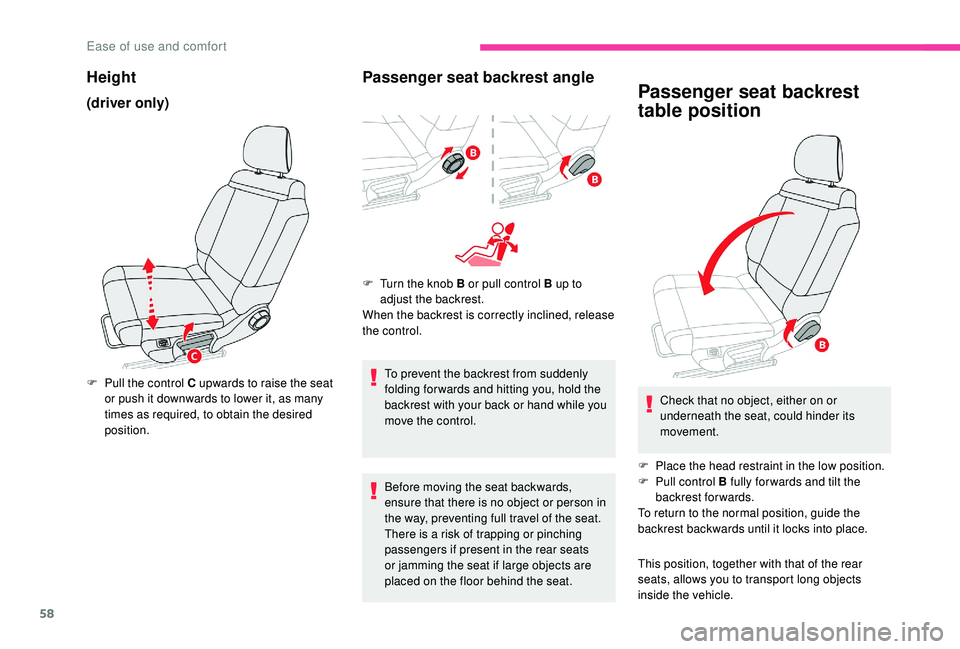
Height
(driver only)
F Pull the control C upwards to raise the seat or push it downwards to lower it, as many
times as required, to obtain the desired
position.
Passenger seat backrest angle
F Turn the knob B or pull control B up to adjust the backrest.
When the backrest is correctly inclined, release
the control.
To prevent the backrest from suddenly
folding for wards and hitting you, hold the
backrest with your back or hand while you
move the control.
Before moving the seat backwards,
ensure that there is no object or person in
the way, preventing full travel of the seat.
There is a risk of trapping or pinching
passengers if present in the rear seats
or jamming the seat if large objects are
placed on the floor behind the seat.
Passenger seat backrest
table position
Check that no object, either on or
underneath the seat, could hinder its
movement.
F
P
lace the head restraint in the low position.
F
P
ull control B fully for wards and tilt the
backrest forwards.
To return to the normal position, guide the
backrest backwards until it locks into place.
This position, together with that of the rear
seats, allows you to transport long objects
inside the vehicle.
Ease of use and comfort
Page 64 of 308
62
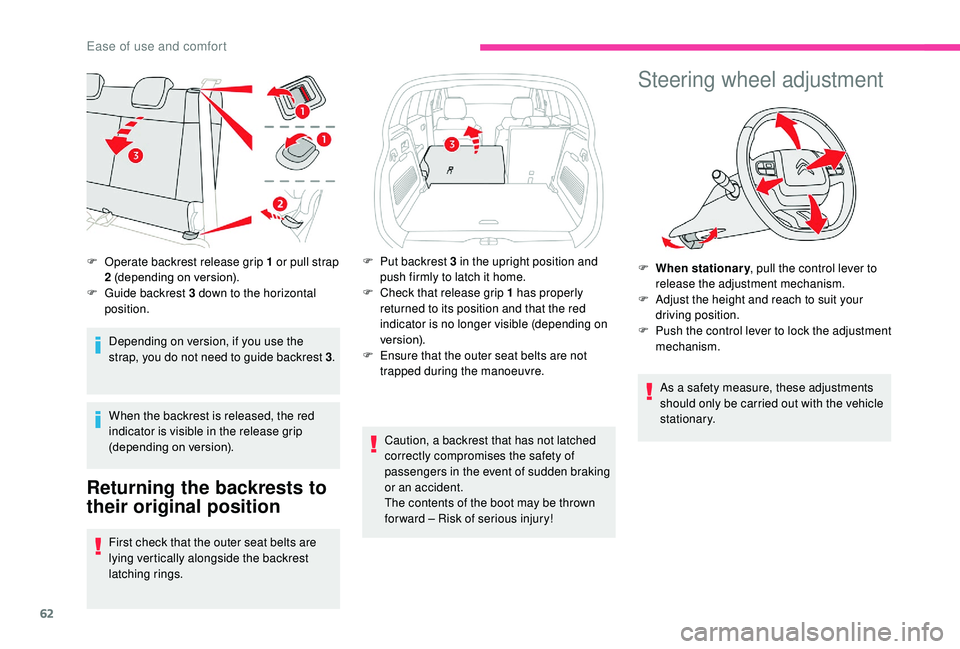
Depending on version, if you use the
strap, you do not need to guide backrest 3.
When the backrest is released, the red
indicator is visible in the release grip
(depending on version).
Returning the backrests to
their original position
First check that the outer seat belts are
lying vertically alongside the backrest
latching rings. Caution, a backrest that has not latched
correctly compromises the safety of
passengers in the event of sudden braking
or an accident.
The contents of the boot may be thrown
forward – Risk of serious injury!
F
O
perate backrest release grip 1 or pull strap
2 (depending on version).
F
G
uide backrest 3 down to the horizontal
position. F
P
ut backrest 3 in the upright position and
push firmly to latch it home.
F
C
heck that release grip 1 has properly
returned to its position and that the red
indicator is no longer visible (depending on
ve r s i o n).
F
E
nsure that the outer seat belts are not
trapped during the manoeuvre.
Steering wheel adjustment
F When stationary , pull the control lever to
release the adjustment mechanism.
F
A
djust the height and reach to suit your
driving position.
F
P
ush the control lever to lock the adjustment
mechanism.
As a safety measure, these adjustments
should only be carried out with the vehicle
stationary.
Ease of use and comfort
Page 65 of 308
63
Mirrors
Door mirrors
Demisting – Defrosting
Demisting - defrosting of the door
mirrors operates with the engine
running, by switching on the heated
rear screen.
For more information on Rear screen demist –
defrost , refer to the corresponding section.
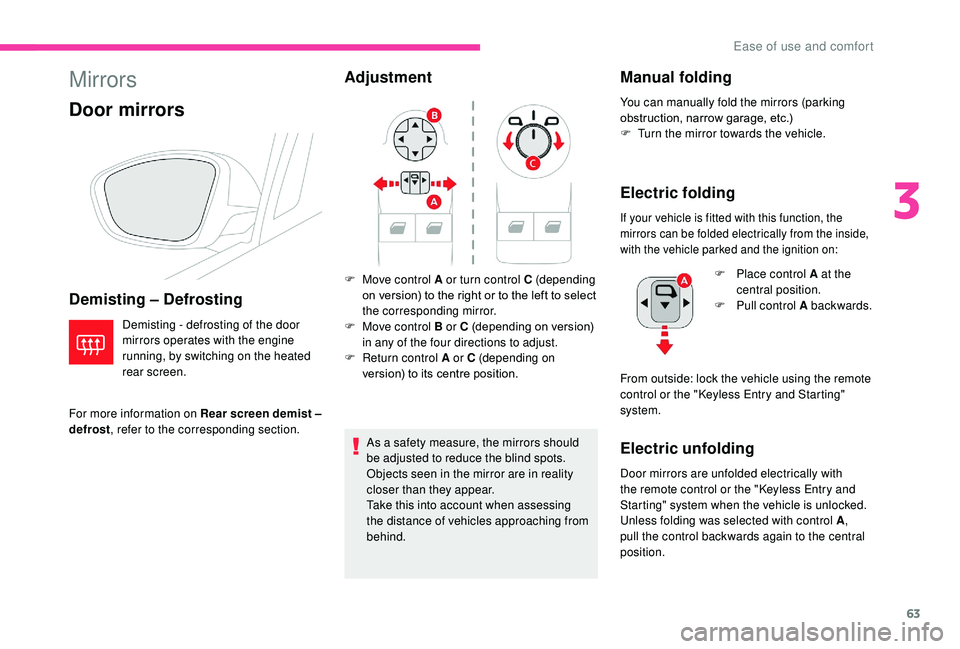
Adjustment
As a safety measure, the mirrors should
be adjusted to reduce the blind spots.
Objects seen in the mirror are in reality
closer than they appear.
Take this into account when assessing
the distance of vehicles approaching from
behind.
Manual folding
You can manually fold the mirrors (parking
obstruction, narrow garage, etc.)
F
T
urn the mirror towards the vehicle.
Electric folding
F Place control A at the central position.
F
P
ull control A backwards.
From outside: lock the vehicle using the remote
control or the "
K
eyless Entry and Starting"
system.
Electric unfolding
Door mirrors are unfolded electrically with
the remote control or the " K eyless Entry and
Starting" system when the vehicle is unlocked.
Unless folding was selected with control A ,
pull the control backwards again to the central
position.
F
M
ove control A or turn control C (depending
on version) to the right or to the left to select
the corresponding mirror.
F
M
ove control B or C (depending on version)
in any of the four directions to adjust.
F
R
eturn control A or
C (depending on
version) to its centre position.
If your vehicle is fitted with this function, the
mirrors can be folded electrically from the inside,
with the vehicle parked and the ignition on:
3
Ease of use and comfort
Page 66 of 308
64
Folding/unfolding during locking/unlocking
can be disabled. Contact a CITROËN
dealer or a qualified workshop.
If necessary, the mirrors can be folded
manually.
Rear view mirror
Equipped with an anti-dazzle system, which
darkens the mirror glass and reduces the
nuisance to the driver caused by the sun,
headlamps from other vehicles, etc.
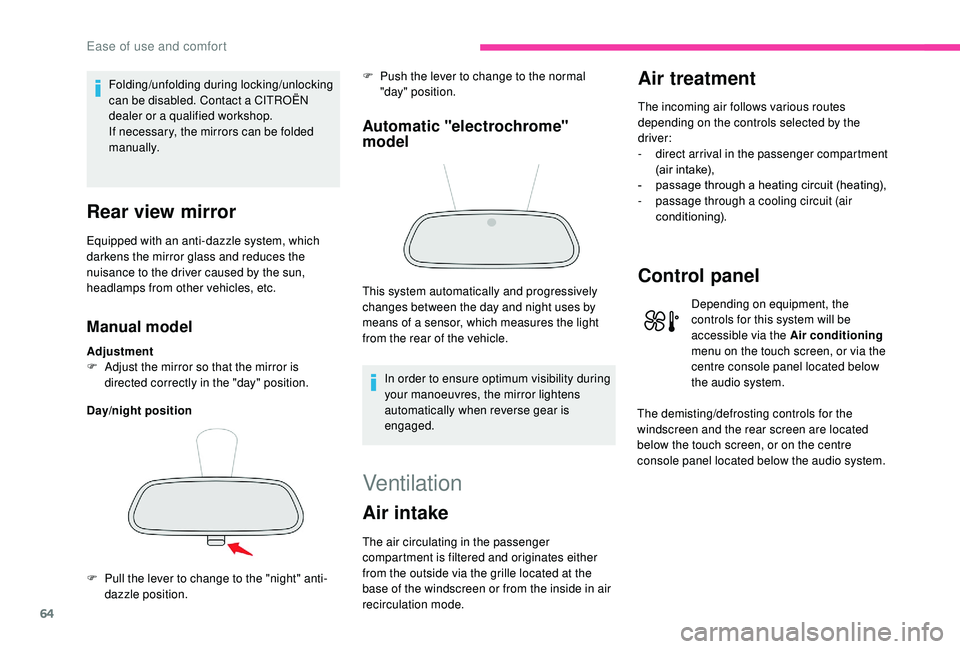
Manual model
Adjustment
F A djust the mirror so that the mirror is
directed correctly in the "day" position.
Day/night position
Automatic "electrochrome"
model
In order to ensure optimum visibility during
your manoeuvres, the mirror lightens
automatically when reverse gear is
engaged.
F
P
ull the lever to change to the "night" anti-
dazzle position. F
P
ush the lever to change to the normal
"day" position.
This system automatically and progressively
changes between the day and night uses by
means of a sensor, which measures the light
from the rear of the vehicle.
Ventilation
Air intake
The air circulating in the passenger
compartment is filtered and originates either
from the outside via the grille located at the
base of the windscreen or from the inside in air
recirculation mode.
Air treatment
The incoming air follows various routes
depending on the controls selected by the
driver:
-
d
irect arrival in the passenger compartment
(air intake),
-
p
assage through a heating circuit (heating),
-
p
assage through a cooling circuit (air
conditioning).
Control panel
Depending on equipment, the
controls for this system will be
accessible via the Air conditioning
menu on the touch screen, or via the
centre console panel located below
the audio system.
The demisting/defrosting controls for the
windscreen and the rear screen are located
below the touch screen, or on the centre
console panel located below the audio system.
Ease of use and comfort
Page 77 of 308
75
To avoid any risk of jamming of the pedals:
- o nly use mats which are suited to the
fixings already present in the vehicle;
these fixings must be used,
-
n
ever place one mat on top of another.
The use of mats not approved by
CITROËN may inter fere with access to
the pedals and hinder the operation of the
cruise control/speed limiter.
The mats approved by CITROËN have two
fixings located below the seat.
Rear fittings
Pockets, seat backrest
They are on the back of the front seats.
Side blinds
Fitted to the side windows, they protect the passenger
compartment from the sun's rays.
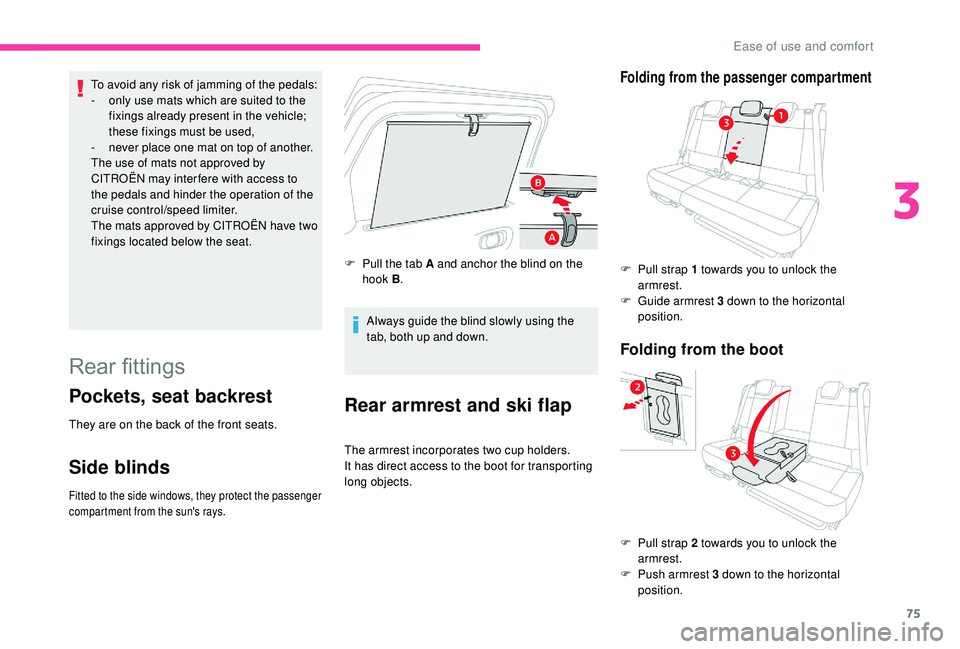
F Pull the tab A and anchor the blind on the hook B .
Always guide the blind slowly using the
tab, both up and down.
Rear armrest and ski flap
The armrest incorporates two cup holders.
It has direct access to the boot for transporting
long objects.
Folding from the passenger compartment
F Pull strap 1 towards you to unlock the armrest.
F
G
uide armrest 3 down to the horizontal
position.
Folding from the boot
F Pull strap 2 towards you to unlock the armrest.
F
P
ush armrest 3 down to the horizontal
position.
3
Ease of use and comfort
Page 78 of 308
76
Caution, when putting the armrest back
in place, ensure that it is properly locked
and that the red indicator for each strap is
no longer visible. Otherwise, passenger
safety could be compromised if sharp
braking occurs or if there is a collision.
The contents of the boot may be thrown
forward – Risk of serious injury!
12 V accessory socket
Do not exceed the maximum power rating
of the socket (risk of damage to your
device). The connection of an electrical device
not approved by CITROËN, such as a
USB charger, may adversely affect the
operation of vehicle electrical systems,
causing faults such as poor telephone
reception or inter ference with displays in
the screens.
F
T
o connect a 12 V accessory (maximum
power: 120 watts), lift the cover and plug in
the correct adapter.
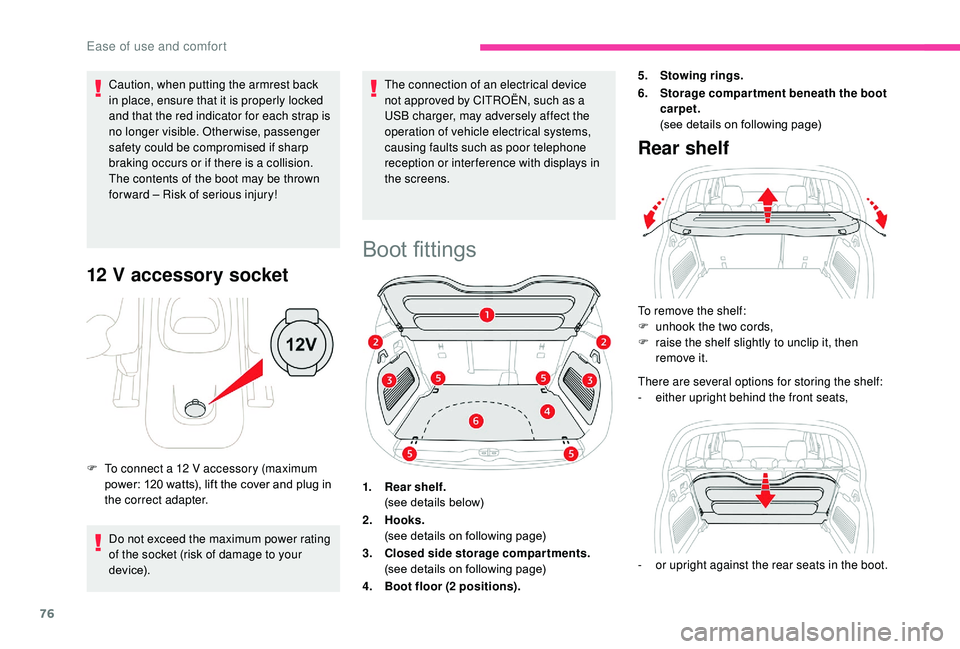
Boot fittings
1. Rear shelf.
(see details below)
2. Hooks.
(see details on following page)
3. Closed side storage compartments.
(see details on following page)
4. Boot floor (2 positions). 5.
Stowing rings.
6. Storage compar tment beneath the boot
carpet.
(see details on following page)
Rear shelf
To remove the shelf:
F
u nhook the two cords,
F
r
aise the shelf slightly to unclip it, then
remove it.
There are several options for storing the shelf:
-
ei
ther upright behind the front seats,
-
o
r upright against the rear seats in the boot.
Ease of use and comfort
Page 80 of 308
78
Depending on version, it includes:
- a t emporary puncture repair kit with the
vehicle tools,
-
a s
pare wheel with or without the vehicle
tools.
F
R
aise the boot floor as far as possible to
access the storage compartment.
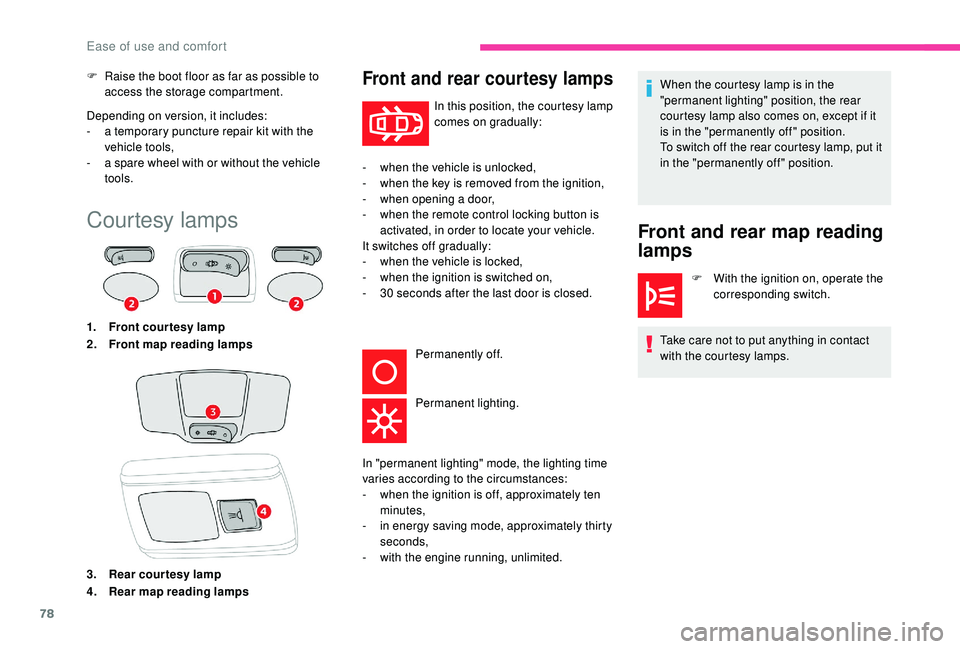
Courtesy lamps
1. Front courtesy lamp
2. Front map reading lamps
3. Rear courtesy lamp
4. Rear map reading lamps
Front and rear courtesy lamps
In this position, the courtesy lamp
comes on gradually:
-
w
hen the vehicle is unlocked,
-
w
hen the key is removed from the ignition,
-
w
hen opening a door,
-
w
hen the remote control locking button is
activated, in order to locate your vehicle.
It switches off gradually:
-
w
hen the vehicle is locked,
-
w
hen the ignition is switched on,
-
3
0
seconds after the last door is closed. Permanently off.
Permanent lighting.
Front and rear map reading
lamps
F With the ignition on, operate the corresponding switch.
Take care not to put anything in contact
with the courtesy lamps.
In "permanent lighting" mode, the lighting time
varies according to the circumstances:
-
w
hen the ignition is off, approximately ten
minutes,
-
i
n energy saving mode, approximately thirty
seconds,
-
w
ith the engine running, unlimited. When the courtesy lamp is in the
"permanent lighting" position, the rear
courtesy lamp also comes on, except if it
is in the "permanently off " position.
To switch off the rear courtesy lamp, put it
in the "permanently off " position.
Ease of use and comfort
Page 85 of 308
83
This is confirmed by an audible signal and
illumination of the corresponding direction
indicator lamp in the instrument panel.
To switch off the parking lamps, return the
lighting control stalk to the central position.
Guide-me-home lighting
Automatic
With the "Automatic illumination of headlamps"
function activated (lighting control stalk
at the AUTO position), under low ambient
light, the dipped beam headlamps come on
automatically when the ignition is switched off.
Activation, deactivation and the duration of the
guide-me-home lighting are set in the vehicle
configuration menu.
Manual
The temporary illumination of the dipped beam
headlamps after the vehicle's ignition has been
switched off makes the driver's exit easier
when the light is poor.
Switching on
F
W
ith the ignition off, "flash" the headlamps
using the lighting control stalk.
F
A
nother "headlamp flash" switches the
function off.
Switching off
Manual guide-me-home lighting goes off
automatically at the end of a given period of time.
Automatic exterior
welcome lighting
With the "Automatic headlamp illumination"
function activated, under low ambient light, the
sidelamps and dipped beam headlamps come
on automatically when the vehicle is unlocked.
Activation, deactivation and the duration of the
exterior welcome lighting are set in the vehicle
configuration menu.
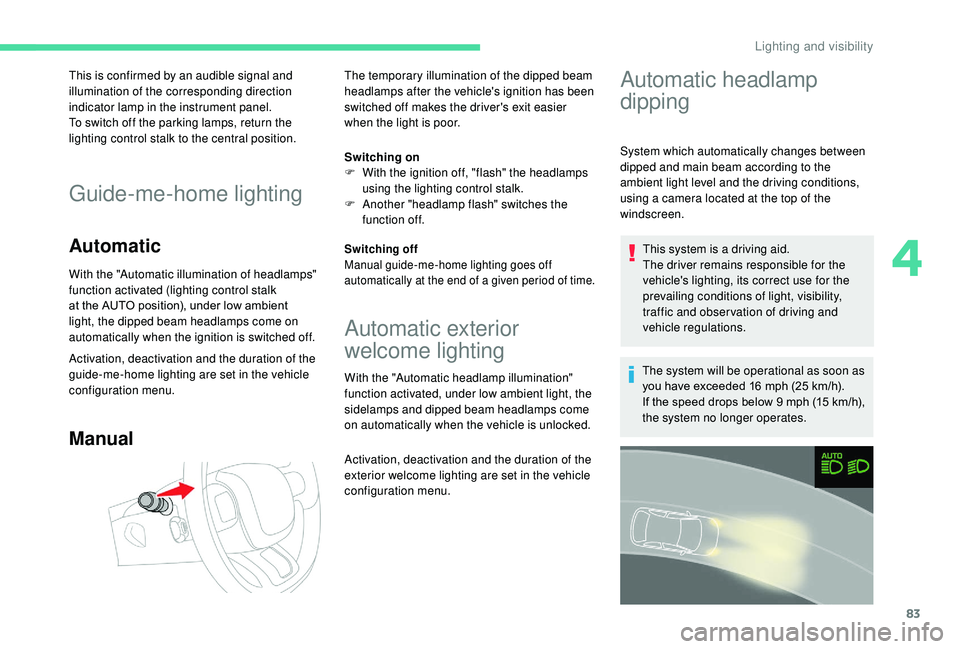
Automatic headlamp
dipping
System which automatically changes between
dipped and main beam according to the
ambient light level and the driving conditions,
using a camera located at the top of the
windscreen.
This system is a driving aid.
The driver remains responsible for the
vehicle's lighting, its correct use for the
prevailing conditions of light, visibility,
traffic and obser vation of driving and
vehicle regulations.
The system will be operational as soon as
you have exceeded 16
mph (25 km/h).
If the speed drops below 9
mph (15 km/h),
the system no longer operates.
4
Lighting and visibility
Page 95 of 308
93
To reactivate geolocation, simultaneously press
the "Localised Emergency Call" and "Localised
Assistance Call" buttons again, followed by
a press on "Localised Assistance Call" to
confirm.If you purchased your vehicle outside the
brand's dealer network, we invite you to
have a dealer check the configuration of
these ser vices and, if desired, modify it to
suit your wishes. In a multilingual country,
configuration is possible in the official
national language of your choice.
For technical reasons and, in particular, to
improve the quality of Telematic ser vices
to customers, the manufacturer reserves
the right to carry out updates to the
vehicle's on-board telematic system.
If you benefit from the Citroën Connect
Box offer with the SOS and assistance
pack included, there are additional
ser vices available to you in your personal
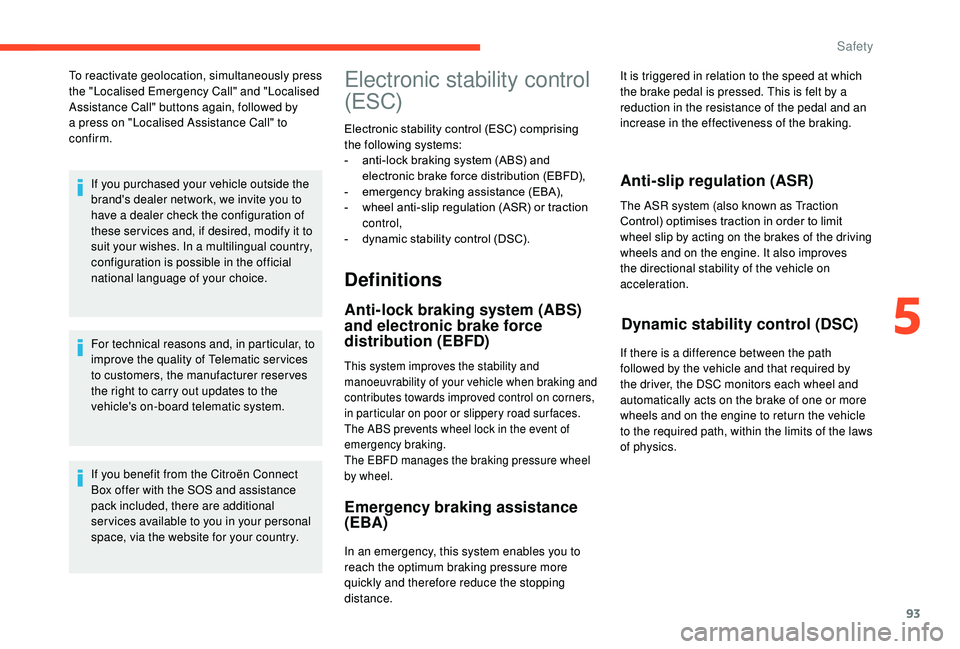
space, via the website for your country.Electronic stability control
(ESC)
Electronic stability control (ESC) comprising
the following systems:
-
a
nti-lock braking system (ABS) and
electronic brake force distribution (EBFD),
-
e
mergency braking assistance (EBA),
-
w
heel anti-slip regulation (ASR) or traction
control,
-
d
ynamic stability control (DSC).
Definitions
Anti-lock braking system (ABS)
and electronic brake force
distribution (EBFD)
This system improves the stability and
manoeuvrability of your vehicle when braking and
contributes towards improved control on corners,
in particular on poor or slippery road sur faces.
The ABS prevents wheel lock in the event of
emergency braking.
The EBFD manages the braking pressure wheel
by wheel.
Emergency braking assistance
(EBA)
In an emergency, this system enables you to
reach the optimum braking pressure more
quickly and therefore reduce the stopping
distance.
Anti-slip regulation (ASR)
The ASR system (also known as Traction
Control) optimises traction in order to limit
wheel slip by acting on the brakes of the driving
wheels and on the engine. It also improves
the directional stability of the vehicle on
acceleration.
Dynamic stability control (DSC)
If there is a difference between the path
followed by the vehicle and that required by
the driver, the DSC monitors each wheel and
automatically acts on the brake of one or more
wheels and on the engine to return the vehicle
to the required path, within the limits of the laws
of physics. It is triggered in relation to the speed at which
the brake pedal is pressed. This is felt by a
reduction in the resistance of the pedal and an
increase in the effectiveness of the braking.
5
Safety
Page 96 of 308
94
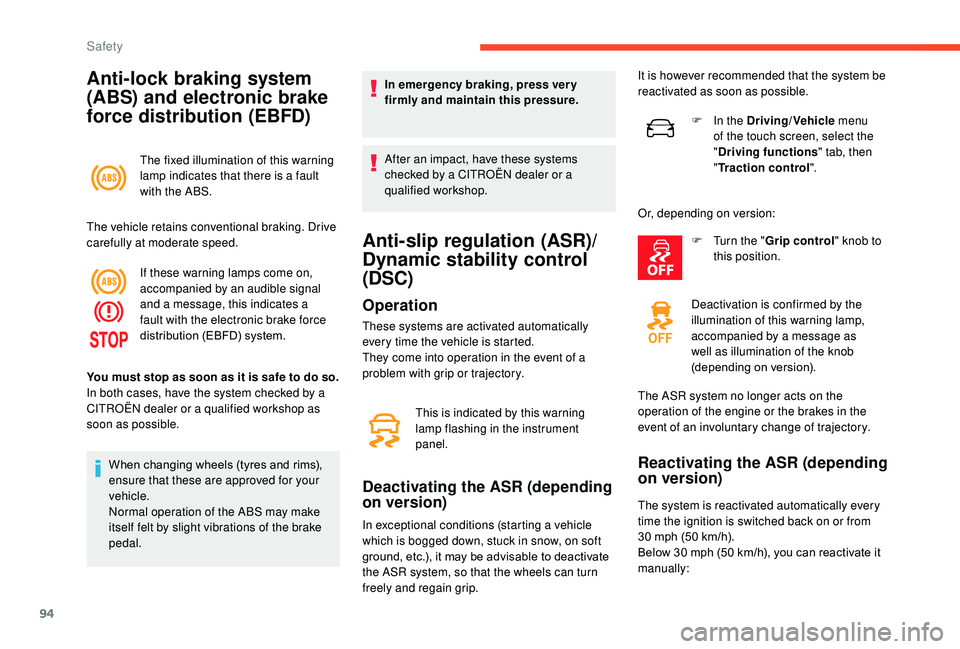
Anti-lock braking system
(ABS) and electronic brake
force distribution (EBFD)
The fixed illumination of this warning
lamp indicates that there is a fault
with the ABS.
The vehicle retains conventional braking. Drive
carefully at moderate speed. If these warning lamps come on,
accompanied by an audible signal
and a message, this indicates a
fault with the electronic brake force
distribution (EBFD) system.
When changing wheels (tyres and rims),
ensure that these are approved for your
vehicle.
Normal operation of the ABS may make
itself felt by slight vibrations of the brake
pedal. In emergency braking, press ver y
firmly and maintain this pressure.
After an impact, have these systems
checked by a CITROËN dealer or a
qualified workshop.
Anti-slip regulation (ASR)/
Dynamic stability control
(DSC)
Operation
These systems are activated automatically
every time the vehicle is started.
They come into operation in the event of a
problem with grip or trajectory.
Deactivating the ASR (depending
on version)
In exceptional conditions (starting a vehicle
which is bogged down, stuck in snow, on soft
ground, etc.), it may be advisable to deactivate
the ASR system, so that the wheels can turn
freely and regain grip.
You must stop as soon as it is safe to do so.
In both cases, have the system checked by a
CITROËN dealer or a qualified workshop as
soon as possible.
This is indicated by this warning
lamp flashing in the instrument
panel.It is however recommended that the system be
reactivated as soon as possible.
F
I
n the Driving/Vehicle
menu
of the touch screen, select the
" Driving functions " tab, then
" Traction control".
Or, depending on version: F
T
urn the "
Grip control" knob to
this position.
Deactivation is confirmed by the
illumination of this warning lamp,
accompanied by a message as
well as illumination of the knob
(depending on version).
The ASR system no longer acts on the
operation of the engine or the brakes in the
event of an involuntary change of trajectory.
Reactivating the ASR (depending
on version)
The system is reactivated automatically every
time the ignition is switched back on or from
30
mph (50 km/h).
Below 30
mph (50 km/h), you can reactivate it
manually:
Safety