Break CITROEN C3 AIRCROSS 2020 Owners Manual
[x] Cancel search | Manufacturer: CITROEN, Model Year: 2020, Model line: C3 AIRCROSS, Model: CITROEN C3 AIRCROSS 2020Pages: 308, PDF Size: 9.13 MB
Page 5 of 308
3
.
.
bit.ly/helpPSA
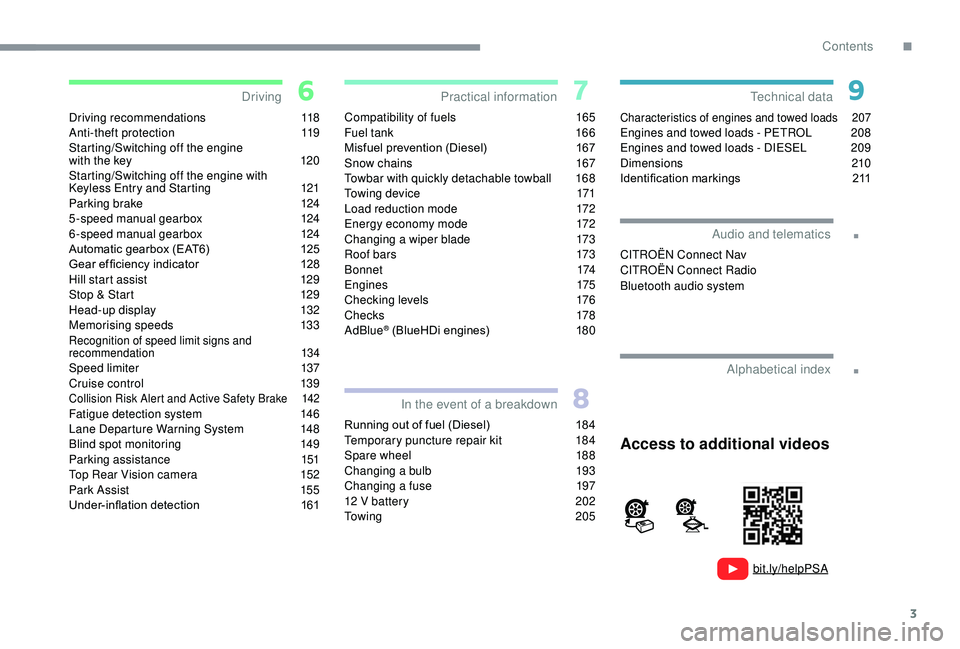
Driving recommendations 118
Anti-theft protection 1 19
Starting/Switching off the engine
with the key
1
20
Starting/Switching off the engine with
K
eyless Entry and Starting
1
21
Parking brake
1
24
5-speed manual gearbox
1
24
6-speed manual gearbox
1
24
Automatic gearbox (EAT6)
1
25
Gear ef ficiency indicator
1
28
Hill start assist
1
29
Stop & Start
1
29
Head-up display
1
32
Memorising speeds
1
33
Recognition of speed limit signs and
recommendation 1 34
Speed limiter 137
Cruise control 1 39
Collision Risk Alert and Active Safety Brake 1 42Fatigue detection system 146
Lane Departure Warning System 1 48
Blind spot monitoring
1
49
Parking assistance
1
51
Top Rear Vision camera
1
52
Park Assist
1
55
Under-inflation detection
1
61Compatibility of fuels
1
65
Fuel tank
1
66
Misfuel prevention (Diesel)
1
67
Snow chains
1
67
Towbar with quickly detachable towball
1
68
Towing device
1
71
Load reduction mode
1
72
Energy economy mode
1
72
Changing a wiper blade
1
73
Roof bars
1
73
B o n n e t
174
Engines
175
Checking levels
1
76
C h e c ks
178
AdBlue
® (BlueHDi engines) 1 80
Running out of fuel (Diesel)
1
84
Temporary puncture repair kit
1
84
Spare wheel
1
88
Changing a bulb
1
93
Changing a fuse
1
97
12
V battery
2
02
To w i n g
2 0 5
Characteristics of engines and towed loads 2 07Engines and towed loads - PETROL 208
Engines and towed loads - DIESEL 2 09
Dimensions
210
Identification markings
2
11
DrivingPractical information
In the event of a breakdown Technical data
Alphabetical index
Access to additional videos
Audio and telematics
CITROËN Connect Nav
CITROËN Connect Radio
Bluetooth audio system
.
Contents
Page 21 of 308

19
+
+SCR emissions
control system
(BlueHDi Diesel)
Fixed, on switching on
the ignition, associated
with the Ser vice and
engine diagnostic warning
lamps, accompanied by
an audible signal and a
message.A fault with the SCR emissions
control system has been detected.
This alert disappears once the exhaust emissions
return to normal levels.
Flashing, on switching
on the ignition,
associated with the
Service and engine
diagnostic warning
lamps, accompanied by
an audible signal and a
message indicating the
remaining driving range.After confirmation of the fault with
the emissions control system, you
can drive for up to 680 miles (1,100 km) before the engine starting prevention
system is triggered.To avoid a breakdown, contact a CITROËN dealer
or a qualified workshop without delay
.
Flashing, on switching
on the ignition,
associated with the
Service and engine
diagnostic warning
lamps, accompanied
by an audible signal
and a message. You have exceeded the authorised
driving limit following confirmation
of a fault with the emissions
control system: the engine starting
prevention system prevents starting
of the engine.
To be able to restart the engine, you must
call on a
CITROËN dealer or a qualified workshop.
For topping up or for more information on the AdBlue
® (BlueHDi engines) , refer to the corresponding section.
Warning/indicator lamp
StateCause Action/Observations
1
Dashboard instruments
Page 31 of 308

29
CHECK
F You can access the information via the Driving/Vehicle
menu, by selecting " Driving
functions " then "Diagnostic ".When driving, this message is displayed
approximately every 200
miles (300 km) until
the liquid has been topped up.
The reser ve level has been reached; it is
recommended that you top up as soon as
possible.
It is recommended that you do not top up by
more than 10 litres of AdBlue.
For more information on AdBlue
® and
the SCR system , and, in particular,
on topping up the AdBlue
®, refer to the
corresponding section.
Range below 370 miles (600 km)
When driving, this message is displayed every
30 seconds until the AdBlue fluid has been
topped up.
It is essential to top up as soon as possible and
before the tank is completely empty; other wise
it will not be possible to restart the engine after
the next stop.
In the event of the risk of non-
starting related to a lack of
AdBlue
®
The engine start prevention system
required by regulations is activated
automatically once the AdBlue
® tank is
e m pt y.
Range greater than 1,500
miles (2,400 km)
When switching on the ignition, there is no
automatic display of range in the instrument
panel.
Pressing this button will temporarily display the
remaining range.
With touch screen
Remaining range between 1,500 and
370 miles (2,400 and 600 km)
When switching on the ignition, this
warning
lamp comes on, accompanied by an audible
signal and the display of a message (e.g. "NO
START IN 900
miles" or "Top up AdBlue: Starting
impossible in 900
miles") indicating the remaining
range expressed in miles or kilometres. When switching on the ignition, this warning lamp
flashes, accompanied by an audible signal and
the display of a message (e.g. "NO START IN
180
m
iles" or "Top up AdBlue: Starting impossible
in 180
miles") indicating the remaining range
expressed in miles or kilometres.
For more information on AdBlue®
(BlueHDi engines) and, in particular, on
topping up, refer to the corresponding
section.
Breakdown related to a lack of AdBlue®
When switching on the ignition, this warning lamp
flashes, together with an audible signal and the
display of the message "NO START IN 0
miles"
or "Top up AdBlue: Starting impossible".
1
Dashboard instruments
Page 53 of 308

51
Alarm
System which protects and provides a deterrent
against theft and break-ins. It provides the
following types of monitoring:
- Perimeter monitoring
The system monitors the opening of the
vehicle.
The alarm is triggered if anyone tries to open a
door, the boot or the bonnet.
- Volumetric monitoring
The system checks for any variation in the
volume in the passenger compartment.
The alarm is triggered if anyone breaks a
window, enters the passenger compartment or
moves inside the vehicle.
- Anti-tilt monitoring
The system checks for any change in the
attitude of the vehicle.
The alarm is triggered if the vehicle is lifted,
moved or knocked.Self-protection function
The system checks for the disconnection
of any of its components.
The alarm is triggered if the battery,
button or siren wiring is disconnected or
damaged.
For all work on the alarm system,
contact a CITROËN dealer or a qualified
workshop.
Locking the vehicle with full
alarm system
Activation
F Lock or deadlock the vehicle
using the remote control.
or
F
L
ock or deadlock the vehicle using the
"Keyless Entry and Starting" system. Following a command to lock the vehicle
using the remote control or the "
K
eyless Entry
and Starting" system, the exterior perimeter
monitoring is activated after 5 seconds, the
interior volumetric and anti-tilt monitoring after
45
seconds.
If an opening (door, boot, etc.) is incorrectly
closed, the vehicle is not locked but the exterior
perimeter monitoring will be activated after
45 seconds at the same time as the interior
volumetric and anti-tilt monitoring.
Deactivation
F Press the unlocking button on the remote control.
or
F
U
nlock the vehicle with the "
K
eyless Entry
and Starting" system.
The monitoring system is
deactivated: the indicator lamp goes
off and the direction indicators flash
for about 2
seconds.
When the vehicle automatically locks itself
again (as happens if a door or boot is not
opened within 30
seconds of unlocking),
the monitoring system is automatically
reactivated.
F Switch off the ignition and get out of the vehicle.
The monitoring system is active: the button’s
indicator lamp flashes once per second and
the direction indicators come on for about
2
seconds.
2
Access
Page 62 of 308
60
F With the engine running, use the adjustment knob to switch on and choose the heating
level desired:
0 : Of f.
1 : Low.
2 : Medium.
3 : High.
The front seats can be heated individually.
Do not use the function when the seat is
not occupied.
Reduce the intensity of the heating as
soon as possible.
When the seat and passenger
compartment have reached an
adequate temperature, you can stop
the function; reducing the consumption
of electrical current reduces fuel
consumption. Prolonged use at the highest setting is
not recommended for those with sensitive
skin.
There is a risk of burns for people whose
perception of heat is impaired (illness,
taking medication, etc.).
There is a risk of overheating the system if
material with insulating properties is used,
such as cushions or seat covers.
Do not use the system:
-
i
f wearing damp clothing,
-
i
f child seats are fitted.
To avoid breaking the heating element in
the seat:
-
d
o not place heavy objects on the seat,
-
d
o not kneel or stand on the seat,
-
d
o not place sharp objects on the seat,
-
d
o not spill liquids onto the seat.
To avoid the risk of short-circuit:
-
d
o not use liquid products for cleaning
the seat,
-
n
ever use the heating function when
the seat is damp.Rear seats
Bench seat with a fixed cushion or on rails
(depending on version) and split folding
backrests (2/3 -1/3) to adapt the boot loading
space.
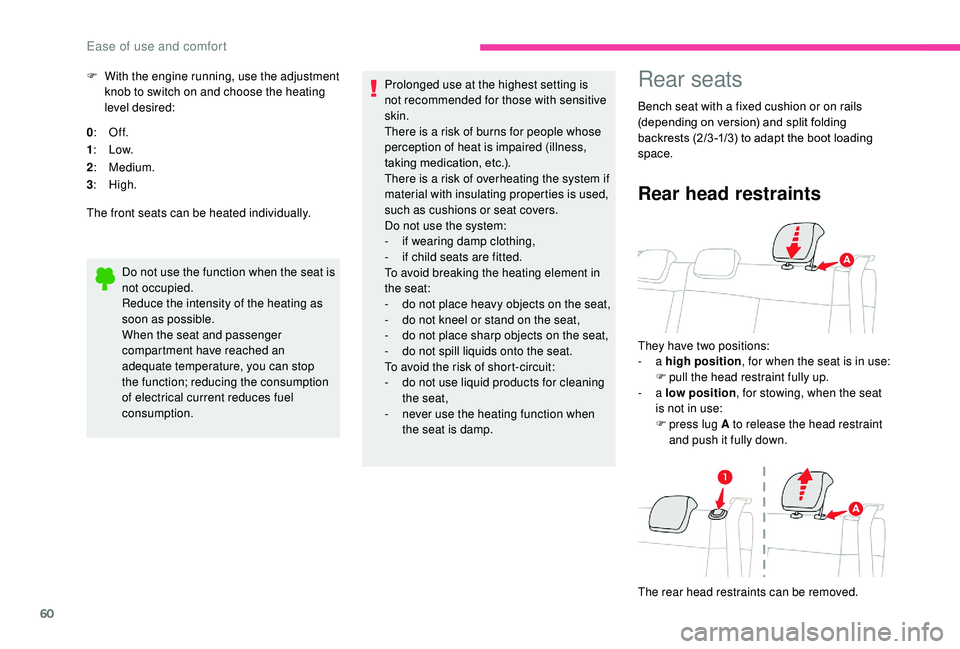
Rear head restraints
They have two positions:
- a high position , for when the seat is in use:
F
p
ull the head restraint fully up.
-
a low position , for stowing, when the seat
is not in use:
F
press lug A to release the head restraint
and push it fully down.
The rear head restraints can be removed.
Ease of use and comfort
Page 92 of 308
90
General safety
recommendations
Labels are attached in different places on
your vehicle. They include safety warnings
as well as identification information for
your vehicle. Do not remove them: they
are an integral part of your vehicle.
For any work on your vehicle, use a
qualified workshop that has the technical
information, skills and equipment required,
all of which a CITROËN dealer is able to
provide.We draw your attention to the following
points:
-
T
he fitting of electrical equipment
or accessories not approved by
CITROËN may cause excessive
current consumption and faults and
failures with the electrical system of
your vehicle. Contact a CITROËN
dealer for information on the range of
recommended accessories.
-
A
s a safety measure, access to
the diagnostic socket, used for the
vehicle's electronic systems, is
reser ved strictly for CITROËN dealers
or qualified workshops, equipped
with the special tools required (risk
of malfunctions of the vehicle's
electronic systems that could cause
breakdowns or serious accidents).
The manufacturer cannot be held
responsible if this advice is not
followed.
-
A
ny modification or adaptation not
intended or authorised by CITROËN
or carried out without meeting the
technical requirements defined by
the manufacturer will result in the
suspension of the legal and contractual
warranties. Installation of accessory radio
communication transmitters
Before installing a radio communication
transmitter, you must contact a CITROËN
dealer for the specification of transmitters
which can be fitted (frequency, maximum
power, aerial position, specific installation
requirements), in line with the Vehicle
Electromagnetic Compatibility Directive
(2004/104/EC).
Depending on country regulations, some
safety equipment may be compulsory:
high visibility safety vests, warning
triangles, breathalysers, spare bulbs,
spare fuses, fire extinguisher, first aid kit,
mud flaps at the rear of the vehicle, etc.
Safety
Page 94 of 308

92
** As per the geographic coverage of "Localised Emergency Call", "Localised
Assistance Call" and the official national
language chosen by the owner of the vehicle.
The list of countries covered and of
Telematic services is available from dealers
or on the website for your country.
Operation of the system (type 1)
When the ignition is switched
on, the green LED comes on for
3
seconds indicating that the
system is operating correctly.
If the orange indicator lamp
flashes then goes off: the system
has a fault.
If the orange indicator lamp is on fixed: replace
the back-up battery.
In both cases, the emergency and assistance
calls ser vice may not work.
Contact a qualified repairer as soon as
possible. The fault with the system does not prevent
the vehicle from being driven.
*
I
n accordance with the general conditions
of use for the ser vice available from dealers
and subject to technological and technical
limitations.
Operation of the system (type 2)
When the ignition is switched
on, the green LED comes on for
3
seconds indicating that the
system is operating correctly.
For all countries except Russia, Belarus
and Kazakhstan.
If the red indicator lamp flashes then goes off:
there is a system fault.
If the red indicator lamp is on fixed: replace the
back-up battery.
For Russia, Belarus and Kazakhstan.
If the red indicator lamp is on fixed: there is a
system fault.
If the red indicator lamp flashes: replace the
back-up battery.
In either case, the emergency and assistance
calls ser vice may not work.
Contact a qualified repairer as soon as
possible.
The fault with the system does not prevent
the vehicle from being driven.
Localised Assistance Call
** As per the geographic coverage of "Localised Emergency Call", "Localised
Assistance Call" and the official national
language chosen by the owner of the vehicle.
The list of countries covered and of
Telematic services is available from dealers
or on the website for your country. Press this button for more than
2
seconds to request assistance
if the vehicle breaks down.
A voice message confirms that the call has
been made**.
Pressing this button again immediately cancels
the request.
The cancellation is confirmed by a voice
message.
Geolocation
You can deactivate geolocation by
simultaneously pressing the "Localised
Emergency Call" and "Localised Assistance
Call" buttons, followed by pressing "Localised
Assistance Call" to confirm.
Safety
Page 120 of 308

118
Driving recommendations
Observe the driving regulations and remain
vigilant whatever the traffic conditions.
Pay close attention to the traffic and keep your
hands on the wheel so that you are ready to
react at any time to any eventuality.
As a safety measure, the driver must only carry
out any operations that require close attention
when the vehicle is stationary.
On a long journey, a break every two hours is
strongly recommended.
In difficult weather, drive smoothly, anticipate
the need to brake and increase the distance
from other vehicles.Never leave the engine running in
an enclosed area without adequate
ventilation: internal combustion engines
emit toxic exhaust gases, such as carbon
monoxide. There is a risk of poisoning and
death!
In very severe wintry conditions
(temperatures below -23°C), to guarantee
correct operation and the longevity of
the mechanical elements of your vehicle,
engine and gearbox, the engine must be
left running for 4
minutes before driving.
Important!
Never drive with the parking brake applied
– Risk of overheating and damage to the
braking system!
As the exhaust system of your vehicle
is very hot, even several minutes after
switching off the engine, never park or run
the engine on inflammable sur faces (dry
grass, fallen leaves, etc.) - Risk of fire!
Never leave a vehicle unsuper vised with
the engine running. If you have to leave
your vehicle with the engine running, apply
the parking brake and put the gearbox into
neutral or position N or P , depending on
the type of gearbox.
Driving on flooded roads
We strongly advise against driving on flooded
roads, as this could cause serious damage
to the engine and gearbox, as well as to the
electrical systems of your vehicle. If you must drive through water:
-
c
heck that the depth of the water is not
more than 6 inches (15 cm), allowing for any
waves that might be made by other road
users,
-
d
eactivate the Stop & Start function,
-
d
rive as slowly as possible without stalling.
In all cases, do not exceed 6 mph (10 km/h),
-
d
o not stop and do not switch off the engine.
On leaving the flooded road and as soon as
it is safe to do so, make several light brake
applications to dry the brake discs and pads.
If in doubt on the state of your vehicle, contact
a CITROËN dealer or a qualified workshop.
Driving
Page 121 of 308

119
In case of towing
Driving with a trailer places greater
demands on the towing vehicle and
requires extra care from the driver.
Side wind
F Take into account the increased sensitivity to wind.
Cooling
Towing a trailer on a slope increases the
temperature of the coolant.
As the fan is electrically controlled, its cooling
capacity is not dependent on the engine speed.
F
T
o lower the engine speed, reduce your
speed.
The maximum towable load on an incline
depends on the gradient and the exterior
temperature.
In all cases, keep a check on the coolant
temperature.
Braking
Towing a trailer increases the braking distance.
To avoid overheating of the brakes, the use of
engine braking is recommended.
Ty r e s
F Check the tyre pressures of the towing vehicle and of the trailer, observing the
recommended pressures.
Lighting
F Check the electrical lighting and signalling on the trailer and the headlamp beam height
of your vehicle. If the exterior temperature is high, it is
recommended that the engine be allowed
to idle for 1 to 2
minutes after the vehicle
comes to a stop, to facilitate its cooling.
F
I
f this warning lamp and the
STOP warning lamp come on,
stop the vehicle and switch off
the engine as soon as possible. New vehicle
Do not pull a trailer before having driven at
least 600
miles (1,000 kilometres).
For more information on Headlamp
adjustment , refer to the corresponding
section.
The rear parking sensors will be
deactivated automatically to avoid the
audible signal if a genuine CITROËN
towbar is used.
Anti-theft protection
Electronic immobiliser
The keys contain an electronic chip which has
a secret code. When the ignition is switched
on, this code must be recognised in order for
starting to be possible.
A few seconds after switching off the ignition,
this system locks the engine control system,
therefore preventing the engine from being
started in the event of a break-in.
If the system fails, as reported by a message,
the engine will not start.
Contact a CITROËN dealer.
For safety and theft protection reasons,
never leave your electronic key in the
vehicle, even when you are close to it.
It is recommended that you keep it with
you.
6
Driving
Page 148 of 308
146
Malfunction
There may be interference in the operation
of the camera or it may not work at all in
the following situations:
-
p
oor visibility (inadequate street
lighting, falling snow, heavy rain, dense
fog, etc.),
-
d
azzle (headlamps of an oncoming
vehicle, low sun, reflections on a damp
road, leaving a tunnel, alternating shade
and light, etc.),
-
c
amera masked (mud, frost, snow,
condensation, etc.).
In these situations, detection performance
may be reduced.
Clean the windscreen regularly,
particularly the area in front of the camera.
The internal sur face of the windscreen can
also become misted around the camera.
In humid and cold weather, demist the
windscreen regularly.
Do not allow snow to accumulate on the
bonnet or roof of the vehicle as this could
mask the camera's view.
Fatigue detection system
Take a break as soon as you feel tired or at
least every two hours. The system cannot in any circumstances
replace the need for vigilance on the part
of the driver.
Do not take the wheel if you are tired.
Activation/Deactivation
The system is activated or deactivated via the
vehicle configuration menu.
Without audio system
F In the " DRIVE ASSIST " menu on the
instrument panel display, activate/deactivate
" VIGILANCE ALT " (Fatigue Detection
S yste m).
With audio system
F In the " Personalisation-
configuration " menu, activate/
deactivate " Fatigue Detection
System ".
With touch screen
F In the Driving/Vehicle menu,
select the " Vehicle settings "
tab, then " Security" and
activate/deactivate " Fatigue
Detection System ".
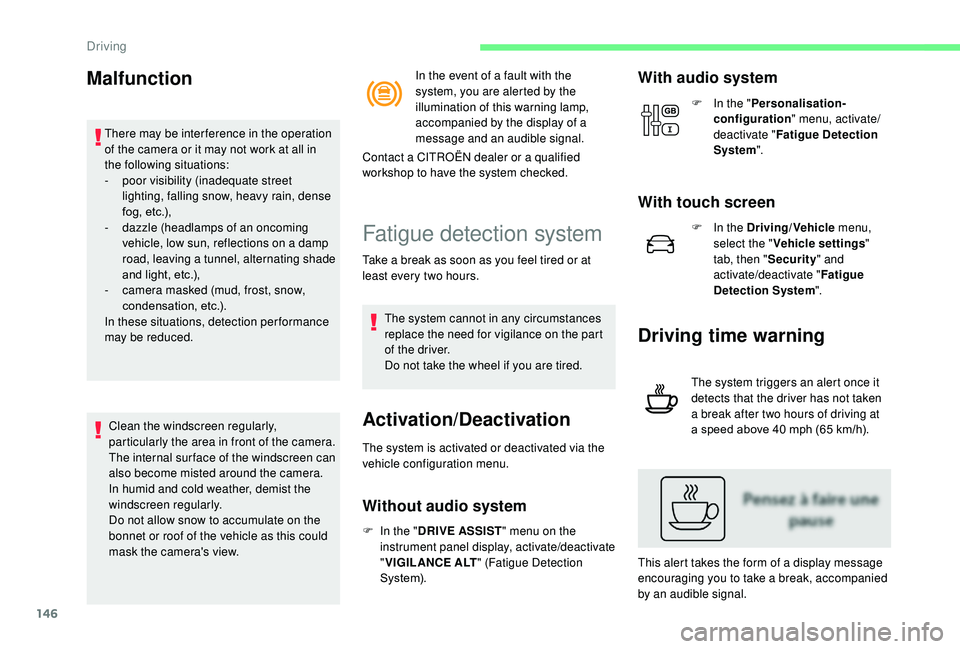
Driving time warning
The system triggers an alert once it
detects that the driver has not taken
a break after two hours of driving at
a speed above 40
mph (65 km/h).
In the event of a fault with the
system, you are alerted by the
illumination of this warning lamp,
accompanied by the display of a
message and an audible signal.
This alert takes the form of a display message
encouraging you to take a break, accompanied
by an audible signal.
Contact a CITROËN dealer or a qualified
workshop to have the system checked.
Driving