cool CITROEN C3 PICASSO 2010 Owners Manual
[x] Cancel search | Manufacturer: CITROEN, Model Year: 2010, Model line: C3 PICASSO, Model: CITROEN C3 PICASSO 2010Pages: 244, PDF Size: 8.29 MB
Page 26 of 244

1
24
MONITORING
Warning lamp
is on
Cause
Action/Observations
Front
foglamps
fi xed. The front foglamps are
switched on. Turn the ring on the stalk rearwards twice to
switch off the front foglamps.
Rear
foglamps
fi xed. The rear foglamps are
switched on. Turn the ring on the stalk rearwards to switch off
the rear foglamps.
Diesel engine
pre-heating
fi xed. The ignition switch is at the
2nd position (ignition on).
Wait until the warning lamp has switched off before starting.
The duration for which the warning lamp is on is
determined by the climatic conditions.
Parking brake
fi xed. The parking brake is
applied or not properly
released. Release the parking brake to switch off the warning
lamp, keeping your foot on the brake pedal.
Observe the safety recommendations.
For further information on the parking brake, refer
to the "Driving" section.
Engine
coolant
temperature
fi xed blue
. On starting the engine, it
indicates that the engine is
cold. After a few minutes driving, it swiches off to
indicate that the engine temperature is normal.
In order to protect your engine, avoid driving too
hard until the warning lamp has switched off.
Stop & Start
fi xed. When the vehicle stops
(red lights, traffi c jams, ...)
the Stop & Start system has
put the engine into STOP
mode. The warning lamp goes off and the engine
restarts automatically in START mode, as soon
as you want to move off.
fl ashes for a
few seconds,
then goes off. STOP mode is temporarily
unavailable.
or
START mode is invoked
automatically. Refer to "Driving - § Stop & Start" for special
cases with STOP mode and START mode.
Page 29 of 244
1
MONITORING
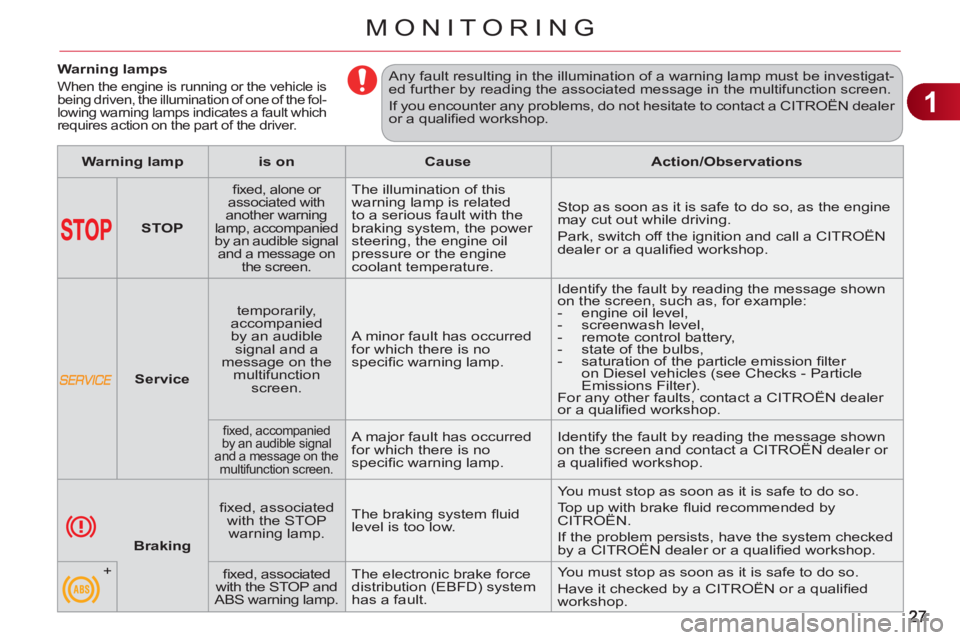
Warning lamps
When the engine is running or the vehicle is
being driven, the illumination of one of the fol-
lowing warning lamps indicates a fault which
requires action on the part of the driver. Any fault resulting in the illumination of a warning lamp must be investigat-
ed further by reading the associated message in the multifunction screen.
If you encounter any problems, do not hesitate to contact a CITROËN dealer
or a qualifi ed workshop.
Warning lamp
is on
Cause
Action/Observations
STOP
fi xed, alone or
associated with
another warning
lamp, accompanied
by an audible signal
and a message on
the screen.
The illumination of this
warning lamp is related
to a serious fault with the
braking system, the power
steering, the engine oil
pressure or the engine
coolant temperature. Stop as soon as it is safe to do so, as the engine
may cut out while driving.
Park, switch off the ignition and call a CITROËN
dealer or a qualifi ed workshop.
Service
temporarily,
accompanied
by an audible
signal and a
message on the
multifunction
screen. A minor fault has occurred
for which there is no
specifi c warning lamp. Identify the fault by reading the message shown
on the screen, such as, for example:
- engine oil level,
- screenwash level,
- remote control battery,
- state of the bulbs,
- saturation of the particle emission fi lter
on Diesel vehicles (see Checks - Particle
Emissions Filter).
For any other faults, contact a CITROËN dealer
or a qualifi ed workshop.
fi xed, accompanied
by an audible signal
and a message on the
multifunction screen.
A major fault has occurred
for which there is no
specifi c warning lamp. Identify the fault by reading the message shown
on the screen and contact a CITROËN dealer or
a qualifi ed workshop.
Braking
fi xed, associated
with the STOP
warning lamp. The braking system fl uid
level is too low. You must stop as soon as it is safe to do so.
Top up with brake fl uid recommended by
CITROËN.
If the problem persists, have the system checked
by a CITROËN dealer or a qualifi ed workshop.
+
fi xed, associated
with the STOP and
ABS warning lamp. The electronic brake force
distribution (EBFD) system
has a fault. You must stop as soon as it is safe to do so.
Have it checked by a CITROËN or a qualifi ed
workshop.
Page 31 of 244
1
29
MONITORING
Warning lamp
is on
Cause
Action/Observations
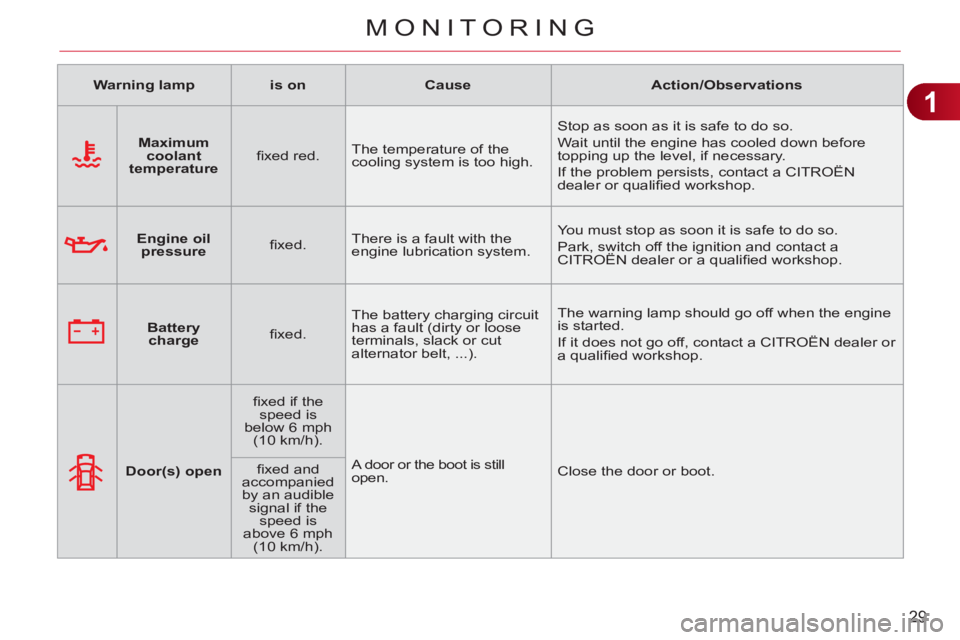
Maximum
coolant
temperature
fi xed red. The temperature of the
cooling system is too high. Stop as soon as it is safe to do so.
Wait until the engine has cooled down before
topping up the level, if necessary.
If the problem persists, contact a CITROËN
dealer or qualifi ed workshop.
Engine oil
pressure
fi xed. There is a fault with the
engine lubrication system. You must stop as soon it is safe to do so.
Park, switch off the ignition and contact a
CITROËN dealer or a qualifi ed workshop.
Battery
charge
fi xed. The battery charging circuit
has a fault (dirty or loose
terminals, slack or cut
alternator belt, ...). The warning lamp should go off when the engine
is started.
If it does not go off, contact a CITROËN dealer or
a qualifi ed workshop.
Door(s) open
fi xed if the
speed is
below 6 mph
(10 km/h).
A door or the boot is still
open. Close the door or boot.
fi xed and
accompanied
by an audible
signal if the
speed is
above 6 mph
(10 km/h).
Page 47 of 244
3
45
COMFORT
VENTILATION
System which creates and maintains
comfortable conditions in the vehicle's
passenger compartment.
Air flow paths
The incoming air follows various routes
depending on the controls selected by
the driver:
- direct arrival in the passenger com-
partment (air intake),
- passage through a heating circuit
(heating),
- passage through a cooling circuit
(air conditioning).
The temperature control enables you to
obtain the level of comfort required by
mixing the air of the various circuits. The air distribution control enables you
to diffuse the air in the passenger com-
partment combining several air vents.
The air fl ow control enables you to
increase or reduce the speed of the
ventilation fan.
The air circulating in the passenger com-
partment is fi ltered and originates either
from the outside via the grille located at
the base of the windscreen or from the
inside in air recirculation mode.
Control panel
The controls of this system are grouped
together on control panel A
on the centre
console. Depending on the model, the
functions offered are:
- the level of comfort required,
- air fl ow,
- air distribution,
- demisting and defrosting,
- manual or digital air conditioning
controls.
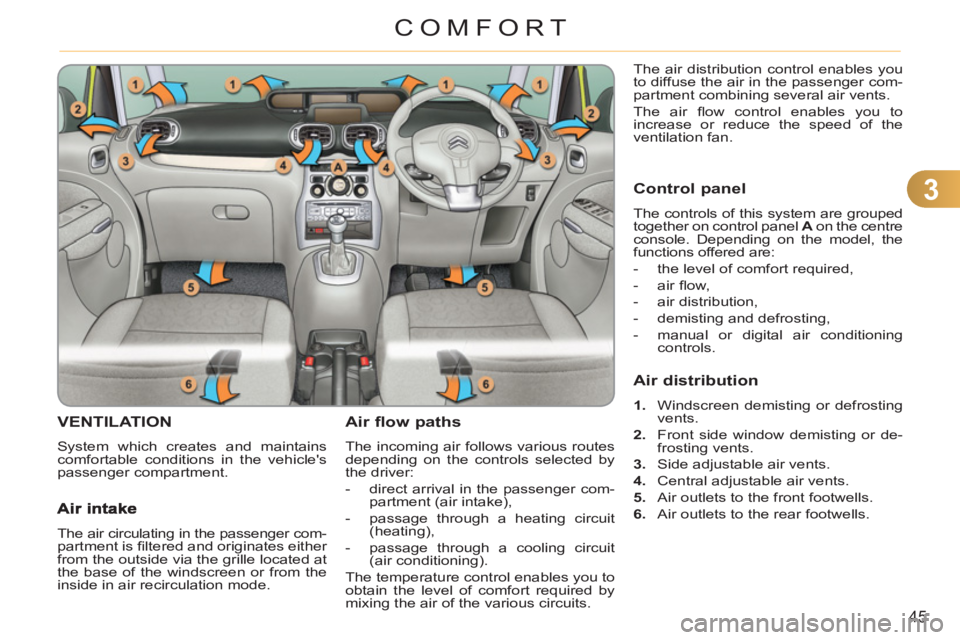
Air distribution
1.
Windscreen demisting or defrosting
vents.
2.
Front side window demisting or de-
frosting vents.
3.
Side adjustable air vents.
4.
Central adjustable air vents.
5.
Air outlets to the front footwells.
6.
Air outlets to the rear footwells.
Page 50 of 244
3
48
COMFORT
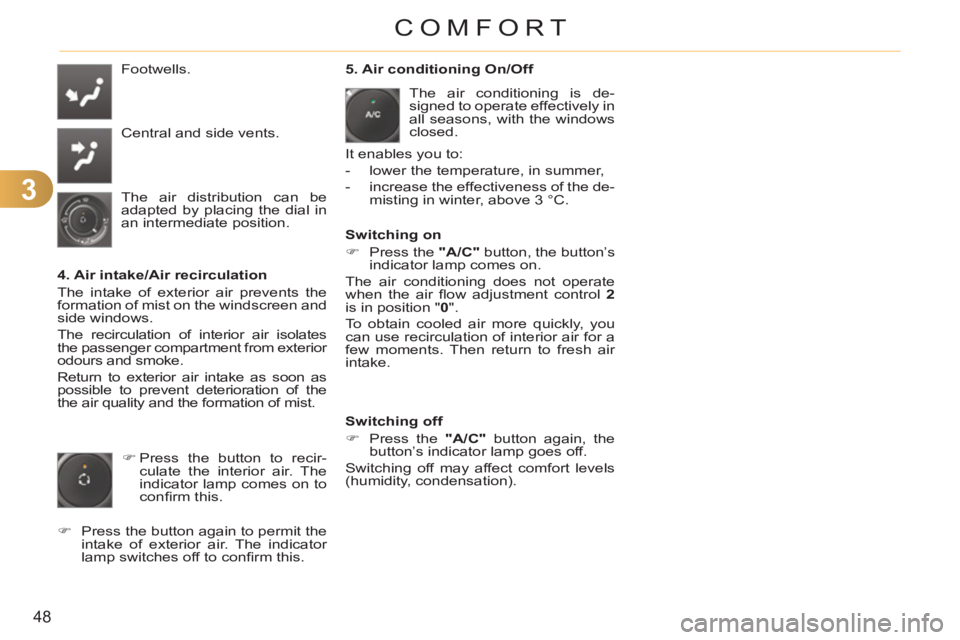
Footwells.
Central and side vents.
The air distribution can be
adapted by placing the dial in
an intermediate position.
4. Air intake/Air recirculation
The intake of exterior air prevents the
formation of mist on the windscreen and
side windows.
The recirculation of interior air isolates
the passenger compartment from exterior
odours and smoke.
Return to exterior air intake as soon as
possible to prevent deterioration of the
the air quality and the formation of mist.
)
Press the button to recir-
culate the interior air. The
indicator lamp comes on to
confi rm this.
)
Press the button again to permit the
intake of exterior air. The indicator
lamp switches off to confi rm this.
5. Air conditioning On/Off
It enables you to:
- lower the temperature, in summer,
- increase the effectiveness of the de-
misting in winter, above 3 °C.
Switching off
)
Press the "A/C"
button again, the
button’s indicator lamp goes off.
Switching off may affect comfort levels
(humidity, condensation).
The air conditioning is de-
signed to operate effectively in
all seasons, with the windows
closed.
Switching on
)
Press the "A/C"
button, the button’s
indicator lamp comes on.
The air conditioning does not operate
when the air fl ow adjustment control 2
is in position " 0
".
To obtain cooled air more quickly, you
can use recirculation of interior air for a
few moments. Then return to fresh air
intake.
Page 52 of 244
3
50
COMFORT
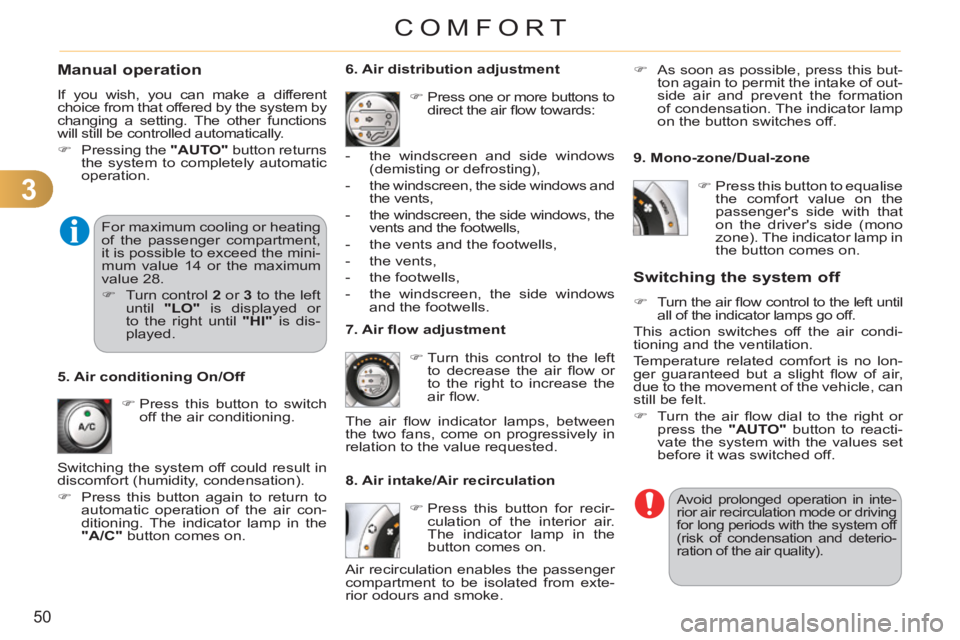
Manual operation
If you wish, you can make a different
choice from that offered by the system by
changing a setting. The other functions
will still be controlled automatically.
)
Pressing the "AUTO"
button returns
the system to completely automatic
operation.
)
Press this button to switch
off the air conditioning.
6. Air distribution adjustment
)
Press one or more buttons to
direct the air fl ow towards:
7. Air fl ow adjustment
)
Turn this control to the left
to decrease the air fl ow or
to the right to increase the
air fl ow.
8. Air intake/Air recirculation
Switching the system off
)
Turn the air fl ow control to the left until
all of the indicator lamps go off.
This action switches off the air condi-
tioning and the ventilation.
Temperature related comfort is no lon-
ger guaranteed but a slight fl ow of air,
due to the movement of the vehicle, can
still be felt.
)
Turn the air fl ow dial to the right or
press the "AUTO"
button to reacti-
vate the system with the values set
before it was switched off.
)
Press this button for recir-
culation of the interior air.
The indicator lamp in the
button comes on.
5. Air conditioning On/Off
Avoid prolonged operation in inte-
rior air recirculation mode or driving
for long periods with the system off
(risk of condensation and deterio-
ration of the air quality).
- the windscreen and side windows
(demisting or defrosting),
- the windscreen, the side windows and
the vents,
- the windscreen, the side windows, the
vents and the footwells,
- the vents and the footwells,
- the vents,
- the footwells,
- the windscreen, the side windows
and the footwells.
The air fl ow indicator lamps, between
the two fans, come on progressively in
relation to the value requested.
)
As soon as possible, press this but-
ton again to permit the intake of out-
side air and prevent the formation
of condensation. The indicator lamp
on the button switches off.
For maximum cooling or heating
of the passenger compartment,
it is possible to exceed the mini-
mum value 14 or the maximum
value 28.
)
Turn control 2
or 3
to the left
until "LO"
is displayed or
to the right until "HI"
is dis-
played.
9. Mono-zone/Dual-zone
)
Press this button to equalise
the comfort value on the
passenger's side with that
on the driver's side (mono
zone). The indicator lamp in
the button comes on.
Air recirculation enables the passenger
compartment to be isolated from exte-
rior odours and smoke. Switching the system off could result in
discomfort (humidity, condensation).
)
Press this button again to return to
automatic operation of the air con-
ditioning. The indicator lamp in the
"A/C"
button comes on.
Page 130 of 244
10
CHECKS
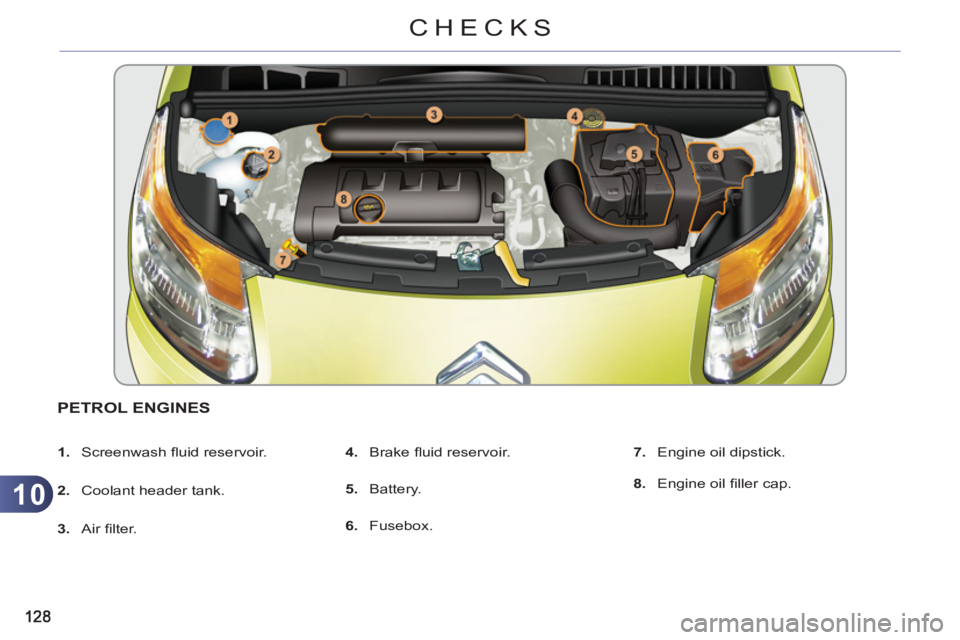
PETROL ENGINES
1.
Screenwash fl uid reservoir.
2.
Coolant header tank.
3.
Air fi lter.
4.
Brake fl uid reservoir.
5.
Battery.
6.
Fusebox.
7.
Engine oil dipstick.
8.
Engine oil fi ller cap.
Page 131 of 244
10
CHECKS
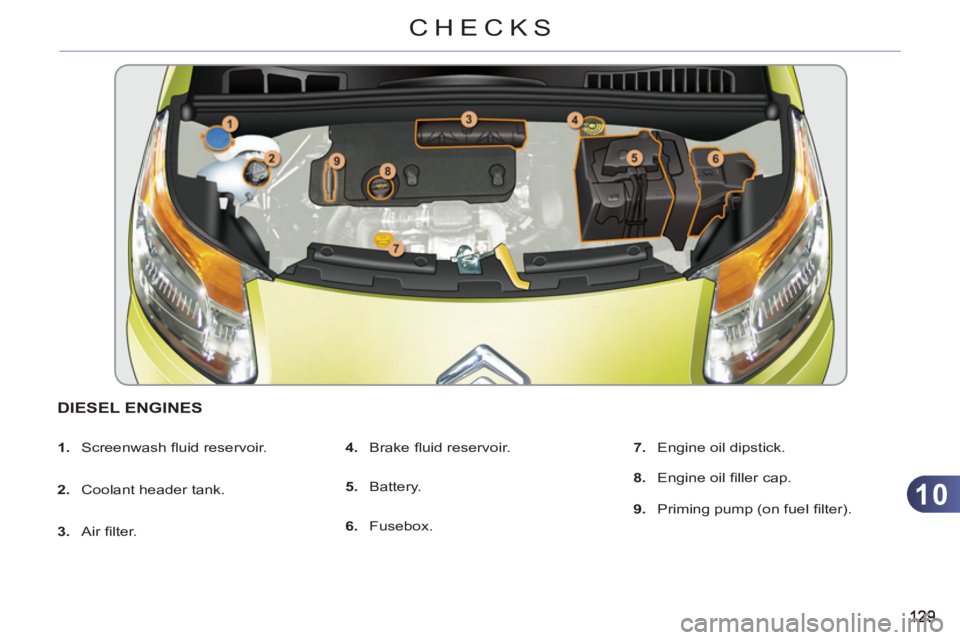
DIESEL ENGINES
1.
Screenwash fl uid reservoir.
2.
Coolant header tank.
3.
Air fi lter.
4.
Brake fl uid reservoir.
5.
Battery.
6.
Fusebox.
7.
Engine oil dipstick.
8.
Engine oil fi ller cap.
9.
Priming pump (on fuel fi lter).
Page 132 of 244
10
130
CHECKS
CHECKING LEVELS
Brake fluid level
Oil level
The reading will only be correct if the
vehicle is on level ground and the
engine has been off for more than
30 minutes.
The check is carried out either when the ignition
is switched on using the oil level indicator in the
instrument panel, or using the dipstick.
The brake fl uid level should be
close to the "MAX" mark. If it is
not, check the brake pad wear.
Changing the fl uid
Refer to the servicing booklet for details
of the interval for this operation.
Coolant level
The coolant level should be
close to the "MAX" mark but
should never exceed it.
When the engine is warm, the
temperature of the coolant is regulated
by the fan. This can operate with the
ignition off.
On vehicles which are fi tted with a par-
ticle emission fi lter, the fan may operate
after the vehicle has been switched off,
even if the engine is cold.
Fluid specifi cation
For optimum cleaning and to avoid
freezing, this fl uid must not be topped
up or replaced with plain water.
Engine oil change
Refer to the servicing booklet for details
of the interval for this operation.
In order to maintain the reliability of the
engine and emission control system,
the use of additives in the engine oil is
prohibited.
Oil grade
The oil must be suitable for your engine
and conform to the manufacturer's
recommendations.
Fluid specifi cation
The brake fl uid must conform to the
manufacturer's recommendations and
meet the DOT4 standard.
Fluid specifi cation
The coolant must conform to the manu-
facturer's recommendations.
Changing the coolant
The coolant does not have to be changed.
Screenwash fluid level
Check all of these levels regularly and
top them up if necessary, unless other-
wise indicated.
If a level drops signifi cantly, have the
corresponding system checked by a
CITROËN dealer or a qualifi ed work-
shop. In addition, as the cooling system is
pressurised, wait at least one hour after
switching off the engine before carrying
out any work.
To avoid any risk of scalding, unscrew
the cap by two turns to allow the pres-
sure to drop. When the pressure has
dropped, remove the cap and top up
the level.
Top up the level when necessary.
Take care when carrying out
checks under the bonnet as
some parts of the engine can be
very hot (risk of burns).
It is normal to top up the engine oil
between services. CITROËN rec-
ommends that you check the oil
level and top up if necessary, every
3 000 miles (5 000 kilometres).
Page 154 of 244
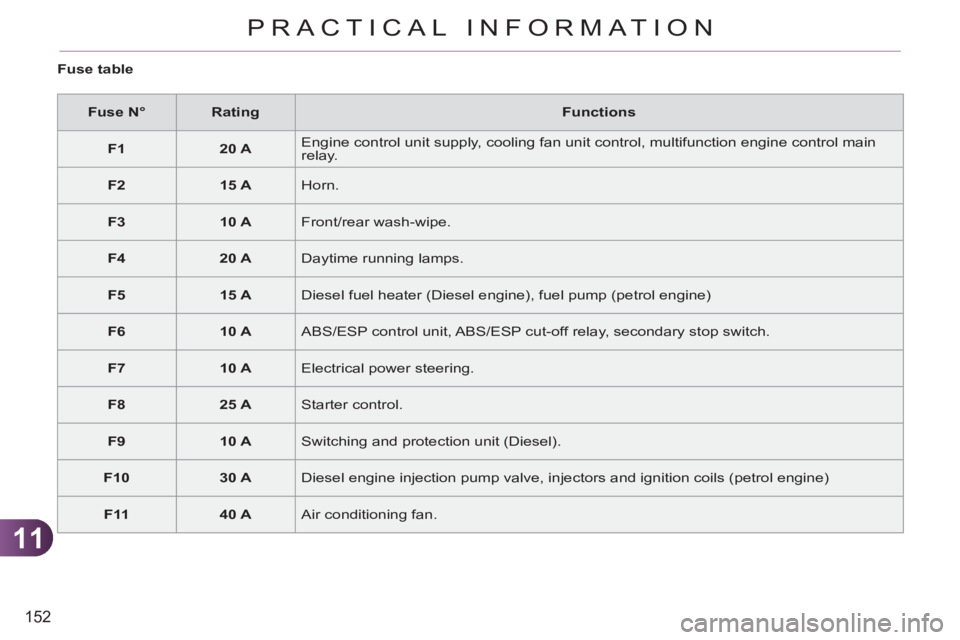
11
152
PRACTICAL INFORMATION
Fuse N°
Rating
Functions
F1
20 A
Engine control unit supply, cooling fan unit control, multifunction engine control main
relay.
F2
15 A
Horn.
F3
10 A
Front/rear wash-wipe.
F4
20 A
Daytime running lamps.
F5
15 A
Diesel fuel heater (Diesel engine), fuel pump (petrol engine)
F6
10 A
ABS/ESP control unit, ABS/ESP cut-off relay, secondary stop switch.
F7
10 A
Electrical power steering.
F8
25 A
Starter control.
F9
10 A
Switching and protection unit (Diesel).
F10
30 A
Diesel engine injection pump valve, injectors and ignition coils (petrol engine)
F11
40 A
Air conditioning fan.
Fuse table