tyre CITROEN C3 PICASSO 2017 User Guide
[x] Cancel search | Manufacturer: CITROEN, Model Year: 2017, Model line: C3 PICASSO, Model: CITROEN C3 PICASSO 2017Pages: 292, PDF Size: 8.23 MB
Page 115 of 292
113
C3Picasso_en_Chap08_securite_ed01-2015
Braking assistance systems
Anti-lock braking system
and electronic brake force
distribution
Linked systems which improve the stability and
manoeuvrability of your vehicle when braking,
in particular on poor or slippery sur faces.
Activation
The anti-lock braking system comes into
operation automatically when there is a risk of
wheel lock.
Normal operation of the ABS may make itself
felt by slight vibration of the brake pedal.When braking in an emergency, press
very firmly without releasing the
pressure.
Group of supplementary systems which help
you to obtain optimum braking in complete
safety in emergency situations:
-
a
nti-lock braking system (ABS),
-
e
lectronic brake force distribution (EBFD),
-
em
ergency braking assistance (EBA).
Operating fault
If this warning lamp comes on,
accompanied by an audible signal
and a message in the screen, it
indicates a malfunction of the anti-
lock braking system which could
result in loss of control of the vehicle
when braking.
If this warning lamp comes on,
together with the STOP
and ABS
warning lamps, accompanied by an
audible signal and a message in the
screen, it indicates a malfunction of
the electronic brake force distribution
which could result in loss of control of
the vehicle when braking.
Emergency braking assistance
System which, in an emergency, enables you
to obtain the optimum braking pressure more
quickly, thus reducing the stopping distance.
Activation
It is triggered by the speed at which the brake
pedal is pressed.
The effect of this is a reduction in the
resistance of the pedal and an increase in
braking efficiency.
In either case, contact a CITROËN dealer or a
qualified workshop. When braking in an emergency, press
firmly without releasing the pressure.
When replacing wheels (tyres and
rims), ensure that they conform to the
manufacturer's recommendations.
You must stop as soon as it is safe to do so.
8
Safety
Page 116 of 292

114
C3Picasso_en_Chap08_securite_ed01-2015
Deactivation
In exceptional conditions (starting a vehicle
which is bogged down, stuck in snow, on soft
ground...), it may be advisable to deactivate the
DSC and ASR systems, so that the wheels can
move freely and regain grip.
F
P
ress the button, located in the centre of
the dashboard.
Illumination of the indicator lamp in the button
indicates that the DSC and ASR systems are
deactivated.
Reactivation
These systems are reactivated automatically
each time the ignition is switched back on or
from 30 mph (50 km/h).
F
P
ress the button again to reactivate them
manually.
Operating fault
The illumination of this warning lamp
comes in the instrument panel and in
the button, accompanied by an audible
signal and a message in the multifunction
screen, indicates a fault in these systems.
Trajectory control systems
The anti-slip regulation (also known as traction
control) optimises traction to prevent skidding of
the wheels, by acting on the brakes of the driving
wheels and on the engine.
The electronic stability control acts on the brake
of one or more wheels and on the engine to keep
the vehicle on the trajectory required by the driver,
within the limits of the laws of physics.
Anti-slip regulation (ASR)
and dynamic stability
control (DSC)
This is indicated by flashing of this
warning lamp in the instrument panel.
Activation
These systems are activated automatically
each time the vehicle is started.
They come into operation in the event of a grip
or trajectory problem. The DSC/ASR systems offer
exceptional safety in normal driving, but
this should not encourage the driver to
take extra risks or drive at high speed.
The correct operation of these
systems depends on observation of
the manufacturer's recommendations
regarding wheels (tyres and rims),
braking components, electronic
components and assembly and repair
procedures.
After an impact, have these systems
checked by a CITROËN dealer or a
qualified workshop.
Have it checked by a CITROËN dealer or a
qualified workshop.
Safety
Page 152 of 292
150
C3Picasso_en_Chap11_informations-pratiques_ed01-2015
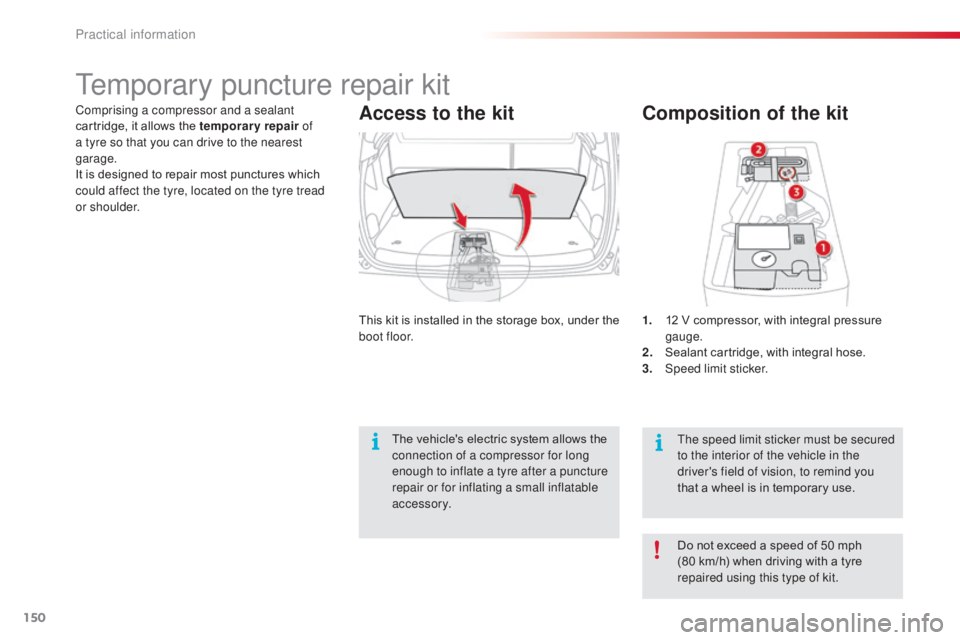
Composition of the kit
1. 12 V compressor, with integral pressure gauge.
2.
S
ealant cartridge, with integral hose.
3.
Spe
ed limit sticker.
Access to the kit
This kit is installed in the storage box, under the
boot floor.
The speed limit sticker must be secured
to the interior of the vehicle in the
driver's field of vision, to remind you
that a wheel is in temporary use.
Comprising a compressor and a sealant
cartridge, it allows the temporary repair
of
a tyre so that you can drive to the nearest
garage.
It is designed to repair most punctures which
could affect the tyre, located on the tyre tread
or shoulder.
Do not exceed a speed of 50 mph
(80 km/h) when driving with a tyre
repaired using this type of kit.
The vehicle's electric system allows the
connection of a compressor for long
enough to inflate a tyre after a puncture
repair or for inflating a small inflatable
accessory.
Temporary puncture repair kit
Practical information
Page 153 of 292
151
C3Picasso_en_Chap11_informations-pratiques_ed01-2015
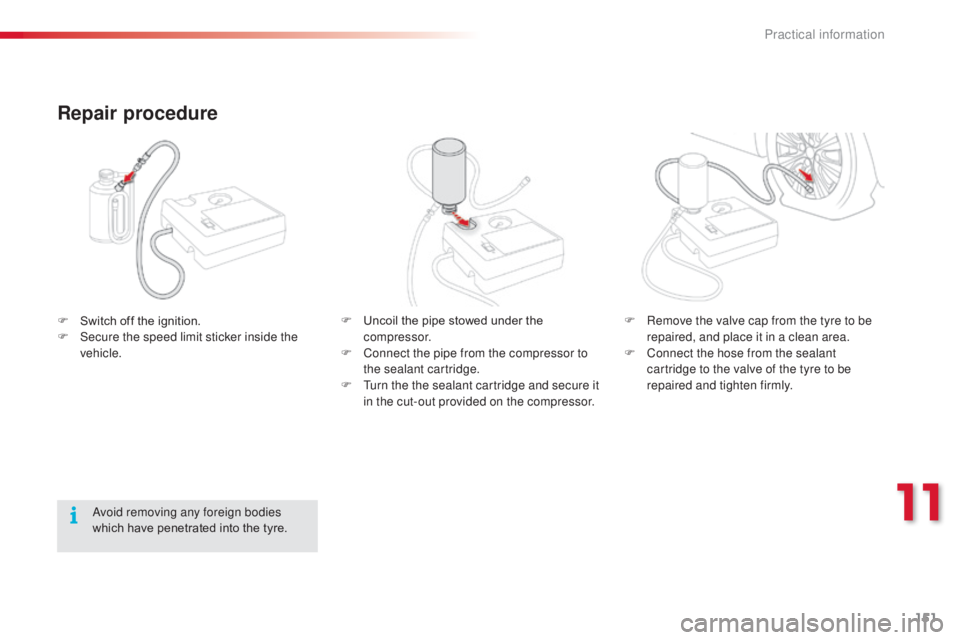
F Switch off the ignition.
F S ecure the speed limit sticker inside the
vehicle. F
U ncoil the pipe stowed under the
compressor.
F
C
onnect the pipe from the compressor to
the sealant cartridge.
F
T
urn the the sealant cartridge and secure it
in the cut-out provided on the compressor.
Avoid removing any foreign bodies
which have penetrated into the tyre. F
R emove the valve cap from the tyre to be
repaired, and place it in a clean area.
F
C
onnect the hose from the sealant
cartridge to the valve of the tyre to be
repaired and tighten firmly.
Repair procedure
11
Practical information
Page 154 of 292
152
C3Picasso_en_Chap11_informations-pratiques_ed01-2015
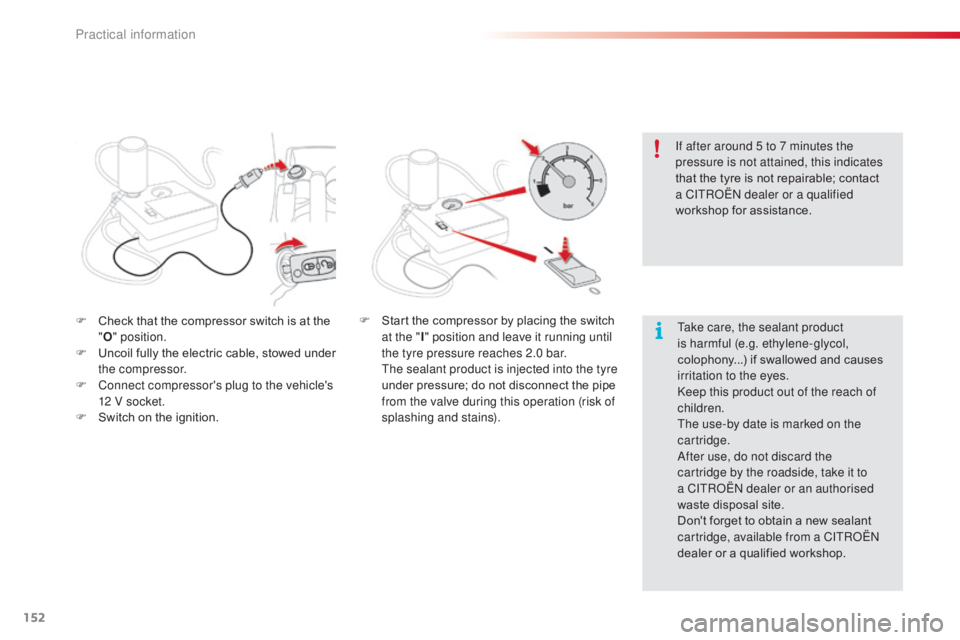
F Check that the compressor switch is at the "O " position.
F
U
ncoil fully the electric cable, stowed under
the compressor.
F
C
onnect compressor's plug to the vehicle's
12 V socket.
F
S
witch on the ignition. Take care, the sealant product
is harmful (e.g. ethylene-glycol,
colophony...) if swallowed and causes
irritation to the eyes.
Keep this product out of the reach of
children.
The use-by date is marked on the
cartridge.
After use, do not discard the
cartridge by the roadside, take it to
a CITROËN
dealer or an authorised
waste disposal site.
Don't forget to obtain a new sealant
cartridge, available from a CITROËN
dealer or a qualified workshop.
F
S tart the compressor by placing the switch
at the " I" position and leave it running until
the tyre pressure reaches 2.0 bar.
T
he sealant product is injected into the tyre
under pressure; do not disconnect the pipe
from the valve during this operation (risk of
splashing and stains). If after around 5 to 7 minutes the
pressure is not attained, this indicates
that the tyre is not repairable; contact
a CITROËN dealer or a qualified
workshop for assistance.
Practical information
Page 155 of 292
153
C3Picasso_en_Chap11_informations-pratiques_ed01-2015
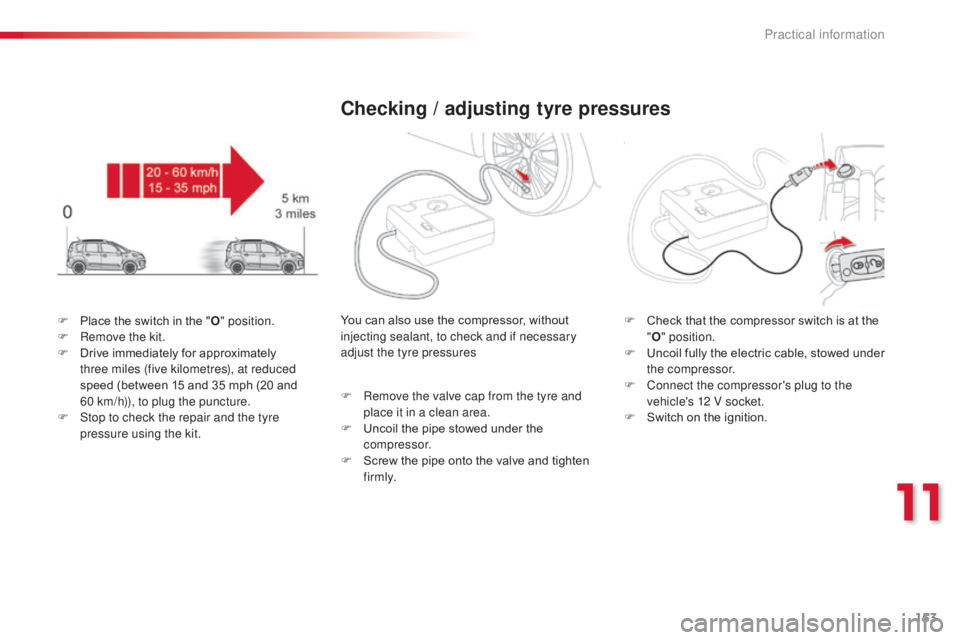
F Place the switch in the "O" position.
F R emove the kit.
F
D
rive immediately for approximately
three miles (five kilometres), at reduced
speed (between 15 and 35 mph (20 and
60
km/h)), to plug the puncture.
F
S
top to check the repair and the tyre
pressure using the kit.
Checking / adjusting tyre pressures
You can also use the compressor, without
injecting sealant, to check and if necessary
adjust the tyre pressures
F
R
emove the valve cap from the tyre and
place it in a clean area.
F
U
ncoil the pipe stowed under the
compressor.
F
S
crew the pipe onto the valve and tighten
f i r m l y. F
C heck that the compressor switch is at the
" O " position.
F
U
ncoil fully the electric cable, stowed under
the compressor.
F
C
onnect the compressor's plug to the
vehicle's 12 V socket.
F
S
witch on the ignition.
11
Practical information
Page 156 of 292
154
C3Picasso_en_Chap11_informations-pratiques_ed01-2015
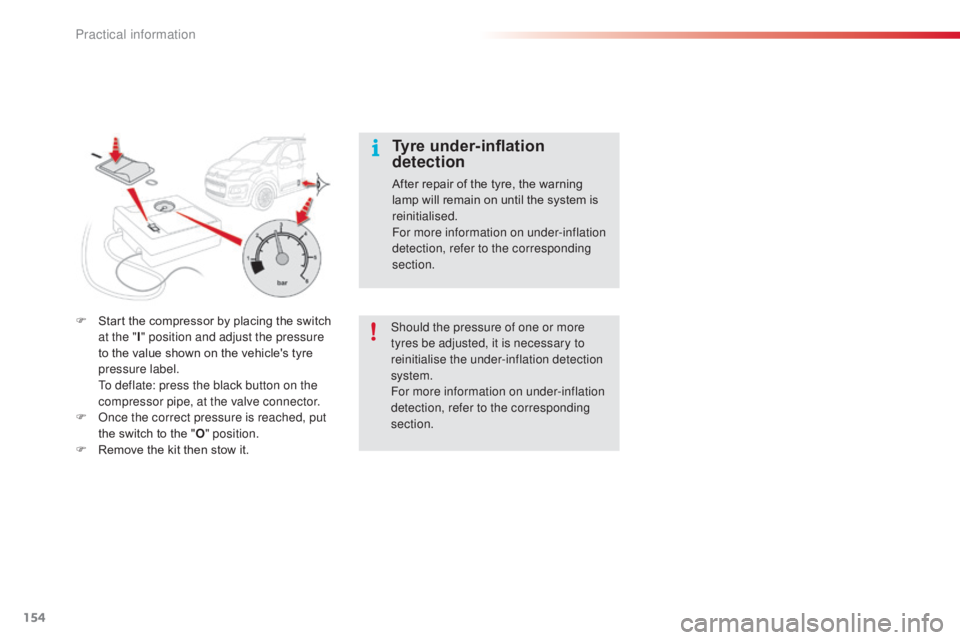
F Start the compressor by placing the switch at the " I" position and adjust the pressure
to the value shown on the vehicle's tyre
pressure label.
T
o deflate: press the black button on the
compressor pipe, at the valve connector.
F
O
nce the correct pressure is reached, put
the switch to the " O" position.
F
R
emove the kit then stow it.
Tyre under-inflation
detection
After repair of the tyre, the warning
lamp will remain on until the system is
reinitialised.
For more information on under-inflation
detection, refer to the corresponding
section.
Should the pressure of one or more
tyres be adjusted, it is necessary to
reinitialise the under-inflation detection
system.
For more information on under-inflation
detection, refer to the corresponding
section.
Practical information
Page 157 of 292
155
C3Picasso_en_Chap11_informations-pratiques_ed01-2015
Spare wheel
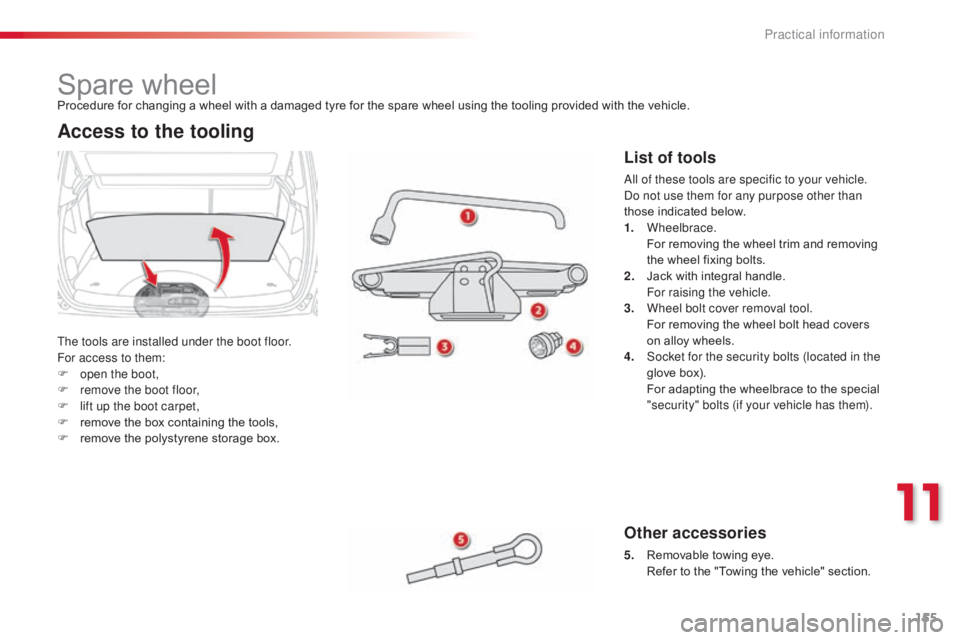
The tools are installed under the boot floor.
For access to them:
F
o
pen the boot,
F
r
emove the boot floor,
F
l
ift up the boot carpet,
F
r
emove the box containing the tools,
F
r
emove the polystyrene storage box.
Other accessories
5. Removable towing eye. R
efer to the "Towing the vehicle" section.
Access to the tooling
Procedure for changing a wheel with a damaged tyre for the spare wheel using the tooling provided with the vehicle.
List of tools
All of these tools are specific to your vehicle.
Do not use them for any purpose other than
those indicated below.
1.
Wheelbrace.
F
or removing the wheel trim and removing
the wheel fixing bolts.
2.
J
ack with integral handle.
F
or raising the vehicle.
3.
W
heel bolt cover removal tool.
F
or removing the wheel bolt head covers
on alloy wheels.
4.
S
ocket for the security bolts (located in the
glove box).
F
or adapting the wheelbrace to the special
"security" bolts (if your vehicle has them).
11
Practical information
Page 159 of 292
157
C3Picasso_en_Chap11_informations-pratiques_ed01-2015
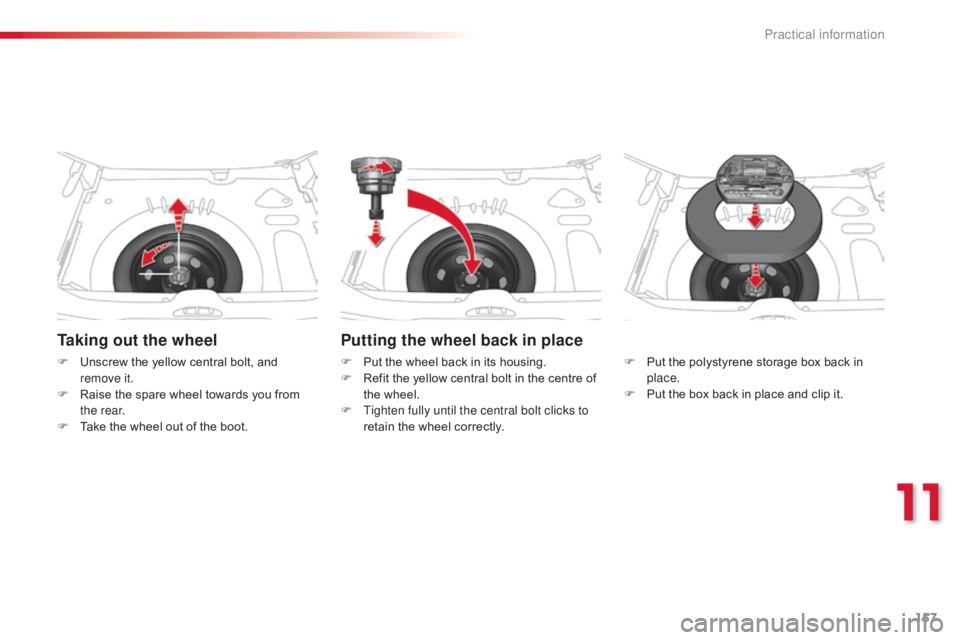
Taking out the wheel
F Unscrew the yellow central bolt, and remove it.
F
R
aise the spare wheel towards you from
the rear.
F
T
ake the wheel out of the boot.
Putting the wheel back in place
F Put the wheel back in its housing.
F R efit the yellow central bolt in the centre of
the wheel.
F
T
ighten fully until the central bolt clicks to
retain the wheel correctly. F
P ut the polystyrene storage box back in
place.
F
P
ut the box back in place and clip it.
11
Practical information
Page 160 of 292
158
C3Picasso_en_Chap11_informations-pratiques_ed01-2015
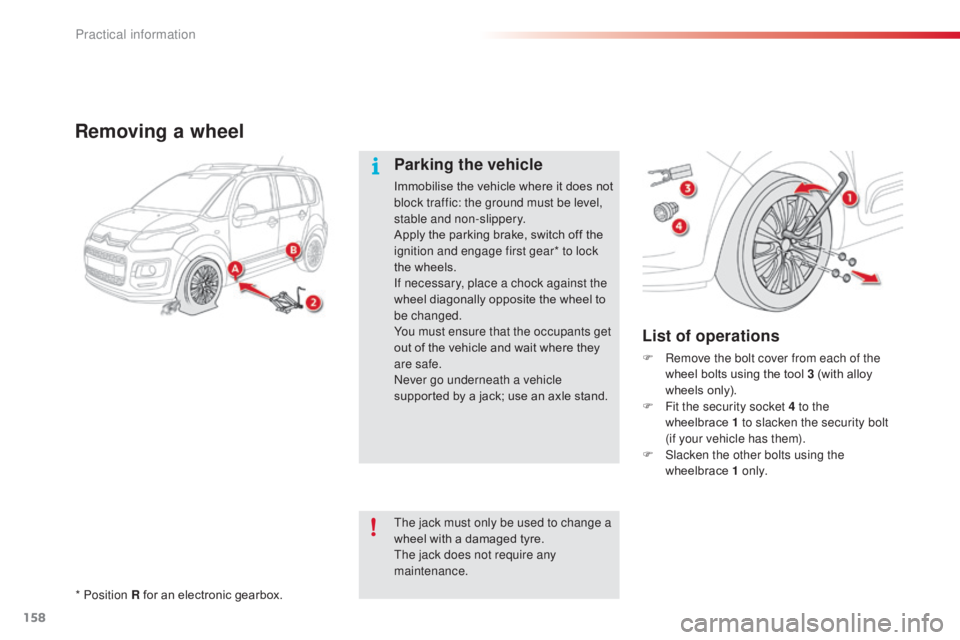
Removing a wheel
List of operations
F Remove the bolt cover from each of the wheel bolts using the tool 3 (with alloy
wheels only).
F
F
it the security socket 4 to the
wheelbrace
1
to slacken the security bolt
(if your vehicle has them).
F
S
lacken the other bolts using the
wheelbrace 1 o n l y.
Parking the vehicle
Immobilise the vehicle where it does not
block traffic: the ground must be level,
stable and non-slippery.
Apply the parking brake, switch off the
ignition and engage first gear* to lock
the wheels.
If necessary, place a chock against the
wheel diagonally opposite the wheel to
be changed.
You must ensure that the occupants get
out of the vehicle and wait where they
are safe.
Never go underneath a vehicle
supported by a jack; use an axle stand.
* Position R for an electronic gearbox. The jack must only be used to change a
wheel with a damaged tyre.
The jack does not require any
maintenance.
Practical information