steering Citroen C3 PICASSO RHD 2014 1.G Owner's Manual
[x] Cancel search | Manufacturer: CITROEN, Model Year: 2014, Model line: C3 PICASSO RHD, Model: Citroen C3 PICASSO RHD 2014 1.GPages: 288, PDF Size: 8.38 MB
Page 4 of 288
.
.
Child seats 93
dea
ctivating the passenger's front airbag
9
6
Isofix child seats
1
01
Child lock
1
05
Child safety
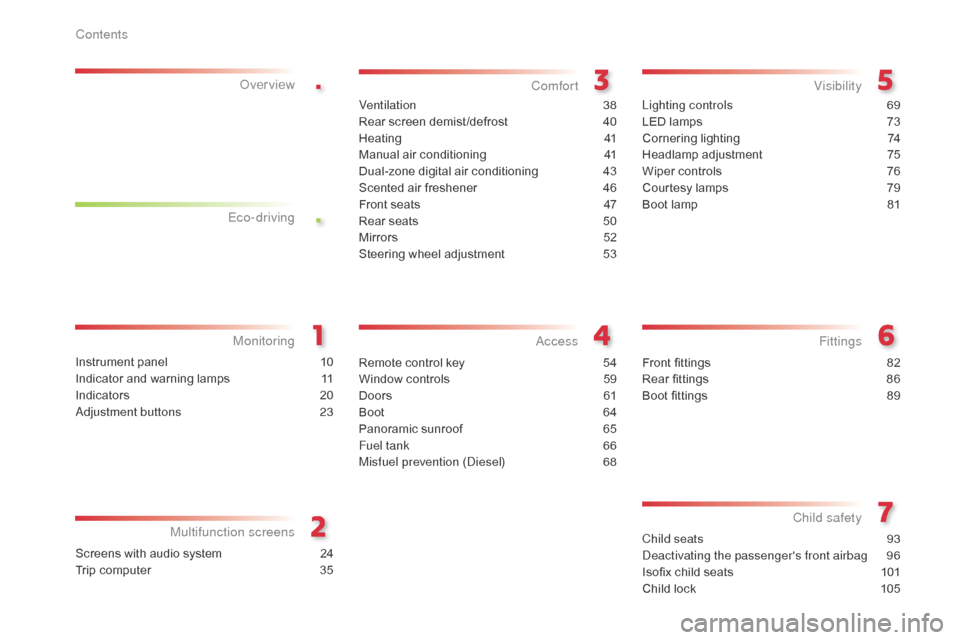
Instrument panel 1 0
Indicator and warning lamps
1
1
Indicators
2
0
a
djustment buttons
2
3
MonitoringOver view
Screens with audio system 2
4
Trip computer
3
5
Multifunction screens
Ventilation 38
Rear screen demist /defrost
4
0
Heating
4
1
Manual air conditioning
4
1
Dual-zone digital air conditioning
4
3
Scented air freshener
4
6
Front seats
4
7
Rear seats
5
0
Mirrors
5
2
Steering wheel adjustment
5
3
Comfort
Remote control key 54
Window controls
5
9
Doors
61
Boo
t
6
4
Panoramic sunroof
6
5
Fuel tank
6
6
Misfuel prevention (
die
sel)
6
8
access
Lighting controls 69
LED lamps
7
3
Cornering lighting
7
4
Headlamp adjustment
7
5
Wiper controls
7
6
Courtesy lamps
7
9
Boot lamp
8
1
Visibility
Front fittings 82
Rear fittings
8
6
Boot fittings
8
9
Fittings
Eco-driving
Contents
Page 8 of 288
6
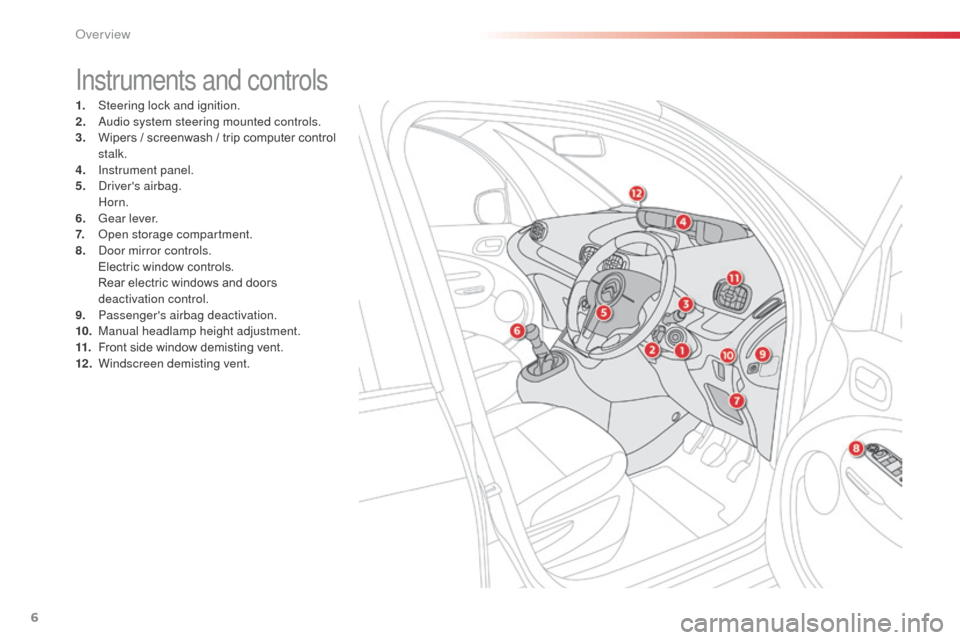
Instruments and controls
1. Steering lock and ignition.
2. au dio system steering mounted controls.
3.
W
ipers / screenwash / trip computer control
stalk.
4.
I
nstrument panel.
5.
d
r
iver's airbag.
Horn.
6.
G
ear lever.
7.
o
pe
n storage compartment.
8.
d
o
or mirror controls.
E
lectric window controls.
R
ear electric windows and doors
deactivation control.
9.
P
assenger's airbag deactivation.
10.
M
anual headlamp height adjustment.
11.
F
ront side window demisting vent.
12 .
W
indscreen demisting vent.
over view
Page 9 of 288
7
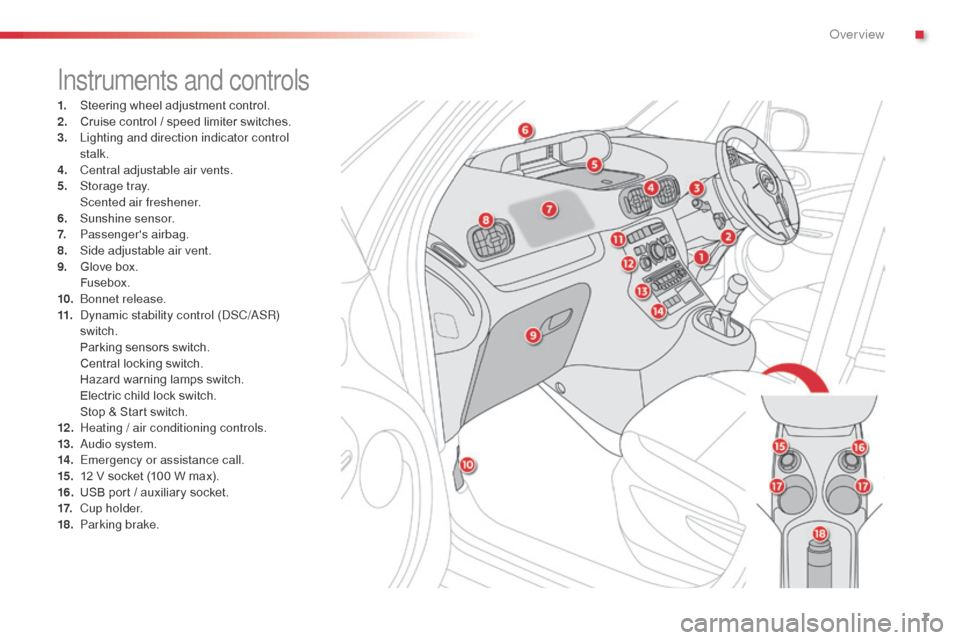
Instruments and controls
1. Steering wheel adjustment control.
2. Cruise control / speed limiter switches.
3.
L
ighting and direction indicator control
stalk.
4.
C
entral adjustable air vents.
5.
St
orage tray.
S
cented air freshener.
6.
S
unshine sensor.
7.
P
assenger's airbag.
8.
S
ide adjustable air vent.
9.
G
love box.
F
usebox.
10.
b
o
nnet release.
11.
d
y
namic stability control (
dSC
/
aS
R)
switch.
P
arking sensors switch.
C
entral locking switch.
H
azard warning lamps switch.
E
lectric child lock switch.
S
top & Start switch.
12 .
H
eating / air conditioning controls.
13.
a
u
dio system.
14 .
E
mergency or assistance call.
15.
1
2 V socket (100 W max).
16.
U
SB port / auxiliary socket.
17.
C
u p h o l d e r.
18.
P
arking brake.
.
over view
Page 17 of 288
15
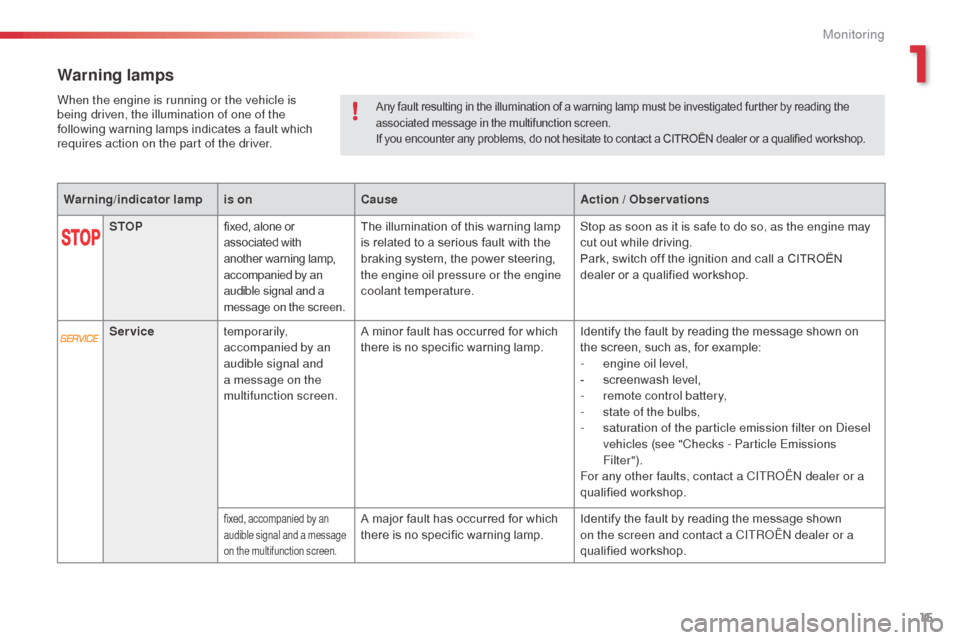
Warning lamps
Warning/indicator lampis on Cause Action / Observations
STOP
fixed, alone or
associated with
another warning lamp,
accompanied by an
audible signal and a
message on the screen.The illumination of this warning lamp
is related to a serious fault with the
braking system, the power steering,
the engine oil pressure or the engine
coolant temperature. Stop as soon as it is safe to do so, as the engine may
cut out while driving.
Park, switch off the ignition and call a CITROËN
dealer or a qualified workshop.
Service temporarily,
accompanied by an
audible signal and
a message on the
multifunction screen. A minor fault has occurred for which
there is no specific warning lamp.
Identify the fault by reading the message shown on
the screen, such as, for example:
-
e
ngine oil level,
-
s
creenwash level,
-
r
emote control battery,
-
s
tate of the bulbs,
-
s
aturation of the particle emission filter on d
i
esel
vehicles (see "Checks - Particle Emissions
Filter").
For any other faults, contact a CITR
oËn
dealer or a
qualified workshop.
fixed, accompanied by an
audible signal and a message
on the multifunction screen.A major fault has occurred for which
there is no specific warning lamp. Identify the fault by reading the message shown
on the screen and contact a CITRoËn
dealer or a
qualified workshop.
Any fault resulting in the illumination of a warning lamp must be investigated further by reading the
associated message in the multifunction screen.
If you encounter any problems, do not hesitate to contact a CITROËN dealer or a qualified workshop.When the engine is running or the vehicle is
being driven, the illumination of one of the
following warning lamps indicates a fault which
requires action on the part of the driver.
1
Monitoring
Page 20 of 288
18
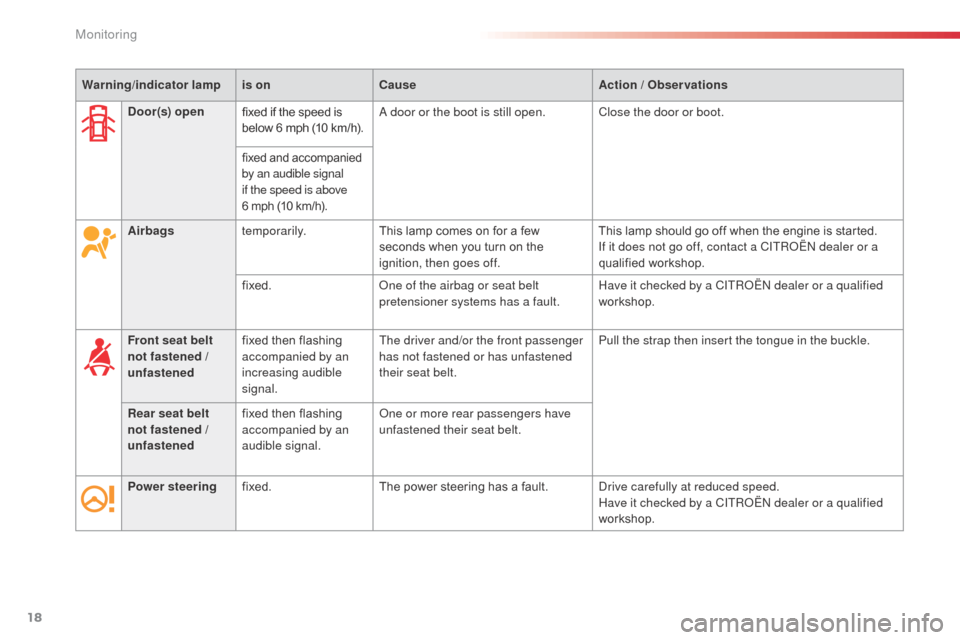
Warning/indicator lampis on Cause Action / Observations
Airbags temporarily. This lamp comes on for a few
seconds when you turn on the
ignition, then goes off. This lamp should go off when the engine is started.
If it does not go off, contact a CITR
oËn
dealer or a
qualified workshop.
fixed.
on
e of the airbag or seat belt
pretensioner systems has a fault. Have it checked by a CITR
oËn
dealer or a qualified
workshop.
Front seat belt
not fastened /
unfastened fixed then flashing
accompanied by an
increasing audible
signal. The driver and/or the front passenger
has not fastened or has unfastened
their seat belt.
Pull the strap then insert the tongue in the buckle.
Rear seat belt
not fastened /
unfastened fixed then flashing
accompanied by an
audible signal.
on
e or more rear passengers have
unfastened their seat belt.
Power steering fixed. The power steering has a fault.
dr
ive carefully at reduced speed.
Have it checked by a CITR
oËn
dealer or a qualified
workshop.
Door(s) open
fixed if the speed is
below 6 mph (10 km/h).a door or the boot is still open. C
lose the door or boot.
fixed and accompanied
by an audible signal
if the speed is above
6
mph (10 km/h).
Monitoring
Page 55 of 288
53
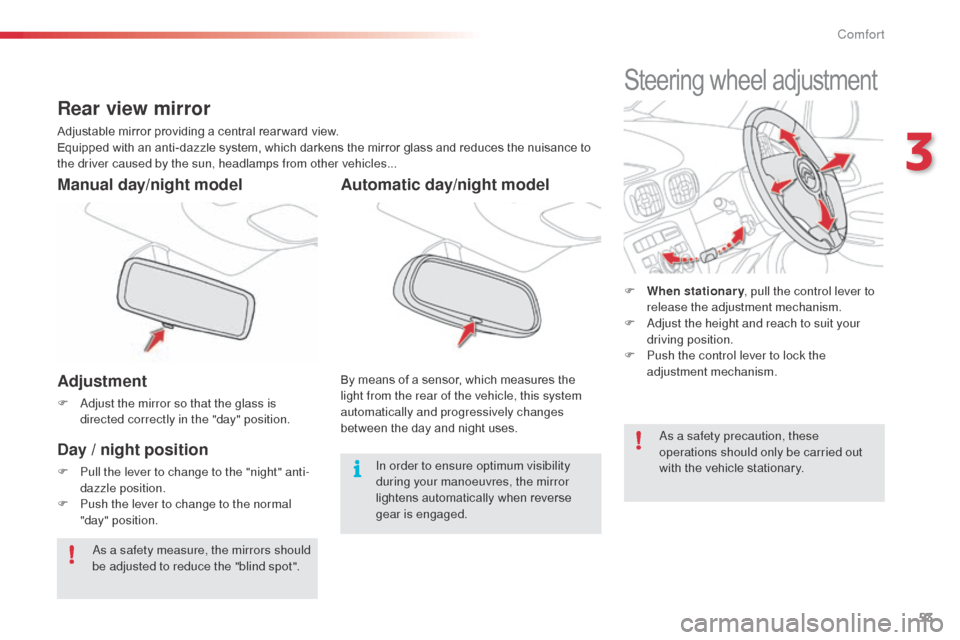
Adjustment
F adjust the mirror so that the glass is directed correctly in the "day" position.
Manual day/night model
Day / night position
F Pull the lever to change to the "night" anti-dazzle position.
F
P
ush the lever to change to the normal
"day" position.
Rear view mirror
Adjustable mirror providing a central rear ward view.
Equipped with an anti-dazzle system, which darkens the mirror glass and reduces the nuisance to
the driver caused by the sun, headlamps from other vehicles...
Steering wheel adjustment
F When stationary , pull the control lever to
release the adjustment mechanism.
F
a
d
just the height and reach to suit your
driving position.
F
P
ush the control lever to lock the
adjustment mechanism.
as a s
afety measure, the mirrors should
be adjusted to reduce the "blind spot".
as a s
afety precaution, these
operations should only be carried out
with the vehicle stationary.
Automatic day/night model
By means of a sensor, which measures the
light from the rear of the vehicle, this system
automatically and progressively changes
between the day and night uses.
In order to ensure optimum visibility
during your manoeuvres, the mirror
lightens automatically when reverse
gear is engaged.
3
Comfort
Page 76 of 288
74
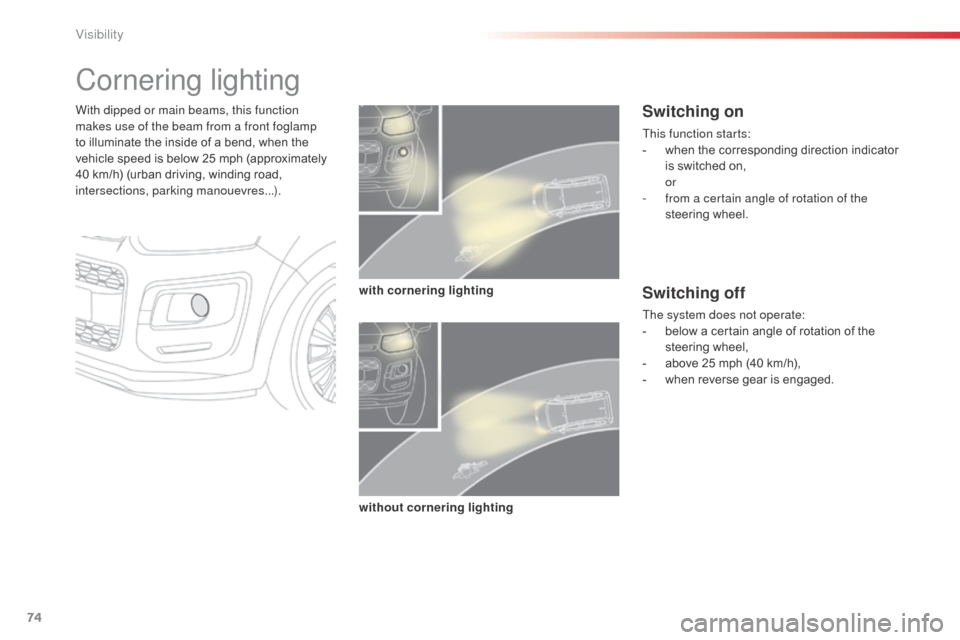
Cornering lighting
With dipped or main beams, this function
makes use of the beam from a front foglamp
to illuminate the inside of a bend, when the
vehicle speed is below 25 mph (approximately
40 km/h) (urban driving, winding road,
intersections, parking manouevres...).with cornering lighting
without cornering lightingSwitching on
This function starts:
- w hen the corresponding direction indicator
is switched on,
or
-
f
rom a certain angle of rotation of the
steering wheel.
Switching off
The system does not operate:
- b elow a certain angle of rotation of the
steering wheel,
-
a
bove 25 mph (40 km/h),
-
w
hen reverse gear is engaged.
Visibility
Page 109 of 288
107
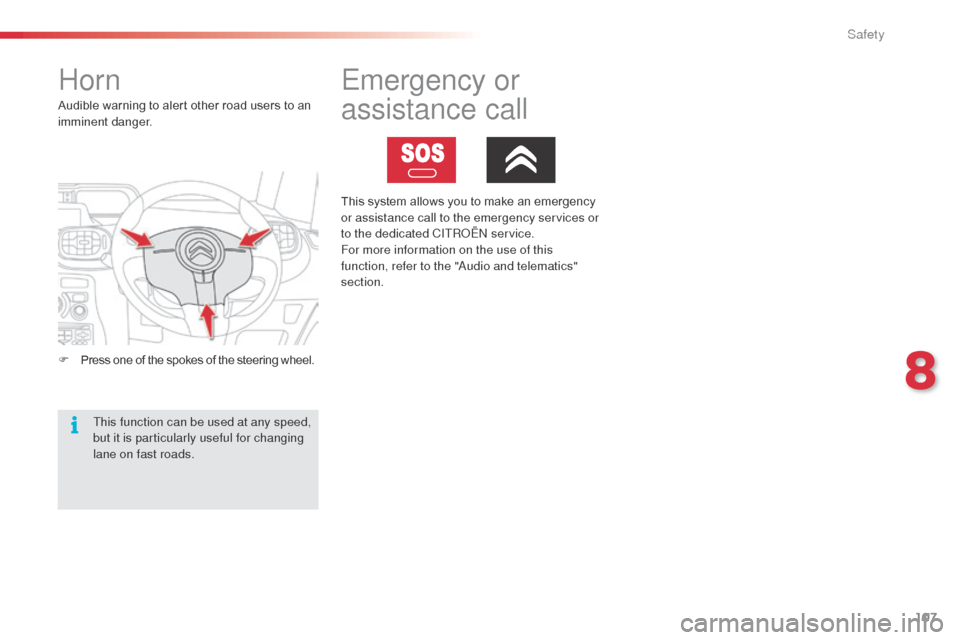
Horn
F Press one of the spokes of the steering wheel. Audible warning to alert other road users to an
imminent danger.This function can be used at any speed,
but it is particularly useful for changing
lane on fast roads.
Emergency or
assistance call
This system allows you to make an emergency
or assistance call to the emergency services or
to the dedicated CITR
oËn
service.
For more information on the use of this
function, refer to the "
au
dio and telematics"
section.
8
Safety
Page 111 of 288
109
Under-inflation alert
This is given by fixed illumination of
this warning lamp, accompanied by
an audible signal and, depending on
equipment, the display of a message.
F
R
educe speed immediately, avoid
excessive steering movements and sudden
braking
F
S
top the vehicle as soon as it is safe to do so. The loss of pressure detected does not
always cause visible bulging of the tyre.
Do not satisfy yourself with just a visual
check. The alert is maintained until the system
is reinitialised.
F
I n the event of a puncture, use the
temporary puncture repair kit or the spare
wheel (depending on equipment),
or
F
i
f you have a compressor, such as the one
in the temporary puncture repair kit, check
the pressures of the four tyres when cold,
or
F
i
f it is not possible to make this check
immediately, drive carefully at reduced
speed.
Reinitialisation
It is necessary to reinitialise the system every
time one or more tyre pressure is adjusted, and
after changing one or more wheels.
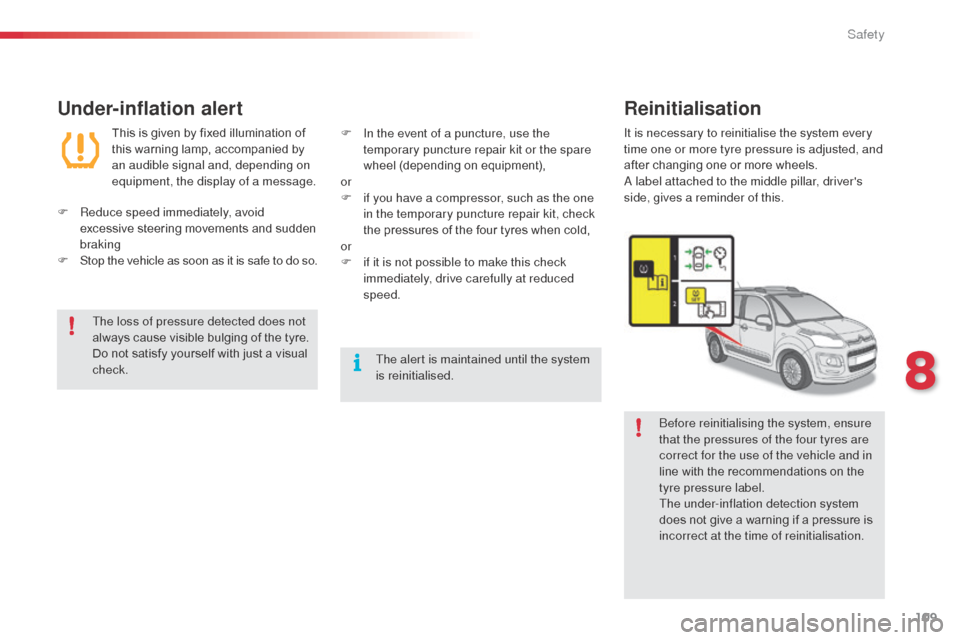
a
label attached to the middle pillar, driver's
side, gives a reminder of this.
be
fore reinitialising the system, ensure
that the pressures of the four tyres are
correct for the use of the vehicle and in
line with the recommendations on the
tyre pressure label.
The under-inflation detection system
does not give a warning if a pressure is
incorrect at the time of reinitialisation.
8
Safety
Page 120 of 288
118
airbags
Front airbags
System which protects the driver and front
passenger in the event of a serious front impact
in order to limit the risk of injury to the head and
chest.
The driver's airbag is fitted in the centre of the
steering wheel; the front passenger's airbag is
fitted in the dashboard above the glove box.
Deployment
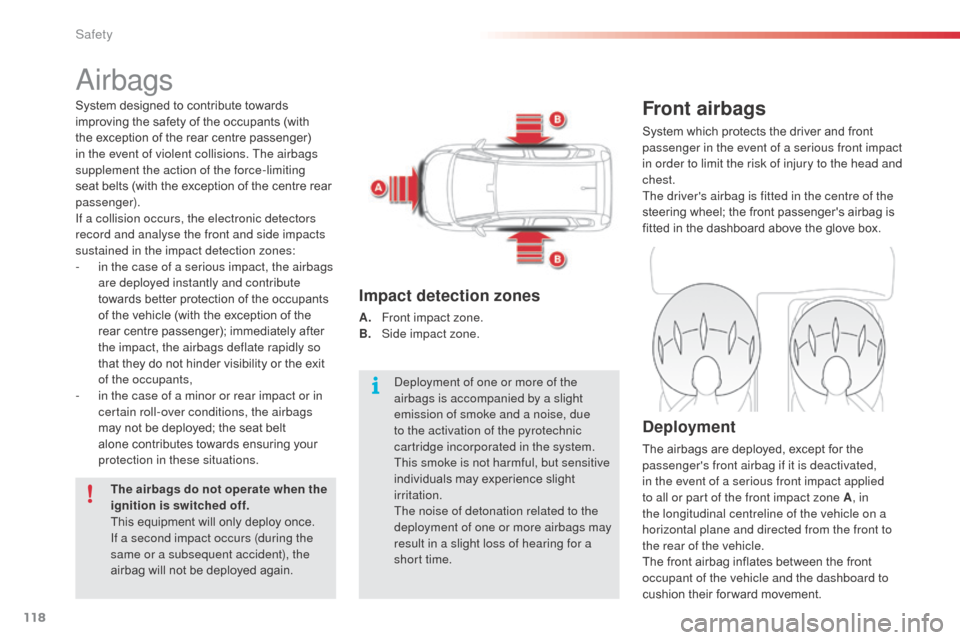
The airbags are deployed, except for the
passenger's front airbag if it is deactivated,
in the event of a serious front impact applied
to all or part of the front impact zone A, in
the longitudinal centreline of the vehicle on a
horizontal plane and directed from the front to
the rear of the vehicle.
The front airbag inflates between the front
occupant of the vehicle and the dashboard to
cushion their for ward movement.
Impact detection zones
A. Front impact zone.
B. S ide impact zone.
System designed to contribute towards
improving the safety of the occupants (with
the exception of the rear centre passenger)
in the event of violent collisions. The airbags
supplement the action of the force-limiting
seat belts (with the exception of the centre rear
passenger).
If a collision occurs, the electronic detectors
record and analyse the front and side impacts
sustained in the impact detection zones:
-
i
n the case of a serious impact, the airbags
are deployed instantly and contribute
towards better protection of the occupants
of the vehicle (with the exception of the
rear centre passenger); immediately after
the impact, the airbags deflate rapidly so
that they do not hinder visibility or the exit
of the occupants,
-
i
n the case of a minor or rear impact or in
certain roll-over conditions, the airbags
may not be deployed; the seat belt
alone contributes towards ensuring your
protection in these situations.
The airbags do not operate when the
ignition is switched off.
This equipment will only deploy once.
If a second impact occurs (during the
same or a subsequent accident), the
airbag will not be deployed again.
de
ployment of one or more of the
airbags is accompanied by a slight
emission of smoke and a noise, due
to the activation of the pyrotechnic
cartridge incorporated in the system.
This smoke is not harmful, but sensitive
individuals may experience slight
irritation.
The noise of detonation related to the
deployment of one or more airbags may
result in a slight loss of hearing for a
short time.
Safety