air condition Citroen C3 PICASSO RHD 2015 1.G User Guide
[x] Cancel search | Manufacturer: CITROEN, Model Year: 2015, Model line: C3 PICASSO RHD, Model: Citroen C3 PICASSO RHD 2015 1.GPages: 292, PDF Size: 8.16 MB
Page 49 of 292

47
4. Automatic visibility programme
The automatic comfort programme
may not be sufficient to quickly
demist or defrost the windscreen
and side windows (humidity, several
passengers, ice, etc.).
F
T
o switch the system off, press this button
again or press "AUTO" . The indicator lamp
in the button goes off and the indicator
lamp in the "AUTO" button comes on.
F
P
ress this button to activate the automatic
visibility programme. The indicator lamp in
the button comes on.
The system automatically controls the air
conditioning, the air flow and the air intake and
provides optimum distribution of the ventilation
to the windscreen and side windows. If you wish, you can make a different choice
from that offered by the system by changing
a setting. The other functions will still be
controlled automatically.
F
P
ressing the "AUTO" button returns the
system to completely automatic operation.
For maximum cooling or heating of the
passenger compartment, it is possible
to exceed the minimum value 14 or the
maximum value 28.
F
T
urn control 2 or 3 to the left until
"LO" is displayed or to the right
until "HI" is displayed.
Manual operation
F Press this button to switch off
the air conditioning.
5. Air conditioning On / Off
Switching the system off could result in
discomfort (humidity, condensation).
F
P
ress this button again to return to
automatic operation of the air conditioning.
The indicator lamp in the "A /C " button
comes on.
3
Comfort
Page 50 of 292

48
6. Air distribution adjustment
F Press one or more buttons to direct the air flow towards:
7. Air flow adjustment
F Turn this control to the left to decrease the air flow or to the
right to increase the air flow.
8. Air intake / Air recirculationF Turn the air flow control to the left until all of the indicator lamps go off.
This action switches off the air conditioning and
the ventilation.
Temperature related comfort is no longer
guaranteed but a slight flow of air, due to the
movement of the vehicle, can still be felt.
F
T
urn the air flow dial to the right or press the
"AUTO" button to reactivate the system with
the values set before it was switched off.
F
P
ress this button for recirculation
of the interior air. The indicator
lamp in the button comes on.
-
t
he windscreen and side windows
(demisting or defrosting),
-
t
he windscreen, the side windows and the
vents,
-
t
he windscreen, the side windows, the
vents and the footwells,
-
t
he vents and the footwells,
-
t
he vents,
-
t
he footwells,
-
t
he windscreen, the side windows and the
footwells.
The air flow indicator lamps, between the two
fans, come on progressively in relation to the
value requested. F
A
s soon as possible, press this button
again to permit the intake of outside air and
prevent the formation of condensation. The
indicator lamp on the button switches off.
9. Mono-zone / Dual-zone
F Press this button to equalise the comfort value on the
passenger's side with that on
the driver's side (mono zone).
The indicator lamp in the button
comes on.
Air recirculation enables the passenger compartment
to be isolated from exterior odours and smoke.
Avoid prolonged operation in interior
air recirculation mode or driving for
long periods with the system off (risk of
condensation and deterioration of the
air quality).
Switching the system off
Comfort
Page 51 of 292
49
Scented air freshenerSystem permitting the diffusion of a fragrance in the passenger compartment in accordance with
your requirements, by means of the adjustment dial and the various fragrance cartridges available.
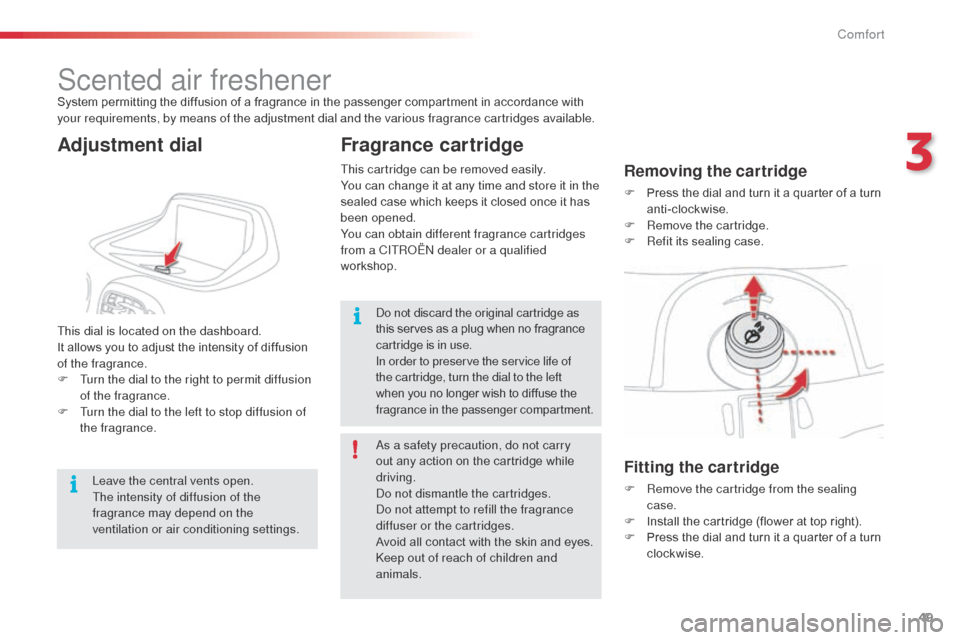
Fitting the cartridge
F Remove the cartridge from the sealing case.
F
I
nstall the cartridge (flower at top right).
F
P
ress the dial and turn it a quarter of a turn
clockwise.
This dial is located on the dashboard.
It allows you to adjust the intensity of diffusion
of the fragrance.
F
T
urn the dial to the right to permit diffusion
of the fragrance.
F
T
urn the dial to the left to stop diffusion of
the fragrance.
Fragrance cartridge
Removing the cartridge
F Press the dial and turn it a quarter of a turn anti-clockwise.
F
R
emove the cartridge.
F
R
efit its sealing case.
As a safety precaution, do not carry
out any action on the cartridge while
driving.
Do not dismantle the cartridges.
Do not attempt to refill the fragrance
diffuser or the cartridges.
Avoid all contact with the skin and eyes.
Keep out of reach of children and
animals. Do not discard the original cartridge as
this serves as a plug when no fragrance
cartridge is in use.
In order to preserve the service life of
the cartridge, turn the dial to the left
when you no longer wish to diffuse the
fragrance in the passenger compartment.
Leave the central vents open.
The intensity of diffusion of the
fragrance may depend on the
ventilation or air conditioning settings.
Adjustment dial
This cartridge can be removed easily.
You can change it at any time and store it in the
sealed case which keeps it closed once it has
been opened.
You can obtain different fragrance cartridges
from a CITROËN dealer or a qualified
workshop.
3
Comfort
Page 110 of 292
108
Horn
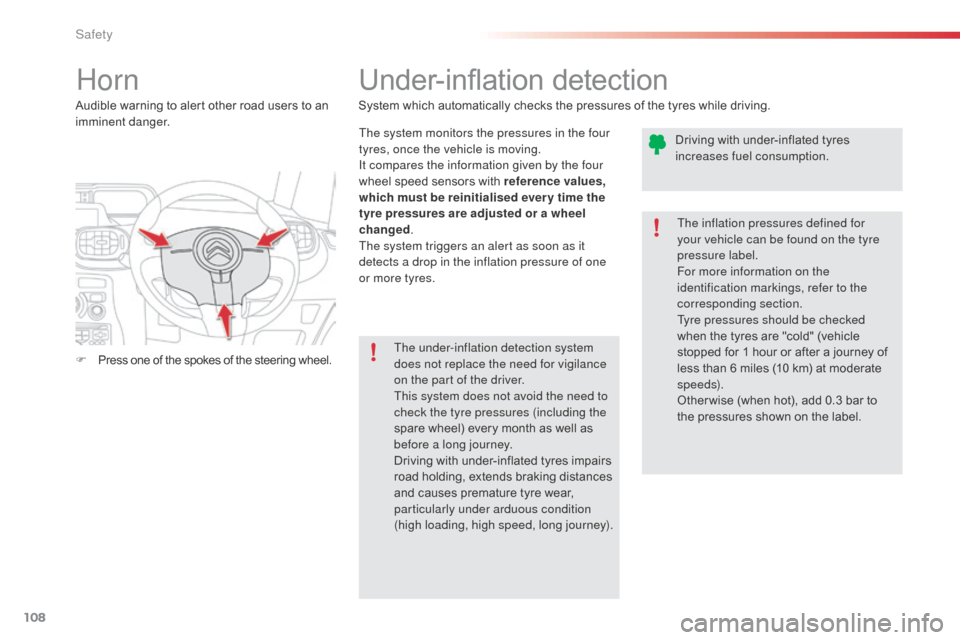
F Press one of the spokes of the steering wheel. Audible warning to alert other road users to an
imminent danger.
Under-inflation detection
System which automatically checks the pressures of the tyres while driving.The system monitors the pressures in the four
tyres, once the vehicle is moving.
It compares the information given by the four
wheel speed sensors with reference values,
which must be reinitialised ever y time the
tyre pressures are adjusted or a wheel
changed .
The system triggers an alert as soon as it
detects a drop in the inflation pressure of one
or more tyres.
The under-inflation detection system
does not replace the need for vigilance
on the part of the driver.
This system does not avoid the need to
check the tyre pressures (including the
spare wheel) every month as well as
before a long journey.
Driving with under-inflated tyres impairs
road holding, extends braking distances
and causes premature tyre wear,
particularly under arduous condition
(high loading, high speed, long journey). The inflation pressures defined for
your vehicle can be found on the tyre
pressure label.
For more information on the
identification markings, refer to the
corresponding section.
Tyre pressures should be checked
when the tyres are "cold" (vehicle
stopped for 1 hour or after a journey of
less than 6 miles (10 km) at moderate
speeds).
Other wise (when hot), add 0.3 bar to
the pressures shown on the label.
Driving with under-inflated tyres
increases fuel consumption.
Safety
Page 115 of 292

113
Deactivation
In exceptional conditions (starting a vehicle
which is bogged down, stuck in snow, on soft
ground...), it may be advisable to deactivate the
DSC and ASR systems, so that the wheels can
move freely and regain grip.
F
P
ress the button, located in the centre of
the dashboard.
Illumination of the indicator lamp in the button
indicates that the DSC and ASR systems are
deactivated.
Reactivation
These systems are reactivated automatically
each time the ignition is switched back on or
from 30 mph (50 km/h).
F
P
ress the button again to reactivate them
manually.
Operating fault
The illumination of this warning lamp
comes in the instrument panel and in
the button, accompanied by an audible
signal and a message in the multifunction
screen, indicates a fault in these systems.
Trajectory control systems
The anti-slip regulation (also known as traction
control) optimises traction to prevent skidding of
the wheels, by acting on the brakes of the driving
wheels and on the engine.
The electronic stability control acts on the brake
of one or more wheels and on the engine to keep
the vehicle on the trajectory required by the driver,
within the limits of the laws of physics.
Anti-slip regulation (ASR)
and dynamic stability
control (DSC)
This is indicated by flashing of this
warning lamp in the instrument panel.
Activation
These systems are activated automatically
each time the vehicle is started.
They come into operation in the event of a grip
or trajectory problem. The DSC/ASR systems offer
exceptional safety in normal driving, but
this should not encourage the driver to
take extra risks or drive at high speed.
The correct operation of these
systems depends on observation of
the manufacturer's recommendations
regarding wheels (tyres and rims),
braking components, electronic
components and assembly and repair
procedures.
After an impact, have these systems
checked by a CITROËN dealer or a
qualified workshop.
Have it checked by a CITROËN dealer or a
qualified workshop.
8
Safety
Page 120 of 292
118
Airbags
Front airbags
System which protects the driver and front
passenger in the event of a serious front impact
in order to limit the risk of injury to the head and
chest.
The driver's airbag is fitted in the centre of the
steering wheel; the front passenger's airbag is
fitted in the dashboard above the glove box.
Deployment
The airbags are deployed, except for the
passenger's front airbag if it is deactivated,
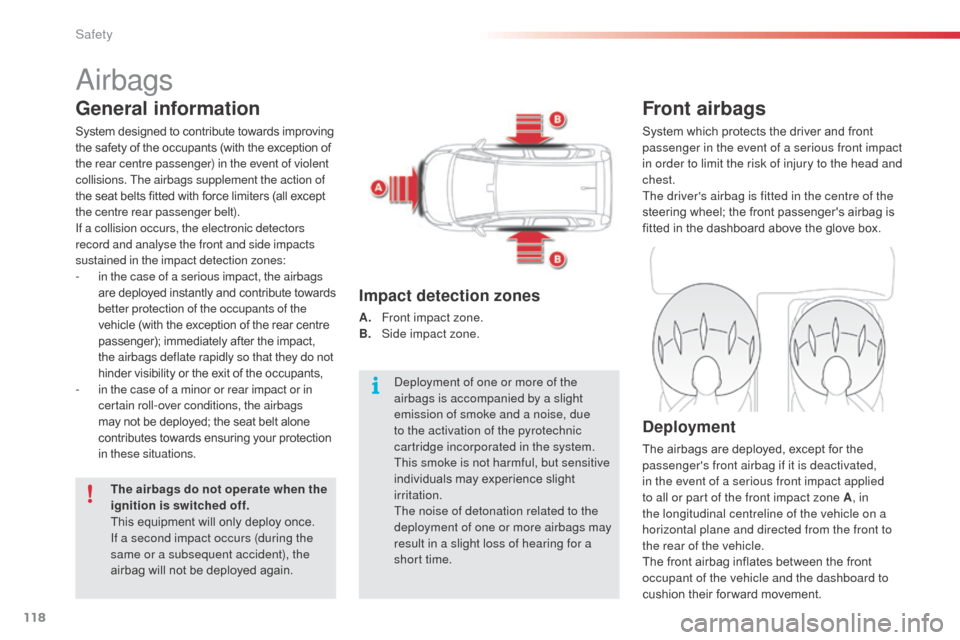
in the event of a serious front impact applied
to all or part of the front impact zone A, in
the longitudinal centreline of the vehicle on a
horizontal plane and directed from the front to
the rear of the vehicle.
The front airbag inflates between the front
occupant of the vehicle and the dashboard to
cushion their for ward movement.
Impact detection zones
A. Front impact zone.
B. S ide impact zone.
General information
System designed to contribute towards improving
the safety of the occupants (with the exception of
the rear centre passenger) in the event of violent
collisions. The airbags supplement the action of
the seat belts fitted with force limiters (all except
the centre rear passenger belt).
If a collision occurs, the electronic detectors
record and analyse the front and side impacts
sustained in the impact detection zones:
-
i
n the case of a serious impact, the airbags
are deployed instantly and contribute towards
better protection of the occupants of the
vehicle (with the exception of the rear centre
passenger); immediately after the impact,
the airbags deflate rapidly so that they do not
hinder visibility or the exit of the occupants,
-
i
n the case of a minor or rear impact or in
certain roll-over conditions, the airbags
may not be deployed; the seat belt alone
contributes towards ensuring your protection
in these situations.
The airbags do not operate when the
ignition is switched off.
This equipment will only deploy once.
If a second impact occurs (during the
same or a subsequent accident), the
airbag will not be deployed again. Deployment of one or more of the
airbags is accompanied by a slight
emission of smoke and a noise, due
to the activation of the pyrotechnic
cartridge incorporated in the system.
This smoke is not harmful, but sensitive
individuals may experience slight
irritation.
The noise of detonation related to the
deployment of one or more airbags may
result in a slight loss of hearing for a
short time.
Safety
Page 149 of 292
147
Particle filter (Diesel)
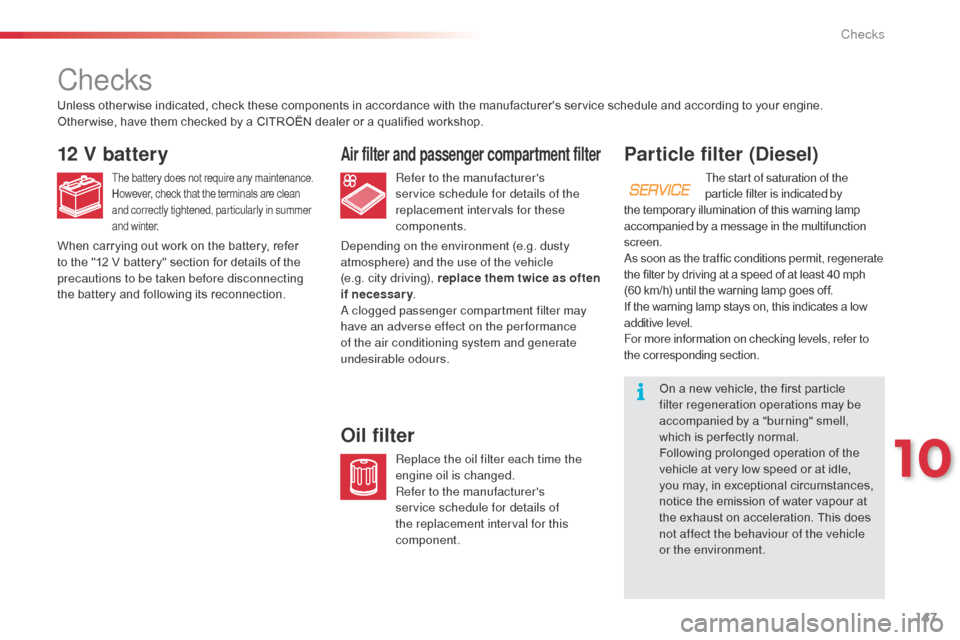
The start of saturation of the
particle filter is indicated by
the temporary illumination of this warning lamp
accompanied by a message in the multifunction
screen.
As soon as the traffic conditions permit, regenerate
the filter by driving at a speed of at least 40 mph
(60 km/h) until the warning lamp goes off.
If the warning lamp stays on, this indicates a low
additive level.
For more information on checking levels, refer to
the corresponding section.
On a new vehicle, the first particle
filter regeneration operations may be
accompanied by a "burning" smell,
which is per fectly normal.
Following prolonged operation of the
vehicle at very low speed or at idle,
you may, in exceptional circumstances,
notice the emission of water vapour at
the exhaust on acceleration. This does
not affect the behaviour of the vehicle
or the environment.
Checks
12 V battery
The battery does not require any maintenance.
However, check that the terminals are clean
and correctly tightened, particularly in summer
and winter.
Air filter and passenger compartment filter
Refer to the manufacturer's
service schedule for details of the
replacement intervals for these
components.
Oil filter
Replace the oil filter each time the
engine oil is changed.
Refer to the manufacturer's
service schedule for details of
the replacement interval for this
component.
Unless other wise indicated, check these components in accordance with the manufacturer's service schedule and according to your engine.
Other wise, have them checked by a CITROËN dealer or a qualified workshop.
When carrying out work on the battery, refer
to the "12 V battery" section for details of the
precautions to be taken before disconnecting
the battery and following its reconnection.
Depending on the environment (e.g. dusty
atmosphere) and the use of the vehicle
(e.g.
city driving), replace them twice as often
if necessary .
A clogged passenger compartment filter may
have an adverse effect on the per formance
of the air conditioning system and generate
undesirable odours.
10
Checks
Page 179 of 292
177
Changing a fuseProcedure for replacing a failed fuse with a new fuse to rectify a failure of the corresponding function.
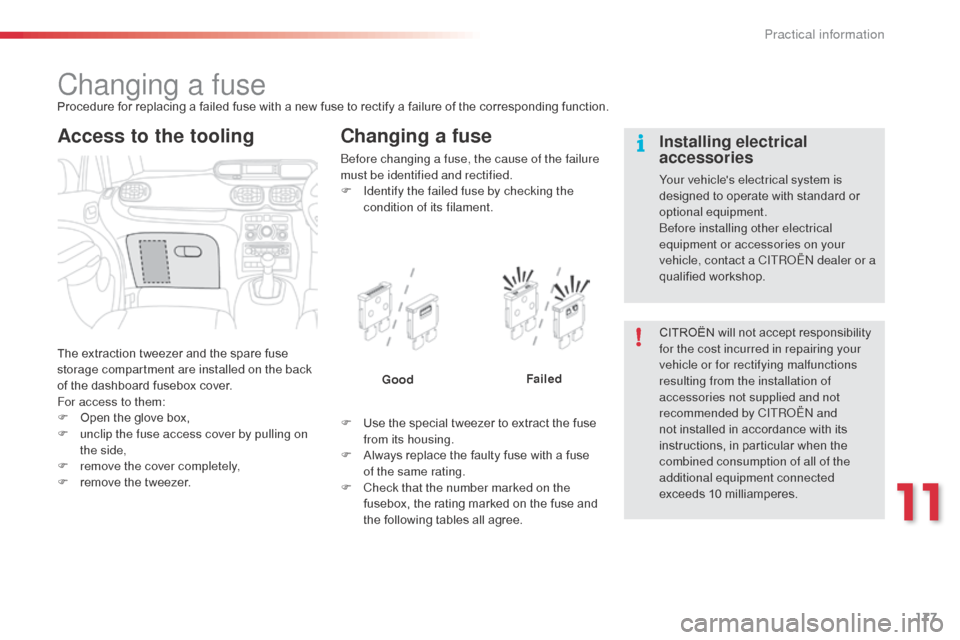
The extraction tweezer and the spare fuse
storage compartment are installed on the back
of the dashboard fusebox cover.
For access to them:
F
O
pen the glove box,
F
u
nclip the fuse access cover by pulling on
the side,
F
r
emove the cover completely,
F
r
emove the tweezer.
Changing a fuse
Before changing a fuse, the cause of the failure
must be identified and rectified.
F
I
dentify the failed fuse by checking the
condition of its filament.
F
U
se the special tweezer to extract the fuse
from its housing.
F
A
lways replace the faulty fuse with a fuse
of the same rating.
F
C
heck that the number marked on the
fusebox, the rating marked on the fuse and
the following tables all agree. Good
FailedCITROËN will not accept responsibility
for the cost incurred in repairing your
vehicle or for rectifying malfunctions
resulting from the installation of
accessories not supplied and not
recommended by CITROËN and
not installed in accordance with its
instructions, in particular when the
combined consumption of all of the
additional equipment connected
exceeds 10 milliamperes.Installing electrical
accessories
Your vehicle's electrical system is
designed to operate with standard or
optional equipment.
Before installing other electrical
equipment or accessories on your
vehicle, contact a CITROËN dealer or a
qualified workshop.
Access to the tooling
11
Practical information
Page 180 of 292

178
Dashboard fuses
The fusebox is located in the glove box.
Access to the fuses
F refer to the paragraph "Access to the tooling".
Fuse tables
Fuse N° Rating Functions
FH36 5 ATrailer relay unit.
FH37 15 ATrailer accessories socket supply.
FH38 20 ANavigation.
FH39 -Not used.
FH40 30 ATrailer relay unit.
Fuse N° Rating Functions
F1 15 ARear wiper.
F2 -Not used.
F3 5 AAirbags and pretensioners control unit.
F4 10 ASteering wheel angle sensor, air conditioning, clutch switch,
particle filter pump, diagnostic socket, air flow meter.
F5 30 AElectric windows panel, passenger's electric window control,
front electric windows motor.
F6 30 ARear electric windows motor and driver's electric window motor.
F7 5 ACourtesy and front map reading lamps, rear reading lamps.
Practical information
Page 181 of 292
179
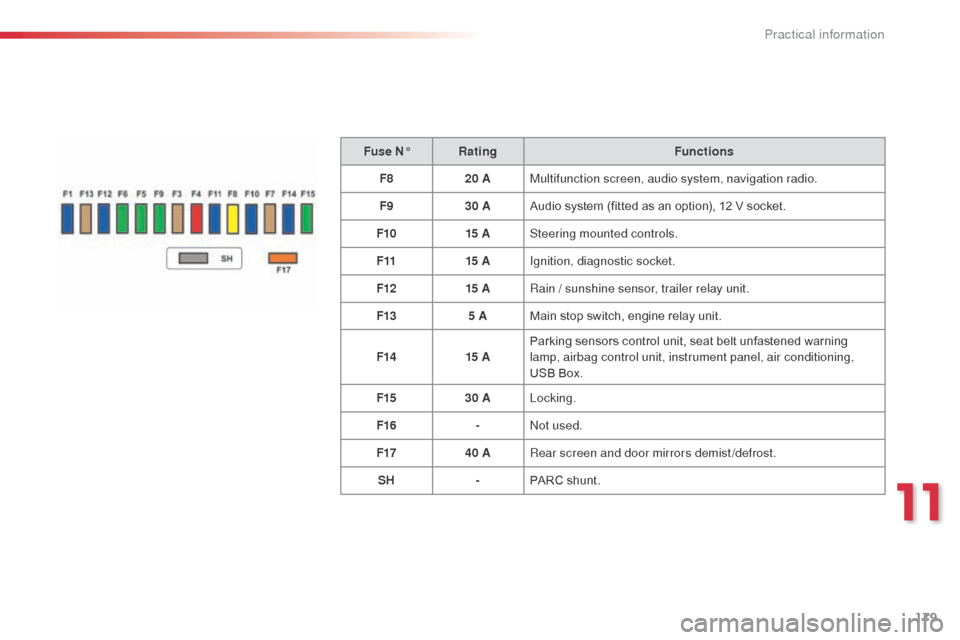
Fuse N°Rating Functions
F8 20 AMultifunction screen, audio system, navigation radio.
F9 30 AAudio system (fitted as an option), 12 V socket.
F10 15 ASteering mounted controls.
F11 15 AIgnition, diagnostic socket.
F12 15 ARain / sunshine sensor, trailer relay unit.
F13 5 AMain stop switch, engine relay unit.
F14 15 AParking sensors control unit, seat belt unfastened warning
lamp, airbag control unit, instrument panel, air conditioning,
USB Box.
F15 30 ALocking.
F16 -Not used.
F17 40 ARear screen and door mirrors demist/defrost.
SH -PARC shunt.
11
Practical information