deactivate Citroen C3 RHD 2014 2.G Owner's Guide
[x] Cancel search | Manufacturer: CITROEN, Model Year: 2014, Model line: C3 RHD, Model: Citroen C3 RHD 2014 2.GPages: 284, PDF Size: 8.99 MB
Page 111 of 284
109
airbags
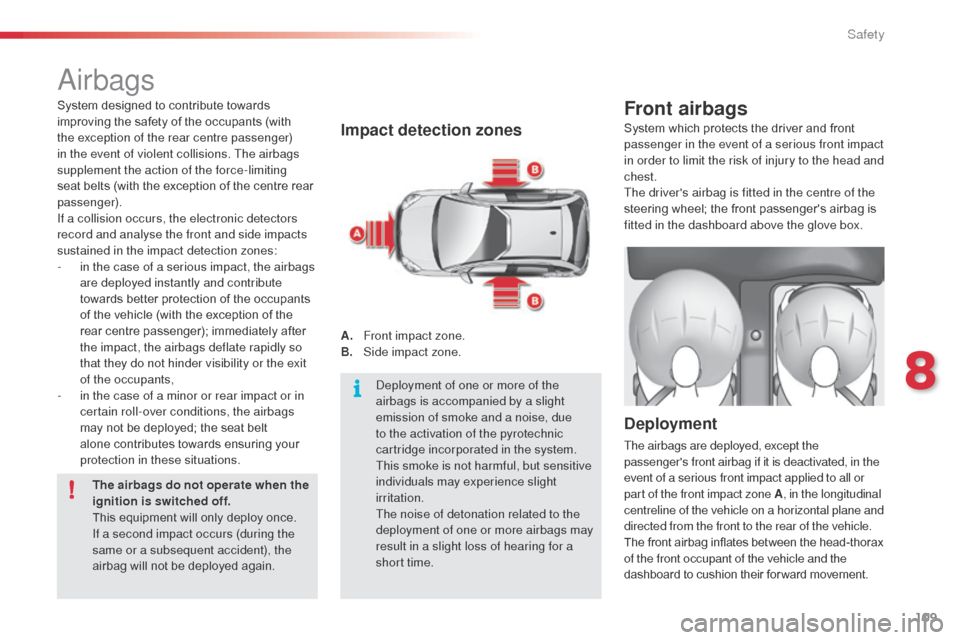
Impact detection zones
A. Front impact zone.
B. Side impact zone.
Front airbags
Deployment
The airbags are deployed, except the
passenger's front airbag if it is deactivated, in the
event of a serious front impact applied to all or
part of the front impact zone A , in the longitudinal
centreline of the vehicle on a horizontal plane and
directed from the front to the rear of the vehicle.
The front airbag inflates between the head-thorax
of the front occupant of the vehicle and the
dashboard to cushion their for ward movement.
System designed to contribute towards
improving the safety of the occupants (with
the exception of the rear centre passenger)
in the event of violent collisions. The airbags
supplement the action of the force-limiting
seat belts (with the exception of the centre rear
passenger).
If a collision occurs, the electronic detectors
record and analyse the front and side impacts
sustained in the impact detection zones:
-
i
n the case of a serious impact, the airbags
are deployed instantly and contribute
towards better protection of the occupants
of the vehicle (with the exception of the
rear centre passenger); immediately after
the impact, the airbags deflate rapidly so
that they do not hinder visibility or the exit
of the occupants,
-
i
n the case of a minor or rear impact or in
certain roll-over conditions, the airbags
may not be deployed; the seat belt
alone contributes towards ensuring your
protection in these situations.
The airbags do not operate when the
ignition is switched off.
de
ployment of one or more of the
airbags is accompanied by a slight
emission of smoke and a noise, due
to the activation of the pyrotechnic
cartridge incorporated in the system.
This smoke is not harmful, but sensitive
individuals may experience slight
irritation.
The noise of detonation related to the
deployment of one or more airbags may
result in a slight loss of hearing for a
short time. System which protects the driver and front
passenger in the event of a serious front impact
in order to limit the risk of injury to the head and
chest.
The driver's airbag is fitted in the centre of the
steering wheel; the front passenger's airbag is
fitted in the dashboard above the glove box.
This equipment will only deploy once.
If a second impact occurs (during the
same or a subsequent accident), the
airbag will not be deployed again.
8
Safety
Page 112 of 284
110
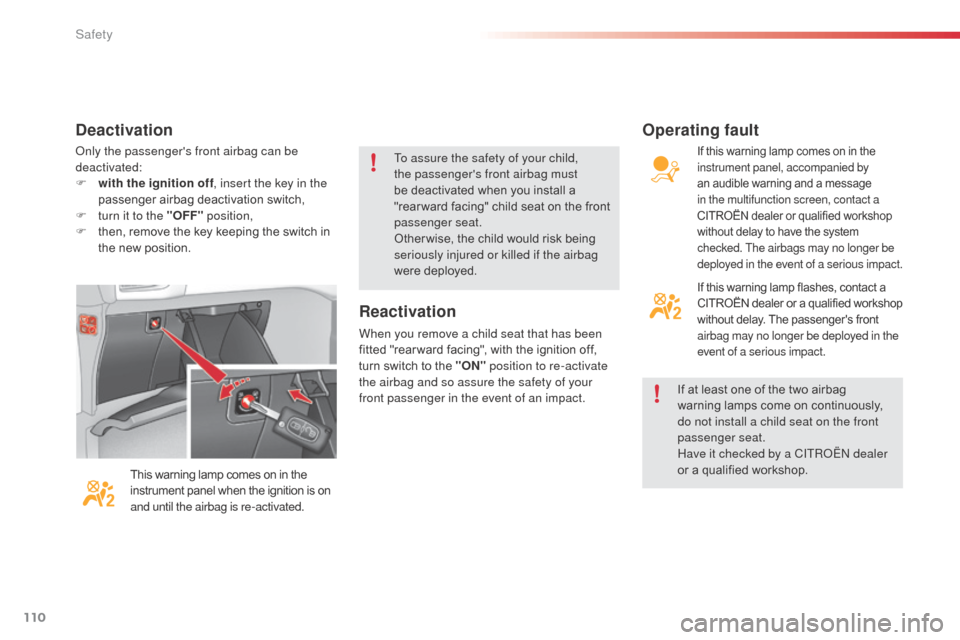
only the passenger's front airbag can be
deactivated:
F
w
ith the ignition off , insert the key in the
passenger airbag deactivation switch,
F
t
urn it to the "OFF" position,
F
t
hen, remove the key keeping the switch in
the new position.
This warning lamp comes on in the
instrument panel when the ignition is on
and until the airbag is re-activated.
Reactivation
When you remove a child seat that has been
fitted "rear ward facing", with the ignition off,
turn switch to the "ON" position to re-activate
the airbag and so assure the safety of your
front passenger in the event of an impact.
Operating fault
If this warning lamp comes on in the
instrument panel, accompanied by
an audible warning and a message
in the multifunction screen, contact a
CITROËN dealer or qualified workshop
without delay to have the system
checked. The airbags may no longer be
deployed in the event of a serious impact.
If this warning lamp flashes, contact a
CITROËN dealer or a qualified workshop
without delay. The passenger's front
airbag may no longer be deployed in the
event of a serious impact.
If at least one of the two airbag
warning lamps come on continuously,
do not install a child seat on the front
passenger seat.
Have it checked by a CITR
oËn
dealer
or a qualified workshop.
To assure the safety of your child,
the passenger's front airbag must
be deactivated when you install a
"rear ward facing" child seat on the front
passenger seat.
Other wise, the child would risk being
seriously injured or killed if the airbag
were deployed.
Deactivation
Safety
Page 124 of 284
122
Gear efficiency indicator*
In the case of driving which makes
particular demands on the performance
of the engine (firm pressure on the
accelerator pedal, for example, when
overtaking...), the system will not
recommend a gear change.
The system never suggests:
-
e
ngaging first gear,
-
enga
ging reverse gear,
-
e
ngaging a lower gear.
System which reduces fuel consumption by advising the driver to change up.
Operation
The system intervenes only when driving
economically.
dep
ending on the driving situation and your
vehicle's equipment, the system may advise
you to skip one or more gears. You can
follow this instruction without engaging the
intermediate gears.
The gear engagement recommendations must
not be considered compulsory. In fact, the
configuration of the road, the amount of traffic
and safety remain determining factors when
choosing the best gear. Therefore, the driver
remains responsible for deciding whether or not
to follow the advice given by the system.
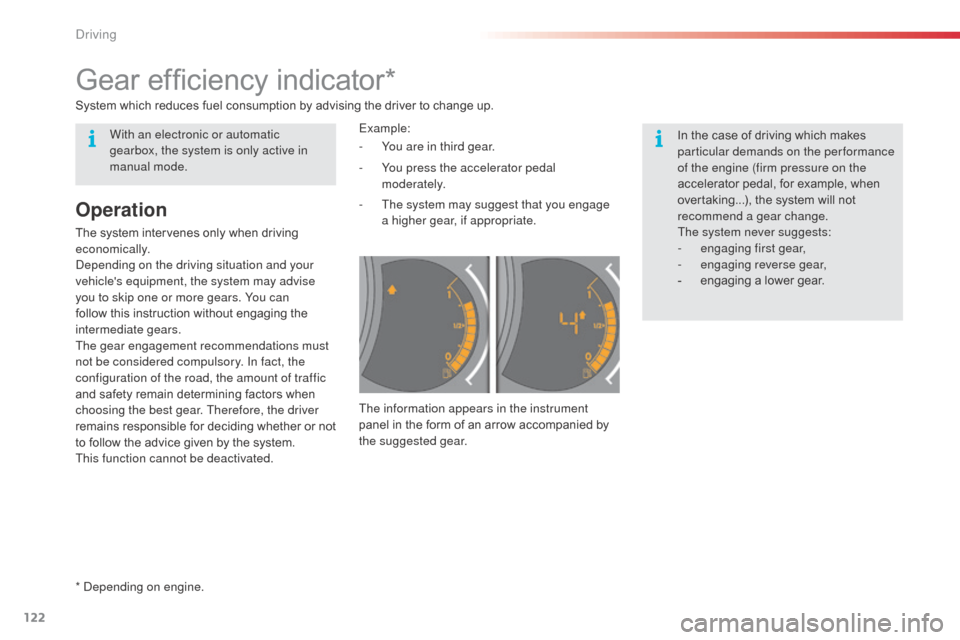
This function cannot be deactivated. Example:
-
T
he system may suggest that you engage
a higher gear, if appropriate.
-
Y
ou are in third gear.
-
Y
ou press the accelerator pedal
moderately.
* d
ep
ending on engine.With an electronic or automatic
gearbox, the system is only active in
manual mode.
The information appears in the instrument
panel in the form of an arrow accompanied by
the suggested gear.
driving
Page 126 of 284
124
Going into engine START
mode
The "ECO" warning lamp goes off
and the engine starts:
-
w
ith a manual gearbox , when you
depress the clutch pedal,
-
w
ith a 5-speed or 6-speed electronic
gearbox :
●
g
ear lever in position A or M , when you
release the brake pedal,
●
o
r gear lever in position N and the brake
pedal released, when you move the gear
lever to position A or M ,
●
o
r when you engage reverse gear.
Special cases: START invoked
automatically
For reasons of safety and for your comfort,
START mode is invoked automatically when:
-
y
ou open the driver's door,
-
y
ou unfasten the driver's seat belt,
-
t
he speed of the vehicle exceeds 7 mph
(11 km/h) with the electronic gearbox
system,
-
s
ome special conditions (battery charge,
engine temperature, braking assistance,
ambient temperature...) where the engine is
needed for control of a system.
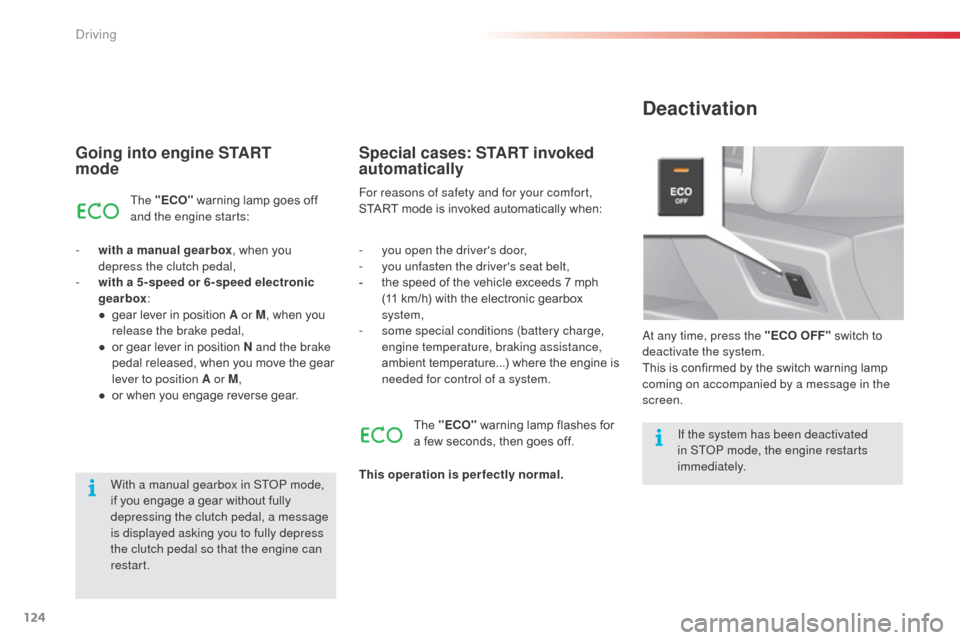
Deactivation
at any time, press the "ECO OFF" switch to
deactivate the system.
This is confirmed by the switch warning lamp
coming on accompanied by a message in the
screen.
The "ECO" warning lamp flashes for
a few seconds, then goes off.
This operation is perfectly normal.
With a manual gearbox in ST
oP m
ode,
if you engage a gear without fully
depressing the clutch pedal, a message
is displayed asking you to fully depress
the clutch pedal so that the engine can
restart. If the system has been deactivated
in ST
oP m
ode, the engine restarts
immediately.
Driving
Page 127 of 284
125
Operating faultMaintenance
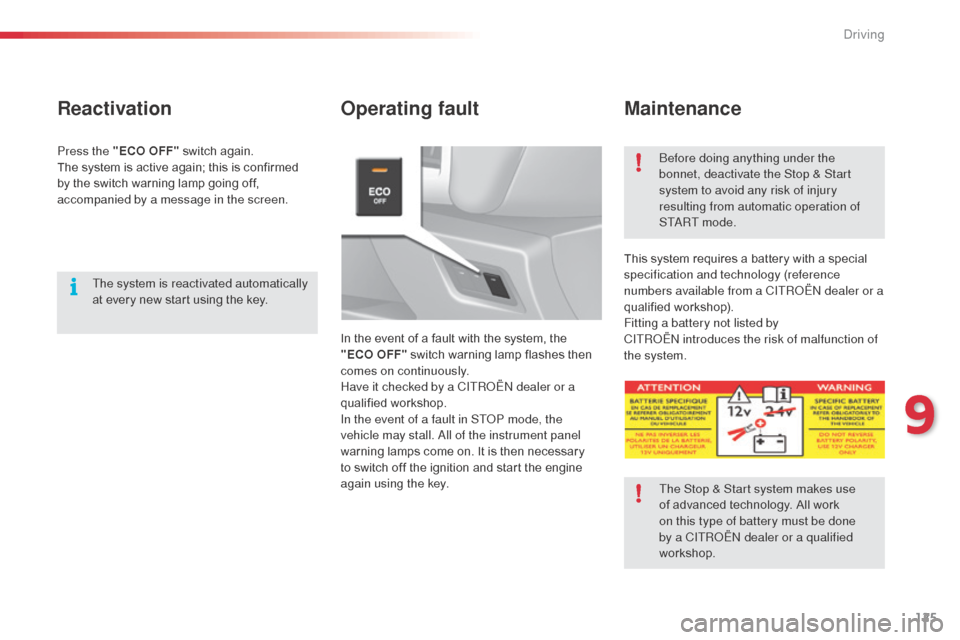
In the event of a fault with the system, the
"ECO OFF" switch warning lamp flashes then
comes on continuously.
Have it checked by a CITR
oËn
dealer or a
qualified workshop.
In the event of a fault in ST
oP m
ode, the
vehicle may stall.
a
l
l of the instrument panel
warning lamps come on. It is then necessary
to switch off the ignition and start the engine
again using the key. This system requires a battery with a special
specification and technology (reference
numbers available from a CITR
oËn
dealer or a
qualified workshop).
Fitting a battery not listed by
CITRoËn introduces the risk of malfunction of
the system.
Press the "ECO OFF" switch again.
The system is active again; this is confirmed
by the switch warning lamp going off,
accompanied by a message in the screen.
be
fore doing anything under the
bonnet, deactivate the Stop & Start
system to avoid any risk of injury
resulting from automatic operation of
S T a
R
T m o d e .
The system is reactivated automatically
at every new start using the key.
The Stop & Start system makes use
of advanced technology. All work
on this type of battery must be done
by a CITR
oËn
dealer or a qualified
workshop.
Reactivation
9
Driving
Page 128 of 284
126
Hill start assist
System which holds your vehicle temporarily
(approximately 2 seconds) when starting on a
slope, the time it takes to move your foot from
the brake pedal to the accelerator pedal.
This function is only active when:
-
t
he vehicle is completely stationary, with
your foot on the brake pedal,
-
c
ertain conditions on a slope are met,
-
w
ith the driver’s door closed.
The hill start assist function cannot be
deactivated.
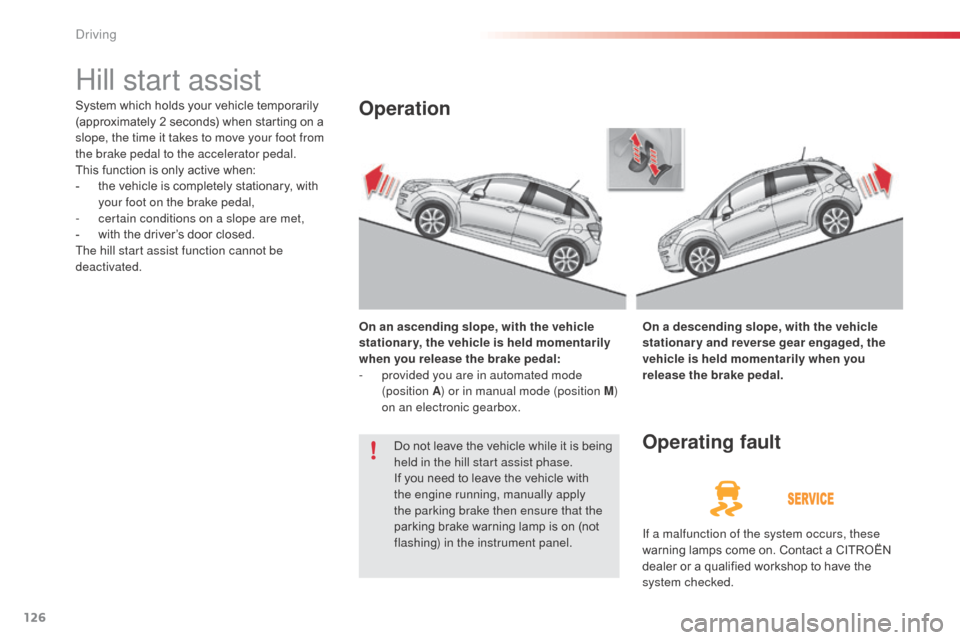
On an ascending slope, with the vehicle
stationary, the vehicle is held momentarily
when you release the brake pedal:
-
p
rovided you are in automated mode
(position A ) or in manual mode (position M )
on an electronic gearbox.
Operating fault
If a malfunction of the system occurs, these
warning lamps come on. Contact a CITROËN
dealer or a qualified workshop to have the
system checked. On a descending slope, with the vehicle
stationary and reverse gear engaged, the
vehicle is held momentarily when you
release the brake pedal.
Do not leave the vehicle while it is being
held in the hill start assist phase.
If you need to leave the vehicle with
the engine running, manually apply
the parking brake then ensure that the
parking brake warning lamp is on (not
flashing) in the instrument panel.
Operation
driving
Page 130 of 284
128
Programming
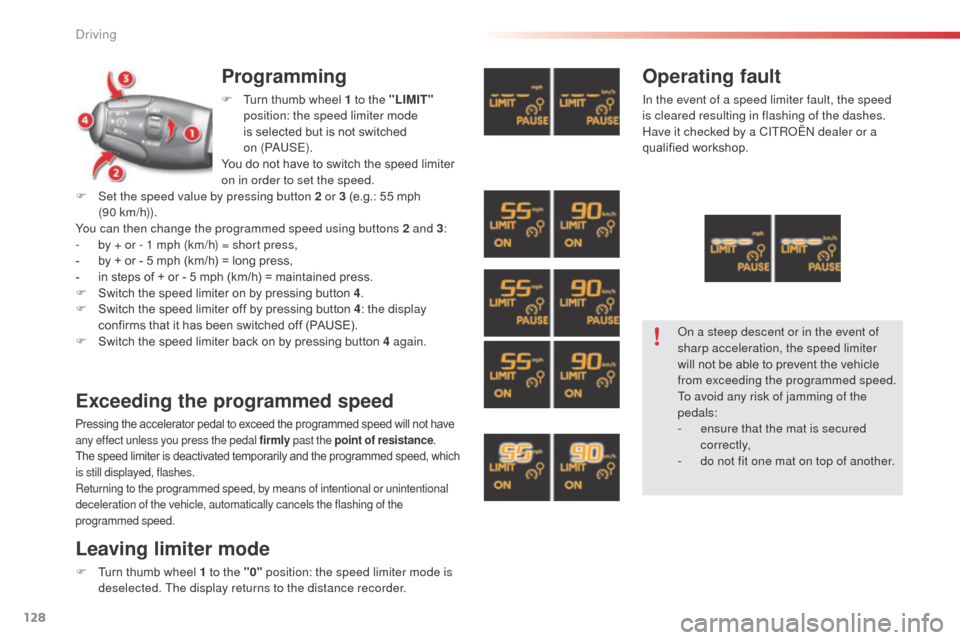
F Turn thumb wheel 1 to the "LIMIT"
position: the speed limiter mode
is selected but is not switched
on
(P a
U
S E).
You do not have to switch the speed limiter
on in order to set the speed.
Exceeding the programmed speed
Pressing the accelerator pedal to exceed the programmed speed will not have
any effect unless you press the pedal firmly past the point of resistance.
The speed limiter is deactivated temporarily and the programmed speed, which
is still displayed, flashes.
Returning to the programmed speed, by means of intentional or unintentional
deceleration of the vehicle, automatically cancels the flashing of the
programmed speed.
Leaving limiter mode
F Turn thumb wheel 1 to the "0" position: the speed limiter mode is
deselected. The display returns to the distance recorder.
Operating fault
In the event of a speed limiter fault, the speed
is cleared resulting in flashing of the dashes.
Have it checked by a CITR
oËn
dealer or a
qualified workshop.
F
S
et the speed value by pressing button 2 or 3 (e.g.: 55 mph
(90 km/h)).
You can then change the programmed speed using buttons 2 and 3 :
-
b
y + or - 1 mph (km/h) = short press,
-
b
y + or - 5 mph (km/h) = long press,
-
i
n steps of + or - 5 mph (km/h) = maintained press.
F
S
witch the speed limiter on by pressing button 4 .
F
S
witch the speed limiter off by pressing button 4 : the display
confirms that it has been switched off (PAUSE).
F
S
witch the speed limiter back on by pressing button 4 again.
on a s
teep descent or in the event of
sharp acceleration, the speed limiter
will not be able to prevent the vehicle
from exceeding the programmed speed.
To avoid any risk of jamming of the
pedals:
-
e
nsure that the mat is secured
c o r r e c t l y,
-
d
o not fit one mat on top of another.
Driving
Page 134 of 284
132
You can activate or deactivate the system by
means of the multifunction screen configuration
menu. The system state is memorised when
switching off the ignition.
For more information on access to the parking
sensors menu, refer to " Vehicle configuration"
or " Vehicle parameters" section for your
multifunction screen.
Operating faults
If there is an operating fault, when
reverse gear is engaged this
warning lamp comes on in the
instrument panel, accompanied
by an audible signal (short beep)
and a message in the multifunction
screen.
Programming
The system will be deactivated
automatically when towing a trailer or
when a bicycle carrier is fitted (vehicle
fitted with a towbar or bicycle carrier
recommended by CITR
oËn)
.In bad or wintry weather, ensure that
the sensors are not covered with mud,
frost or snow.
driving
Page 176 of 284
174
Energy economy mode
Exiting economy mode
These functions are reactivated automatically
the next time the vehicle is driven.
F
I
n order to resume the use of these
functions immediately, start the engine and
let it run for a few minutes.
The time available to you will then be double
the period for which the engine is left running.
However, this period will always be between
five and thirty minutes.
Switching to economy mode
once this period has elapsed, a message
appears on the multifunction screen indicating
that the vehicle has switched to economy mode
and the active functions are put on standby.
a
flat battery prevents the engine from
starting (refer to the corresponding
paragraph).
If the telephone is being used at the
same time on the eMyWay audio
navigation system, it will be interrupted
after 10 minutes.
System which manages the period of use of
certain functions to conserve a sufficient level
of charge in the battery.
af
ter the engine has stopped, you can
still use functions such as the audio
equipment, windscreen wipers, dipped
beam headlamps, courtesy lamps, etc. for a
maximum combined period of thirty minutes.
System which manages the use of certain
functions according to the level of charge
remaining in the battery.
When the vehicle is being driven, the load
reduction function temporarily deactivates
certain functions, such as the air conditioning,
the heated rear screen...
The deactivated functions are reactivated
automatically as soon as conditions permit.
Load reduction mode
This period may be greatly reduced if
the battery is not fully charged.
Practical information
Page 181 of 284
179
Braking
Towing a trailer increases the braking distance.
To avoid overheating of the brakes on a long
mountain type of descent, the use of engine
braking is recommended.
Ty r e s
F Check the tyre pressures of the towing vehicle and of the trailer, observing the
recommended pressures.
Lighting
F Check the electrical lighting and signalling on the trailer.
The rear parking sensors will be
deactivated automatically if a genuine
CITROËN towbar is used.
Cooling
Towing a trailer on a slope increases the
temperature of the coolant.
as t
he fan is electrically controlled, its cooling
capacity is not dependent on the engine speed.
F
T
o lower the engine speed, reduce your
speed.
The maximum towed load on a long incline
depends on the gradient and the ambient
temperature.
In all cases, keep a check on the coolant
temperature.
F
I
f the warning lamp and the
STOP warning lamp come on,
stop the vehicle and switch off
the engine as soon as possible.
11
Practical information