wheel Citroen C3 RHD 2015 2.G User Guide
[x] Cancel search | Manufacturer: CITROEN, Model Year: 2015, Model line: C3 RHD, Model: Citroen C3 RHD 2015 2.GPages: 324, PDF Size: 9.86 MB
Page 110 of 324

108
Under-inflation detection
System which automatically checks the pressures of the tyres while driving.
The system monitors the pressures in the four
tyres, once the vehicle is moving.
It compares the information given by the four
wheel speed sensors with reference values,
which must be reinitialised ever y time the
tyre pressures are adjusted or a wheel
changed.
The system triggers an alert as soon as it
detects a drop in the inflation pressure of one
or more tyres. The under-inflation detection system
does not replace the need for vigilance
on the part of the driver.
This system does not avoid the need to
check the tyre pressures (including the
spare wheel) every month as well as
before a long journey.
Driving with under-inflated tyres impairs
road holding, extends braking distances
and causes premature tyre wear,
particularly under arduous condition
(high loading, high speed, long journey).The inflation pressures defined for
your vehicle can be found on the tyre
pressure label.
See the "Identification markings"
section.
Tyre pressures should be checked
when the tyres are "cold" (vehicle
stopped for 1 hour or after a journey of
less than 6 miles (10 km) at moderate
speeds).
Other wise (when hot), add 0.3 bar to
the pressures shown on the label.
Driving with under-inflated tyres
increases fuel consumption.
Safety
Page 111 of 324

109
Under-inflation alert
This is given by fixed illumination of
this warning lamp, accompanied by
an audible signal and, depending on
equipment, the display of a message.
F
R
educe speed immediately, avoid
excessive steering movements and sudden
braking.
F
S
top the vehicle as soon as it is safe to
do
so.
The loss of pressure detected does not
always cause visible bulging of the tyre.
Do not satisfy yourself with just a visual
check. The alert is maintained until the system
is reinitialised.
F
I n the event of a puncture, use the
temporary puncture repair kit or the spare
wheel (depending on equipment),
or
F
i
f you have a compressor, such as the one
in the temporary puncture repair kit, check
the pressures of the four tyres when cold,
or
F
i
f it is not possible to make this check
immediately, drive carefully at reduced
speed.
Reinitialisation
It is necessary to reinitialise the system every
time one or more tyre pressure is adjusted, and
after changing one or more wheels.
a
label on the middle pillar, left hand side, gives
a reminder of this.
be
fore reinitialising the system, ensure
that the pressures of the four tyres are
correct for the use of the vehicle, as
given on the tyre pressure label.
The under-inflation detection system
does not give a warning if a pressure is
incorrect at the time of reinitialisation.
8
Safety
Page 114 of 324
112
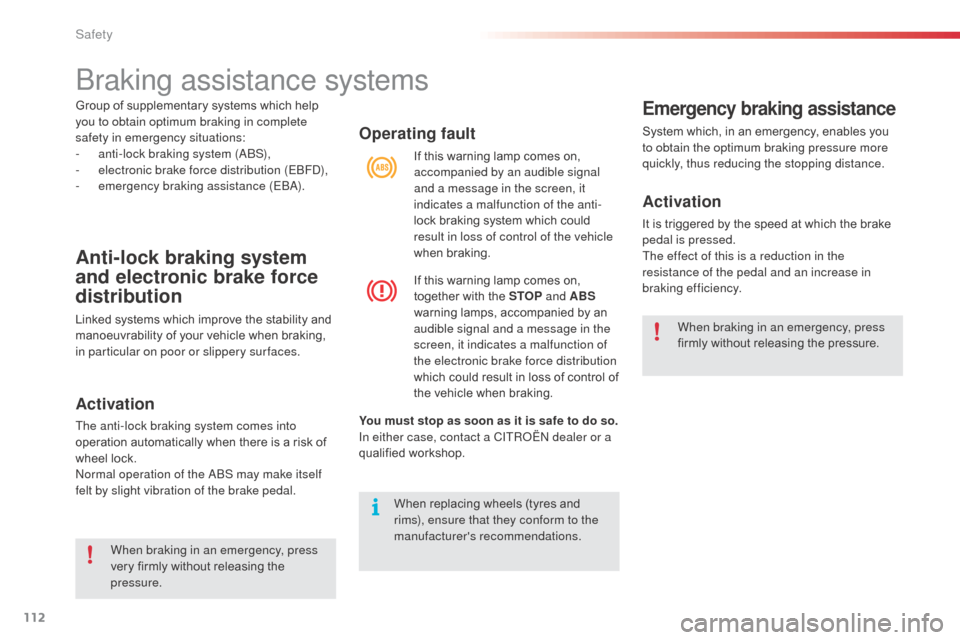
Operating fault
You must stop as soon as it is safe to do so.
In either case, contact a CITRoËn dealer or a
qualified workshop. If this warning lamp comes on,
accompanied by an audible signal
and a message in the screen, it
indicates a malfunction of the anti-
lock braking system which could
result in loss of control of the vehicle
when braking.
If this warning lamp comes on,
together with the STOP and ABS
warning lamps, accompanied by an
audible signal and a message in the
screen, it indicates a malfunction of
the electronic brake force distribution
which could result in loss of control of
the vehicle when braking.
Emergency braking assistance
System which, in an emergency, enables you
to obtain the optimum braking pressure more
quickly, thus reducing the stopping distance.
Activation
It is triggered by the speed at which the brake
pedal is pressed.
The effect of this is a reduction in the
resistance of the pedal and an increase in
braking efficiency.
When replacing wheels (tyres and
rims), ensure that they conform to the
manufacturer's recommendations. When braking in an emergency, press
firmly without releasing the pressure.
braking assistance systems
Anti-lock braking system
and electronic brake force
distribution
Linked systems which improve the stability and
manoeuvrability of your vehicle when braking,
in particular on poor or slippery sur faces.
Activation
The anti-lock braking system comes into
operation automatically when there is a risk of
wheel lock.
no
rmal operation of the ab
S m
ay make itself
felt by slight vibration of the brake pedal.
When braking in an emergency, press
very firmly without releasing the
pressure.
Group of supplementary systems which help
you to obtain optimum braking in complete
safety in emergency situations:
-
a
nti-lock braking system (
a
b
S
),
-
e
lectronic brake force distribution (E
bFd)
,
-
em
ergency braking assistance (E
ba)
.
Safety
Page 115 of 324
113
Trajectory control systems
Anti-slip regulation (ASR)
and dynamic stability
control (DSC)
The anti-slip regulation (also known as traction
control) optimises traction to prevent skidding
of the wheels, by acting on the brakes of the
driving wheels and on the engine.
The electronic stability control acts on the brake
of one or more wheels and on the engine to
keep the vehicle on the trajectory required by
the driver, within the limits of the laws of physics.
Activation
These systems are activated automatically
each time the vehicle is started.
They come into operation in the event of a grip
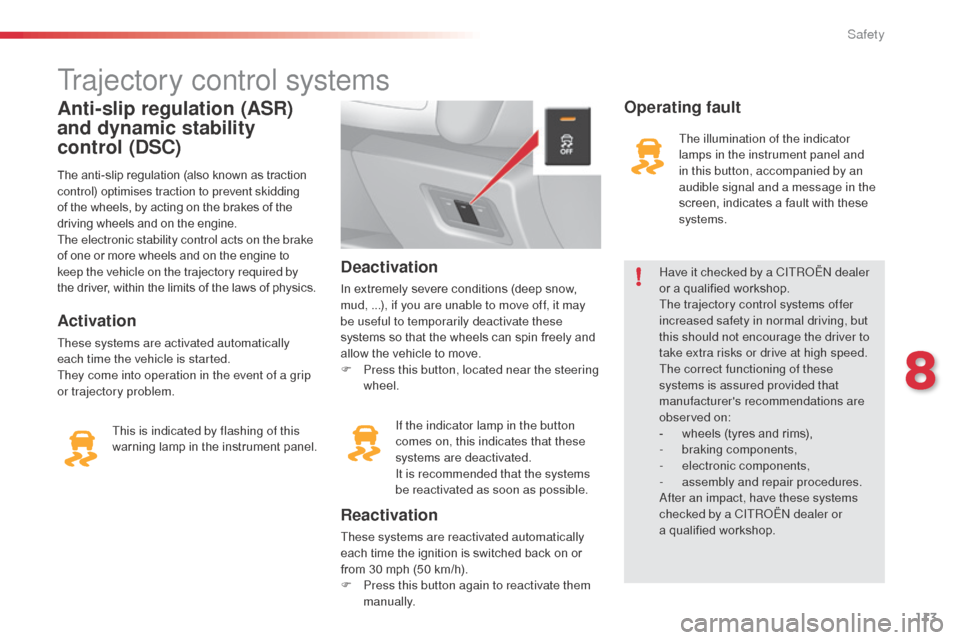
or trajectory problem.This is indicated by flashing of this
warning lamp in the instrument panel.
Deactivation
In extremely severe conditions (deep snow,
mud, ...), if you are unable to move off, it may
be useful to temporarily deactivate these
systems so that the wheels can spin freely and
allow the vehicle to move.
F
P
ress this button, located near the steering
wheel.
If the indicator lamp in the button
comes on, this indicates that these
systems are deactivated.
It is recommended that the systems
be reactivated as soon as possible.
Reactivation
These systems are reactivated automatically
each time the ignition is switched back on or
from 30 mph (50 km/h).
F
P
ress this button again to reactivate them
manually.
Operating fault
The illumination of the indicator
lamps in the instrument panel and
in this button, accompanied by an
audible signal and a message in the
screen, indicates a fault with these
systems.
Have it checked by a CITR
oËn
dealer
or a qualified workshop.
The trajectory control systems offer
increased safety in normal driving, but
this should not encourage the driver to
take extra risks or drive at high speed.
The correct functioning of these
systems is assured provided that
manufacturer's recommendations are
observed on:
-
w
heels (tyres and rims),
-
b
raking components,
-
el
ectronic components,
-
a
ssembly and repair procedures.
af
ter an impact, have these systems
checked by a CITR
oËn
dealer or
a
qualified workshop.
8
Safety
Page 118 of 324
116
airbags
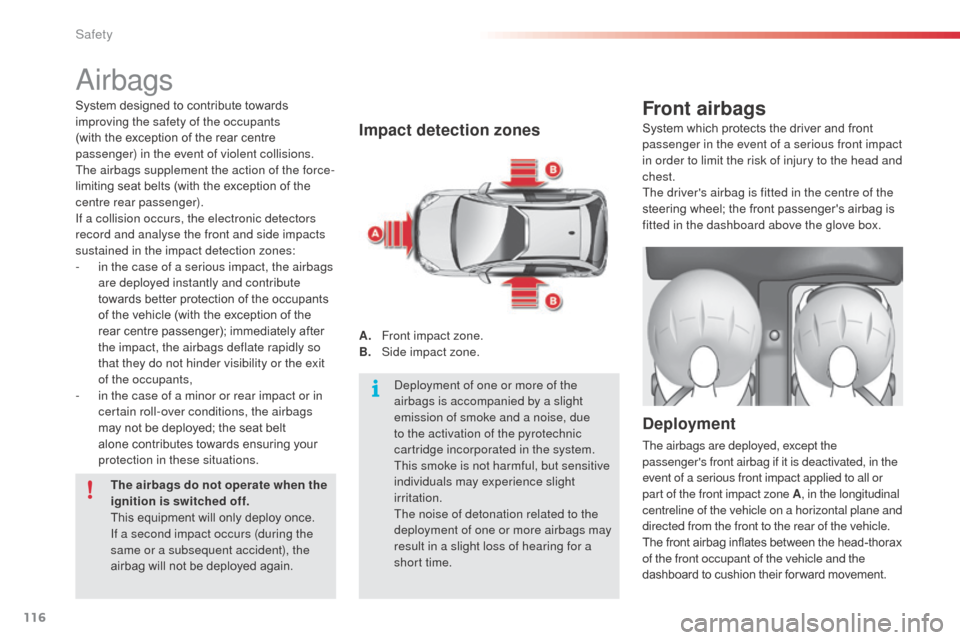
Impact detection zones
A. Front impact zone.
B. Side impact zone.
Front airbags
Deployment
The airbags are deployed, except the
passenger's front airbag if it is deactivated, in the
event of a serious front impact applied to all or
part of the front impact zone A , in the longitudinal
centreline of the vehicle on a horizontal plane and
directed from the front to the rear of the vehicle.
The front airbag inflates between the head-thorax
of the front occupant of the vehicle and the
dashboard to cushion their for ward movement.
System designed to contribute towards
improving the safety of the occupants
(with the exception of the rear centre
passenger) in the event of violent collisions.
The airbags supplement the action of the force-
limiting seat belts (with the exception of the
centre rear passenger).
If a collision occurs, the electronic detectors
record and analyse the front and side impacts
sustained in the impact detection zones:
-
i
n the case of a serious impact, the airbags
are deployed instantly and contribute
towards better protection of the occupants
of the vehicle (with the exception of the
rear centre passenger); immediately after
the impact, the airbags deflate rapidly so
that they do not hinder visibility or the exit
of the occupants,
-
i
n the case of a minor or rear impact or in
certain roll-over conditions, the airbags
may not be deployed; the seat belt
alone contributes towards ensuring your
protection in these situations.
The airbags do not operate when the
ignition is switched off.
de
ployment of one or more of the
airbags is accompanied by a slight
emission of smoke and a noise, due
to the activation of the pyrotechnic
cartridge incorporated in the system.
This smoke is not harmful, but sensitive
individuals may experience slight
irritation.
The noise of detonation related to the
deployment of one or more airbags may
result in a slight loss of hearing for a
short time. System which protects the driver and front
passenger in the event of a serious front impact
in order to limit the risk of injury to the head and
chest.
The driver's airbag is fitted in the centre of the
steering wheel; the front passenger's airbag is
fitted in the dashboard above the glove box.
This equipment will only deploy once.
If a second impact occurs (during the
same or a subsequent accident), the
airbag will not be deployed again.
Safety
Page 121 of 324
119
For the airbags to be fully
effective, observe the following
safety rules:
Sit in a normal upright position.
Wear a correctly adjusted seat belt.
Do not leave anything between the
occupants and the airbags (a child, pet,
object...). This could hamper the operation of
the airbags or injure the occupants.
af
ter an accident or if the vehicle has been
stolen or broken into, have the airbag
systems checked.
All work on the airbag system must be
carried out by a CITR
oËn
dealer or a
qualified workshop.
Even if all of the precautions mentioned
are observed, a risk of injury or of minor
burns to the head, chest or arms when an
airbag is deployed cannot be ruled out. The
bag inflates almost instantly (within a few
milliseconds) then deflates within the same
time discharging the hot gas via openings
provided for this purpose.
Front airbags
Do not drive holding the steering wheel by its spokes or resting your hands on the centre part
of the wheel.
Passengers must not place their feet on the dashboard.
do n
ot smoke as deployment of the airbags can cause burns or the risk of injury from a
cigarette or pipe.
Never remove or pierce the steering wheel or hit it violently.
Do not fit or attach anything to the steering wheel or dashboard, this could cause injuries with
deployment of the airbags.
Lateral airbags
Use only approved covers on the seats, compatible with the deployment the lateral airbags.
For information on the range of seat covers suitable for your vehicle, you can contact a
CITR
oËn
dealer.
Refer to the "
ac
cessories" section.
do n
ot fix or attach anything to the seat backs (clothing...). This could cause injury to the chest
or arms if the lateral airbag is deployed.
Do not sit with the upper part of the body any nearer to the door than necessary.
Curtain airbags
do not fix or attach anything to the roof. This could cause injury to the head if the curtain
airbag is deployed.
If fitted on your vehicle, do not remove the grab handles installed on the roof, they play a part
in securing the curtain airbags.
8
Safety
Page 122 of 324
120
A few driving recommendations
Never drive with the parking brake
applied - Risk of overheating and
damage to the braking system!
Do not park or run the engine when
stationary in areas where inflammable
substances and materials (dry grass,
dead leaves...) might come into contact
with the hot exhaust system - Risk
of fire!
ne
ver leave a vehicle unsupervised
with the engine running. If you have
to leave your vehicle with the engine
running, apply the parking brake
and put the gearbox into neutral or
position
N or P, depending on the type
of gearbox.
ob
serve the driving regulations at all times and
remain vigilant whatever the traffic conditions.
Pay close attention to the traffic and keep your
hands on the wheel so that you are ready to
react at any time to any eventuality.
On a long journey, a break every two hours is
strongly recommended.
In difficult weather, drive smoothly, anticipate
the need to brake and increase the distance
from other vehicles.
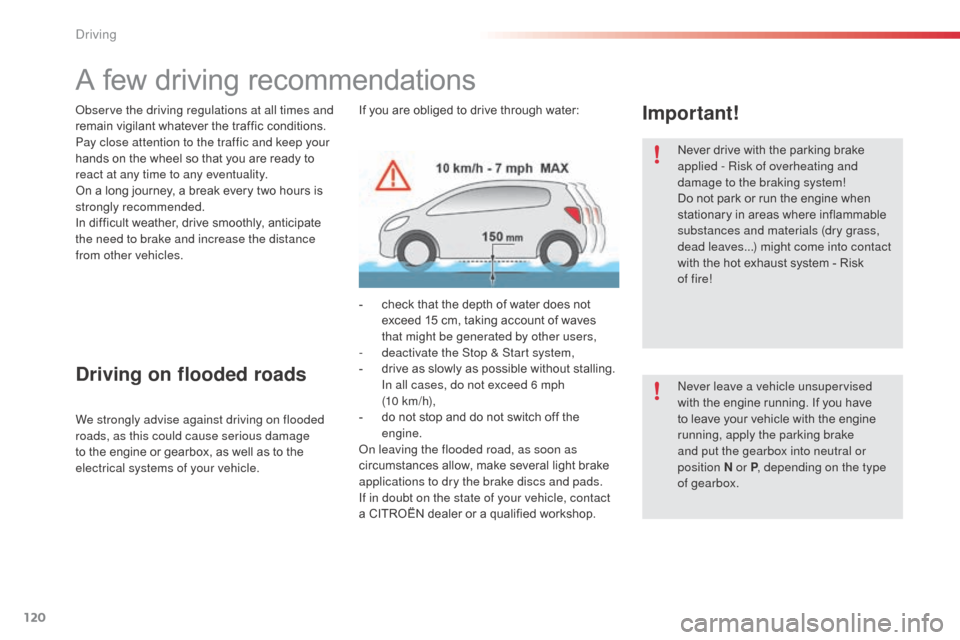
Driving on flooded roads
We strongly advise against driving on flooded
roads, as this could cause serious damage
to the engine or gearbox, as well as to the
electrical systems of your vehicle. -
c
heck that the depth of water does not
exceed 15 cm, taking account of waves
that might be generated by other users,
-
d
eactivate the Stop & Start system,
-
d
rive as slowly as possible without stalling.
In all cases, do not exceed 6 mph
(10 km/h),
- d o not stop and do not switch off the
engine.
on l
eaving the flooded road, as soon as
circumstances allow, make several light brake
applications to dry the brake discs and pads.
If in doubt on the state of your vehicle, contact
a CITROËN dealer or a qualified workshop. If you are obliged to drive through water:
Important!
driving
Page 124 of 324
122
Starting the engine
F apply the parking brake.
F W ith a manual gearbox: place the lever in
neutral and fully depress the clutch pedal.
F
W
ith an electronic gearbox: place the lever
at position N and press the brake pedal
f i r m l y.
F
W
ith an automatic gearbox: place the lever
at position P and press the brake pedal
f i r m l y.
F
I
nsert the key in the ignition switch; the
system recognises the code.
F
U
nlock the steering column by
simultaneously turning the steering and
t h e
key.
In some circumstances, you may have
to apply some force to turn the steering
wheel (wheels on lock for example).
F
W
ith a petrol engine, operate the starter
motor by turning the key to position 3 until
the engine starts, without pressing the
accelerator pedal.
o
n
ce the engine starts,
release the key. F
W ith a di esel engine, turn the key to
position 2 , ignition on, to operate the
engine preheating system.
Wait until this warning lamp goes off
in the instrument panel, then operate
the starter motor by turning the key to
position 3 until the engine starts, without
pressing the accelerator pedal.
o
n
ce
the engine starts, release the key.
If the engine does not start straight
away, switch the ignition off. Wait a
few moments before trying again. If
the engine does not start after a few
attempts, do not keep trying: you risk
damaging the starter motor and the
engine. Call on a CITR
oËn
dealer or a
qualified workshop.
ne
ver leave the engine running in
an enclosed area without adequate
ventilation: internal combustion
engines emit toxic exhaust gases,
such as carbon monoxide.
d
a
nger of
intoxication and death. In very severe
winter conditions (temperatures
below -23°C), it is necessary to allow
the engine to run for 4 minutes before
setting off, in order to ensure the
correct operation and durability of
the mechanical components of your
vehicle, the engine and gearbox.
In wintry conditions, the warning lamp
will stay on longer. When the engine is
hot, it does not come on. In temperate conditions, do not
warm the engine up with the vehicle
stationary, but move off straight away
and drive at moderate engine speeds.
Driving
Page 125 of 324
123
Switching the engine off
F Immobilise the vehicle.
F W ith the engine at idle, turn the key fully
towards you to position 1 (Stop) .
F
R
emove the key from the ignition switch.
F
T
o lock the steering column, turn the
steering wheel until it locks.
Never switch the ignition off until the
vehicle has come to a complete stop
and the parking brake has been applied.
With the engine stopped, the braking and
steering assistance systems are also cut
off: risk of loss of control of the vehicle. To facilitate unlocking of the steering
column, put the front wheels in the
straight ahead position before switching
the ignition off.
When you leave the vehicle, take the
key with you and lock the vehicle.Key reminder
If the key is left in the ignition switch, an
audible signal sounds when the driver's
door is opened.
For more information, refer to the
"Energy economy mode" section.
F
E
nsure that the parking brake is applied
correctly, particularly when on a slope.
Energy economy mode
After switching off the engine (position 1 - Stop ),
you can still use functions such as the audio
and telematic system, the wipers, dipped beam,
courtesy lamps, etc., for maximum cumulative
period of 30 minutes.
9
Driving
Page 126 of 324
124
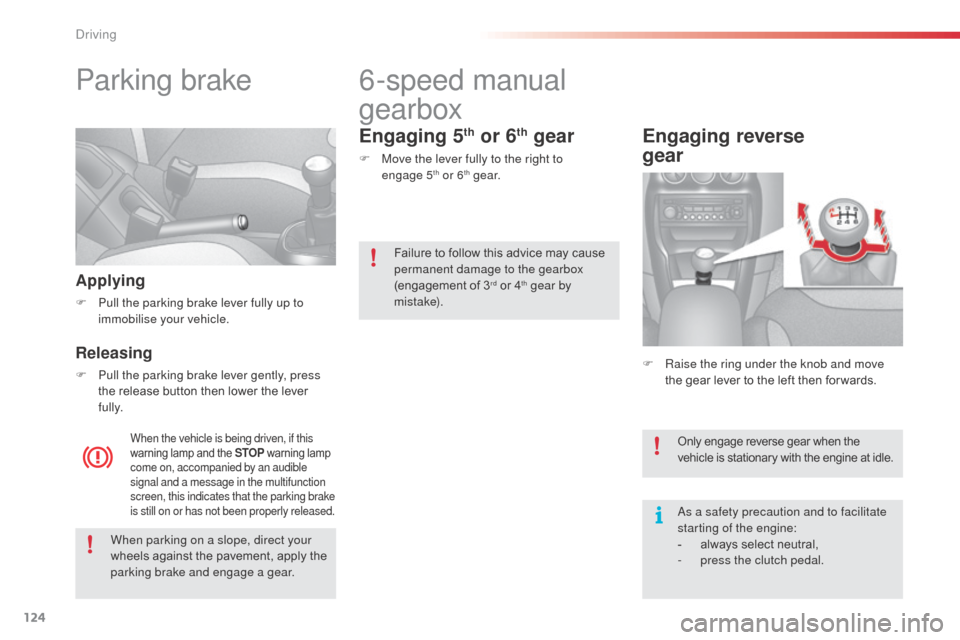
Parking brake
Applying
F Pull the parking brake lever fully up to immobilise your vehicle.
Releasing
F Pull the parking brake lever gently, press the release button then lower the lever
fully.
When the vehicle is being driven, if this
warning lamp and the STOP warning lamp
come on, accompanied by an audible
signal and a message in the multifunction
screen, this indicates that the parking brake
is still on or has not been properly released.
6-speed manual
gearbox
Engaging 5th or 6th gear
F Move the lever fully to the right to
engage 5th or 6th g e a r.
F
R
aise the ring under the knob and move
the gear lever to the left then for wards.
Engaging reverse
gear
Only engage reverse gear when the
vehicle is stationary with the engine at idle.
as a safety precaution and to facilitate
starting of the engine:
-
a
lways select neutral,
-
p
ress the clutch pedal.
When parking on a slope, direct your
wheels against the pavement, apply the
parking brake and engage a gear. Failure to follow this advice may cause
permanent damage to the gearbox
(engagement of 3
rd or 4th gear by
m i st a ke).
driving