engine Citroen C3 RHD 2017 2.G Manual PDF
[x] Cancel search | Manufacturer: CITROEN, Model Year: 2017, Model line: C3 RHD, Model: Citroen C3 RHD 2017 2.GPages: 442, PDF Size: 9.75 MB
Page 212 of 442
210
AdBlue® and SCR system
for BlueHDi Diesel engines
To assure respect for the environment and
conformity with the new Euro 6 emissions
standard, without adversely affecting the
per formance or fuel consumption of Diesel
engines, CITROËN has taken the decision to
equip its vehicles with an effective system that
associates SCR (Selective Catalytic Reduction)
with a particle filter (FAP) for the treatment of
exhaust gases.
SCR system
Using a fluid called AdBlue® containing
urea, a
catalytic converter turns up to 85%
of nitrogen oxides (NOx) into nitrogen and
water, which are harmless to health and the
environment. Once the AdBlue
® tank is empty,
a
system required by regulations
prevents starting of the engine.
If the SCR
system is faulty, the level
of emissions from your vehicle will no
longer meet the Euro 6 standard: your
vehicle becomes polluting.
In the event of a confirmed fault
with the SCR system, you must go
to a CITROËN dealer or a qualified
workshop as soon as possible: after
a running distance of 650 miles
(1
100 km), a system will be triggered
automatically to prevent engine starting.
In either case, a range indicator gives
you the distance you can travel before
the vehicle is immobilised.
The AdBlue® is held in a special tank with
a capacity of about 15 litres: this provides
a driving range of about 11 000 miles
(18
000
km). An alert is triggered automatically
to warn you when the reserve level is
reached: you can then drive about 1 500 miles
(2
400
km) before the tank is empty.
Freezing of the AdBlue
®
AdBlue® freezes at temperatures below
around -11°C.
The SCR system includes a heater
for the AdBlue
® tank, allowing you
to continue driving in all weather
conditions.
Practical information
Page 214 of 442
212
Recommendations on storage
Never store bottles of AdBlue® in your
vehicle.
Procedure
Park the vehicle
F Switch off the ignition and remove the key from the switch to switch off the engine.
or
F
W
ith Keyless Entry and Starting, press the
" START/STOP " button to switch off the
engine.
AdBlue
® freezes at about -11°C and
deteriorates above 25°C. It is recommended
that bottles be stored in a cool area and
protected from direct sunlight .
Under these conditions, the fluid can be kept
for at least a year .
If the additive has frozen, it can be used once it
has completely thawed out. Before topping up, ensure that the vehicle is
parked on a flat and level sur face.
In wintry conditions, ensure that the
temperature of the vehicle is above -11°C.
Otherwise the AdBlue
® may be frozen and
so cannot be poured into its tank. Park your
vehicle in a warmer area for a few hours to
allow the top-up to be carried out.
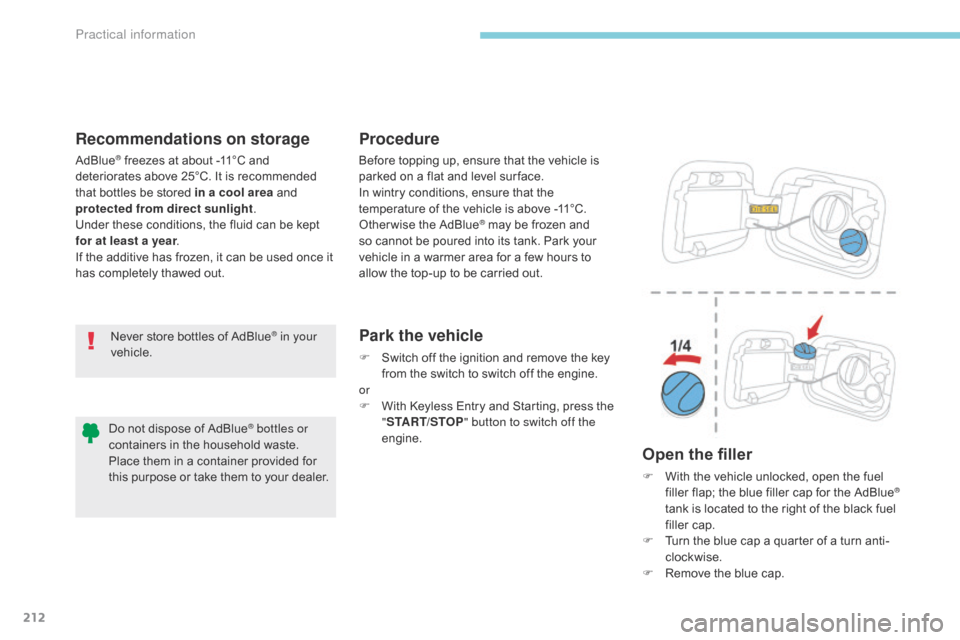
Open the filler
F With the vehicle unlocked, open the fuel filler flap; the blue filler cap for the AdBlue®
tank is located to the right of the black fuel
filler cap.
F
T
urn the blue cap a quarter of a turn anti-
clockwise.
F
R
emove the blue cap.
Do not dispose of AdBlue
® bottles or
containers in the household waste.
Place them in a container provided for
this purpose or take them to your dealer.
Practical information
Page 215 of 442
213
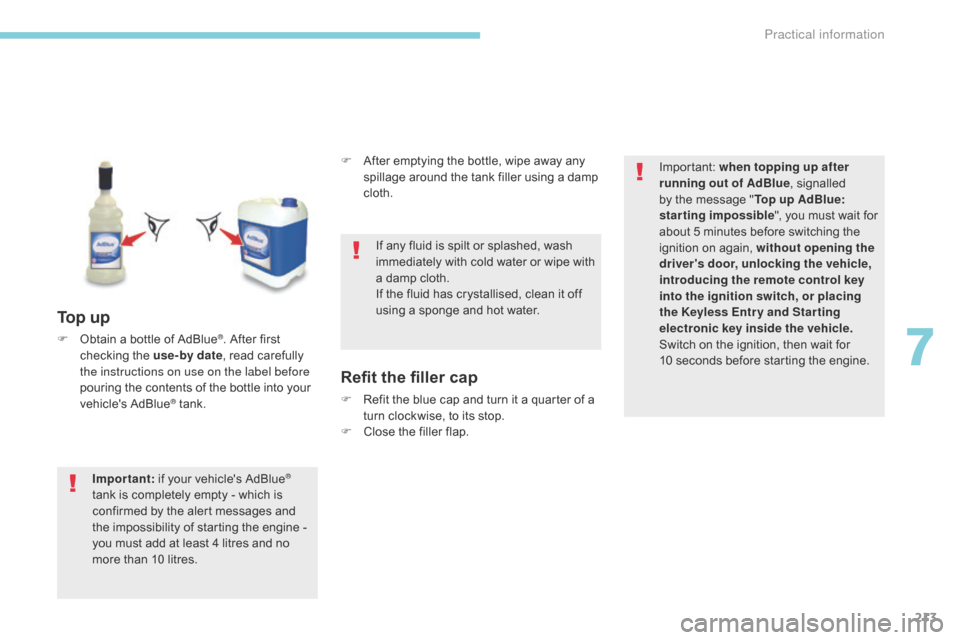
To p u p
F Obtain a bottle of AdBlue®. After first
checking the use-by date , read carefully
the instructions on use on the label before
pouring the contents of the bottle into your
vehicle's AdBlue
® tank.
Important : if your vehicle's AdBlue
®
tank is completely empty
- which is
confirmed by the alert messages and
the impossibility of starting the engine
-
you must add at least 4 litres and no
more than 10 litres. If any fluid is spilt or splashed, wash
immediately with cold water or wipe with
a damp cloth.
If the fluid has crystallised, clean it off
using a sponge and hot water.
Important:
when topping up after
running out of AdBlue , signalled
by the message " To p up AdBlue:
starting impossible ", you must wait for
about 5 minutes before switching the
ignition on again, without opening the
driver's door, unlocking the vehicle,
introducing the remote control key
into the ignition switch, or placing
the Keyless Entr y and Star ting
electronic key inside the vehicle.
Switch on the ignition, then wait for
10 seconds before starting the engine.
F
A
fter emptying the bottle, wipe away any
spillage around the tank filler using a damp
cloth.
Refit the filler cap
F Refit the blue cap and turn it a quarter of a turn clockwise, to its stop.
F
C
lose the filler flap.
7
Practical information
Page 217 of 442
215
Warning triangle
The triangle can be stored on the rear face of
the boot, secured by straps.
Assembling the triangle
As a safety precaution, before leaving your
vehicle to set up and install the triangle, switch
on the hazard warning lamps and put on your
high visibility vest.Refer to the instructions provided with the
triangle.
Positioning the triangle
Running out of fuel
(Diesel)
On vehicles fitted with Diesel engines, the fuel
system must be primed if you run out of fuel. For more information on Misfuel
prevention (Diesel) , refer to the
corresponding section.
If the engine does not start first
time, don't keep trying, but start the
procedure again from the beginning.
BlueHDi engines
F Fill the fuel tank with at least five litres of Diesel.
F
S
witch on the ignition (without starting the
engine).
F
W
ait around 6 seconds and switch off the
ignition.
F
R
epeat the operation 10 times.
F
O
perate the starter to run the engine.
F
P
lace the triangle behind the vehicle, as
required by local legislation.
Other HDi engines
(except BlueHDi version)
F A dd at least five litres of Diesel fuel to the
tank.
F
O
pen the bonnet.
F
I
f necessary, unclip the styling cover for
access to the priming pump.
F
S
queeze and release the priming pump
repeatedly until resistance is felt (there
may be resistance at the first press).
F
O
perate the starter to start the engine
(if the engine does not start at the first
attempt, wait around 15 seconds before
trying again).
F
I
f the engine does not start after a few
attempts, operate the priming pump again
then start the engine.
F
R
efit the styling cover and clip it in place.
F
C
lose the bonnet.
8
In the event of a breakdown
Page 224 of 442
222
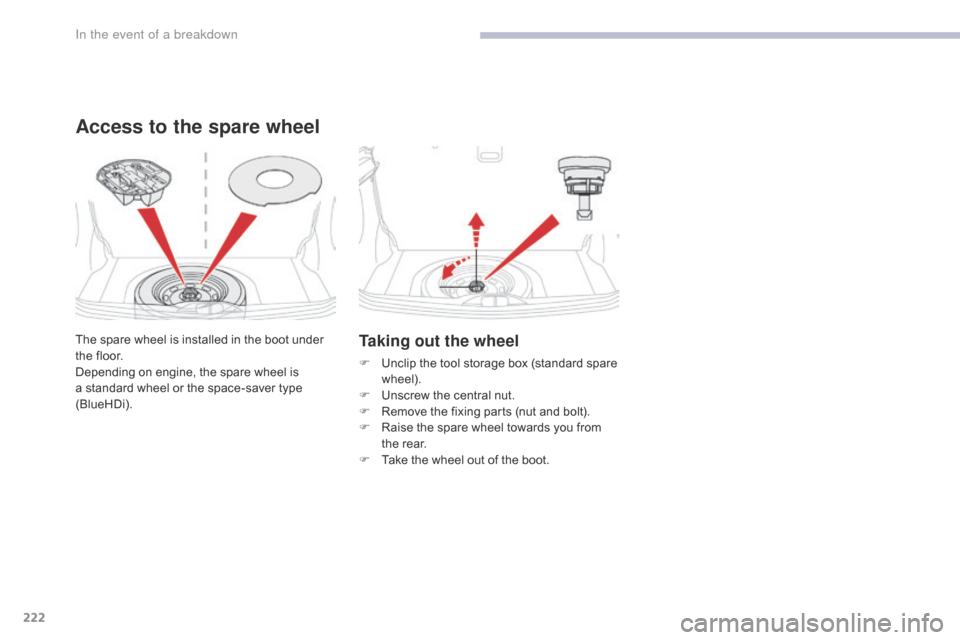
Taking out the wheel
F Unclip the tool storage box (standard spare wheel).
F
U
nscrew the central nut.
F
R
emove the fixing parts (nut and bolt).
F
R
aise the spare wheel towards you from
the rear.
F
T
ake the wheel out of the boot.
The spare wheel is installed in the boot under
the floor.
Depending on engine, the spare wheel is
a standard wheel or the space-saver type
(BlueHDi).
Access to the spare wheel
In the event of a breakdown
Page 241 of 442
239
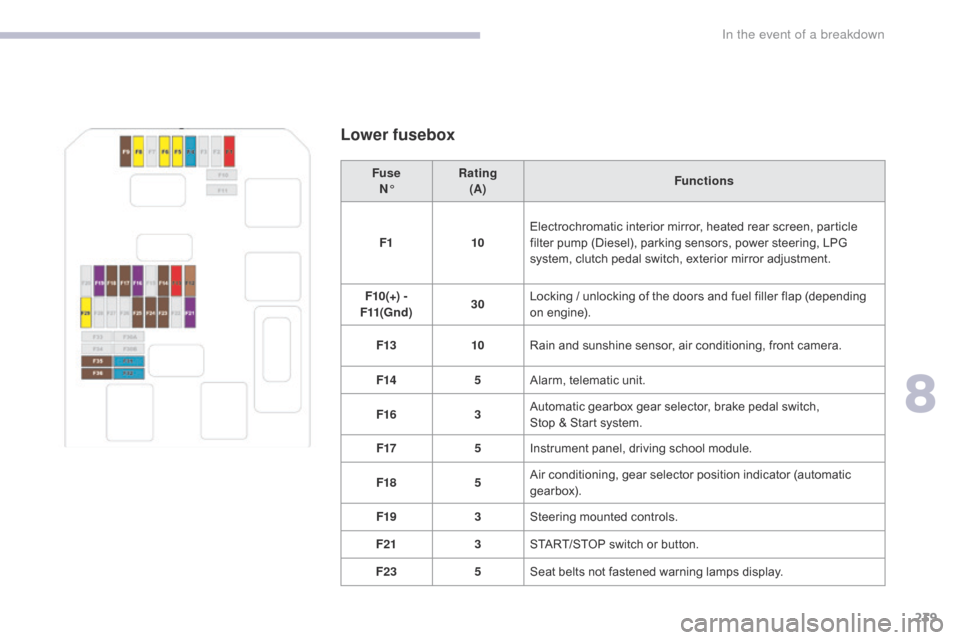
Lower fusebox
FuseN° Rating
(A) Functions
F1 10Electrochromatic interior mirror, heated rear screen, particle
filter pump (Diesel), parking sensors, power steering, LPG
system, clutch pedal switch, exterior mirror adjustment.
F10(+) -
F11(Gnd) 30Locking / unlocking of the doors and fuel filler flap (depending
on engine).
F13 10Rain and sunshine sensor, air conditioning, front camera.
F14 5Alarm, telematic unit.
F16 3Automatic gearbox gear selector, brake pedal switch,
Stop & Start system.
F17 5Instrument panel, driving school module.
F18 5Air conditioning, gear selector position indicator (automatic
gearbox).
F19 3Steering mounted controls.
F21 3START/STOP switch or button.
F23 5Seat belts not fastened warning lamps display.
8
In the event of a breakdown
Page 243 of 442
241
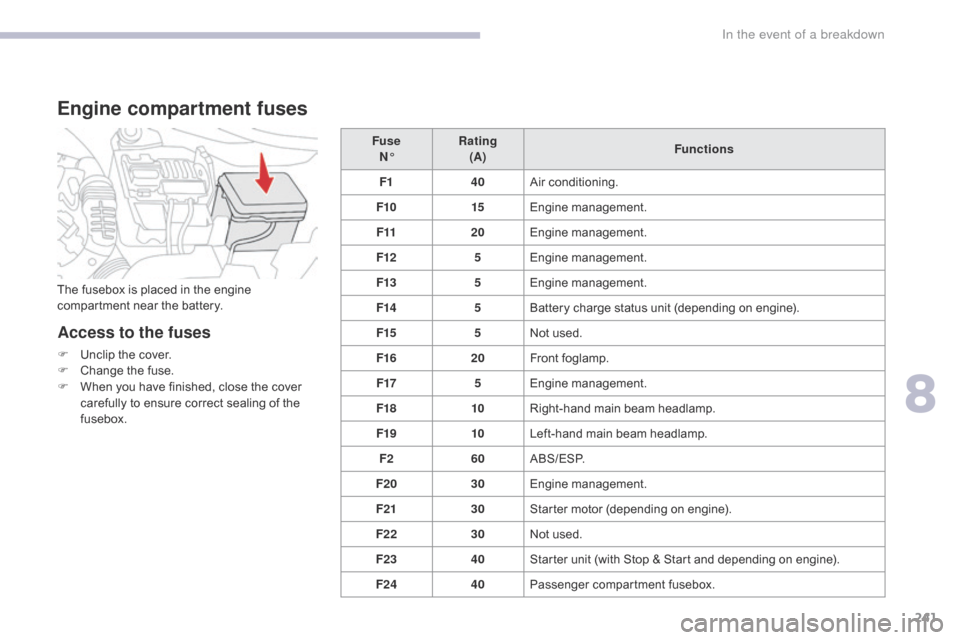
Engine compartment fuses
Access to the fuses
F Unclip the cover.
F C hange the fuse.
F
W
hen you have finished, close the cover
carefully to ensure correct sealing of the
fusebox. Fuse
N° Rating
(A) Functions
F1 40Air conditioning.
F10 15Engine management.
F11 20Engine management.
F12 5Engine management.
F13 5Engine management.
F14 5Battery charge status unit (depending on engine).
F15 5Not used.
F16 20Front foglamp.
F17 5Engine management.
F18 10Right-hand main beam headlamp.
F19 10Left-hand main beam headlamp.
F2 60A B S / E S P.
F20 30Engine management.
F21 30Starter motor (depending on engine).
F22 30Not used.
F23 40Starter unit (with Stop & Start and depending on engine).
F24 40Passenger compartment fusebox.
The fusebox is placed in the engine
compartment near the battery.
8
In the event of a breakdown
Page 244 of 442
242
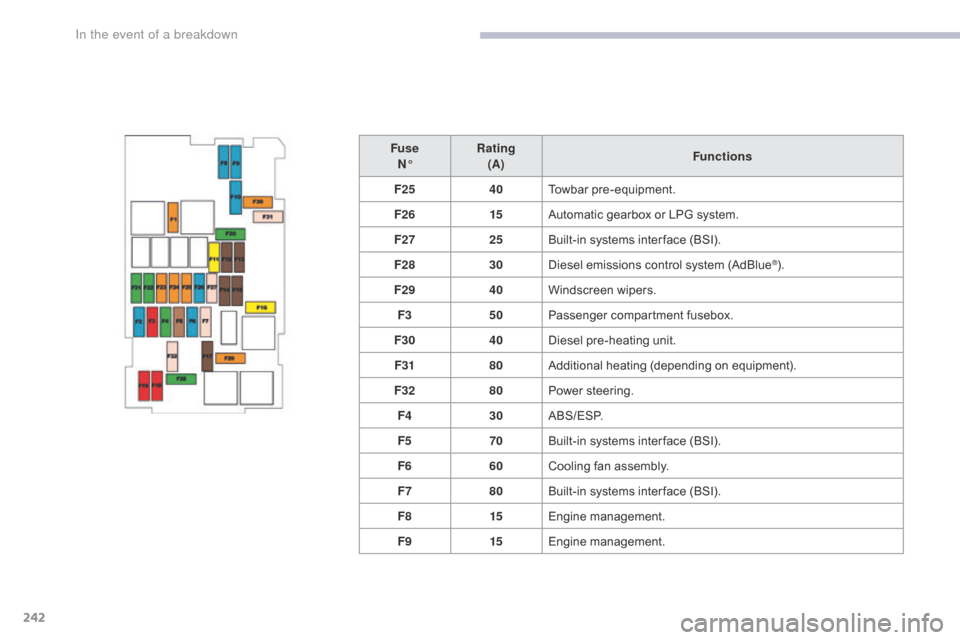
FuseN° Rating
(A) Functions
F25 40Towbar pre-equipment.
F26 15Automatic gearbox or LPG system.
F27 25Built-in systems inter face (BSI).
F28 30Diesel emissions control system (AdBlue
®).
F29 40Windscreen wipers.
F3 50Passenger compartment fusebox.
F30 40Diesel pre-heating unit.
F31 80Additional heating (depending on equipment).
F32 80Power steering.
F4 30A B S / E S P.
F5 70Built-in systems inter face (BSI).
F6 60Cooling fan assembly.
F7 80Built-in systems inter face (BSI).
F8 15Engine management.
F9 15Engine management.
In the event of a breakdown
Page 245 of 442
243
12 V battery
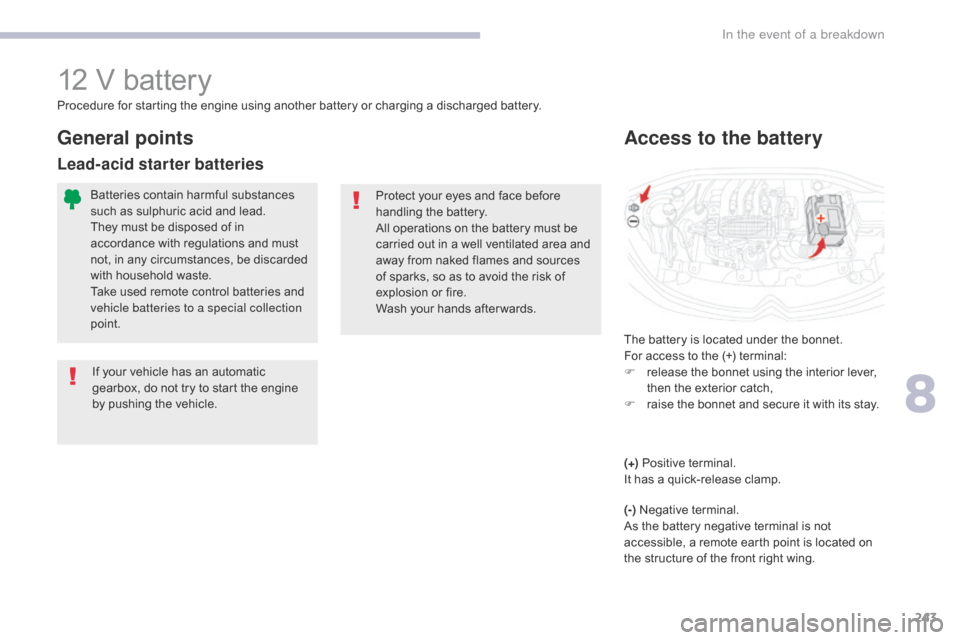
The battery is located under the bonnet.
For access to the (+) terminal:
F
r
elease the bonnet using the interior lever,
then the exterior catch,
F
r
aise the bonnet and secure it with its stay.
Access to the battery
Procedure for starting the engine using another battery or charging a discharged battery.
Protect your eyes and face before
handling the battery.
All operations on the battery must be
carried out in a well ventilated area and
away from naked flames and sources
of sparks, so as to avoid the risk of
explosion or fire.
Wash your hands after wards.
If your vehicle has an automatic
gearbox, do not try to start the engine
by pushing the vehicle.
General points
Lead-acid starter batteries
Batteries contain harmful substances
such as sulphuric acid and lead.
They must be disposed of in
accordance with regulations and must
not, in any circumstances, be discarded
with household waste.
Take used remote control batteries and
vehicle batteries to a special collection
point.
(+) Positive terminal.
It has a quick-release clamp.
(-) Negative terminal.
As the battery negative terminal is not
accessible, a remote earth point is located on
the structure of the front right wing.
8
In the event of a breakdown
Page 246 of 442
244
When your vehicle's battery is discharged, the
engine can be started using a slave battery
(external or on another vehicle) and jump lead
cables or a battery booster.
Starting using another battery
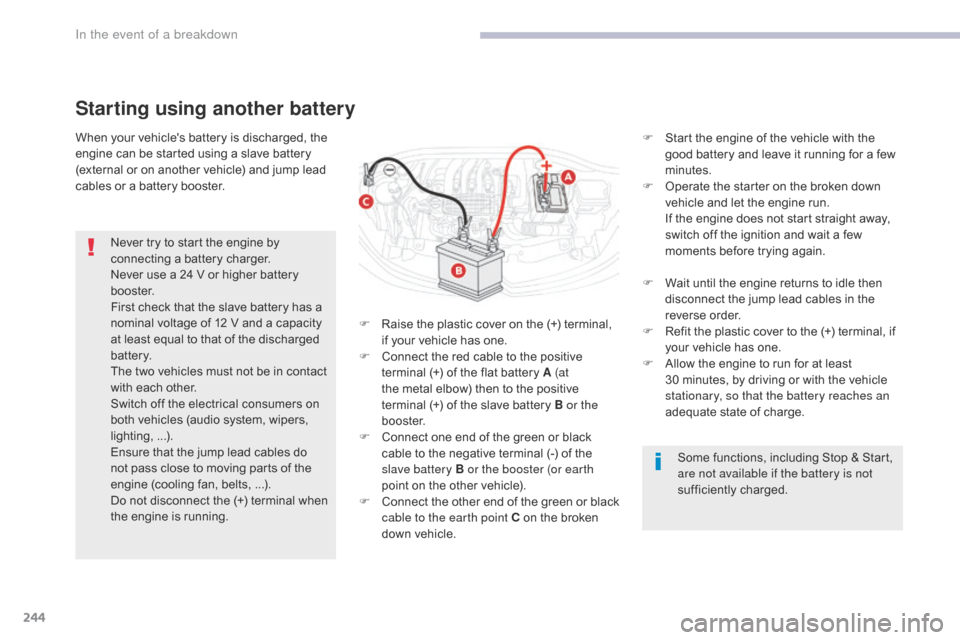
F Raise the plastic cover on the (+) terminal, if your vehicle has one.
F
C
onnect the red cable to the positive
terminal (+) of the flat battery A (at
the metal elbow) then to the positive
terminal
(+) of the slave battery B or the
b o o s t e r.
F
C
onnect one end of the green or black
cable to the negative terminal (-) of the
slave battery B or the booster (or earth
point on the other vehicle).
F
C
onnect the other end of the green or black
cable to the earth point C on the broken
down vehicle. F
S
tart the engine of the vehicle with the
good battery and leave it running for a few
minutes.
F
O
perate the starter on the broken down
vehicle and let the engine run.
I
f the engine does not start straight away,
switch off the ignition and wait a few
moments before trying again.
Never try to start the engine by
connecting a battery charger.
Never use a 24 V or higher battery
b o o s t e r.
First check that the slave battery has a
nominal voltage of 12 V and a capacity
at least equal to that of the discharged
battery.
The two vehicles must not be in contact
with each other.
Switch off the electrical consumers on
both vehicles (audio system, wipers,
lighting,
...
).
Ensure that the jump lead cables do
not pass close to moving parts of the
engine (cooling fan, belts,
...).
Do not disconnect the (+) terminal when
the engine is running. F
W
ait until the engine returns to idle then
disconnect the jump lead cables in the
reverse order.
F R efit the plastic cover to the (+) terminal, if
your vehicle has one.
F
A
llow the engine to run for at least
30
minutes, by driving or with the vehicle
stationary, so that the battery reaches an
adequate state of charge.
Some functions, including Stop & Start,
are not available if the battery is not
sufficiently charged.
In the event of a breakdown