seats Citroen C3 RHD 2017 2.G Owner's Manual
[x] Cancel search | Manufacturer: CITROEN, Model Year: 2017, Model line: C3 RHD, Model: Citroen C3 RHD 2017 2.GPages: 442, PDF Size: 9.75 MB
Page 4 of 442
.
.
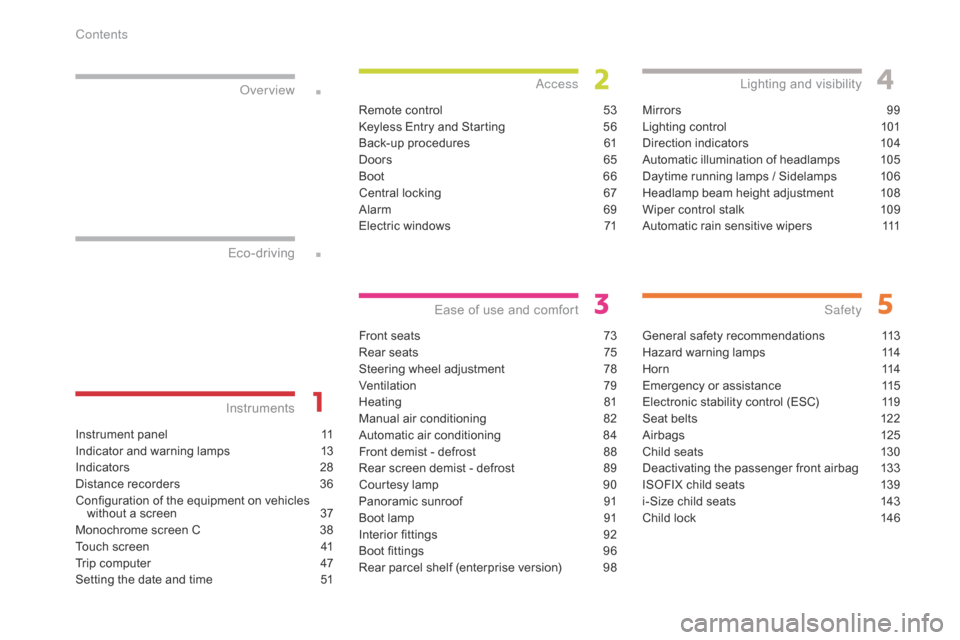
Instrument panel 11
Indicator and warning lamps
1
3
Indicators
2
8
Distance recorders
3
6
Configuration of the equipment on vehicles without a screen
3
7
Monochrome screen C
3
8
Touch screen
4
1
Trip computer
4
7
Setting the date and time
5
1
InstrumentsOver view
Remote control 5
3
Keyless Entry and Starting
5
6
Back-up procedures
6
1
Doors
65
Boo
t
6
6
Central locking
6
7
Alarm
6
9
Electric windows
7
1
Access
Front seats 73
Rear seats
7
5
Steering wheel adjustment
7
8
Ventilation
7
9
Heating
8
1
Manual air conditioning
8
2
Automatic air conditioning
8
4
Front demist - defrost
8
8
Rear screen demist - defrost
8
9
Courtesy lamp
9
0
Panoramic sunroof
9
1
Boot lamp
9
1
Interior fittings
9
2
Boot fittings
9
6
Rear parcel shelf (enterprise version)
9
8
Ease of use and comfort
Mirrors 99
Lighting control
1
01
Direction indicators
1
04
Automatic illumination of headlamps
1
05
Daytime running lamps / Sidelamps
1
06
Headlamp beam height adjustment
1
08
Wiper control stalk
1
09
Automatic rain sensitive wipers
1
11
Lighting and visibility
General safety recommendations 113
Hazard warning lamps
1
14
H o r n
11
4
Emergency or assistance
1
15
Electronic stability control (ESC)
1
19
Seat belts
1
22
Airbags
1
25
Child seats
1
30
Deactivating the passenger front airbag
1
33
ISOFIX child seats
1
39
i-Size child seats
1
43
Child lock
1
46
Safety
Eco-driving
Contents
Page 7 of 442
5
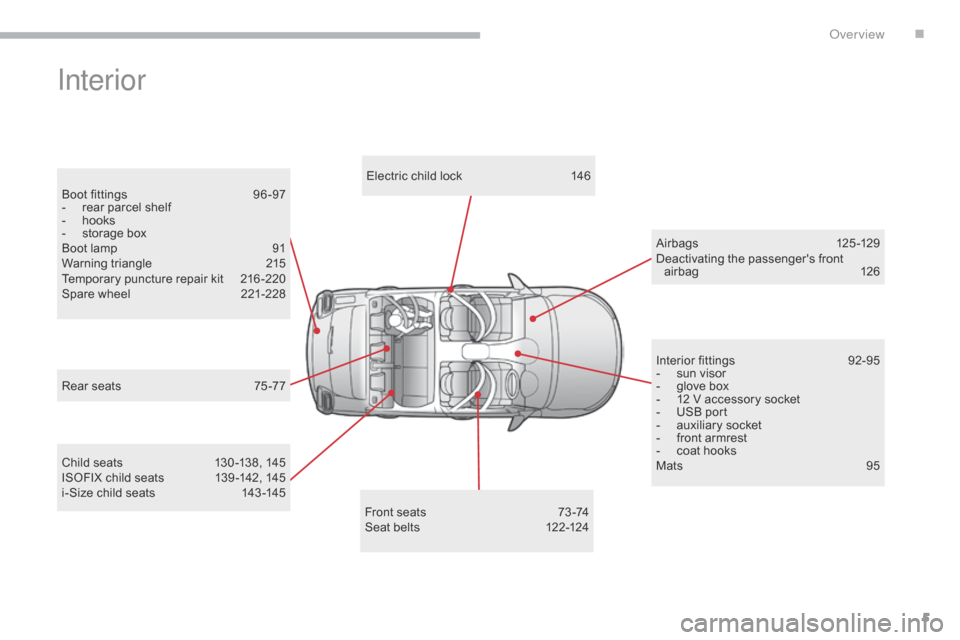
Boot fittings 96 -97
- r ear parcel shelf
-
h
ooks
-
s
torage box
Boot lamp
9
1
Warning triangle
2
15
Temporary puncture repair kit
2
16 -220
Spare wheel
2
21-228
Interior
Child seats 130 -138, 145
ISOFIX child seats 1 39 -142, 145
i-Size child seats
1
43 -145
Rear seats
7
5 -77
Interior fittings
9
2-95
-
s
un visor
-
g
love box
-
1
2 V accessory socket
-
U
SB port
-
a
uxiliary socket
-
f
ront armrest
- c oat hooks
Mats 9 5
Front seats
7
3 -74
Seat belts
1
22-124A ir bags
12
5 -129
Deactivating the passenger's front airbag
1
26
Electric child lock
1
46
.
Over view
Page 12 of 442
10
Limit the causes of excess consumption
Spread loads throughout the vehicle; place the heaviest items in the
bottom of the boot, as close as possible to the rear seats.
Limit the loads carried in the vehicle and reduce wind resistance (roof
bars, roof rack, bicycle carrier, trailer...). Use a roof box in preference.
Remove roof bars and roof racks after use.
At the end of winter, remove snow tyres and refit your summer tyres.
Observe the recommendations on
maintenance
Check the tyre pressures regularly, when cold, referring to the label in
the door aperture, driver's side.
Carry out this check in particular:
-
b
efore a long journey,
-
a
t each change of season,
-
a
fter a long period out of use.
Don't forget the spare wheel and the tyres on any trailer or caravan.
Have your vehicle serviced regularly (engine oil, oil filter, air filter,
passenger compartment filter...) and observe the schedule of
operations recommended in the manufacturer's service schedule.
With a BlueHDi Diesel engine, if the SCR system is faulty your vehicle
becomes polluting; go to a CITROËN dealer or a qualified workshop
without delay to have the emissions of nitrogen oxides brought back to
the legal level.
When refuelling, do not continue after the third cut-off of the nozzle to
avoid any over flow.
At the wheel of your new vehicle, it is only after the first 1 800 miles
(3
000 kilometres) that you will see the fuel consumption settle down to
a consistent average.
Eco-driving
Page 68 of 442
66
Boot
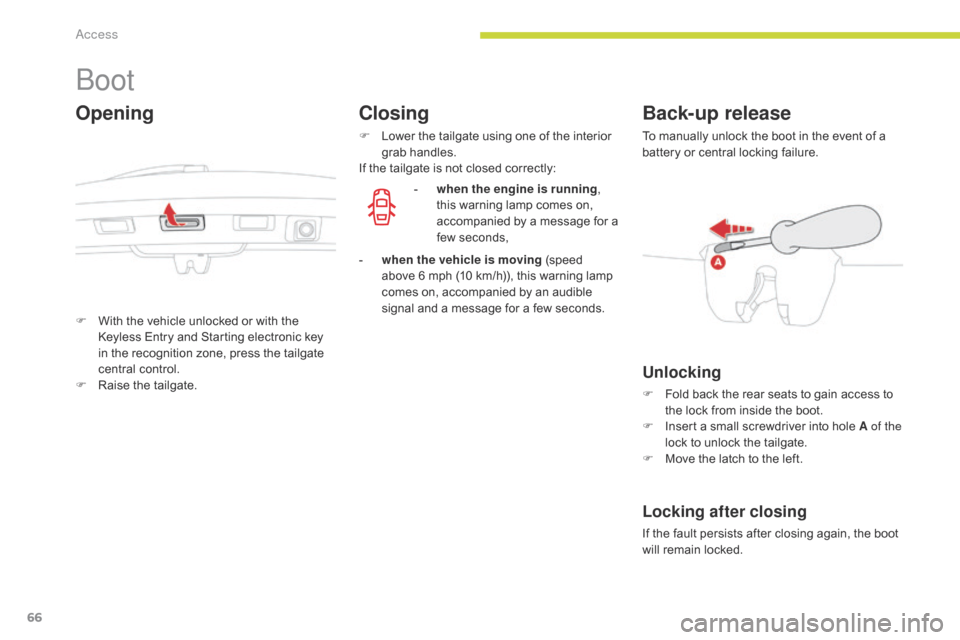
F With the vehicle unlocked or with the Keyless Entry and Starting electronic key
in the recognition zone, press the tailgate
central control.
F
Ra
ise the tailgate.
Closing
F Lower the tailgate using one of the interior grab handles.
If the tailgate is not closed correctly:
-
w
hen the engine is running ,
this warning lamp comes on,
accompanied by a message for a
few seconds,
Back-up release
To manually unlock the boot in the event of a
battery or central locking failure.
Unlocking
F Fold back the rear seats to gain access to the lock from inside the boot.
F
I
nsert a small screwdriver into hole A of the
lock to unlock the tailgate.
F
M
ove the latch to the left.
Locking after closing
If the fault persists after closing again, the boot
will remain locked.
Opening
- when the vehicle is moving (speed above 6 mph (10 km/h)), this warning lamp
comes on, accompanied by an audible
signal and a message for a few seconds.
Access
Page 75 of 442
73
Front seats
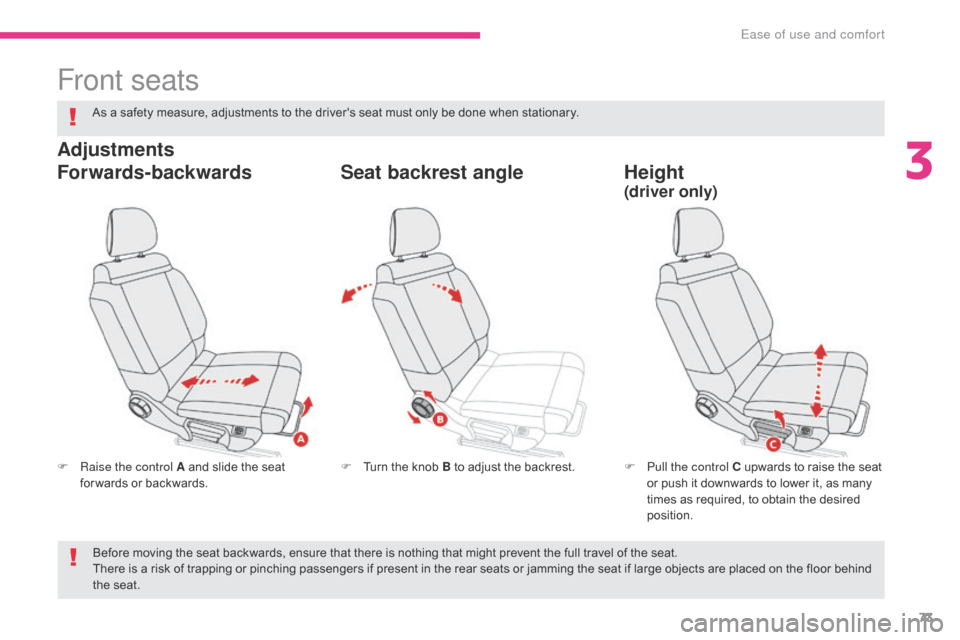
F Raise the control A and slide the seat for wards or backwards. F
P ull the control C upwards to raise the seat
or push it downwards to lower it, as many
times as required, to obtain the desired
position.
F
T urn the knob B to adjust the backrest.
Forwards-backwards
Height
Seat backrest angle
Adjustments
(driver only)
As a safety measure, adjustments to the driver's seat must only be done when stationary.
Before moving the seat backwards, ensure that there is nothing that might prevent the full travel of the seat.
There is a risk of trapping or pinching passengers if present in the rear seats or jamming the seat if large objects are placed on the floor behind
the seat.
3
Ease of use and comfort
Page 77 of 442
75
Rear seats
Bench seat with fixed cushions and split folding backrests (2/3 -1/3) to adapt the boot load space.
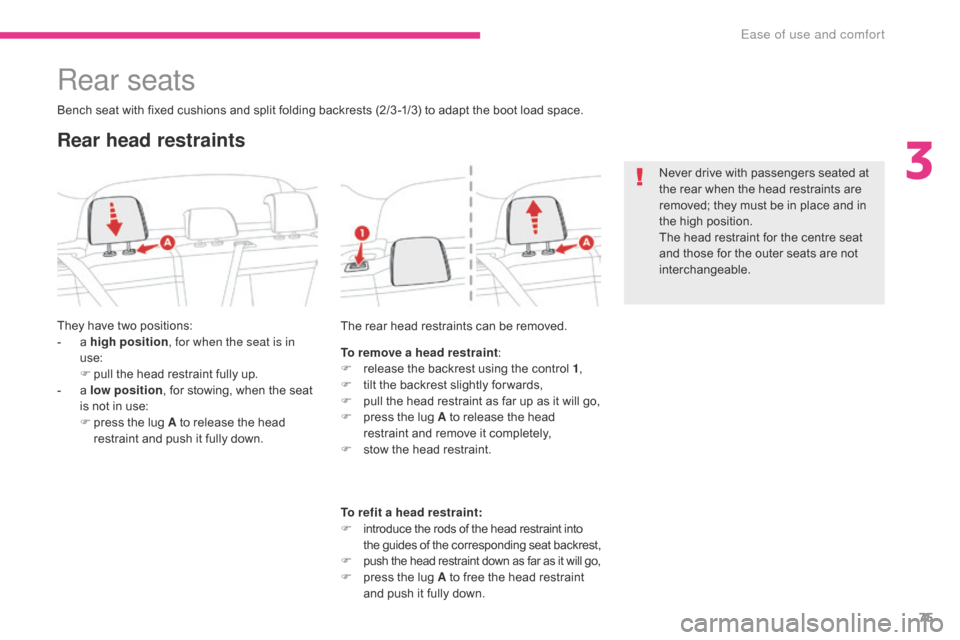
They have two positions:
-
a
high position , for when the seat is in
use:
F
p
ull the head restraint fully up.
-
a
low position , for stowing, when the seat
is not in use:
F
p
ress the lug A to release the head
restraint and push it fully down. Never drive with passengers seated at
the rear when the head restraints are
removed; they must be in place and in
the high position.
The head restraint for the centre seat
and those for the outer seats are not
interchangeable.
To remove a head restraint :
F
r
elease the backrest using the control 1,
F
t
ilt the backrest slightly for wards,
F
p
ull the head restraint as far up as it will go,
F
p
ress the lug A to release the head
restraint and remove it completely,
F
s
tow the head restraint.
Rear head restraints
The rear head restraints can be removed.
To refit a head restraint:
F
i
ntroduce the rods of the head restraint into
the guides of the corresponding seat backrest,
F
push the head restraint down as far as it will go,F press the lug A to free the head restraint and push it fully down.
3
Ease of use and comfort
Page 78 of 442
76
Folding the backrests
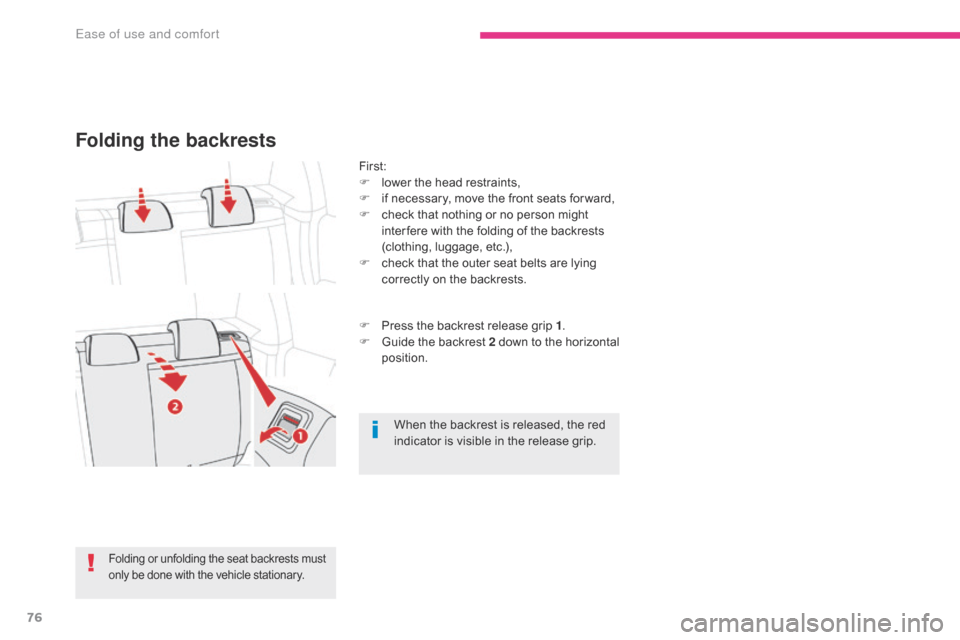
First:
F l ower the head restraints,
F
i
f necessary, move the front seats for ward,
F
c
heck that nothing or no person might
inter fere with the folding of the backrests
(clothing, luggage, etc.),
F
c
heck that the outer seat belts are lying
correctly on the backrests.
When the backrest is released, the red
indicator is visible in the release grip.
F
P
ress the backrest release grip 1 .
F
G
uide the backrest 2 down to the horizontal
position.
Folding or unfolding the seat backrests must
only be done with the vehicle stationary.
Ease of use and comfort
Page 99 of 442
97
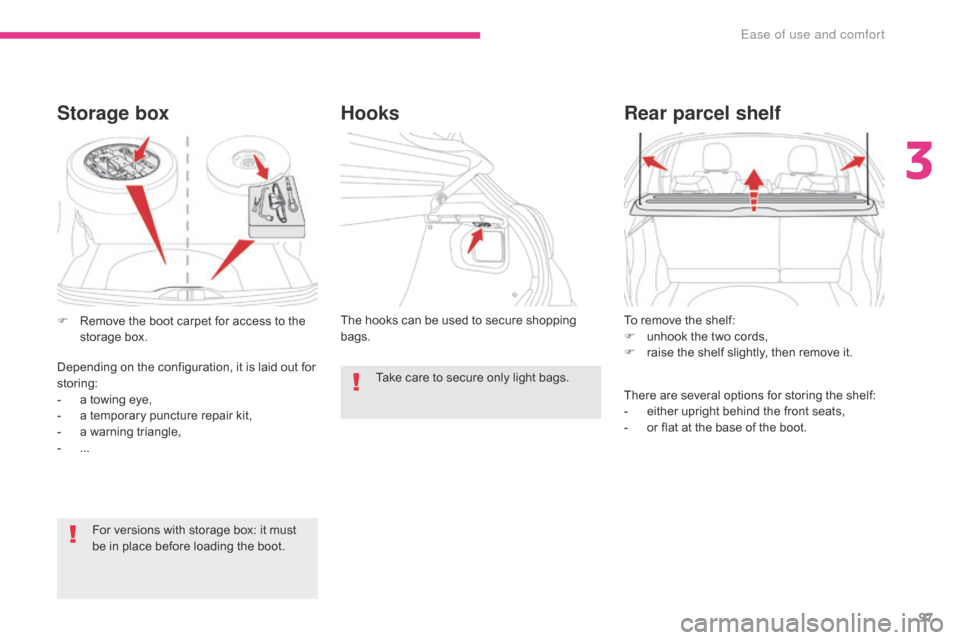
To remove the shelf:
F u nhook the two cords,
F
r
aise the shelf slightly, then remove it.
Rear parcel shelf
There are several options for storing the shelf:
- e ither upright behind the front seats,
-
o
r flat at the base of the boot.
The hooks can be used to secure shopping
bags.
Hooks
Storage box
For versions with storage box: it must
be in place before loading the boot.
F
R
emove the boot carpet for access to the
storage box.
Depending on the configuration, it is laid out for
storing:
-
a t
owing eye,
-
a t
emporary puncture repair kit,
-
a w
arning triangle,
-
... T
ake care to secure only light bags.
3
Ease of use and comfort
Page 124 of 442
122
Seat belts
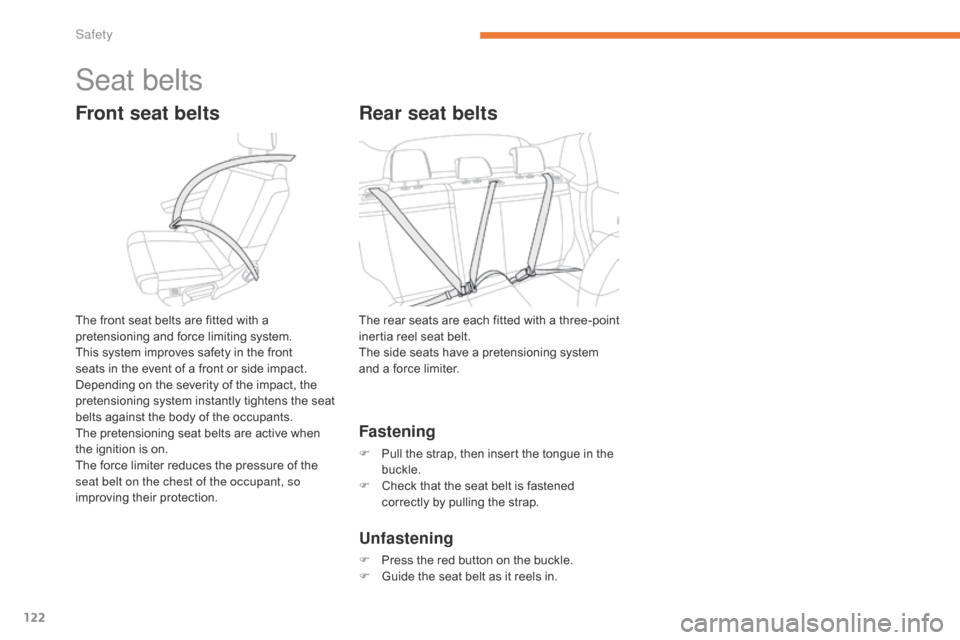
Front seat belts
The front seat belts are fitted with a
pretensioning and force limiting system.
This system improves safety in the front
seats in the event of a front or side impact.
Depending on the severity of the impact, the
pretensioning system instantly tightens the seat
belts against the body of the occupants.
The pretensioning seat belts are active when
the ignition is on.
The force limiter reduces the pressure of the
seat belt on the chest of the occupant, so
improving their protection.
Fastening
F Pull the strap, then insert the tongue in the buckle.
F
C
heck that the seat belt is fastened
correctly by pulling the strap.
Unfastening
F Press the red button on the buckle.
F G uide the seat belt as it reels in.
Rear seat belts
The rear seats are each fitted with a three-point
inertia reel seat belt.
The side seats have a pretensioning system
and a force limiter.
Safety
Page 126 of 442
124
The driver must ensure that passengers use
the seat belts correctly and that they are all
fastened before setting off.
Wherever you are seated in the vehicle,
always fasten your seat belt, even for short
journeys.
Do not interchange the seat belt buckles as
they will not fulfill their role fully.
The seat belts are fitted with an inertia reel
permitting automatic adjustment of the
length of the strap to your size. The seat belt
is stowed automatically when not in use.
Before and after use, ensure that the seat
belt is reeled in correctly.
The lower part of the strap must be
positioned as low as possible on the pelvis.
The upper part must be positioned in the
hollow of the shoulder.
The inertia reels are fitted with an automatic
locking device which comes into operation in
the event of a collision, emergency braking
or if the vehicle rolls over. You can release
the device by pulling the strap firmly and
then releasing it so that it reels in slightly.
In the event of an impact
Depending on the nature and
seriousness of the impact, the
pretensioning device may be deployed
before and independently of the airbags.
Deployment of the pretensioners is
accompanied by a slight discharge of
harmless smoke and a noise, due to the
activation of the pyrotechnic cartridge
incorporated in the system.
In all cases, the airbag warning lamp
comes
on.
Following an impact, have the seat belts
system checked, and if necessary replaced,
by a CITROËN dealer or a qualified
workshop.
In order to be effective, a seat belt must:
-
b
e tightened as close to the body as
possible,
-
b
e pulled in front of you with a smooth
movement, checking that it does not
twist,
-
b
e used to restrain only one person,
-
n
ot bear any trace of cuts or fraying,
-
n
ot be converted or modified to avoid
affecting its performance.
Recommendations for children
Use a suitable child seat if the passenger is
less than 12 years old or shorter than one
and a half metres.
Never use the same seat belt to secure more
than one person.
Never allow a child to travel on your lap.
For more information on Child seats , refer
to the corresponding section.
In accordance with current safety
regulations, for all repairs on your vehicle's
seat belts, go to a qualified workshop with
the skills and equipment needed, which a
CITROËN dealer is able to provide.
Have your seat belts checked regularly by
a CITROËN dealer or a qualified workshop,
particularly if the straps show signs of
damage.
Clean the seat belt straps with soapy
water or a textile cleaning product, sold by
CITROËN dealers.
After folding or moving a seat or rear bench
seat, ensure that the seat belt is positioned
and reeled in correctly.
Advice
Safety