pressure Citroen C4 2012 2.G User Guide
[x] Cancel search | Manufacturer: CITROEN, Model Year: 2012, Model line: C4, Model: Citroen C4 2012 2.GPages: 332, PDF Size: 28.33 MB
Page 176 of 332
9
DRIVING
174
When the cruise control is
switched on, be careful if you
maintain the pressure on one of
the programmed speed chang-
ing buttons: this may result in a
very rapid change in the speed
of your vehicle.
Do not use the cruise control on
slippery roads or in heavy traffi c.
On a steep descent, the cruise
control will not be able to prevent
the vehicle from exceeding the
programmed speed.
On steep climbs or when towing,
the programmed speed may not
be reached or maintained.
To avoid any risk of jamming of
the pedals:
- ensure that the mat is posi-
tioned correctly,
- never fi t one mat on top of
another.
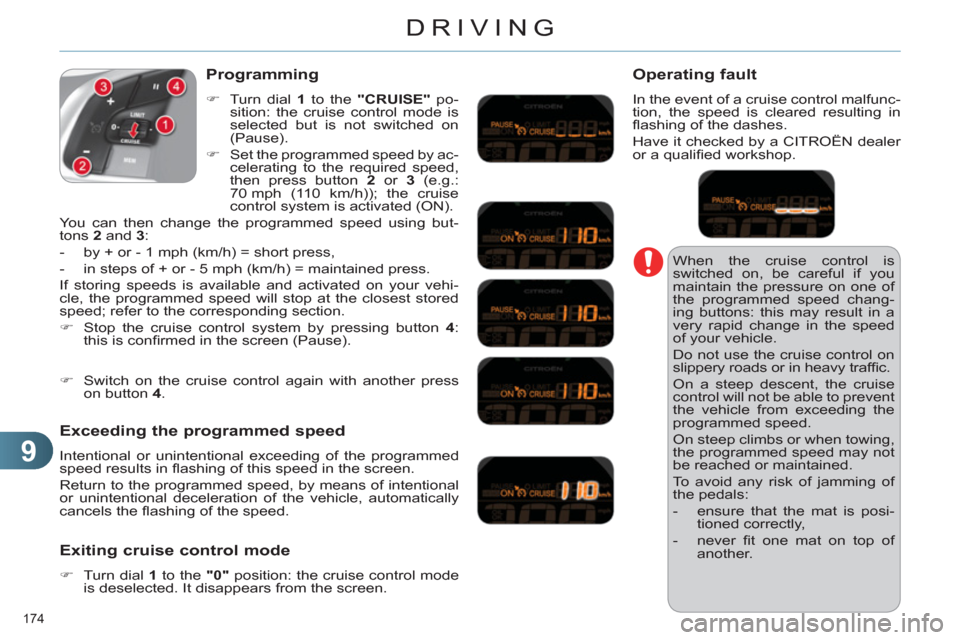
Programming
)
Turn dial 1
to the "CRUISE"
po-
sition: the cruise control mode is
selected but is not switched on
(Pause).
)
Set the programmed speed by ac-
celerating to the required speed,
then press button 2
or 3
(e.g.:
70 mph (110 km/h)); the cruise
control system is activated (ON).
You can then change the programmed speed using but-
tons 2
and 3
:
- by + or - 1 mph (km/h) = short press,
- in steps of + or - 5 mph (km/h) = maintained press.
If storing speeds is available and activated on your vehi-
cle, the programmed speed will stop at the closest stored
speed; refer to the corresponding section.
)
Stop the cruise control system by pressing button 4
:
this is confi rmed in the screen (Pause).
Exceeding the programmed speed
Intentional or unintentional exceeding of the programmed
speed results in fl ashing of this speed in the screen.
Return to the programmed speed, by means of intentional
or unintentional deceleration of the vehicle, automatically
cancels the fl ashing of the speed.
Exiting cruise control mode
)
Turn dial 1
to the "0"
position: the cruise control mode
is deselected. It disappears from the screen.
)
Switch on the cruise control again with another press
on button 4
.
Operating fault
In the event of a cruise control malfunc-
tion, the speed is cleared resulting in
fl ashing of the dashes.
Have it checked by a CITROËN dealer
or a qualifi ed workshop.
Page 186 of 332
10
CHECKS
184
CHECKING LEVELS
Check all of these levels regularly and
top them up if necessary, unless other-
wise indicated.
If a level drops signifi cantly, have the
corresponding system checked by a
CITROËN dealer or a qualifi ed work-
shop.
When working under the bonnet,
take care, as certain areas of the
engine may be extremely hot (risk
of burns).
The reading will only be correct if
the vehicle is on level ground and
the engine has been off for more
than 30 minutes.
The check is carried out either when the
ignition is switched on using the oil level
indicator in the instrument panel, or using
the dipstick.
It is normal to top up the oil level between
two services. CITROËN recommends that
you check the oil level, and top up if neces-
sary, every 3 000 miles (5 000 kilometres).
Oil level
Engine oil change
Refer to the servicing booklet for the
interval for this operation.
In order to maintain the reliability of the
engine and emission control system,
the use of additives in the engine oil is
prohibited.
Oil specifi cation
The oil must correspond to your engine
and conform to the manufacturer's rec-
ommendations.
Brake fluid level
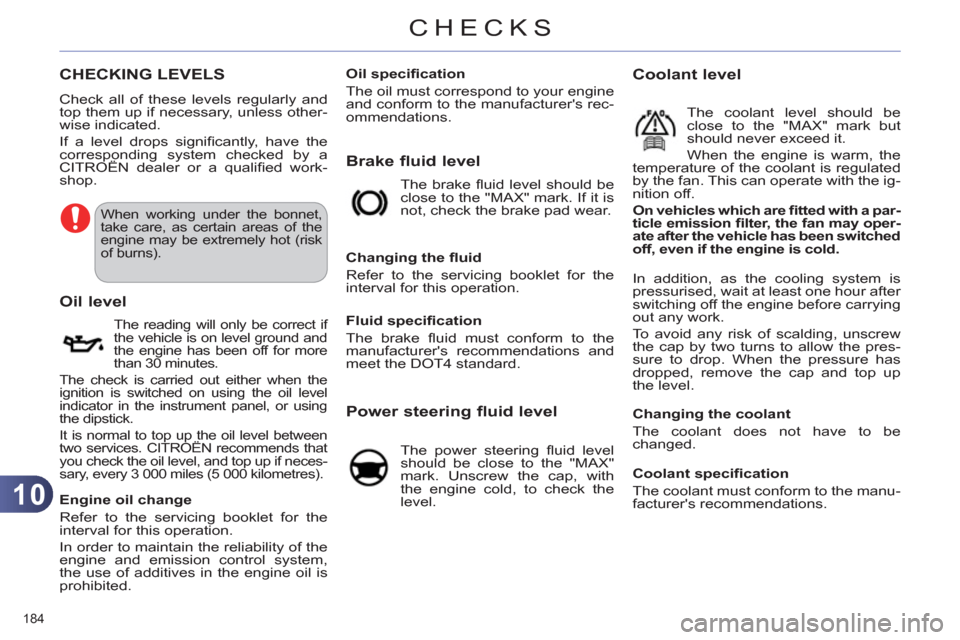
The brake fl uid level should be
close to the "MAX" mark. If it is
not, check the brake pad wear.
Changing the fl uid
Refer to the servicing booklet for the
interval for this operation.
Fluid specifi cation
The brake fl uid must conform to the
manufacturer's recommendations and
meet the DOT4 standard.
Power steering fluid level
The power steering fl uid level
should be close to the "MAX"
mark. Unscrew the cap, with
the engine cold, to check the
level.
Coolant level
The coolant level should be
close to the "MAX" mark but
should never exceed it.
When the engine is warm, the
temperature of the coolant is regulated
by the fan. This can operate with the ig-
nition off.
On vehicles which are fi tted with a par-
ticle emission fi lter, the fan may oper-
ate after the vehicle has been switched
off, even if the engine is cold.
In addition, as the cooling system is
pressurised, wait at least one hour after
switching off the engine before carrying
out any work.
To avoid any risk of scalding, unscrew
the cap by two turns to allow the pres-
sure to drop. When the pressure has
dropped, remove the cap and top up
the level.
Changing the coolant
The coolant does not have to be
changed.
Coolant specifi cation
The coolant must conform to the manu-
facturer's recommendations.
Page 189 of 332
10
CHECKS
187
Manual gearbox
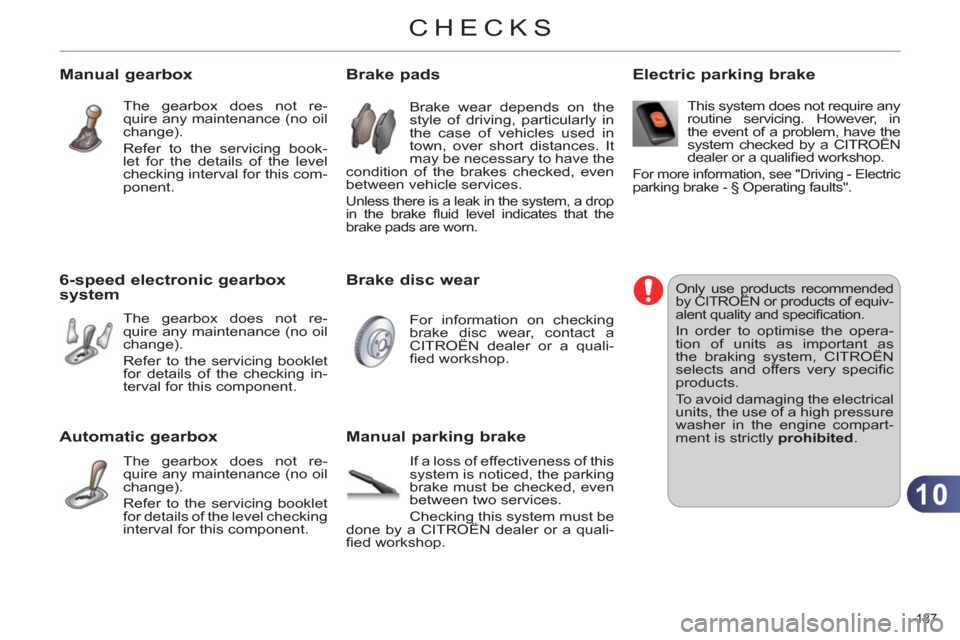
The gearbox does not re-
quire any maintenance (no oil
change).
Refer to the servicing book-
let for the details of the level
checking interval for this com-
ponent.
6-speed electronic gearbox
system
The gearbox does not re-
quire any maintenance (no oil
change).
Refer to the servicing booklet
for details of the checking in-
terval for this component.
Automatic gearbox
The gearbox does not re-
quire any maintenance (no oil
change).
Refer to the servicing booklet
for details of the level checking
interval for this component.
Electric parking brake
This system does not require any
routine servicing. However, in
the event of a problem, have the
system checked by a CITROËN
dealer or a qualifi ed workshop.
For more information, see "Driving - Electric parking brake - § Operating faults".
Brake pads
Brake disc wear
If a loss of effectiveness of this
system is noticed, the parking
brake must be checked, even
between two services.
Checking this system must be
done by a CITROËN dealer or a quali-
fi ed workshop.
Only use products recommended
by CITROËN or products of equiv-
alent quality and specifi cation.
In order to optimise the opera-
tion of units as important as
the braking system, CITROËN
selects and offers very specifi c
products.
To avoid damaging the electrical
units, the use of a high pressure
washer in the engine compart-
ment is strictly prohibited
.
Manual parking brake
For information on checking
brake disc wear, contact a
CITROËN dealer or a quali-
fi ed workshop. Brake wear depends on the
style of driving, particularly in
the case of vehicles used in
town, over short distances. It
may be necessary to have the
condition of the brakes checked, even
between vehicle services.
Unless there is a leak in the system, a drop
in the brake fl uid level indicates that the
brake pads are worn.
Page 190 of 332

11
PRACTICAL INFORMATION
188
TEMPORARY PUNCTURE
REPAIR KIT
Complete system consisting of a com-
pressor and a sealant cartridge which
permits temporary repair
of a tyre so
that you can drive to the nearest ga-
rage.
It is designed to repair most punctures
which could affect the tyre, located on
the tyre tread or shoulder.
Access to the kit
The speed limit sticker I
must be
affi xed to the vehicle's steering
wheel to remind you that a wheel
is in temporary use.
Do not exceed a speed of 50 mph
(80 km/h) when driving with a tyre
repaired using this type of kit.
This kit is installed in the storage box,
under the boot fl oor.
A.
"Sealant" or "Air" position selector.
B.
On "I"
/off "O"
switch.
C.
Defl ation button.
D.
Pressure gauge (in bar or p.s.i.).
E.
Compartment housing:
-
a cable with adaptor for 12 V socket,
- various infl ation adaptors for ac-
cessories, such as balls, bicycle
tyres...
Description of the kit
F.
Sealant cartridge.
G.
White pipe with cap for repair.
H.
Black pipe for infl ation.
I.
Speed limit sticker.
Page 192 of 332

11
PRACTICAL INFORMATION
190
Tyre under-infl ation detection
If the vehicle is fi tted with tyre under-
infl ation detection, the under-infl ation
warning lamp will remain on after the
wheel has been repaired until the
system is reinitialised by a CITROËN
dealer or a qualifi ed workshop.
If after around 5 to 7 minutes the
pressure is not attained, this in-
dicates that the tyre is not repair-
able; contact a CITROËN dealer
or a qualifi ed workshop for as-
sistance.
)
Switch on the compressor by mov-
ing the switch B
to position "I"
until
the tyre pressure reaches 2.0 bars.
The sealant is injected into the tyre
under pressure; do not disconnect
the pipe from the valve during this
operation (risk of splashing).
)
Remove the kit and screw the cap
back on the white pipe.
Take care to avoid staining your ve-
hicle with traces of fl uid. Keep the
kit to hand.
)
Drive immediately for approximate-
ly three miles (fi ve kilometres), at
reduced speed (between 15 and
35 mph [20 and 60 km/h]), to plug
the puncture.
)
Stop to check the repair and the tyre
pressure using the kit.
Page 193 of 332

11
PRACTICAL INFORMATION
191
)
Connect the compressor's electric
plug to the vehicle's 12 V socket.
)
Start the vehicle again and leave
the engine running.
)
Visit a CITROËN dealer or a
qualifi ed workshop as soon
as possible.
You must inform the techni-
cian that you have used this
kit. After inspection, the tech-
nician will inform you wheth-
er the tyre can be repaired or
must be replaced.
)
Turn the selector A
to the
"air" position.
)
Uncoil the black pipe H
fully.
)
Connect the black pipe to
the valve of the wheel.
2. Infl ation
)
Adjust the pressure using the com-
pressor (to infl ate: switch B
in po-
sition "I"
; to defl ate: switch B
in
position "O"
and press button C
), in
accordance with the vehicle's tyre
pressure label (located on the left
hand door aperture).
A loss of pressure indicates that the
puncture has not been fully plugged;
contact a CITROËN dealer or quali-
fi ed workshop for assistance.
)
Remove and stow the kit.
)
Drive at reduced speed (50 mph
[80 km/h] max) limiting the distance
travelled to approximately 120 miles
(200 km).
Page 194 of 332

11
PRACTICAL INFORMATION
192
Removing the cartridge
)
Stow the black pipe.
)
Detach the angled base from the
white pipe.
)
Support the compressor vertically.
)
Unscrew the cartridge from the bot-
tom.
)
Connect the compressor's electrical
connector to the vehicle's 12 V socket.
)
Start the vehicle and let the engine
run.
)
Adjust the pressure using the com-
pressor (to infl ate: switch B
in posi-
tion "I"
; to defl ate: switch B
in position
"O"
and press button C
), according
to the vehicle's tyre pressure label or
the accessory's pressure label.
)
Remove the kit then stow it.
Beware of discharges of fl uid.
The expiry date of the fl uid is in-
dicated on the cartridge.
The sealant cartridge is designed
for single use; even if only partly
used, it must be replaced.
After use, do not discard the car-
tridge into the environment, take
it to an authorised waste dispos-
al site or a CITROËN dealer.
Do not forget to obtain a new
sealant cartridge, available from
CITROËN dealers or from a
qualifi ed workshop.
Checking tyre pressures/
inflating accessories
You can also use the compressor, with-
out injecting any product, to:
- check or adjust the pressure of your
tyres,
- infl ate other accessories (balls, bi-
cycle tyres...).
)
Turn the selector A
to the
"Air" position.
)
Uncoil the black pipe H
fully.
)
Connect the black pipe to
the valve of the wheel or accessory.
If necessary, fi t one of the adaptors
supplied with the kit fi rst.
Page 198 of 332

11
PRACTICAL INFORMATION
196
Fitting a wheel
Fitting a steel or "space-
saver" spare wheel
If your vehicle is fi tted with al-
loy wheels, when tightening the
bolts on fi tting it is normal to
notice that the washers do not
come into contact with the steel
or "space-saver" spare wheel.
The wheel is secured by the
conical contact of each bolt.
After changing a wheel
To store the punctured wheel in
the boot correctly, fi rst remove
the central cover.
When using the "space-saver"
type spare wheel, do not exceed
50 mph (80 km/h).
Have the tightening of the bolts and
the pressure of the spare wheel
checked by a CITROËN dealer or
a qualifi ed workshop without delay.
Have the punctured wheel re-
paired and replace it on the vehicle
as soon as possible.
List of operations
)
Put the wheel in place on the hub.
)
Screw in the bolts by hand to the
stop.
)
Pre-tighten the security bolt using
the wheelbrace 1
fi tted with the se-
curity socket 4
.
)
Pre-tighten the other bolts using the
wheelbrace 1
only.
)
Lower the vehicle fully.
)
Fold the jack 2
and detach it.
)
Tighten the security bolt using the
wheelbrace 1
fi tted with the security
socket 4
.
)
Tighten the other bolts using the
wheelbrace 1
only.
)
Refi t the chromed bolt covers on
each of the bolts (according to
equipment).
)
Store the tools in the box.
Page 199 of 332
11
PRACTICAL INFORMATION
197
CHANGING A BULB
The headlamps are fi tted with
polycarbonate glass with a pro-
tective coating:
)
do not clean them using a
dry or abrasive cloth, nor
with a detergent or solvent
product,
)
use a sponge and soapy water,
)
when using a high pressure
washer on persistent marks,
do not keep the lance direct-
ed towards the lamps or their
edges for too long, so as not
to damage their protective
coating and seals.
)
Do not touch the bulb directly
with your fi ngers, use lint-
free cloths.
Changing a bulb should only be
done after the headlamp has been
switched off for a few minutes (risk
of serious burns).
It is imperative to use only anti-
ultraviolet (UV) type bulbs in
order not to damage the head-
lamp.
Always replace a failed bulb with
a new bulb with the same type
and specifi cation.
Risk of electrocution
Xenon bulbs (D1S-35W) must be
replaced by a CITROËN dealer
or a qualifi ed workshop.
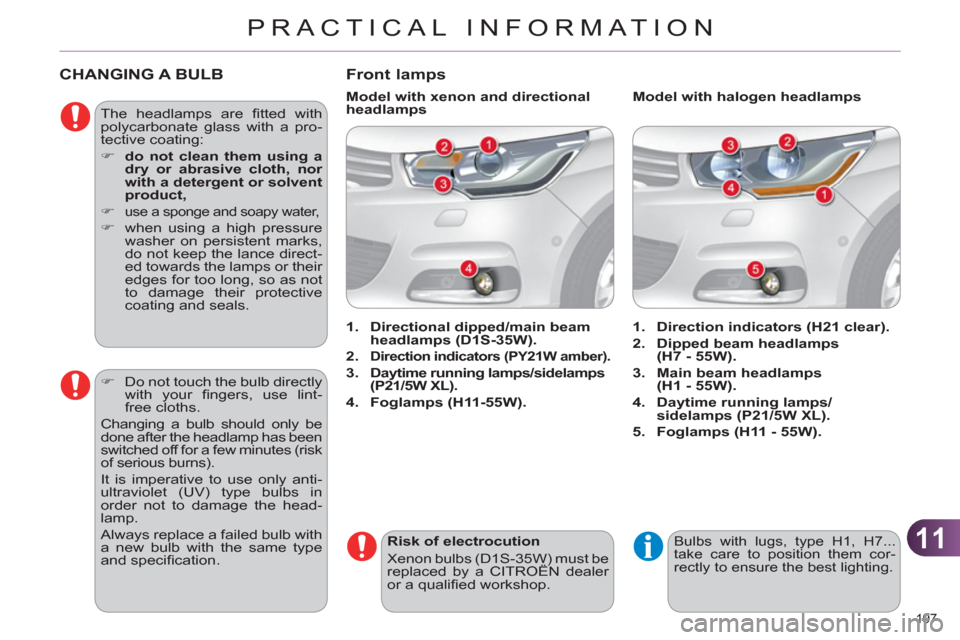
Front lamps
1.
Direction indicators (H21 clear).
2.
Dipped beam headlamps
(H7 - 55W).
3.
Main beam headlamps
(H1 - 55W).
4.
Daytime running lamps/
sidelamps (P21/5W XL).
5.
Foglamps (H11 - 55W).
1.
Directional dipped/main beam
headlamps (D1S-35W).
2.
Direction indicators (PY21W amber).
3.
Daytime running lamps/sidelamps
(P21/5W XL).
4.
Foglamps (H11-55W).
Model with halogen headlamps
Model with xenon and directional
headlamps
Bulbs with lugs, type H1, H7...
take care to position them cor-
rectly to ensure the best lighting.
Page 215 of 332

11
PRACTICAL INFORMATION
213
TOWING A TRAILER,
A CARAVAN, ETC.
We recommend the use of genu-
ine CITROËN towbars and their
harnesses that have been tested
and approved from the design
stage of your vehicle, and that
the fi tting of the towbar is en-
trusted to a CITROËN dealer or
a qualifi ed workshop.
If the towbar is not fi tted by a
CITROËN dealer, it is impera-
tive that it is fi tted in accordance
with the vehicle manufacturer's
instructions. The rear parking sensors will
be deactivated automatically if
a genuine CITROËN towbar is
used.
Towbar suitable for the attachment of a
trailer or caravan with additional lighting
and signalling.
Your vehicle is primarily designed for
transporting people and luggage, but it
may also be used for towing a trailer. Driving with a trailer places greater de-
mands on the towing vehicle and the
driver must take particular care.
Driving advice
Distribution of loads
)
Distribute the load in the trailer so
that the heaviest items are as close
as possible to the axle and the nose
weight approaches the maximum
permitted without exceeding it.
Air density decreases with altitude, thus
reducing engine performance. Above
1 000 metres, the maximum towed load
must be reduced by 10 % for every
1 000 metres of altitude.
Refer to the "Technical Data" section for
details of the weights and towed loads
which apply to your vehicle.
Side wind
)
Take into account the increased
sensitivity to side wind.
Cooling
Towing a trailer on a slope increases
the temperature of the coolant.
As the fan is electrically controlled, its
cooling capacity is not dependent on
the engine speed.
)
To lower the engine speed, reduce
your speed. The maximum towed load on a long in-
cline depends on the gradient and the
ambient temperature.
In all cases, keep a check on the cool-
ant temperature.
)
If the warning lamp and the
STOP
warning lamp come
on, stop the vehicle and
switch off the engine as
soon as possible.
Braking
Towing a trailer increases the braking
distance.
To avoid overheating of the brakes on a
long mountain type of descent, the use
of engine braking is recommended.
Tyres
)
Check the tyre pressures of the towing
vehicle and of the trailer, observing the
recommended pressures.
Lighting
)
Check the electrical lighting and sig-
nalling on the trailer.