towing Citroen C4 2014 2.G Owner's Manual
[x] Cancel search | Manufacturer: CITROEN, Model Year: 2014, Model line: C4, Model: Citroen C4 2014 2.GPages: 340, PDF Size: 28.99 MB
Page 5 of 340
CONTENTS
3
Direction indicators 139
Hazard warning lamps 139
Horn 139
Braking assistance systems 140
Trajectory control systems (ESP) 141
Emergency or assistance call 142
Front seat belts 143
Airbags 146
8 - SAFETY 139 149
Electric parking brake 150
Manual parking brake 157
Manual gearbox 157
Electronic gearbox 158
Automatic gearbox 161
Hill start assist 164
Gear effi ciency indicator 165
Tyre under-infl ation detection 166
Stop & Start 168
Lane departure warning system 171
Blind spot sensors 172
Speed limiter 176
Cruise control 178
Parking space sensors 180
Parking sensors 182
9 - DRIVING 150 183
Bonnet 185
Running out of fuel (Diesel) 186
Petrol engines 187
Diesel engines 188
Checking levels 189
Checks 191
10 - CHECKS 184 192
Temporary puncture repair kit 193
Changing a wheel 198
Snow chains 202
Changing a bulb 203
Changing a fuse 209
12 V battery 213
Energy economy mode 216
Changing a wiper blade 216
Fitting roof bars 217
Very cold climate screen 217
Towing the vehicle 218
Towing a trailer 220
Audio pre-equipment 221
Accessories 222
11 - PRACTICAL
INFORMATION 193 223
Petrol engines 224
Petrol weights 225
Diesel engines 226
Diesel weights 227
Dimensions 230
Identifi cation markings 231
12 - TECHNICAL
DATA 224 232
Emergency or assistance 233
eMyWay 235
Audio system 289
AUDIO and
TELEMATICS 233 322
ALPHABETICAL
INDEX 327 331 VISUAL SEARCH 323 326
Page 22 of 340
20
DRIVING SAFELY
Electric parking brake
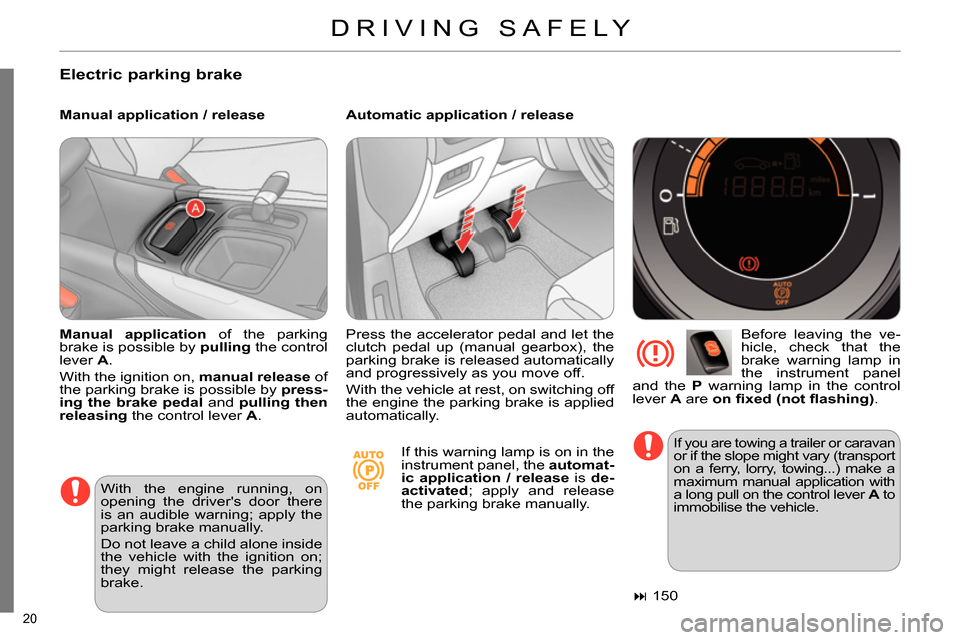
Manual application / release
Automatic application / release
Before leaving the ve-
hicle, check that the
brake warning lamp in
the instrument panel
and the P
warning lamp in the control
lever A
are on fi xed (not fl ashing)
.
Manual application
of the parking
brake is possible by pulling
the control
lever A
.
With the ignition on, manual release
of
the parking brake is possible by press-
ing the brake pedal
and pulling then
releasing
the control lever A
. Press the accelerator pedal and let the
clutch pedal up (manual gearbox), the
parking brake is released automatically
and progressively as you move off.
With the vehicle at rest, on switching off
the engine the parking brake is applied
automatically.
150
With the engine running, on
opening the driver's door there
is an audible warning; apply the
parking brake manually.
Do not leave a child alone inside
the vehicle with the ignition on;
they might release the parking
brake.
If you are towing a trailer or caravan or if the slope might vary (transport
on a ferry, lorry, towing...) make a
maximum manual application with
a long pull on the control lever A
to
immobilise the vehicle. If this warning lamp is on in the
instrument panel, the automat-
ic application / release
is de-
activated
; apply and release
the parking brake manually.
Page 64 of 340
3
COMFORT
62
RECOMMENDATIONS FOR VENTILATION AND AIR
CONDITIONING
In order for these systems to be fully effective, follow the operation and
maintenance guidelines below:
To obtain an even air distribution, take care not to obstruct the exterior
air intake grilles located at the base of the windscreen, the nozzles, the
vents and the air outlets, as well as the air extractor located in the boot.
Do not cover the sunshine sensor, located on the dashboard; this is
used for regulation of the air conditioning system.
Operate the air conditioning system for at least 5 to 10 minutes, once or
twice a month to keep it in perfect working order.
Ensure that the passenger compartment fi lter is in good condition and
have the fi lter elements replaced regularly.
We recommend the use of a combined passenger compartment fi lter.
Thanks to its special active additive, it contributes to the purifi cation of
the air breathed by the occupants and the cleanliness of the passenger
compartment (reduction of allergic symptoms, bad odours and greasy
deposits).
To ensure correct operation of the air conditioning system, you are also
advised to have it checked regularly as recommended in the mainte-
nance and warranty guide.
If the system does not produce cold air, switch it off and contact a
CITROËN dealer or a qualifi ed workshop.
When towing the maximum load on a steep gradient in high temperatures,
switching off the air conditioning increases the available engine power and
so improves the towing ability.
If after an extended stop in sun-
shine, the interior temperature is
very high, fi rst ventilate the pas-
senger compartment for a few
moments.
Put the air fl ow control at a set-
ting high enough to quickly
change the air in the passenger
compartment.
The air conditioning system
does not contain chlorine and
does not present any danger to
the ozone layer.
The condensation created by
the air conditioning results in a
discharge of water under the ve-
hicle which is perfectly normal.
Stop & Start
The heating and air conditioning systems only work when the engine is
running. To maintain a comfortable temperature in the passenger compart-
ment, you can temporarily deactivate the Stop & Start system (see the
corresponding section).
Page 141 of 340
8
SAFETY
139
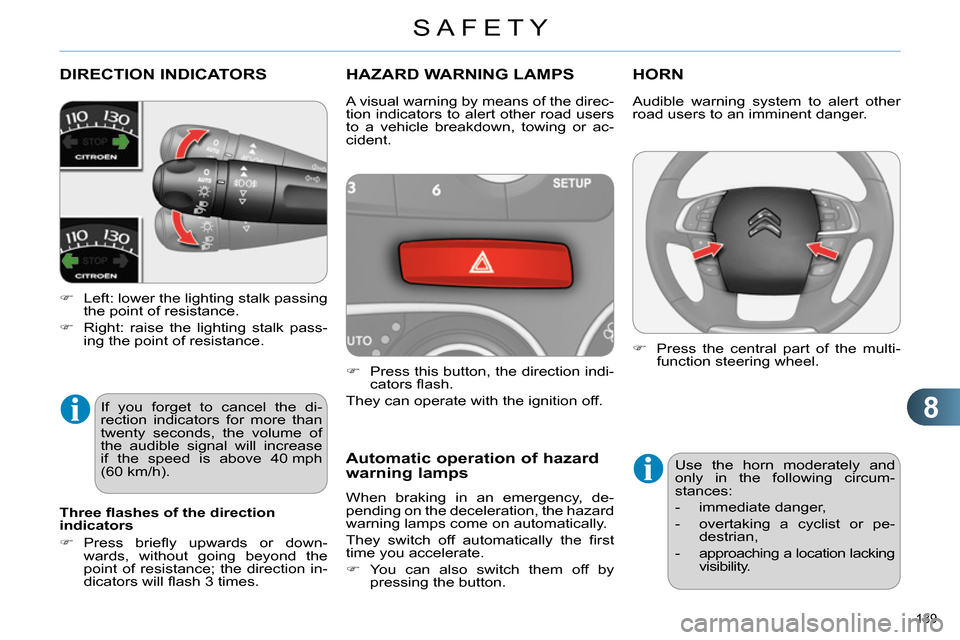
DIRECTION INDICATORS
Left: lower the lighting stalk passing
the point of resistance.
Right: raise the lighting stalk pass-
ing the point of resistance.
HAZARD WARNING LAMPS
Press this button, the direction indi-
cators fl ash.
They can operate with the ignition off.
Automatic operation of hazard
warning lamps
When braking in an emergency, de-
pending on the deceleration, the hazard
warning lamps come on automatically.
They switch off automatically the fi rst
time you accelerate.
You can also switch them off by
pressing the button.
HORN
A visual warning by means of the direc-
tion indicators to alert other road users
to a vehicle breakdown, towing or ac-
cident.
Three fl ashes of the direction
indicators
Press briefl y upwards or down-
wards, without going beyond the
point of resistance; the direction in-
dicators will fl ash 3 times.
If you forget to cancel the di-
rection indicators for more than
twenty seconds, the volume of
the audible signal will increase
if the speed is above 40 mph
(60 km/h). Audible warning system to alert other
road users to an imminent danger.
Press the central part of the multi-
function steering wheel.
Use the horn moderately and
only in the following circum-
stances:
- immediate danger,
- overtaking a cyclist or pe-
destrian,
- approaching a location lacking
visibility.
Page 152 of 340
9
DRIVING
150
ELECTRIC PARKING BRAKE
The electric parking brake combines
2 operational modes:
- Automatic Application/Release
Application is automatic when the
engine stops, release is automatic
on use of the accelerator (activated
by default),
- Manual Application/Release
The parking brake can be applied /
released manually by pulling control
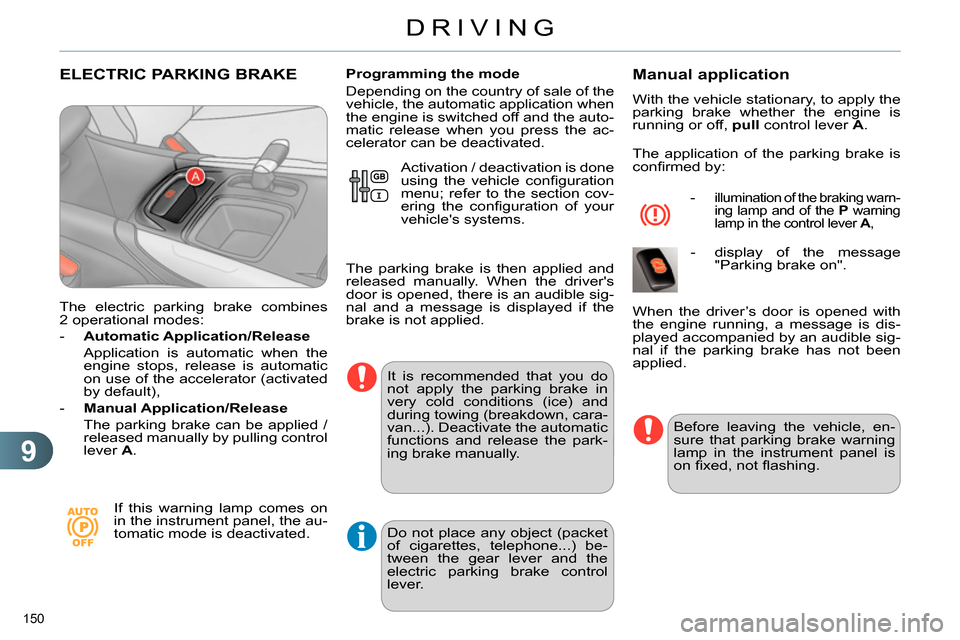
lever A
.
If this warning lamp comes on
in the instrument panel, the au-
tomatic mode is deactivated.
Programming the mode
Depending on the country of sale of the
vehicle, the automatic application when
the engine is switched off and the auto-
matic release when you press the ac-
celerator can be deactivated.
It is recommended that you do
not apply the parking brake in
very cold conditions (ice) and
during towing (breakdown, cara-
van...). Deactivate the automatic
functions and release the park-
ing brake manually.
Manual application
With the vehicle stationary, to apply the
parking brake whether the engine is
running or off, pull
control lever A
.
The application of the parking brake is
confi rmed by:
- illumination of the braking warn-
ing lamp and of the P
warning
lamp in the control lever A
,
- display of the message
"Parking brake on".
Before leaving the vehicle, en-
sure that parking brake warning
lamp in the instrument panel is
on fi xed, not fl ashing.
When the driver’s door is opened with
the engine running, a message is dis-
played accompanied by an audible sig-
nal if the parking brake has not been
applied. Activation / deactivation is done
using the vehicle confi guration
menu; refer to the section cov-
ering the confi guration of your
vehicle's systems.
The parking brake is then applied and
released manually. When the driver's
door is opened, there is an audible sig-
nal and a message is displayed if the
brake is not applied.
Do not place any object (packet
of cigarettes, telephone...) be-
tween the gear lever and the
electric parking brake control
lever.
Page 153 of 340
9
DRIVING
151
Manual release
With the ignition on or the engine run-
ning, to release the parking brake,
press
on the brake
pedal
or the accel-
erator, pull then release
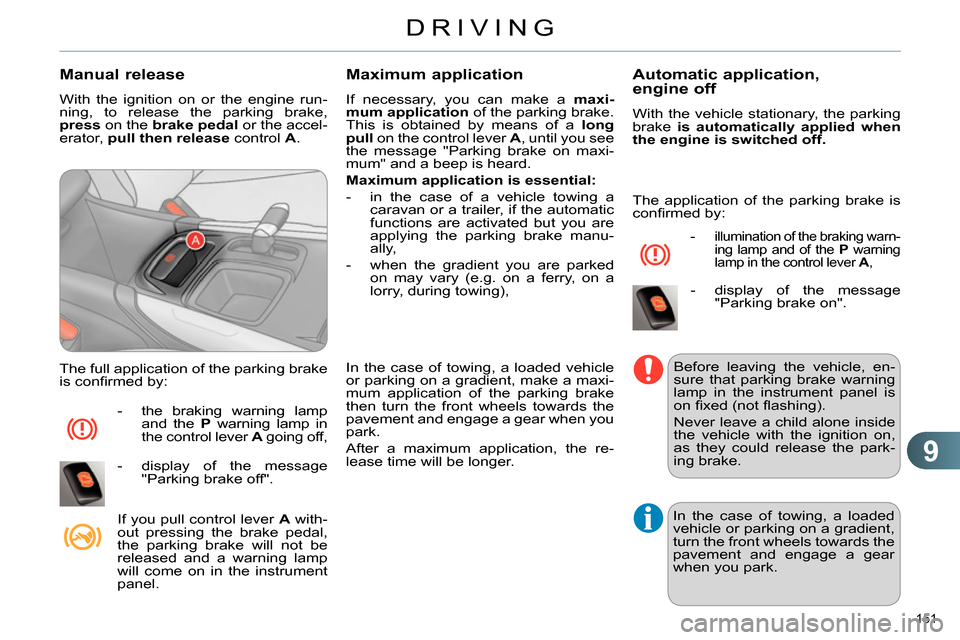
control A
.
The full application of the parking brake
is confi rmed by:
- the braking warning lamp
and the P
warning lamp in
the control lever A
going off,
- display of the message
"Parking brake off".
If you pull control lever A
with-
out pressing the brake pedal,
the parking brake will not be
released and a warning lamp
will come on in the instrument
panel.
Maximum application
If necessary, you can make a maxi-
mum application
of the parking brake.
This is obtained by means of a long
pull
on the control lever A
, until you see
the message "Parking brake on maxi-
mum" and a beep is heard.
Maximum application is essential:
- in the case of a vehicle towing a
caravan or a trailer, if the automatic
functions are activated but you are
applying the parking brake manu-
ally,
- when the gradient you are parked
on may vary (e.g. on a ferry, on a
lorry, during towing),
In the case of towing, a loaded vehicle
or parking on a gradient, make a maxi-
mum application of the parking brake
then turn the front wheels towards the
pavement and engage a gear when you
park.
After a maximum application, the re-
lease time will be longer.
Automatic application,
engine off
With the vehicle stationary, the parking
brake is automatically applied when
the engine is switched off.
- illumination of the braking warn-
ing lamp and of the P
warning
lamp in the control lever A
,
- display of the message
"Parking brake on".
Before leaving the vehicle, en-
sure that parking brake warning
lamp in the instrument panel is
on fi xed (not fl ashing).
Never leave a child alone inside
the vehicle with the ignition on,
as they could release the park-
ing brake.
In the case of towing, a loaded
vehicle or parking on a gradient,
turn the front wheels towards the
pavement and engage a gear
when you park.
The application of the parking brake is
confi rmed by:
Page 176 of 340
9
DRIVING
174
The system may suffer tem-
porary interference in certain
weather conditions (rain, hail...).
In particular, driving on a wet sur-
face or moving from a dry area to
a wet area can cause false alerts
(for example, the presence of a
fog of water droplets in the blind
spot angle is interpreted as a ve-
hicle).
In bad or wintry weather, ensure
that the sensors are not covered
by mud, ice or snow.
Take care not to cover the warn-
ing zone in the door mirrors or
the detection zones on the front
and rear bumpers with adhesive
labels or other objects; they may
hamper the correct operation of
the system.
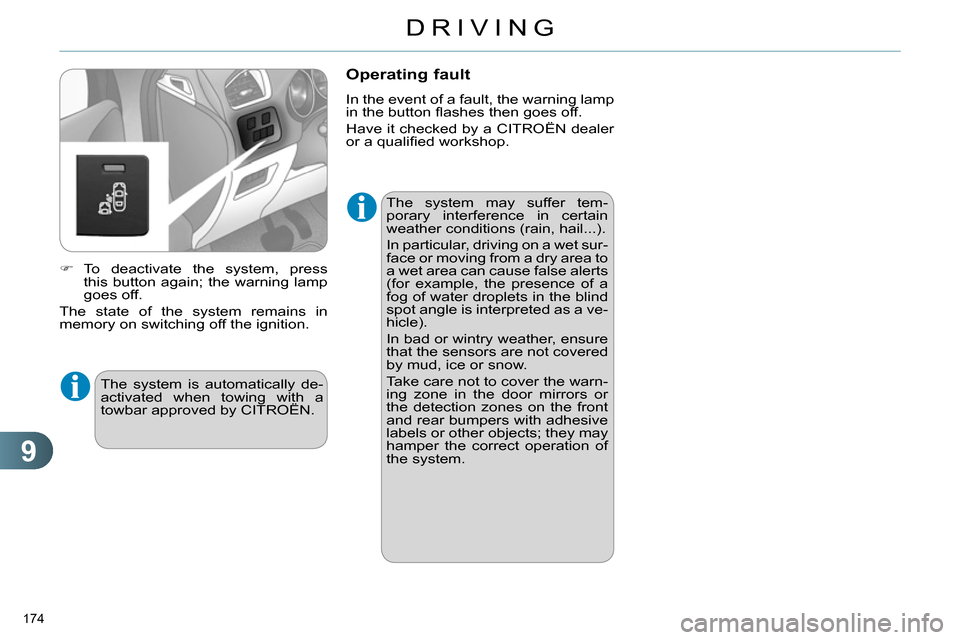
To deactivate the system, press
this button again; the warning lamp
goes off.
The state of the system remains in
memory on switching off the ignition.
Operating fault
In the event of a fault, the warning lamp
in the button fl ashes then goes off.
Have it checked by a CITROËN dealer
or a qualifi ed workshop.
The system is automatically de-
activated when towing with a
towbar approved by CITROËN.
Page 181 of 340
9
DRIVING
179
When the cruise control is
switched on, be careful if you
maintain the pressure on one of
the programmed speed changing
buttons: this may result in a very
rapid change in the speed of your
vehicle.
Do not use the cruise control on
slippery roads or in heavy traffi c.
On a steep descent, the cruise
control will not be able to prevent
the vehicle from exceeding the
programmed speed.
On steep climbs or when towing,
the programmed speed may not
be reached or maintained.
To avoid any risk of jamming of
the pedals:
- ensure that the mat is posi-
tioned correctly,
- never fi t one mat on top of
another.
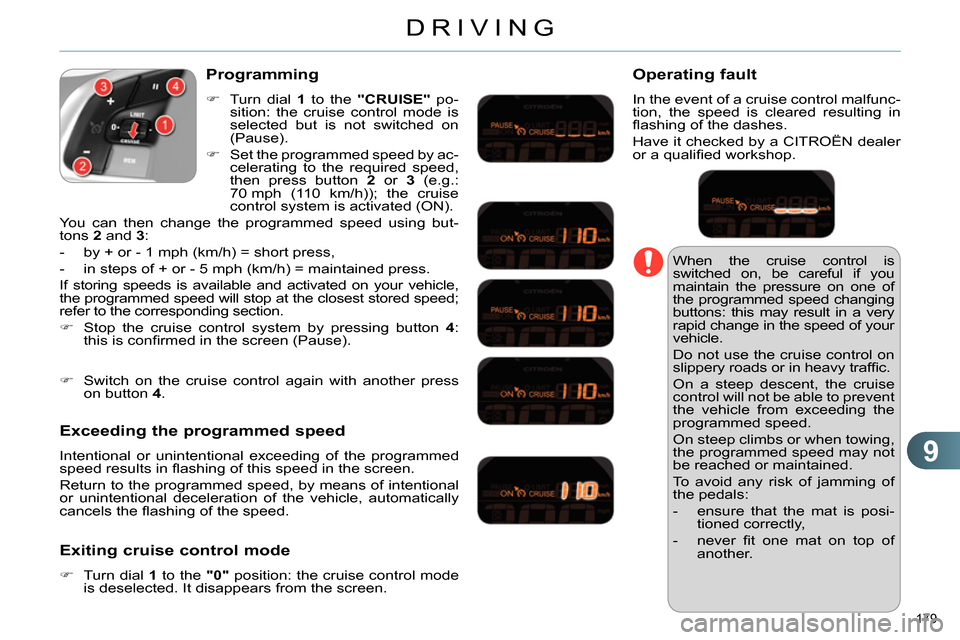
Programming
Turn dial 1
to the "CRUISE"
po-
sition: the cruise control mode is
selected but is not switched on
(Pause).
Set the programmed speed by ac-
celerating to the required speed,
then press button 2
or 3
(e.g.:
70 mph (110 km/h)); the cruise
control system is activated (ON).
You can then change the programmed speed using but-
tons 2
and 3
:
- by + or - 1 mph (km/h) = short press,
- in steps of + or - 5 mph (km/h) = maintained press.
If storing speeds is available and activated on your vehicle,
the programmed speed will stop at the closest stored speed;
refer to the corresponding section.
Stop the cruise control system by pressing button 4
:
this is confi rmed in the screen (Pause).
Exceeding the programmed speed
Intentional or unintentional exceeding of the programmed
speed results in fl ashing of this speed in the screen.
Return to the programmed speed, by means of intentional
or unintentional deceleration of the vehicle, automatically
cancels the fl ashing of the speed.
Exiting cruise control mode
Turn dial 1
to the "0"
position: the cruise control mode
is deselected. It disappears from the screen.
Switch on the cruise control again with another press
on button 4
.
Operating fault
In the event of a cruise control malfunc-
tion, the speed is cleared resulting in
fl ashing of the dashes.
Have it checked by a CITROËN dealer
or a qualifi ed workshop.
Page 219 of 340
11
PRACTICAL INFORMATION
217
VERY COLD CLIMATE SCREEN *
* According to country.
Fitting
Offer up the very cold climate
screen to the front of the lower sec-
tion of the front bumper.
Press around its edge to engage its
fi xing clips one by one.
Removal
Use a screwdriver as a lever to re-
lease each fi xing clip in turn.
Do not forget to remove the very
cold climate screen when:
- the ambient temperature ex-
ceeds 10 °C,
- towing,
-
driving at speeds above 75 mph
(120 km/h).
Removable protective screen which
prevents the accumulation of snow at
the radiator cooling fan.
FITTING ROOF BARS
For safety reasons and to avoid dam-
aging the roof, it is essential to use the
transverse bars approved for your ve-
hicle.
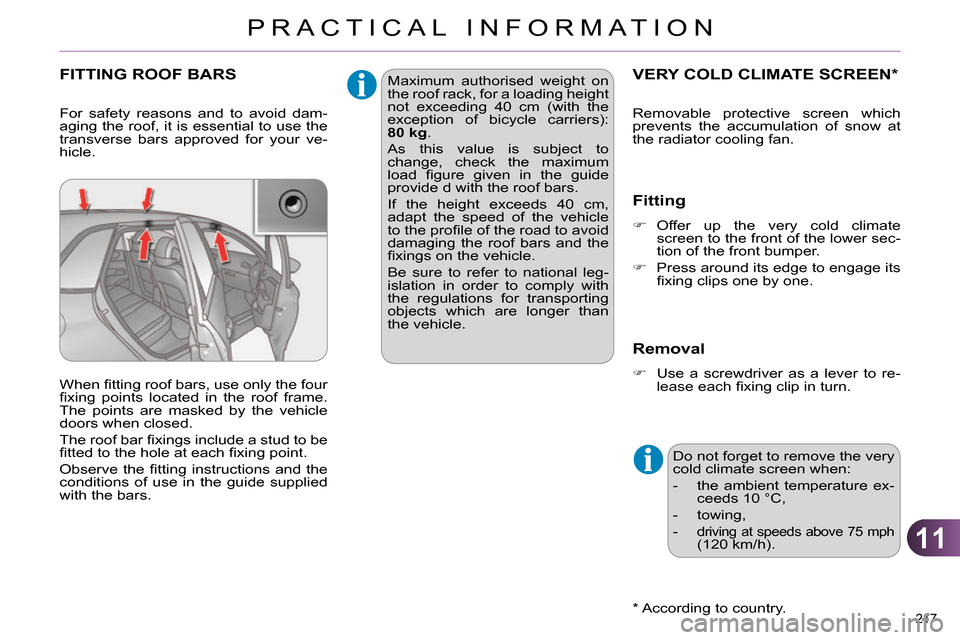
When fi tting roof bars, use only the four
fi xing points located in the roof frame.
The points are masked by the vehicle
doors when closed.
The roof bar fi xings include a stud to be
fi tted to the hole at each fi xing point.
Observe the fi tting instructions and the
conditions of use in the guide supplied
with the bars.
Maximum authorised weight on
the roof rack, for a loading height
not exceeding 40 cm (with the
exception of bicycle carriers):
80
kg
.
As this value is subject to
change, check the maximum
load fi gure given in the guide
provide d with the roof bars.
If the height exceeds 40 cm,
adapt the speed of the vehicle
to the profi le of the road to avoid
damaging the roof bars and the
fi xings on the vehicle.
Be sure to refer to national leg-
islation in order to comply with
the regulations for transporting
objects which are longer than
the vehicle.
Page 220 of 340
11
PRACTICAL INFORMATION
218
TOWING THE VEHICLE
Procedure for having your vehicle
towed or for towing another vehicle us-
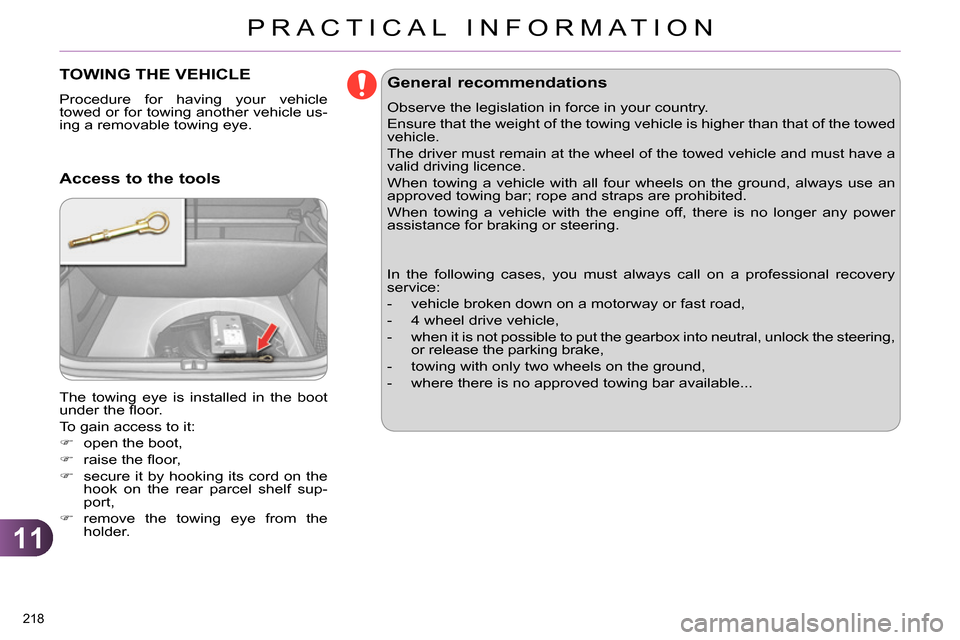
ing a removable towing eye.
The towing eye is installed in the boot
under the fl oor.
To gain access to it:
open the boot,
raise the fl oor,
secure it by hooking its cord on the
hook on the rear parcel shelf sup-
port,
remove the towing eye from the
holder.
Access to the tools
General recommendations
Observe the legislation in force in your country.
Ensure that the weight of the towing vehicle is higher than that of the towed
vehicle.
The driver must remain at the wheel of the towed vehicle and must have a
valid driving licence.
When towing a vehicle with all four wheels on the ground, always use an
approved towing bar; rope and straps are prohibited.
When towing a vehicle with the engine off, there is no longer any power
assistance for braking or steering.
In the following cases, you must always call on a professional recovery
service:
- vehicle broken down on a motorway or fast road,
- 4 wheel drive vehicle,
- when it is not possible to put the gearbox into neutral, unlock the steering,
or release the parking brake,
- towing with only two wheels on the ground,
- where there is no approved towing bar available...