lock Citroen C4 2014.5 2.G Service Manual
[x] Cancel search | Manufacturer: CITROEN, Model Year: 2014.5, Model line: C4, Model: Citroen C4 2014.5 2.GPages: 494, PDF Size: 21.47 MB
Page 132 of 494
130
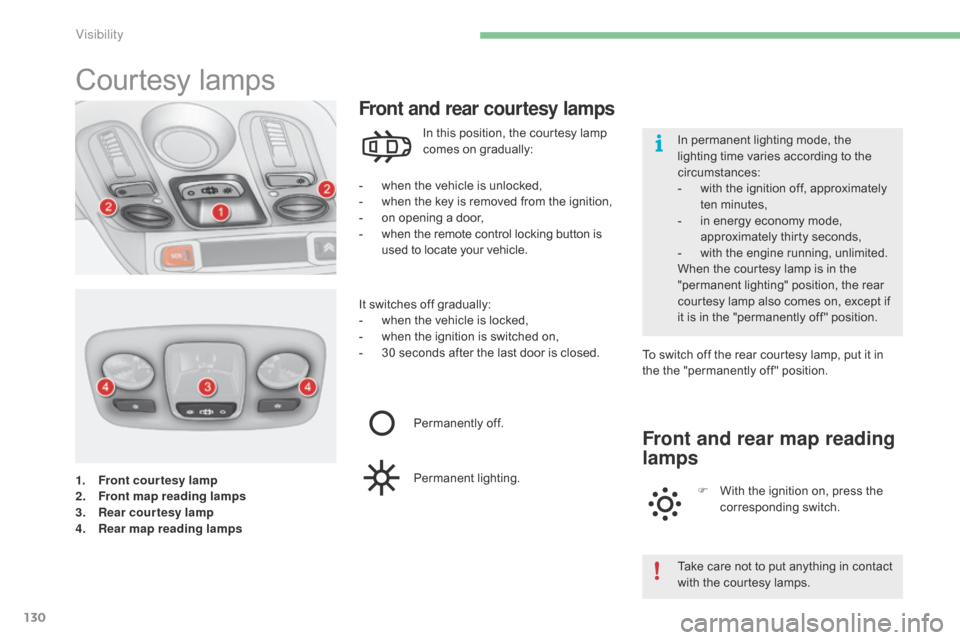
1. Front courtesy lamp
2. Front map reading lamps
3.
R
ear courtesy lamp
4.
R
ear map reading lamps
Courtesy lam ps
- when the vehicle is unlocked,
- w hen the key is removed from the ignition,
-
o
n opening a door,
-
w
hen the remote control locking button is
u
sed to locate your vehicle.
Front and rear courtesy lamps
In this position, the courtesy lamp comes on gradually:
It
switches
off gradually:
-
w
hen
the vehicle is locked,
-
w
hen
the ignition is switched on,
-
3
0
seconds after the last door is closed.To
switch off the rear courtesy lamp, put it in
t
he the "permanently off " position.
Permanently
off.
Permanent
l
ighting.
Front and rear map reading
lamps
F With the ignition on, press the c
orresponding s witch.
Take
care not to put anything in contact
w
ith the courtesy lamps.
In
permanent lighting mode, the
l
ighting time varies according to the
c
ircumstances:
-
w
ith the ignition off, approximately
t
en
m
inutes,
-
i
n energy economy mode,
a
pproximately thirty seconds,
-
w
ith the engine running, unlimited.
When the courtesy lamp is in the
"
permanent lighting" position, the rear
c
ourtesy lamp also comes on, except if
i
t
is
in the "permanently off " position.
Visibility
Page 147 of 494
145
For optimum installation of the for ward facing child seat, ensure that the back of the child
s
eat is as close as possible to the backrest of
t
he vehicle's seat, in contact if possible.
You
mst remove the head restraint before
i
nstalling a child seat with backrest to a
p
assenger
sea
t.
Ensure
that the head restraint is stored or
a
ttached securely to prevent it from being
t
hrown around the vehicle in the event of
s
harp braking. Refit the head restraint when
t
he child seat is removed.
Advice on child seats
Installing a booster
seat
Children at the frontThe incorrect installation of a child seat in a v ehicle compromises the child's protection in
t
he event of an accident.
Ensure that there is no seat belt or seat belt
buckle
under the child seat, as this could
de
stabilise
i
t.
Remember
to fasten the seat belts or the
c
hild seat harnesses keeping the slack
r
elative to the child's body to a minimum,
e
ven for short journeys.
When
installing a child seat using the seat
b
elt, ensure that the seat belt is tightened
c
orrectly on the child seat and that it secures
t
he child seat firmly on the seat of your
v
ehicle. If your passenger seat is adjustable,
m
ove it for wards if necessary. The
legislation on carrying children on the
f
ront passenger seat is specific to each
c
ountry. Refer to the legislation in force in
y
our country.
Deactivate
the passenger airbag when a
r
ear ward facing child seat is installed on the
f
ront seat.
Other wise,
the child would risk being
s
eriously injured or killed if the airbag were
t
o inflate.The
chest part of the seat belt must be
p
ositioned on the child's shoulder without
t
ouching the neck.
Ensure that the lap part of the seat belt
passes
correctly over the child's thighs.
CITROËN
recommends the use of a booster
s
eat which has a back, fitted with a seat belt
g
uide at shoulder level.
As
a safety precaution, do not leave:
-
a
child or children alone and
u
nsupervised in a vehicle,
-
a
child or an animal in a vehicle which
i
s exposed to the sun, with the windows
c
losed,
-
t
he keys within reach of children inside
t
he vehicle.
At
rear seating positions, always leave
s
ufficient space between the front seat and:
-
a
rear ward facing child seat,
-
t
he child's feet for a child seat fitted
fo
rward
f
acing.
To
do this, move the front seat for wards
a
nd, if necessary, move its backrest into the
u
pright
p
osition. To
prevent accidental opening of the doors
a
nd rear windows, use the child lock.
Take
care not to open the rear windows by
m
ore than one third.
To
protect young children from the rays of the
s
un, fit side blinds on the rear windows.
7
Child safety
Page 148 of 494
146
Electric child lock
Switching on
F Press this button.
The indicator lamp in the button comes on,
a
ccompanied by a message in the screen.
This
indicator lamp remains on until the child
l
ock is switched off.
Switching off
F Press this button again.
The indicator lamp on button A goes off,
a
ccompanied by a message in the screen.
This
indicator lamp remains on while child lock
i
s switched on. This
system is independent and in no c
ircumstances does it take the place of t
he central locking control.
Check
the status of the child lock each
t
ime you switch on the ignition.
Always
remove the key from the ignition
w
hen leaving the vehicle, even for a
s
hort time.
In
the event of a serious impact, the
e
lectric child lock is switched off
a
utomatically to permit the exit of the
r
ear
p
assengers.
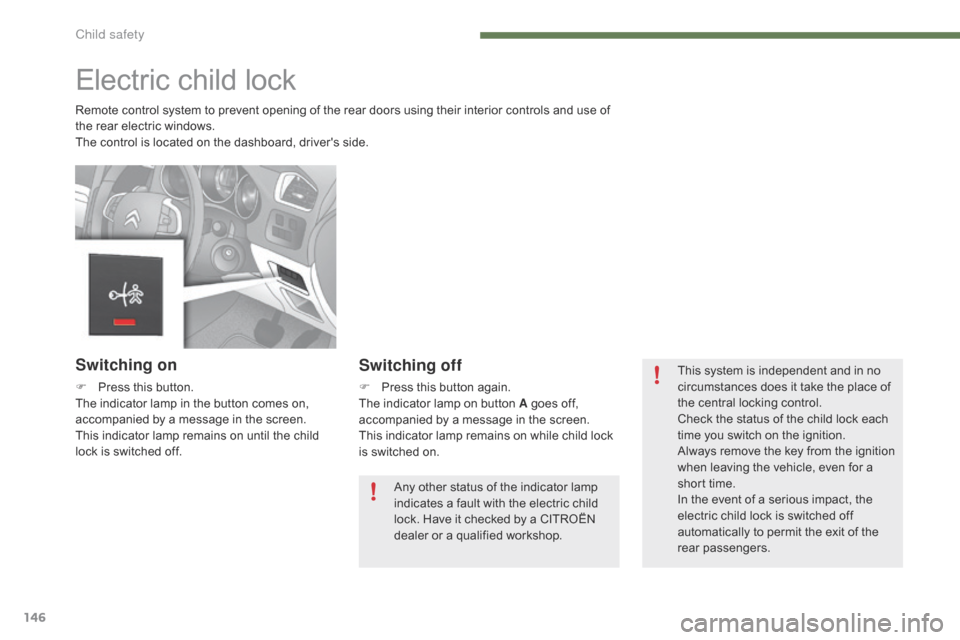
Remote
control
system
to
prevent
opening
of
the
rear doors using their interior controls and use of
t
he
rear
electric
windows.
The
control
is
located
on
the
dashboard,
driver's
side.
Any other status of the indicator lamp
i
ndicates a fault with the electric child
l
ock. Have it checked by a CITROËN
d
ealer or a qualified workshop.
Child safety
Page 150 of 494
148
Group of supplementary systems which help you to obtain optimum braking in complete
s
afety in emergency situations:
-
a
nti-lock braking system (ABS),
-
e
lectronic brake force distribution (EBFD),
-
e
mergency braking assistance (EBA).
Anti-lock braking system
and electronic brake force
distribution
Linked systems which improve the stability and manoeuvrability of your vehicle when braking, in p
articular on poor or slippery sur faces.
Activation
The anti-lock braking system comes into operation automatically when there is a risk of
w
heel lock.
Normal
operation of the ABS may make itself
f
elt by slight vibration of the brake pedal.
Operating fault
If this warning lamp comes on, accompanied by an audible signal
a
nd a message in the screen, it
i
ndicates a malfunction of the anti-
lock
braking system which could
r
esult in loss of control of the vehicle
when
b
raking.
If
this warning lamp comes on,
t
ogether with the STOP
and ABS
warning
lamps, accompanied by an
a
udible signal and a message in the
s
creen, it indicates a malfunction of
t
he electronic brake force distribution
w
hich could result in loss of control of
t
he vehicle when braking.
Emergency braking
assistance
System which, in an emergency, enables you to obtain the optimum braking pressure more
q
uickly, thus reducing the stopping distance.
Activation
It is triggered by the speed at which the brake pedal is pressed.
The
effect of this is a reduction in the
r
esistance of the pedal and an increase in
b
raking
e
fficiency.
You must stop as soon as it is safe to do so.
In
either
case,
contact
a
CITROËN
dealer
or
a
q
ualified
w
orkshop.
When
braking
in
an
emergency,
press
v
ery
firmly
without
releasing
the
p
ressure. When
braking in an emergency, press
f
irmly without releasing the pressure.
When
replacing
wheels
(tyres
and
r
ims),
ensure
that
they
conform
to
the
ma
nufacturer's
r
ecommendations.
Braking assistance systems
Safety
Page 162 of 494
160
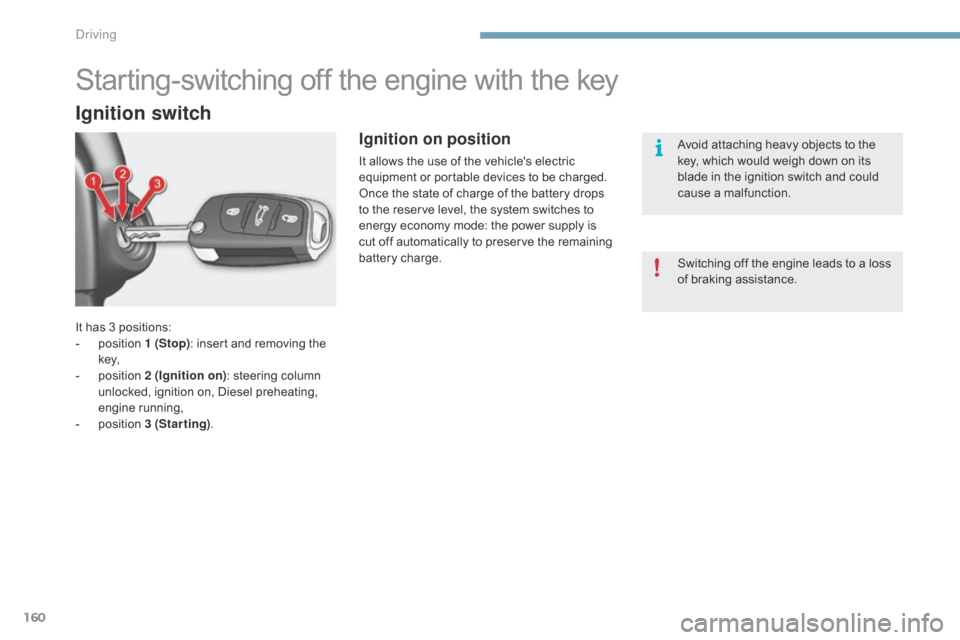
It has 3 positions:
- p osition 1 (Stop):
insert and removing the
k
ey,
-
p
osition 2 (Ignition on) :
steering column
u
nlocked, ignition on, Diesel preheating,
e
ngine
r
unning,
-
p
osition 3 (Starting).
Ignition on position
It allows the use of the vehicle's electric e
quipment or portable devices to be charged.
Once
the state of charge of the battery drops
t
o the reserve level, the system switches to
e
nergy economy mode: the power supply is
c
ut off automatically to preserve the remaining
b
attery charge.
Starting-switching off the engine with the key
Ignition switch
Avoid attaching heavy objects to the key, which would weigh down on its
b
lade in the ignition switch and could
c
ause a malfunction.
Switching
off the engine leads to a loss
o
f braking assistance.
Driving
Page 163 of 494
161
Starting the engine
F With a petrol engine, operate the starter m
otor by turning the key to position 3
without
pressing the accelerator pedal,
u
ntil the engine starts. Once the engine is
r
unning, release the key. F
W
ith a Diesel engine, turn the key to
p
osition 2
, ignition on, to operate the
eng
ine
p
re-heating
s
ystem.
Wait until this warning lamp goes off
i
n the instrument panel then operate
t
he starter motor by turning the key
t
o position 3 without pressing the
a
ccelerator pedal, until the engine
s
tarts. Once the engine is running,
r
elease the key.
If the engine does not start straight
a
way, switch off the ignition. Wait a
f
ew moments before operating the
s
tarter motor again. If the engine does
n
ot start after several attempts, do not
k
eep trying: you risk damaging the
s
tarter motor or the engine. Contact
a
CITROËN dealer or a qualified
w
orkshop.Never
leave the engine running in
a
n enclosed area without adequate
v
entilation:
in
ternal
c
ombustion
e
ngines emit toxic exhaust gases,
s
uch as carbon monoxide. Danger of
i
ntoxication and death.
In very severe wintry conditions
(
temperatures below -23°C), to ensure
t
he correct operation and durability of
t
he mechanical components of your
v
ehicle, engine and gearbox, it is n
ecessary to leave the engine running f
or 4 minutes before moving off.
In
certain cases, you may have to apply
m
ore force to the steering (wheels on
f
ull lock, for example).
In wintry conditions, the warning lamp
c
an stay on for a longer period. When
t
he engine is hot, the warning lamp
d
oes not come on.In temperate conditions, do not leave
t
he engine at idle to warm up but move
o
ff straight away and drive at moderate
s
peed.
With the parking brake applied and the gearbox
i
n neutral or position N or P
:
F
d
epress the clutch pedal fully (manual
g
earbox),
or
F
p
ress the brake pedal firmly (electronic or
a
utomatic gearbox),
F
i
nsert the key into the ignition switch; the
s
ystem recognises the code,
F
u
nlock the steering column by
s
imultaneously turning the steering and the
k
ey.
9
Driving
Page 164 of 494
162
Switching off the engine
Energy economy mode
After switching off the engine (position 1- Stop),
for a maximum of 30 minutes you can still use
f
unctions such as the audio and telematic
s
ystem, the wipers, dipped beam headlamps,
c
ourtesy lamps, ...
F
C
heck
that
the
parking
brake
is
correctly
a
pplied,
particularly
on
sloping
ground.
Never
switch
off
the
ignition
before
the
v
ehicle
is
at
a
complete
stop.
With
the
e
ngine
off,
the
braking
and
steering
a
ssistance
systems
are
also
cut
off:
risk
o
f
loss
of
control
of
the
vehicle.
To
facilitate
unlocking
of
the
steering
c
olumn,
it
is
recommended
that
the
w
heels
be
returned
to
the
straight
ahead
p
osition
before
switching
off
the
engine.
When
you
leave
the
vehicle,
keep
the
k
ey
with
you
and
lock
the
vehicle. For
more information, refer to the
"
Practical information" section, under
"
Energy economy mode".Key left in the "Ignition on"
position
If the key has been left in the ignition switch at position 2 (Ignition on) ,
the
ignition will be switched off
a
utomatically after one hour.
To
switch the ignition back on, turn the
k
ey to position 1 (Stop),
then back to
p
osition 2 (Ignition on) .
F
S
top
the
vehicle.
F
W
ith
the
engine
running
at
idle,
turn
the
key
t
o position 1
.
F
R
emove
the
key
from
the
ignition
switch.
F
T
o
lock
the
steering
column,
turn
the
s
teering
until
it
locks.
Driving
Page 165 of 494
163
Starting-switching off the engine with the
" Keyless Entry and Starting" system
Starting the engine
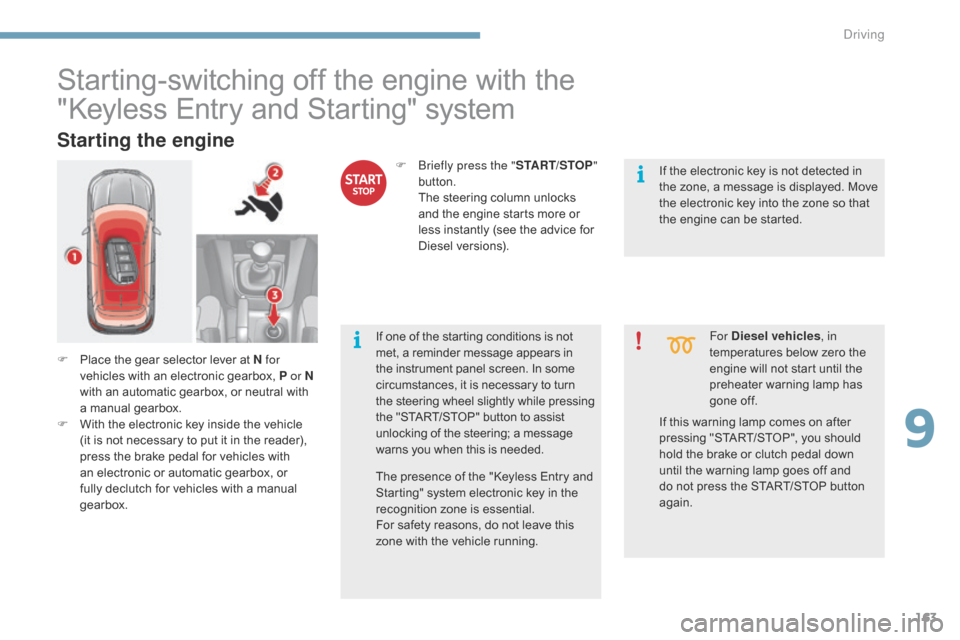
F Place the gear selector lever at N for
vehicles with an electronic gearbox, P or N
with
an automatic gearbox, or neutral with
a m
anual
g
earbox.
F
W
ith the electronic key inside the vehicle
(
it is not necessary to put it in the reader),
p
ress the brake pedal for vehicles with
a
n electronic or automatic gearbox, or
f
ully declutch for vehicles with a manual
g
earbox. F
b
r
iefly press the "
START/STOP"
button.
T
he steering column unlocks
a
nd the engine starts more or
l
ess instantly (see the advice for
D
iesel
v
ersions).
If this warning lamp comes on after
p
ressing "START/STOP", you should
h
old the brake or clutch pedal down
u
ntil the warning lamp goes off and
d
o not press the START/STOP button
ag
ain.
If
one of the starting conditions is not
m
et, a reminder message appears in t
he instrument panel screen. In some c
ircumstances, it is necessary to turn
t
he steering wheel slightly while pressing
t
he "START/STOP" button to assist
u
nlocking of the steering; a message
w
arns you when this is needed.If
the electronic key is not detected in
t
he zone, a message is displayed. Move
t
he electronic key into the zone so that
t
he engine can be started.
The presence of the "Keyless Entry and
S
tarting" system electronic key in the
r
ecognition zone is essential.
For
safety reasons, do not leave this
z
one with the vehicle running.For Diesel vehicles
, in
temperatures below zero the e
ngine will not start until the
p
reheater warning lamp has
g
one off.
9
driving
Page 166 of 494
164
Switching off the engine
F Immobilise the vehicle.
F P lace the gear selector lever at N for
vehicles
with an electronic gearbox, P or N
with
an automatic gearbox, or neutral with
a m
anual
g
earbox.
do n
ot leave your vehicle with the
electronic
key still inside.
Switching
off the engine leads to a loss
o
f braking assistance.
If
the vehicle is not immobilised, the
e
ngine will not stop.
F
W
ith the electronic key inside
t
he vehicle, press the " S TA R T/
STOP "
button.
T
he engine stops and the
s
teering column locks.
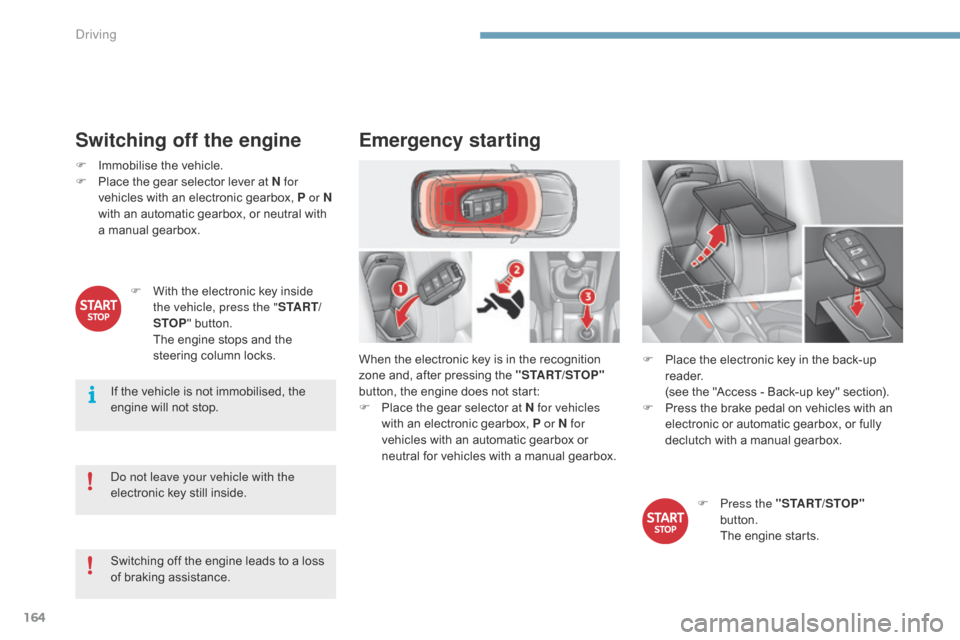
Emergency starting
When the electronic key is in the recognition zone and, after pressing the "START/STOP"
button,
the engine does not start:
F
P
lace the gear selector at N for vehicles
with
an electronic gearbox, P or N for
vehicles
with an automatic gearbox or
n
eutral for vehicles with a manual gearbox.F
P lace the electronic key in the back-up
re
ader.
(
see the "Access - Back-up key" section).
F
P
ress the brake pedal on vehicles with an
e
lectronic or automatic gearbox, or fully
d
eclutch with a manual gearbox.
F
P
ress the "START/STOP"
button.
T
he engine starts.
Driving
Page 167 of 494
165
Emergency switch-off
In the event of an emergency only, the e ngine c an b e s witched o f w ithout
c
onditions. To do this, press and hold
t
he "START/STOP" button for about
3
seconds.
In
this
case the steering column locks as soon
a
s
the
vehicle stops.
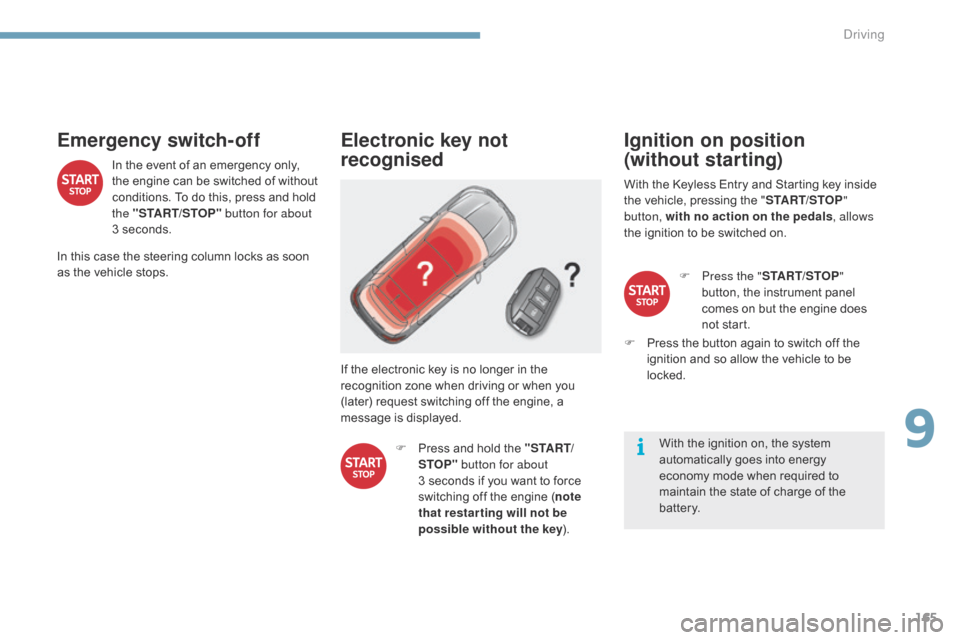
Electronic key not
recognised
If the electronic key is no longer in the recognition zone when driving or when you
(
later) request switching off the engine, a
m
essage is displayed.
F
P
ress and hold the " S TA R T/
STOP" button for about
3 seconds
if you want to force
s
witching off the engine (note
that restar ting will not be
possible without the key ).
Ignition on position
(without starting)
With the Keyless Entry and Starting key inside t
he vehicle, pressing the "START/STOP "
button, with no action on the pedals , allows
the
ignition to be switched on.
With
the ignition on, the system
a
utomatically goes into energy
e
conomy mode when required to
m
aintain the state of charge of the
b
attery.F
P
ress the "START/STOP "
button,
the instrument panel
c
omes on but the engine does
n
ot start.
F
P
ress the button again to switch off the
i
gnition and so allow the vehicle to be
lo
cked.
9
Driving