gearbox Citroen C4 2016 2.G User Guide
[x] Cancel search | Manufacturer: CITROEN, Model Year: 2016, Model line: C4, Model: Citroen C4 2016 2.GPages: 396, PDF Size: 10.22 MB
Page 178 of 396
176
C4-2_en_Chap06_conduite_ed02-2015
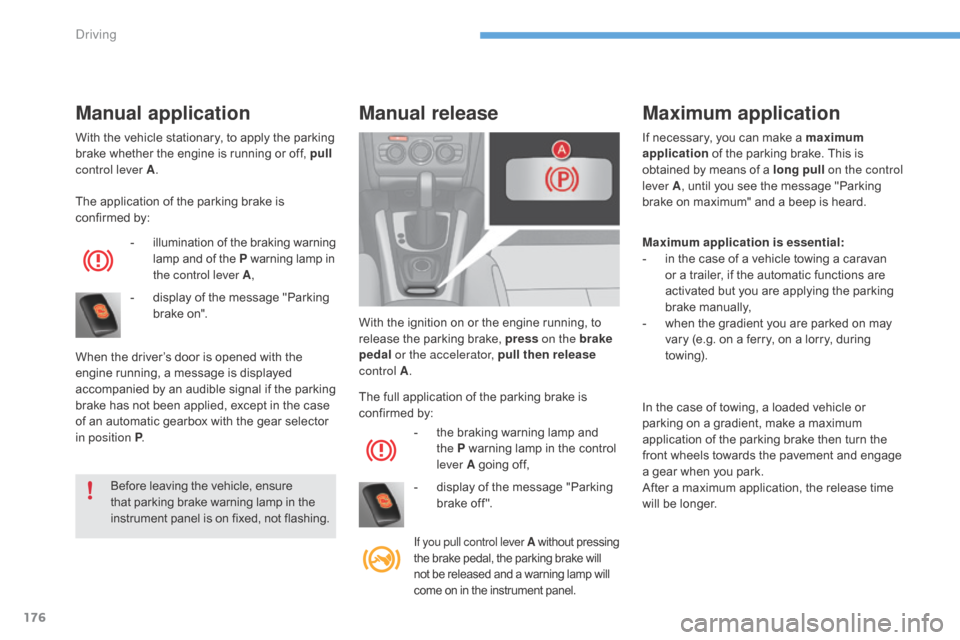
With the vehicle stationary, to apply the parking brake whether the engine is running or off, pull
control lever A .
The
application of the parking brake is
c
onfirmed by:
-
i
llumination
o
f
t
he
b
raking
w
arning
l
amp and of the P
warning lamp in
t
he control lever A ,
-
d
isplay of the message "Parking
b
rake on".
When
the driver’s door is opened with the
e
ngine running, a message is displayed
a
ccompanied by an audible signal if the parking
b
rake has not been applied, except in the case
o
f an automatic gearbox with the gear selector
i
n position P .
Before
leaving the vehicle, ensure
t
hat parking brake warning lamp in the
i
nstrument panel is on fixed, not flashing.
Manual applicationManual release
The full application of the parking brake is c
onfirmed by:
-
t
he braking warning lamp and
t
he P warning lamp in the control
l
ever A going off,
-
d
isplay of the message "Parking
b
rake off ".
If you pull control lever A without pressing t
he brake pedal, the parking brake will n
ot be released and a warning lamp will
c
ome on in the instrument panel.
With the ignition on or the engine running, to release the parking brake, press on the brake
pedal or the accelerator, pull then release
control A . If
necessary, you can make a maximum
application
of the parking brake. This is
o
btained
by m
eans
o
f
a long
pull
on the control
lever A , until you see the message "Parking
b
rake on maximum" and a beep is heard.
In the case of towing, a loaded vehicle or
p
arking on a gradient, make a maximum
a
pplication of the parking brake then turn the
f
ront wheels towards the pavement and engage
a
gear when you park.
After
a maximum application, the release time
w
ill be longer.
Maximum application
Maximum application is essential:
- i n the case of a vehicle towing a caravan
o
r a trailer, if the automatic functions are
a
ctivated but you are applying the parking
b
rake
m
anually,
-
w
hen the gradient you are parked on may
v
ary (e.g. on a ferry, on a lorry, during
tow
ing).
Driving
Page 179 of 396
177
C4-2_en_Chap06_conduite_ed02-2015
Automatic release
Full release of the parking brake is confirmed by:
-
t
he braking warning lamp and
t
he P warning lamp in the control
l
ever A going off,
-
d
isplay of the message "Parking
b
rake off ".
Automatic application,
engine off
- illumination of t he b raking w arning l
amp and of the P warning lamp in t
he control lever A ,
-
d
isplay of the message "Parking
b
rake on".
The
application of the parking brake is
c
onfirmed by:
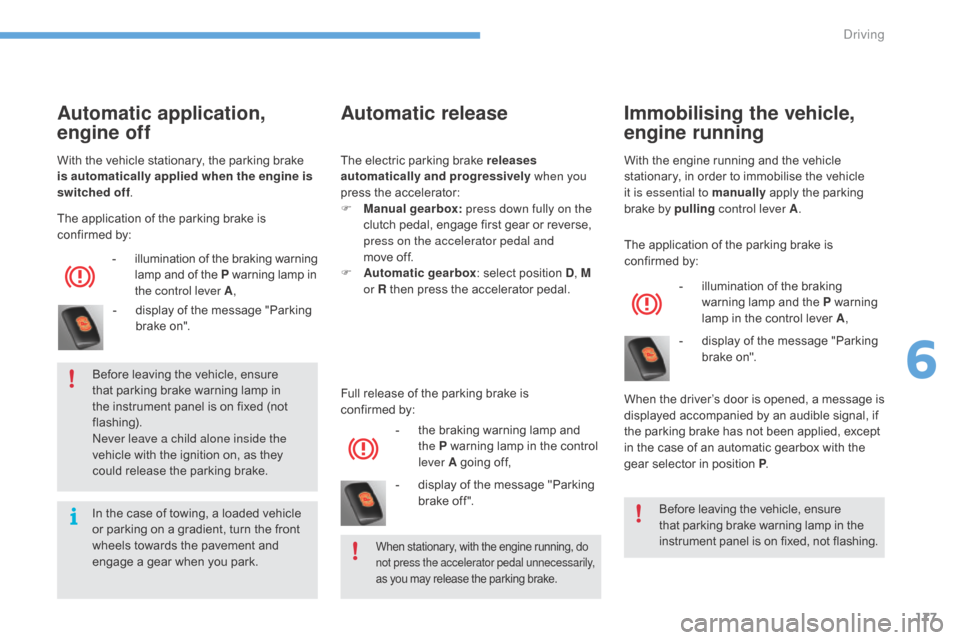
With
the
vehicle stationary, the parking brake
i
s automatically applied when the engine is
switched off .
Before leaving the vehicle, ensure
t
hat parking brake warning lamp in
t
he
instrument panel is on fixed (not
f
lashing).
Never leave a child alone inside the
vehicle
with the ignition on, as they
c
ould release the parking brake.
When stationary, with the engine running, do not press the accelerator pedal unnecessarily,
as
you may release the parking brake.
In the case of towing, a loaded vehicle or parking on a gradient, turn the front
w
heels towards the pavement and
e
ngage a gear when you park.The
electric parking brake releases
automatically and progressively when you
press the accelerator:
F
M
anual gearbox:
press down fully on the
clutch pedal, engage first gear or reverse,
p
ress on the accelerator pedal and
move off.
F
A
utomatic gearbox
: select position D
, M
or R then press the accelerator pedal.
Immobilising the vehicle,
engine running
- illumination
of the braking w
arning lamp and the P warning
l
amp in the control lever A,
-
d
isplay of the message "Parking
b
rake on".
When
the
driver’s door is opened, a message is
d
isplayed
accompanied by an audible signal, if
t
he
parking brake has not been applied, except
i
n
the
case of an automatic gearbox with the
g
ear
selector in position P.
The
application of the parking brake is
c
onfirmed by:
With
the
engine running and the vehicle
s
tationary, in order to immobilise the vehicle
i
t is essential to manually
apply the parking
b
rake
by
pulling
control lever A .
Before leaving the vehicle, ensure
t
hat parking brake warning lamp in the
i
nstrument panel is on fixed, not flashing.
6
Driving
Page 183 of 396
181
C4-2_en_Chap06_conduite_ed02-2015
6-speed manual gearbox
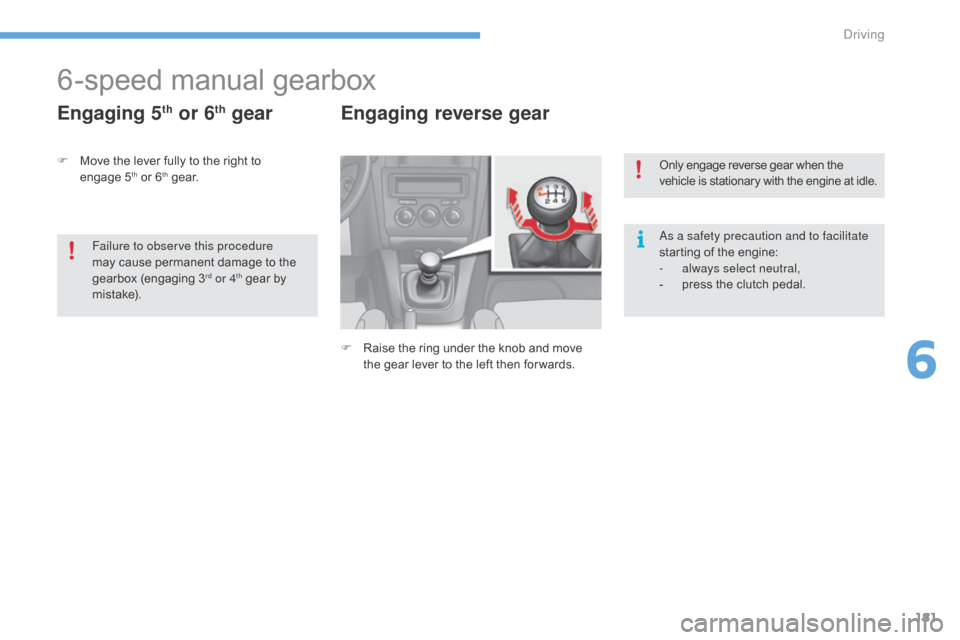
Engaging 5th or 6th gear Engaging reverse gear
F Raise the ring under the knob and move t
he gear lever to the left then for wards.Only
engage reverse gear when the
v
ehicle is stationary with the engine at idle.
As a safety precaution and to facilitate
starting of the engine:
-
a
lways select neutral,
-
p
ress the clutch pedal.
F
M
ove
the
lever
fully
to
the
right
to
enga
ge 5
th or 6th ge a r.
Failure to observe this procedure
may
cause
permanent damage to the
g
earbox
(
engaging
3rd or 4th gear by m
i st a ke).
6
Driving
Page 184 of 396
182
C4-2_en_Chap06_conduite_ed02-2015
Automatic gearbox
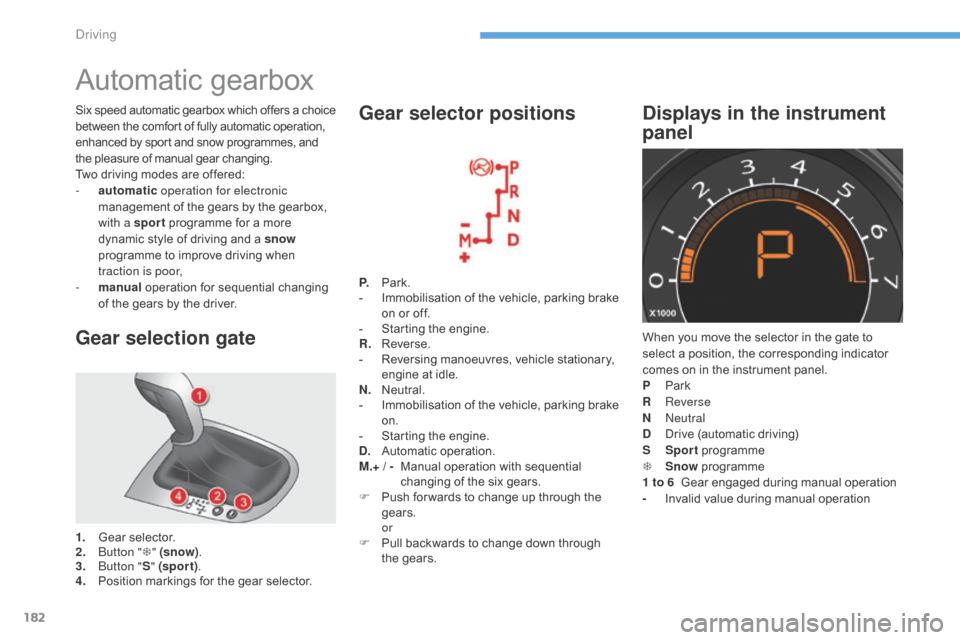
Gear selection gate
1. Gear selector.
2. B utton " T" (snow) .
3.
B
utton " S" (spor t) .
4.
P
osition markings for the gear selector.P.
Pa
rk.
-
I
mmobilisation of the vehicle, parking brake
o
n or off.
-
S
tarting the engine.
R.
R
everse.
-
R
eversing manoeuvres, vehicle stationary,
e
ngine at idle.
N.
N
eutral.
-
I
mmobilisation of the vehicle, parking brake
o
n.
-
S
tarting the engine.
D.
A
utomatic
ope
ration.
M.+ / -
M
anual operation with sequential
c
hanging of the six gears.
F
P
ush for wards to change up through the
g
ears.
or
F P ull backwards to change down through
t
he gears.
Gear selector positions
When you move the selector in the gate to select a position, the corresponding indicator
c
omes on in the instrument panel.
P
Pa
rk
R
Reverse
N
Neutral
D
D
rive (automatic driving)
S
Sp
ort
pro
gramme
T
S
now
pro
gramme
1 to 6
Gear engaged during manual operation
-
I
nvalid value during manual operation
Displays in the instrument
panelSix speed automatic gearbox which of fers a choice b
etween the comfort of fully automatic operation, e
nhanced by sport and snow programmes, and
t
he pleasure of manual gear changing.
Two
driving modes are offered:
-
a
utomatic operation for electronic
management
of the gears by the gearbox,
w
ith a sport
programme for a more
d
ynamic style of driving and a snow
programme
to improve driving when
t
raction is poor,
-
m
anual
operation for sequential changing
o
f the gears by the driver.
Driving
Page 185 of 396
183
C4-2_en_Chap06_conduite_ed02-2015
Moving off
If position N is engaged inadvertently while driving, allow the engine to
r
eturn to idle then engage position D to
accelerate. F
Sel
ect position D for automatic
c
hanging
o
f the six gears.
The gearbox then operates in auto-adaptive
m
ode, without any intervention on the part
o
f the driver. It continuously selects the most
s
uitable gear according to the style of driving, t
he profile of the road and the load in the
vehicle.
For
maximum acceleration without touching
t
he selector, press the accelerator pedal down
fully
(kick down). The gearbox changes down
a
utomatically or maintains the gear selected
u
ntil the maximum engine speed is reached.
On
braking, the gearbox changes down
a
utomatically to provide effective engine
b
raking.
If you release the accelerator sharply, the
gearbox
will not change to a higher gear for
s
afety reasons.
When
the engine is running at idle, with
t
he brakes released, if position R,
D
or
M is selected, the vehicle moves
e
ven without the accelerator being
p
ressed.
Never leave children unsupervised in
the
vehicle when the engine is running.
When
carrying out maintenance with
t
he engine running, apply the parking
b
rake and select position P.
Never select position N while the
vehicle
is moving.
Never select positions P or R unless the
vehicle
is completely stationary.
If
the parking brake does not release
a
utomatically, check that the front doors
a
re fully closed.
F
W
ith
your
foot
on
the
brake,
select
p
osition
P or N
.
F
S
tart
the
engine.
If this procedure is not followed, an audible
signal
is
heard,
accompanied
by
a
message
in
t
he
instrument
panel
screen.
F
W
ith
the
engine
running,
press
the
brake
ped
al.
F
Sel
ect position R , D or M.
Automatic operation
The parking brake is released manually, the v
ehicle moves off.
If
the parking brake is on and automatic mode
i
s activated, accelerate progressively.
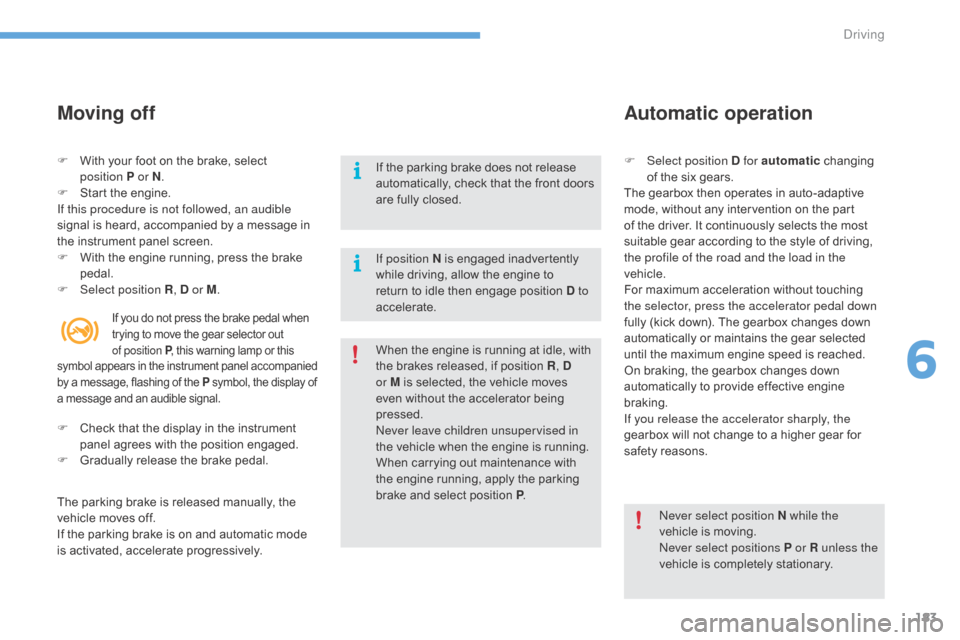
If you do not press the brake pedal when trying to move the gear selector out o
f position P ,
this warning lamp or this
s
ymbol
ap
pears
in t
he
in
strument
pan
el
a
ccompanied
b
y
a
message, flashing of the P
symbol, the display of
a
message
and an audible signal.
F Check that the display in the instrument p
anel agrees with the position engaged.
F
G
radually release the brake pedal.
6
Driving
Page 186 of 396
184
C4-2_en_Chap06_conduite_ed02-2015
These two special programmes supplement the automatic operation in very specific conditions
o
f use.
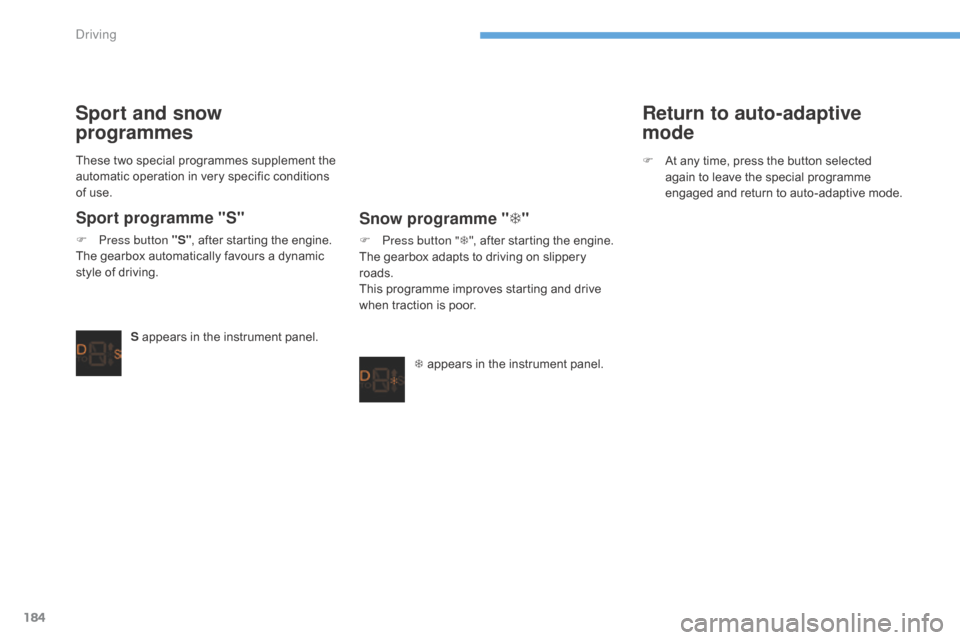
Sport programme "S"
F Press button "S" , after starting the engine.
The gearbox automatically favours a dynamic
s
tyle of driving.
S
appears in the instrument panel.
Snow programme "T"
F Press button " T", after starting the engine.
The gearbox adapts to driving on slippery
r
oads.
This
programme improves starting and drive
w
hen traction is poor.
T
appears in the instrument panel.F
A
t any time, press the button selected
a
gain to leave the special programme
e
ngaged and return to auto-adaptive mode.
Sport and snow
programmes
Return to auto-adaptive
mode
Driving
Page 187 of 396
185
C4-2_en_Chap06_conduite_ed02-2015
Manual operation
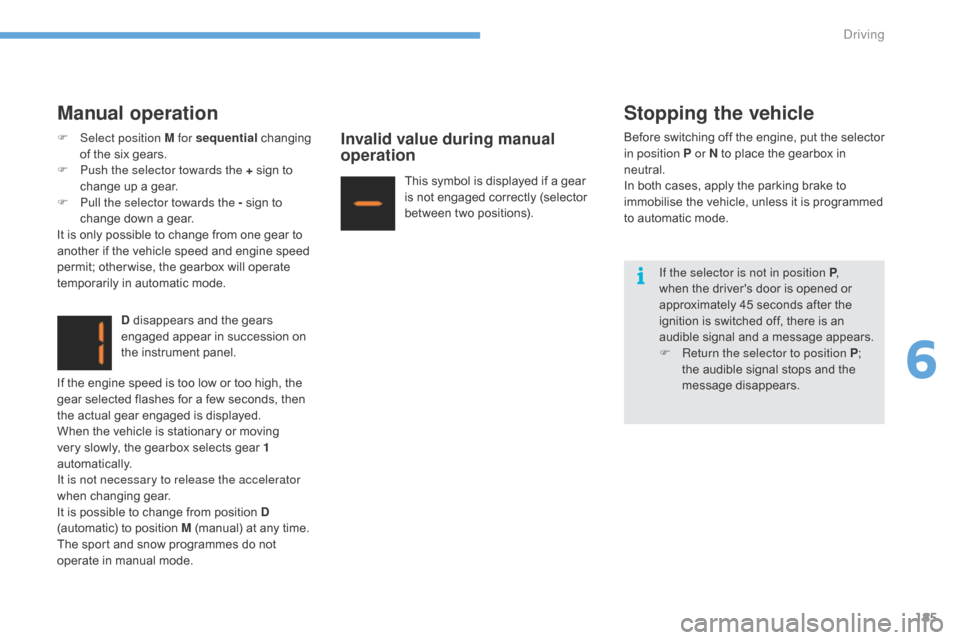
D disappears and the gears engaged appear in succession on
t
he instrument panel.
Invalid value during manual
operation
This symbol is displayed if a gear is not engaged correctly (selector
b
etween two positions).
Stopping the vehicle
If the selector is not in position P ,
when the driver's door is opened or
a
pproximately 45 seconds after the
i
gnition is switched off, there is an
a
udible signal and a message appears.
F
R
eturn the selector to position P ;
t
he audible signal stops and the
m
essage
d
isappears.
F
Sel
ect position M for sequential
c
hanging
o
f
the
six
gears.
F
P
ush the selector towards the +
sign
to
c
hange
up
a
gear.
F
P
ull the selector towards the -
sign
to
c
hange
down
a
gear.
It
is
only
possible
to
change
from
one
gear
to
a
nother
if
the
vehicle
speed
and
engine
speed
p
ermit;
other wise,
the
gearbox
will
operate
t
emporarily
in
automatic
mode.
If
the
engine
speed
is
too
low
or
too
high,
the
g
ear
selected
flashes
for
a
few
seconds,
then
t
he
actual
gear
engaged
is
displayed.
When
the
vehicle
is
stationary
or
moving
v
ery
slowly,
the
gearbox
selects
gear
1
automatically.
It is not necessary to release the accelerator
when
c
hanging
g
ear.
It
is
possible
to
change
from
position
D
(automatic)
to
position
M
(manual)
at
any
time.
The
sport
and
snow
programmes
do
not
o
perate
in
manual
mode. Before
s
witching
o
ff
t
he
e
ngine,
p
ut
t
he
s
elector
i
n position P or N to place the gearbox in
neu
tral.
In
both cases, apply the parking brake to
i
mmobilise the vehicle, unless it is programmed
t
o
automatic mode.
6
Driving
Page 188 of 396
186
C4-2_en_Chap06_conduite_ed02-2015
When the ignition is on, a message appears in the instrument panel
s
creen to indicate a gearbox fault.
Operating fault
You risk damaging the gearbox:
- i f you press the accelerator and
brake
pedals at the same time,
-
i
f you force the selector from
p
osition P to another position when
the
battery is flat.
To
reduce fuel consumption when
s
tationary for long periods with the
e
ngine running (traffic jam...), position
t
he gear selector at N and apply the
parking
brake, unless it is programmed
i
n automatic mode.
In
this
case,
the
gearbox
switches
to
back-up
m
ode
and
is
locked
in
3rd
gear.
You
may
feel
a
substantial
knock
when
changing
from
P
to R
and
from
N to R .
This
will
not
cause
any
d
amage
to
the
gearbox.
Do
not
exceed
60
mph
(100
km/h),
local
speed
r
estrictions
p
ermitting.
Have
it
checked
by
a
CITROËN
dealer
or
a
q
ualified
w
orkshop.
Driving
Page 189 of 396
187
C4-2_en_Chap06_conduite_ed02-2015
Gear shift indicator*
Depending on the driving situation and your vehicle's equipment, the system may advise
y
ou to skip one (or more) gear(s). You can
f
ollow this instruction without engaging the
i
ntermediate
g
ears.
The
gear engagement recommendations must
n
ot be considered compulsory. In fact, the
c
onfiguration of the road, the amount of traffic
a
nd safety remain determining factors when
c
hoosing the best gear. Therefore, the driver
r
emains responsible for deciding whether or not
t
o follow the advice given by the system.
This
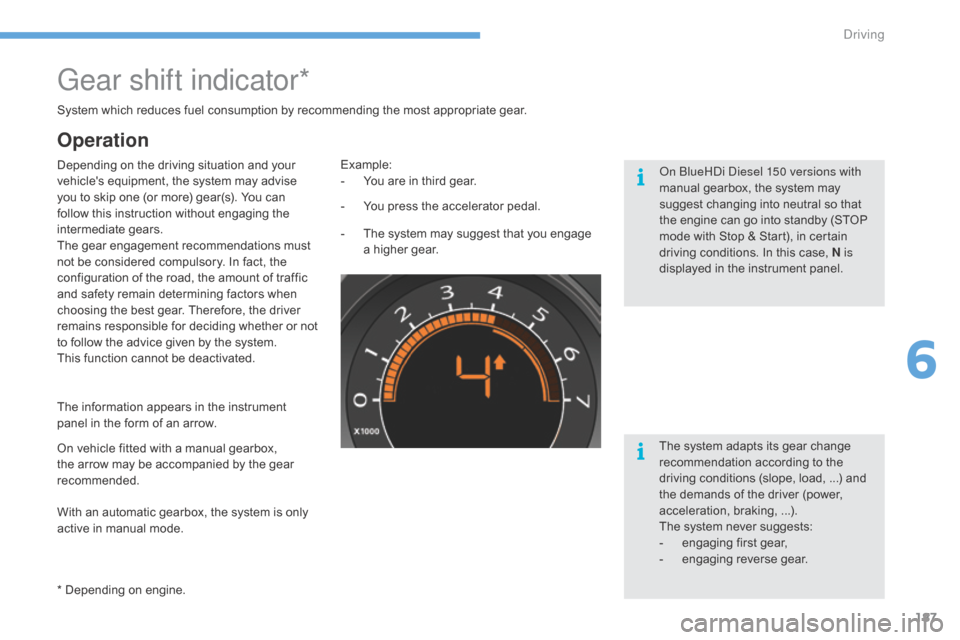
function cannot be deactivated. -
Y
ou press the accelerator pedal.
Example:
-
Y ou are in third gear.
-
T
he system may suggest that you engage
a
higher gear.
The
information appears in the instrument
p
anel in the form of an arrow.
System
which reduces fuel consumption by recommending the most appropriate gear.
With an automatic gearbox, the system is only
a
ctive in manual mode.
* Depending
on engine.
On
vehicle fitted with a manual gearbox,
t
he arrow may be accompanied by the gear
re
commended. The
system adapts its gear change
r
ecommendation according to the
d
riving conditions (slope, load, ...) and
t
he demands of the driver (power,
a
cceleration, braking, ...).
The
system never suggests:
-
e
ngaging first gear,
-
enga
ging
r
everse
g
ear.
Operation
On BlueHDi Diesel 150 versions with
manual gearbox, the system may
s
uggest changing into neutral so that
t
he engine can go into standby (STOP
m
ode with Stop & Start), in certain
d
riving conditions. In this case, N is
displayed
in the instrument panel.
6
Driving
Page 190 of 396
188
C4-2_en_Chap06_conduite_ed02-2015
Stop & Start
Operation
Going into engine STOP mode
The "ECO" warning lamp comes on i
n the instrument panel and the engine g
oes into standby automatically:
-
w
ith a manual gearbox , at speeds below
12
m
ph
(
20
k
m/h),
o
r
v
ehicle
s
tationary
w
ith
P
ureTech 130 petrol and BlueHDi 115 and
1
20
Diesel versions, when you put the gear
l
ever into neutral and release the clutch
pedal,
If your vehicle is fitted with the
system,
a time counter calculates
t
he sum of the periods in STOP
m
ode during a journey. It resets
i
tself to zero every time the
i
gnition is switched on with the
k
ey or the "START/STOP" button.
-
w
ith an automatic gearbox, vehicle
stationary,
when you press the brake pedal
o
r
place the gear selector in position N.
Special cases: STOP mode
unavailable
STOP mode is not invoked when:
- t he vehicle is on a steep slope (up or
d
ow n),
-
t
he driver's door is open,
-
t
he driver's seat belt is not fastened,
-
t
he vehicle has not exceeded 6 mph
(
10 km/h) since the last engine start (using
t
he key or the "START/STOP" button),
-
t
he electric parking brake is applied or
be
ing
a
pplied,
-
t
he engine is needed to maintain a
c
omfortable temperature in the passenger
c
ompartment,
-
d
emisting is active,
-
s
ome special conditions (battery charge,
e
ngine temperature, braking assistance,
a
mbient temperature...) where the engine is
n
eeded to assure control of a system.
In this case, the "ECO"
warning lamp
f
lashes for a few seconds, then goes
o
f f.
This operation is perfectly normal.
The
Stop
&
Start system
puts
the
engine
temporarily
into
standby
-
STOP
mode
-
during
stops
in
the
traffic (red lights, traffic jams, or other...). The
e
ngine
restarts
automatically
-
START
mode
-
as
soon
as
you
want
to
move
off.
The
restart
takes
place
instantly, quickly and silently.
Per fect
for
urban
use,
the
Stop
&
Start
system
reduces
fuel
consumption
and
exhaust
emissions
as
well
as the noise level when stationary.
Never
refuel
with
the
engine
in
STOP
m
ode;
you
must
switch
off
the
ignition
w
ith
the
key
or
the
"START/STOP"
b
utton.
STOP
mode
does
not
affect
the
f
unctionality of the vehicle, such as
braking,
power
steering,
for
example.
Driving