light Citroen C4 2016 2.G Workshop Manual
[x] Cancel search | Manufacturer: CITROEN, Model Year: 2016, Model line: C4, Model: Citroen C4 2016 2.GPages: 396, PDF Size: 10.22 MB
Page 149 of 396
147
C4-2_en_Chap05_securite_ed02-2015
Airbags
General information
System designed to contribute towards improving the safety of the occupants (with
t
he exception of the rear centre passenger)
i
n the event of violent collisions. The airbags
s
upplement the action of the seat belts fitted
w
ith force limiters (all except the centre rear
p
assenger
b
elt).
If a collision occurs, the electronic detectors
record
and analyse the front and side impacts
s
ustained in the impact detection zones:
-
i
n the case of a serious impact, the airbags
a
re deployed instantly and contribute
towards better protection of the occupants
of
the vehicle (with the exception of the
r
ear centre passenger); immediately after
t
he impact, the airbags deflate rapidly so
t
hat they do not hinder visibility or the exit
o
f the occupants,
-
i
n the case of a minor or rear impact or in
c
ertain roll-over conditions, the airbags
m
ay not be deployed; the seat belt
a
lone contributes towards ensuring your
p
rotection in these situations.
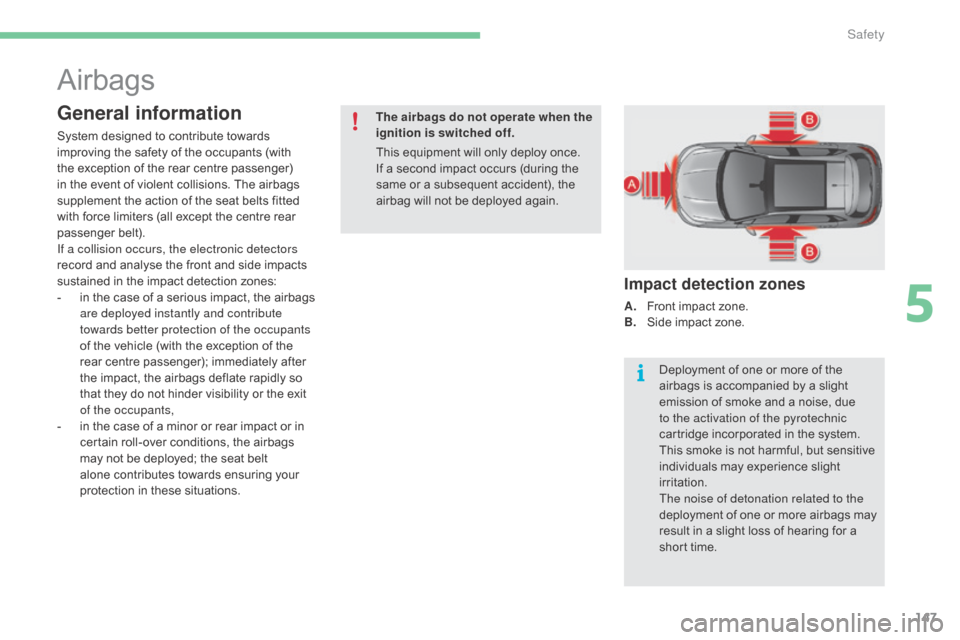
Impact detection zones
A. Front impact zone.
B. S ide impact zone.
The airbags do not operate when the
ignition is switched off.
This
equipment
will
only
deploy
once.
I
f
a
second
impact
occurs
(during
the
s
ame
or
a
subsequent
accident),
the
a
irbag
will
not
be
deployed
again.
Deployment of one or more of the
a
irbags is accompanied by a slight
e
mission of smoke and a noise, due
t
o the activation of the pyrotechnic
cartridge
incorporated in the system.
This
smoke is not harmful, but sensitive
i
ndividuals may experience slight
ir
ritation.
The noise of detonation related to the
deployment
of one or more airbags may
r
esult in a slight loss of hearing for a
s
hort time.
5
Safety
Page 168 of 396
166
C4-2_en_Chap06_conduite_ed02-2015
Driving recommendations
Observe the driving regulations and remain vigilant whatever the traffic conditions.
Pay
close attention to the traffic and keep your
h
ands on the wheel so that you are ready to
react
at any time to any eventuality.
On
a long journey, a break every two hours is
s
trongly
re
commended.
In
difficult weather, drive smoothly, anticipate
t
he need to brake and increase the distance
f
rom other vehicles.
Driving on flooded roads
We strongly advise against driving on flooded roads, as this could cause serious damage
t
o the engine or gearbox, as well as to the
e
lectrical systems of your vehicle.
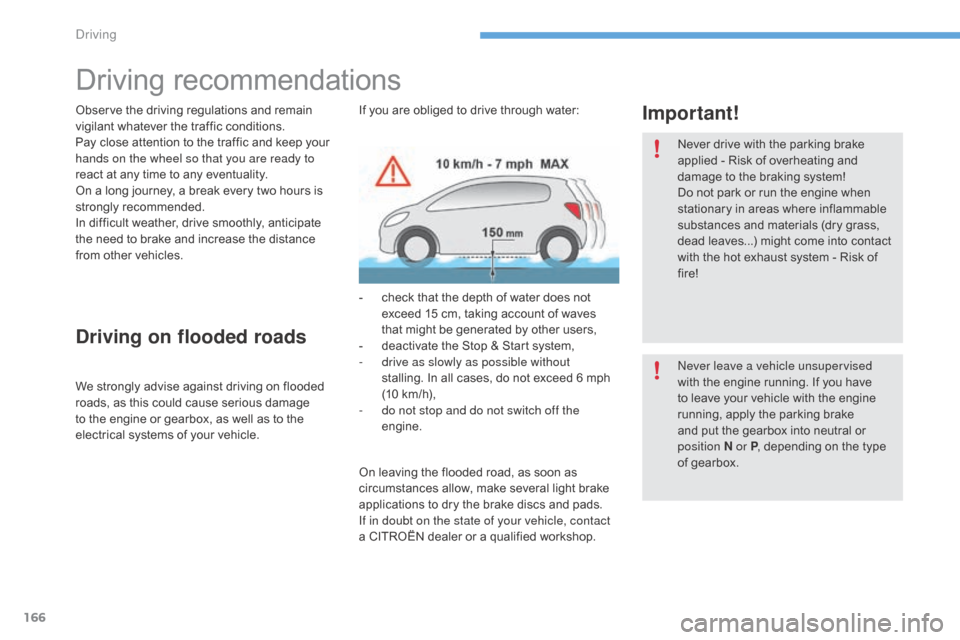
Important!If you are obliged to drive through water:
-
c
heck that the depth of water does not
e
xceed 15 cm, taking account of waves
t
hat might be generated by other users,
-
d
eactivate the Stop & Start system,
-
d
rive as slowly as possible without
stalling.
In all cases, do not exceed 6 mph
(
10 km/h),
-
d
o not stop and do not switch off the
engine. Never
drive with the parking brake
a
pplied - Risk of overheating and
d
amage to the braking system!
Do
not park or run the engine when
s
tationary in areas where inflammable
s
ubstances and materials (dry grass,
d
ead leaves...) might come into contact
w
ith the hot exhaust system - Risk of
f
ire!
Never leave a vehicle unsupervised
with
the engine running. If you have
t
o leave your vehicle with the engine
r
unning, apply the parking brake
a
nd put the gearbox into neutral or
p
osition
N or P,
depending on the type
o
f gearbox.
On
leaving the flooded road, as soon as
c
ircumstances allow, make several light brake
a
pplications to dry the brake discs and pads.
If in doubt on the state of your vehicle, contact
a
CITROËN dealer or a qualified workshop.
Driving
Page 169 of 396
167
C4-2_en_Chap06_conduite_ed02-2015
When towing
Distribution of loads
F Distribute the load in the trailer so that the heaviest items are as close as possible to t
he axle and the nose weight approaches the
m
aximum permitted without exceeding it.
Air density decreases with altitude,
thus
r
educing
e
ngine
p
erformance.
A
bove 1 000 metres, the maximum towed
l
oad must be reduced by 10 % for every
1 0
00 metres of altitude.
Side wind
F Take into account the increased sensitivity t
o side wind.
For
more information on weights (and the
t
owed loads which apply to your vehicle) refer
t
o the corresponding section.
F
I
f the warning lamp and the
S
TOP
warning lamp come on,
s
top the vehicle and switch off
the engine as soon as possible.
Braking
Towing a trailer increases the braking distance.
T o avoid overheating of the brakes, the use of
e
ngine braking is recommended.
Ty r e s
F Check the tyre pressures of the towing v
ehicle and of the trailer, observing the
re
commended
p
ressures.
Lighting
F Check the electrical lighting and signalling o
n the trailer and the hadlamp beam height
o
f your vehicle.
For
more information on adjusting the
h
eadlamp beam height, refer to the
c
orresponding
s
ection.
The
rear parking sensors will be
d
eactivated automatically if a genuine
C
ITROËN towbar is used.
Cooling
Towing a trailer on a slope increases the temperature of the coolant.
As
the fan is electrically controlled, its cooling
c
apacity is not dependent on the engine speed.
F
T
o lower the engine speed, reduce your
s
peed.
The
maximum towed load on a long incline
d
epends on the gradient and the ambient
t
emperature.
In
all cases, keep a check on the coolant
t
emperature.
6
Driving
Page 173 of 396
171
C4-2_en_Chap06_conduite_ed02-2015
Starting / Switching off the engine with Keyless Entry and
S
tarting
Starting the engine
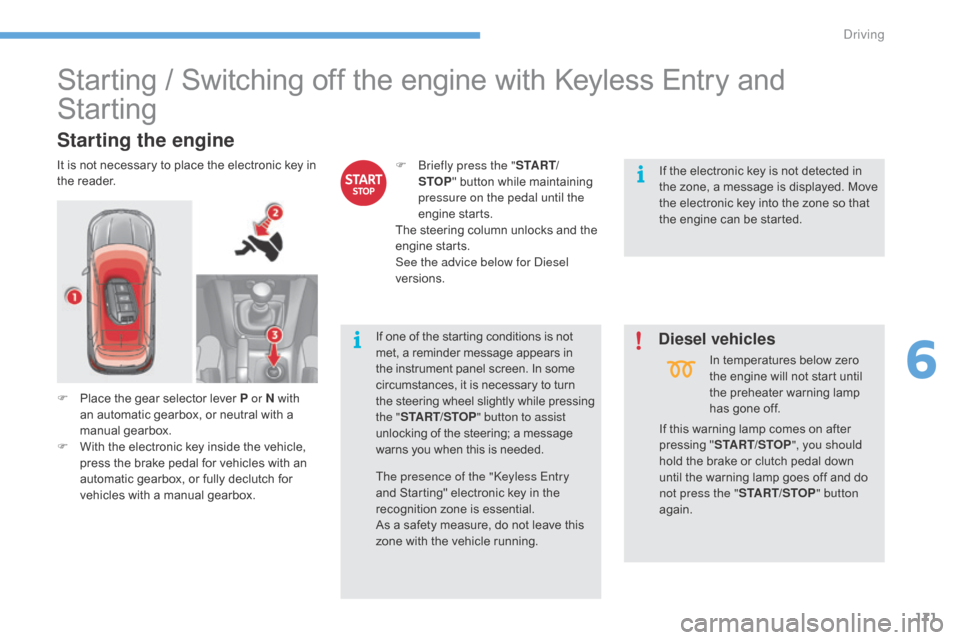
It is not necessary to place the electronic key in t
he r eader. F
B riefly press the "S TA R T/
STOP "
button while maintaining
p
ressure on the pedal until the
engine
s
tarts.
The
steering column unlocks and the
e
ngine
s
tarts.
See the advice below for Diesel
versions.
If
this warning lamp comes on after
p
ressing "START/STOP ", you should
hold
the brake or clutch pedal down
u
ntil the warning lamp goes off and do
n
ot press the "START/STOP " button
again.
If
one of the starting conditions is not
m
et, a reminder message appears in
t
he instrument panel screen. In some
c
ircumstances, it is necessary to turn
t
he steering wheel slightly while pressing
t
he "START/STOP " button to assist
unlocking
of the steering; a message
w
arns you when this is needed.If
the electronic key is not detected in
t
he zone, a message is displayed. Move
t
he electronic key into the zone so that
t
he engine can be started.
The presence of the "Keyless Entry
and
Starting" electronic key in the
r
ecognition zone is essential.
As
a safety measure, do not leave this
z
one with the vehicle running.In
temperatures below zero
t
he engine will not start until
t
he preheater warning lamp
h
as gone off.
F
P
lace the gear selector lever P or N with
an
automatic gearbox, or neutral with a
m
anual
g
earbox.
F
W
ith the electronic key inside the vehicle,
p
ress the brake pedal for vehicles with an
a
utomatic gearbox, or fully declutch for
v
ehicles with a manual gearbox.
Diesel vehicles
6
Driving
Page 190 of 396
188
C4-2_en_Chap06_conduite_ed02-2015
Stop & Start
Operation
Going into engine STOP mode
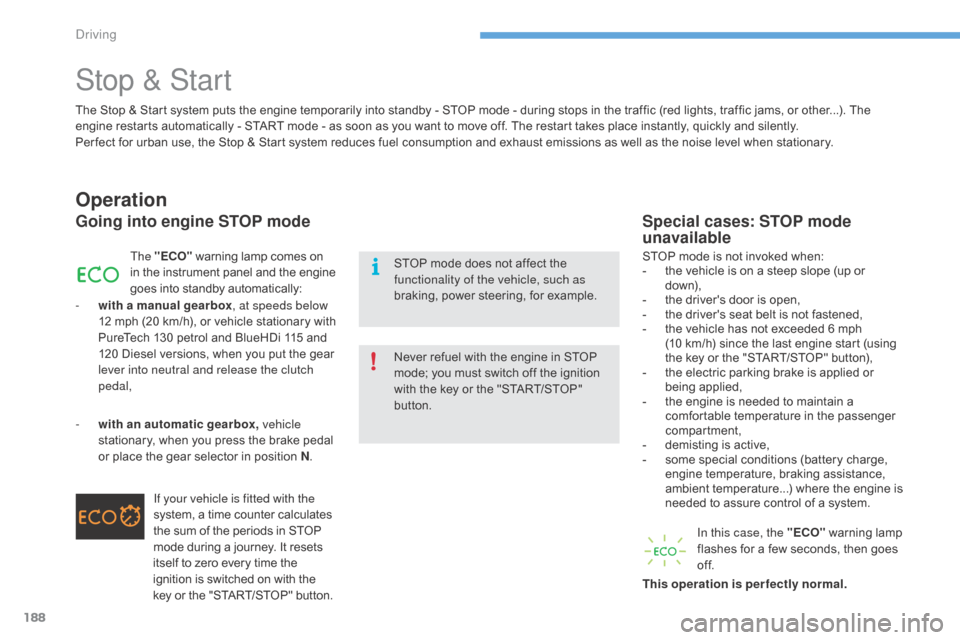
The "ECO" warning lamp comes on i
n the instrument panel and the engine g
oes into standby automatically:
-
w
ith a manual gearbox , at speeds below
12
m
ph
(
20
k
m/h),
o
r
v
ehicle
s
tationary
w
ith
P
ureTech 130 petrol and BlueHDi 115 and
1
20
Diesel versions, when you put the gear
l
ever into neutral and release the clutch
pedal,
If your vehicle is fitted with the
system,
a time counter calculates
t
he sum of the periods in STOP
m
ode during a journey. It resets
i
tself to zero every time the
i
gnition is switched on with the
k
ey or the "START/STOP" button.
-
w
ith an automatic gearbox, vehicle
stationary,
when you press the brake pedal
o
r
place the gear selector in position N.
Special cases: STOP mode
unavailable
STOP mode is not invoked when:
- t he vehicle is on a steep slope (up or
d
ow n),
-
t
he driver's door is open,
-
t
he driver's seat belt is not fastened,
-
t
he vehicle has not exceeded 6 mph
(
10 km/h) since the last engine start (using
t
he key or the "START/STOP" button),
-
t
he electric parking brake is applied or
be
ing
a
pplied,
-
t
he engine is needed to maintain a
c
omfortable temperature in the passenger
c
ompartment,
-
d
emisting is active,
-
s
ome special conditions (battery charge,
e
ngine temperature, braking assistance,
a
mbient temperature...) where the engine is
n
eeded to assure control of a system.
In this case, the "ECO"
warning lamp
f
lashes for a few seconds, then goes
o
f f.
This operation is perfectly normal.
The
Stop
&
Start system
puts
the
engine
temporarily
into
standby
-
STOP
mode
-
during
stops
in
the
traffic (red lights, traffic jams, or other...). The
e
ngine
restarts
automatically
-
START
mode
-
as
soon
as
you
want
to
move
off.
The
restart
takes
place
instantly, quickly and silently.
Per fect
for
urban
use,
the
Stop
&
Start
system
reduces
fuel
consumption
and
exhaust
emissions
as
well
as the noise level when stationary.
Never
refuel
with
the
engine
in
STOP
m
ode;
you
must
switch
off
the
ignition
w
ith
the
key
or
the
"START/STOP"
b
utton.
STOP
mode
does
not
affect
the
f
unctionality of the vehicle, such as
braking,
power
steering,
for
example.
Driving
Page 198 of 396
196
C4-2_en_Chap06_conduite_ed02-2015
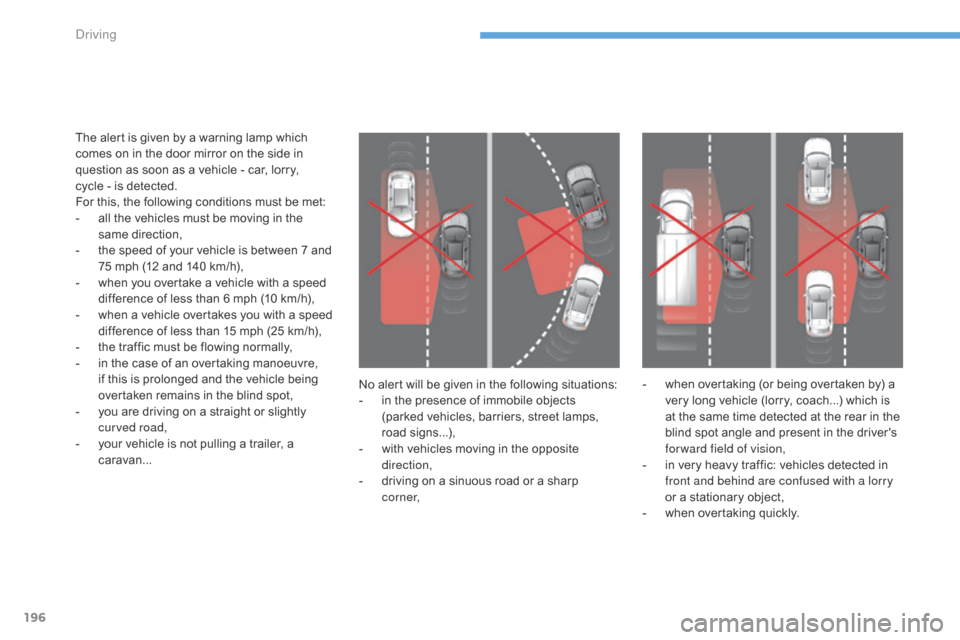
No alert will be given in the following situations:
- i n the presence of immobile objects
(
parked vehicles, barriers, street lamps,
r
oad
s
igns...),
-
w
ith vehicles moving in the opposite
d
irection,
-
d
riving on a sinuous road or a sharp
c
o r n e r,
The
alert
is
given
by
a
warning
lamp
which
c
omes
on
in
the
door
mirror
on
the
side
in
q
uestion
as
soon
as
a
vehicle
-
car,
lorry,
cycle
-
is
detected.
For
this,
the
following
conditions
must
be
met:
-
a
ll
the
vehicles
must
be
moving
in
the
sa
me
d
irection,
-
t
he
speed
of
your
vehicle
is
between
7
and
7
5
mph
(12
and
140
km/h),
-
w
hen
you
overtake
a
vehicle
with
a
speed
d
ifference
of
less
than
6
mph
(10
km/h),
-
w
hen
a
vehicle
overtakes
you
with
a
speed
d
ifference
of
less
than
15
mph
(25
km/h),
-
t
he
traffic
must
be
flowing
normally,
-
i
n
the
case
of
an
overtaking
manoeuvre,
i
f
this
is
prolonged
and
the
vehicle
being
ov
ertaken
remains
in
the
blind
spot,
-
y
ou
are
driving
on
a
straight
or
slightly
c
urved road,
-
y
our
vehicle
is
not
pulling
a
trailer,
a
c
aravan... -
w hen overtaking (or being overtaken by) a v
ery long vehicle (lorry, coach...) which is
a
t the same time detected at the rear in the
b
lind spot angle and present in the driver's
f
orward field of vision,
-
i
n very heavy traffic: vehicles detected in
f
ront and behind are confused with a lorry
or
a stationary object,
-
w
hen overtaking quickly.
Driving
Page 217 of 396
215
C4-2_en_Chap07_infos-pratiques_ed02-2015
Before each use
Check that the towball is correctly fitted by verifying the following points:
- t he towball is correctly locked in place (position A),
-
t
he security key lock is on and the key removed; the locking wheel can no longer be
ope
rated,
-
t
he towball must no longer move at all in its carrier; try to shake it by hand.
During use
Never unlock the device when a trailer or load carrier is fitted to the towball.
N ever exceed the maximum authorised weight for the vehicle plus trailer (Gross Train
W
eight - GTW).
Before
driving, check the adjustment of the headlamp beam height.
For
more information on adjusting the headlamps, refer to the corresponding section.
After use
For journeys made without a trailer or load carrier, the trailer harness socket must be folded away, the towball removed and the blanking plug inserted in the carrier. This measure
a
pplies particularly if the towball could hinder visibility of the number plate or lighting.
7
Practical information
Page 233 of 396
231
C4-2_en_Chap07_infos-pratiques_ed02-2015
Automatic gearbox
The gearbox does not require any maintenance (no oil change).
Refer
to the manufacturer's
s
ervice schedule for details of
the
level checking interval for this
c
omponent.
Electric parking brake
This system does not require any routine servicing. However, in
t
he event of a problem, have the
s
ystem checked by a CITROËN
d
ealer or a qualified workshop.
Manual parking brake
If a loss of effectiveness of this
system i s n oticed, t he p arking b rake
m
ust be checked, even between
t
wo services.
Brake pads
Brake wear depends on the style of driving, particularly in the case
o
f vehicles used in town, over short
distances.
It may be necessary to
Brake disc wear
For information on checking brake disc wear, contact a CITROËN
dealer
or a qualified workshop.
For
more information on the electric parking
b
rake, refer to the corresponding section.
Manual gearbox
The gearbox does not require any maintenance (no oil change).
Refer
to the manufacturer's service
s
chedule for the checking interval
f
or this component.
Only
use products recommended by
C
ITROËN or products of equivalent
q
uality
an
d
sp
ecification.
In
order to optimise the operation of
u
nits as important as those in the
b
raking system, CITROËN selects and
o
ffers very specific products.
After
washing the vehicle, dampness,
o
r in wintry conditions, ice can form
o
n the brake discs and pads: braking
e
fficiency may be reduced. Make light
b
rake applications to dry and defrost
t
he brakes.
have
the
condition of the brakes checked, even
b
etween
v
ehicle
s
ervices.
Unless
there is a leak in the circuit, a drop in
t
he
brake
fluid level indicates that the brake
p
ads
are
worn. Checking
this system must be done by a
C
ITROËN dealer or a qualified workshop.
7
Practical information
Page 236 of 396
234
C4-2_en_Chap07_infos-pratiques_ed02-2015
Recommendations on storageProcedure
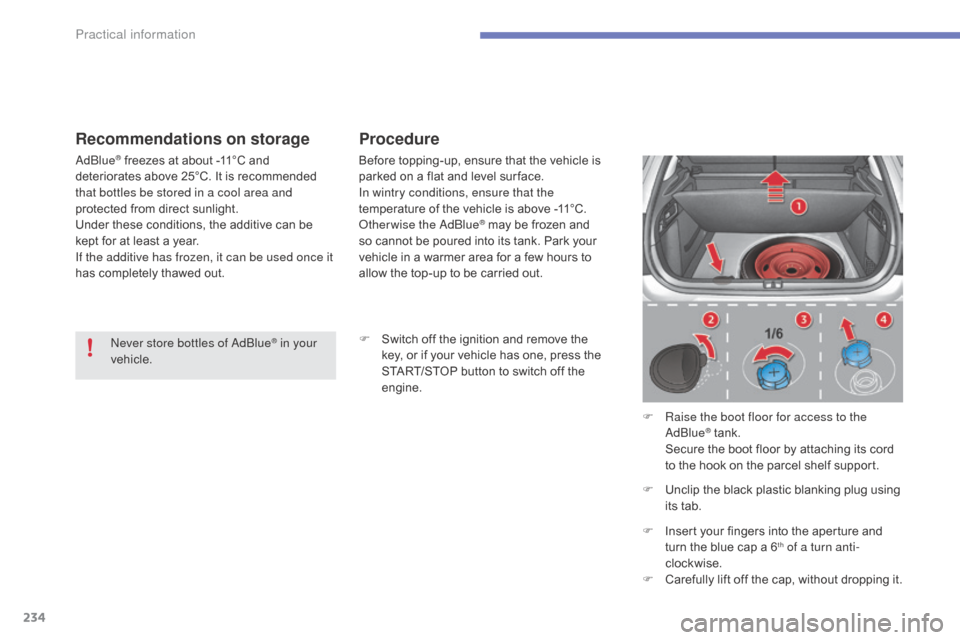
F Switch off the ignition and remove the k
ey, or if your vehicle has one, press the
S
TART/STOP button to switch off the
e
ngine. F
R
aise the boot floor for access to the
AdBlue
® tank. S
ecure
the boot floor by attaching its cord
t
o
the
hook on the parcel shelf support.
F
U
nclip
the black plastic blanking plug using
i
ts
tab.
F
I
nsert
your fingers into the aperture and
t
urn
the
blue cap a 6
th of a turn anti-
clockwise.
F
C
arefully
lift
off
the
cap, without dropping it.
Never store bottles of AdBlue
® in your
vehicle. Before
topping-up, ensure that the vehicle is
p
arked on a flat and level sur face.
In wintry conditions, ensure that the
temperature of the vehicle is above -11°C.
O
therwise the AdBlue
® may be frozen and s
o
cannot
be
poured
into its tank. Park your
v
ehicle
in
a
warmer
area for a few hours to
a
llow
the
top-up
to
be
carried out.
AdBlue
® freezes at about -11°C and d
eteriorates above 25°C. It is recommended
t
hat bottles be stored in a cool area and
protected
from direct sunlight.
Under
these conditions, the additive can be
k
ept
for
at least a year.
If the additive has frozen, it can be used once it
has
completely thawed out.
Practical information
Page 254 of 396
252
C4-2_en_Chap08_en-cas-de-panne_ed02-2015
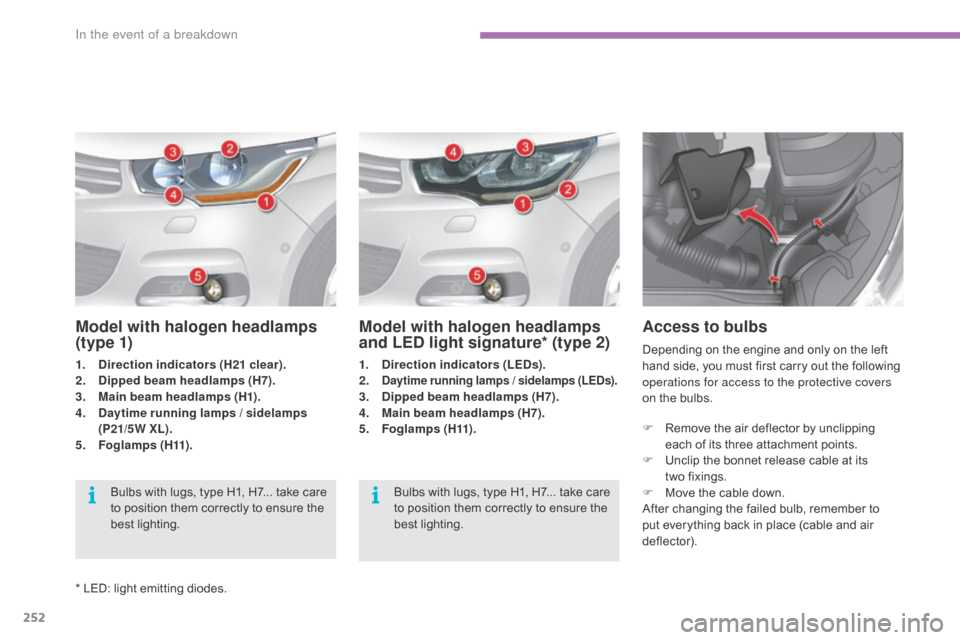
F Remove the air deflector by unclipping e
ach of its three attachment points.
F
U
nclip the bonnet release cable at its
two
fixings.
F
M
ove the cable down.
After
changing the failed bulb, remember to
p
ut everything back in place (cable and air
d
eflector).
Depending
on the engine and only on the left
h
and side, you must first carry out the following
o
perations for access to the protective covers
on the bulbs.
Access to bulbs
Model with halogen headlamps
and LED light signature* (type 2)
1. Direction indicators (LEDs).
2. Daytime running lamps / sidelamps (LEDs).3. Dipped beam headlamps (H7).
4. M
ain beam headlamps (H7).
5.
F
o g l a m p s ( H11) .
Bulbs
with lugs, type H1, H7... take care
t
o position them correctly to ensure the
b
est
l
ighting.
Model with halogen headlamps
(t y p e 1)
1. Direction indicators (H21 clear).
2. Dipped beam headlamps (H7).
3.
M
ain beam headlamps (H1).
4.
D
aytime running lamps / sidelamps
(P21/5W XL).
5.
F
o g l a m p s ( H11) .Bulbs
with lugs, type H1, H7... take care
t
o position them correctly to ensure the
b
est
l
ighting.
*
LED: light emitting diodes.
In the event of a breakdown