bonnet Citroen C4 2016 2.G Owner's Manual
[x] Cancel search | Manufacturer: CITROEN, Model Year: 2016, Model line: C4, Model: Citroen C4 2016 2.GPages: 396, PDF Size: 10.22 MB
Page 5 of 396
C4-2_en_Chap00a_sommaire_ed02-2015
Driving recommendations 166
Starting / Switching off the engine
with
the key
1
68
Starting
/ Switching off the engine
with
Keyless Entry and Starting
1
71
Manual
par
king
b
rake
1
74
Electric
parking brake
1
75
Manual
g
earbox
1
81
Automatic
gearbox
1
82
Gear
ef ficiency indicator
1
87
Stop
& Start
1
88
Hill start assist
1
91
Tyre
under-inflation detection
1
92
Lane
departure warning system
1
94
Blind spot sensors
1
95
Speed
limiter
1
98
Cruise control
2
01
Memorising
speeds
2
04
Parking
sensors
2
06
Driving
Fuel 20 9
Misfuel prevention (Diesel) 2 11
Snow chains
2
12
Very
cold climate screen
2
13
Towing
a trailer
2
13
Towbar
with quickly detachable towball
2
14
Energy
economy mode
2
19
Audio
pre-equipment
2
20
Changing
a wiper blade
2
21
Fitting
roof bars
2
22
Bonnet
2
23
Petrol
engines
2
24
Diesel
engines
2
25
Checking
levels
2
26
Checks
23
0
AdBlue
® additive and SCR system
(
BlueHDi Diesel) 2 32
Accessories
2
36
Practical information
Running out of fuel (Diesel) 2 38
Temporary pu ncture
r
epair kit
2
39
Spare wheel
2
44
Changing
a bulb
2
51
Changing
a fuse
2
60
12
V battery
2
65
Towing
the vehicle
2
69
In the event o f a b reakdown
Petrol engines 2 71
Petrol weights 2 72
Diesel
engines
2
73
Diesel
weights
2
75
Dimensions
2
78
Identification
ma
rkings
2
79
Technical data
Emergency or assistance 280
7-inch touch screen tablet 2 83
Audio
system
3
53
Audio and telematics
Alphabetical
in
dex
Contents
Page 8 of 396
6
C4-2_en_Chap00b_vue-ensemble_ed02-2015
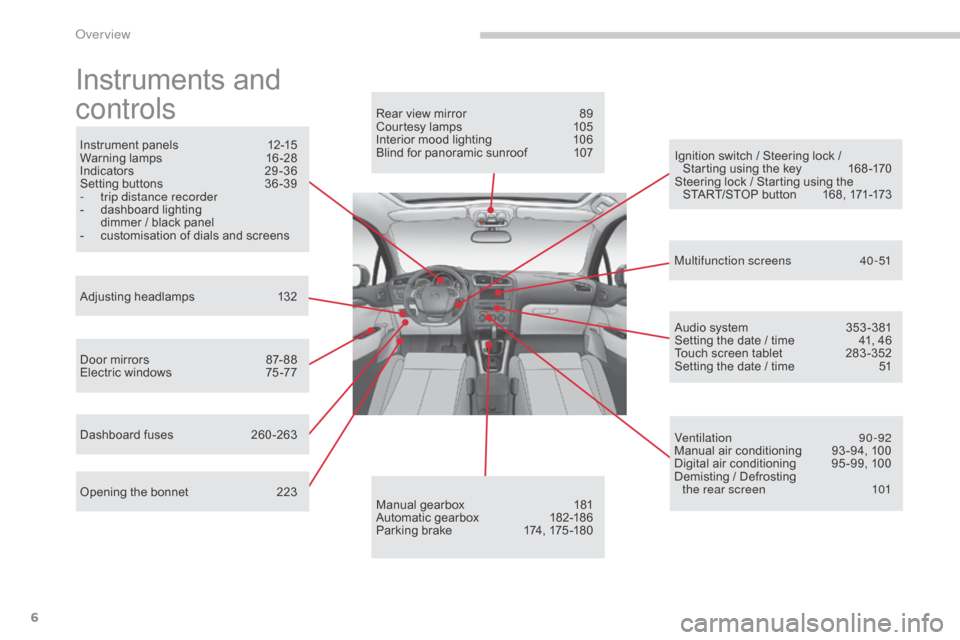
Instruments and
c
ontrols
Instrument panels 1 2-15
Warning lam ps 1 6-28
Indicators
2
9-36
Setting
buttons
3
6 -39
-
t
rip distance recorder
-
d
ashboard lighting
d
immer / black panel
-
c
ustomisation of dials and screens
Adjusting
h
eadlamps
1
32
Door
mirrors
87
- 88
Electric
windows
7
5 -77
Dashboard
fuses
2
60 -263
Opening
the bonnet
2
23 Audio
system
3
53 -381
Setting
the date / time
4
1, 46
Touch
screen tablet
2
83 -352
Setting
the date / time
5
1
Manual
g
earbox
1
81
Automatic
gearbox
1
82-186
Parking
brake
1
74, 175 -180
Rear
view mirror
8
9
Courtesy lamps
1
05
Interior mood lighting 1 06
Blind for panoramic sunroof 1 07
Multifunction screens
4
0-51
Ventilation
9
0-92
Manual
air conditioning
9
3 -94, 100
Digital
air conditioning
9
5 -99, 100
Demisting
/ Defrosting
the rear screen
1
01
Ignition
switch / Steering lock /
S
tarting using the key
1
68 -170
Steering
lock / Starting using the
S
TART/STOP button
1
68, 171-173
Over view
Page 11 of 396
9
C4-2_en_Chap00b_vue-ensemble_ed02-2015
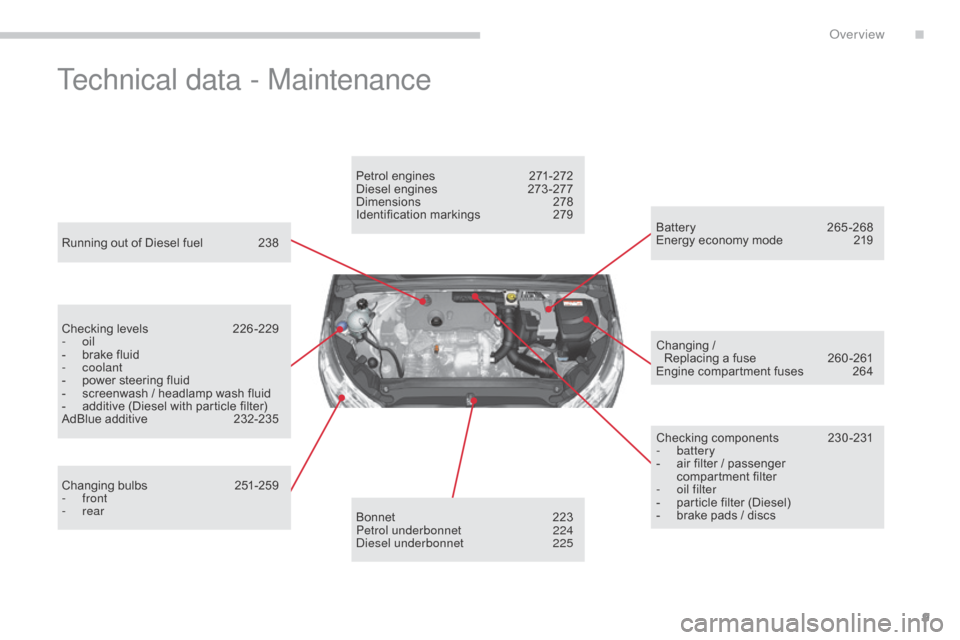
Technical data - Maintenance
Running out of Diesel fuel 238
Checking levels
2
26 -229
-
oil
-
b
rake fluid
-
coolant
-
p
ower steering fluid
-
s
creenwash / headlamp wash fluid
-
a
dditive (Diesel with particle filter)
AdBlue
additive
2
32-235
Changing
bu
lbs
2
51-259
-
front
-
rear Petrol
engines
2
71-272
Diesel engines
2
73 -277
Dimensions
2
78
Identification
ma
rkings
2
79
Bonnet
2
23
Petrol underbonnet
2
24
Diesel underbonnet
2
25Checking
c
omponents
23
0-231
-
battery
-
a
ir filter / passenger
c
ompartment filter
-
o
il filter
-
p
article filter (Diesel)
-
b
rake pads / discs
Battery 2
65 -268
Energy economy mode 2 19
Changing
/
R
eplacing a fuse
2
60 -261
Engine
compartment fuses
2
64
.
Over view
Page 31 of 396
29
C4-2_en_Chap01_instruments-de-bord_ed02-2015
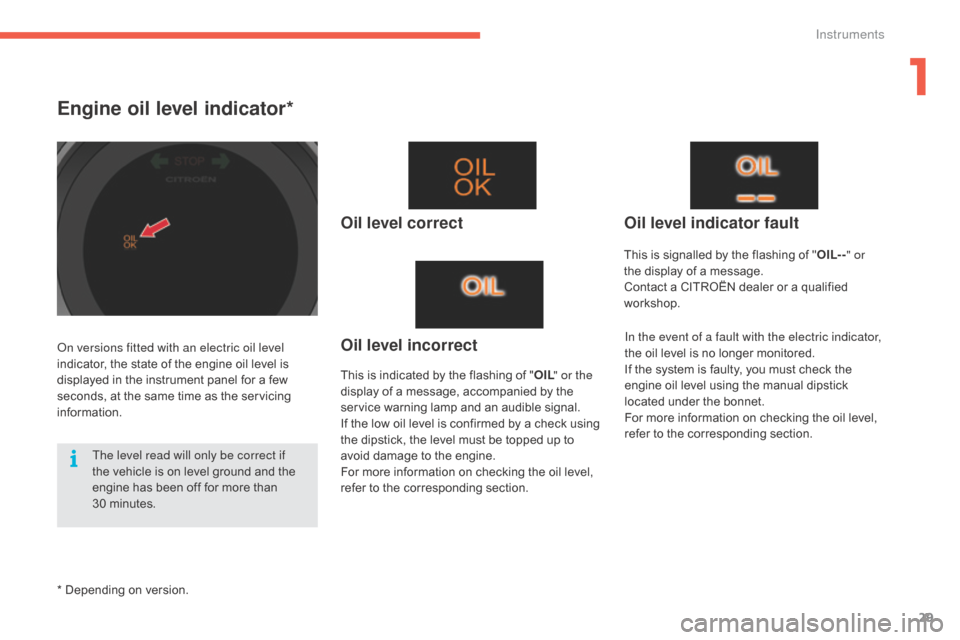
Engine oil level indicator*
Oil level correct
This is indicated by the flashing of "O IL" or the
display of a message, accompanied by the
s
ervice warning lamp and an audible signal.
If
the low oil level is confirmed by a check using
t
he dipstick, the level must be topped up to
a
void damage to the engine.
For
more information on checking the oil level,
r
efer to the corresponding section.
Oil level indicator fault
In the event of a fault with the electric indicator,
the oil level is no longer monitored.
If
the system is faulty, you must check the
e
ngine oil level using the manual dipstick
l
ocated under the bonnet.
For
more information on checking the oil level,
r
efer to the corresponding section.Oil level incorrect
This is signalled by the flashing of "O IL- -" or
the display of a message.
Contact
a CITROËN dealer or a qualified
w
orkshop.
On versions fitted with an electric oil level
indicator,
the
state
of
the
engine
oil
level
is
d
isplayed
in
the
instrument
panel
for
a
few
s
econds,
at
the
same
time
as
the
servicing
i
nformation.
* Depending
on
version.
The level read will only be correct if
the
vehicle
is
on
level
ground
and
the
e
ngine
has
been
off
for
more
than
3
0 minutes.
1
Instruments
Page 73 of 396

71
C4-2_en_Chap02_ouvertures_ed02-2015
* Depending on the country of sale.
Alarm*
- exterior perimeter
The system checks for opening of the vehicle.
T he alarm is triggered if anyone tries to open a
d
oor, the boot, the bonnet...
- interior volumetric
The system checks for any variation in the volume in the passenger compartment.
The
alarm is triggered if anyone breaks a
w
indow, enters the passenger compartment or
m
oves inside the vehicle.
- tilt
The system checks for any change in the attitude of the vehicle.
The
alarm is triggered if the vehicle is lifted,
m
oved or knocked.
Self-protection function
The system checks for the putting out of service of its components.
The
alarm is triggered if the battery, the central
c
ontrol or the siren wiring are put out of service
o
r damaged. For
all work on the alarm system, c
ontact a CITROËN dealer or a
qualified w orkshop.
System
which
protects
and
provides
a
deterrent
against theft and break-ins. It provides the
f
ollowing
types
of
monitoring:
2
Access
Page 139 of 396
137
C4-2_en_Chap04_eclairage-et-visibilite_ed02-2015
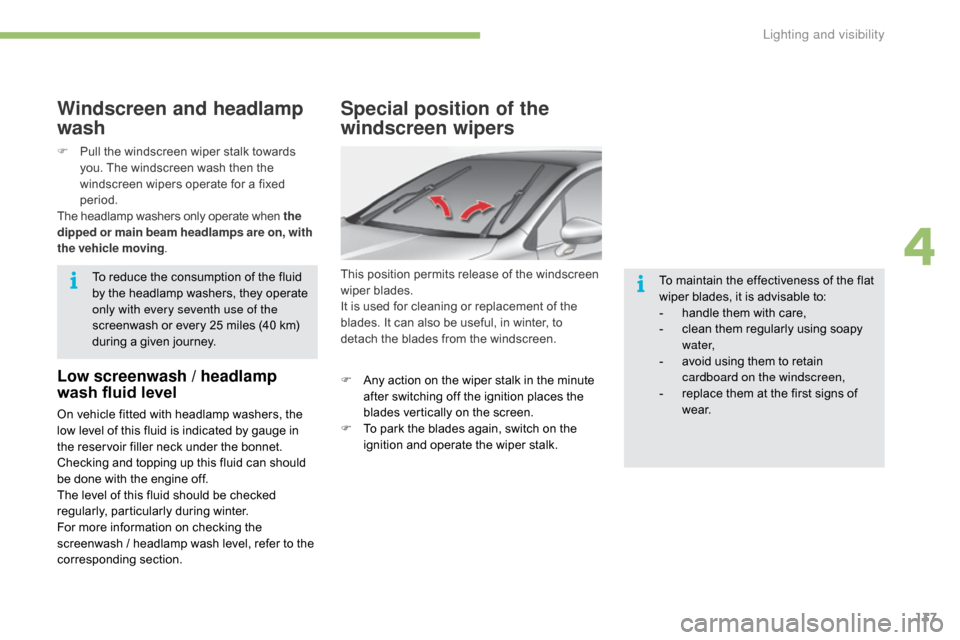
Special position of the
windscreen wipers
This position permits release of the windscreen wiper blades.
It
is used for cleaning or replacement of the
b
lades. It can also be useful, in winter, to
d
etach the blades from the windscreen.
F
A
ny action on the wiper stalk in the minute
a
fter switching off the ignition places the
b
lades vertically on the screen.
F
T
o park the blades again, switch on the
i
gnition and operate the wiper stalk.To
maintain the effectiveness of the flat
w
iper blades, it is advisable to:
-
h
andle them with care,
-
c
lean them regularly using soapy
w
ater,
-
a
void using them to retain
c
ardboard on the windscreen,
-
r
eplace them at the first signs of
w
e a r.
Windscreen and headlamp
wash
Low screenwash / headlamp
wash fluid level
On vehicle fitted with headlamp washers, the low level of this fluid is indicated by gauge in
t
he reservoir filler neck under the bonnet.
Checking
and topping up this fluid can should
b
e done with the engine off.
The
level of this fluid should be checked
r
egularly,
par
ticularly
d
uring
w
inter.
For
more information on checking the
s
creenwash / headlamp wash level, refer to the
c
orresponding
s
ection.
F
P
ull the windscreen wiper stalk towards
y
ou. The windscreen wash then the
w
indscreen wipers operate for a fixed
p
eriod.
The headlamp washers only operate when the
dipped or main beam headlamps are on , with
the vehicle moving .
To reduce the consumption of the fluid
b
y the headlamp washers, they operate
o
nly with every seventh use of the
screenwash or every 25 miles (40 km)
d
uring a given journey.
4
Lighting and visibility
Page 225 of 396
223
C4-2_en_Chap07_infos-pratiques_ed02-2015
Bonnet
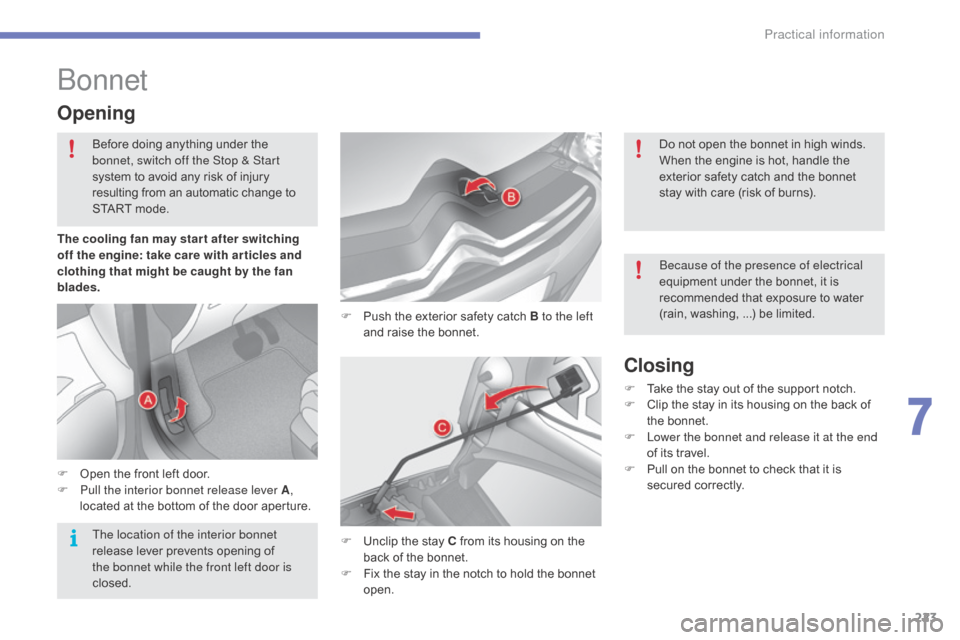
F Push the exterior safety catch B to the left
and raise the bonnet.
Opening
F Open the front left door.
F P ull the interior bonnet release lever A,
located
at the bottom of the door aperture.
F
U
nclip the stay C from its housing on the
b
ack of the bonnet.
F
F
ix the stay in the notch to hold the bonnet
ope
n.
Closing
F Take the stay out of the support notch.
F C lip the stay in its housing on the back of
t
he bonnet.
F
L
ower the bonnet and release it at the end
of
its travel.
F
P
ull on the bonnet to check that it is
s
ecured
c
orrectly.
The cooling fan may star t after switching
off the engine: take care with ar ticles and
clothing that might be caught by the fan
blades.
Before
doing
anything
under
the
b
onnet, switch off the Stop & Start
system
to
avoid
any
risk
of
injury
r
esulting
from
an
automatic
c
hange
t
o
S
TART
mode.
Do not open the bonnet in high winds.
When the engine is hot, handle the
e
xterior safety catch and the bonnet
s
tay with care (risk of burns).
Because of the presence of electrical
equipment under the bonnet, it is
r
ecommended that exposure to water
(
rain,
w
ashing, ...) be limited.
The location of the interior bonnet
release
lever
prevents
opening
of
t
he bonnet while the front left door is
closed.
7
Practical information
Page 230 of 396
228
C4-2_en_Chap07_infos-pratiques_ed02-2015
Screenwash / headlamp
wash fluid level
Specification of the fluid
To ensure optimum cleaning and to avoid freezing, the fluid should never be topped up or r
eplaced by plain water.
In wintry conditions, the use of a fluid
with
an ethyl alcohol or methanol base is
re
commended.
To
check
the
level
or
top
up
the
f
luid
on
vehicle
fitted
with
headlamp
w
ashers,
immobilise
the
vehicle
and
s
witch
of
the
engine.
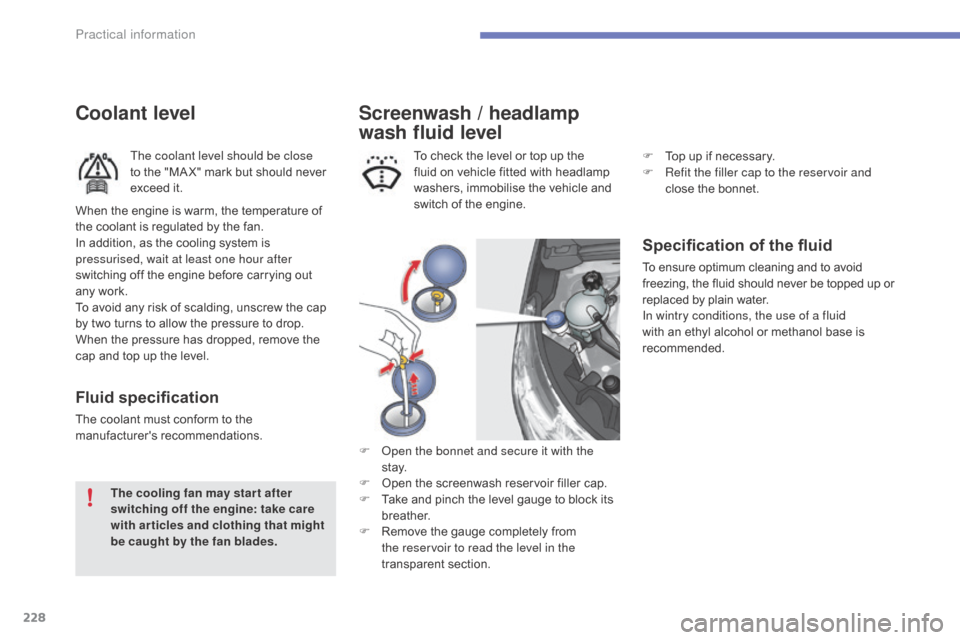
F
O
pen the bonnet and secure it with the
st ay.
F
O
pen
the
screenwash
reservoir
filler
cap.
F
T
ake
and
pinch
the
level
gauge
to
block
its
b
reather.
F
R
emove
the
gauge
completely
from
t
he reservoir to read the level in the
transparent
s
ection.
Coolant level
The coolant level should be close
to the "MA X" mark but should never
e
xceed it.
Fluid specification
The coolant must conform to the manufacturer's r ecommendations.
The cooling fan may star t after
switching off the engine: take care
with articles and clothing that might
be caught by the fan blades.
When
the engine is warm, the temperature of
t
he coolant is regulated by the fan.
In addition, as the cooling system is
p
ressurised, wait at least one hour after
switching off the engine before carrying out
any work.
To avoid any risk of scalding, unscrew the cap
b
y two turns to allow the pressure to drop.
W
hen the pressure has dropped, remove the
c
ap and top up the level. F
T
op up if necessary.
F
R
efit the filler cap to the reservoir and
close the bonnet.
Practical information
Page 240 of 396
238
C4-2_en_Chap08_en-cas-de-panne_ed02-2015
Running out of fuel (Diesel)
Other HDi engines
(except BlueHDi version)
On
vehicles
fitted
with
Diesel
engines,
the
fuel
s
ystem
must
be
primed
if
you
run
out
of
fuel.
For all versions other than BlueHDi, refer to the
corresponding
engine
compartment
view.
For
more
information
on
the
Diesel
m
isfuel
prevention
device,
refer
to
the
c
orresponding
s
ection.
BlueHDi engines
If the engine does not start first time, d on't keep trying but start the procedure
a
gain from the beginning. F
A
dd at least five litres of Diesel fuel to the
tank.
F
O
pen the bonnet.
F
I
f necessary, unclip the styling cover for
a
ccess to the priming pump.
F
S
queeze and release the priming pump
r
epeatedly until resistance is felt (there
m
ay be resistance at the first press).
F
O
perate the starter to start the engine
(
if the engine does not start at the first
a
ttempt, wait around 15 seconds before t
rying ag ain).
F I f the engine does not start after a few
a
ttempts, operate the priming pump again
t
hen start the engine.
F
R
efit the styling cover and clip it in place.
F
C
lose the bonnet.
F
F
ill the fuel tank with at least five litres of
D
iesel.
F
S
witch on the ignition (without starting the
e
ngine).
F
W
ait around 6 seconds and switch off the
ig
nition.
F
R
epeat the operation 10 times.
F
O
perate the starter to run the engine.
In the event of a breakdown
Page 254 of 396
252
C4-2_en_Chap08_en-cas-de-panne_ed02-2015
F Remove the air deflector by unclipping e
ach of its three attachment points.
F
U
nclip the bonnet release cable at its
two
fixings.
F
M
ove the cable down.
After
changing the failed bulb, remember to
p
ut everything back in place (cable and air
d
eflector).
Depending
on the engine and only on the left
h
and side, you must first carry out the following
o
perations for access to the protective covers
on the bulbs.
Access to bulbs
Model with halogen headlamps
and LED light signature* (type 2)
1. Direction indicators (LEDs).
2. Daytime running lamps / sidelamps (LEDs).3. Dipped beam headlamps (H7).
4. M
ain beam headlamps (H7).
5.
F
o g l a m p s ( H11) .
Bulbs
with lugs, type H1, H7... take care
t
o position them correctly to ensure the
b
est
l
ighting.
Model with halogen headlamps
(t y p e 1)
1. Direction indicators (H21 clear).
2. Dipped beam headlamps (H7).
3.
M
ain beam headlamps (H1).
4.
D
aytime running lamps / sidelamps
(P21/5W XL).
5.
F
o g l a m p s ( H11) .Bulbs
with lugs, type H1, H7... take care
t
o position them correctly to ensure the
b
est
l
ighting.
*
LED: light emitting diodes.
In the event of a breakdown