check engine CITROEN C4 2019 User Guide
[x] Cancel search | Manufacturer: CITROEN, Model Year: 2019, Model line: C4, Model: CITROEN C4 2019Pages: 317, PDF Size: 9.31 MB
Page 58 of 317
56
C4-cactus_en_Chap03_Ergonomie-et-confort_ed01-2016
In order for these systems to be fully effective, follow the operation and maintenance guidelines belo w:
F
T
o obtain an even air distribution, take care not to obstruct the exterior air intake grilles
l
ocated at the base of the windscreen, the nozzles, the vents and the air outlets, as well
as
the air extractor located in the boot.
F
D
o not cover the sunshine sensor, located on the dashboard; this is used for regulation
o
f the air conditioning system.
F
O
perate the air conditioning system for at least 5 to 10 minutes, once or twice a month
t
o keep it in per fect working order.
F
E
nsure that the passenger compartment filter is in good condition and have the filter
e
lements replaced regularly.
W
e recommend the use of a combined passenger compartment filter. Thanks to its
s
pecial active additive, it contributes to the purification of the air breathed by the
occupants
and the cleanliness of the passenger compartment (reduction of allergic
s
ymptoms, bad odours and greasy deposits).
F
T
o ensure correct operation of the air conditioning system, you are also advised to have
i
t checked regularly as recommended in the maintenance and warranty guide.
F
I
f the system does not produce cold air, switch it off and contact a CITROËN dealer or a
q
ualified
w
orkshop.
Recommendations for ventilation and air conditioning
If after an extended stop in sunshine, the i nterior t emperature i s v ery h igh, f irst
v
entilate the passenger compartment for
a
few moments.
Put
the air flow control at a setting high
e
nough to quickly change the air in the
p
assenger
c
ompartment.
The
air conditioning system does not
c
ontain chlorine and does not present
any
danger to the ozone layer.
The condensation created by the air
conditioning
results in a discharge
o
f water under the vehicle which is
per fectly
normal.
When
towing
the
maximum
load
on
a
steep
gradient
in
high
temperatures,
switching
off
the
a
ir
conditioning
increases
the
available
engine
power
and
so
improves
the
towing
ability.
Stop & Start
The heating and air conditioning s ystems only work when the engine is
r
unning.
To
maintain a comfortable temperature
i
n the passenger compartment, you can
t
emporarily deactivate the Stop & Start
s
ystem.
For
more information on Stop & Start,
r
efer to the corresponding section.
Ease of use and comfort
Page 95 of 317
93
C4-cactus_en_Chap05_securite_ed01-2016
Dynamic stability control
(DSC) and anti-slip regulation
(ASR)The DSC system offers exceptional safety in normal driving, but this should
n
ot encourage the driver to take extra
r
isks or drive at high speed.
The
correct operation of the system
d
epends on observation of the
manufacturer's
r
ecommendations
r
egarding the wheels (tyres and rims),
t
he braking components, the electronic
c
omponents and the CITROËN
a
ssembly and operation procedures.
After
an impact, have the system
c
hecked by a CITROËN dealer or a
q
ualified
w
orkshop.
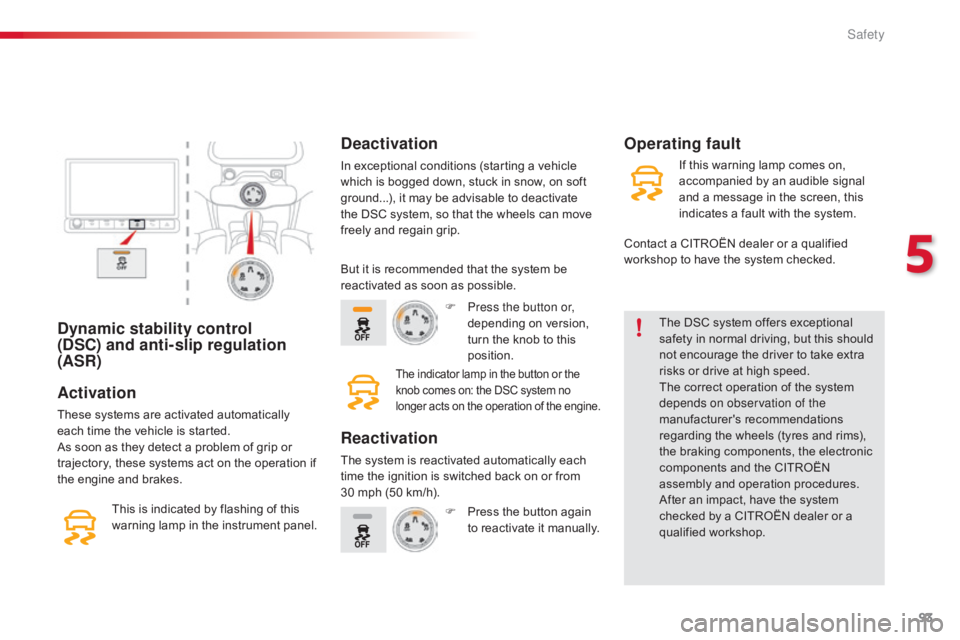
Activation
These systems are activated automatically each time the vehicle is started.
As
soon as they detect a problem of grip or
t
rajectory, these systems act on the operation if
t
he engine and brakes.
Deactivation
In exceptional conditions (starting a vehicle which is bogged down, stuck in snow, on soft
g
round...), it may be advisable to deactivate
t
he DSC system, so that the wheels can move
f
reely and regain grip.
This
is
indicated
by
flashing
of
this
w
arning
lamp
in
the
instrument
panel.
Operating fault
But it is recommended that the system be r eactivated as soon as possible.
F
P
ress the button or,
depending
on version,
t
urn the knob to this
p
osition.
The indicator lamp in the button or the knob comes on: the DSC system no l
onger acts on the operation of the engine.
Reactivation
The system is reactivated automatically each time the ignition is switched back on or from
3
0 mph (50 km/h).F
P
ress the button again
t
o reactivate it manually.If
this warning lamp comes on,
a
ccompanied by an audible signal
a
nd a message in the screen, this
i
ndicates a fault with the system.
Contact a CITROËN dealer or a qualified
w
orkshop to have the system checked.
5
Safety
Page 122 of 317
120
C4-cactus_en_Chap06_conduite_ed01-2016
When towing
Distribution of loads
F Distribute the load in the trailer so that the heaviest items are as close as possible to
t
he axle and the nose weight approaches
t
he maximum permitted without
e
xceeding it.
Air density decreases with altitude, thus
reducing
engine per formance. Above
1 0
00 metres, the maximum towed load must
b
e reduced by 10 % for every 1 000 metres of
al
titude.
For
more information on weights (and the
t
owed loads which apply to your vehicle) refer
to
the corresponding section.
Side wind
F Take into account the increased sensitivity t
o side wind.
Cooling
Towing a trailer on a slope increases the temperature of the coolant.
As
the fan is electrically controlled, its cooling
c
apacity is not dependent on the engine speed.
F
T
o lower the engine speed, reduce your
s
peed.
The
maximum towed load on a long incline
d
epends on the gradient and the ambient
t
emperature.
In
all cases, keep a check on the coolant
t
emperature. F
I
f the warning lamp and the
S
TOP
warning lamp come on,
s
top the vehicle and switch off
the
engine as soon as possible.
Braking
Towing a trailer increases the braking distance.
T o avoid overheating of the brakes, the use of
e
ngine braking is recommended.
Ty r e s
F Check the tyre pressures of the towing v
ehicle and of the trailer, observing the
re
commended
p
ressures.
Lighting
F Check the electrical lighting and signalling o
n the trailer and the hadlamp beam height
o
f your vehicle.
For
more information on adjusting the
h
eadlamp beam height, refer to the
c
orresponding
s
ection.
The
rear parking sensors will be
d
eactivated automatically if a genuine
C
ITROËN towbar is used.
Driving
Page 132 of 317
130
C4-cactus_en_Chap06_conduite_ed01-2016
Before switching off the engine:
- p ress control N to be in neutral,
or
-
l
eave the vehicle in gear; in this case the
v
ehicle cannot be moved.
Stopping the vehicle
For all parking situations, you must
ap ply the parking brake to immobilise
t
he vehicle.
When
immobilising the vehicle with
t
he engine running, you must select
neu
tral
N.
Operating fault
- - - appears in the instrument panel.
F
P
ress control N .
F
P
ress
the brake pedal.
F
W
ait
for around 30 seconds until N or a
gear
appears in the instrument panel.
F
P
ress control D , then N.
F
W
ith
your foot still on the brake pedal, start
t
he
eng
ine.
The
gearbox is operational again.
Reinitialisation
(5-speed electronic
gearbox)
Following disconnection of the battery, it is necessary to reinitialise the gearbox.
F
S
witch on the ignition.
In
exceptional circumstances, the
g
earbox may need an automatic
r
einitialisation: starting and gear
c
hanging are no longer possible.
- - -
appears in the instrument
pan
el.
Follow
the procedure described above.
Before
d
oing
a
nything
u
nder
t
he
b
onnet,
e
nsure that control N has been pressed
and
that
the
parking
brake
is
applied. With
the ignition on, illumination of t
his warning lamp, accompanied by
a
n audible signal and a message,
i
ndicates a gearbox fault.
Have
it checked by a CITROËN dealer or a
q
ualified
w
orkshop.
Driving
Page 136 of 317
134
C4-cactus_en_Chap06_conduite_ed01-2016
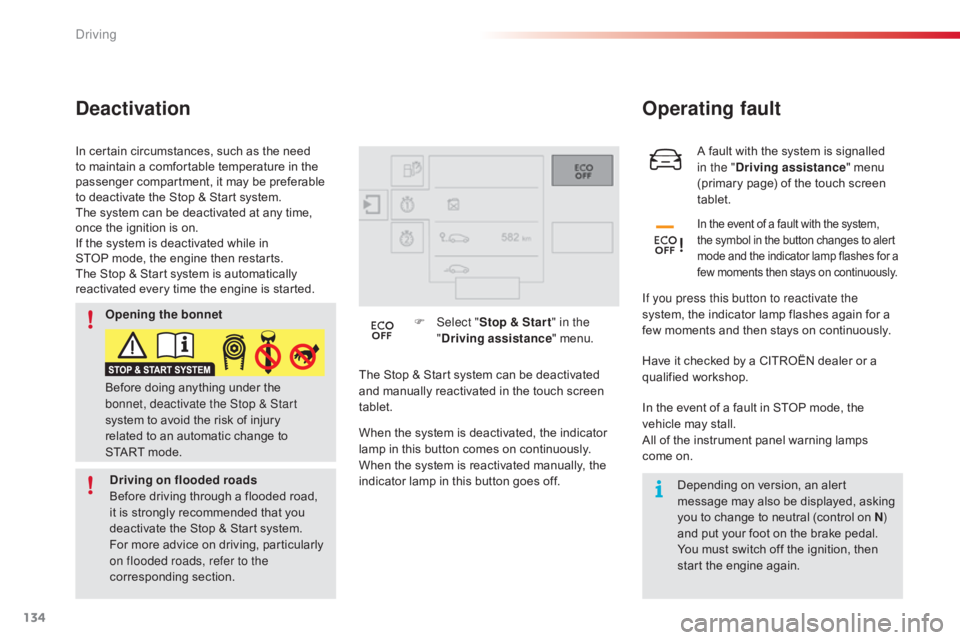
A fault with the system is signalled in the " Driving assistance "
menu
(
primary page) of the touch screen
t
ablet.
Operating fault
In the event of a fault with the system, the symbol in the button changes to alert m
ode and the indicator lamp flashes for a
f
ew moments then stays on continuously.
If you press this button to reactivate the
system, the indicator lamp flashes again for a
f
ew moments and then stays on continuously.
In
certain
circumstances,
such
as
the
need
t
o
maintain
a
comfortable
temperature
in
the
p
assenger
compartment,
it
may
be
preferable
t
o
deactivate
the
Stop
&
Start
system.
The
system
can
be
deactivated
at
any
time,
o
nce
the
ignition
is
on.
If
the
system
is
deactivated
while
in
S
TOP mode,
the
engine
then
restarts.
The
Stop
&
Start
system
is
automatically
r
eactivated
every
time
the
engine
is
started.
Deactivation
The Stop & Start system can be deactivated a
nd manually reactivated in the touch screen
t
ablet. F
Sel
ect "
Stop & Star t " in the
" Driving assistance " menu.
When the system is deactivated, the indicator
l
amp in this button comes on continuously.
When
the system is reactivated manually, the
i
ndicator lamp in this button goes off.Have
it checked by a CITROËN dealer or a q
ualified w orkshop.
In
the event of a fault in STOP mode, the
v
ehicle may stall.
All
of the instrument panel warning lamps
come
on.Depending
on version, an alert
m
essage may also be displayed, asking
y
ou to change to neutral (control on N)
and
put your foot on the brake pedal.
You
must switch off the ignition, then
s
tart the engine again.
Before
doing
anything
under
the
b
onnet, deactivate the Stop & Start
system
to
avoid
the
risk
of
injury
r
elated
to
an
automatic
change
to
S
TART mode.
Opening the bonnet
Driving on flooded roads
Before
driving
through
a
flooded
road,
i
t
is
strongly
recommended
that
you
d
eactivate
the
Stop
&
Start
system.
For
more
advice
on
driving,
particularly
o
n flooded roads, refer to the
corresponding
s
ection.
Driving
Page 169 of 317
167
C4-cactus_en_Chap07_info-pratiques_ed01-2016
Bonnet
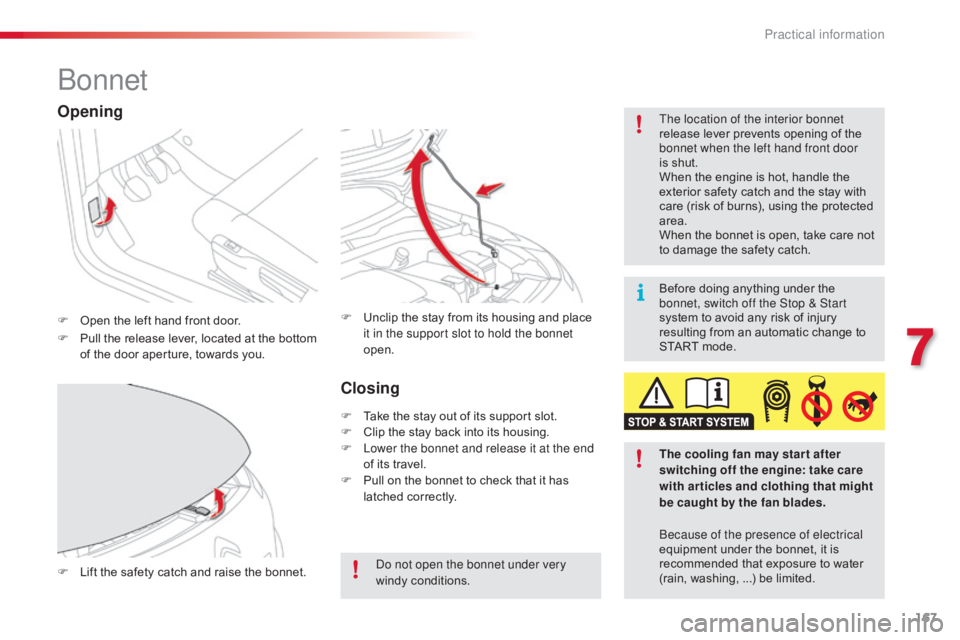
F Open the left hand front door. The location of the interior bonnet
release
lever prevents opening of the
b
onnet when the left hand front door
is shut.
When the engine is hot, handle the
e
xterior safety catch and the stay with
c
are (risk of burns), using the protected
a
rea.
When the bonnet is open, take care not
t
o damage the safety catch.
F
L
ift the safety catch and raise the bonnet.F
U nclip the stay from its housing and place i
t in the support slot to hold the bonnet
open.
Opening
F Pull the release lever, located at the bottom o
f the door aperture, towards you.
The cooling fan may star t after
switching off the engine: take care
with articles and clothing that might
be caught by the fan blades.
Do not open the bonnet under very
windy
c
onditions.
Closing
F Take the stay out of its support slot.
F C lip the stay back into its housing.
F
L
ower the bonnet and release it at the end
of
its travel.
F
P
ull on the bonnet to check that it has
l
atched correctly. Because of the presence of electrical
equipment
under the bonnet, it is
r
ecommended that exposure to water
(
rain, washing, ...) be limited.
Before
doing anything under the
b
onnet, switch off the Stop & Start
system to avoid any risk of injury
r
esulting from an automatic change to
S
TART mode.
7
Practical information
Page 172 of 317
170
C4-cactus_en_Chap07_info-pratiques_ed01-2016
Checking levels
Take care when working under the bonnet, as certain areas of the engine
m
ay be extremely hot (risk of burns)
a
nd the cooling fan could start at any
t
ime (even with the ignition off).
Engine oil level
The check is carried out either when the ignition is switched on using the
o
il level indicator in the instrument
p
anel for vehicles so equipped, or
u
sing the dipstick.
Checking using the dipstick
Check all of these levels regularly, in line with the manufacturer's service schedule. Top them up if necessary, unless other wise indicated.
I f a level drops significantly, have the corresponding system checked by a CITROËN dealer or a qualified workshop.
If you find that the level is above the A
mark or
belo
w the B mark, do not star t the engine.
-
I
f the level is above the MAX
mark (risk
o
f damage to the engine), contact a
C
ITROËN dealer or a qualified workshop.
-
I
f the level is below the MIN
mark, you
m
ust top up the engine oil.
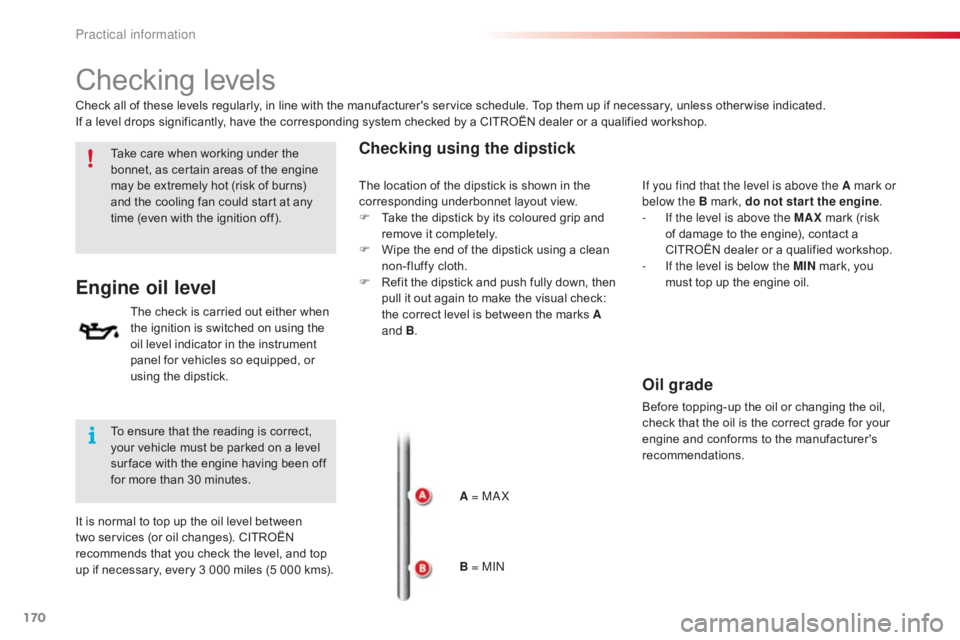
A = MA X
B = MIN
To
ensure that the reading is correct,
y
our vehicle must be parked on a level
s
ur face with the engine having been off
f
or more than 30 minutes.
It
is normal to top up the oil level between
t
wo services (or oil changes). CITROËN
r
ecommends that you check the level, and top
u
p if necessary, every 3 000 miles (5 000 kms).The
location of the dipstick is shown in the
c
orresponding underbonnet layout view.
F
T
ake the dipstick by its coloured grip and
r
emove it completely.
F
W
ipe the end of the dipstick using a clean
n
on-fluffy cloth.
F
R
efit the dipstick and push fully down, then
p
ull it out again to make the visual check:
t
he correct level is between the marks A
and B .
Oil grade
Before topping-up the oil or changing the oil, c
heck that the oil is the correct grade for your
e
ngine and conforms to the manufacturer's
r
ecommendations.
Practical information
Page 173 of 317
171
C4-cactus_en_Chap07_info-pratiques_ed01-2016
After topping-up the oil, the check when switching on the ignition with the oil
l
evel indicator in the instrument panel
i
s not valid during the 30 minutes after
t
opping up.
Topping-up the engine oil level
The location of the oil filler cap is shown in the
corresponding underbonnet layout view.
F
U
nscrew the oil filler cap to reveal the filler
aperture.
F
A
dd oil in small quantities, avoiding any
s
pills on engine components (risk of fire).
F
W
ait a few minutes before checking the
l
evel again using the dipstick.
F
A
dd more oil if necessary.
F
A
fter checking the level, carefully refit the
o
il filler cap and the dipstick in its tube.
Engine oil change
Refer to the manufacturer's service schedule for details of the interval for this operation.
In
order to maintain the reliability of the engine
a
nd emission control system, never use
a
dditives in the engine oil. The
brake fluid level should be close t
o the "MA X" mark. If it is not, check t
he brake pad wear.
Brake fluid level
Changing the fluid
Refer to the manufacturer's service schedule f
or details of the interval for this operation.
Fluid specification
The brake fluid must conform to the manufacturer's r ecommendations.
7
Practical information
Page 175 of 317
173
C4-cactus_en_Chap07_info-pratiques_ed01-2016
Checks
12 V battery
The battery does not require any maintenance.
H owever, check regularly that the terminals
a
re correctly tightened (versions without quick
r
elease terminals) and that the connections
a
re clean.Refer to the manufacturer's service schedule for details of the
replacement
intervals for these
c
omponents.
Air filter and passenger compartment filter
Replace the oil filter each time the e ngine oil is changed.
Refer
to the manufacturer's
s
ervice schedule for details of
the
replacement interval for this
c
omponent.
Oil filter
Unless other wise indicated, check these components in accordance with the manufacturer's service schedule and according to your engine.
O ther wise, have them checked by a CITROËN dealer or a qualified workshop.
Depending
on the environment (e.g. dusty
a
tmosphere) and the use of the vehicle
(e.g.
city driving), replace them twice as often
if necessary .
A
clogged passenger compartment filter may
h
ave an adverse effect on the per formance
o
f the air conditioning system and generate
u
ndesirable
o
dours.
Particle filter (Diesel)
The start of saturation of the
particle filter is indicated by the
fixed illumination of this warning
l
amp accompanied by a warning
m
essage.
As
soon
as
the traffic conditions permit,
r
egenerate
the filter by driving at a speed of at
l
east
40
mph (60 km/h) until the warning lamp
g
oes
off.
If
the
warning lamp stays on, this indicates a
l
ow
additive level.
Refer
to
the "Diesel additive level" section.
On a new vehicle, the first particle
filter
regeneration operations may be
a
ccompanied by a "burning" smell,
w
hich is per fectly normal.
Following
prolonged operation of the
v
ehicle at very low speed or at idle,
you
may, in exceptional circumstances,
n
otice the emission of water vapour at
t
he
exhaust on acceleration. This does
n
ot affect the behaviour of the vehicle
or
the environment.
When
carrying
out
any
operation
on
the
12
V
b
attery,
refer
to
the
corresponding
section
for
d
etails
of
the
precautions
to
be
taken
before
s
tarting
work.
Versions
equipped
with
Stop
&
Start
are
f
itted with a 12 V lead-acid battery of
specific
t
echnology
a
nd
s
pecification.
Its
replacement
should
be
carried
out
o
nly
by
a
CITROËN
dealer
or
a
qualified
w
orkshop.
7
Practical information
Page 176 of 317
174
C4-cactus_en_Chap07_info-pratiques_ed01-2016
Brake wear depends on the style of driving, particularly in the case
o
f vehicles used in town, over short
distances.
It may be necessary to
Brake pads
For information on checking brake disc wear, contact a CITROËN dealer
or
a qualified workshop.
Brake disc wearOnly use products recommended by CITROËN or products of equivalent
q
uality
an
d
sp
ecification.
In
order to optimise the operation of
u
nits as important as those in the
b
raking system, CITROËN selects and
o
ffers very specific products.
After
washing the vehicle, dampness,
o
r in wintry conditions, ice can form
o
n the brake discs and pads: braking
e
fficiency may be reduced. Make light
b
rake applications to dry and defrost
t
he brakes.Manual gearbox
The gearbox does not require any maintenance (no oil change).
Refer
to the manufacturer's service
s
chedule for the checking interval for
t
his
c
omponent.
Electronic gearbox
The gearbox does not require any maintenance (no oil change).
Refer
to the manufacturer's service
s
chedule for details of the checking
i
nterval for this component.
Parking brake
If excessive travel or a loss of effectiveness of this system is
n
oticed, the parking brake must be
c
hecked, even between two services.
Checking
this system must be done by a
C
ITROËN dealer or a qualified workshop. To
avoid damaging the electrical units,
n
ever use a high pressure jet wash in
t
he engine compartment.
have
the
condition
of
the
brakes
checked,
even
b
etween
v
ehicle
s
ervices.
Unless
there
is
a
leak
in
the
circuit,
a
drop
in
t
he
brake
fluid
level
indicates
that
the
brake
p
ads
are
worn.
Practical information