oil CITROEN C4 2019 User Guide
[x] Cancel search | Manufacturer: CITROEN, Model Year: 2019, Model line: C4, Model: CITROEN C4 2019Pages: 317, PDF Size: 9.31 MB
Page 170 of 317
168
C4-cactus_en_Chap07_info-pratiques_ed01-2016
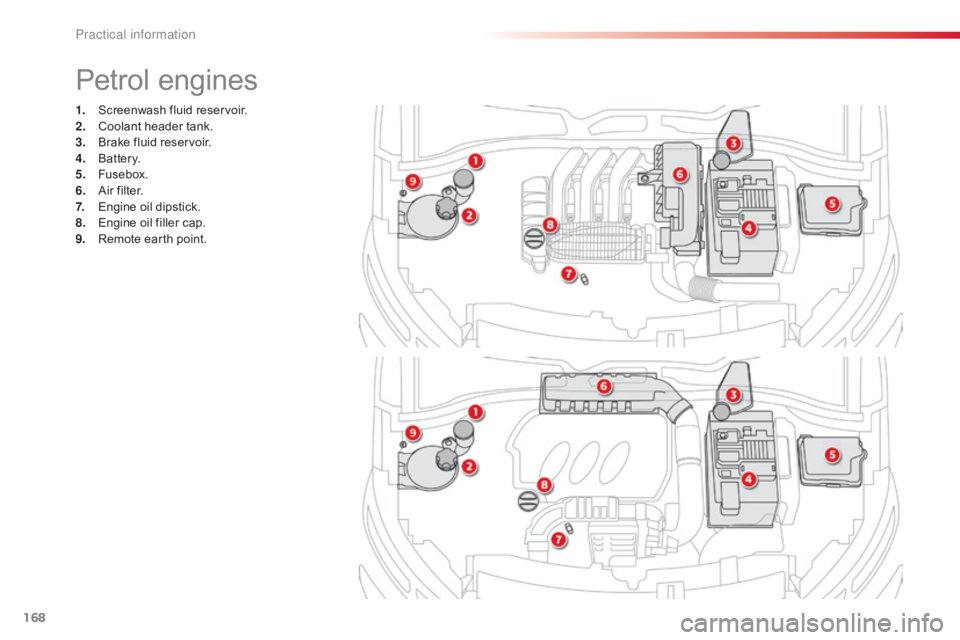
1. Screenwash fluid reservoir.
2. C oolant header tank.
3.
B
rake fluid reservoir.
4.
B
attery.
5.
F
usebox.
6.
A
ir filter.
7.
E
ngine oil dipstick.
8.
E
ngine oil filler cap.
9.
R
emote earth point.
Petrol engines
Practical information
Page 171 of 317
169
C4-cactus_en_Chap07_info-pratiques_ed01-2016
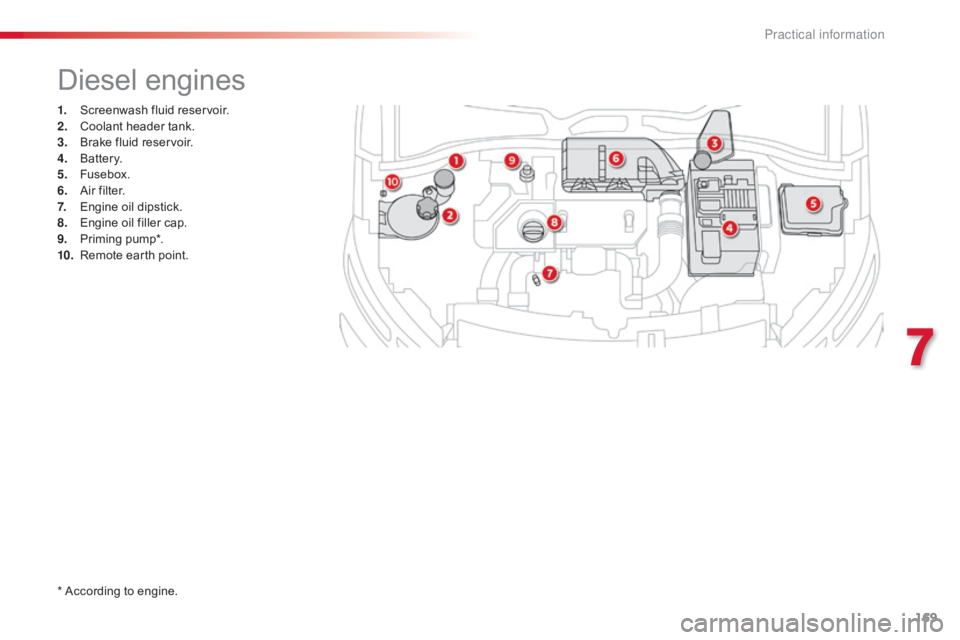
1. Screenwash fluid reservoir.
2. C oolant header tank.
3.
B
rake fluid reservoir.
4.
B
attery.
5.
F
usebox.
6.
A
ir filter.
7.
E
ngine oil dipstick.
8.
E
ngine oil filler cap.
9.
P
riming
pu
mp*.
10.
R
emote earth point.
Diesel engines
* According to engine.
7
Practical information
Page 172 of 317
170
C4-cactus_en_Chap07_info-pratiques_ed01-2016
Checking levels
Take care when working under the bonnet, as certain areas of the engine
m
ay be extremely hot (risk of burns)
a
nd the cooling fan could start at any
t
ime (even with the ignition off).
Engine oil level
The check is carried out either when the ignition is switched on using the
o
il level indicator in the instrument
p
anel for vehicles so equipped, or
u
sing the dipstick.
Checking using the dipstick
Check all of these levels regularly, in line with the manufacturer's service schedule. Top them up if necessary, unless other wise indicated.
I f a level drops significantly, have the corresponding system checked by a CITROËN dealer or a qualified workshop.
If you find that the level is above the A
mark or
belo
w the B mark, do not star t the engine.
-
I
f the level is above the MAX
mark (risk
o
f damage to the engine), contact a
C
ITROËN dealer or a qualified workshop.
-
I
f the level is below the MIN
mark, you
m
ust top up the engine oil.
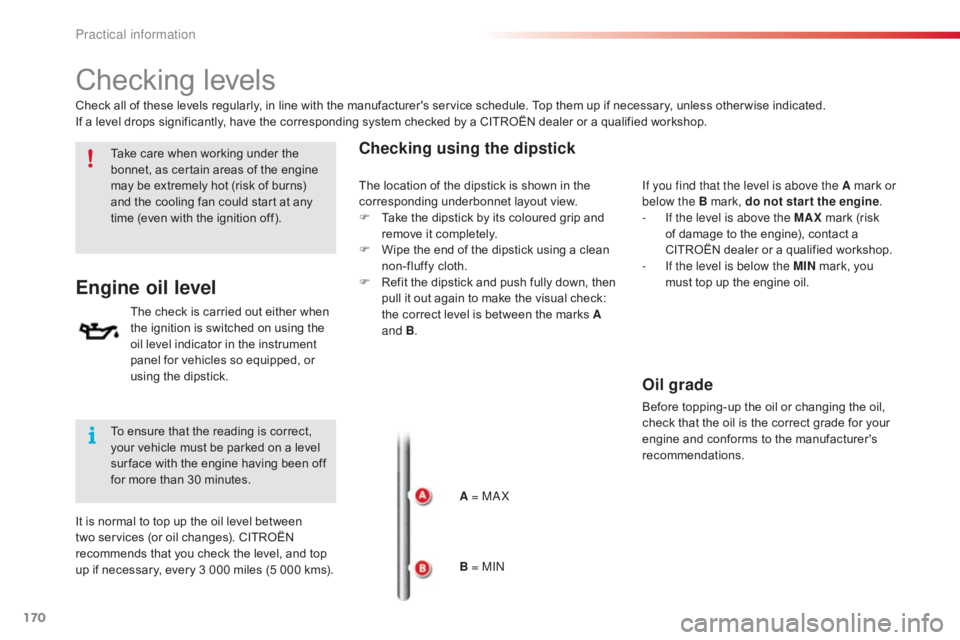
A = MA X
B = MIN
To
ensure that the reading is correct,
y
our vehicle must be parked on a level
s
ur face with the engine having been off
f
or more than 30 minutes.
It
is normal to top up the oil level between
t
wo services (or oil changes). CITROËN
r
ecommends that you check the level, and top
u
p if necessary, every 3 000 miles (5 000 kms).The
location of the dipstick is shown in the
c
orresponding underbonnet layout view.
F
T
ake the dipstick by its coloured grip and
r
emove it completely.
F
W
ipe the end of the dipstick using a clean
n
on-fluffy cloth.
F
R
efit the dipstick and push fully down, then
p
ull it out again to make the visual check:
t
he correct level is between the marks A
and B .
Oil grade
Before topping-up the oil or changing the oil, c
heck that the oil is the correct grade for your
e
ngine and conforms to the manufacturer's
r
ecommendations.
Practical information
Page 173 of 317
171
C4-cactus_en_Chap07_info-pratiques_ed01-2016
After topping-up the oil, the check when switching on the ignition with the oil
l
evel indicator in the instrument panel
i
s not valid during the 30 minutes after
t
opping up.
Topping-up the engine oil level
The location of the oil filler cap is shown in the
corresponding underbonnet layout view.
F
U
nscrew the oil filler cap to reveal the filler
aperture.
F
A
dd oil in small quantities, avoiding any
s
pills on engine components (risk of fire).
F
W
ait a few minutes before checking the
l
evel again using the dipstick.
F
A
dd more oil if necessary.
F
A
fter checking the level, carefully refit the
o
il filler cap and the dipstick in its tube.
Engine oil change
Refer to the manufacturer's service schedule for details of the interval for this operation.
In
order to maintain the reliability of the engine
a
nd emission control system, never use
a
dditives in the engine oil. The
brake fluid level should be close t
o the "MA X" mark. If it is not, check t
he brake pad wear.
Brake fluid level
Changing the fluid
Refer to the manufacturer's service schedule f
or details of the interval for this operation.
Fluid specification
The brake fluid must conform to the manufacturer's r ecommendations.
7
Practical information
Page 174 of 317
172
C4-cactus_en_Chap07_info-pratiques_ed01-2016
Coolant level
The coolant level should be close
to the "MA X" mark but should never
e
xceed it.
In
addition, as the cooling system is pressurised,
w
ait
at
least one hour after switching off the
e
ngine
before carrying out any work.
To
avoid
any risk of scalding, unscrew the cap by
t
wo
turns
to allow the pressure to drop. When the
p
ressure
has dropped, remove the cap and top
u
p
the
level.
Changing the coolant
The coolant does not have to be replaced at routine services.
The cooling fan may star t after switching
off the engine: take care with ar ticles and
clothing that might be caught by the fan
blades. When the engine is warm, the temperature of
t
he coolant is regulated by the fan.
Fluid specification
The coolant must conform to the ma
nufacturer's r ecommendations.
Fluid specification
For optimum cleaning and to avoid freezing, this fluid must not be topped up or replaced
w
ith plain water.
In
w
intry
c
onditions,
i
t
i
s
r
ecommended
t
hat
y
ou
u
se an ethyl alcohol or methanol based fluid.
Screenwash fluid level
Top up the level when necessary.
To p p i n g u p
The reservoir must be topped up without delay by a CITROËN dealer or a qualified workshop.
Diesel fuel additive
level (Diesel with particle
filter)
The additive reservoir low level is
indicated by fixed illumination of
A
void prolonged contact of used oil or
f
luids with the skin.
Most of these fluids are harmful to
h
ealth or indeed very corrosive.
Do not discard used oil or fluids into
sewers or onto the ground.
Take used oil to a CITROËN dealer or
a
qualified workshop (France) or to an
a
uthorised waste disposal site.
Used products
this warning lamp, accompanied by an audible s
ignal and a message that the particle filter
a
dditive level is too low.
Practical information
Page 175 of 317
173
C4-cactus_en_Chap07_info-pratiques_ed01-2016
Checks
12 V battery
The battery does not require any maintenance.
H owever, check regularly that the terminals
a
re correctly tightened (versions without quick
r
elease terminals) and that the connections
a
re clean.Refer to the manufacturer's service schedule for details of the
replacement
intervals for these
c
omponents.
Air filter and passenger compartment filter
Replace the oil filter each time the e ngine oil is changed.
Refer
to the manufacturer's
s
ervice schedule for details of
the
replacement interval for this
c
omponent.
Oil filter
Unless other wise indicated, check these components in accordance with the manufacturer's service schedule and according to your engine.
O ther wise, have them checked by a CITROËN dealer or a qualified workshop.
Depending
on the environment (e.g. dusty
a
tmosphere) and the use of the vehicle
(e.g.
city driving), replace them twice as often
if necessary .
A
clogged passenger compartment filter may
h
ave an adverse effect on the per formance
o
f the air conditioning system and generate
u
ndesirable
o
dours.
Particle filter (Diesel)
The start of saturation of the
particle filter is indicated by the
fixed illumination of this warning
l
amp accompanied by a warning
m
essage.
As
soon
as
the traffic conditions permit,
r
egenerate
the filter by driving at a speed of at
l
east
40
mph (60 km/h) until the warning lamp
g
oes
off.
If
the
warning lamp stays on, this indicates a
l
ow
additive level.
Refer
to
the "Diesel additive level" section.
On a new vehicle, the first particle
filter
regeneration operations may be
a
ccompanied by a "burning" smell,
w
hich is per fectly normal.
Following
prolonged operation of the
v
ehicle at very low speed or at idle,
you
may, in exceptional circumstances,
n
otice the emission of water vapour at
t
he
exhaust on acceleration. This does
n
ot affect the behaviour of the vehicle
or
the environment.
When
carrying
out
any
operation
on
the
12
V
b
attery,
refer
to
the
corresponding
section
for
d
etails
of
the
precautions
to
be
taken
before
s
tarting
work.
Versions
equipped
with
Stop
&
Start
are
f
itted with a 12 V lead-acid battery of
specific
t
echnology
a
nd
s
pecification.
Its
replacement
should
be
carried
out
o
nly
by
a
CITROËN
dealer
or
a
qualified
w
orkshop.
7
Practical information
Page 176 of 317
174
C4-cactus_en_Chap07_info-pratiques_ed01-2016
Brake wear depends on the style of driving, particularly in the case
o
f vehicles used in town, over short
distances.
It may be necessary to
Brake pads
For information on checking brake disc wear, contact a CITROËN dealer
or
a qualified workshop.
Brake disc wearOnly use products recommended by CITROËN or products of equivalent
q
uality
an
d
sp
ecification.
In
order to optimise the operation of
u
nits as important as those in the
b
raking system, CITROËN selects and
o
ffers very specific products.
After
washing the vehicle, dampness,
o
r in wintry conditions, ice can form
o
n the brake discs and pads: braking
e
fficiency may be reduced. Make light
b
rake applications to dry and defrost
t
he brakes.Manual gearbox
The gearbox does not require any maintenance (no oil change).
Refer
to the manufacturer's service
s
chedule for the checking interval for
t
his
c
omponent.
Electronic gearbox
The gearbox does not require any maintenance (no oil change).
Refer
to the manufacturer's service
s
chedule for details of the checking
i
nterval for this component.
Parking brake
If excessive travel or a loss of effectiveness of this system is
n
oticed, the parking brake must be
c
hecked, even between two services.
Checking
this system must be done by a
C
ITROËN dealer or a qualified workshop. To
avoid damaging the electrical units,
n
ever use a high pressure jet wash in
t
he engine compartment.
have
the
condition
of
the
brakes
checked,
even
b
etween
v
ehicle
s
ervices.
Unless
there
is
a
leak
in
the
circuit,
a
drop
in
t
he
brake
fluid
level
indicates
that
the
brake
p
ads
are
worn.
Practical information
Page 189 of 317
187
C4-cactus_en_Chap08_En-cas-de-panne_ed01-2016
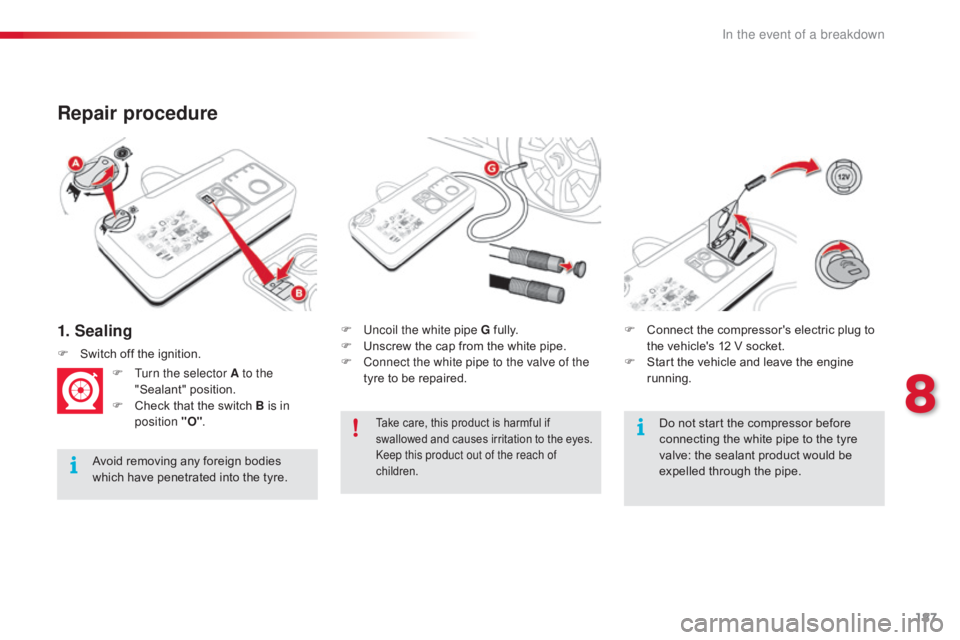
1. Sealing
Repair procedure
Avoid removing any foreign bodies which have penetrated into the tyre.F
U
ncoil the white pipe G
f
ully.
F
U
nscrew the cap from the white pipe.
F
C
onnect the white pipe to the valve of the
tyre to be repaired.
F
S
witch off the ignition.
F
T
urn the selector A to the
"Sealant"
p
osition.
F
C
heck that the switch B is in
position "O" . F
C
onnect the compressor's electric plug to
t
he vehicle's 12 V socket.
F
S
tart the vehicle and leave the engine
r
unning.
Take care, this product is harmful if s
wallowed and causes irritation to the eyes.
Keep this product out of the reach of
children.Do not start the compressor before c onnecting the white pipe to the tyre
v
alve: the sealant product would be
e
xpelled through the pipe.
8
In the event of a breakdown
Page 190 of 317
188
C4-cactus_en_Chap08_En-cas-de-panne_ed01-2016
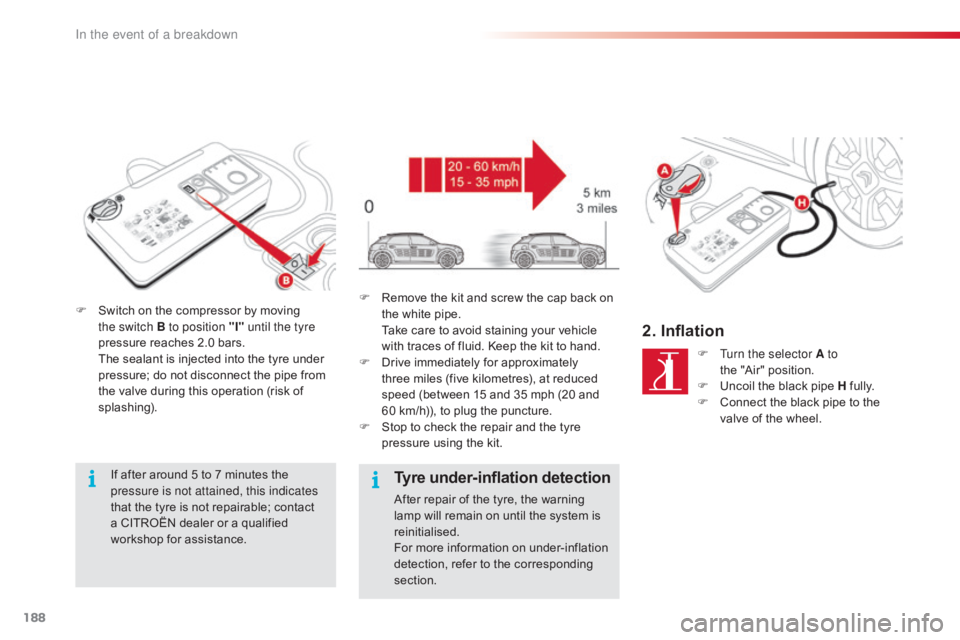
F Switch on the compressor by moving t
he switch B to position "I" until the tyre
pressure
reaches 2.0 bars.
T
he sealant is injected into the tyre under
p
ressure; do not disconnect the pipe from
t
he valve during this operation (risk of
sp
lashing).
If
after around 5 to 7 minutes the
p
ressure is not attained, this indicates
that
the tyre is not repairable; contact
a
CITROËN dealer or a qualified
w
orkshop for assistance. F
R emove the kit and screw the cap back on t
he white pipe.
T
ake care to avoid staining your vehicle
w
ith traces of fluid. Keep the kit to hand.
F
D
rive immediately for approximately
t
hree miles (five kilometres), at reduced
s
peed (between 15 and 35 mph (20 and
6
0 km/h)), to plug the puncture.
F
S
top to check the repair and the tyre
p
ressure using the kit.
Tyre under-inflation detection
After repair of the tyre, the warning lamp will remain on until the system is
r
einitialised.
For
more information on under-inflation
d
etection, refer to the corresponding
s
ection.
2. Inflation
F Turn the selector A to the "Air" position.
F
U
ncoil the black pipe H
f
ully.
F
C
onnect the black pipe to the
v
alve of the wheel.
In the event of a breakdown
Page 192 of 317
190
C4-cactus_en_Chap08_En-cas-de-panne_ed01-2016
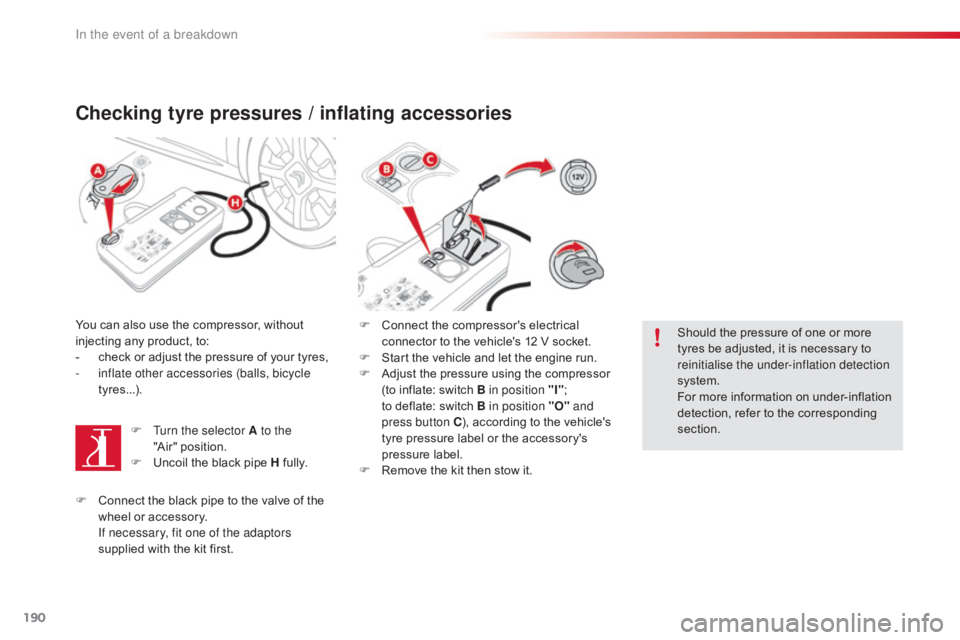
Checking tyre pressures / inflating accessories
You can also use the compressor, without injecting any product, to:
-
c
heck or adjust the pressure of your tyres,
-
i
nflate other accessories (balls, bicycle
tyres...).
F
T
urn the selector A to the
"Air" position.
F
U
ncoil the black pipe H
f
ully.F
C onnect the compressor's electrical
c
onnector to the vehicle's 12 V socket.
F
S
tart the vehicle and let the engine run.
F
A
djust the pressure using the compressor
(
to inflate: switch B in position "I";
t
o deflate: switch B in position "O" and
press button C ),
according to the vehicle's
t
yre pressure label or the accessory's
p
ressure label.
F
R
emove the kit then stow it.Should
the pressure of one or more
t
yres be adjusted, it is necessary to
r
einitialise the under-inflation detection
system.
For
more information on under-inflation
d
etection, refer to the corresponding
s
ection.
F
C
onnect the black pipe to the valve of the
w
heel or accessory.
I
f necessary, fit one of the adaptors
supplied
with the kit first.
In the event of a breakdown