air condition Citroen C4 AIRCROSS 2017 1.G Owner's Guide
[x] Cancel search | Manufacturer: CITROEN, Model Year: 2017, Model line: C4 AIRCROSS, Model: Citroen C4 AIRCROSS 2017 1.GPages: 368, PDF Size: 11.54 MB
Page 153 of 368
151
C4-Aircross_en_Chap06_securite_ed01-2016
Airbags
General information
System designed to contribute towards
improving the safety of the occupants (with
the exception of the rear centre passenger)
in the event of violent collisions. The airbags
supplement the action of the seat belts fitted
with force limiters (all except the centre rear
passenger belt).
If a collision occurs, the electronic detectors
record and analyse the front and side impacts
sustained in the impact detection zones:
-
i
n the case of a serious impact, the airbags
are deployed instantly and contribute
towards better protection of the occupants
of the vehicle (with the exception of the
rear centre passenger); immediately after
the impact, the airbags deflate rapidly so
that they do not hinder visibility or the exit
of the occupants,
-
i
n the case of a minor or rear impact or in
certain roll-over conditions, the airbags
may not be deployed; the seat belt
alone contributes towards ensuring your
protection in these situations.
The airbags do not operate when the
ignition is switched off.
This equipment will only deploy once.
If a second impact occurs (during the
same or a subsequent accident), the
airbag will not be deployed again. Deployment of one or more of the
airbags is accompanied by a slight
emission of smoke and a noise, due
to the activation of the pyrotechnic
cartridge incorporated in the system.
This smoke is not harmful, but sensitive
individuals may experience slight
irritation.
The noise of detonation associated with
the deployment of one or more airbags
may result in a slight loss of hearing for
a short time.
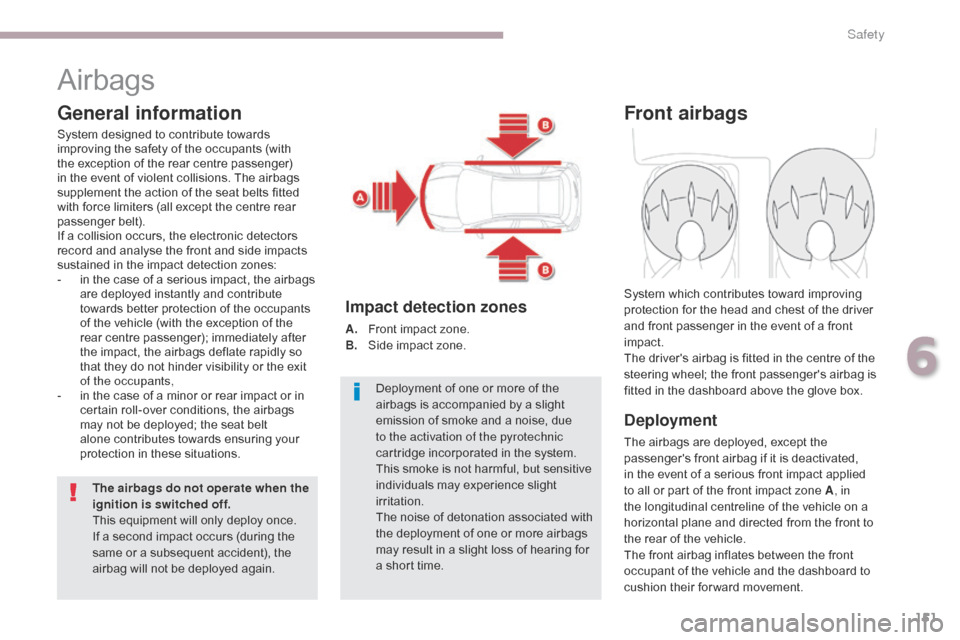
Impact detection zones
A. Front impact zone.
B. S
ide impact zone.
Front airbags
Deployment
The airbags are deployed, except the
passenger's front airbag if it is deactivated,
in the event of a serious front impact applied
to all or part of the front impact zone A , in
the longitudinal centreline of the vehicle on a
horizontal plane and directed from the front to
the rear of the vehicle.
The front airbag inflates between the front
occupant of the vehicle and the dashboard to
cushion their for ward movement. System which contributes toward improving
protection for the head and chest of the driver
and front passenger in the event of a front
impact.
The driver's airbag is fitted in the centre of the
steering wheel; the front passenger's airbag is
fitted in the dashboard above the glove box.
6
Safety
Page 176 of 368
174
C4-Aircross_en_Chap07_info-pratiques_ed01-2016
Fuel used for petrol engines
The petrol engines are compatible with
bio-fuels that conform to current and future
European standards and can be obtained from
filling stations:
Travelling abroad
Cer tain fuels could damage the engine of
your vehicle. In cer tain countries, the use of
a par ticular fuel may be required (specific
octane rating, specific sales name…) to
ensure correct operation of the engine.
For any additional information, contact your
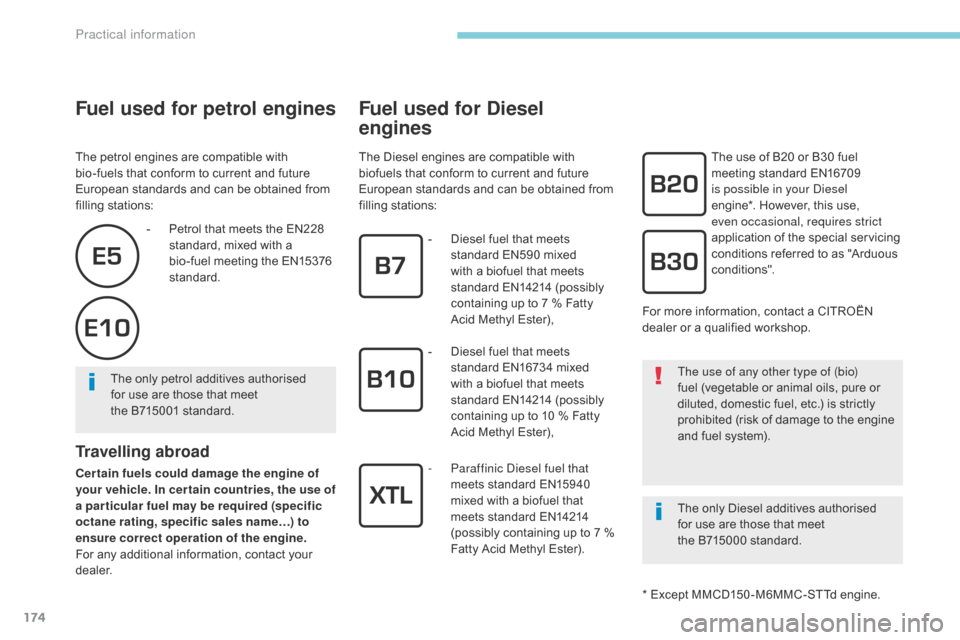
dealer.-
Pe
trol that meets the EN228
standard, mixed with a
bio-fuel meeting the EN15376
standard.
The only petrol additives authorised
for use are those that meet
the B715001 standard.
Fuel used for Diesel
engines
The Diesel engines are compatible with
biofuels that conform to current and future
European standards and can be obtained from
filling stations: The use of B20 or B30 fuel
meeting standard EN16709
is possible in your Diesel
engine*. However, this use,
even occasional, requires strict
application of the special servicing
conditions referred to as "Arduous
conditions".
-
D
iesel fuel that meets
standard EN590 mixed
with a biofuel that meets
standard
EN14214 (possibly
containing up to 7 % Fatty
Acid Methyl Ester),
-
D
iesel fuel that meets
standard EN16734 mixed
with a biofuel that meets
standard
EN14214 (possibly
containing up to 10 % Fatty
Acid Methyl Ester),
-
P
araffinic Diesel fuel that
meets standard EN15940
mixed with a biofuel that
meets standard EN14214
(possibly containing up to 7 %
Fatty Acid Methyl Ester). For more information, contact a CITROËN
dealer or a qualified workshop.
The use of any other type of (bio)
fuel (vegetable or animal oils, pure or
diluted, domestic fuel, etc.) is strictly
prohibited (risk of damage to the engine
and fuel system).
The only Diesel additives authorised
for use are those that meet
the B715000 standard.
* Except MMCD150 -M6MMC-STTd engine.
Practical information
Page 177 of 368
175
C4-Aircross_en_Chap07_info-pratiques_ed01-2016
For more information on snow chains,
contact a CITROËN dealer or a
qualified workshop.
Snow chains
In wintry conditions, snow chains improve traction as well as the behaviour of the vehicle when
braking.
Advice on installation
F If you have to fit the chains during a journey, stop the vehicle on a flat sur face
on the side of the road.
F
A
pply the parking brake and position any
wheel chocks to prevent movement of
your
vehicle.
F
F
it the chains following the instructions
provided by the manufacturer.
F
M
ove off gently and drive for a few
moments, without exceeding 30 mph
(50 km/h).
F
S
top your vehicle and check that the snow
chains are correctly tightened.
The snow chains must be fitted only
to the front wheels. They must never
be fitted to "space-saver" type spare
wheels.
Take account of the legislation in force
in your country on the use of snow
chains and the maximum running speed
authorised.
Avoid driving with snow chains on roads
that have been cleared of snow, to
avoid damaging your vehicle's tyres and
the road sur face. If your vehicle is fitted
with alloy wheels, check that no part of
the chain or its fixings is in contact with
the wheel rim.Use only chains designed for fitment to the type
of road wheels on your vehicle:
Original equipment tyre size Maximum link size
215/70 R16 12 mm
225/55 R18
It is strongly recommended that before
you leave, you practise fitting the snow
chains on a level and dry sur face.
7
Practical information
Page 181 of 368
179
C4-Aircross_en_Chap07_info-pratiques_ed01-2016
Fitting roof bars
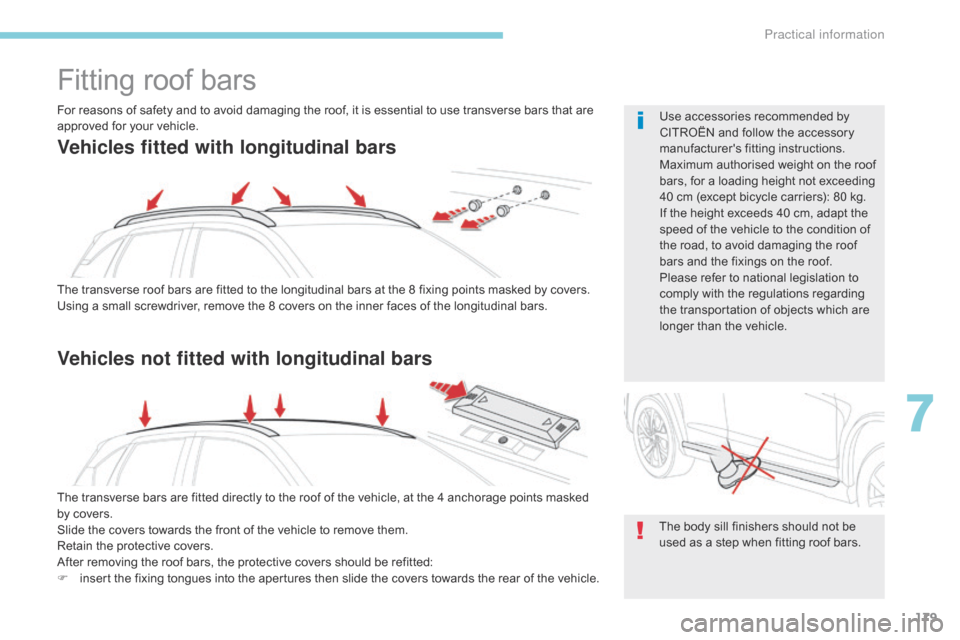
The transverse roof bars are fitted to the longitudinal bars at the 8 fixing points masked by covers.
Using a small screwdriver, remove the 8 covers on the inner faces of the longitudinal bars.
The transverse bars are fitted directly to the roof of the vehicle, at the 4 anchorage points masked
by covers.
Slide the covers towards the front of the vehicle to remove them.
Retain the protective covers.
After removing the roof bars, the protective covers should be refitted:
F
i
nsert the fixing tongues into the apertures then slide the covers towards the rear of the vehicle. The body sill finishers should not be
used as a step when fitting roof bars.Use accessories recommended by
CITROËN and follow the accessory
manufacturer's fitting instructions.
Maximum authorised weight on the roof
bars, for a loading height not exceeding
40
cm (except bicycle carriers): 80 kg.
If the height exceeds 40 cm, adapt the
speed of the vehicle to the condition of
the road, to avoid damaging the roof
bars and the fixings on the roof.
Please refer to national legislation to
comply with the regulations regarding
the transportation of objects which are
longer than the vehicle.
For reasons of safety and to avoid damaging the roof, it is essential to use transverse bars that are
approved for your vehicle.
Vehicles fitted with longitudinal bars
Vehicles not fitted with longitudinal bars
7
Practical information
Page 187 of 368
185
C4-Aircross_en_Chap07_info-pratiques_ed01-2016
Avoid prolonged contact of used oil or
fluids with the skin.
Most of these fluids are harmful to
health or indeed very corrosive.
Do not discard used oil or fluids into
sewers or onto the ground.
Take used oil to a CITROËN dealer or
a qualified workshop (France) or to an
authorised waste disposal site.
Used products
To p p i n g u p
The reservoir must be topped up without delay
by a CITROËN dealer or a qualified workshop.
Additive level (1.6 HDi
115 Diesel versions with
particle filter)
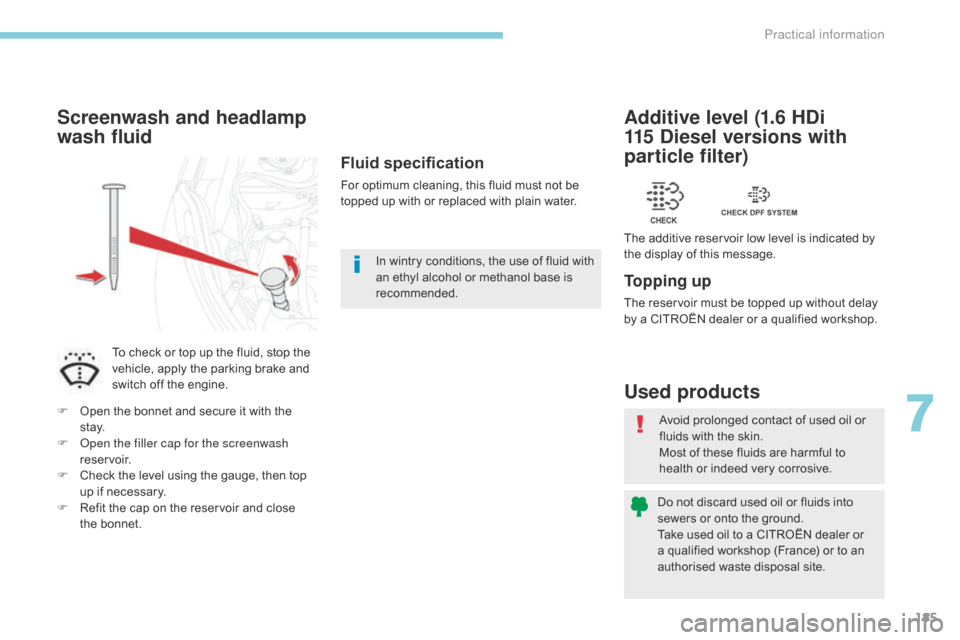
The additive reservoir low level is indicated by
the display of this message.
Fluid specification
For optimum cleaning, this fluid must not be
topped up with or replaced with plain water.
Screenwash and headlamp
wash fluid
To check or top up the fluid, stop the
vehicle, apply the parking brake and
switch off the engine.
F
O
pen the bonnet and secure it with the
st ay.
F
O
pen the filler cap for the screenwash
reservoir.
F
C
heck the level using the gauge, then top
up if necessary.
F
R
efit the cap on the reservoir and close
the
bonnet. In wintry conditions, the use of fluid with
an ethyl alcohol or methanol base is
recommended.
7
Practical information
Page 188 of 368
186
C4-Aircross_en_Chap07_info-pratiques_ed01-2016
Checking components
12 V battery
Electrolyte level
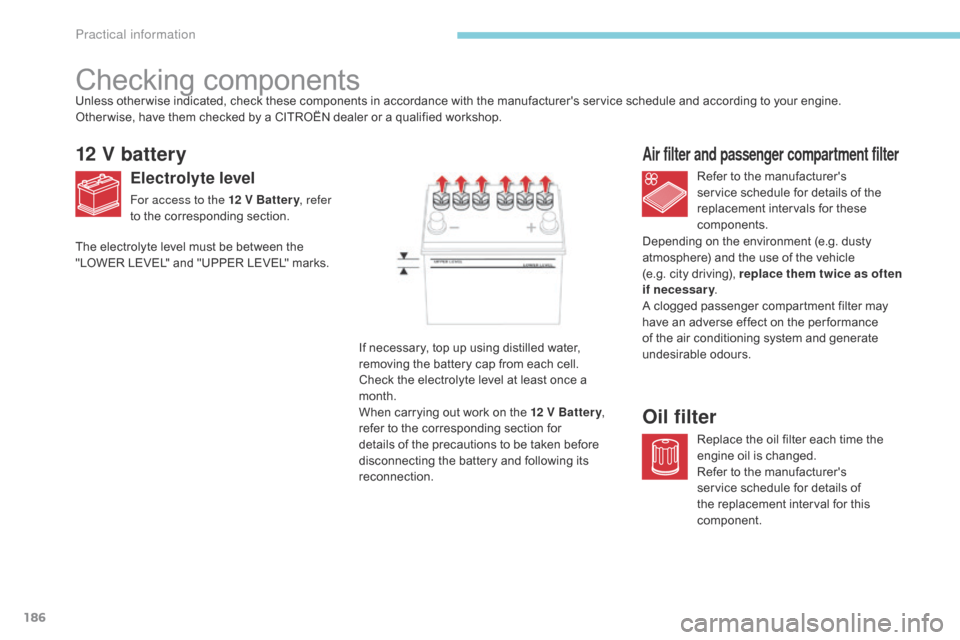
For access to the 12 V Battery, refer
to the corresponding section. Refer to the manufacturer's
service schedule for details of the
replacement intervals for these
components.
Air filter and passenger compartment filter
Replace the oil filter each time the
engine oil is changed.
Refer to the manufacturer's
service schedule for details of
the replacement interval for this
component.
Oil filter
If necessary, top up using distilled water,
removing the battery cap from each cell.
Check the electrolyte level at least once a
month.
When carrying out work on the 12 V
Battery,
refer to the corresponding section for
details of the precautions to be taken before
disconnecting the battery and following its
reconnection.
Unless other wise indicated, check these components in accordance with the manufacturer's service schedule and according to your engine.
Other wise, have them checked by a CITROËN dealer or a qualified workshop.
The electrolyte level must be between the
"LOWER LEVEL" and "UPPER LEVEL" marks.
Depending on the environment (e.g. dusty
atmosphere) and the use of the vehicle
(e.g. city driving), replace them twice as often
if necessary
.
A clogged passenger compartment filter may
have an adverse effect on the per formance
of the air conditioning system and generate
undesirable odours.
Practical information
Page 189 of 368
187
C4-Aircross_en_Chap07_info-pratiques_ed01-2016
Manual gearbox
For servicing of the gearbox, refer to
the manufacturer's service schedule
for details of the interval for checking
this component.
"CVT" gearbox
For servicing of the "CVT" gearbox,
refer to the manufacturer's service
schedule for details of the interval for
checking this component.
Particle filter (Diesel)
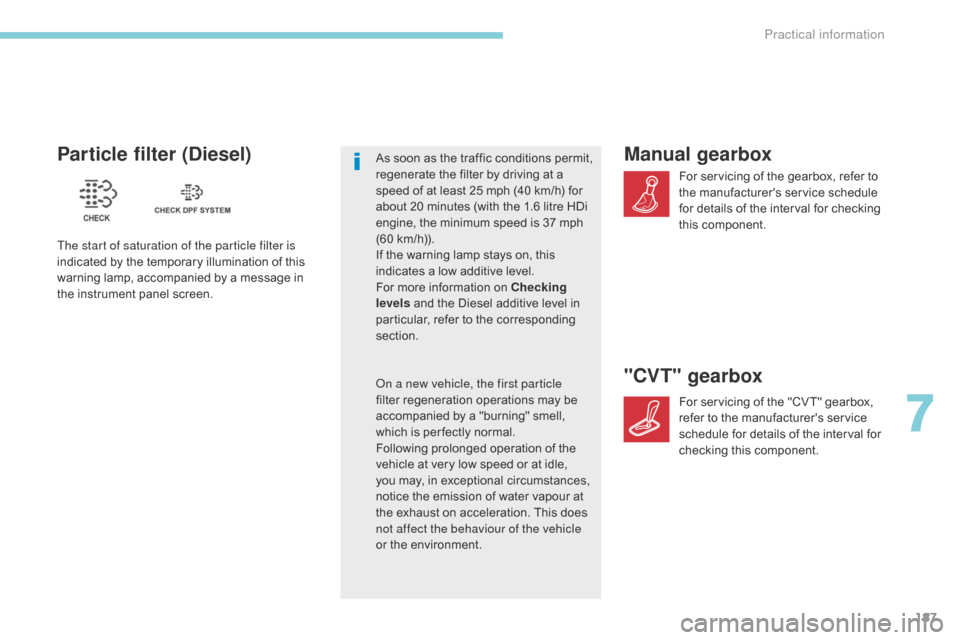
The start of saturation of the particle filter is
indicated by the temporary illumination of this
warning lamp, accompanied by a message in
the instrument panel screen.As soon as the traffic conditions permit,
regenerate the filter by driving at a
speed of at least 25 mph (40 km/h) for
about 20 minutes (with the 1.6 litre HDi
engine, the minimum speed is 37 mph
(60 km/h)).
If the warning lamp stays on, this
indicates a low additive level.
For more information on Checking
levels
and the Diesel additive level in
particular, refer to the corresponding
section.
On a new vehicle, the first particle
filter regeneration operations may be
accompanied by a "burning" smell,
which is per fectly normal.
Following prolonged operation of the
vehicle at very low speed or at idle,
you may, in exceptional circumstances,
notice the emission of water vapour at
the exhaust on acceleration. This does
not affect the behaviour of the vehicle
or the environment.
7
Practical information
Page 190 of 368
188
C4-Aircross_en_Chap07_info-pratiques_ed01-2016
Brake wear depends on the style
of driving, particularly in the case
of vehicles used in town, over short
distances. It may be necessary to have
the condition of the brakes checked,
even between vehicle services.
Brake pads
For information on checking brake
disc wear, contact a CITROËN dealer
or a qualified workshop.
Brake disc wearParking brake
If excessive travel or a loss of
effectiveness of this system is
noticed, the parking brake must be
checked, even between two services.
Only use products recommended by
CITROËN or products of equivalent
quality and specification.
In order to optimise the operation of
units as important as those in the
braking system, CITROËN selects and
offers very specific products.
After washing the vehicle, dampness,
or in wintry conditions, ice can form
on the brake discs and pads: braking
efficiency may be reduced. Make light
brake applications to dry and defrost
the brakes.
Checking this system must be done by a
CITROËN dealer or a qualified workshop.
Unless there is a leak in the circuit, a drop in
the brake fluid level indicates that the brake
pads are worn.
Practical information
Page 207 of 368
205
C4-Aircross_en_Chap08_En-cas-de-panne_ed01-2016
Changing a fuse
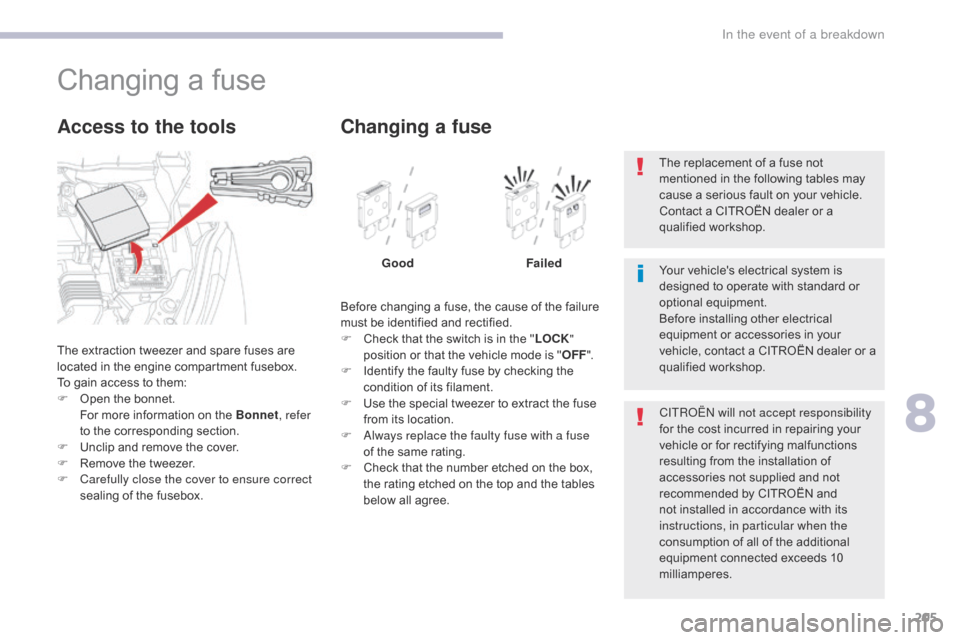
The extraction tweezer and spare fuses are
located in the engine compartment fusebox.
To gain access to them:
F
O
pen the bonnet.
F
or more information on the Bonnet , refer
to the corresponding section.
F
U
nclip and remove the cover.
F
R
emove the tweezer.
F
C
arefully close the cover to ensure correct
sealing of the fusebox.
Access to the tools
Before changing a fuse, the cause of the failure
must be identified and rectified.
F
C
heck that the switch is in the " LOCK"
position or that the vehicle mode is " OFF".
F
I
dentify the faulty fuse by checking the
condition of its filament.
F
U
se the special tweezer to extract the fuse
from its location.
F
A
lways replace the faulty fuse with a fuse
of the same rating.
F
C
heck that the number etched on the box,
the rating etched on the top and the tables
below all agree.
Changing a fuse
Good Failed
CITROËN will not accept responsibility
for the cost incurred in repairing your
vehicle or for rectifying malfunctions
resulting from the installation of
accessories not supplied and not
recommended by CITROËN and
not installed in accordance with its
instructions, in particular when the
consumption of all of the additional
equipment connected exceeds 10
milliamperes. Your vehicle's electrical system is
designed to operate with standard or
optional equipment.
Before installing other electrical
equipment or accessories in your
vehicle, contact a CITROËN dealer or a
qualified workshop. The replacement of a fuse not
mentioned in the following tables may
cause a serious fault on your vehicle.
Contact a CITROËN dealer or a
qualified workshop.
8
In the event of a breakdown
Page 208 of 368
206
C4-Aircross_en_Chap08_En-cas-de-panne_ed01-2016
Dashboard fuses
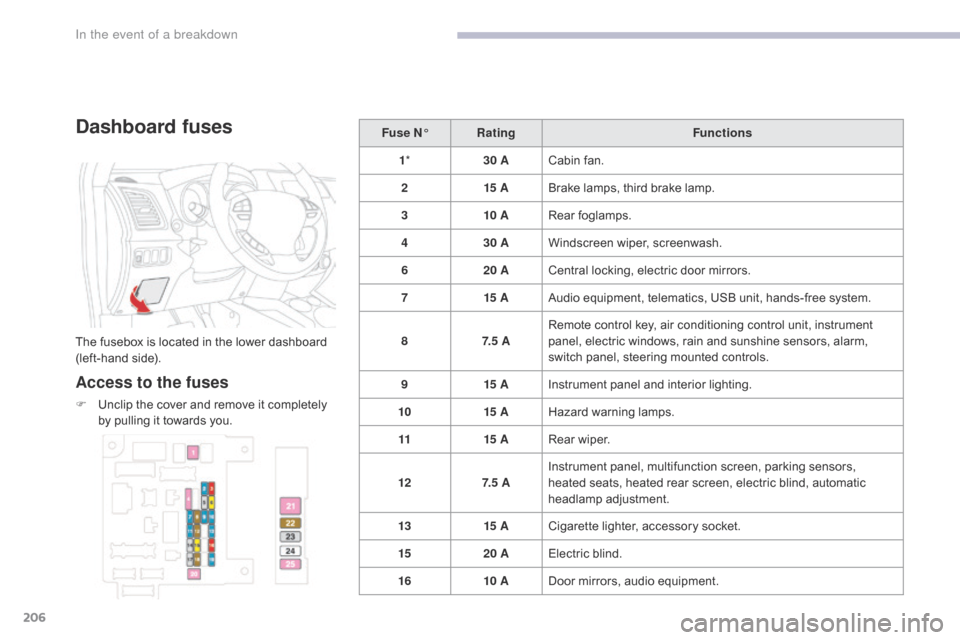
The fusebox is located in the lower dashboard
(left-hand side).
Access to the fuses
F Unclip the cover and remove it completely by pulling it towards you. Fuse N°
Rating Functions
1 * 30 ACabin fan.
2 15 ABrake lamps, third brake lamp.
3 10 ARear foglamps.
4 30 AWindscreen wiper, screenwash.
6 20 ACentral locking, electric door mirrors.
7 15 AAudio equipment, telematics, USB unit, hands-free system.
8 7. 5 ARemote control key, air conditioning control unit, instrument
panel, electric windows, rain and sunshine sensors, alarm,
switch panel, steering mounted controls.
9 15 AInstrument panel and interior lighting.
10 15 AHazard warning lamps.
11 15 ARear wiper.
12 7. 5 AInstrument panel, multifunction screen, parking sensors,
heated seats, heated rear screen, electric blind, automatic
headlamp adjustment.
13 15 ACigarette lighter, accessory socket.
15 20 AElectric blind.
16 10 ADoor mirrors, audio equipment.
In the event of a breakdown