Diesel engine Citroen C4 CACTUS 2016 1.G User Guide
[x] Cancel search | Manufacturer: CITROEN, Model Year: 2016, Model line: C4 CACTUS, Model: Citroen C4 CACTUS 2016 1.GPages: 308, PDF Size: 7.96 MB
Page 125 of 308
123
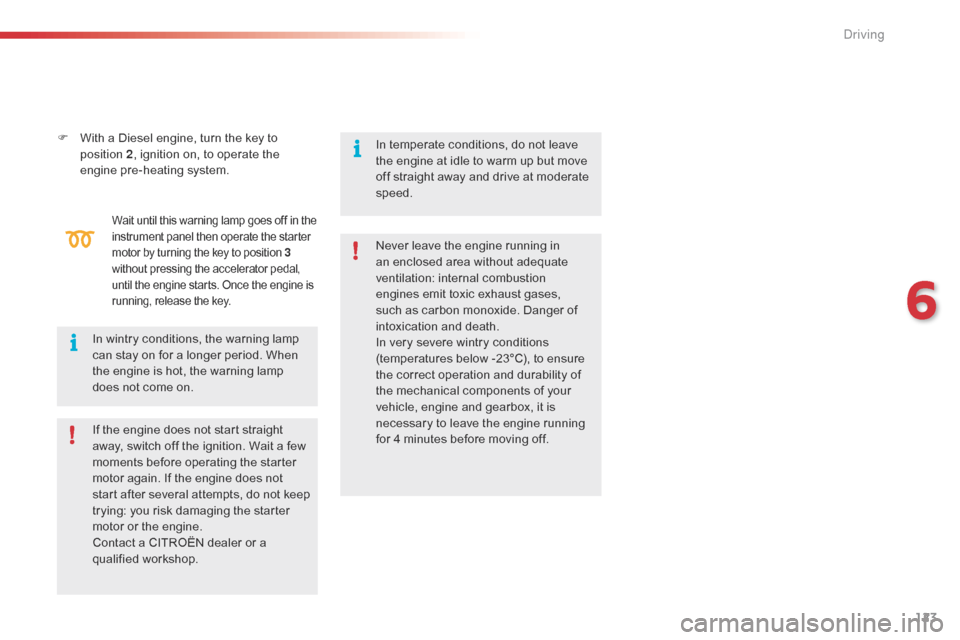
F With a Diesel engine, turn the key to p
osition 2 ,
ignition on, to operate the
eng
ine
p
re-heating
s
ystem.
Wait until this warning lamp goes off in the instrument panel then operate the starter m
otor by turning the key to position 3
without
pressing the accelerator pedal,
u
ntil the engine starts. Once the engine is
r
unning, release the key.
In wintry conditions, the warning lamp can stay on for a longer period. When
t
he engine is hot, the warning lamp
d
oes not come on. In
temperate conditions, do not leave
t
he engine at idle to warm up but move
o
ff straight away and drive at moderate
s
peed.
Never leave the engine running in
a
n enclosed area without adequate
v
entilation:
in
ternal
c
ombustion
e
ngines emit toxic exhaust gases,
s
uch as carbon monoxide. Danger of i
ntoxication and death.
In very severe wintry conditions
(
temperatures below -23°C), to ensure
t
he correct operation and durability of
t
he mechanical components of your
v
ehicle, engine and gearbox, it is
n
ecessary to leave the engine running
f
or 4 minutes before moving off.
If
the engine does not start straight
a
way, switch off the ignition. Wait a few
m
oments before operating the starter
m
otor again. If the engine does not
s
tart after several attempts, do not keep
t
rying: you risk damaging the starter
m
otor or the engine.
Contact
a CITROËN dealer or a
q
ualified
w
orkshop.
6
Driving
Page 129 of 308
127
Operation
Gear efficiency indicator
System which reduces fuel consumption by advising the driver to change up, on vehicles fitted with a manual gearbox.
T he system adapts its gear change
r
ecommendation according to the
d
riving conditions (slope, load, ...) and
t
he demands of the driver (power,
a
cceleration, braking, ...).
The
system never suggests:
-
e
ngaging first gear,
-
enga
ging
r
everse
g
ear,
-
e
ngaging a lower gear.
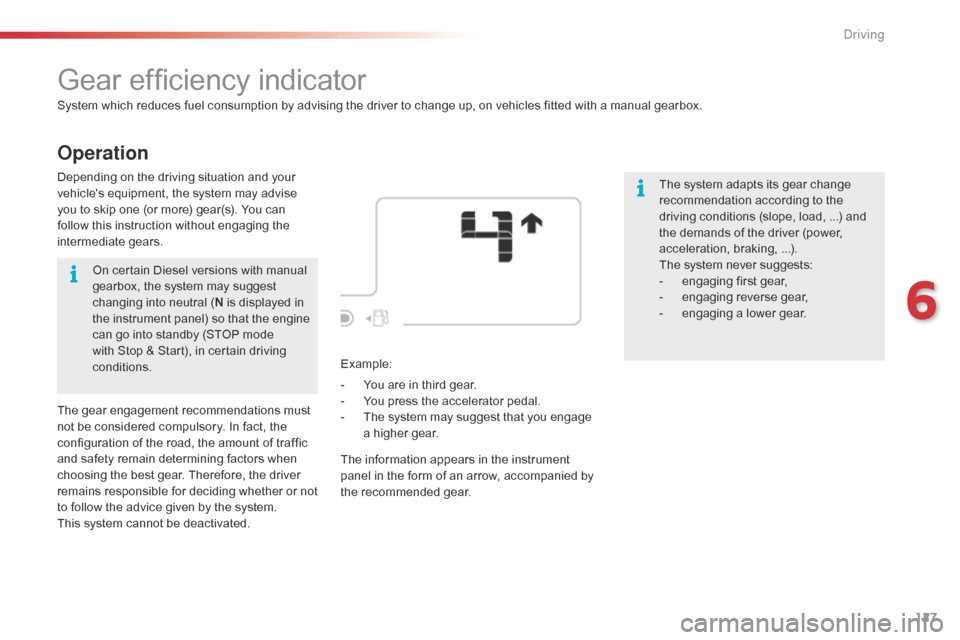
Example:
-
Y
ou are in third gear.
Depending
on the driving situation and your
v
ehicle's equipment, the system may advise
y
ou to skip one (or more) gear(s). You can
f
ollow this instruction without engaging the
i
ntermediate
g
ears.
-
Y
ou press the accelerator pedal.
-
T
he system may suggest that you engage
a
higher gear.
The
information appears in the instrument
p
anel in the form of an arrow, accompanied by
t
he recommended gear.
On
certain Diesel versions with manual
g
earbox, the system may suggest
c
hanging into neutral (N
is displayed in
t
he instrument panel) so that the engine
c
an go into standby (STOP mode
w
ith Stop & Start), in certain driving
c
onditions.
The
gear engagement recommendations must
n
ot be considered compulsory. In fact, the
c
onfiguration of the road, the amount of traffic
a
nd safety remain determining factors when
c
hoosing the best gear. Therefore, the driver
r
emains responsible for deciding whether or not
t
o follow the advice given by the system.
This
system cannot be deactivated.
6
Driving
Page 156 of 308
154
Fuel tank
Capacity of the tank:
- Pe trol: approximately 50 litres.
-
D
iesel: approximately 45 or 50 litres (depending on version).
Low fuel levelRefuelling
When the low fuel level is reached, t
his warning lamp in the instrument
p
anel comes on, accompanied by
a
n audible warning, a message and
t
he last bar of the fuel gauge flashes
i
n red.
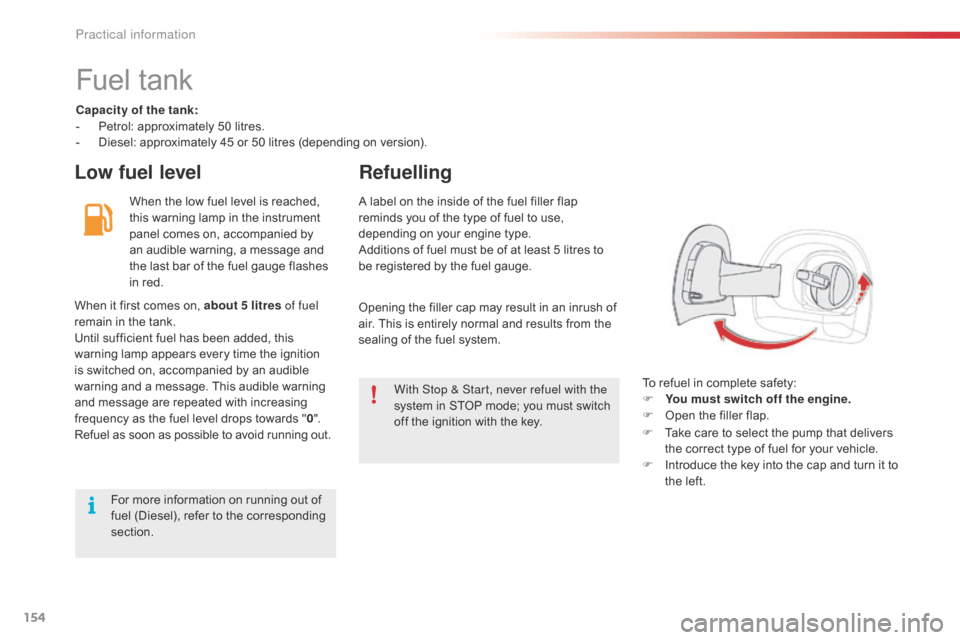
To
refuel in complete safety:
F
Y
ou must switch off the engine.
F
O
pen the filler flap.
A
label on the inside of the fuel filler flap r
eminds you of the type of fuel to use,
d
epending on your engine type.
Additions
of fuel must be of at least 5 litres to
b
e registered by the fuel gauge.
When
it
first comes on, about 5 litres of fuel
remain
in
the tank.
Until
sufficient fuel has been added, this
w
arning
lamp appears every time the ignition
i
s
switched on, accompanied by an audible
w
arning
and a message. This audible warning
a
nd
message are repeated with increasing
f
requency
as the fuel level drops towards "0 ".
Refuel
as
soon as possible to avoid running out.Opening
the filler cap may result in an inrush of
a
ir. This is entirely normal and results from the
s
ealing of the fuel system.
With Stop & Start, never refuel with the
system
in STOP mode; you must switch
o
ff the ignition with the key.
For
more information on running out of
f
uel (Diesel), refer to the corresponding
s
ection. F
T
ake care to select the pump that delivers
t
he correct type of fuel for your vehicle.
F
I
ntroduce the key into the cap and turn it to
t
he left.
Practical information
Page 157 of 308
155
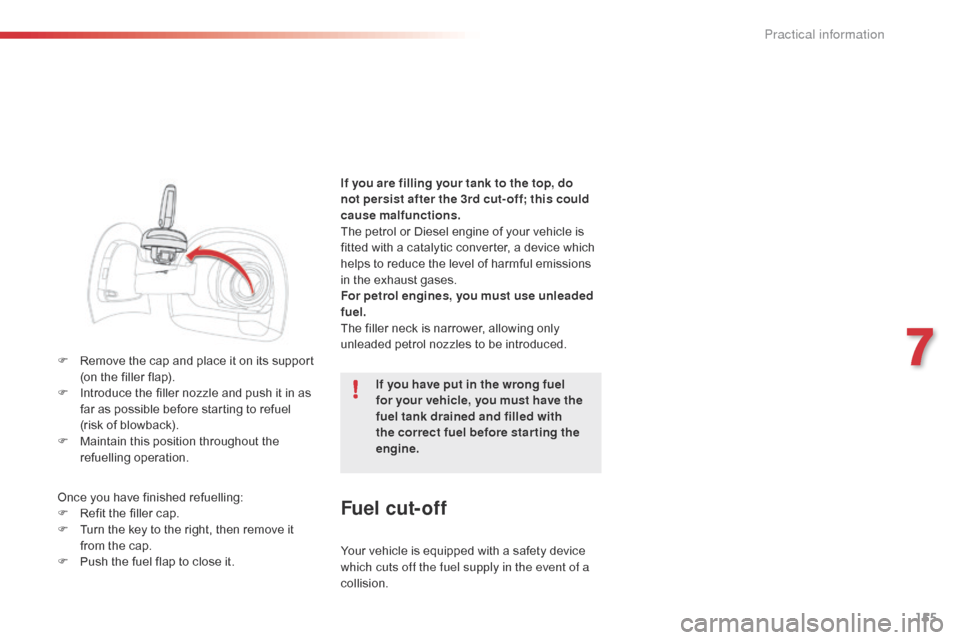
F Remove the cap and place it on its support (
on the filler flap).
F
I
ntroduce the filler nozzle and push it in as
f
ar as possible before starting to refuel
(risk
of blowback).
F
M
aintain this position throughout the
r
efuelling
ope
ration.
Once
you have finished refuelling:
F
R
efit the filler cap.
F
T
urn the key to the right, then remove it
f
rom the cap.
F
P
ush the fuel flap to close it.If you are filling your tank to the top, do
not persist after the 3rd cut- off; this could
cause malfunctions.
The
petrol or Diesel engine of your vehicle is
f
itted with a catalytic converter, a device which
h
elps to reduce the level of harmful emissions
i
n the exhaust gases.
For petrol engines, you must use unleaded
fuel.
The filler neck is narrower, allowing only
u
nleaded petrol nozzles to be introduced.
Your vehicle is equipped with a safety device
w
hich cuts off the fuel supply in the event of a
collision.
Fuel cut- of f
If you have put in the wrong fuel
for your vehicle, you must have the
fuel tank drained and filled with
the correct fuel before star ting the
engine.
7
Practical information
Page 159 of 308
157
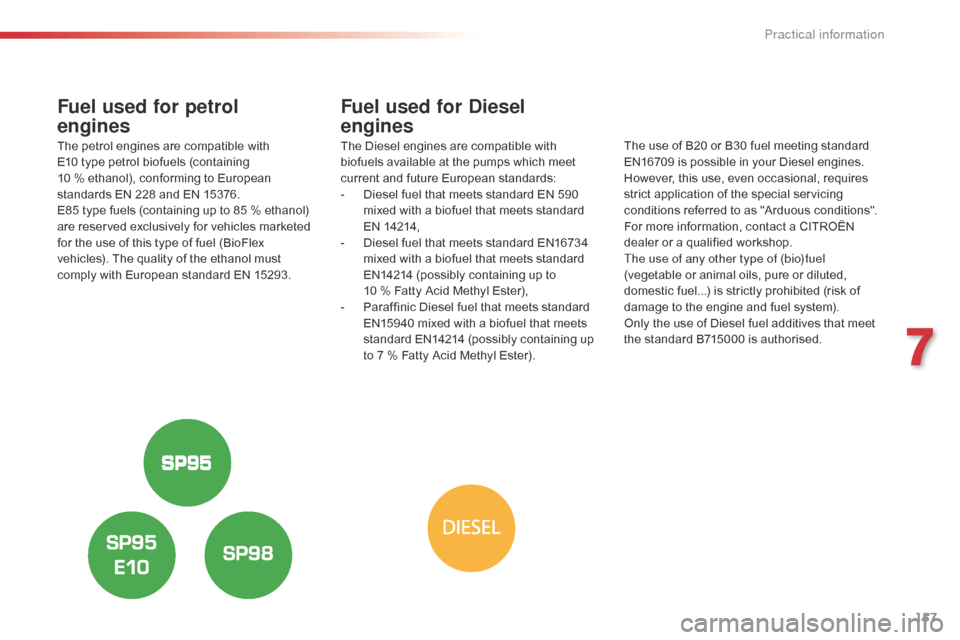
Fuel used for petrol
engines
The petrol engines are compatible with E
10 type petrol biofuels (containing
1
0 % ethanol), conforming to European
s
tandards EN 228 and EN 15376.
E85
type fuels (containing up to 85 % ethanol)
a
re reserved exclusively for vehicles marketed
f
or the use of this type of fuel (BioFlex
v
ehicles). The quality of the ethanol must
c
omply with European standard EN 15293.
Fuel used for Diesel
engines
The Diesel engines are compatible with biofuels available at the pumps which meet
c
urrent and future European standards:
-
D
iesel fuel that meets standard EN 590
m
ixed with a biofuel that meets standard
E
N
14
214,
-
D
iesel fuel that meets standard EN16734
m
ixed with a biofuel that meets standard
E
N14214 (possibly containing up to
1
0 % Fatty Acid Methyl Ester),
-
P
araffinic Diesel fuel that meets standard
E
N15940 mixed with a biofuel that meets
s
tandard EN14214 (possibly containing up
t
o 7 % Fatty Acid Methyl Ester).The
use of B20 or B30 fuel meeting standard E
N16709 is possible in your Diesel engines.
H
owever, this use, even occasional, requires
s
trict application of the special servicing
c
onditions referred to as "Arduous conditions".
F
or more information, contact a CITROËN
d
ealer or a qualified workshop.
The use of any other type of (bio)fuel
(vegetable
or animal oils, pure or diluted,
d
omestic fuel...) is strictly prohibited (risk of
d
amage to the engine and fuel system).
Only
the use of Diesel fuel additives that meet
t
he standard B715000 is authorised.
7
Practical information
Page 172 of 308
170
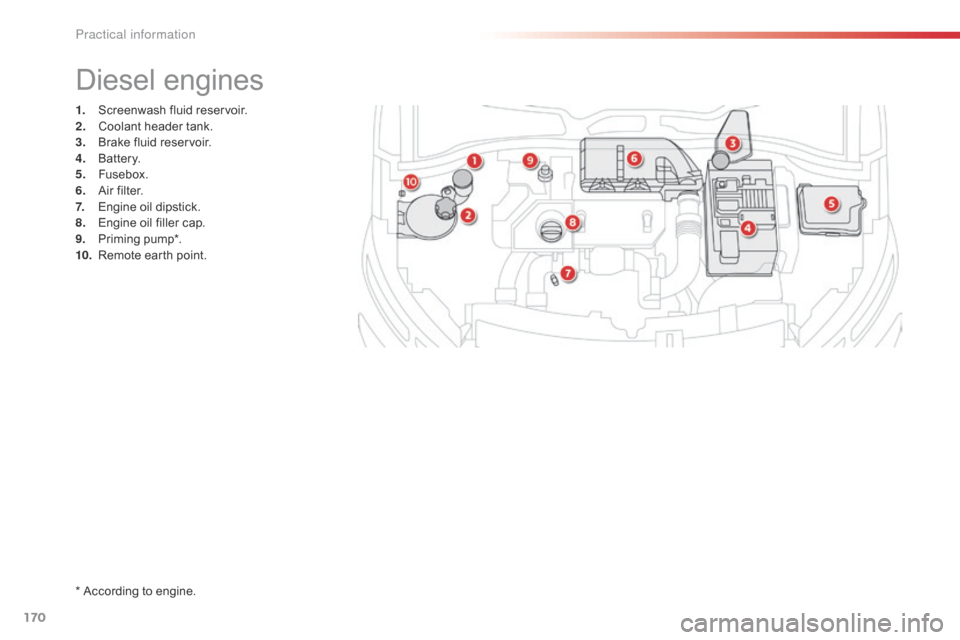
1. Screenwash fluid reservoir.
2. C oolant header tank.
3.
B
rake fluid reservoir.
4.
B
attery.
5.
F
usebox.
6.
A
ir filter.
7.
E
ngine oil dipstick.
8.
E
ngine oil filler cap.
9.
P
riming
pu
mp*.
10.
R
emote earth point.
Diesel engines
* According to engine.
Practical information
Page 175 of 308
173
Coolant level
The coolant level should be close to the "MA X" mark but should never
e
xceed it.
In
addition, as the cooling system is pressurised,
w
ait
at
least one hour after switching off the
e
ngine
before carrying out any work.
To
avoid
any risk of scalding, unscrew the cap by
t
wo
turns
to allow the pressure to drop. When the
p
ressure
has dropped, remove the cap and top
u
p
the
level.
Changing the coolant
The coolant does not have to be replaced at routine services.
The cooling fan may star t after switching
off the engine: take care with ar ticles and
clothing that might be caught by the fan
blades. When the engine is warm, the temperature of
t
he coolant is regulated by the fan.
Fluid specification
The coolant must conform to the ma
nufacturer's r ecommendations.
Fluid specification
For optimum cleaning and to avoid freezing, this fluid must not be topped up or replaced
w
ith plain water.
In
w
intry
c
onditions,
i
t
i
s
r
ecommended
t
hat
y
ou
u
se an ethyl alcohol or methanol based fluid.
Screenwash fluid level
Top up the level when necessary.
To p p i n g u p
The reservoir must be topped up without delay by a CITROËN dealer or a qualified workshop.
Diesel fuel additive
level (Diesel with particle
filter)
The additive reservoir low level is indicated by fixed illumination of
A
void prolonged contact of used oil or
f
luids with the skin.
Most of these fluids are harmful to
h
ealth or indeed very corrosive.
Do not discard used oil or fluids into
s
ewers or onto the ground.
Take used oil to a CITROËN dealer or
a
qualified workshop (France) or to an
a
uthorised waste disposal site.
Used products
this warning lamp, accompanied by an audible s
ignal and a message that the particle filter
a
dditive level is too low.
7
Practical information
Page 176 of 308
174
Checks
12 V battery
The battery does not require any maintenance.
H owever, check regularly that the terminals
a
re correctly tightened (versions without quick
r
elease terminals) and that the connections
a
re clean.Refer to the manufacturer's service schedule for details of the
r
eplacement intervals for these
c
omponents.
Air filter and passenger compartment filter
Replace the oil filter each time the e ngine oil is changed.
Refer
to the manufacturer's
s
ervice schedule for details of
t
he replacement interval for this
c
omponent.
Oil filter
Unless other wise indicated, check these components in accordance with the manufacturer's service schedule and according to your engine.
O ther wise, have them checked by a CITROËN dealer or a qualified workshop.
Depending
on the environment (e.g. dusty
a
tmosphere) and the use of the vehicle
(e.g.
city driving), replace them twice as often
if necessary .
A
clogged passenger compartment filter may
h
ave an adverse effect on the per formance
o
f the air conditioning system and generate
u
ndesirable
o
dours.
Particle filter (Diesel)
The start of saturation of the
particle filter is indicated by the
f
ixed illumination of this warning
l
amp accompanied by a warning
m
essage.
As
soon
as
the traffic conditions permit,
r
egenerate
the filter by driving at a speed of at
l
east
40
mph (60 km/h) until the warning lamp
g
oes
off.
If
the
warning lamp stays on, this indicates a
l
ow
additive level.
Refer
to
the "Diesel additive level" section.
On a new vehicle, the first particle
filter
regeneration operations may be
a
ccompanied by a "burning" smell,
w
hich is per fectly normal.
Following
prolonged operation of the
v
ehicle at very low speed or at idle,
y
ou
may, in exceptional circumstances,
n
otice the emission of water vapour at
t
he
exhaust on acceleration. This does
n
ot affect the behaviour of the vehicle
or
the environment.
When
carrying
out
any
operation
on
the
12
V
b
attery,
refer
to
the
corresponding
section
for
d
etails
of
the
precautions
to
be
taken
before
s
tarting
work.
Versions
equipped
with
Stop
&
Start
are
f
itted
with
a
12
V
lead-acid
battery
of
s
pecific
t
echnology
a
nd
s
pecification.
Its
replacement
should
be
carried
out
o
nly
by
a
CITROËN
dealer
or
a
qualified
w
orkshop.
Practical information
Page 178 of 308
176
AdBlue® additive and SCR system
f
or
BlueHDi Diesel engines
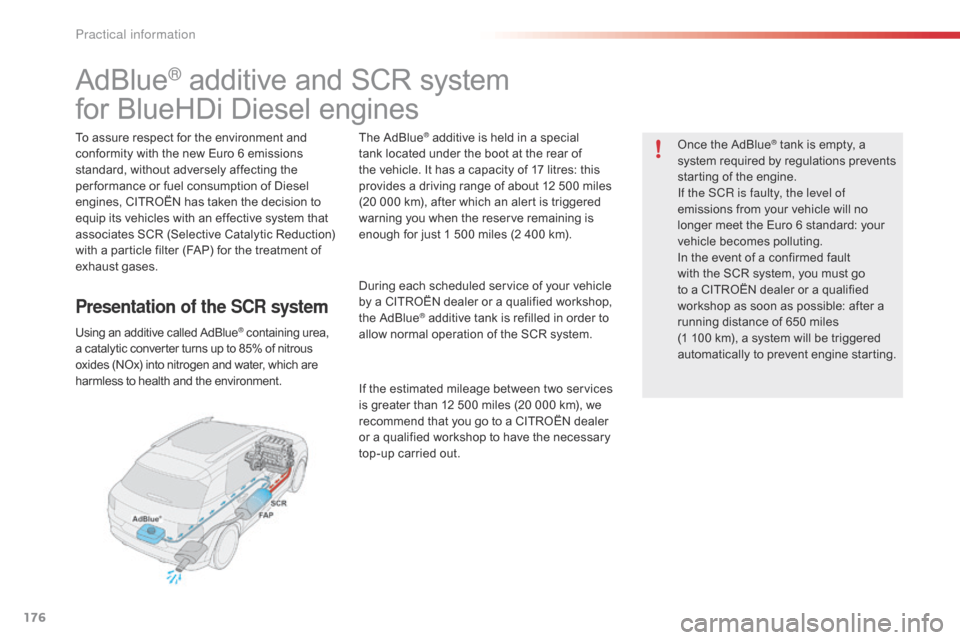
To assure respect for the environment and c
onformity with the new Euro 6 emissions
s
tandard, without adversely affecting the
p
er formance or fuel consumption of Diesel
e
ngines, CITROËN has taken the decision to
e
quip its vehicles with an effective system that
a
ssociates SCR (Selective Catalytic Reduction)
w
ith a particle filter (FAP) for the treatment of
e
xhaust gases.
Presentation of the SCR system
Using an additive called AdBlue® containing urea, a
catalytic
converter
turns
up
to
85% of nitrous o
xides
(NOx)
into
nitrogen
and
water, which are
h
armless
to
health
and
the
environment. Once
the AdBlue
® tank is empty, a s
ystem
required
by regulations prevents
s
tarting
of
the
engine.
If the SCR is faulty, the level of
emissions
from
your vehicle will no
l
onger
meet
the
Euro 6 standard: your
v
ehicle
becomes
polluting.
In
the
event
of
a
confirmed fault
w
ith
the
SCR
system, you must go
t
o
a
CITROËN
dealer or a qualified
w
orkshop
as
soon as possible: after a
r
unning
distance
of 650 miles
(1
100
km),
a
system will be triggered
a
utomatically
to
prevent engine starting.
The
AdBlue® additive is held in a special t
ank
located
under the boot at the rear of
t
he
vehicle.
It has a capacity of 17 litres: this
p
rovides
a
driving range of about 12 500 miles
(
20
000
km),
after which an alert is triggered
w
arning
you
when the reserve remaining is
e
nough
for
just 1 500 miles (2 400 km).
During
each
scheduled service of your vehicle
b
y
a
CITROËN dealer or a qualified workshop,
t
he
AdBlue
® additive tank is refilled in order to a
llow
normal operation of the SCR system.
If
the
estimated mileage between two services
i
s
greater
than 12 500 miles (20 000 km), we
r
ecommend
that you go to a CITROËN dealer
o
r
a
qualified workshop to have the necessary
t
op-up
carried out.
Practical information
Page 214 of 308
212
FuseN° Rating
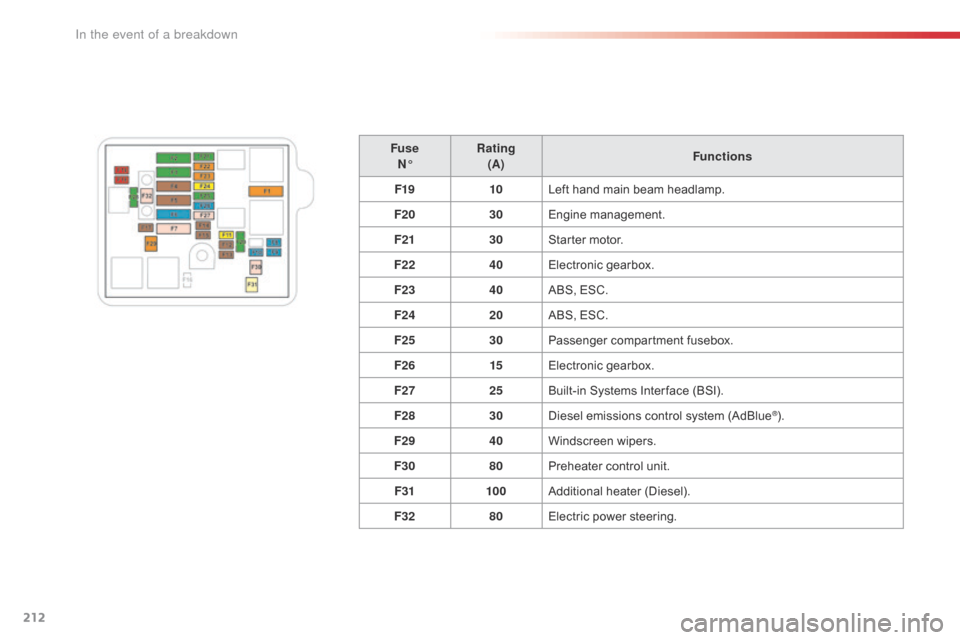
(A) Functions
F19 10Left
hand main beam headlamp.
F20 30Engine
m
anagement.
F21 30Starter
motor.
F22 40Electronic
g
earbox.
F23 40ABS,
ESC.
F24 20ABS,
ESC.
F25 30Passenger
c
ompartment
f
usebox.
F26 15Electronic
g
earbox.
F27 25Built-in
Systems Inter face (BSI).
F28 30Diesel
emissions control system (AdBlue
®).
F29 40Windscreen
w
ipers.
F30 80Preheater
control
unit.
F31 100Additional
hea
ter
(
Diesel).
F32 80Electric
power
steering.
In the event of a breakdown