Temperature Citroen C4 CACTUS 2016 1.G User Guide
[x] Cancel search | Manufacturer: CITROEN, Model Year: 2016, Model line: C4 CACTUS, Model: Citroen C4 CACTUS 2016 1.GPages: 308, PDF Size: 7.96 MB
Page 65 of 308
63
In cold weather with the engine cold, the air flow is increased gradually until
t
he system has warmed up, in order
t
o limit the delivery of cold air into the
p
assenger
c
ompartment.
On
entering the vehicle, if the interior
t
emperature is much colder or warmer
t
han the comfort value setting, there
i
s no need to alter the value displayed
i
n order to reach more quickly the
r
equired level of comfort. The system
c
ompensates automatically and
c
orrects the temperature difference as
q
uickly as possible.
This
setting
is
associated
with
AUTO
mode
o
nly.
However,
on
deactivation
of
AUTO
mode,
t
he
last
setting
used
remains
on.
Changing
the
setting
does
not
reactivate
AUTO
m
ode
if
deactivated.
To
change
the
current
setting,
press
the
button
f
or
the
desired
mode:
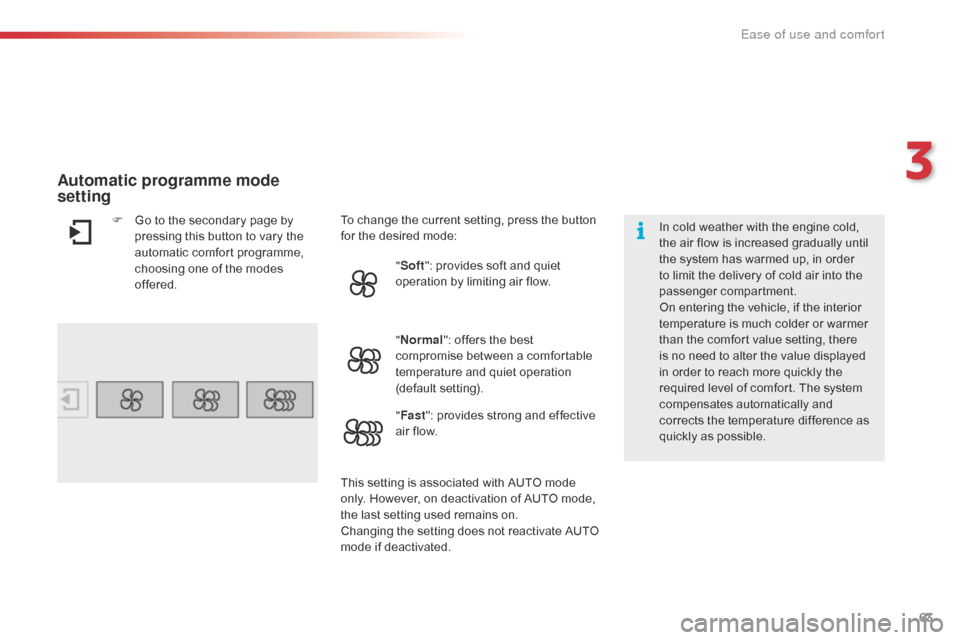
" Soft ":
provides
soft
and
quiet
o
peration
by
limiting
air
flow.
" Normal ":
offers
the
best
c
ompromise
between
a
comfortable
t
emperature
and
quiet
operation
(
default
setting).
" Fast ":
provides
strong
and
effective
a
ir
flow.
Automatic programme mode
setting
F Go to the secondary page by p
ressing this button to vary the
a
utomatic comfort programme,
c
hoosing one of the modes
o
ffered.
3
Ease of use and comfort
Page 67 of 308
65
Avoid the prolonged use of interior air recirculation (risk of misting and
d
eterioration of air quality).
It
allows
you:
-
i
n
summer,
to
lower
the
temperature,
-
i
n
winter,
above
3
°C,
to
improve
demisting.
F
P
ress
this
button
again
to
switch
o
ff
the
air
conditioning.
F
P
ress this button to switch on the
air
c
onditioning.
Air conditioning On/Off
The air conditioning is designed to operate e
fficiently in all seasons, with the windows closed.The
intake of exterior air avoids and eliminates m
isting of the windscreen and side windows.
Air intake/Air recirculation
The recirculation of interior air prevents exterior odours and smoke from entering the passenger
c
ompartment.
F
P
ress this button to recirculate
the
interior air.
F
P
ress this button again to allow
t
he intake of exterior air.
The
air
conditioning
cannot
operate
w
hen
the
air
flow
is
set
to
off. This
function also allows faster heating
o
r cooling of the air in the passenger
c
ompartment.
Ventilation with "ignition on"
function
With the ignition on, you can use the ventilation system and access the "Air conditioning "
menu
to adjust the air flow
and air
distribution
in the passenger compartment.
This
function is available for a few minutes,
d
epending on the state of charge of the battery
o
f your vehicle.
This
function does not activate the air
c
onditioning.
You
can make use of the residual heat in the
e
ngine to warm the passenger compartment
u
sing the temperature setting buttons.
Switching on
Switching off
3
Ease of use and comfort
Page 71 of 308
69
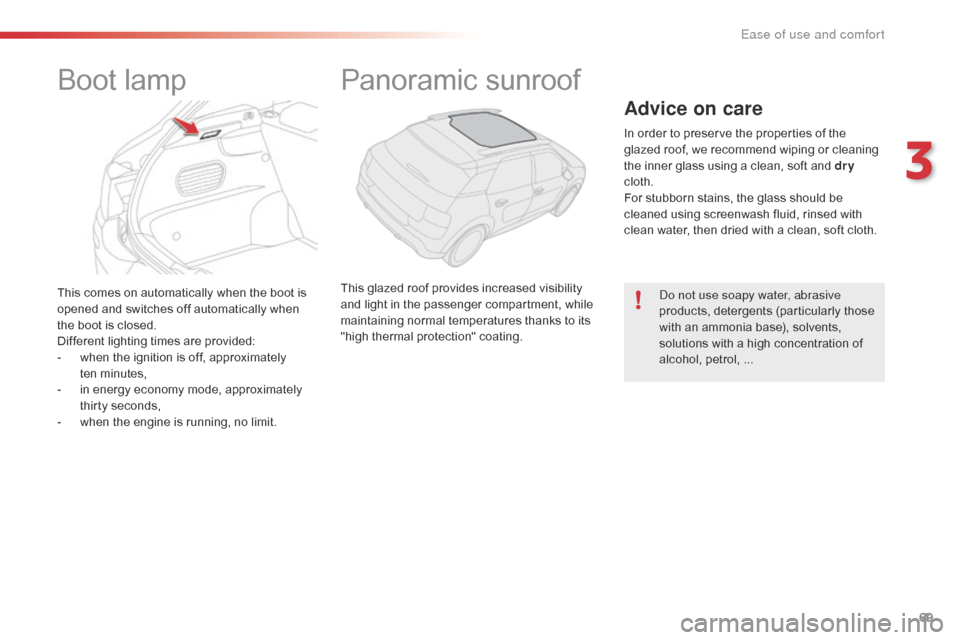
This comes on automatically when the boot is opened and switches off automatically when
t
he boot is closed.
Different
lighting times are provided:
-
w
hen the ignition is off, approximately
t
en minutes,
-
i
n energy economy mode, approximately
t
hirty seconds,
-
w
hen the engine is running, no limit.
Boot lampPanoramic s unroof
This glazed roof provides increased visibility a
nd light in the passenger compartment, while
m
aintaining normal temperatures thanks to its
"
high thermal protection" coating.
Advice on care
In order to preserve the properties of the glazed roof, we recommend wiping or cleaning
t
he inner glass using a clean, soft and dry
cloth.
For
stubborn stains, the glass should be
c
leaned using screenwash fluid, rinsed with
c
lean water, then dried with a clean, soft cloth.
Do not use soapy water, abrasive
products,
detergents (particularly those
w
ith an ammonia base), solvents,
s
olutions with a high concentration of
a
lcohol, petrol, ...
3
Ease of use and comfort
Page 123 of 308
121
When towing
Distribution of loads
F Distribute the load in the trailer so that the h
eaviest items are as close as possible to
t
he axle and the nose weight approaches
t
he maximum permitted without
e
xceeding it.
Air
density decreases with altitude, thus
r
educing engine per formance. Above
1 0
00 metres, the maximum towed load must
b
e reduced by 10 % for every 1 000 metres of
al
titude.
For
more information on weights (and the
t
owed loads which apply to your vehicle) refer
t
o the corresponding section.
Side wind
F Take into account the increased sensitivity t
o side wind.
Cooling
Towing a trailer on a slope increases the temperature of the coolant.
As
the fan is electrically controlled, its cooling
c
apacity is not dependent on the engine speed.
F
T
o lower the engine speed, reduce your
s
peed.
The
maximum towed load on a long incline
d
epends on the gradient and the ambient
t
emperature.
In
all cases, keep a check on the coolant
t
emperature. F
I
f the warning lamp and the
S
TOP
warning lamp come on,
s
top the vehicle and switch off
t
he engine as soon as possible.
Braking
Towing a trailer increases the braking distance.
T o avoid overheating of the brakes, the use of
e
ngine braking is recommended.
Ty r e s
F Check the tyre pressures of the towing v
ehicle and of the trailer, observing the
re
commended
p
ressures.
Lighting
F Check the electrical lighting and signalling o
n the trailer and the hadlamp beam height
o
f your vehicle.
For
more information on adjusting the
h
eadlamp beam height, refer to the
c
orresponding
s
ection.
The
rear parking sensors will be
d
eactivated automatically if a genuine
C
ITROËN towbar is used.
6
Driving
Page 125 of 308
123
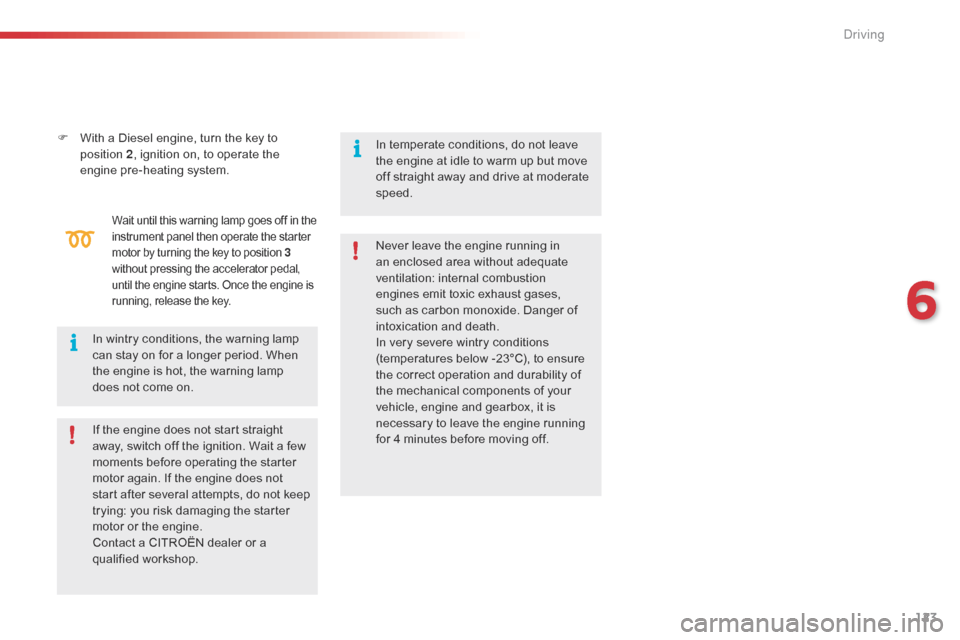
F With a Diesel engine, turn the key to p
osition 2 ,
ignition on, to operate the
eng
ine
p
re-heating
s
ystem.
Wait until this warning lamp goes off in the instrument panel then operate the starter m
otor by turning the key to position 3
without
pressing the accelerator pedal,
u
ntil the engine starts. Once the engine is
r
unning, release the key.
In wintry conditions, the warning lamp can stay on for a longer period. When
t
he engine is hot, the warning lamp
d
oes not come on. In
temperate conditions, do not leave
t
he engine at idle to warm up but move
o
ff straight away and drive at moderate
s
peed.
Never leave the engine running in
a
n enclosed area without adequate
v
entilation:
in
ternal
c
ombustion
e
ngines emit toxic exhaust gases,
s
uch as carbon monoxide. Danger of i
ntoxication and death.
In very severe wintry conditions
(
temperatures below -23°C), to ensure
t
he correct operation and durability of
t
he mechanical components of your
v
ehicle, engine and gearbox, it is
n
ecessary to leave the engine running
f
or 4 minutes before moving off.
If
the engine does not start straight
a
way, switch off the ignition. Wait a few
m
oments before operating the starter
m
otor again. If the engine does not
s
tart after several attempts, do not keep
t
rying: you risk damaging the starter
m
otor or the engine.
Contact
a CITROËN dealer or a
q
ualified
w
orkshop.
6
Driving
Page 131 of 308
129
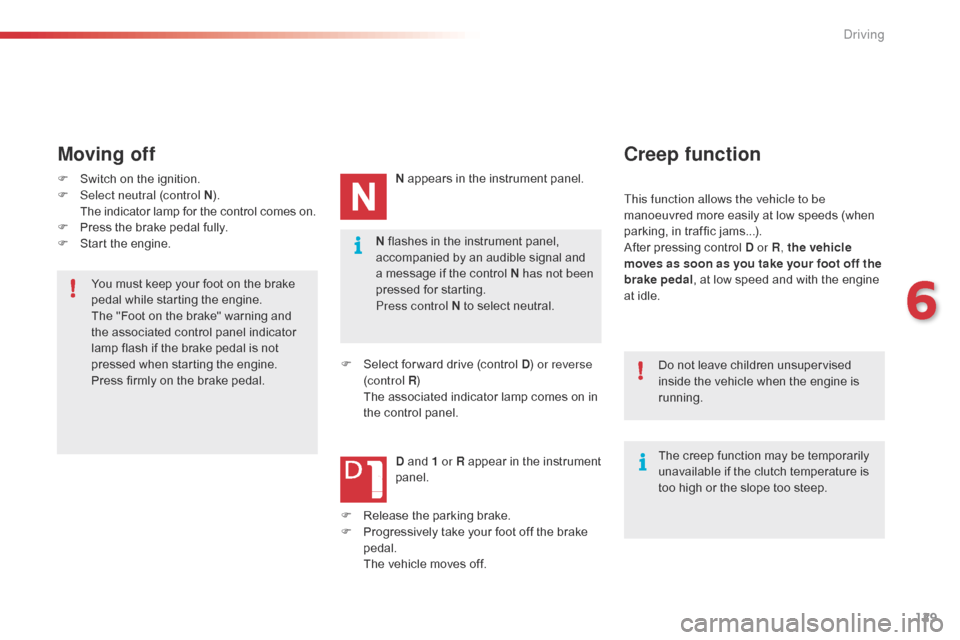
N flashes in the instrument panel, accompanied by an audible signal and
a
message if the control N has not been
pressed
for starting.
Press control N
to select neutral.
Moving off
F Switch on the ignition.
F Sel ect neutral (control N ).
T
he indicator lamp for the control comes on.
F
P
ress the brake pedal fully.
F
S
tart the engine. N
appears in the instrument panel.
F
S
elect for ward drive (control D) or reverse
(c ontrol R )
T
he associated indicator lamp comes on in
t
he control panel.
D
and 1 or R appear in the instrument
pan
el.
Creep function
This function allows the vehicle to be
manoeuvred more easily at low speeds (when
p
arking, in traffic jams...).
After
pressing control D or R, the vehicle
moves as soon as you take your foot off the
brake pedal ,
at low speed and with the engine
a
t idle.
The
creep function may be temporarily
u
navailable if the clutch temperature is
t
oo high or the slope too steep.
Do
not leave children unsupervised
i
nside the vehicle when the engine is
r
unning.
You
must
keep
your
foot
on
the
brake
p
edal
while
starting
the
engine.
The
"Foot
on
the
brake"
warning
and
t
he
associated
control
panel
indicator
l
amp
flash
if
the
brake
pedal
is
not
p
ressed
when
starting
the
engine.
Press
firmly
on
the
brake
pedal. F
R
elease
the
parking
brake.
F
P
rogressively
take
your
foot
off
the
brake
ped
al.
T
he
vehicle
moves
off.
6
Driving
Page 136 of 308
134
Going into engine START
mode
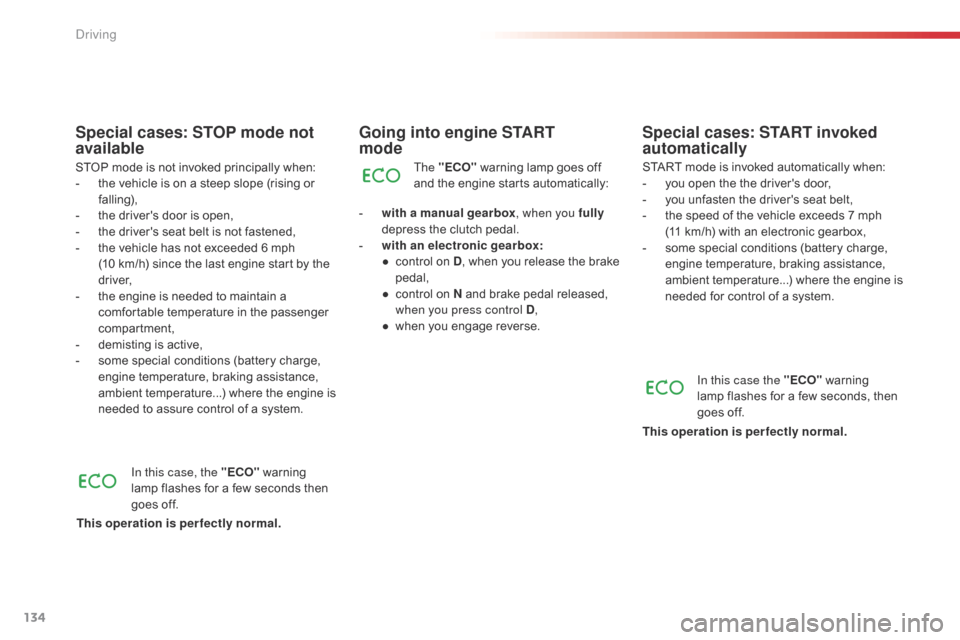
The "ECO" warning lamp goes off a
nd the engine starts automatically:
-
w
ith a manual gearbox , when you fully
depress
the clutch pedal.
-
w
ith an electronic gearbox:
●
c
ontrol
o
n
D,
w
hen
y
ou
r
elease
t
he
b
rake
ped
al,
●
c
ontrol on N and brake pedal released,
w
hen you press control D ,
●
w
hen
y
ou
enga
ge
r
everse. START
mode is invoked automatically when:
- y ou open the the driver's door,
-
y
ou unfasten the driver's seat belt,
-
t
he speed of the vehicle exceeds 7 mph
(11
km/h) with an electronic gearbox,
-
s
ome special conditions (battery charge,
e
ngine temperature, braking assistance,
a
mbient temperature...) where the engine is
n
eeded for control of a system.
Special cases: START invoked
automatically
In this case the "ECO" warning l
amp flashes for a few seconds, then
g
oes off.
This operation is perfectly normal.
Special cases: STOP mode not
available
STOP mode is not invoked principally when:
- t he vehicle is on a steep slope (rising or
f
alling),
-
t
he driver's door is open,
-
t
he driver's seat belt is not fastened,
-
t
he vehicle has not exceeded 6 mph
(
10 km/h) since the last engine start by the
d
river,
-
t
he engine is needed to maintain a
c
omfortable temperature in the passenger
c
ompartment,
-
d
emisting is active,
-
s
ome special conditions (battery charge,
e
ngine temperature, braking assistance,
a
mbient temperature...) where the engine is
n
eeded to assure control of a system.
In this case, the "ECO"
warning
l
amp flashes for a few seconds then
g
oes off.
This operation is perfectly normal.
Driving
Page 137 of 308

135
A fault with the system is signalled in the " Driving assistance "
menu
(
primary page) of the touch screen
t
ablet.
Operating fault
In the event of a fault with the system, the symbol in the button changes to alert
m
ode and the indicator lamp flashes for a
f
ew moments then stays on continuously.
If you press this button to reactivate the
system, the indicator lamp flashes again for a
f
ew moments and then stays on continuously.
In
certain
circumstances,
such
as
the
need
t
o
maintain
a
comfortable
temperature
in
the
p
assenger
compartment,
it
may
be
preferable
t
o
deactivate
the
Stop
&
Start
system.
The
system
can
be
deactivated
at
any
time,
o
nce
the
ignition
is
on.
If
the
system
is
deactivated
while
in
S
TOP mode,
the
engine
then
restarts.
The
Stop
&
Start
system
is
automatically
r
eactivated
every
time
the
engine
is
started.
Deactivation
The Stop & Start system can be deactivated a
nd manually reactivated in the touch screen
t
ablet. F
Sel
ect "
Stop & Star t " in the
" Driving assistance " menu.
When the system is deactivated, the indicator
l
amp in this button comes on continuously.
When
the system is reactivated manually, the
i
ndicator lamp in this button goes off.Have
it checked by a CITROËN dealer or a q
ualified w orkshop.
In
the event of a fault in STOP mode, the
v
ehicle may stall.
All
of the instrument panel warning lamps
come
on.Depending
on version, an alert
m
essage may also be displayed, asking
y
ou to change to neutral (control on N)
and
put your foot on the brake pedal.
You
must switch off the ignition, then
s
tart the engine again.
Before
doing
anything
under
the
b
onnet,
deactivate
the
Stop
&
Start
s
ystem
to
avoid
the
risk
of
injury
r
elated
to
an
automatic
change
to
S
TART mode.
Opening the bonnet
Driving on flooded roads
Before
driving
through
a
flooded
road,
i
t
is
strongly
recommended
that
you
d
eactivate
the
Stop
&
Start
system.
For
more
advice
on
driving,
particularly
o
n
flooded
roads,
refer
to
the
c
orresponding
s
ection.
6
Driving
Page 161 of 308
159
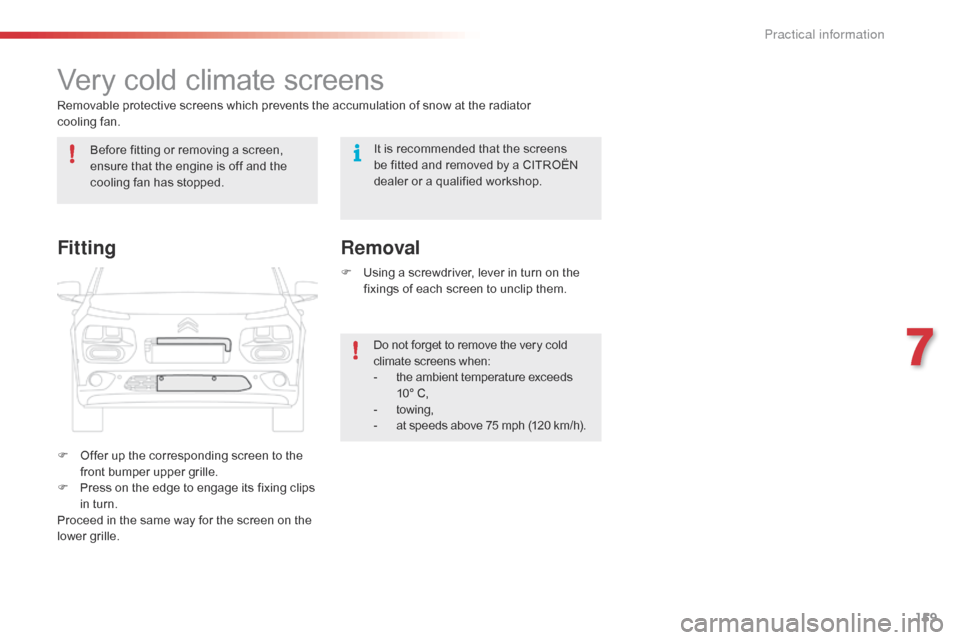
Very cold climate screens
Removable protective screens which prevents the accumulation of snow at the radiator
c ooling fan.
F
O
ffer up the corresponding screen to the
f
ront bumper upper grille.
F
P
ress on the edge to engage its fixing clips
i
n turn.
Proceed
in the same way for the screen on the
l
ower grille. F
U
sing a screwdriver, lever in turn on the
f
ixings of each screen to unclip them.
Do
not forget to remove the very cold
c
limate screens when:
-
t
he ambient temperature exceeds
1
0° C,
-
tow
ing,
-
a
t speeds above 75 mph (120 km/h).
Removal
Fitting
Before fitting or removing a screen, e
nsure that the engine is off and the
c
ooling fan has stopped. It
is recommended that the screens b
e fitted and removed by a CITROËN
d
ealer or a qualified workshop.
7
Practical information
Page 175 of 308
173
Coolant level
The coolant level should be close to the "MA X" mark but should never
e
xceed it.
In
addition, as the cooling system is pressurised,
w
ait
at
least one hour after switching off the
e
ngine
before carrying out any work.
To
avoid
any risk of scalding, unscrew the cap by
t
wo
turns
to allow the pressure to drop. When the
p
ressure
has dropped, remove the cap and top
u
p
the
level.
Changing the coolant
The coolant does not have to be replaced at routine services.
The cooling fan may star t after switching
off the engine: take care with ar ticles and
clothing that might be caught by the fan
blades. When the engine is warm, the temperature of
t
he coolant is regulated by the fan.
Fluid specification
The coolant must conform to the ma
nufacturer's r ecommendations.
Fluid specification
For optimum cleaning and to avoid freezing, this fluid must not be topped up or replaced
w
ith plain water.
In
w
intry
c
onditions,
i
t
i
s
r
ecommended
t
hat
y
ou
u
se an ethyl alcohol or methanol based fluid.
Screenwash fluid level
Top up the level when necessary.
To p p i n g u p
The reservoir must be topped up without delay by a CITROËN dealer or a qualified workshop.
Diesel fuel additive
level (Diesel with particle
filter)
The additive reservoir low level is indicated by fixed illumination of
A
void prolonged contact of used oil or
f
luids with the skin.
Most of these fluids are harmful to
h
ealth or indeed very corrosive.
Do not discard used oil or fluids into
s
ewers or onto the ground.
Take used oil to a CITROËN dealer or
a
qualified workshop (France) or to an
a
uthorised waste disposal site.
Used products
this warning lamp, accompanied by an audible s
ignal and a message that the particle filter
a
dditive level is too low.
7
Practical information