belt CITROEN C4 CACTUS 2017 User Guide
[x] Cancel search | Manufacturer: CITROEN, Model Year: 2017, Model line: C4 CACTUS, Model: CITROEN C4 CACTUS 2017Pages: 256, PDF Size: 7.62 MB
Page 83 of 256
81
General points relating to
child seats
The regulations on carrying children are
specific to each country. Refer to the
legislation in force in your country.
For maximum safety, please obser ve the
following recommendations:
-
I
n accordance with European regulations,
all children under the age of 12 or less
than one and a half metres tall must
travel in approved child seats suited to
their weight , on seats fitted with a seat belt
or ISOFIX mountings.
-
S
tatistically, the safest seats in your
vehicle for carr ying children are the rear
seats.
-
A c
hild weighing less than 9 kg must
travel in the rear ward facing position
both in the front and in the rear.
It is recommended that children travel on
the rear seats of your vehicle:
-
"rearward facing " up to the age of 3,
-
"forward facing " over the age of 3. Ensure that the seat belt is positioned and
tightened correctly.
For child seats with a support leg, ensure
that the latter is in firm and steady contact
with the floor.
In the front: if necessary, adjust the
passenger seat.
At the rear: if necessary, adjust the
relevant front seat.
Remove and stow the head restraint
before installing a child seat with backrest
on a passenger seat.
Refit the head restraint once the child seat
has been removed.
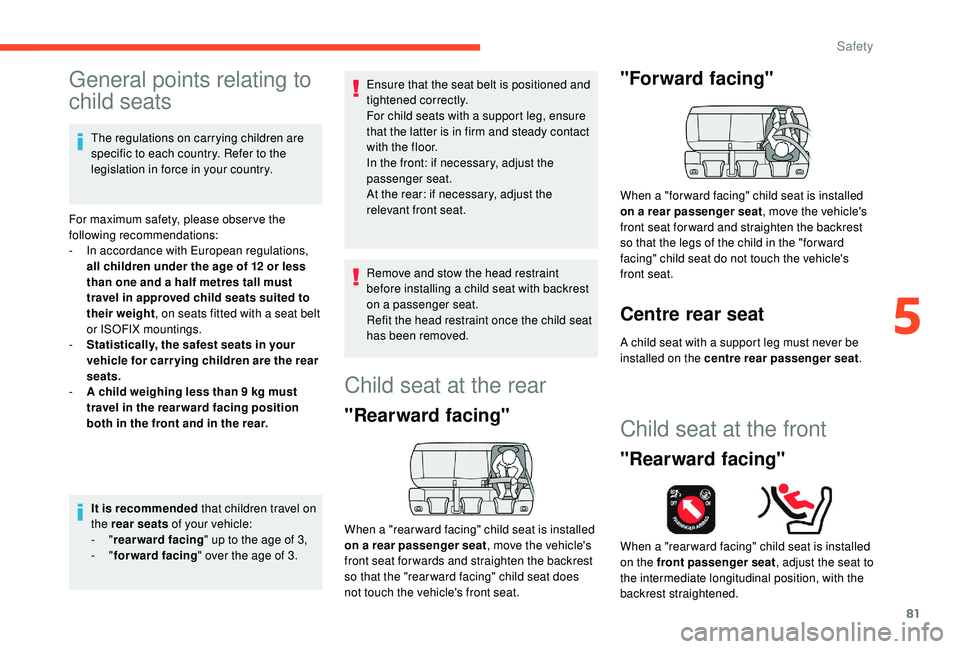
Child seat at the rear
"Rearward facing"
When a "rear ward facing" child seat is installed
on a rear passenger seat
, move the vehicle's
front seat for wards and straighten the backrest
so that the "rear ward facing" child seat does
not touch the vehicle's front seat.
"Forward facing"
When a "for ward facing" child seat is installed
on a rear passenger seat , move the vehicle's
front seat for ward and straighten the backrest
so that the legs of the child in the "for ward
facing" child seat do not touch the vehicle's
front seat.
Centre rear seat
A child seat with a support leg must never be
installed on the centre rear passenger seat .
Child seat at the front
"Rearward facing"
When a "rear ward facing" child seat is installed
on the front passenger seat, adjust the seat to
the intermediate longitudinal position, with the
backrest straightened.
5
Safety
Page 84 of 256
82
The front passenger airbag must be
deactivated. Otherwise, the child risks
being seriously injured or killed if the
airbag is deployed.
"Forward facing"
When a "for ward facing" child seat is installed
on the front passenger seat , adjust the
vehicle's seat to the intermediate longitudinal
position with the backrest straightened and
leave the front passenger airbag activated.
Ensure that the seat belt is correctly
tensioned.
For child seats with a support leg, ensure
that the latter is in firm contact with the
floor. If necessary, adjust the passenger
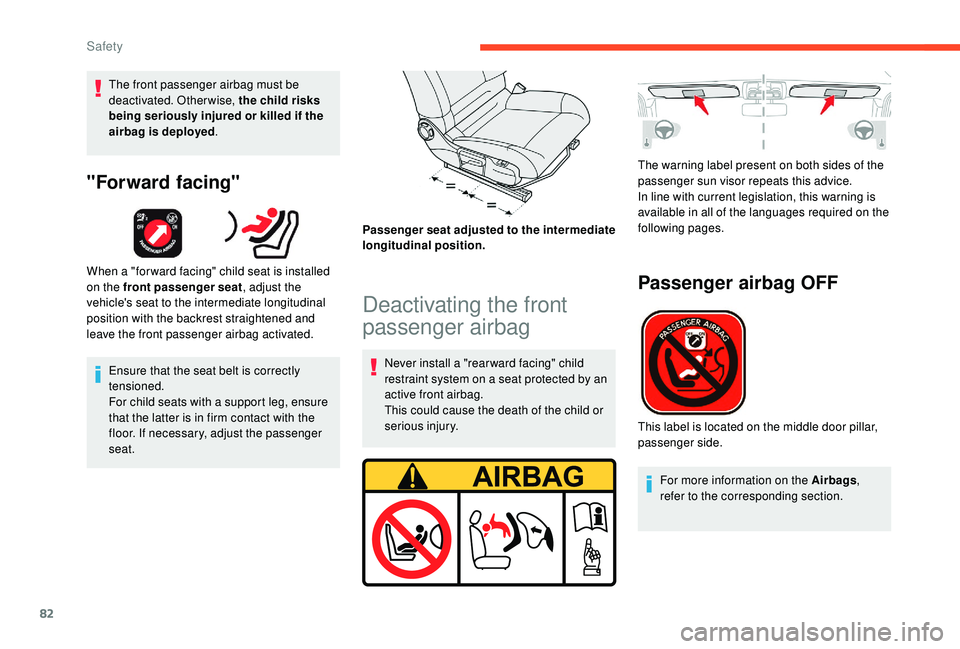
seat. Passenger seat adjusted to the intermediate
longitudinal position.
Deactivating the front
passenger airbag
Never install a "rear ward facing" child
restraint system on a seat protected by an
active front airbag.
This could cause the death of the child or
serious injury.The warning label present on both sides of the
passenger sun visor repeats this advice.
In line with current legislation, this warning is
available in all of the languages required on the
following pages.
Passenger airbag OFF
This label is located on the middle door pillar,
passenger side.
For more information on the Airbags ,
refer to the corresponding section.
Safety
Page 85 of 256
83
Deactivating the front
passenger airbag
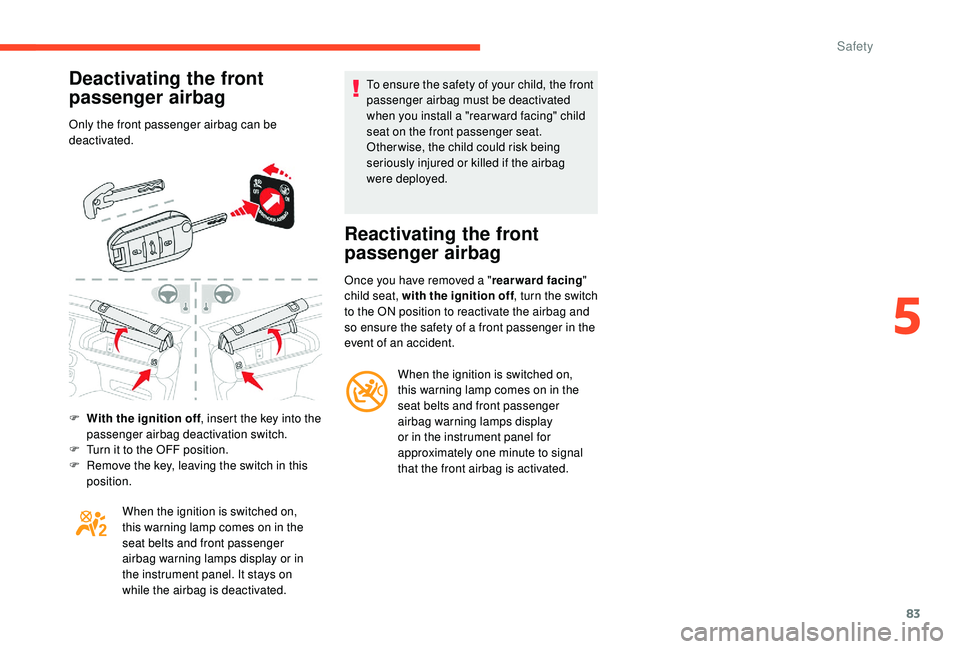
Only the front passenger airbag can be
deactivated.
F
W
ith the ignition off , insert the key into the
passenger airbag deactivation switch.
F
T
urn it to the OFF position.
F
R
emove the key, leaving the switch in this
position.
When the ignition is switched on,
this warning lamp comes on in the
seat belts and front passenger
airbag warning lamps display or in
the instrument panel. It stays on
while the airbag is deactivated. To ensure the safety of your child, the front
passenger airbag must be deactivated
when you install a "rear ward facing" child
seat on the front passenger seat.
Otherwise, the child could risk being
seriously injured or killed if the airbag
were deployed.
Reactivating the front
passenger airbag
Once you have removed a "
rearward facing"
child seat, with the ignition off , turn the switch
to the ON position to reactivate the airbag and
so ensure the safety of a front passenger in the
event of an accident.
When the ignition is switched on,
this warning lamp comes on in the
seat belts and front passenger
airbag warning lamps display
or in the instrument panel for
approximately one minute to signal
that the front airbag is activated.
5
Safety
Page 88 of 256
86
Recommended child
seats
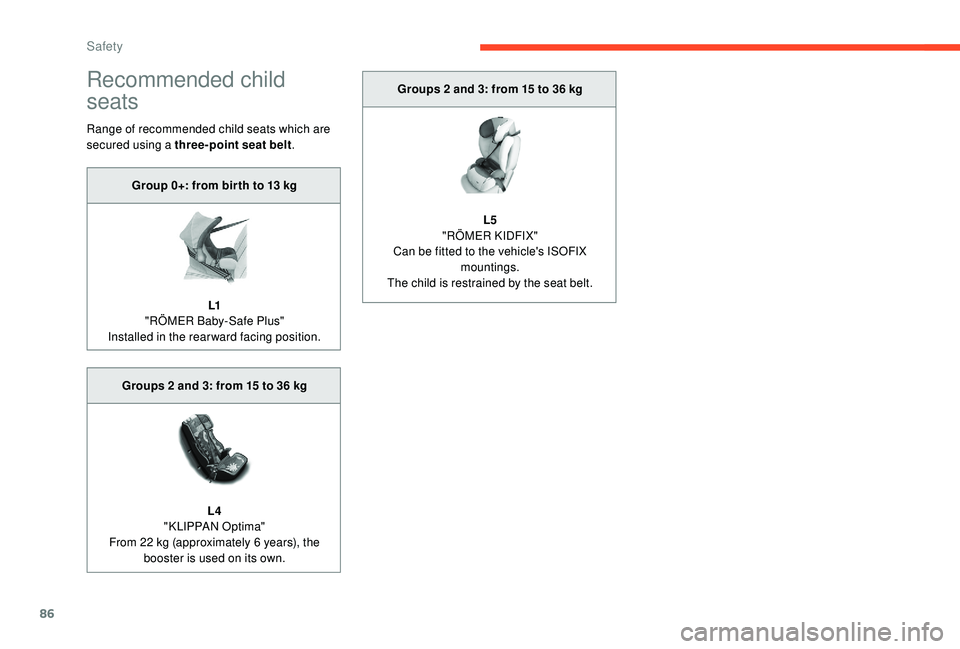
Range of recommended child seats which are
secured using a three-point seat belt.Groups 2 and 3: from 15 to 36 kg
L5
"RÖMER KIDFIX"
Can be fitted to the vehicle's ISOFIX mountings.
The child is restrained by the seat belt.
Group 0+: from bir th to 13 kg
L1
"RÖMER Baby-Safe Plus"
Installed in the rearward facing position.
Groups 2 and 3: from 15 to 36 kg
L4
"KLIPPAN Optima"
From 22 kg (approximately 6 years), the booster is used on its own.
Safety
Page 89 of 256
87
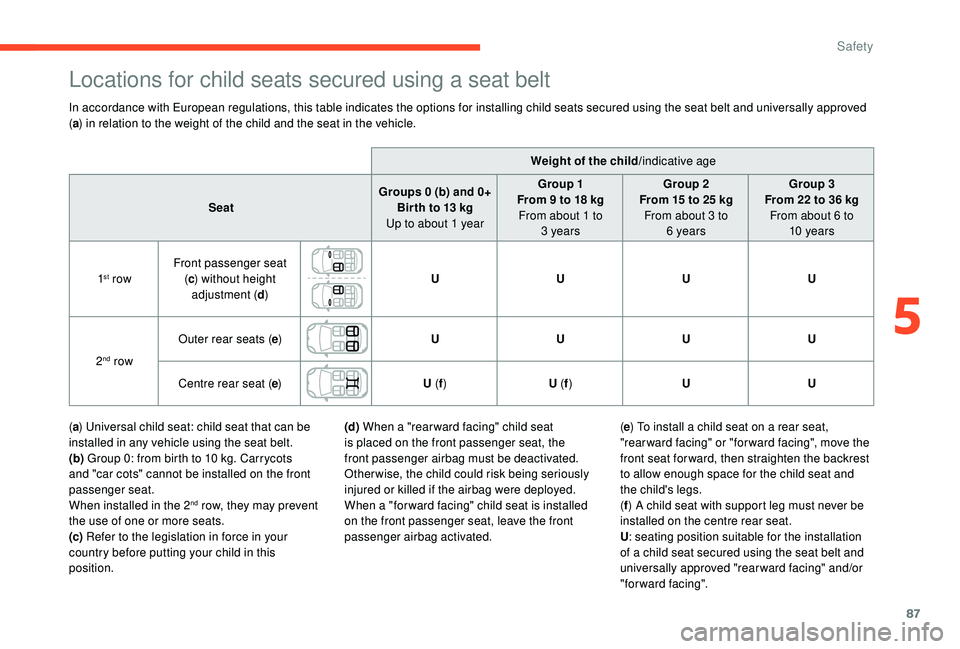
Locations for child seats secured using a seat belt
In accordance with European regulations, this table indicates the options for installing child seats secured using the seat belt and universally approved
(a ) in relation to the weight of the child and the seat in the vehicle.
( a ) Universal child seat: child seat that can be
installed in any vehicle using the seat belt.
(b) Group 0: from birth to 10 kg. Carrycots
and "car cots" cannot be installed on the front
passenger seat.
When installed in the 2
nd row, they may prevent
the use of one or more seats.
(c) Refer to the legislation in force in your
country before putting your child in this
position. (d)
When a "rear ward facing" child seat
is placed on the front passenger seat, the
front passenger airbag must be deactivated.
Otherwise, the child could risk being seriously
injured or killed if the airbag were deployed.
When a "for ward facing" child seat is installed
on the front passenger seat, leave the front
passenger airbag activated. (
e ) To install a child seat on a rear seat,
"rear ward facing" or "for ward facing", move the
front seat for ward, then straighten the backrest
to allow enough space for the child seat and
the child's legs.
( f ) A child seat with support leg must never be
installed on the centre rear seat.
U : seating position suitable for the installation
of a child seat secured using the seat belt and
universally approved "rearward facing" and/or
"forward facing".
Weight of the child/
indicative age
Seat Groups 0 (b) and 0+
Bir th to 13 kg
Up to about 1 year Group 1
From 9 to 18 kg From about 1 to 3 years
Group 2
From 15 to 25 kg From about 3 to 6 years
Group 3
From 22 to 36 kg From about 6 to 10 years
1
st row Front passenger seat
(c ) without height
adjustment ( d) U
UUU
2
nd row Outer rear seats (
e) UUUU
Centre rear seat ( e) U (f) U (f) U U
5
Safety
Page 90 of 256
88
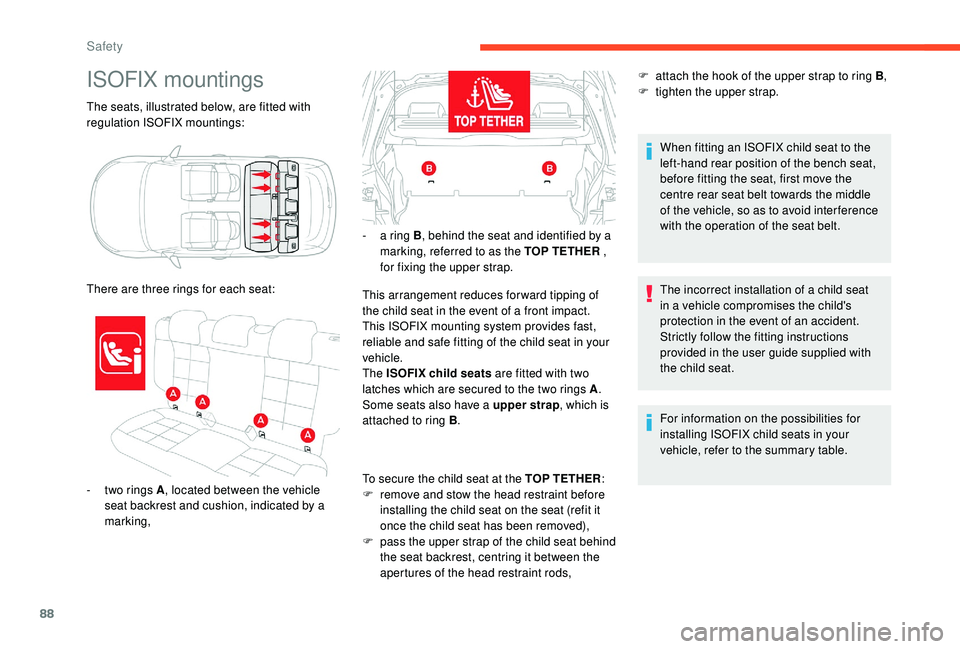
The seats, illustrated below, are fitted with
regulation ISOFIX mountings:
ISOFIX mountings
- two rings A, located between the vehicle
seat backrest and cushion, indicated by a
marking,
There are three rings for each seat:
-
a r
ing B
, behind the seat and identified by a
marking, referred to as the TOP TETHER ,
for fixing the upper strap.
This arrangement reduces forward tipping of
the child seat in the event of a front impact.
This ISOFIX mounting system provides fast,
reliable and safe fitting of the child seat in your
vehicle.
The ISOFIX child seats are fitted with two
latches which are secured to the two rings A .
Some seats also have a upper strap , which is
attached to ring B .
To secure the child seat at the TOP TETHER :
F r emove and stow the head restraint before
installing the child seat on the seat (refit it
once the child seat has been removed),
F
p
ass the upper strap of the child seat behind
the seat backrest, centring it between the
apertures of the head restraint rods, When fitting an ISOFIX child seat to the
left-hand rear position of the bench seat,
before fitting the seat, first move the
centre rear seat belt towards the middle
of the vehicle, so as to avoid inter ference
with the operation of the seat belt.
The incorrect installation of a child seat
in a vehicle compromises the child's
protection in the event of an accident.
Strictly follow the fitting instructions
provided in the user guide supplied with
the child seat.
For information on the possibilities for
installing ISOFIX child seats in your
vehicle, refer to the summary table.
F
a
ttach the hook of the upper strap to ring B
,
F
t
ighten the upper strap.
Safety
Page 91 of 256
89
Recommended ISOFIX
child seats
Also consult the installation notes from the
child seat's manufacturer to find out how
to install and remove the seat.
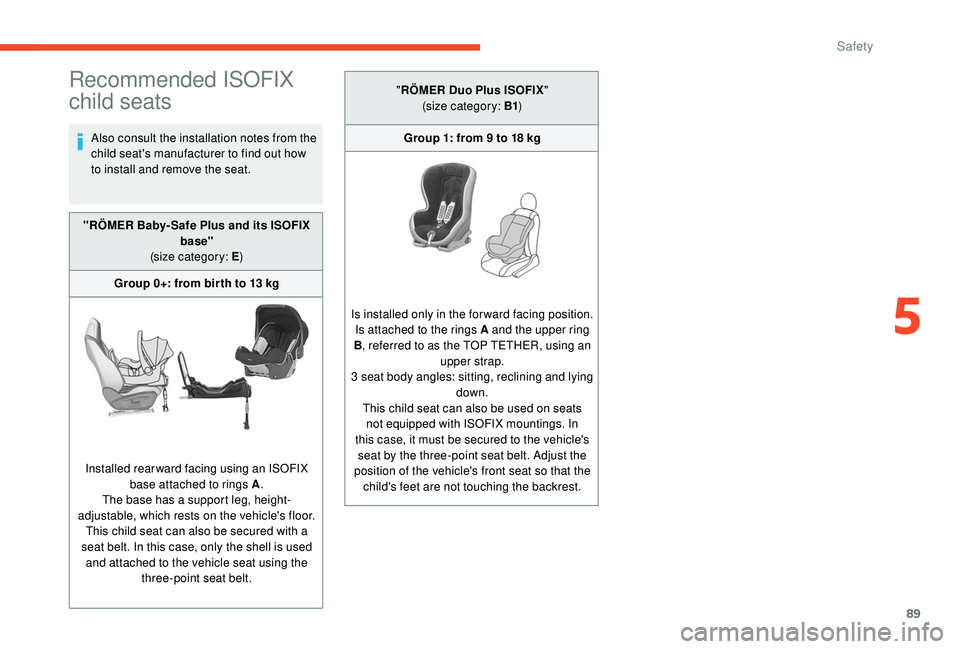
"RÖMER Baby- Safe Plus and its ISOFIX base"
(size category: E )
Group 0+: from bir th to 13 kg
Installed rearward facing using an ISOFIX base attached to rings A .
The base has a support leg, height-
adjustable, which rests on the vehicle's floor. This child seat can also be secured with a
seat belt. In this case, only the shell is used and attached to the vehicle seat using the three-point seat belt. "
RÖMER Duo Plus ISOFIX "
(size category: B1 )
Group 1: from 9 to 18 kg
Is installed only in the forward facing position. Is attached to the rings A and the upper ring
B , referred to as the TOP TETHER, using an
upper strap.
3 seat body angles: sitting, reclining and lying down.
This child seat can also be used on seats not equipped with ISOFIX mountings. In
this case, it must be secured to the vehicle's seat by the three-point seat belt. Adjust the
position of the vehicle's front seat so that the child's feet are not touching the backrest.
5
Safety
Page 94 of 256
92
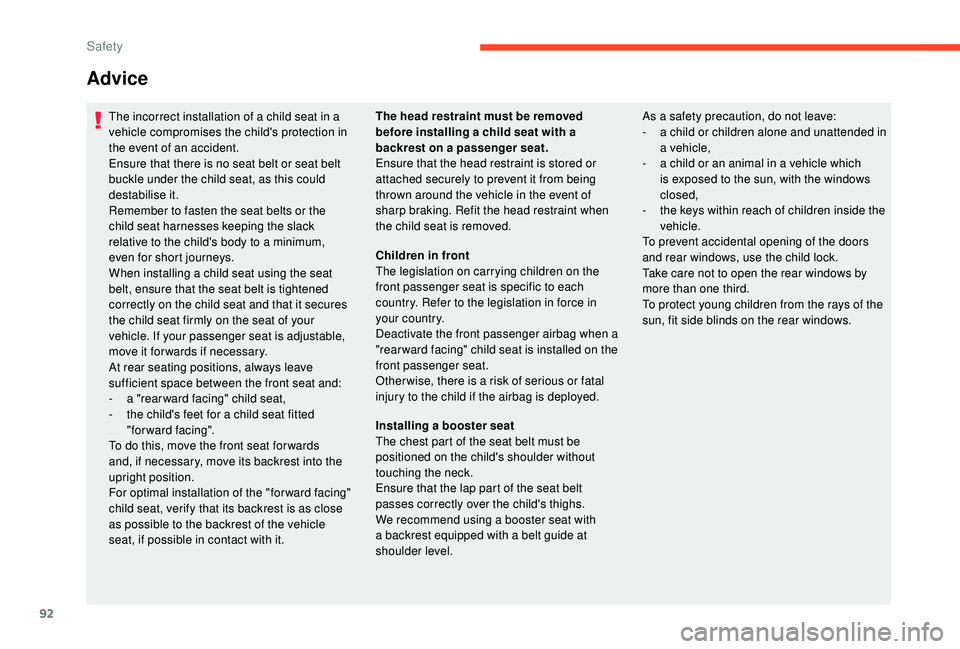
Advice
The incorrect installation of a child seat in a
vehicle compromises the child's protection in
the event of an accident.
Ensure that there is no seat belt or seat belt
buckle under the child seat, as this could
destabilise it.
Remember to fasten the seat belts or the
child seat harnesses keeping the slack
relative to the child's body to a minimum,
even for short journeys.
When installing a child seat using the seat
belt, ensure that the seat belt is tightened
correctly on the child seat and that it secures
the child seat firmly on the seat of your
vehicle. If your passenger seat is adjustable,
move it for wards if necessary.
At rear seating positions, always leave
sufficient space between the front seat and:
-
a "
rear ward facing" child seat,
-
t
he child's feet for a child seat fitted
"forward facing".
To do this, move the front seat for wards
and, if necessary, move its backrest into the
upright position.
For optimal installation of the "forward facing"
child seat, verify that its backrest is as close
as possible to the backrest of the vehicle
seat, if possible in contact with it. The head restraint must be removed
before installing a child seat with a
backrest on a passenger seat.
Ensure that the head restraint is stored or
attached securely to prevent it from being
thrown around the vehicle in the event of
sharp braking. Refit the head restraint when
the child seat is removed.
As a safety precaution, do not leave:
-
a c hild or children alone and unattended in
a vehicle,
-
a c
hild or an animal in a vehicle which
is exposed to the sun, with the windows
closed,
-
t
he keys within reach of children inside the
vehicle.
To prevent accidental opening of the doors
and rear windows, use the child lock.
Take care not to open the rear windows by
more than one third.
To protect young children from the rays of the
sun, fit side blinds on the rear windows.
Children in front
The legislation on carrying children on the
front passenger seat is specific to each
country. Refer to the legislation in force in
your country.
Deactivate the front passenger airbag when a
"rear ward facing" child seat is installed on the
front passenger seat.
Other wise, there is a risk of serious or fatal
injury to the child if the airbag is deployed.
Installing a booster seat
The chest part of the seat belt must be
positioned on the child's shoulder without
touching the neck.
Ensure that the lap part of the seat belt
passes correctly over the child's thighs.
We recommend using a booster seat with
a backrest equipped with a belt guide at
shoulder level.
Safety
Page 110 of 256

108
Per fect for urban use, the Stop & Start system
reduces fuel consumption and exhaust
emissions as well as the noise level when
stationary.
Going into engine STOP
mode
This indicator lamp comes on in the
instrument panel and the engine
goes into standby automatically.
-
W
ith a manual gearbox , at speeds below
2
mph (3 km/h) or with the vehicle stationary
(depending on version), when you place the
gear lever in neutral and release the clutch
pedal,
-
W
ith an automatic gearbox , at speeds
below 2 mph (3 km/h), or when the vehicle
is stationary (depending on version), when
you press the brake pedal or place the gear
selector into position N .
-
W
ith an electronic gearbox , at speeds
below 2 mph (3 km/h), or when the vehicle
is stationary (depending on version), when
you press the brake pedal or place the gear
selector into position N .
Time counter of the Stop & Star t.
(minutes/seconds or hours/minutes) If your vehicle is fitted with this system, a time
counter calculates the sum of the periods in
STOP mode during a journey.
It resets to zero every time the ignition is
switched on.
For your comfort, during parking
manoeuvres, STOP mode is not available
for a few seconds after coming out of
reverse gear.
The Stop & Start system does not affect
the functionality of the vehicle, such as for
example, braking, power steering, etc.
Never refuel with the engine in STOP
mode; you must switch off the ignition with
the "START/STOP" button.
Special cases: STOP mode not
available
STOP mode is not activated when:
- t he vehicle is on a steep slope (uphill or
downhill),
-
t
he driver's door is open,
-
t
he driver's seat belt is not fastened,
-
t
he vehicle has not exceeded 6 mph (10
km/h) since the last engine start,
-
t
he engine is needed to maintain a
comfortable temperature in the passenger
compartment, -
d
emisting is active,
-
s
ome special conditions (battery charge,
engine temperature, braking assistance,
exterior temperature, etc.) where the engine
is needed to control the system.
Going into engine START
mode
This indicator lamp goes off and the
engine starts automatically: In this case, this indicator lamp
flashes for a few seconds then goes
of f.
This operation is perfectly normal.
-
W
ith a manual gearbox , when you fully
depress the clutch pedal.
-
W
ith an automatic gearbox :
•
g
ear selector in position D or M , when
you release the brake pedal,
•
o
r gear selector in position N and brake
pedal released, when you place the gear
selector in position D or M ,
•
o
r when you engage reverse gear.
Driving
Page 111 of 256

109
- With an electronic gearbox:
• g ear selector in position D , when you
release the brake pedal,
•
o
r gear selector in position N and brake
pedal released, when you place the gear
selector in position D ,
•
o
r when you engage reverse gear.
Special cases: START activated
automatically
As a safety measure or to maintain comfort
levels in the vehicle, START mode is activated
automatically when:
-
y
ou open the driver's door,
-
t
he driver's seat belt is not fastened,
-
t
he speed of the vehicle exceeds 7 mph
(11 km/h) with an electronic gearbox,
-
s
ome special conditions (battery charge,
engine temperature, braking assistance,
exterior temperature, etc.) where the engine
is needed to control the system or the
vehicle.
Deactivation/Reactivation
In certain circumstances, such as the need
to maintain the temperature in the passenger
compartment, it may be useful to deactivate the
Stop & Start system.
The system can be deactivated at any time,
once the ignition is switched on.
If the engine is in STOP mode, it then restarts.
The Stop & Start system is reactivated
automatically every time the ignition is switched
on.
F
I
n the Driving/Vehicle menu
of the touch screen, select the
" Driving functions " tab, then
" Stop & Star t ".
Opening the bonnet
Before doing anything under the bonnet,
deactivate the Stop & Start system to
avoid any risk of injury resulting from an
automatic change to START mode. Driving on flooded roads
Before driving in a flooded area, it is
strongly recommended that you deactivate
the Stop & Start system.
For more information on Driving
recommendations
, particularly on
flooded roads, refer to the corresponding
section.
Operating fault
In the event of a fault with the
system, this warning lamp flashes in
the instrument panel.
Have it checked by a CITROËN dealer or a
qualified workshop.
In the event of a fault in STOP mode, the
vehicle may stall.
All of the instrument panel warning lamps come
on.
It is then necessary to switch off the ignition,
then restart the engine. Depending on the version, an alert
message may also be displayed, asking
you to change to neutral ( N) and to press
the brake pedal.
You must switch off the ignition, then start
the engine again.
In this case, this indicator lamp
flashes for a few seconds, then goes
of f.
This operation is perfectly normal.
6
Driving