instrument panel CITROEN C4 CACTUS 2017 User Guide
[x] Cancel search | Manufacturer: CITROEN, Model Year: 2017, Model line: C4 CACTUS, Model: CITROEN C4 CACTUS 2017Pages: 256, PDF Size: 7.62 MB
Page 65 of 256

63
Automatic illumination of
headlamps
As soon as the light returns to a sufficient level
or after the windscreen wipers are switched off,
the lamps are switched off automatically.
Switching on
Switching off
F Turn the ring to another position.
Deactivation of the function is accompanied by
the display of a message.
Malfunction
In the event of a malfunction of the
sunshine sensor, the lamps come
on, this warning lamp is displayed on
the instrument panel together with
an audible signal and/or a message.
Contact a CITROËN dealer or a
qualified workshop.
Do not cover the sunshine sensor,
integrated with the rain sensor and located
at the top centre of the windscreen behind
the rear view mirror; the associated
functions would no longer be controlled.
In fog or snow, the sunshine sensor may
detect sufficient light. In this case, the
lighting will not come on automatically.
Daytime running lamps/
Sidelamps (LEDs)
The LEDs are brighter when operating as
daytime running lamps.
F
T
urn the ring to the "
AUTO" position.
The activation of the function is accompanied
by the display of a message.
Three flashes
F Press briefly upwards or downwards, without going beyond the point of
resistance; the direction indicators will flash
3 times.
The light-emitting diodes (LEDs) come on
automatically when the engine is started.
They provide the following functions:
-
D
aytime running lamps (lighting control
stalk at position " 0" or " AUTO " with
adequate light level).
-
S
idelamps (lighting control stalk in position
" AUTO " with low light level or "Sidelamps
only" or "Main or dipped beam headlamps").
4
Lighting and visibility
Page 66 of 256

64
Parking lamps
Vehicle side marking by illumination of the
sidelamps on the traffic side only.
F
D
epending on version, within one minute
of switching off the ignition, operate the
lighting control stalk up or down depending
on the traffic side (for example, when
parking on the right, move the lighting
control stalk downwards; the left-hand
sidelamps light up).
This is confirmed by an audible signal and
illumination of the corresponding direction
indicator lamp in the instrument panel.
To switch off the parking lamps, return the
lighting control stalk to the central position.
Guide-me-home lighting
Automatic
When the automatic illumination of headlamps
is activated, if the ambient light level is
low, the dipped beam headlamps come on
automatically when switching off the ignition.
Activation or deactivation, as well as the
duration for the guide-me-home lighting can be
set in the touch screen.
F
I
n the Driving/Vehicle menu,
select the " Vehicle settings "
tab, then " Headlamps " and
activate/deactivate " Guide-Me-
Home Lighting ".
Manual
The temporary illumination of the dipped beam
headlamps after the vehicle's ignition has been
switched off makes the driver's exit easier
when the light is poor. Switching on
F
W
ith the ignition off, "flash" the headlamps
using the lighting control stalk.
F
A
nother "headlamp flash" switches the
function off.
Switching off
The manual guide-me lighting goes off
automatically at the end of a given period of
time.
Headlamp beam height
adjustment
To avoid causing a nuisance to other road
users, the headlamp beams should be adjusted
for height according to the vehicle's load.
0. Driver only or driver + front passenger.
-. Driver + front passenger + rear
passengers.
Lighting and visibility
Page 70 of 256
68
Automatic windscreen
wipers
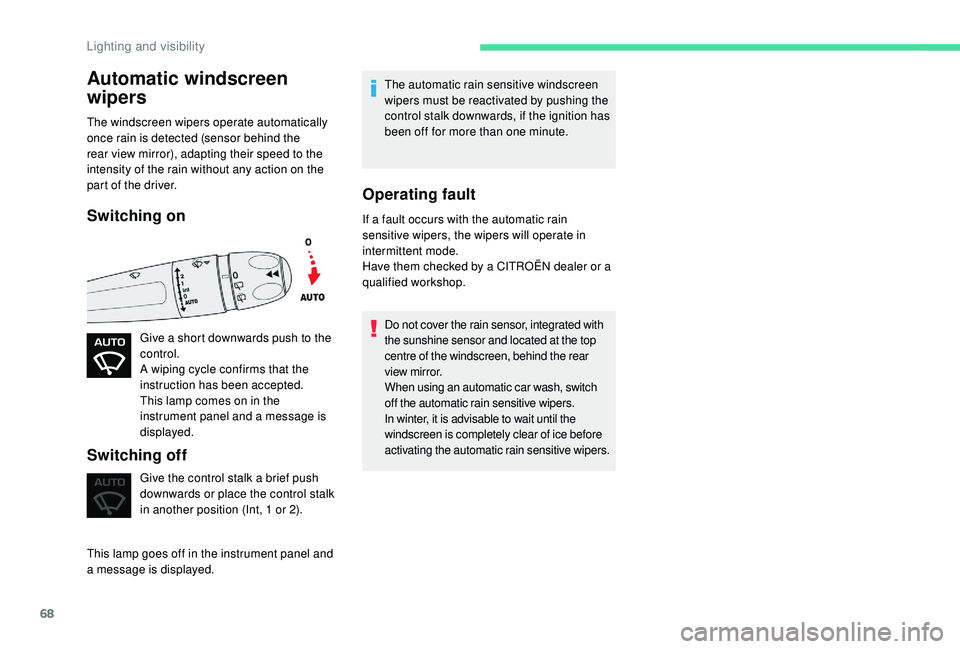
The windscreen wipers operate automatically
once rain is detected (sensor behind the
rear view mirror), adapting their speed to the
intensity of the rain without any action on the
part of the driver.
Switching on
Give a short downwards push to the
control.
A wiping cycle confirms that the
instruction has been accepted.
This lamp comes on in the
instrument panel and a message is
displayed.
Switching off
Give the control stalk a brief push
downwards or place the control stalk
in another position (Int, 1 or 2).
This lamp goes off in the instrument panel and
a message is displayed. The automatic rain sensitive windscreen
wipers must be reactivated by pushing the
control stalk downwards, if the ignition has
been off for more than one minute.
Operating fault
If a fault occurs with the automatic rain
sensitive wipers, the wipers will operate in
intermittent mode.
Have them checked by a CITROËN dealer or a
qualified workshop.
Do not cover the rain sensor, integrated with
the sunshine sensor and located at the top
centre of the windscreen, behind the rear
view mirror.
When using an automatic car wash, switch
off the automatic rain sensitive wipers.
In winter, it is advisable to wait until the
windscreen is completely clear of ice before
activating the automatic rain sensitive wipers.
Lighting and visibility
Page 75 of 256

73
Dynamic stability control (DSC)
and anti-slip regulation (ASR)
Operation
These systems are activated automatically
every time the vehicle is started.
They come into operation in the event of a
problem with grip or trajectory.
Activation
These systems are activated automatically
every time the vehicle is started.
As soon as they detect a problem of grip or
trajectory, these systems act on the operation
of the engine and brakes.This is indicated by this warning
lamp flashing in the instrument
panel.
Deactivating the ASR
In exceptional conditions (starting a vehicle
which is bogged down, stuck in snow, on soft
ground, etc.), it may be advisable to deactivate
the ASR system, so that the wheels can move
freely and regain grip. F
I
n the Driving/Vehicle
menu
of the touch screen, select the
" Driving functions " tab, then
" Traction control".
Or depending on version:
F
T
urn the "
Grip control" knob to
this position.
Deactivation is signalled by the
illumination of this warning lamp,
accompanied by a message as
well as illumination of the knob
(depending on version).
The ASR system no longer acts on the
operation of the engine or the brakes in the
event of an involuntary change of trajectory.
Reactivating the ASR
The system is reactivated automatically each
time the ignition is switched back on or from
31 mph (50 km/h).
Below 31 mph (50 km/h), you can reactivate it
manually: F
I
n the Driving/Vehicle
menu
of the touch screen, select the
" Driving functions " tab, then
" Traction control".
Or depending on version:
F
T
urn the "
Grip control" knob to
this position.
Operating fault
The illumination of this warning
lamp, accompanied by an audible
signal and a message, indicates that
there is a fault with the system.
After an impact, have the system checked
by a CITROËN dealer or a qualified
workshop.
This is indicated by this warning
lamp flashing in the instrument
panel. It is however recommended that the system be
reactivated as soon as possible.
Contact a CITROËN dealer or a qualified
workshop to have the system checked.
5
Safety
Page 78 of 256
76
Fastening
F Pull the strap then insert the tongue in the buckle.
F
C
heck that the seat belt is fastened
correctly by pulling the strap.
Unfastening
F Press the red button on the buckle.
F G uide the seat belt as it reels in.
Rear seat belts
The rear seats are each fitted with a three-point
seat belt.
Fastening
F Pull the strap then insert the tongue in the buckle.
F
C
heck that the seat belt is fastened
correctly by pulling the strap.
Unfastening
F Press the red button on the buckle.
F G uide the seat belt as it reels in.
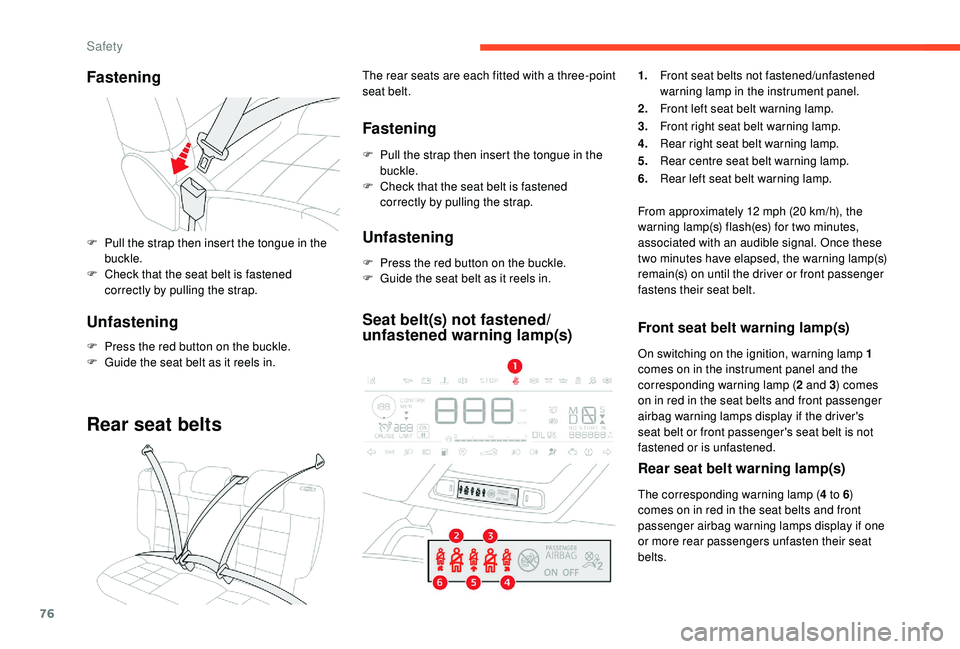
Seat belt(s) not fastened/
unfastened warning lamp(s)
1.Front seat belts not fastened/unfastened
warning lamp in the instrument panel.
2. Front left seat belt warning lamp.
3. Front right seat belt warning lamp.
4. Rear right seat belt warning lamp.
5. Rear centre seat belt warning lamp.
6. Rear left seat belt warning lamp.
From approximately 12 mph (20 km/h), the
warning lamp(s) flash(es) for two minutes,
associated with an audible signal. Once these
two minutes have elapsed, the warning lamp(s)
remain(s) on until the driver or front passenger
fastens their seat belt.
Front seat belt warning lamp(s)
On switching on the ignition, warning lamp 1
c omes on in the instrument panel and the
corresponding warning lamp ( 2 and 3) comes
on in red in the seat belts and front passenger
airbag warning lamps display if the driver's
seat belt or front passenger's seat belt is not
fastened or is unfastened.
Rear seat belt warning lamp(s)
The corresponding warning lamp ( 4 to 6)
comes on in red in the seat belts and front
passenger airbag warning lamps display if one
or more rear passengers unfasten their seat
belts.
Safety
Page 81 of 256
79
Deployment
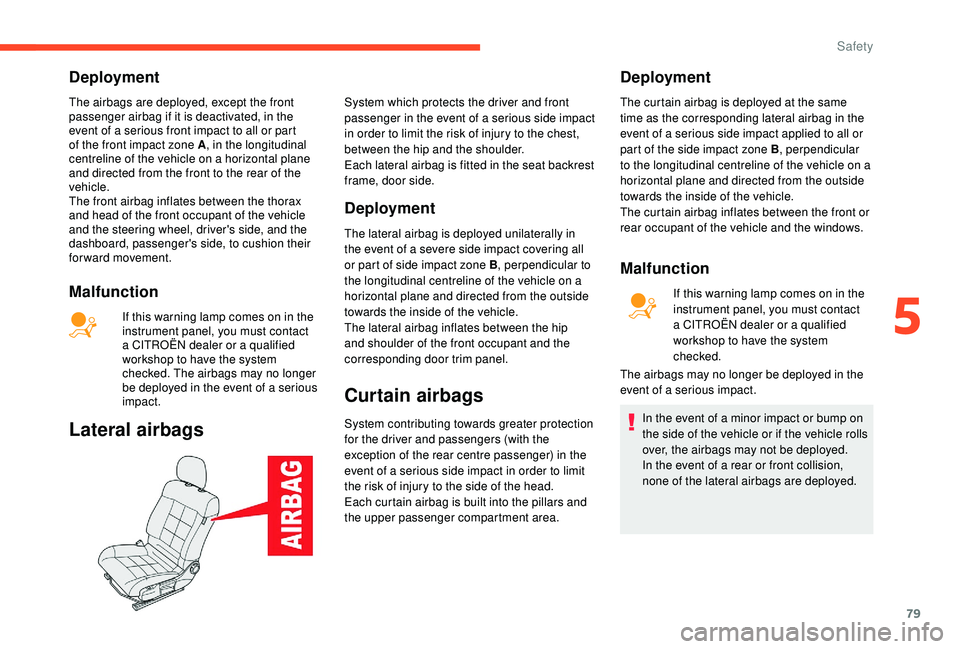
The airbags are deployed, except the front
passenger airbag if it is deactivated, in the
event of a serious front impact to all or part
of the front impact zone A, in the longitudinal
centreline of the vehicle on a horizontal plane
and directed from the front to the rear of the
vehicle.
The front airbag inflates between the thorax
and head of the front occupant of the vehicle
and the steering wheel, driver's side, and the
dashboard, passenger's side, to cushion their
for ward movement.
Malfunction
If this warning lamp comes on in the
instrument panel, you must contact
a CITROËN dealer or a qualified
workshop to have the system
checked. The airbags may no longer
be deployed in the event of a serious
impact.
Lateral airbags
System which protects the driver and front
passenger in the event of a serious side impact
in order to limit the risk of injury to the chest,
between the hip and the shoulder.
Each lateral airbag is fitted in the seat backrest
frame, door side.
Deployment
The lateral airbag is deployed unilaterally in
the event of a severe side impact covering all
or part of side impact zone B , perpendicular to
the longitudinal centreline of the vehicle on a
horizontal plane and directed from the outside
towards the inside of the vehicle.
The lateral airbag inflates between the hip
and shoulder of the front occupant and the
corresponding door trim panel.
Curtain airbags
System contributing towards greater protection
for the driver and passengers (with the
exception of the rear centre passenger) in the
event of a serious side impact in order to limit
the risk of injury to the side of the head.
Each curtain airbag is built into the pillars and
the upper passenger compartment area.
Deployment
The curtain airbag is deployed at the same
time as the corresponding lateral airbag in the
event of a serious side impact applied to all or
part of the side impact zone B , perpendicular
to the longitudinal centreline of the vehicle on a
horizontal plane and directed from the outside
towards the inside of the vehicle.
The curtain airbag inflates between the front or
rear occupant of the vehicle and the windows.
Malfunction
If this warning lamp comes on in the
instrument panel, you must contact
a CITROËN dealer or a qualified
workshop to have the system
checked.
The airbags may no longer be deployed in the
event of a serious impact.
In the event of a minor impact or bump on
the side of the vehicle or if the vehicle rolls
over, the airbags may not be deployed.
In the event of a rear or front collision,
none of the lateral airbags are deployed.
5
Safety
Page 85 of 256
83
Deactivating the front
passenger airbag
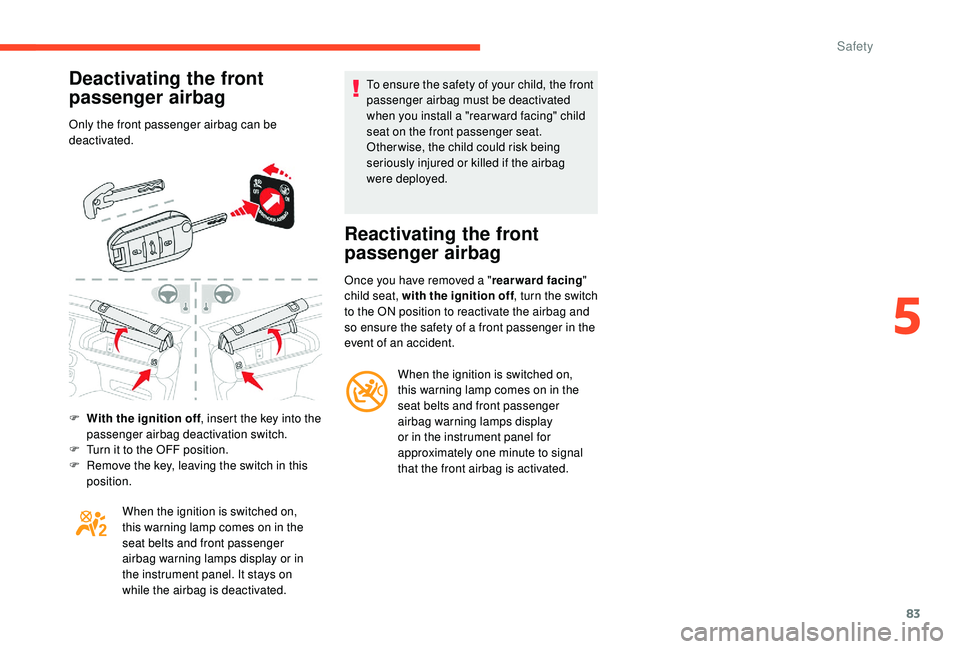
Only the front passenger airbag can be
deactivated.
F
W
ith the ignition off , insert the key into the
passenger airbag deactivation switch.
F
T
urn it to the OFF position.
F
R
emove the key, leaving the switch in this
position.
When the ignition is switched on,
this warning lamp comes on in the
seat belts and front passenger
airbag warning lamps display or in
the instrument panel. It stays on
while the airbag is deactivated. To ensure the safety of your child, the front
passenger airbag must be deactivated
when you install a "rear ward facing" child
seat on the front passenger seat.
Otherwise, the child could risk being
seriously injured or killed if the airbag
were deployed.
Reactivating the front
passenger airbag
Once you have removed a "
rearward facing"
child seat, with the ignition off , turn the switch
to the ON position to reactivate the airbag and
so ensure the safety of a front passenger in the
event of an accident.
When the ignition is switched on,
this warning lamp comes on in the
seat belts and front passenger
airbag warning lamps display
or in the instrument panel for
approximately one minute to signal
that the front airbag is activated.
5
Safety
Page 98 of 256
96
Starting/Switching off the
engine with the key
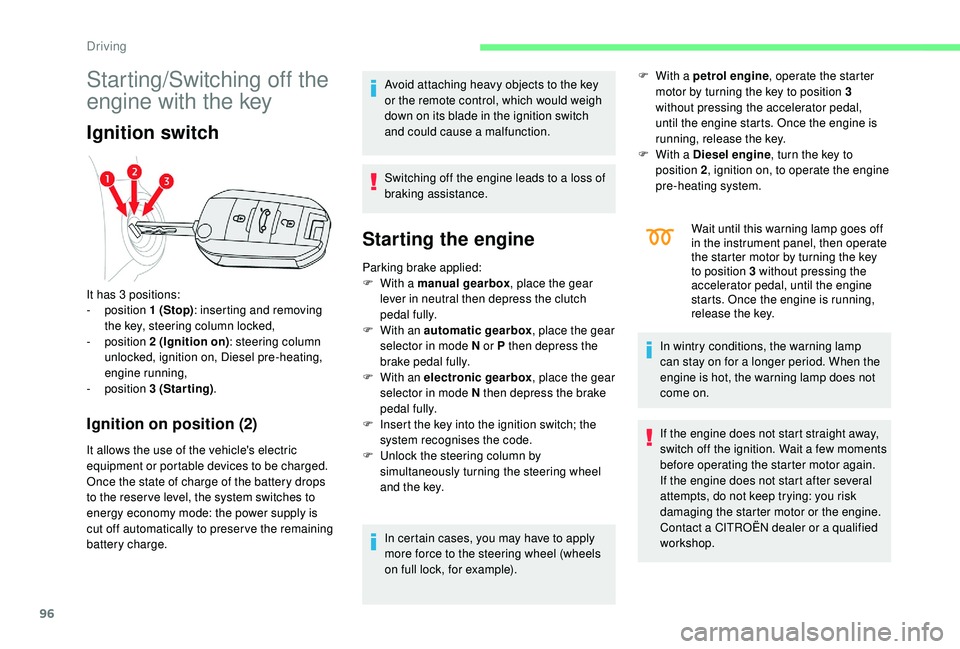
Ignition switch
Ignition on position (2)
It allows the use of the vehicle's electric
equipment or portable devices to be charged.
Once the state of charge of the battery drops
to the reser ve level, the system switches to
energy economy mode: the power supply is
cut off automatically to preser ve the remaining
battery charge.Avoid attaching heavy objects to the key
or the remote control, which would weigh
down on its blade in the ignition switch
and could cause a malfunction.
Switching off the engine leads to a loss of
braking assistance.
Starting the engine
Parking brake applied:
F
W ith a manual gearbox , place the gear
lever in neutral then depress the clutch
pedal fully.
F
W
ith an automatic gearbox , place the gear
selector in mode N or P then depress the
brake pedal fully.
F
W
ith an electronic gearbox , place the gear
selector in mode N then depress the brake
pedal fully.
F
I
nsert the key into the ignition switch; the
system recognises the code.
F
U
nlock the steering column by
simultaneously turning the steering wheel
and the key.
In certain cases, you may have to apply
more force to the steering wheel (wheels
on full lock, for example). F
W
ith a petrol engine
, operate the starter
motor by turning the key to position 3
without pressing the accelerator pedal,
until the engine starts. Once the engine is
running, release the key.
F
W
ith a Diesel engine
, turn the key to
position 2 , ignition on, to operate the engine
pre-heating system.
It has 3 positions:
-
position 1 (Stop): inserting and removing
the key, steering column locked,
-
position 2 (Ignition on) : steering column
unlocked, ignition on, Diesel pre-heating,
engine running,
-
position 3 (Starting) . Wait until this warning lamp goes off
in the instrument panel, then operate
the starter motor by turning the key
to position 3 without pressing the
accelerator pedal, until the engine
starts. Once the engine is running,
release the key.
In wintry conditions, the warning lamp
can stay on for a longer period. When the
engine is hot, the warning lamp does not
come on.
If the engine does not start straight away,
switch off the ignition. Wait a few moments
before operating the starter motor again.
If the engine does not start after several
attempts, do not keep trying: you risk
damaging the starter motor or the engine.
Contact a CITROËN dealer or a qualified
workshop.
Driving
Page 100 of 256

98
F With an automatic gearbox, place the gear
selector in mode P or N then depress the
brake pedal fully.
F
W
ith an electronic gearbox , place the gear
selector in mode N then depress the brake
pedal fully.
F
B
riefly press the " START/STOP" button
while maintaining pressure on the pedal
until the engine starts.
The steering column unlocks and the engine
starts.
For Diesel engines , when the temperature is
below zero and/or the engine is cold, starting
will only be done once the pre-heater warning
lamp is off.
If this warning lamp comes on after
pressing the " START/STOP " button:
F
W
ith a manual gearbox , you should keep
the clutch pedal fully depressed until the
warning lamp goes off and not press the
" START/STOP " button again until the
engine is running. F
W ith an automatic or electronic gearbox
,
you should keep the brake pedal fully
depressed until the warning lamp goes off
and not press the " START/STOP" button
again until the engine is running.
The presence of the "
K
eyless Entry and
Starting" electronic key in the recognition
zone is essential.
If the electronic key is not detected in this
zone, a message is displayed.
Move the electronic key into this zone so
that the engine can be started.
If there is still a problem, refer to the "Key
not detected – Back-up starting" section.
If one of the starting conditions is not met,
a reminder message is displayed in the
instrument panel.
In some circumstances, it is necessary
to turn the steering wheel slightly while
pressing the " START/STOP " button to
assist unlocking of the steering column; a
message warns you when this is needed.
For safety reasons, never leave the
vehicle while the engine is running.Switching off the engine
F Immobilise the vehicle, engine at idle.
F W ith a manual gearbox , put the gear lever
into neutral.
F
W
ith an automatic gearbox , place the gear
selector in mode P or N.
F
W
ith an electronic gearbox , select mode
N .
F
W
ith the electronic key inside the vehicle,
press the " START/STOP " button.
The engine stops and the steering column
locks.
In some circumstances, it is necessary to turn
the steering wheel slightly to lock the steering
column.
If the vehicle is not immobilised, the
engine will not stop.
Never leave your vehicle with the
electronic key still inside.
Switching off the engine leads to a loss of
braking assistance.
Driving
Page 101 of 256

99
Switching the ignition on
(without starting)
F Press the "START/STOP" button, the
instrument panel comes on but the engine
does not start.
F
P
ress the button again to switch off the
ignition and allow the vehicle to be locked.
With the ignition on, the system
automatically goes into energy economy
mode to maintain an adequate state of
charge in the battery.
Key not detected
Back-up starting
A back-up reader is fitted underneath the
parking brake lever so that the engine can be
started if the system does not detect the key in
the recognition zone, or when the battery in the
electronic key is flat.
F
W
ith a manual gearbox, place the gear
lever in neutral, then fully depress the clutch
pedal.
F
W
ith an automatic gearbox , select
mode P, then fully depress the brake pedal.
F
W
ith an electronic gearbox , select
mode N, then fully depress the brake pedal.
F
P
ress the " START/STOP " button.
The engine starts.
Back-up switch-off
Emergency switch-off
With the Keyless Entry and Starting remote
control inside the vehicle, pressing the
" START/STOP " button, with no action on the
pedals , allows the ignition to be switched on.
This also allows the accessories to be used (for
example: audio system, lighting, etc.).
F
P
lace and hold the remote control against
the reader. When the electronic key is not detected or is
no longer in the recognition zone, a message
appears on the touch screen when closing a
door or trying to switch off the engine.
F
T
o confirm the instruction to switch off the
engine, press the " START/STOP" button for
about three seconds.
In the event of a fault with the electronic key,
contact a CITROËN dealer or a qualified
workshop.
In the event of an emergency only, the
engine can be switched off without
conditions (even when driving).
Press the " START/STOP " button for about
three seconds.
In this case, the steering column locks as
soon as the vehicle stops.
6
Driving