gearbox CITROEN C4 CACTUS 2017 Owner's Manual
[x] Cancel search | Manufacturer: CITROEN, Model Year: 2017, Model line: C4 CACTUS, Model: CITROEN C4 CACTUS 2017Pages: 256, PDF Size: 7.62 MB
Page 110 of 256

108
Per fect for urban use, the Stop & Start system
reduces fuel consumption and exhaust
emissions as well as the noise level when
stationary.
Going into engine STOP
mode
This indicator lamp comes on in the
instrument panel and the engine
goes into standby automatically.
-
W
ith a manual gearbox , at speeds below
2
mph (3 km/h) or with the vehicle stationary
(depending on version), when you place the
gear lever in neutral and release the clutch
pedal,
-
W
ith an automatic gearbox , at speeds
below 2 mph (3 km/h), or when the vehicle
is stationary (depending on version), when
you press the brake pedal or place the gear
selector into position N .
-
W
ith an electronic gearbox , at speeds
below 2 mph (3 km/h), or when the vehicle
is stationary (depending on version), when
you press the brake pedal or place the gear
selector into position N .
Time counter of the Stop & Star t.
(minutes/seconds or hours/minutes) If your vehicle is fitted with this system, a time
counter calculates the sum of the periods in
STOP mode during a journey.
It resets to zero every time the ignition is
switched on.
For your comfort, during parking
manoeuvres, STOP mode is not available
for a few seconds after coming out of
reverse gear.
The Stop & Start system does not affect
the functionality of the vehicle, such as for
example, braking, power steering, etc.
Never refuel with the engine in STOP
mode; you must switch off the ignition with
the "START/STOP" button.
Special cases: STOP mode not
available
STOP mode is not activated when:
- t he vehicle is on a steep slope (uphill or
downhill),
-
t
he driver's door is open,
-
t
he driver's seat belt is not fastened,
-
t
he vehicle has not exceeded 6 mph (10
km/h) since the last engine start,
-
t
he engine is needed to maintain a
comfortable temperature in the passenger
compartment, -
d
emisting is active,
-
s
ome special conditions (battery charge,
engine temperature, braking assistance,
exterior temperature, etc.) where the engine
is needed to control the system.
Going into engine START
mode
This indicator lamp goes off and the
engine starts automatically: In this case, this indicator lamp
flashes for a few seconds then goes
of f.
This operation is perfectly normal.
-
W
ith a manual gearbox , when you fully
depress the clutch pedal.
-
W
ith an automatic gearbox :
•
g
ear selector in position D or M , when
you release the brake pedal,
•
o
r gear selector in position N and brake
pedal released, when you place the gear
selector in position D or M ,
•
o
r when you engage reverse gear.
Driving
Page 111 of 256

109
- With an electronic gearbox:
• g ear selector in position D , when you
release the brake pedal,
•
o
r gear selector in position N and brake
pedal released, when you place the gear
selector in position D ,
•
o
r when you engage reverse gear.
Special cases: START activated
automatically
As a safety measure or to maintain comfort
levels in the vehicle, START mode is activated
automatically when:
-
y
ou open the driver's door,
-
t
he driver's seat belt is not fastened,
-
t
he speed of the vehicle exceeds 7 mph
(11 km/h) with an electronic gearbox,
-
s
ome special conditions (battery charge,
engine temperature, braking assistance,
exterior temperature, etc.) where the engine
is needed to control the system or the
vehicle.
Deactivation/Reactivation
In certain circumstances, such as the need
to maintain the temperature in the passenger
compartment, it may be useful to deactivate the
Stop & Start system.
The system can be deactivated at any time,
once the ignition is switched on.
If the engine is in STOP mode, it then restarts.
The Stop & Start system is reactivated
automatically every time the ignition is switched
on.
F
I
n the Driving/Vehicle menu
of the touch screen, select the
" Driving functions " tab, then
" Stop & Star t ".
Opening the bonnet
Before doing anything under the bonnet,
deactivate the Stop & Start system to
avoid any risk of injury resulting from an
automatic change to START mode. Driving on flooded roads
Before driving in a flooded area, it is
strongly recommended that you deactivate
the Stop & Start system.
For more information on Driving
recommendations
, particularly on
flooded roads, refer to the corresponding
section.
Operating fault
In the event of a fault with the
system, this warning lamp flashes in
the instrument panel.
Have it checked by a CITROËN dealer or a
qualified workshop.
In the event of a fault in STOP mode, the
vehicle may stall.
All of the instrument panel warning lamps come
on.
It is then necessary to switch off the ignition,
then restart the engine. Depending on the version, an alert
message may also be displayed, asking
you to change to neutral ( N) and to press
the brake pedal.
You must switch off the ignition, then start
the engine again.
In this case, this indicator lamp
flashes for a few seconds, then goes
of f.
This operation is perfectly normal.
6
Driving
Page 116 of 256
114
To modify the speed limiter setting using
the speed suggested by the speed limit sign
recognition system:
F
t
he speed suggested is displayed in the
instrument panel,
F
m
ake a first press on button 5 ; a message
is displayed to confirm the memorisation
request,
F
p
ress button 5 again to save the suggested
speed.
The speed displays immediately in the
instrument panel as the new speed setting.
Temporarily exceeding the
speed setting
F Press firmly on the accelerator pedal,
going beyond the point of resistance, to
exceed the programmed speed limit.
The speed limiter is deactivated temporarily
and the displayed programmed speed flashes.
On a steep descent or in the event of
sharp acceleration, the speed limiter will
not be able to prevent the vehicle from
exceeding the programmed speed.
When the limit speed is exceeded but this is not
due to action by the driver, there is an audible
signal to supplement the visual alert (setting
flashes). Once the vehicle slows down to the
programmed setting, the speed limiter is active
again: the speed setting display is fixed once
more.
Switching off
F Turn the wheel 1 to the position 0: the
display of information about the speed
limiter disappears.
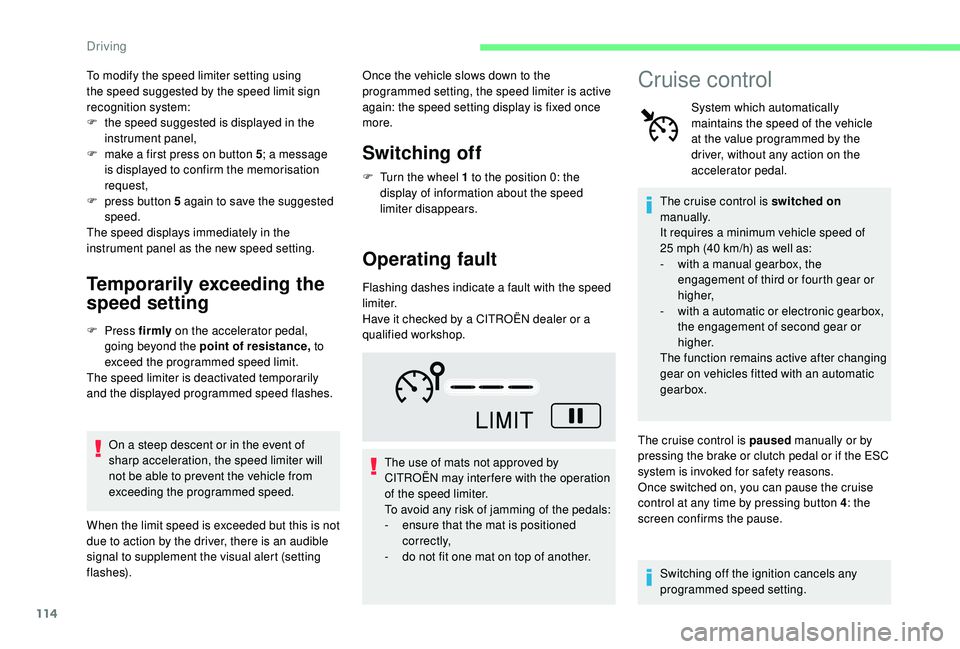
Operating fault
Flashing dashes indicate a fault with the speed
limiter.
Have it checked by a CITROËN dealer or a
qualified workshop.
The use of mats not approved by
CITROËN may inter fere with the operation
of the speed limiter.
To avoid any risk of jamming of the pedals:
-
e
nsure that the mat is positioned
c o r r e c t l y,
-
d
o not fit one mat on top of another.
Cruise control
System which automatically
maintains the speed of the vehicle
at the value programmed by the
driver, without any action on the
accelerator pedal.
The cruise control is switched on
manually.
It requires a minimum vehicle speed of
25 mph (40 km/h) as well as:
-
w
ith a manual gearbox, the
engagement of third or fourth gear or
higher,
-
w
ith a automatic or electronic gearbox,
the engagement of second gear or
higher.
The function remains active after changing
gear on vehicles fitted with an automatic
gearbox.
The cruise control is paused manually or by
pressing the brake or clutch pedal or if the ESC
system is invoked for safety reasons.
Once switched on, you can pause the cruise
control at any time by pressing button 4 : the
screen confirms the pause.
Switching off the ignition cancels any
programmed speed setting.
Driving
Page 121 of 256

119
If the camera has confirmed
the presence of a vehicle or a
pedestrian, this warning lamp
flashes once the function is acting
on the vehicle's brakes.
Important: if operation of the
automatic emergency braking is
triggered, you should take back
control of your vehicle and brake
with the pedal to add to or finish the
automatic braking action.
The driver can take back control of the vehicle
at any time by sharply turning the steering
wheel and/or pressing the accelerator pedal.
The point at which braking is triggered
may be adjusted depending on the driving
actions of the driver, such as movement
of the steering wheel or actions on the
accelerator pedal.
Operation of the function may be felt by
slight vibration in the brake pedal.
If the vehicle comes to a complete stop,
the automatic braking is maintained for 1
to 2 seconds. With a manual gearbox, in the event of
automatic emergency braking until the
vehicle comes to a complete stop, the
engine may stall.
With an automatic or electronic gearbox,
in the event of automatic emergency
braking until the vehicle comes to a
complete stop, keep the brake pedal
pressed down to prevent the vehicle from
starting off again.
Specific conditions for operation
The vehicle's speed must be between 3 mph
and 53 mph (5 km/h and 85 km/h) when a
moving vehicle is detected.
The vehicle's speed must not exceed 50 mph
(80 km/h) when a stopped vehicle is detected.
The vehicle's speed must not exceed 37 mph
(60 km/h) when a pedestrian is detected.
The ESC system must not be faulty.
The ASR system must not be deactivated.
All passenger seat belts must be fastened.
Sporty driving or driving on winding roads may
impede the function.
After an impact, the function automatically
stops operating. Consult a CITROËN
dealer or a qualified workshop to have the
system checked.
Deactivation/Activation
By default, the system is automatically
activated at every engine start-up. Deactivation of the system is
signalled by the illumination of this
indicator lamp, accompanied by the
display of a message.
F
I
n the Driving/Vehicle menu
of the touch screen, select the
" Vehicle settings " tab then
" Safety " and activate/deactivate
" Collision risk and auto
braking ".
The camera may be disrupted or not work
in the following situations:
-
p
oor visibility (inadequate street
lighting, falling snow, heavy rain, dense
f o g , e t c .),
-
d
azzle (headlamps of an oncoming
vehicle, low sun, reflections on a damp
road, leaving a tunnel, alternating
shade and light, etc.),
-
c
amera obstructed (mud, frost, snow,
condensation, etc.).
On versions with camera alone, this
message indicates to you that the camera
is obstructed: " Driving aids camera:
visibility limited, see user guide ".
In these situations, detection performance
may be reduced.
Using the camera, this function acts on the
vehicle's braking system.
6
Driving
Page 150 of 256
148
As soon as the traffic conditions permit,
regenerate the filter by driving at a speed
of at least 37 mph (60 km/h) until the
warning lamp goes off.
If the warning lamp stays on, this indicates
a low Diesel additive level.
For more information on Checking the
levels and particularly on the level of
Diesel additive, refer to the corresponding
section.
On a new vehicle, the first particle
filter regeneration operations may be
accompanied by a "burning" smell, which
is per fectly normal.
Following prolonged operation of the
vehicle at very low speed or at idle,
you may, in exceptional circumstances,
notice the emission of water vapour at the
exhaust on acceleration. This does not
affect the behaviour of the vehicle or the
environment.
Manual gearbox
The gearbox does not require any
maintenance (no oil change).
Automatic gearbox
The gearbox does not require any
maintenance (no oil change).
Electronic gearbox
The gearbox does not require any
maintenance (no oil change).
Brake pads
Brake wear depends on the style
of driving, particularly in the case
of vehicles used in town, over short
distances. It may be necessary to
have the condition of the brakes
checked, even between vehicle
services.
Unless there is a leak in the circuit, a drop in
the brake fluid level indicates that the brake
pads are worn.
Brake disc/drum wear
For information on checking brake
disc/drum wear, contact a CITROËN
dealer or a qualified workshop.
Parking brake
If excessive travel or a loss of
effectiveness of this system is
noticed, the parking brake must
be checked, even between two
services.
This system must be checked by a CITROËN
dealer or a qualified workshop.
Only use products recommended by
CITROËN or products of equivalent quality
and specification.
In order to optimise the operation of units
as important as those in the braking
system, CITROËN selects and offers very
specific products.
After washing the vehicle, dampness, or
in wintry conditions, ice can form on the
brake discs and pads: braking efficiency
may be reduced. Make light brake
applications to dry and defrost the brakes.
Practical information
Page 161 of 256
159
Removing a wheel
Parking the vehicle
Park the vehicle where it does not block
traffic: the ground must be level, stable
and non-slippery.
With a manual gearbox, engage first
gear then switch off the ignition to block
the wheels.
With an automatic gearbox , place the
gear selector at position P then switch off
the ignition to block the wheels.
With an electronic gearbox , place the
gear selector at position D then switch off
the ignition to block the wheels.
Apply the parking brake and check that
the warning lamp is on in the instrument
panel.
The passengers must get out of the
vehicle and wait in safety.
Make sure that the jack is correctly
positioned at one of the vehicle's jacking
points.
Incorrect use of the jack could cause the
vehicle to drop.
Never go underneath a vehicle raised
using a jack; use an axle stand. Wheel with hub cap
When refitting the wheel
, after tightening
the wheel bolts, refit the hub cap, starting
by placing its aperture in line with the
valve and then pushing it into place all
round its edge with the palm of your hand.
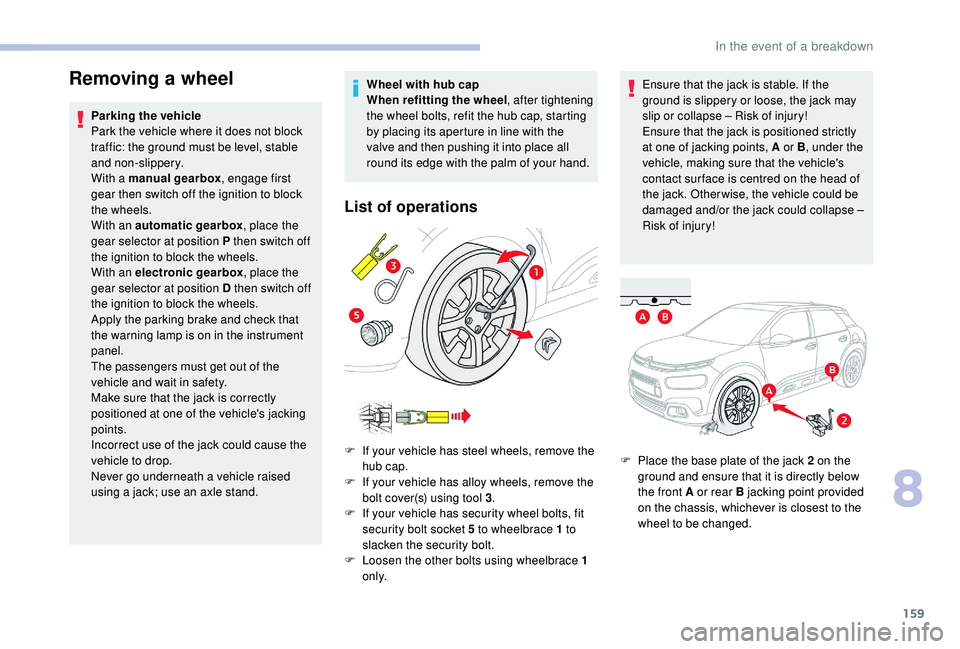
List of operations
F If your vehicle has steel wheels, remove the hub cap.
F
I
f your vehicle has alloy wheels, remove the
bolt cover(s) using tool 3 .
F
I
f your vehicle has security wheel bolts, fit
security bolt socket 5 to wheelbrace 1 to
slacken the security bolt.
F
L
oosen the other bolts using wheelbrace 1
o n l y. Ensure that the jack is stable. If the
ground is slippery or loose, the jack may
slip or collapse – Risk of injury!
Ensure that the jack is positioned strictly
at one of jacking points, A or B
, under the
vehicle, making sure that the vehicle's
contact sur face is centred on the head of
the jack. Otherwise, the vehicle could be
damaged and/or the jack could collapse –
Risk of injury!
F P lace the base plate of the jack 2 on the
ground and ensure that it is directly below
the front A or rear B jacking point provided
on the chassis, whichever is closest to the
wheel to be changed.
8
In the event of a breakdown
Page 176 of 256
174
You must reinitialise certain systems yourself,
by referring to the corresponding section, such
as:
-
t
he remote control or electronic key
(depending on version),
-
t
he electric windows,
-
t
he date and time,
-
t
he radio preset stations.The Stop & Start system may not be
operational during the trip following the
first engine start.
In this case, the system will only be
available again after a continuous
period of immobilisation of the vehicle,
a period which depends on the exterior
temperature and the state of charge of the
battery (up to about 8 hours).To w i n g
Procedure for having your vehicle towed or for
towing another vehicle using the towing eye.
Access to tools
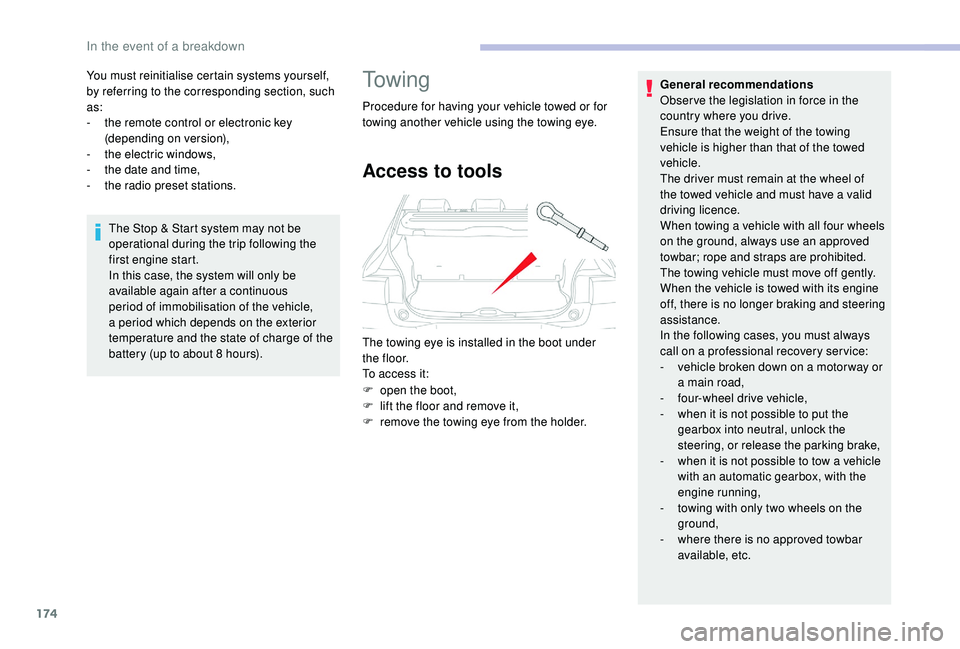
The towing eye is installed in the boot under
t h e f l o o r.
To access it:
F
o
pen the boot,
F
l
ift the floor and remove it,
F
r
emove the towing eye from the holder. General recommendations
Obser ve the legislation in force in the
country where you drive.
Ensure that the weight of the towing
vehicle is higher than that of the towed
vehicle.
The driver must remain at the wheel of
the towed vehicle and must have a valid
driving licence.
When towing a vehicle with all four wheels
on the ground, always use an approved
towbar; rope and straps are prohibited.
The towing vehicle must move off gently.
When the vehicle is towed with its engine
off, there is no longer braking and steering
assistance.
In the following cases, you must always
call on a professional recovery ser vice:
-
v
ehicle broken down on a motor way or
a main road,
-
f
our-wheel drive vehicle,
-
w
hen it is not possible to put the
gearbox into neutral, unlock the
steering, or release the parking brake,
-
w
hen it is not possible to tow a vehicle
with an automatic gearbox, with the
engine running,
-
t
owing with only two wheels on the
ground,
-
w
here there is no approved towbar
available, etc.
In the event of a breakdown
Page 177 of 256
175
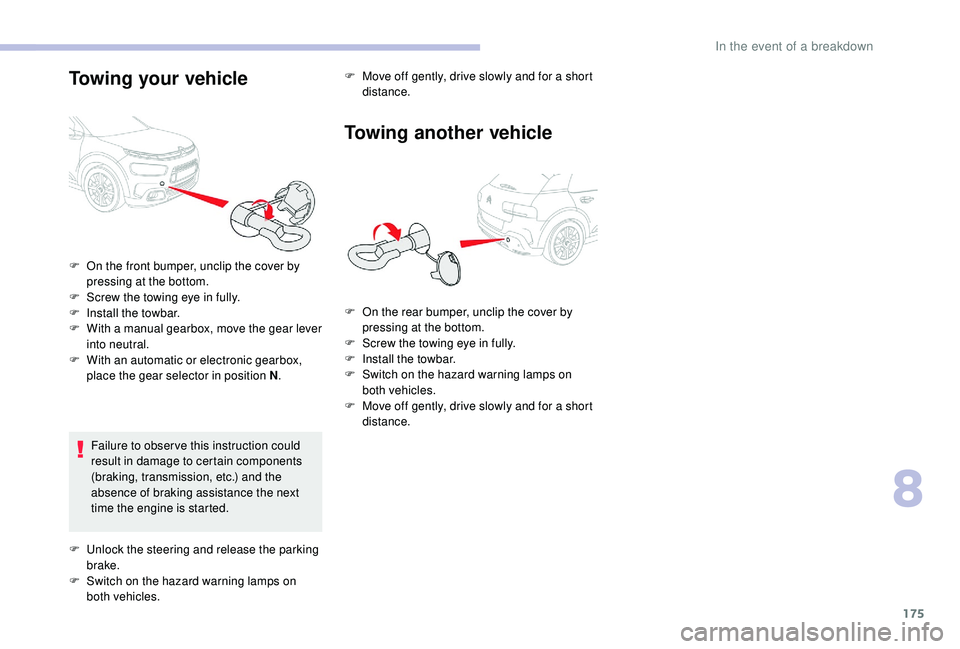
Towing your vehicle
Failure to obser ve this instruction could
result in damage to certain components
(braking, transmission, etc.) and the
absence of braking assistance the next
time the engine is started.F
M
ove off gently, drive slowly and for a short
distance.
Towing another vehicle
F On the front bumper, unclip the cover by pressing at the bottom.
F
S
crew the towing eye in fully.
F
I
nstall the towbar.
F
W
ith a manual gearbox, move the gear lever
into neutral.
F
W
ith an automatic or electronic gearbox,
place the gear selector in position N .
F
U
nlock the steering and release the parking
brake.
F
S
witch on the hazard warning lamps on
both vehicles. F
O
n the rear bumper, unclip the cover by
pressing at the bottom.
F
S
crew the towing eye in fully.
F
I
nstall the towbar.
F
S
witch on the hazard warning lamps on
both vehicles.
F
M
ove off gently, drive slowly and for a short
distance.
8
In the event of a breakdown
Page 179 of 256
177
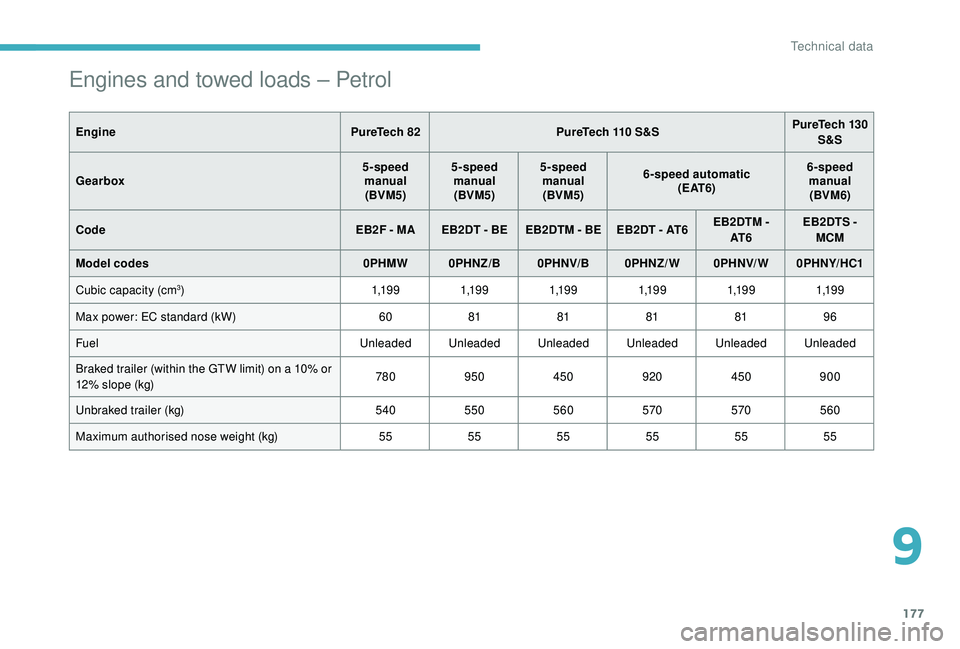
Engines and towed loads – Petrol
EnginePureTech 82PureTech 110 S&S PureTech 130
S&S
Gearbox 5-speed
manual(BVM5) 5-speed
manual(BVM5) 5-speed
manual(BVM5) 6-speed automatic
( E AT 6 ) 6-speed
manual(BVM6)
Code EB2F - MA EB2DT - BE EB2DTM - BE EB2DT - AT6 EB2DTM -
AT 6 EB2DTS -
MCM
Model codes 0PHMW 0PHNZ/B 0PHNV/B0PHNZ/ W0PHNV/ W0PHNY/HC1
Cubic capacity (cm
3) 1,1 9 91,1 9 91,1 9 91,1 9 91,1 9 91,1 9 9
Max power: EC standard (kW) 608181818196
Fuel Unleaded Unleaded Unleaded Unleaded Unleaded Unleaded
Braked trailer (within the GTW limit) on a 10% or
12% slope (kg) 780
950 450 920450900
Unbraked trailer (kg) 540550560 570570560
Maximum authorised nose weight (kg) 555555555555
9
Technical data
Page 180 of 256
178
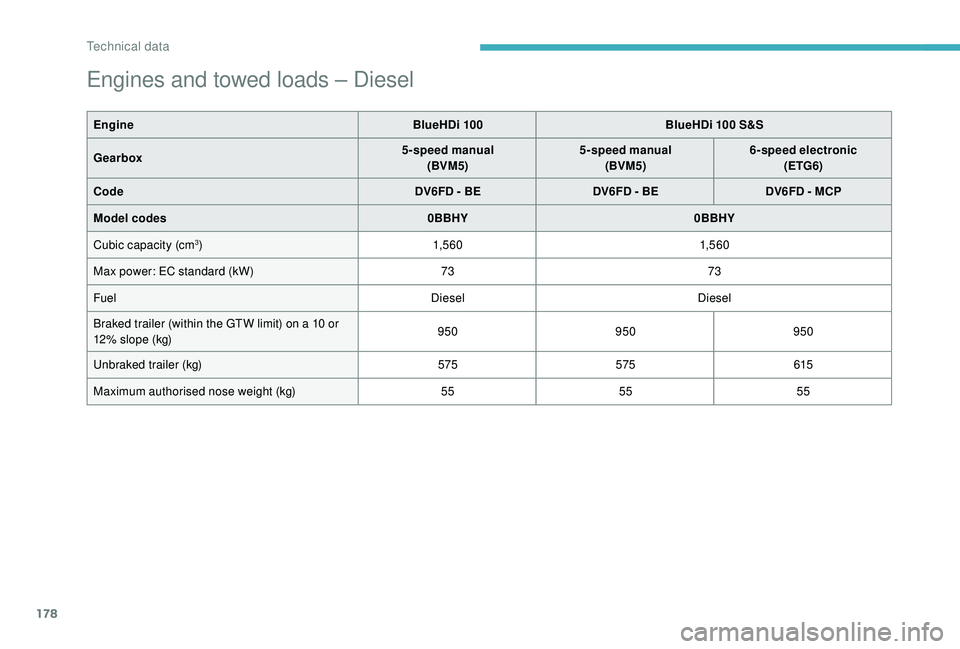
Engines and towed loads – Diesel
EngineBlueHDi 100BlueHDi 100 S&S
Gearbox 5-speed manual
(BVM5) 5-speed manual
(BVM5) 6-speed electronic
(ETG6)
Code DV6FD - BEDV6FD - BEDV6FD - MCP
Model codes 0BBHY0BBHY
Cubic capacity (cm
3) 1,5 6 0 1,5 6 0
Max power: EC standard (kW) 7373
Fuel DieselDiesel
Braked trailer (within the GTW limit) on a 10 or
12% slope (kg) 950
950950
Unbraked trailer (kg) 575575 615
Maximum authorised nose weight (kg) 555555
Technical data