Under car CITROEN C4 CACTUS 2020 Owners Manual
[x] Cancel search | Manufacturer: CITROEN, Model Year: 2020, Model line: C4 CACTUS, Model: CITROEN C4 CACTUS 2020Pages: 256, PDF Size: 7.62 MB
Page 5 of 256
3
.
.
Driving recommendations 94
Anti-theft protection 9 5
Starting/Switching off the engine
with the key
9
6
Starting/Switching off the engine with
K
eyless Entry and Starting
9
7
Parking brake
1
00
5-speed manual gearbox
1
00
6-speed manual gearbox
1
00
Automatic gearbox (EAT6)
1
01
Electronic gearbox (ETG)
1
03
Gear ef ficiency indicator
1
06
Hill start assist
1
07
Stop & Start
1
07
Recognition of speed limit signs and
recommendation
110
Speed limiter
1
13
Cruise control
1
14
Collision Risk Alert and Active Safety Brake
1
17
Fatigue detection system
1
20
Lane Departure Warning System
1
22
Blind spot monitoring
1
23
Parking sensors
1
25
Reversing camera
1
27
Park Assist
1
27
Tyre under-inflation detection
1
32Compatibility of fuels 1
36
Fuel tank 1 37
Misfuel prevention (Diesel)
1
38
Snow chains
1
38
Very cold climate screens
1
39
Towing device
1
40
Load reduction mode
1
40
Energy economy mode
1
40
Changing a wiper blade
1
41
Roof bars
1
42
Bonnet
143
Engines
1
44
Checking levels
1
44
Checks
147
AdBlue
® (BlueHDi engines) 1 49
Advice on care and maintenance 1 52
Running out of fuel (Diesel)
1
53
Warning triangle (storage)
1
53
Temporary puncture repair kit
1
53
Spare wheel
1
57
Changing a bulb
1
61
Changing a fuse
1
66
12 V battery
1
71
To w i n g
174Engine technical data and towed loads
1
76
Engines and towed loads – Petrol
1
77
Engines and towed loads – Diesel
1
78
Dimensions
179
Identification markings
1
79
Driving
Practical information
In the event of a breakdown Technical data
Alphabetical index
bit.ly/helpPSA
Audio and telematics
CITROËN Connect Nav
CITROËN Connect Radio
.
Contents
Page 13 of 256
11
Warning/indicator lampState Cause Action/Observations
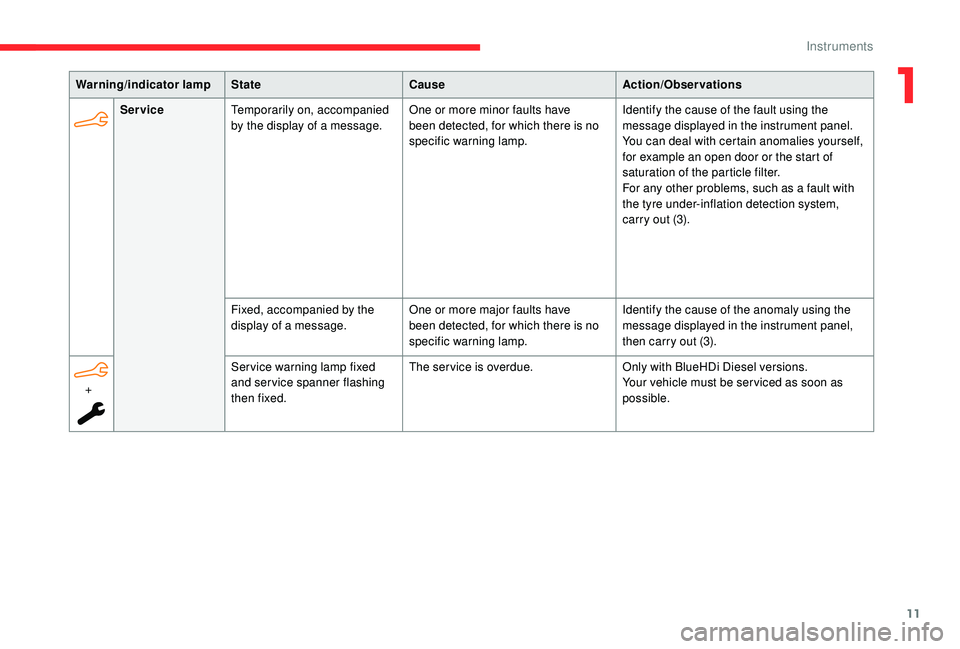
Service Temporarily on, accompanied
by the display of a message. One or more minor faults have
been detected, for which there is no
specific warning lamp. Identify the cause of the fault using the
message displayed in the instrument panel.
You can deal with certain anomalies yourself,
for example an open door or the start of
saturation of the particle filter.
For any other problems, such as a fault with
the tyre under-inflation detection system,
carry out (3).
Fixed, accompanied by the
display of a message. One or more major faults have
been detected, for which there is no
specific warning lamp. Identify the cause of the anomaly using the
message displayed in the instrument panel,
then carry out (3).
+ Ser vice warning lamp fixed
and service spanner flashing
then fixed. The ser vice is overdue.
Only with BlueHDi Diesel versions.
Your vehicle must be ser viced as soon as
possible.
1
Instruments
Page 18 of 256

16
Under-inflationFixed, accompanied by an
audible signal and a message. The pressure in one or more tyres is
too low. Check the pressure of the tyres as soon as
possible.
Reinitialise the detection system after
adjusting the pressure.
+ Under-inflation
Flashing then fixed,
accompanied by the Ser vice
warning lamp. The system is faulty: tyre pressures
are no longer monitored.
As soon as possible, check the pressure of
the tyres and carry out (3).
Diesel engine
pre-heating Fixed.
The period of illumination
depends on the climatic
conditions. The ignition is on.
Wait until the lamp goes off before starting.
If the engine does not start, switch the
ignition off and then on, wait until the lamp
goes off again, then start the engine.
Front passenger
airbag (ON) Fixed.
The front passenger airbag is
activated.
The control is in the "ON" position. In this case, do NOT install a "rear ward
facing" child seat on the front passenger
seat – Risk of serious injur y!
Front passenger
airbag (OFF) Fixed.
The front passenger airbag is
deactivated.
The control is in the "OFF" position. You can install a "rear ward facing" child
seat, unless there is a fault with the airbags
(Airbags warning lamp on).
Airbags Fixed. One of the airbags or seat belt
pyrotechnic pretensioners is faulty. Carry out (3).
Warning/indicator lamp
State Cause Action/Observations
Instruments
Page 27 of 256

25
Radio Media.
See the "Audio and telematics" section.
Mirror Screen or Connected
navigation.*
See the "Audio and telematics" section
Air conditioning.
Allows control of the settings for
temperature, air flow, etc. For more information on Heating
, Manual
air conditioning and Automatic air
conditioning , refer to the corresponding
sections.
Telephone.
See the "Audio and telematics" section.
Applications.
Allows the display of the connected
services available.
See the "Audio and telematics" section.
Vehicle or Driving.*
Allows the activation, deactivation
and adjustment of settings for
certain functions.
The functions accessible from this menu are
arranged under two tabs: " Vehicle settings"
and " Driving functions ".
Volume control/mute.
See the "Audio and telematics"
section.
Press with three fingers on the touch
screen to access the menu carousel.
Upper bar
* Depending on equipment -
A
ccess to Configuration
.
After a few moments with no action on
the secondary page, the primary page is
displayed automatically.
Use this button to confirm.
Use this button to return to the
previous page.
Menus
* Depending on equipment. Certain information is always present in the
upper bar of the touch screen:
-
R
eminder of the air conditioning
information, and access to a simplified
menu (temperature and air flow adjustment
only).
-
R
eminder of information from the Radio
Media and Telephone menus and
navigation instructions*.
-
N
otifications zone (texts and email)*.
1
Instruments
Page 68 of 256

66
Do not operate the wipers on a dry
windscreen. Under extremely hot or cold
conditions, ensure that the wiper blades
are not stuck to the windscreen before
operating the wipers.
Manual controls
The wipers are controlled directly by the driver.
With manual wiping
With AUTO wipingWindscreen wipers
Raise or lower the control to the desired
position to change the wiping speed.
Fast wiping (heavy rain).
Normal wiping (moderate rain).
Intermittent wiping (proportional to
the speed of the vehicle).
Of f.
Single wipe (press downwards or
pull the stalk briefly towards you,
then release).
Automatic wiping (press down,
then release) or single wipe (pull
the stalk briefly towards you).
or
Rear wiper
Rear wiper selection ring:
Of f.
Intermittent wiping.
Wash-wipe (set duration).
Reverse gear
When reverse gear is engaged, the rear wiper
will come into operation automatically if the
windscreen wipers are operating.
The system is activated or deactivated via the
vehicle configuration menu.
This system is activated by default.
If a significant accumulation of snow or ice
is present, or when using a bicycle carrier
on the boot, deactivate the automatic rear
w i p e r. F
I
n the Driving/Vehicle menu
of the touch screen, select
the " Vehicle settings " tab
then " Parking " and activate/
deactivate " Rear wiper in
reverse ".
Lighting and visibility
Page 83 of 256
81
General points relating to
child seats
The regulations on carrying children are
specific to each country. Refer to the
legislation in force in your country.
For maximum safety, please obser ve the
following recommendations:
-
I
n accordance with European regulations,
all children under the age of 12 or less
than one and a half metres tall must
travel in approved child seats suited to
their weight , on seats fitted with a seat belt
or ISOFIX mountings.
-
S
tatistically, the safest seats in your
vehicle for carr ying children are the rear
seats.
-
A c
hild weighing less than 9 kg must
travel in the rear ward facing position
both in the front and in the rear.
It is recommended that children travel on
the rear seats of your vehicle:
-
"rearward facing " up to the age of 3,
-
"forward facing " over the age of 3. Ensure that the seat belt is positioned and
tightened correctly.
For child seats with a support leg, ensure
that the latter is in firm and steady contact
with the floor.
In the front: if necessary, adjust the
passenger seat.
At the rear: if necessary, adjust the
relevant front seat.
Remove and stow the head restraint
before installing a child seat with backrest
on a passenger seat.
Refit the head restraint once the child seat
has been removed.
Child seat at the rear
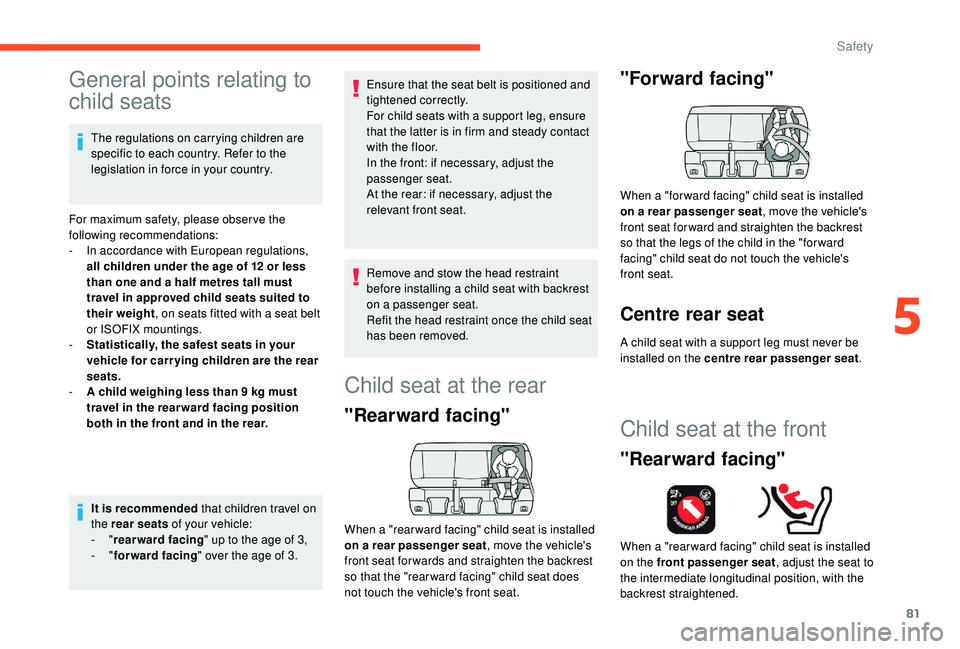
"Rearward facing"
When a "rear ward facing" child seat is installed
on a rear passenger seat
, move the vehicle's
front seat for wards and straighten the backrest
so that the "rear ward facing" child seat does
not touch the vehicle's front seat.
"Forward facing"
When a "for ward facing" child seat is installed
on a rear passenger seat , move the vehicle's
front seat for ward and straighten the backrest
so that the legs of the child in the "for ward
facing" child seat do not touch the vehicle's
front seat.
Centre rear seat
A child seat with a support leg must never be
installed on the centre rear passenger seat .
Child seat at the front
"Rearward facing"
When a "rear ward facing" child seat is installed
on the front passenger seat, adjust the seat to
the intermediate longitudinal position, with the
backrest straightened.
5
Safety
Page 92 of 256

90
Summary table of locations for ISOFIX child seats
In line with European regulations, this table indicates the options for installing ISOFIX child seats on the vehicle seats fitted with ISOFIX mountings.
In the case of universal and semi-universal ISOFIX child seats, the ISOFIX size category of the child seat, determined by a letter between A to G, is
indicated on the child seat next to the ISOFIX logo.
Weight of the child/indicative age
Under 10 kg (group 0)
Up to about 6 months Under 10 kg
(group 0)
Under 13 kg (group 0+)
Up to about 1 year From 9 to 18 kg (group 1)
From about 1 to 3 years
Type of ISOFIX child seat Carr ycotrearward facing rearward facing forward facing
ISOFIX size categor y F G C D E C D A B B1
1
st row Front passenger
seat Not ISOFIX
2
nd row Outer rear seats
IL- SU* IL- SU IL- SU IL- SU IL- SU IUF
IL- SU
Centre rear seat Not ISOFIX
IL- SU: seat position suitable for the installation
of an I sofix S emi-Universal seat either:
-
"
rear ward facing" fitted with an upper strap
or a support leg,
-
"
for ward facing" fitted with a support leg,
*
T
he ISOFIX carrycot, secured to the lower
rings of an ISOFIX seat, occupies all of the
space on the rear bench seat. -
a c
arrycot seat fitted with an upper strap or
a support leg.
For more information on ISOFIX child seats
and the upper strap, refer to the corresponding
section.
I UF:
seat suitable for the installation of an I sofix
U niversal seat, "Forward facing" secured
using the upper strap.
Safety
Page 94 of 256

92
Advice
The incorrect installation of a child seat in a
vehicle compromises the child's protection in
the event of an accident.
Ensure that there is no seat belt or seat belt
buckle under the child seat, as this could
destabilise it.
Remember to fasten the seat belts or the
child seat harnesses keeping the slack
relative to the child's body to a minimum,
even for short journeys.
When installing a child seat using the seat
belt, ensure that the seat belt is tightened
correctly on the child seat and that it secures
the child seat firmly on the seat of your
vehicle. If your passenger seat is adjustable,
move it for wards if necessary.
At rear seating positions, always leave
sufficient space between the front seat and:
-
a "
rear ward facing" child seat,
-
t
he child's feet for a child seat fitted
"forward facing".
To do this, move the front seat for wards
and, if necessary, move its backrest into the
upright position.
For optimal installation of the "forward facing"
child seat, verify that its backrest is as close
as possible to the backrest of the vehicle
seat, if possible in contact with it. The head restraint must be removed
before installing a child seat with a
backrest on a passenger seat.
Ensure that the head restraint is stored or
attached securely to prevent it from being
thrown around the vehicle in the event of
sharp braking. Refit the head restraint when
the child seat is removed.
As a safety precaution, do not leave:
-
a c hild or children alone and unattended in
a vehicle,
-
a c
hild or an animal in a vehicle which
is exposed to the sun, with the windows
closed,
-
t
he keys within reach of children inside the
vehicle.
To prevent accidental opening of the doors
and rear windows, use the child lock.
Take care not to open the rear windows by
more than one third.
To protect young children from the rays of the
sun, fit side blinds on the rear windows.
Children in front
The legislation on carrying children on the
front passenger seat is specific to each
country. Refer to the legislation in force in
your country.
Deactivate the front passenger airbag when a
"rear ward facing" child seat is installed on the
front passenger seat.
Other wise, there is a risk of serious or fatal
injury to the child if the airbag is deployed.
Installing a booster seat
The chest part of the seat belt must be
positioned on the child's shoulder without
touching the neck.
Ensure that the lap part of the seat belt
passes correctly over the child's thighs.
We recommend using a booster seat with
a backrest equipped with a belt guide at
shoulder level.
Safety
Page 96 of 256

94
Driving recommendations
Observe the driving regulations and remain
vigilant whatever the traffic conditions.
Pay close attention to the traffic and keep your
hands on the wheel so that you are ready to
react at any time to any eventuality.
As a safety measure, the driver should only
carry out any operations that require close
attention when the vehicle is stationary.
On a long journey, a break every two hours is
strongly recommended.
In bad weather, drive smoothly, anticipate the
need to brake and increase the distance from
other vehicles.Never leave the engine running in
an enclosed area without adequate
ventilation: internal combustion engines
emit toxic exhaust gases, such as carbon
monoxide. There is a risk of poisoning and
death!
In very severe wintry conditions
(temperatures below -23°C), to guarantee
correct operation and the longevity of
the mechanical elements of your vehicle,
engine and gearbox, the engine must be
left running for 4 minutes before driving.
Important!
Never drive with the parking brake applied –
Risk of overheating and damage to the
braking system!
As the exhaust system of your vehicle
is very hot, even several minutes after
switching off the engine, never park or run
the engine on inflammable sur faces (dry
grass, fallen leaves, etc.): Risk of fire!
Never leave a vehicle unsuper vised with
the engine running. If you have to leave
your vehicle with the engine running, apply
the parking brake and put the gearbox into
neutral or position N or P , depending on
the type of gearbox.
Driving on flooded roads
We strongly advise against driving on flooded
roads, as this could cause serious damage
to the engine or gearbox, as well as to the
electrical systems of your vehicle. If you are obliged to drive through water:
-
c
heck that the depth of water does not
exceed 15 cm, taking account of waves that
might be generated by other users,
-
d
eactivate the Stop & Start function,
-
d
rive as slowly as possible without stalling.
Under no circumstances exceed 6 mph
(10
km/h),
-
d
o not stop and do not switch off the engine.
On leaving the flooded road, as soon as
circumstances allow, make several light brake
applications to dry the brake discs and pads.
If in doubt about the state of your vehicle,
contact a CITROËN dealer or a qualified
workshop.
Driving
Page 133 of 256

131
The manoeuvring symbol is displayed in red,
accompanied by the "Manoeuvre cancelled "
message on the touch screen.
A message encourages the driver to take back
control of their vehicle.
The function is deactivated after a few seconds
and returns to the initial display.
End of the parking space entry or
exit manoeuvre
The vehicle stops as soon as the manoeuvre is
completed.
The manoeuvre symbol is displayed in red
accompanied by the message " Manoeuvre
completed " on the touch screen.
When deactivated, the indicator lamp in the
button goes off, accompanied by an audible
signal.
If entering a parking space, the driver may be
required to complete the manoeuvre.
Operating limits
- The system can suggest an inappropriate parking space (parking prohibited, work
in progress with damaged road sur face,
location alongside a ditch, etc.).
-
T
he system is not designed for per forming
the parking manoeuvre on a sharp curve. The vehicle's sensors and camera(s) may be
impaired by:
-
a
ccumulated snow or fallen leaves on the
road,
-
a
dverse weather conditions (heavy rain,
thick fog, falling snow),
-
nois
e interference from noisy vehicles and
machinery (lorries, pneumatic drills, etc.). Do not use the system:
-
A
longside a soft shoulder (ditch) or
quay or on a cliff edge.
-
W
hen carrying an object extending
beyond the vehicle size (ladder on the
roof bars, bike carrier on the tailgate,
e t c .) .
-
W
ith a non-approved tow ball in place.
-
W
ith snow chains fitted.
-
I
n the event of under-inflation of a tyre.
-
W
hen driving on a small-diameter or
"space-saver" type spare wheel.
-
W
hen the wheels fitted are different
from the original ones.
-
I
f one of the bumpers is damaged.
-
A
fter modifying one or both bumpers
(adding protection, etc.).
-
I
f a camera is faulty.
-
I
f the sensors have been repainted
outside the CITROËN dealer network.
-
W
ith sensors not approved for your
vehicle.
-
W
hen the road sur face is slippery (ice,
e t c .) .
-
T
he system does not detect spaces that are
much larger than the vehicle itself or that
are delimited by obstacles that are too low
(pavements, studs, etc.) or too thin (trees,
posts, wire fences, etc.).
-
C
ertain obstacles located in the sensors'
blind spots may not be detected or no
longer detected during the manoeuvre.
-
C
ertain materials (fabrics) absorb sound
waves: pedestrians may not be detected.
-
A f
ront or rear impact to the vehicle can
upset the sensor settings which is not
always detected by the system: distance
measurements may be falsified.
-
I
f the boot is heavily loaded, the tilt of the
vehicle towards the rear may inter fere with
the distance measurements.
6
Driving