door lock CITROEN C4 CACTUS 2022 User Guide
[x] Cancel search | Manufacturer: CITROEN, Model Year: 2022, Model line: C4 CACTUS, Model: CITROEN C4 CACTUS 2022Pages: 256, PDF Size: 7.62 MB
Page 39 of 256

37
Central locking not
functioning
Use these procedures in the following cases:
- c entral locking fault,
-
b
attery disconnected or discharged. In the event of a malfunction with the
central locking system, the battery must
be disconnected to lock the boot and thus
ensure that the vehicle is locked fully.
Driver's door
F Turn the key towards the rear of the vehicle
to lock it, or towards the front to unlock it.
Passenger doors
Unlocking
F P ull the interior door opening handle.
Locking
F
O
pen the door.
F
O
n the rear doors, check that the child lock
is not activated. Refer to the corresponding
section.
F
I
nsert the key in the door lock.
F
T
urn the key towards the front of the vehicle
to unlock it, or towards the rear to lock it.
F
T
urn the key towards the rear again within
5 seconds to deadlock the vehicle.
For versions without an alarm, the lighting
of the direction indicators for a few seconds
confirms that the procedure has been
completed correctly.
If your vehicle is fitted with an alarm, this
function will not be activated when locking
with the key.
If the alarm is activated, the siren sounds
on opening the door; switch on the ignition
to stop it.
Changing the battery
If the battery is flat, you are informed
by illumination of this warning lamp,
an audible signal and a message in
the screen.
Version without
K
eyless Entr y and Star ting
Batter y type: CR1620/3 volts. F
R
emove the black cap on the edge of the
door, using the key.
F
W
ithout forcing, insert the key into the
aperture, then, without turning it, move the
latch sideways towards the inside of the
d o o r.
F
R
emove the key and refit the black cap.
F
C
lose the doors and check from the outside
that the vehicle is locked.
2
Access
Page 41 of 256

39
Doors
Opening
From outside
F After unlocking the vehicle using the remote control or the key, pull the door handle.
From inside
F Pull the interior opening control of a door; this unlocks the whole vehicle.
The interior opening control on a rear door
does not work if the child lock is on.
For more information on the Child Lock ,
refer to the corresponding section.
Closing
When a door is not closed correctly:
- w ith the engine running or the vehicle
moving (speed below 6 mph (10 km/h)) , a
message appears in the screen.
-
w
ith the vehicle moving (speed above
6
mph (10 km/h)) , a message appears in
the screen, accompanied by an audible
signal.
F
S
witch on the ignition by pressing the
" START/STOP " button.
The electronic key is now fully operational
again.
If the fault persists after reinitialisation, contact
a CITROËN dealer or a qualified workshop
without delay.
Boot
Opening
F With the vehicle unlocked or with the electronic key of the K eyless Entry and
Starting system in the recognition zone,
press the central tailgate control.
F
Ra
ise the tailgate.
Unlocking the boot using the remote
control opens the tailgate slightly.
For more information on the Remote control
or on
K
eyless Entr y and Star ting , refer to the
corresponding section.
2
Access
Page 42 of 256

40
In case of malfunction or difficulties
moving the tailgate when opening or
closing it, have it checked as soon as
possible by a CITROËN dealer or a
qualified workshop to ensure that this
inconvenience does not get worse, making
the tailgate fall and causing serious
injuries.
Closing
If the tailgate is not fully closed:
- w ith the engine running or the vehicle
moving (speed below 6 mph (10 km/h)) , a
message appears in the screen.
-
w
ith the vehicle moving (speed above
6
mph (10 km/h)) , a message appears in the
screen, accompanied by an audible signal.
Emergency control
F Lower the tailgate using the interior grab handle.
To unlock the boot manually in the event of a
battery or central locking failure.
To unlock the boot
F Fold the rear seats to gain access to the lock from inside the boot.
F
I
nsert a small screwdriver into hole A of the
lock.
F
M
ove the latch to the left.
To re-lock the boot
If the problem persists, the boot will remain
locked after opening and closing.
Alarm
System which protects and provides a deterrent
against theft and break-ins. It provides the
following type of monitoring: -
E
xterior perimeter
:
The system checks whether the vehicle is
opened. The alarm is triggered if anyone
tries to open a door, the boot or the bonnet.
Self-protection function : the system
checks for the putting out of ser vice of its
own components. The alarm is triggered
if the battery, button or siren wiring is
disconnected or damaged.
For all work on the alarm system,
contact a CITROËN dealer or a qualified
workshop.
Locking the vehicle with
alarm system
Activation
F Switch off the ignition and get out of the vehicle.
F
L
ock or deadlock the vehicle
using the remote control or
Keyless Entry and Starting
system.
When the monitoring system is active, the
button indicator lamp flashes once per second
and the direction indicators come on for about
two seconds.
Access
Page 43 of 256

41
When the vehicle automatically locks itself
again (as happens if a door or boot is not
opened within 30 seconds of unlocking),
the monitoring system is automatically
reactivated.
Triggering of the alarm
This is indicated by sounding of the siren
and flashing of the direction indicators for
30 seconds.
The monitoring functions remain active until
the alarm has been triggered eleven times
consecutively.
When the vehicle is unlocked using the remote
control or the
K
eyless Entry and Starting
system, rapid flashing of the locking button
indicator lamp informs you that the alarm
was triggered during your absence. When
the ignition is switched on, this flashing stops
immediately.
Locking the vehicle without
activating the alarm
F Lock or deadlock the vehicle using the key (integral to the remote control) in the driver's
door lock.
Failure of the remote
control
To deactivate the monitoring functions:
F u nlock the vehicle using the key (integral to
the remote control) in the driver's door lock,
F
O
pen the door; this sets off the alarm.
F
U
pon switching on the ignition, the alarm
stops. The button indicator lamp goes off.
The monitoring system is
deactivated: the indicator lamp in
the button goes off and the direction
indicators flash for about 2 seconds.
If a door, boot, etc. is not properly closed,
the vehicle is not locked but the exterior
perimeter monitoring will be activated after
45 seconds.
Deactivation
F Press the unlocking button on
the remote control.
or
F
U
nlock the vehicle with the
K
eyless Entry
and Starting system.
The exterior perimeter monitoring is activated
after five seconds.
Malfunction
When the ignition is switched on, and for
10 seconds after wards, the flashing of the
locking button indicator lamp indicates a
system fault.
Have the system checked by a CITROËN
dealer or a qualified workshop.
Front electric window
controls
1.
Front left.
2. Front right.
Manual operation
To open or close the window, press or pull the
switch gently, without exceeding the resistance
point. The window stops as soon as the switch
is released.
2
Access
Page 48 of 256

46
When folding the seat, the centre seat belt
should not be fastened but laid out flat on
the backrest.
The rear seat cushion remains fixed.
To increase the boot volume, fold the
backrest onto the cushion.
Returning the backrest to
the normal position
When repositioning the backrest, ensure
that the seat belts are not trapped and the
red indicator, located next to the controls 1,
is no longer visible.
Rear head restraints
These have one position for use (up) and a
stowed position (down).
They can be removed and are interchangeable
side to side.
To remove a head restraint:
F
P
ull the head restraint upwards as far as
possible.
F
T
hen, press the lug A .
To refit a head restraint:
F
E
ngage the head restraint rods in the
openings, keeping the head restraint in line
with the seat backrest.
To lower a head restraint:
F
P
ress down on the head restraint and on lug
A at the same time.
Never drive with the head restraints
removed; they must be in place and
adjusted to the normal position (up).
F
S
traighten the backrest 2 and secure it.
F
U
nfasten and return the seat belts to the
sides of the backrest.
Steering wheel adjustment
As a safety precaution, these operations
should only be carried out while the
vehicle is stationary.
F
W
hen stationary
, lower the control lever
A to release the steering wheel adjustment
mechanism.
F
A
djust the steering wheel height and reach
to suit your driving position.
F
R
aise the control lever A to lock the steering
wheel adjustment mechanism.
Mirrors
Door mirrors
The objects obser ved are, in reality, closer
than they appear.
Take this into account in order to
correctly judge the distance of vehicles
approaching from behind.
Ease of use and comfort
Page 49 of 256

47
Electric adjustment
As a safety measure, the mirrors should
be adjusted to reduce the "blind spots".
Manual folding
You can manually fold the mirrors (parking
obstruction, narrow garage, etc.).
F
T
urn the mirror towards the vehicle.
Electric folding
From outside: lock the vehicle using the remote
control or the Keyless Entry and Starting
system.
The folding and unfolding of the door
mirrors when locking or unlocking the
vehicle can be deactivated via the vehicle
configuration menu.
Demisting – Defrosting
F Turn control A to the right or left to select the corresponding mirror.
F
M
ove the control in all four directions to
adjust.
F
R
eturn the control to the central position.
Demisting-defrosting of the door
mirrors operates with the engine
running, by switching on the heated
rear screen.
For more information on Rear screen
demisting – defrosting, refer to the
corresponding section.
Rear view mirror
Equipped with an anti-dazzle system, which
darkens the mirror glass and reduces the
nuisance to the driver caused by the sun,
headlamps of other vehicles, etc.
Manual model
Adjustment
F A djust the mirror so that the glass is
directed correctly in the "day" position.
Day/night position
F
P
ull the lever to change to the "night" anti-
dazzle position.
F
P
ush the lever to change to the normal
"day" position.
If your vehicle is fitted with this function, the
mirrors can be folded electrically from the inside,
with the vehicle parked and the ignition on:
F
T
urn control A to opposite the mark.
Automatic "electrochrome"
model
3
Ease of use and comfort
Page 56 of 256
54
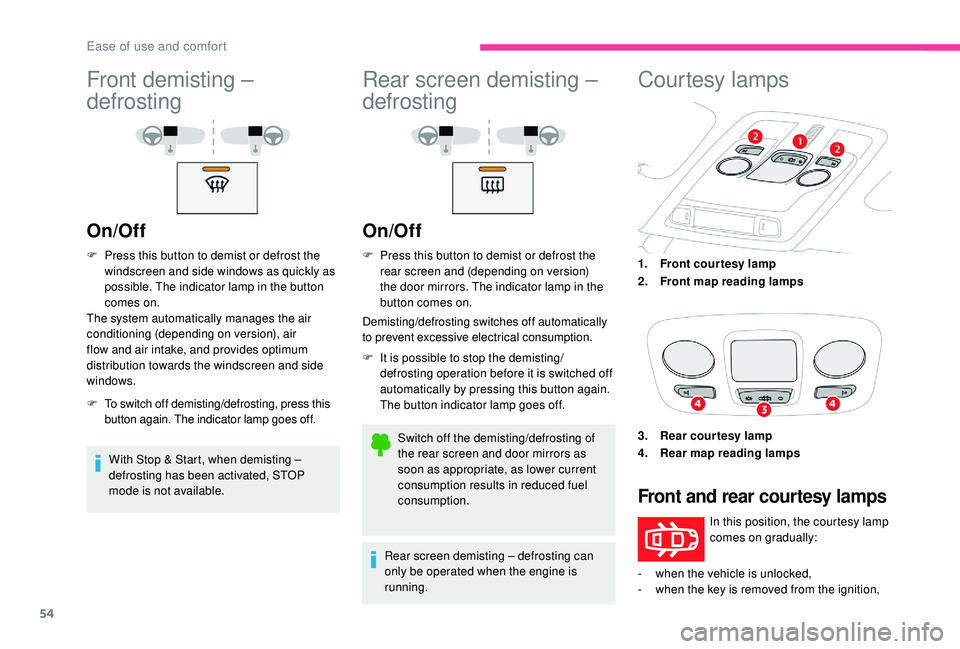
Front demisting –
defrosting
On/Off
F Press this button to demist or defrost the windscreen and side windows as quickly as
possible. The indicator lamp in the button
comes on.
The system automatically manages the air
conditioning (depending on version), air
flow and air intake, and provides optimum
distribution towards the windscreen and side
windows.
F
T
o switch off demisting/defrosting, press this
button again. The indicator lamp goes off.
With Stop & Start, when demisting –
defrosting has been activated, STOP
mode is not available.
Rear screen demisting –
defrosting
On/Off
F Press this button to demist or defrost the rear screen and (depending on version)
the door mirrors. The indicator lamp in the
button comes on.
Demisting/defrosting switches off automatically
to prevent excessive electrical consumption.
F
I
t is possible to stop the demisting/
defrosting operation before it is switched off
automatically by pressing this button again.
The button indicator lamp goes off.
Switch off the demisting/defrosting of
the rear screen and door mirrors as
soon as appropriate, as lower current
consumption results in reduced fuel
consumption.
Rear screen demisting – defrosting can
only be operated when the engine is
running.
Courtesy lamps
1. Front courtesy lamp
2. Front map reading lamps
3. Rear courtesy lamp
4. Rear map reading lamps
Front and rear courtesy lamps
In this position, the courtesy lamp
comes on gradually:
-
w
hen the vehicle is unlocked,
-
w
hen the key is removed from the ignition,
Ease of use and comfort
Page 57 of 256

55
- when opening a door,
- w hen the remote control locking button is
activated, in order to locate your vehicle.
It switches off gradually:
-
w
hen the vehicle is locked,
-
w
hen the ignition is switched on,
-
3
0 seconds after the last door is closed. Permanently off.
Permanent lighting.
In "permanent lighting" mode, the lighting time
varies according to the circumstances:
-
w
hen the ignition is off, approximately ten
minutes,
-
i
n energy saving mode, approximately thirty
seconds,
-
w
ith the engine running, unlimited.
When the courtesy lamp is in the
"permanent lighting" position, the rear
courtesy lamp also comes on, except if it
is in the "permanently off " position.
To switch off the rear courtesy lamp, put it
in the "permanently off " position.Front and rear map reading
lamps
F With the ignition on, press the corresponding switch.
Take care to avoid leaving anything in
contact with the courtesy lamps.
Boot lamp
It comes on automatically when the boot is
opened.
Different lighting times are provided:
-
w
ith the ignition off, approximately ten
minutes,
-
i
n energy economy mode, approximately
thirty seconds,
-
w
ith the engine running, unlimited.
Panoramic glazed sunroof
This glazed roof provides increased visibility
and light in the passenger compartment, while
maintaining normal temperatures thanks to its
"high thermal protection" coating.
Advice on care
In order to preser ve the properties of the
glazed roof, we recommend wiping or cleaning
the inner glass using a clean, soft and dry
cloth.
For stubborn stains, the glass should be
cleaned using screenwash fluid, rinsed with
clean water, then dried with a clean, soft cloth.
Do not use soapy water, abrasive
products, detergents (particularly those
with an ammonia base), solvents,
solutions with a high concentration of
alcohol, petrol, etc.
3
Ease of use and comfort
Page 94 of 256

92
Advice
The incorrect installation of a child seat in a
vehicle compromises the child's protection in
the event of an accident.
Ensure that there is no seat belt or seat belt
buckle under the child seat, as this could
destabilise it.
Remember to fasten the seat belts or the
child seat harnesses keeping the slack
relative to the child's body to a minimum,
even for short journeys.
When installing a child seat using the seat
belt, ensure that the seat belt is tightened
correctly on the child seat and that it secures
the child seat firmly on the seat of your
vehicle. If your passenger seat is adjustable,
move it for wards if necessary.
At rear seating positions, always leave
sufficient space between the front seat and:
-
a "
rear ward facing" child seat,
-
t
he child's feet for a child seat fitted
"forward facing".
To do this, move the front seat for wards
and, if necessary, move its backrest into the
upright position.
For optimal installation of the "forward facing"
child seat, verify that its backrest is as close
as possible to the backrest of the vehicle
seat, if possible in contact with it. The head restraint must be removed
before installing a child seat with a
backrest on a passenger seat.
Ensure that the head restraint is stored or
attached securely to prevent it from being
thrown around the vehicle in the event of
sharp braking. Refit the head restraint when
the child seat is removed.
As a safety precaution, do not leave:
-
a c hild or children alone and unattended in
a vehicle,
-
a c
hild or an animal in a vehicle which
is exposed to the sun, with the windows
closed,
-
t
he keys within reach of children inside the
vehicle.
To prevent accidental opening of the doors
and rear windows, use the child lock.
Take care not to open the rear windows by
more than one third.
To protect young children from the rays of the
sun, fit side blinds on the rear windows.
Children in front
The legislation on carrying children on the
front passenger seat is specific to each
country. Refer to the legislation in force in
your country.
Deactivate the front passenger airbag when a
"rear ward facing" child seat is installed on the
front passenger seat.
Other wise, there is a risk of serious or fatal
injury to the child if the airbag is deployed.
Installing a booster seat
The chest part of the seat belt must be
positioned on the child's shoulder without
touching the neck.
Ensure that the lap part of the seat belt
passes correctly over the child's thighs.
We recommend using a booster seat with
a backrest equipped with a belt guide at
shoulder level.
Safety
Page 95 of 256

93
Manual child lock
LockingUnlocking
F Using the ignition key or the integral key,
depending on version, turn the red control
as far as it will go:
-
t
o the left on the left-hand rear door,
-
t
o the right on the right-hand rear door.
Do not confuse the child lock control,
which is red, with the back-up locking
control, which is black.
Electric child lock
Activation/Deactivation
Any other state of the indicator lamp
indicates a fault with the electric child lock.
Have it checked by a CITROËN dealer or
a qualified workshop.
This system is independent and in no
circumstances does it take the place of
the central locking control.
Check the status of the child locks each
time you switch on the ignition.
Always remove the key from the ignition
when leaving the vehicle, even for a short
time.
Mechanical system to prevent opening of a rear
door using its interior control.
The control is located on the edge of each rear
d o o r.
F
U
sing the ignition key or the integral key,
depending on version, turn the red control
as far as it will go:
-
t
o the right on the left-hand rear door,
-
t
o the left on the right-hand rear door. Remotely operated system to prevent opening
of the rear doors using their interior controls. With the ignition on:
F
p
ress this button; its indicator lamp comes
on, accompanied by a message to confirm
the activation,
F
p
ress this button again; its indicator lamp
goes off, accompanied by a message to
confirm the deactivation.
The indicator lamp remains on for as long as
the child lock is activated. Opening the doors
from the outside remains possible.
The indicator lamp remains off for as long as
the child lock is deactivated.
5
Safety