brake CITROEN C4 CACTUS 2022 Owners Manual
[x] Cancel search | Manufacturer: CITROEN, Model Year: 2022, Model line: C4 CACTUS, Model: CITROEN C4 CACTUS 2022Pages: 256, PDF Size: 7.62 MB
Page 5 of 256
3
.
.
Driving recommendations 94
Anti-theft protection 9 5
Starting/Switching off the engine
with the key
9
6
Starting/Switching off the engine with
K
eyless Entry and Starting
9
7
Parking brake
1
00
5-speed manual gearbox
1
00
6-speed manual gearbox
1
00
Automatic gearbox (EAT6)
1
01
Electronic gearbox (ETG)
1
03
Gear ef ficiency indicator
1
06
Hill start assist
1
07
Stop & Start
1
07
Recognition of speed limit signs and
recommendation
110
Speed limiter
1
13
Cruise control
1
14
Collision Risk Alert and Active Safety Brake
1
17
Fatigue detection system
1
20
Lane Departure Warning System
1
22
Blind spot monitoring
1
23
Parking sensors
1
25
Reversing camera
1
27
Park Assist
1
27
Tyre under-inflation detection
1
32Compatibility of fuels 1
36
Fuel tank 1 37
Misfuel prevention (Diesel)
1
38
Snow chains
1
38
Very cold climate screens
1
39
Towing device
1
40
Load reduction mode
1
40
Energy economy mode
1
40
Changing a wiper blade
1
41
Roof bars
1
42
Bonnet
143
Engines
1
44
Checking levels
1
44
Checks
147
AdBlue
® (BlueHDi engines) 1 49
Advice on care and maintenance 1 52
Running out of fuel (Diesel)
1
53
Warning triangle (storage)
1
53
Temporary puncture repair kit
1
53
Spare wheel
1
57
Changing a bulb
1
61
Changing a fuse
1
66
12 V battery
1
71
To w i n g
174Engine technical data and towed loads
1
76
Engines and towed loads – Petrol
1
77
Engines and towed loads – Diesel
1
78
Dimensions
179
Identification markings
1
79
Driving
Practical information
In the event of a breakdown Technical data
Alphabetical index
bit.ly/helpPSA
Audio and telematics
CITROËN Connect Nav
CITROËN Connect Radio
.
Contents
Page 6 of 256
4
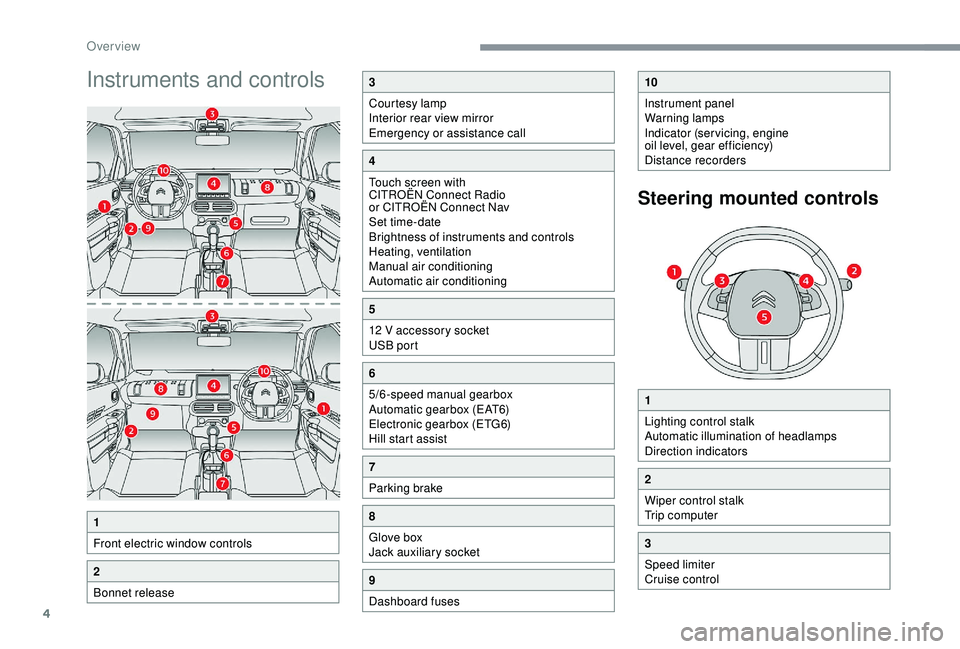
Instruments and controls
1
Front electric window controls
2
Bonnet release
3
Courtesy lamp
Interior rear view mirror
Emergency or assistance call
4
Touch screen with
CITROËN Connect Radio
or CITROËN Connect Nav
Set time-date
Brightness of instruments and controls
Heating, ventilation
Manual air conditioning
Automatic air conditioning
5
12 V accessory socket
USB port
6
5/6-speed manual gearbox
Automatic gearbox (EAT6)
Electronic gearbox (ETG6)
Hill start assist
7
Parking brake
8
Glove box
Jack auxiliary socket
9
Dashboard fuses
10
Instrument panel
Warning lamps
Indicator (servicing, engine
oil level, gear efficiency)
Distance recorders
1
Lighting control stalk
Automatic illumination of headlamps
Direction indicators
2
Wiper control stalk
Trip computer
3
Speed limiter
Cruise control
Steering mounted controls
Over view
Page 8 of 256
6
Eco- driving
Optimise the use of your
gearbox
With a manual gearbox, move off gently
and change up without waiting. During
acceleration, change up early.
With an automatic or electronic gearbox,
give preference to automatic mode and avoid
pressing the accelerator pedal heavily or
suddenly.
Adopt a smooth driving style
Maintain a safe distance between vehicles,
use engine braking rather than the
brake pedal, and press the accelerator
progressively. These practices contribute
towards a reduction in fuel consumption and
CO
2 emissions and also help to reduce the
background traffic noise.
If your vehicle has cruise control, make use of
the system at speeds above 25 mph (40 km/h)
when the traffic is flowing well.
Control the use of your electrical
equipment
Before moving off, if the passenger
compartment is too warm, ventilate it by
opening the windows and air vents before
using the air conditioning.
Above 31 mph (50 km/h), close the windows
and leave the air vents open.
Remember to make use of equipment that can
help keep the temperature in the passenger
compartment down (sunroof and window
blinds, etc.).
Switch off the air conditioning, unless it has
automatic regulation, as soon as the desired
temperature is attained. Switch off the lamps and foglamps when the
ambient light level does not require their use.
Avoid running the engine before moving off,
particularly in winter; your vehicle will warm up
much faster while driving. Switch off the demisting and defrosting
controls when not required, if they are not
automatically controlled.
Switch off the heated seat as soon as
possible.
As a passenger, if you avoid connecting your
multimedia devices (film, music, video game,
etc.), you will contribute towards limiting the
consumption of electrical energy, and so of
fuel.
Disconnect your portable devices before
leaving the vehicle.
The gear efficiency indicator invites you to
engage the most suitable gear: as soon as the
indication is displayed in the instrument panel,
follow it straight away.
For vehicles fitted with an electronic or
automatic gearbox, this indicator appears only
in manual mode. Eco-driving is a range of everyday practices
that allow the motorist to optimise their fuel
consumption and CO
2 emissions.
Eco-driving
Page 11 of 256

9
List of warning and indicator lamps
Warning/indicator lampState Cause Action/Observations
Red warning/indicator lamps
STOPFixed, associated with another
warning lamp, accompanied
by the display of a message
and an audible signal. Indicates a serious fault with the
engine, braking system, power
steering, automatic gearbox or a
major electrical fault. Carry out (1) and then (2).
Engine oil
pressure Fixed.
There is a fault with the engine oil
lubrication circuit. Carry out (1) and then (2).
Brakes Fixed. The brake fluid level has dropped
significantly. Carry out (1), then top up with brake fluid
that complies with the manufacturer's
recommendations. If the problem persists,
carry out (2).
+ Brakes
Fixed, associated with the
ABS warning lamp. The electronic brake force
distribution (EBFD) system has a
fault. Carry out (1) and then (2).
Parking brake Fixed. The parking brake is applied or not
properly released.
Maximum
coolant
temperature Fixed.
The temperature of the cooling
system is too high. Carry out (1), then wait until the engine
has cooled down before topping up to the
required level if necessary. If the problem
persists, carry out (2).
1
Instruments
Page 17 of 256

15
Warning/indicator lampState Cause Action/Observations
Collision Risk
Alert/Active
Safety Brake Flashing.
The system is operating. The vehicle brakes briefly so as to reduce the
speed of collision with the vehicle ahead.
Fixed, accompanied by a
message and an audible
signal. The system has a fault.
Carry out (3).
Collision Risk
Alert/Active
Safety Brake Fixed, accompanied by a
message.
The system has been deactivated via
the vehicle configuration menu.
Dynamic
stability control
(DSC/ASR) Flashing.
The DSC/ASR adjustment is
activated if there is a loss of grip or
trajectory.
Fixed. The DSC/ASR system has a fault. Carry out (3).
Dynamic
stability control
(DSC/ASR) Fixed.
The DSC/ASR is deactivated. Press the button to activate the DSC/ASR.
The DSC/ASR system is activated
automatically when the vehicle is started.
If the system is deactivated, it is reactivated
automatically once a speed of around 31
mph
(50 km/h) is reached.
(1 ) : You must stop as soon as it is safe to do so and switch off the ignition.
(2): Contact a CITROËN dealer or a qualified workshop.
(3) : Go to a CITROËN dealer or a qualified workshop.
1
Instruments
Page 21 of 256

19
Foot on brakeFixed. Omission or insufficient pressure on
the brake pedal. With an electronic gearbox, selector in
position N
, to start the engine.
With an automatic gearbox, engine running
and before releasing the parking brake, to
move out of position P .
Flashing. With an electronic gearbox, the
clutch will overheat if you hold
the vehicle on a slope using the
accelerator for too long. Use the brake pedal and/or the parking
brake.
Automatic
wiping Fixed.
Automatic front wiping is activated.
Warning/indicator lamp
State Cause Action/Observations
Black/white warning/indicator lamps
1
Instruments
Page 40 of 256

38
Version with Keyless Entr y and Star ting
Batter y type: CR2032/3 volts.
F
U
nclip the cover by inserting a small
screwdriver in the slot and raise the cover.
F
R
emove the flat battery from its housing.
F
I
nsert the new battery with the correct
polarity and clip the cover onto the housing.
F
R
einitialise the remote control.
For more information on Reinitialising the
remote control , refer to the corresponding
section.
Do not throw remote control batteries
away as they contain metals which are
harmful to the environment. Take them
to an approved collection point.Reinitialising the remote
control
Following replacement of the battery or in
the event of a remote control fault, it may be
necessary to reinitialise the remote control.
Version without K eyless Entry
and Starting
F Switch off the ignition.
F
T urn the key to position 2 (Ignition on) .
F
P
ress the closed padlock immediately for a
few seconds.
F
S
witch off the ignition and remove the key
from the ignition switch.
The remote control is fully operational again.
Version with K eyless Entry and
Starting
F With a manual gearbox, place the gear
lever in neutral then fully depress the clutch
pedal.
F
Wi
th an automatic gearbox, from mode P,
fully depress the brake pedal.
F
W
ith an electronic gearbox, from mode N ,
fully depress the brake pedal.
F
P
lace the mechanical key (integral with the
remote control) in the lock to unlock your
vehicle.
F
P
lace the electronic key against the back-up
reader under the parking brake lever and
hold it there until the ignition is switched on.
Access
Page 74 of 256

72
Electronic stability control
(ESC)
Electronic stability control integrating the
following systems:
-
a
nti-lock braking system (ABS) and
electronic brake force distribution (EBFD),
-
em
ergency braking assistance (EBA),
-
w
heel anti-slip regulation (ASR) or traction
control,
-
d
ynamic stability control (DSC).
Definitions
Anti-lock braking system (ABS)
and electronic brake force
distribution (EBFD)
This system improves the stability and
manoeuvrability of your vehicle when braking and
contributes towards improved control on corners, in
particular on poor or slippery road sur faces.
The ABS prevents wheel lock in the event of
emergency braking.
The electronic brake force distribution system (EBFD)
manages the braking pressure wheel by wheel.
Emergency braking assistance
(EBA)
In an emergency, this system permits the
optimum braking pressure to be reached
more quickly, therefore reducing the stopping
distance.
It is triggered in relation to the speed at which
the brake pedal is pressed. The effect of this is
a reduction in the resistance of the pedal and
an increase in braking efficiency.
Anti-slip regulation (ASR)
The ASR system (also known as Traction
Control) optimises traction in order to limit
wheel slip by acting on the brakes of the driving
wheels and on the engine. It also improves
the directional stability of the vehicle on
acceleration.
Dynamic stability control (DSC)
If there is a difference between the path
followed by the vehicle and that required by
the driver, the DSC monitors each wheel and
automatically acts on the brake of one or more
wheels and on the engine to return the vehicle
to the required path, within the limits of the laws
of physics.
If you benefit from the Citroën Connect
Box offer with the SOS and assistance
pack included, there are additional
ser vices available to you in your personal
space, via the website for your country.
Anti-lock braking system
(ABS) and electronic brake
force distribution (EBFD)
The fixed illumination of this warning
lamp indicates that there is a fault
with the ABS.
If this warning lamp comes on, in
conjunction with the STOP
and
ABS warning lamps, an audible
signal and a message, this indicates
that the electronic brake force
distribution (EBFD) is faulty.
You must stop as soon as it is
safe to do so.
In both cases, have the system
checked by a CITROËN dealer or
a qualified workshop as soon as
possible.
When changing wheels (tyres and rims),
ensure that these are approved for your
vehicle.
Normal operation of the ABS may make
itself felt by slight vibration of the brake
pedal.
If you need to brake in an emergency,
press the brake pedal ver y firmly and
keep the pressure applied.
Safety
Page 75 of 256

73
Dynamic stability control (DSC)
and anti-slip regulation (ASR)
Operation
These systems are activated automatically
every time the vehicle is started.
They come into operation in the event of a
problem with grip or trajectory.
Activation
These systems are activated automatically
every time the vehicle is started.
As soon as they detect a problem of grip or
trajectory, these systems act on the operation
of the engine and brakes.This is indicated by this warning
lamp flashing in the instrument
panel.
Deactivating the ASR
In exceptional conditions (starting a vehicle
which is bogged down, stuck in snow, on soft
ground, etc.), it may be advisable to deactivate
the ASR system, so that the wheels can move
freely and regain grip. F
I
n the Driving/Vehicle
menu
of the touch screen, select the
" Driving functions " tab, then
" Traction control".
Or depending on version:
F
T
urn the "
Grip control" knob to
this position.
Deactivation is signalled by the
illumination of this warning lamp,
accompanied by a message as
well as illumination of the knob
(depending on version).
The ASR system no longer acts on the
operation of the engine or the brakes in the
event of an involuntary change of trajectory.
Reactivating the ASR
The system is reactivated automatically each
time the ignition is switched back on or from
31 mph (50 km/h).
Below 31 mph (50 km/h), you can reactivate it
manually: F
I
n the Driving/Vehicle
menu
of the touch screen, select the
" Driving functions " tab, then
" Traction control".
Or depending on version:
F
T
urn the "
Grip control" knob to
this position.
Operating fault
The illumination of this warning
lamp, accompanied by an audible
signal and a message, indicates that
there is a fault with the system.
After an impact, have the system checked
by a CITROËN dealer or a qualified
workshop.
This is indicated by this warning
lamp flashing in the instrument
panel. It is however recommended that the system be
reactivated as soon as possible.
Contact a CITROËN dealer or a qualified
workshop to have the system checked.
5
Safety
Page 77 of 256

75
All road (mud, damp grass,
etc.)
This mode, when moving off, allows
considerable spin on the wheel with the least
grip to optimise clearing of the mud and regain
grip. At the same time, the wheel with the most
grip is controlled in such a way as to pass as
much torque as possible.
When moving, the system optimises wheel spin
to respond to the driver's requirements as fully
as possible.
(mode active up to 31 mph (50 km/h))F
P
lace the knob in this position.
Sand
This mode allows little spin on the two driving
wheels at the same time to allow the vehicle to
move for ward and limit the risks of getting stuck
in the sand.
(mode active up to 75 mph (120 km/h))F
P
lace the knob in this position.
Do not use the other modes on sand as
the vehicle may become stuck. You can deactivate the ASR
and DSC systems by turning
the knob to the "
OFF" position.
The ASR and DSC systems will no longer
have an effect on engine operation or
the brakes in the event of an involuntary
change of trajectory.
These systems are reactivated
automatically from 31 mph (50 km/h) or
every time the ignition is switched on.
Driving recommendations
Your vehicle is designed principally to
drive on tarmac roads but it allows you to
occasionally drive on other less passable
terrain.
However, it does not permit off-road
driving such as:
- c rossing and driving on terrain which
could damage the underbody or strip
away components (fuel pipe, fuel
cooler, etc.) due to obstacles or stones
in particular,
-
d
riving on terrain with steep gradients
and poor grip,
-
c
rossing a stream.
Seat belts
Front seat belts
The front seat belts are fitted with a
pretensioning and force limiting system.
This system improves safety in the front
seats in the event of a front or side impact.
Depending on the severity of the impact, the
pretensioning system instantly tightens the seat
belts against the body of the occupants.
The pretensioning seat belts are active when
the ignition is on.
The force limiter reduces the pressure of
the seat belt on the occupant's chest, thus
improving their protection.
5
Safety