light CITROEN C4 CACTUS 2023 User Guide
[x] Cancel search | Manufacturer: CITROEN, Model Year: 2023, Model line: C4 CACTUS, Model: CITROEN C4 CACTUS 2023Pages: 196, PDF Size: 6.12 MB
Page 32 of 196
30
Ease of use and comfort
Returning the backrest to
the normal position
► Straighten the seat backrest 2 and secure it.
► Unfasten and return the seat belts to the
sides of the backrest.
When repositioning the backrest, ensure
that the seat belts are not trapped and
the red indicator, located next to the controls
1, is no longer visible.
Rear head restraints
These have one position for use (up) and a
stowed position (down).
Interior rear view mirror
Equipped with an anti-dazzle system, which
darkens the mirror glass and reduces the
nuisance to the driver caused by the sun,
headlamps of other vehicles, etc.
Manual model
Adjustment
► Adjust the mirror so that the glass is in the
"day" position.
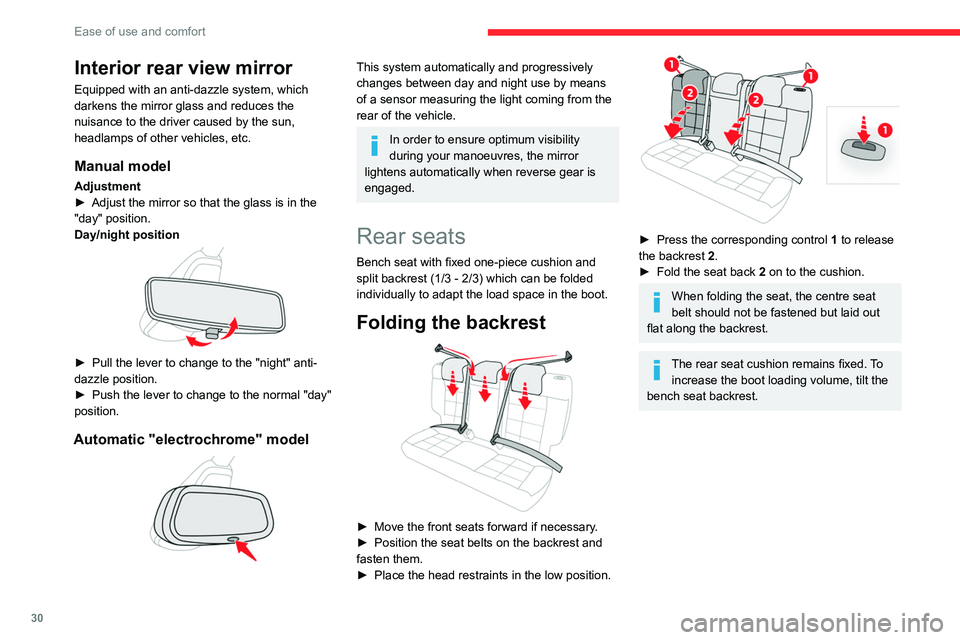
Day/night position
► Pull the lever to change to the "night" anti-
dazzle position.
►
Push the lever to change to the normal "day"
position.
Automatic "electrochrome" model
This system automatically and progressively
changes between day and night use by means
of a sensor measuring the light coming from the
rear of the vehicle.
In order to ensure optimum visibility
during your manoeuvres, the mirror
lightens automatically when reverse gear is
engaged.
Rear seats
Bench seat with fixed one-piece cushion and
split backrest (1/3 - 2/3) which can be folded
individually to adapt the load space in the boot.
Folding the backrest
► Move the front seats forward if necessary .
► Position the seat belts on the backrest and
fasten them.
►
Place the head restraints in the low position.
► Press the corresponding control 1 to release
the backrest 2.
►
Fold the seat back
2 on to the cushion.
When folding the seat, the centre seat
belt should not be fastened but laid out
flat along the backrest.
The rear seat cushion remains fixed. To increase the boot loading volume, tilt the
bench seat backrest.
Page 37 of 196
35
Ease of use and comfort
3It allows you:
– lower the temperature, in summer ,
–
increase the effectiveness of the demisting in
winter
, above 3°C.
►
Press button
5 to activate/deactivate the air
conditioning system.
When the indicator lamp is on, the air
conditioning function is activated.
The air conditioning does not operate when the air flow adjustment is inhibited.
Ventilation function with the
ignition on
When the ignition is switched on, you can
use the ventilation system to adjust the air
flow settings and the air distribution in the
passenger compartment for a duration which
depends on the battery charge.
This function does not operate the air
conditioning.
Recirculation of interior air
The intake of exterior air helps avoid and
eliminate misting of the windscreen and side
windows.
Recirculating the interior air isolates the
passenger compartment from exterior odours
and fumes.
When required, this function also allows
faster heating or cooling of the air in the
passenger compartment.
►
Press button
1 to recirculate the interior air or
allow the intake of exterior air.
Avoid prolonged use of interior air recirculation (due to the risk of misting
and deteriorating air quality).
System switch-off
► Press this button; the indicator lamp in the
button comes on.
This action switches off all of the functions of the
system.
T
emperature is no longer regulated. A slight flow
of air can still be felt, resulting from the forward
movement of the vehicle.
Pressing any button reactivates the system
with the settings that were in use before the
deactivation.
Avoid driving for long periods with the system off - risk of misting and
deterioration of air quality!
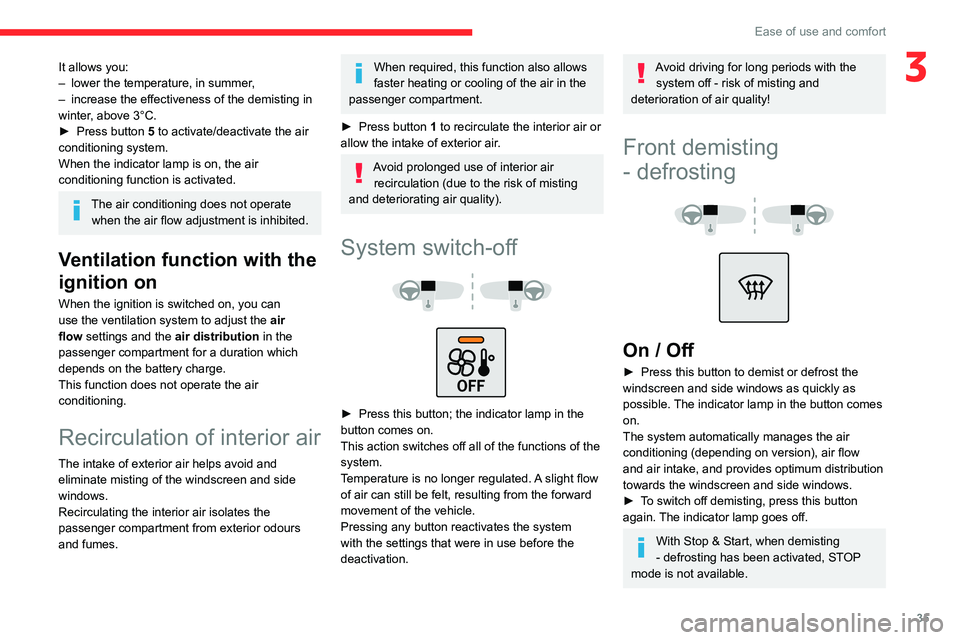
Front demisting
- defrosting
On / Off
► Press this button to demist or defrost the
windscreen and side windows as quickly as
possible.
The indicator lamp in the button comes
on.
The system automatically manages the air
conditioning (depending on version), air flow
and air intake, and provides optimum distribution
towards the windscreen and side windows.
►
T
o switch off demisting, press this button
again. The indicator lamp goes off.
With Stop & Start, when demisting
- defrosting has been activated, STOP
mode is not available.
Page 38 of 196
36
Ease of use and comfort
Boot lighting
It comes on automatically when the boot is
opened.
There are different lighting times:
– when the ignition is off, approximately ten
minutes,
– in energy economy mode, approximately thirty
seconds,
– with the engine running, unlimited.
Panoramic glass sunroof
Rear screen demisting
- defrosting
On / Off
► Press this button to demist/defrost the rear
screen and, depending on version, the door
mirrors.
The button indicator lamp comes on.
Defrosting switches off automatically to prevent
excessive electrical consumption.
►
It is possible to stop the demisting / defrosting
operation before it is switched off automatically
by pressing this button again.
The button
indicator lamp goes off.
Switch off the demisting/defrosting of
the rear screen and door mirrors as
soon as appropriate, as lower current
consumption results in reduced fuel
consumption.
Rear screen demisting - defrosting can
only be operated when the engine is
running.
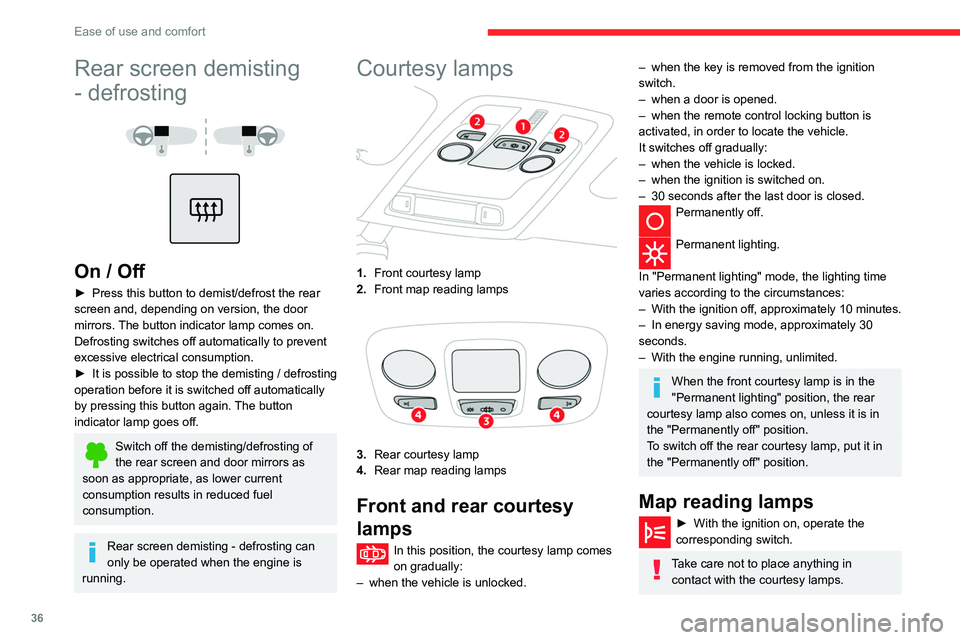
Courtesy lamps
1. Front courtesy lamp
2. Front map reading lamps
3.Rear courtesy lamp
4. Rear map reading lamps
Front and rear courtesy
lamps
In this position, the courtesy lamp comes
on gradually:
–
when the vehicle is unlocked.
– when the key is removed from the ignition
switch.
–
when a door is opened.
–
when the remote control locking button is
activated, in order to locate the vehicle.
It switches off gradually:
–
when the vehicle is locked.
–
when the ignition is switched on.
–
30 seconds after the last door is closed.
Permanently off.
Permanent lighting.
In "Permanent lighting" mode, the lighting time
varies according to the circumstances:
–
With
the ignition off, approximately 10 minutes.
–
In energy saving mode, approximately 30
seconds.
–
With the engine running, unlimited.
When the front courtesy lamp is in the
"Permanent lighting" position, the rear
courtesy lamp also comes on, unless it is in
the "Permanently off" position.
To switch off the rear courtesy lamp, put it in
the "Permanently off" position.
Map reading lamps
► With the ignition on, operate the
corresponding switch.
Take care not to place anything in contact with the courtesy lamps.
Page 39 of 196
37
Ease of use and comfort
3Boot lighting
It comes on automatically when the boot is
opened.
There are different lighting times:
–
when the ignition is off, approximately ten
minutes,
–
in energy economy mode, approximately thirty
seconds,
–
with the engine running, unlimited.
Panoramic glass sunroof
This glazed roof provides increased visibility
and light in the passenger compartment, while
maintaining normal temperatures thanks to its
"high thermal protection" coating.
Advice on care
In order to preserve the properties of the glazed
roof, we recommend wiping and cleaning the
inner glass using a clean, soft and dry cloth.
For stubborn stains, the glass should be cleaned
using screenwash fluid, rinsed with clean water,
then dried with a clean, soft cloth.
Do not use soapy water, abrasive
products, detergents (particularly those
with an ammonia base), solvents or solutions
with a high concentration of alcohol, petrol
etc.
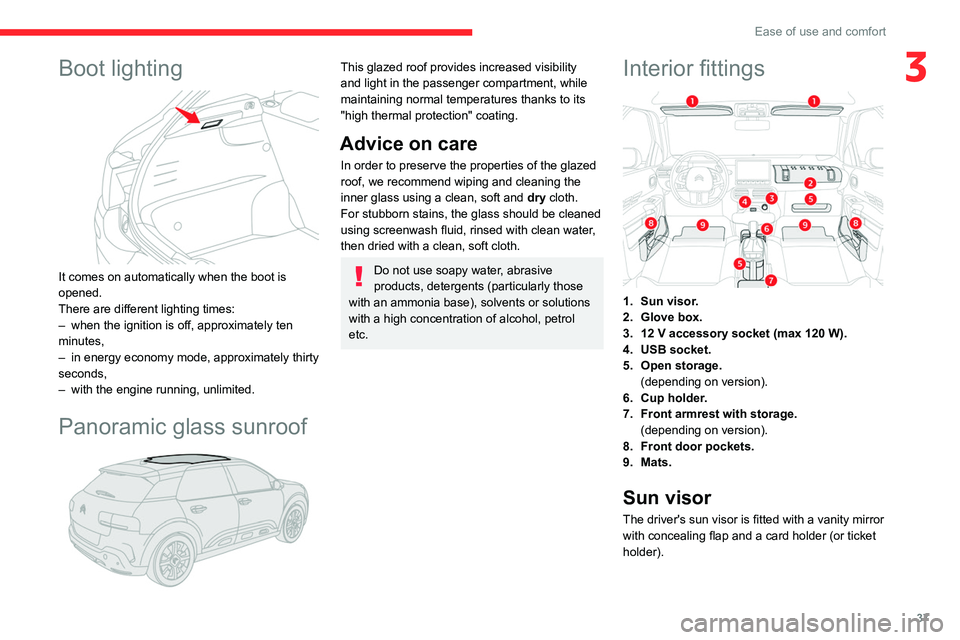
Interior fittings
1. Sun visor.
2. Glove box.
3. 12 V accessory socket (max 120 W).
4. USB socket.
5. Open storage. (depending on version).
6. Cup holder.
7. Front armrest with storage. (depending on version).
8. Front door pockets.
9. Mats.
Sun visor
The driver's sun visor is fitted with a vanity mirror
with concealing flap and a card holder (or ticket
holder).
Page 42 of 196
40
Ease of use and comfort
► gently lift the shelf, then remove it.
There are several ways of storing it:
– either upright behind the front seats,
– or flat on the bottom of the boot.
Rear shelf (van version)
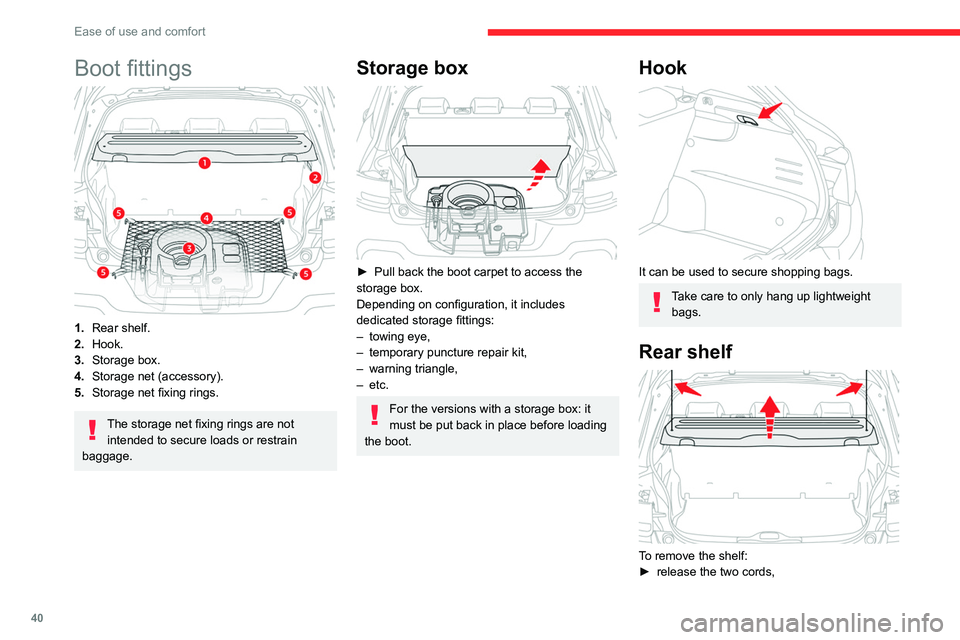
Boot fittings
1. Rear shelf.
2. Hook.
3. Storage box.
4. Storage net (accessory).
5. Storage net fixing rings.
The storage net fixing rings are not
intended to secure loads or restrain
baggage.
Storage box
► Pull back the boot carpet to access the
storage box.
Depending on configuration, it includes
dedicated storage fittings:
–
towing eye,
–
temporary puncture repair kit,
–
warning triangle,
–
etc.
For the versions with a storage box: it
must be put back in place before loading
the boot.
Hook
It can be used to secure shopping bags.
Take care to only hang up lightweight bags.
Rear shelf
To remove the shelf:
► release the two cords,
Page 44 of 196
42
Lighting and visibility
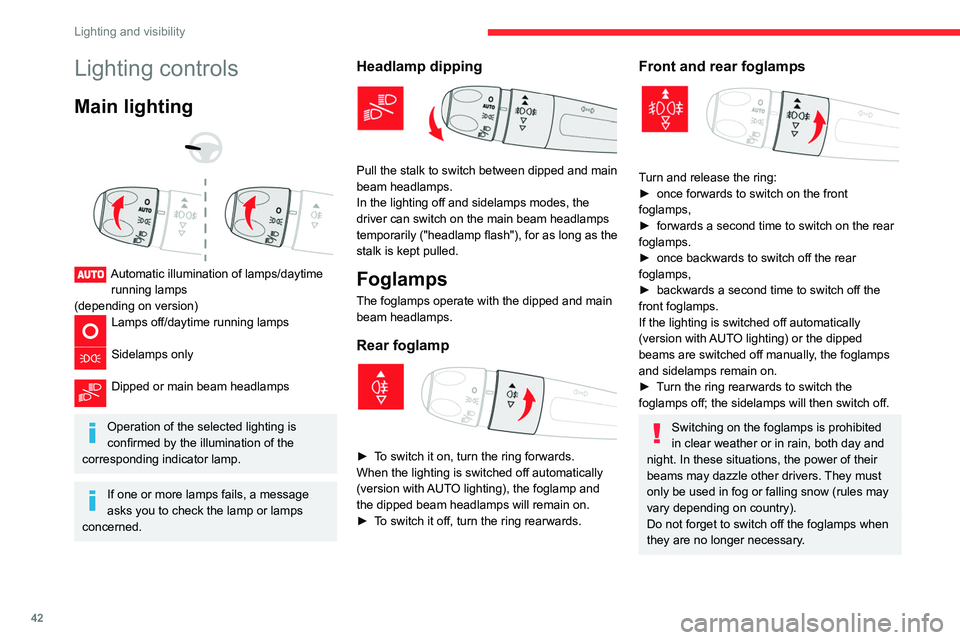
Lighting controls
Main lighting
Automatic illumination of lamps/daytime running lamps
(depending on version)
Lamps off/daytime running lamps
Sidelamps only
Dipped or main beam headlamps
Operation of the selected lighting is
confirmed by the illumination of the
corresponding indicator lamp.
If one or more lamps fails, a message
asks you to check the lamp or lamps
concerned.
Headlamp dipping
Pull the stalk to switch between dipped and main
beam headlamps.
In the lighting off and sidelamps modes, the
driver can switch on the main beam headlamps
temporarily ("headlamp flash"), for as long as the
stalk is kept pulled.
Foglamps
The foglamps operate with the dipped and main
beam headlamps.
Rear foglamp
► To switch it on, turn the ring forwards.
When the lighting is switched off automatically
(version with AUTO lighting), the foglamp and
the dipped beam headlamps will remain on.
►
T
o switch it off, turn the ring rearwards.
Front and rear foglamps
Turn and release the ring:
► once forwards to switch on the front
foglamps,
►
forwards a second time to switch on the rear
foglamps.
►
once backwards to switch off the rear
foglamps,
►
backwards a second time to switch off the
front foglamps.
If the lighting is switched off automatically
(version with
AUTO lighting) or the dipped
beams are switched off manually, the foglamps
and sidelamps remain on.
►
T
urn the ring rearwards to switch the
foglamps off; the sidelamps will then switch off.
Switching on the foglamps is prohibited
in clear weather or in rain, both day and
night. In these situations, the power of their
beams may dazzle other drivers. They must
only be used in fog or falling snow (rules may
vary depending on country).
Do not forget to switch off the foglamps when
they are no longer necessary.
Switching off of the lamps when the
ignition is switched off
When the ignition is switched off, all of the
lamps turn off immediately, except for dipped
beam headlamps if automatic guide-me-home
lighting is activated.
Switching on the lighting after
switching off the ignition
To reactivate the lighting control, rotate the
ring to the "0" position - lights off, then to the
desired position.
When the driver's door is opened, a
temporary audible signal warns you that the
vehicle's lighting is on.
The lighting, with the exception of the
side lights, switch off automatically after a
maximum duration of thirty minutes to prevent
discharging of the battery.
In some weather conditions (e.g. low
temperature or humidity), misting on the
internal surface of the glass of the headlamps
and rear lamps is normal, and will disappear
after the lamps have been on for a few
minutes.
Travelling abroad
Vehicles equipped with halogen
headlamps:
If planning to use your vehicle in a country
that drives on the other side of the road, the
Page 45 of 196
43
Lighting and visibility
4Switching off of the lamps when the
ignition is switched off
When the ignition is switched off, all of the
lamps turn off immediately, except for dipped
beam headlamps if automatic guide-me-home
lighting is activated.
Switching on the lighting after
switching off the ignition
To reactivate the lighting control, rotate the
ring to the "0" position - lights off, then to the
desired position.
When the driver's door is opened, a
temporary audible signal warns you that the
vehicle's lighting is on.
The lighting, with the exception of the
side lights, switch off automatically after a
maximum duration of thirty minutes to prevent
discharging of the battery.
In some weather conditions (e.g. low
temperature or humidity), misting on the
internal surface of the glass of the headlamps
and rear lamps is normal, and will disappear
after the lamps have been on for a few
minutes.
Travelling abroad
Vehicles equipped with halogen
headlamps:
If planning to use your vehicle in a country
that drives on the other side of the road, the
headlamp dipped beams must be adjusted to
avoid dazzling oncoming drivers. Contact a
CITROËN dealer or a qualified workshop.
Direction indicators
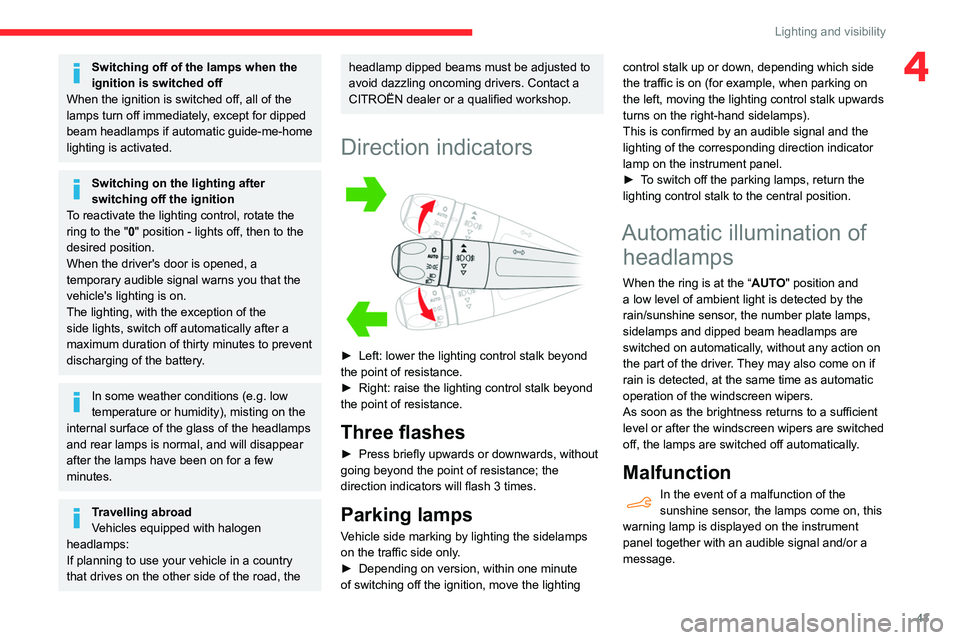
► Left: lower the lighting control stalk beyond
the point of resistance.
►
Right: raise the lighting control stalk beyond
the point of resistance.
Three flashes
► Press briefly upwards or downwards, without
going beyond the point of resistance; the
direction indicators will flash 3 times.
Parking lamps
Vehicle side marking by lighting the sidelamps
on the traffic side only.
►
Depending on version, within one minute
of switching off the ignition, move the lighting control stalk up or down, depending which side
the traffic is on (for example, when parking on
the left, moving the lighting control stalk upwards
turns on the right-hand sidelamps).
This is confirmed by an audible signal and the
lighting of the corresponding direction indicator
lamp on the instrument panel.
►
T
o switch off the parking lamps, return the
lighting control stalk to the central position.
Automatic illumination of headlamps
When the ring is at the “AUTO" position and
a low level of ambient light is detected by the
rain/sunshine sensor, the number plate lamps,
sidelamps and dipped beam headlamps are
switched on automatically, without any action on
the part of the driver. They may also come on if
rain is detected, at the same time as automatic
operation of the windscreen wipers.
As soon as the brightness returns to a sufficient
level or after the windscreen wipers are switched
off, the lamps are switched off automatically.
Malfunction
In the event of a malfunction of the
sunshine sensor, the lamps come on, this
warning lamp is displayed on the instrument
panel together with an audible signal and/or a
message.
Page 46 of 196
44
Lighting and visibility
Contact a CITROËN dealer or a qualified
workshop.
Do not cover the sunshine sensor, linked
with the rain sensor and located at the
top centre of the windscreen behind the rear
view mirror; the associated functions would
no longer be controlled.
In fog or snow, the sunshine sensor may
detect sufficient light. In this case, the
lighting will not come on automatically.
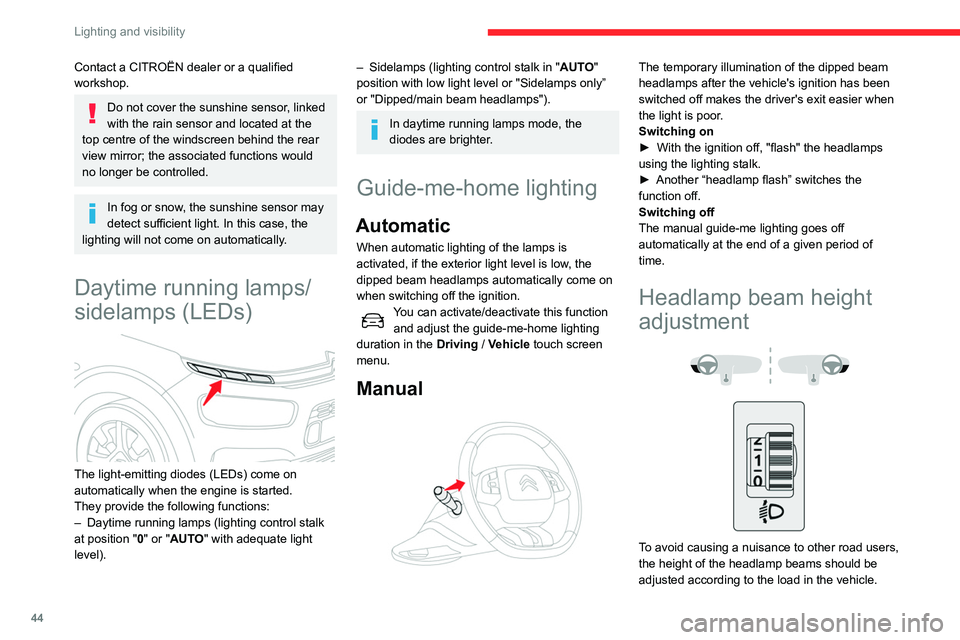
Daytime running lamps/
sidelamps (LEDs)
The light-emitting diodes (LEDs) come on
automatically when the engine is started.
They provide the following functions:
–
Daytime running lamps (lighting control stalk
at position "
0" or "AUTO" with adequate light
level).
– Sidelamps (lighting control stalk in " AUT O"
position with low light level or "Sidelamps only”
or "Dipped/main beam headlamps").
In daytime running lamps mode, the
diodes are brighter.
Guide-me-home lighting
Automatic
When automatic lighting of the lamps is
activated, if the exterior light level is low, the
dipped beam headlamps automatically come on
when switching off the ignition.
You can activate/deactivate this function and adjust the guide-me-home lighting
duration in the Driving
/ Vehicle touch screen
menu.
Manual
The temporary illumination of the dipped beam
headlamps after the vehicle's ignition has been
switched off makes the driver's exit easier when
the light is poor.
Switching on
►
With the ignition off, "flash" the headlamps
using the lighting stalk.
►
Another “headlamp flash” switches the
function off.
Switching off
The manual guide-me lighting goes off
automatically at the end of a given period of
time.
Headlamp beam height
adjustment
To avoid causing a nuisance to other road users,
the height of the headlamp beams should be
adjusted according to the load in the vehicle.
0. (Initial adjustment) Driver only or driver + front passenger
-. Driver + front passenger + rear passengers
1. Driver + front passenger + rear passengers +
load in the boot
-. Driver + front passenger + rear passengers +
load in the boot
2. Driver only + maximum authorised load in
the boot
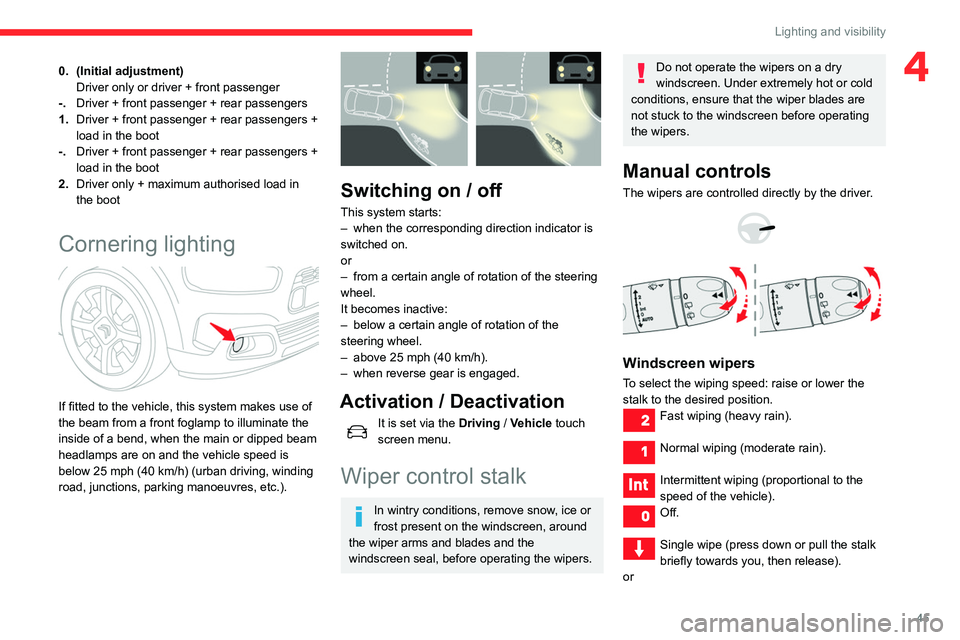
Cornering lighting
If fitted to the vehicle, this system makes use of
the beam from a front foglamp to illuminate the
inside of a bend, when the main or dipped beam
headlamps are on and the vehicle speed is
below 25 mph (40 km/h) (urban driving, winding
road, junctions, parking manoeuvres, etc.).
Page 47 of 196
45
Lighting and visibility
40. (Initial adjustment)Driver only or driver + front passenger
-. Driver + front passenger + rear passengers
1. Driver + front passenger + rear passengers +
load in the boot
-. Driver + front passenger + rear passengers +
load in the boot
2. Driver only + maximum authorised load in
the boot
Cornering lighting
If fitted to the vehicle, this system makes use of
the beam from a front foglamp to illuminate the
inside of a bend, when the main or dipped beam
headlamps are on and the vehicle speed is
below 25 mph (40
km/h) (urban driving, winding
road, junctions, parking manoeuvres, etc.).
Switching on / off
This system starts:
– when the corresponding direction indicator is
switched on.
or
–
from a certain angle of rotation of the steering
wheel.
It becomes inactive:
–
below a certain angle of rotation of the
steering wheel.
–
above 25 mph (40
km/h).
–
when reverse gear is engaged.
Activation / Deactivation
It is set via the Driving / Vehicle touch
screen menu.
Wiper control stalk
In wintry conditions, remove snow, ice or
frost present on the windscreen, around
the wiper arms and blades and the
windscreen seal, before operating the wipers.
Do not operate the wipers on a dry
windscreen. Under extremely hot or cold
conditions, ensure that the wiper blades are
not stuck to the windscreen before operating
the wipers.
Manual controls
The wipers are controlled directly by the driver.
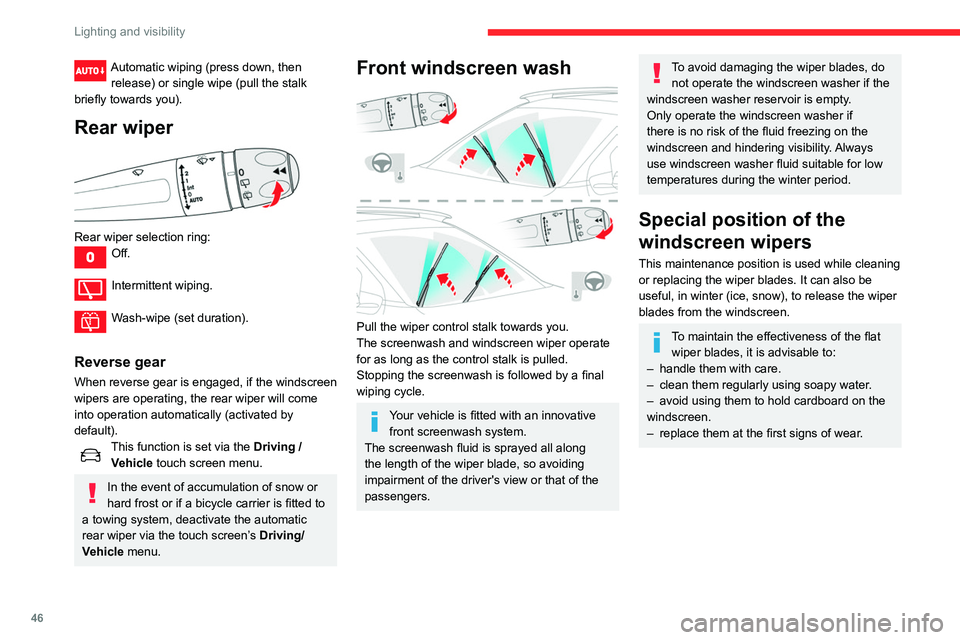
Windscreen wipers
To select the wiping speed: raise or lower the
stalk to the desired position.
Fast wiping (heavy rain).
Normal wiping (moderate rain).
Intermittent wiping (proportional to the
speed of the vehicle).
Off.
Single wipe (press down or pull the stalk
briefly towards you, then release).
or
Page 48 of 196
46
Lighting and visibility
Automatic wiping (press down, then release) or single wipe (pull the stalk
briefly towards you).
Rear wiper
Rear wiper selection ring:Off.
Intermittent wiping.
Wash-wipe (set duration).
Reverse gear
When reverse gear is engaged, if the windscreen
wipers are operating, the rear wiper will come
into operation automatically (activated by
default).
This function is set via the Driving /
V ehicle touch screen menu.
In the event of accumulation of snow or
hard frost or if a bicycle carrier is fitted to
a towing system, deactivate the automatic
rear wiper via the touch screen’s Driving/
Vehicle menu.
Front windscreen wash
Pull the wiper control stalk towards you.
The screenwash and windscreen wiper operate
for as long as the control stalk is pulled.
Stopping the screenwash is followed by a final
wiping cycle.
Your vehicle is fitted with an innovative front screenwash system.
The screenwash fluid is sprayed all along
the length of the wiper blade, so avoiding
impairment of the driver's view or that of the
passengers.
To avoid damaging the wiper blades, do not operate the windscreen washer if the
windscreen washer reservoir is empty.
Only operate the windscreen washer if
there is no risk of the fluid freezing on the
windscreen and hindering visibility. Always
use windscreen washer fluid suitable for low
temperatures during the winter period.
Special position of the
windscreen wipers
This maintenance position is used while cleaning
or replacing the wiper blades. It can also be
useful, in winter (ice, snow), to release the wiper
blades from the windscreen.
To maintain the effectiveness of the flat wiper blades, it is advisable to:
–
handle them with care.
–
clean them regularly using soapy water
.
–
avoid using them to hold cardboard on the
windscreen.
–
replace them at the first signs of wear
.