ECU CITROEN C4 DAG 2013 User Guide
[x] Cancel search | Manufacturer: CITROEN, Model Year: 2013, Model line: C4 DAG, Model: CITROEN C4 DAG 2013Pages: 340, PDF Size: 28.95 MB
Page 147 of 340
8
SAFETY
145
The driver must ensure that passen-
gers use the seat belts correctly and
that they are all restrained securely
before setting off.
Wherever you are seated in the ve-
hicle, always fasten your seat belt,
even for short journeys.
Do not interchange the seat belt
buckles as they will not fulfi l their role
fully.
The seat belts are fi tted with an inertia
reel permitting automatic adjustment
of the length of the strap to your size.
The seat belt is stowed automatically
when not in use.
Before and after use, ensure that the
seat belt is reeled in correctly.
The lower part of the strap must be
positioned as low as possible on the
pelvis.
The upper part must be positioned in
the hollow of the shoulder.
The inertia reels are fi tted with an au-
tomatic locking device which comes
into operation in the event of a col-
lision, emergency braking or if the
vehicle rolls over. You can release
the device by pulling fi rmly on the
strap and releasing it so that it reels
in slightly. In order to be effective, a seat belt
must:
- be tightened as close to the body
as possible,
- be pulled in front of you with a
smooth movement, checking that
it does not twist,
-
be used to restrain only one person,
- not bear any trace of cuts or fraying,
- not be converted or modifi ed to
avoid affecting its performance.
In accordance with current safety
regulations, for all repairs on your ve-
hicle, go to a qualifi ed workshop with
the skills and equipment needed,
which a CITROËN dealer is able to
provide.
Have your seat belts checked regu-
larly by a CITROËN dealer or a
qualifi ed workshop, particularly if the
straps show signs of damage.
Clean the seat belt straps with soapy
water or a textile cleaning product,
sold by CITROËN dealers.
After folding or moving a seat or rear
bench seat, ensure that the seat belt
is positioned and reeled in correctly.
Recommendations for children
Use a suitable child seat if the pas-
senger is less than 12 years old or
shorter than one and a half metres.
Never use the same seat belt to se-
cure more than one person.
Never allow a child to travel on your
lap.
In the event of an impact
Depending on the nature and se-
riousness of the impact
, the pre-
tensioning device may be deployed
before and independently of the
airbags. Deployment of the preten-
sioners is accompanied by a slight
discharge of harmless smoke and
a noise, due to the activation of the
pyrotechnic cartridge incorporated in
the system.
In all cases, the airbag warning lamp
comes on.
Following an impact, have the seat
belts system checked, and if neces-
sary replaced, by a CITROËN dealer
or a qualifi ed workshop.
Page 151 of 340
8
SAFETY
149
For the airbags to be fully
effective, observe the
following safety rules:
Sit in a normal upright position.
Wear a correctly adjusted seat
belt.
Do not leave anything between
the occupants and the airbags
(a child, pet, object...). This could
hamper the operation of the air-
bags or injure the occupants.
After an accident or if the ve-
hicle has been stolen or broken
into, have the airbag systems
checked.
All work on the airbag system must
be carried out by a CITROËN
dealer or a qualifi ed workshop.
Even if all of the precautions
mentioned are observed, a risk
of injury or of minor burns to the
head, chest or arms when an air-
bag is deployed cannot be ruled
out. The bag infl ates almost in-
stantly (within a few milliseconds)
then defl ates within the same
time discharging the hot gas via
openings provided for this pur-
pose.
Front airbags
Do not drive holding the steering wheel by its spokes or resting your hands on
the centre part of the wheel.
Passengers must not place their feet on the dashboard.
If possible, do not smoke as deployment of the airbags can cause burns or the
risk of injury from a cigarette or pipe.
Never remove or pierce the steering wheel or hit it violently.
Lateral airbags
Use only approved covers on the seats, compatible with the deployment the lat-
eral airbags. For information on the range of seat covers suitable for your vehicle,
you can contact a CITROËN dealer (see "Practical information - § Accessories").
Do not fi x or attach anything to the seat backs (clothing...). This could cause
injury to the chest or arms if the lateral airbag is deployed.
Do not sit with the upper part of the body any nearer to the door than necessary.
Curtain airbags
Do not fi x or attach anything to the roof. This could cause injury to the head if the
curtain airbag is deployed.
If fi tted on your vehicle, do not remove the grab handles installed on the roof, they
play a part in securing the curtain airbags.
Page 187 of 340
10
CHECKS
185
BONNET
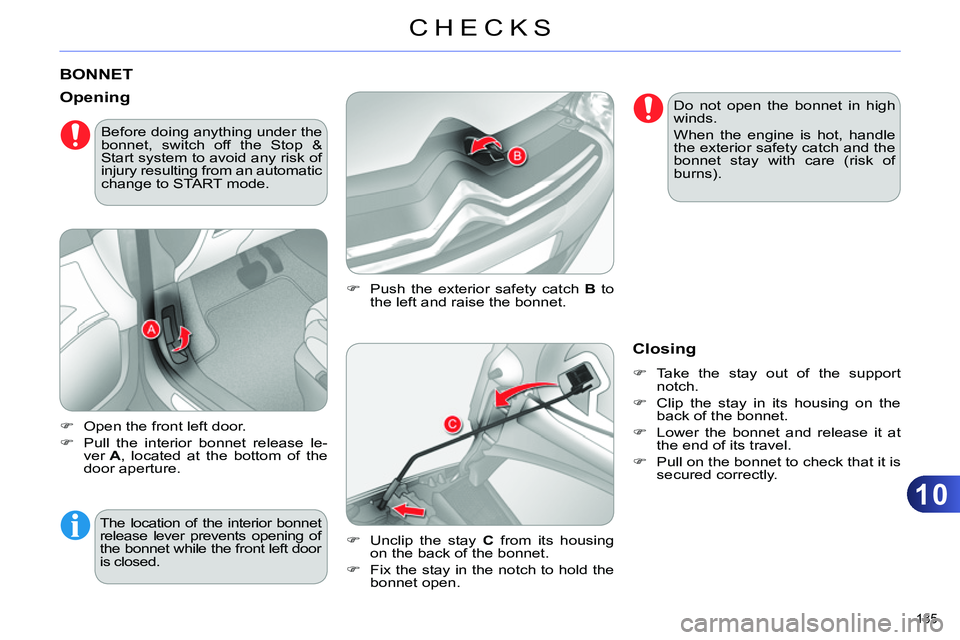
Push the exterior safety catch B
to
the left and raise the bonnet.
Opening
Open the front left door.
Pull the interior bonnet release le-
ver A
, located at the bottom of the
door aperture.
Unclip the stay C
from its housing
on the back of the bonnet.
Fix the stay in the notch to hold the
bonnet open.
The location of the interior bonnet
release lever prevents opening of
the bonnet while the front left door
is closed.
Closing
Take the stay out of the support
notch.
Clip the stay in its housing on the
back of the bonnet.
Lower the bonnet and release it at
the end of its travel.
Pull on the bonnet to check that it is
secured correctly.
Do not open the bonnet in high
winds.
When the engine is hot, handle
the exterior safety catch and the
bonnet stay with care (risk of
burns).
Before doing anything under the
bonnet, switch off the Stop &
Start system to avoid any risk of
injury resulting from an automatic
change to START mode.
Page 192 of 340
10
CHECKS
190
Used products
Avoid prolonged contact of used
oil or fl uids with the skin.
Most of these fl uids are harmful
to health or indeed very corro-
sive.
Do not discard used oil or fl uids
into sewers or onto the ground.
Take used oil to a CITROËN
dealer or a qualifi ed workshop
(France) or to an authorised
waste disposal site.
Additive level (Diesel with
particle emissions filter)
The additive reservoir low level is indi-
cated by:
Topping up
The reservoir must be topped up with-
out delay by a CITROËN dealer or a
qualifi ed workshop.
- fi xed illumination of the par-
ticle emissions fi lter warning
lamp, accompanied by an au-
dible signal and a message
that the particle emissions
fi lter additive level is too low.
Screenwash / headlamp wash
fluid level
Specifi cation of the fl uid
To ensure optimum cleaning and to
avoid freezing, the fl uid should never be
topped up or replaced by plain water.
In wintry conditions, the use of a fl uid
with an ethyl alcohol or methanol base
is recommended.
To check the level or top up
the fl uid on vehicle fi tted with
headlamp washers, immobilise
the vehicle and switch of the
engine.
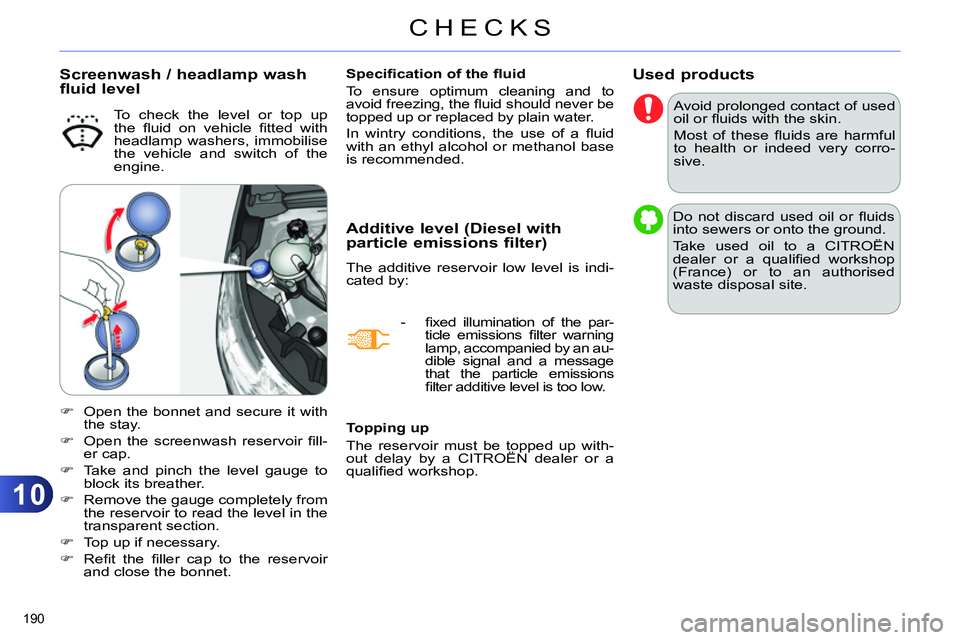
Open the bonnet and secure it with
the stay.
Open the screenwash reservoir fi ll-
er cap.
Take and pinch the level gauge to
block its breather.
Remove the gauge completely from
the reservoir to read the level in the
transparent section.
Top up if necessary.
Refi t the fi ller cap to the reservoir
and close the bonnet.
Page 200 of 340
11
PRACTICAL INFORMATION
198
CHANGING A WHEEL
Procedure for changing a faulty wheel
for the spare wheel using the tools pro-
vided with the vehicle.
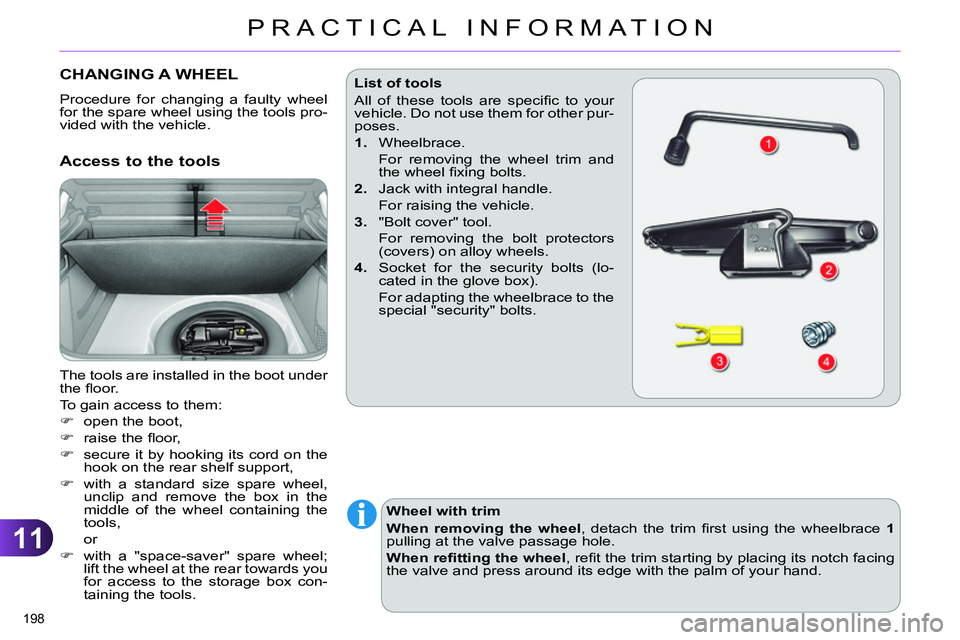
Access to the tools
The tools are installed in the boot under
the fl oor.
To gain access to them:
open the boot,
raise the fl oor,
secure it by hooking its cord on the
hook on the rear shelf support,
with a standard size spare wheel,
unclip and remove the box in the
middle of the wheel containing the
tools,
or
with a "space-saver" spare wheel;
lift the wheel at the rear towards you
for access to the storage box con-
taining the tools.
List of tools
All of these tools are specifi c to your
vehicle. Do not use them for other pur-
poses.
1.
Wheelbrace.
For removing the wheel trim and
the wheel fi xing bolts.
2.
Jack with integral handle.
For raising the vehicle.
3.
"Bolt cover" tool.
For removing the bolt protectors
(covers) on alloy wheels.
4.
Socket for the security bolts (lo-
cated in the glove box).
For adapting the wheelbrace to the
special "security" bolts.
Wheel with trim
When removing the wheel
, detach the trim fi rst using the wheelbrace 1
pulling at the valve passage hole.
When refi tting the wheel
, refi t the trim starting by placing its notch facing
the valve and press around its edge with the palm of your hand.
Page 202 of 340
11
PRACTICAL INFORMATION
200
Removing a wheel
Parking the vehicle
Immobilise the vehicle where it
does not block traffi c: the ground
must be level, stable and non-
slippery ground.
Apply the parking brake unless
it has been programmed to au-
tomatic mode, switch off the ig-
nition and engage fi rst gear * to
lock the wheels.
Check that the braking warning
lamps in the instrument panel
are on (not fl ashing).
The occupants must get out of
the vehicle and wait where they
are safe.
If necessary, place a chock un-
der the wheel diagonally oppo-
site the wheel to be changed.
Never go underneath a vehicle
raised using a jack; use an axle
stand.
*
position R
for an electronic gearbox; P
for an automatic gearbox.
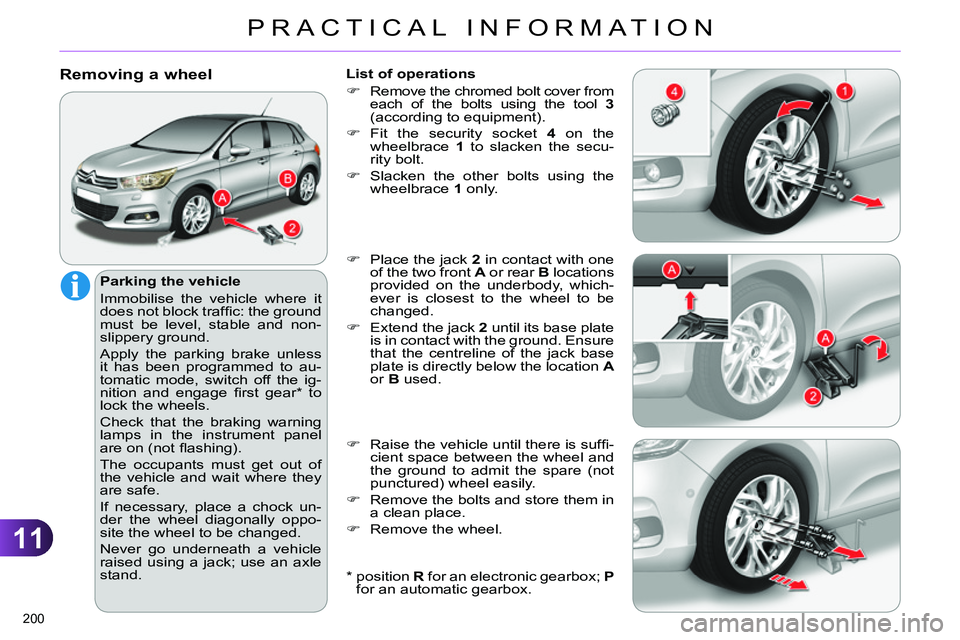
List of operations
Remove the chromed bolt cover from
each of the bolts using the tool 3
(according to equipment).
Fit the security socket 4
on the
wheelbrace 1
to slacken the secu-
rity bolt.
Slacken the other bolts using the
wheelbrace 1
only.
Place the jack 2
in contact with one
of the two front A
or rear B
locations
provided on the underbody, which-
ever is closest to the wheel to be
changed.
Extend the jack 2
until its base plate
is in contact with the ground. Ensure
that the centreline of the jack base
plate is directly below the location A
or B
used.
Raise the vehicle until there is suffi -
cient space between the wheel and
the ground to admit the spare (not
punctured) wheel easily.
Remove the bolts and store them in
a clean place.
Remove the wheel.
Page 203 of 340
11
PRACTICAL INFORMATION
201
Fitting a wheel
Fitting a steel or "space-
saver" spare wheel
If your vehicle is fi tted with al-
loy wheels, when tightening the
bolts on fi tting it is normal to
notice that the washers do not
come into contact with the steel
or "space-saver" spare wheel.
The wheel is secured by the
conical contact of each bolt.
After changing a wheel
To store the punctured wheel in the boot
correctly, fi rst remove the central cover.
When using the "space-saver" type
spare wheel, do not exceed 50 mph
(80 km/h).
Have the tightening of the bolts and
the pressure of the spare wheel
checked by a CITROËN dealer or a
qualifi ed workshop without delay.
Have the punctured wheel repaired
and replace it on the vehicle as soon
as possible.
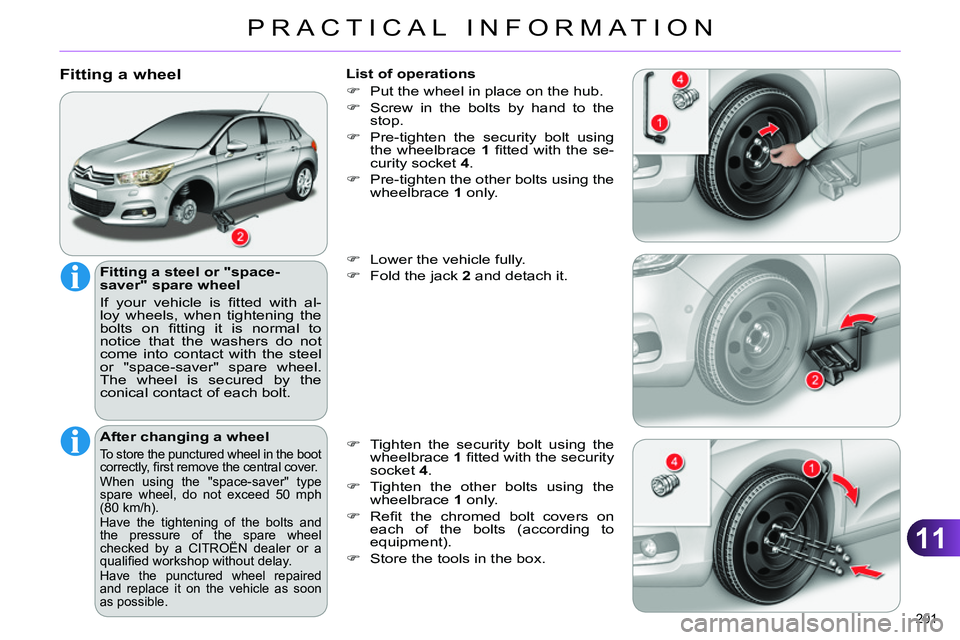
List of operations
Put the wheel in place on the hub.
Screw in the bolts by hand to the
stop.
Pre-tighten the security bolt using
the wheelbrace 1
fi tted with the se-
curity socket 4
.
Pre-tighten the other bolts using the
wheelbrace 1
only.
Lower the vehicle fully.
Fold the jack 2
and detach it.
Tighten the security bolt using the
wheelbrace 1
fi tted with the security
socket 4
.
Tighten the other bolts using the
wheelbrace 1
only.
Refi t the chromed bolt covers on
each of the bolts (according to
equipment).
Store the tools in the box.
Page 211 of 340
11
PRACTICAL INFORMATION
209
CHANGING A FUSE
Access to the tools
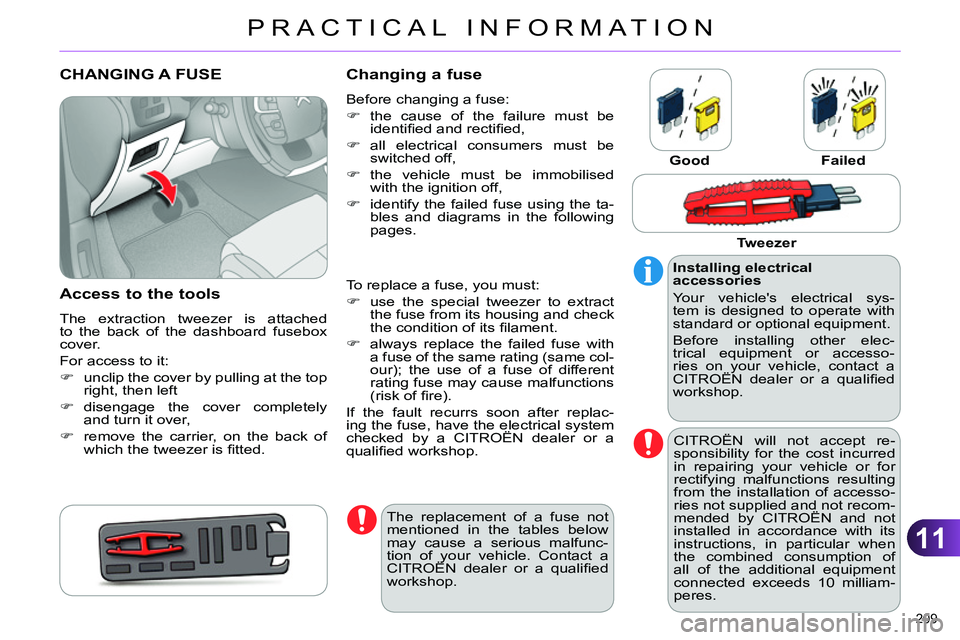
The extraction tweezer is attached
to the back of the dashboard fusebox
cover.
For access to it:
unclip the cover by pulling at the top
right, then left
disengage the cover completely
and turn it over,
remove the carrier, on the back of
which the tweezer is fi tted.
Changing a fuse
Before changing a fuse:
the cause of the failure must be
identifi ed and rectifi ed,
all electrical consumers must be
switched off,
the vehicle must be immobilised
with the ignition off,
identify the failed fuse using the ta-
bles and diagrams in the following
pages.
Good
Failed
To replace a fuse, you must:
use the special tweezer to extract
the fuse from its housing and check
the condition of its fi lament.
always replace the failed fuse with
a fuse of the same rating (same col-
our); the use of a fuse of different
rating fuse may cause malfunctions
(risk of fi re).
If the fault recurrs soon after replac-
ing the fuse, have the electrical system
checked by a CITROËN dealer or a
qualifi ed workshop.
Installing electrical
accessories
Your vehicle's electrical sys-
tem is designed to operate with
standard or optional equipment.
Before installing other elec-
trical equipment or accesso-
ries on your vehicle, contact a
CITROËN dealer or a qualifi ed
workshop.
CITROËN will not accept re-
sponsibility for the cost incurred
in repairing your vehicle or for
rectifying malfunctions resulting
from the installation of accesso-
ries not supplied and not recom-
mended by CITROËN and not
installed in accordance with its
instructions, in particular when
the combined consumption of
all of the additional equipment
connected exceeds 10 milliam-
peres.
The replacement of a fuse not
mentioned in the tables below
may cause a serious malfunc-
tion of your vehicle. Contact a
CITROËN dealer or a qualifi ed
workshop.
Tweezer
Page 212 of 340
11
PRACTICAL INFORMATION
210
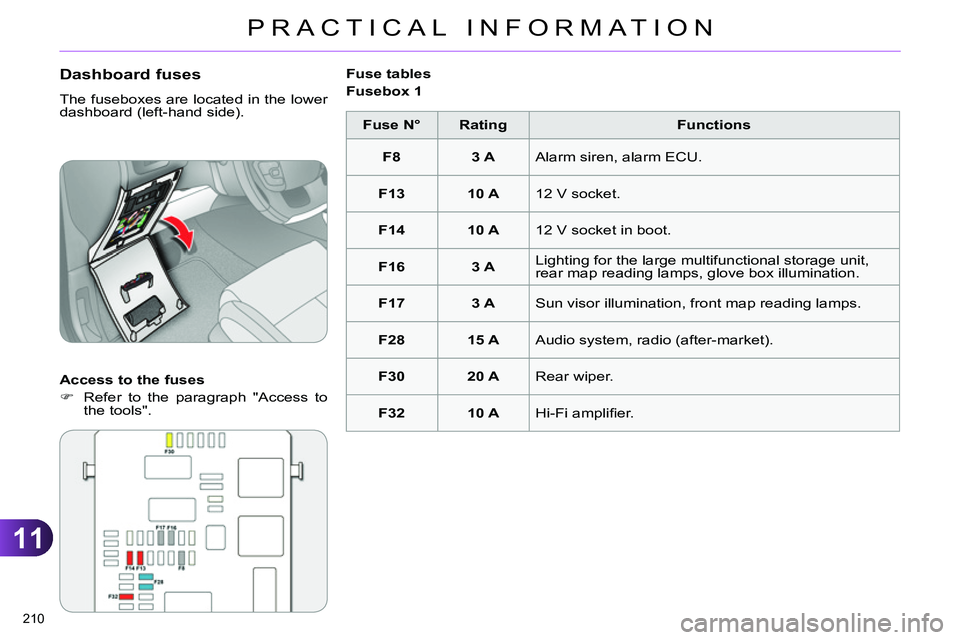
Dashboard fuses
The fuseboxes are located in the lower
dashboard (left-hand side).
Access to the fuses
Refer to the paragraph "Access to
the tools".
Fuse tables
Fusebox 1
Fuse N°
Rating
Functions
F8
3 A
Alarm siren, alarm ECU.
F13
10 A
12 V socket.
F14
10 A
12 V socket in boot.
F16
3 A
Lighting for the large multifunctional storage unit,
rear map reading lamps, glove box illumination.
F17
3 A
Sun visor illumination, front map reading lamps.
F28
15 A
Audio system, radio (after-market).
F30
20 A
Rear wiper.
F32
10 A
Hi-Fi amplifi er.
Page 215 of 340
11
PRACTICAL INFORMATION
213
When your vehicle's battery is dis-
charged, the engine can be started
using a slave battery (external or on
another vehicle) and jump lead cables.
Starting using another battery
12 V BATTERY
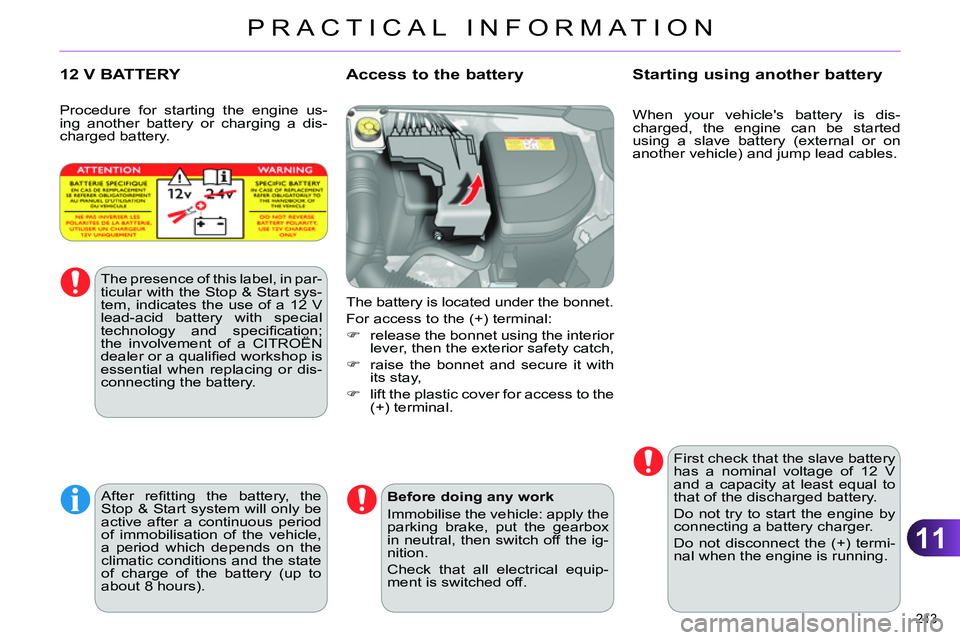
The battery is located under the bonnet.
For access to the (+) terminal:
release the bonnet using the interior
lever, then the exterior safety catch,
raise the bonnet and secure it with
its stay,
lift the plastic cover for access to the
(+) terminal.
Access to the battery
The presence of this label, in par-
ticular with the Stop & Start sys-
tem, indicates the use of a 12 V
lead-acid battery with special
technology and specifi cation;
the involvement of a CITROËN
dealer or a qualifi ed workshop is
essential when replacing or dis-
connecting the battery.
Procedure for starting the engine us-
ing another battery or charging a dis-
charged battery.
After refi tting the battery, the
Stop & Start system will only be
active after a continuous period
of immobilisation of the vehicle,
a period which depends on the
climatic conditions and the state
of charge of the battery (up to
about 8 hours).
First check that the slave battery
has a nominal voltage of 12 V
and a capacity at least equal to
that of the discharged battery.
Do not try to start the engine by
connecting a battery charger.
Do not disconnect the (+) termi-
nal when the engine is running.
Before doing any work
Immobilise the vehicle: apply the
parking brake, put the gearbox
in neutral, then switch off the ig-
nition.
Check that all electrical equip-
ment is switched off.