fuel CITROEN C4 DAG 2013 Owner's Manual
[x] Cancel search | Manufacturer: CITROEN, Model Year: 2013, Model line: C4 DAG, Model: CITROEN C4 DAG 2013Pages: 340, PDF Size: 28.95 MB
Page 62 of 340
2
MULTIFUNCTION SCREENS
60
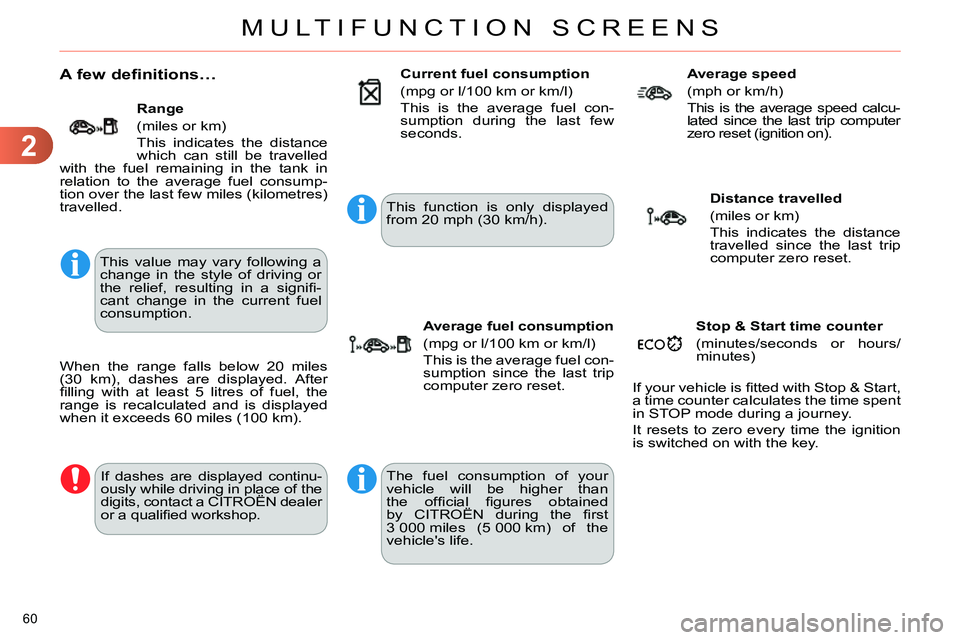
A few definitions…
This value may vary following a
change in the style of driving or
the relief, resulting in a signifi -
cant change in the current fuel
consumption.
If dashes are displayed continu-
ously while driving in place of the
digits, contact a CITROËN dealer
or a qualifi ed workshop. This function is only displayed
from 20 mph (30 km/h).
Range
(miles or km)
This indicates the distance
which can still be travelled
with the fuel remaining in the tank in
relation to the average fuel consump-
tion over the last few miles (kilometres)
travelled.
When the range falls below 20 miles
(30 km), dashes are displayed. After
fi lling with at least 5 litres of fuel, the
range is recalculated and is displayed
when it exceeds 60 miles (100 km).
Current fuel consumption
(mpg or l/100 km or km/l)
This is the average fuel con-
sumption during the last few
seconds.
Average fuel consumption
(mpg or l/100 km or km/l)
This is the average fuel con-
sumption since the last trip
computer zero reset.
Average speed
(mph or km/h)
This is the average speed calcu-
lated since the last trip computer
zero reset (ignition on).
Distance travelled
(miles or km)
This indicates the distance
travelled since the last trip
computer zero reset.
Stop & Start time counter
(minutes/seconds or hours/
minutes)
If your vehicle is fi tted with Stop & Start,
a time counter calculates the time spent
in STOP mode during a journey.
It resets to zero every time the ignition
is switched on with the key.
The fuel consumption of your
vehicle will be higher than
the offi cial fi gures obtained
by CITROËN during the fi rst
3 000 miles (5 000 km) of the
vehicle's life.
Page 71 of 340
3
COMFORT
69
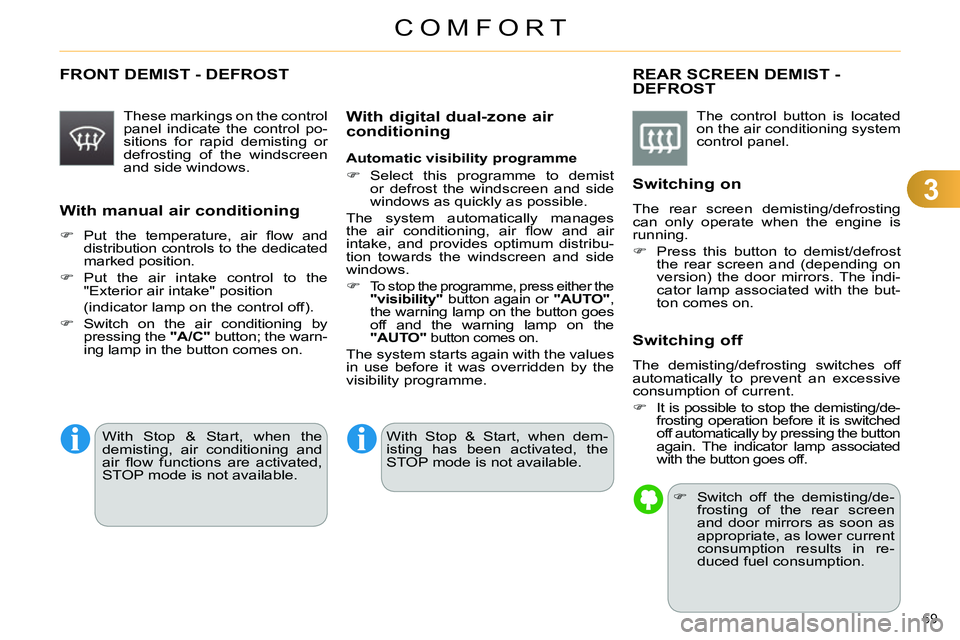
FRONT DEMIST - DEFROST
These markings on the control
panel indicate the control po-
sitions for rapid demisting or
defrosting of the windscreen
and side windows.
With manual air conditioning
Put the temperature, air fl ow and
distribution controls to the dedicated
marked position.
Put the air intake control to the
"Exterior air intake" position
(indicator lamp on the control off).
Switch on the air conditioning by
pressing the "A/C"
button; the warn-
ing lamp in the button comes on.
REAR SCREEN DEMIST -
DEFROST
The control button is located
on the air conditioning system
control panel.
Switching on
The rear screen demisting/defrosting
can only operate when the engine is
running.
Press this button to demist/defrost
the rear screen and (depending on
version) the door mirrors. The indi-
cator lamp associated with the but-
ton comes on.
Switching off
The demisting/defrosting switches off
automatically to prevent an excessive
consumption of current.
It is possible to stop the demisting/de-
frosting operation before it is switched
off automatically by pressing the button
again. The indicator lamp associated
with the button goes off.
Switch off the demisting/de-
frosting of the rear screen
and door mirrors as soon as
appropriate, as lower current
consumption results in re-
duced fuel consumption.
With digital dual-zone air
conditioning
Automatic visibility programme
Select this programme to demist
or defrost the windscreen and side
windows as quickly as possible.
The system automatically manages
the air conditioning, air fl ow and air
intake, and provides optimum distribu-
tion towards the windscreen and side
windows.
To stop the programme, press either the
"visibility"
button again or "AUTO"
,
the warning lamp on the button goes
off and the warning lamp on the
"AUTO"
button comes on.
The system starts again with the values
in use before it was overridden by the
visibility programme.
With Stop & Start, when dem-
isting has been activated, the
STOP mode is not available.
With Stop & Start, when the
demisting, air conditioning and
air fl ow functions are activated,
STOP mode is not available.
Page 97 of 340
4
ACCESS
95
FUEL TANK
Capacity of the tank: approximately
60 litres.
When the low fuel level in the
tank is reached, this warning
lamp comes on in the instru-
ment panel, accompanied by an
audible warning and the display
of an alert message. When it
fi rst comes on, around 6 litres
of fuel remain in the tank.
Until suffi cient fuel has been added,
every time the ignition is switched on,
this warning lamp appears, accompa-
nied by an audible signal and an alert
message. When driving, this audible
signal and the display of this alert mes-
sage are repeated with increasing fre-
quency, as the level drops towards 0
.
You must refuel as soon as possible to
avoid running out.
If you run out of fuel (Diesel), refer also
to "Checks".
Low fuel level
Refuelling
Additions of fuel must be of at least
5 litres to be registered by the fuel
gauge.
Opening the fi ller cap may result in an
inrush of air. This vacuum is entirely
normal and results from the sealing of
the fuel system.
If you have put in the wrong
fuel for your vehicle, you must
have
the tank drained and re-
fi lled with the correct fuel be-
fore you start the engine.
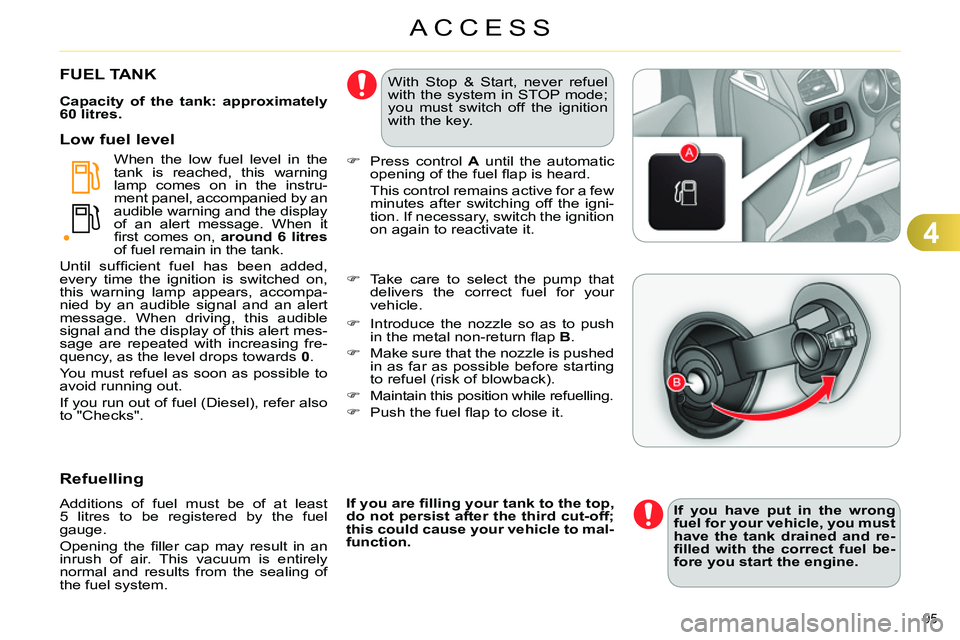
Press control A
until the automatic
opening of the fuel fl ap is heard.
This control remains active for a few
minutes after switching off the igni-
tion. If necessary, switch the ignition
on again to reactivate it.
If you are fi lling your tank to the top,
do not persist after the third cut-off;
this could cause your vehicle to mal-
function.
Take care to select the pump that
delivers the correct fuel for your
vehicle.
With Stop & Start, never refuel
with the system in STOP mode;
you must switch off the ignition
with the key.
Introduce the nozzle so as to push
in the metal non-return fl ap B.
Make sure that the nozzle is pushed
in as far as possible before starting
to refuel (risk of blowback).
Maintain this position while refuelling.
Push the fuel fl ap to close it.
Page 98 of 340
4
ACCESS
96
Quality of the fuel used for
petrol engines
The petrol engines are perfectly com-
patible with E10 or E24 type petrol
biofuels (containing 10 % or 24 % etha-
nol), conforming to European standards
EN 228 and EN 15376.
E85 type fuels (containing up to 85 %
ethanol) are reserved exclusively for
vehicles marketed for the use of this
type of fuel (BioFlex vehicles). The
quality of the ethanol must comply with
European standard EN 15293.
For Brazil only, special vehicles are
marketed to run on fuels containing up
to 100 % ethanol (E100 type).
Quality of the fuel used for
Diesel engines
The Diesel engines are perfectly com-
patible with biofuels which conform to
current and future European standards
(Diesel fuel which complies with stan-
dard EN 590 mixed with a biofuel which
complies with standard EN 14214)
available at the pumps (containing up
to 7 % Fatty Acid Methyl Ester).
The B30 biofuel can be used in certain
Diesel engines; however, this use is sub-
ject to strict application of the special ser-
vicing conditions. Contact a CITROËN
dealer or a qualifi ed workshop.
The use of any other type of (bio)fuel
(vegetable or animal oils, pure or dilut-
ed, domestic fuel...) is strictly prohibited
(risk of damage to the engine and fuel
system).
The petrol or Diesel engine of your vehicle
is fi tted with a catalytic converter, a device
which helps to reduce the level of harmful
emissions in the exhaust gases.
For petrol engines, the use of unleaded
fuel is compulsory.
The fi ller neck is narrower, admitting un-
leaded petrol nozzles only.
Fuel supply cut-off
Your vehicle is equipped with a safety
device which cuts off the fuel supply in
the event of a collision.
Page 99 of 340
4
ACCESS
97
MISFUEL PREVENTION
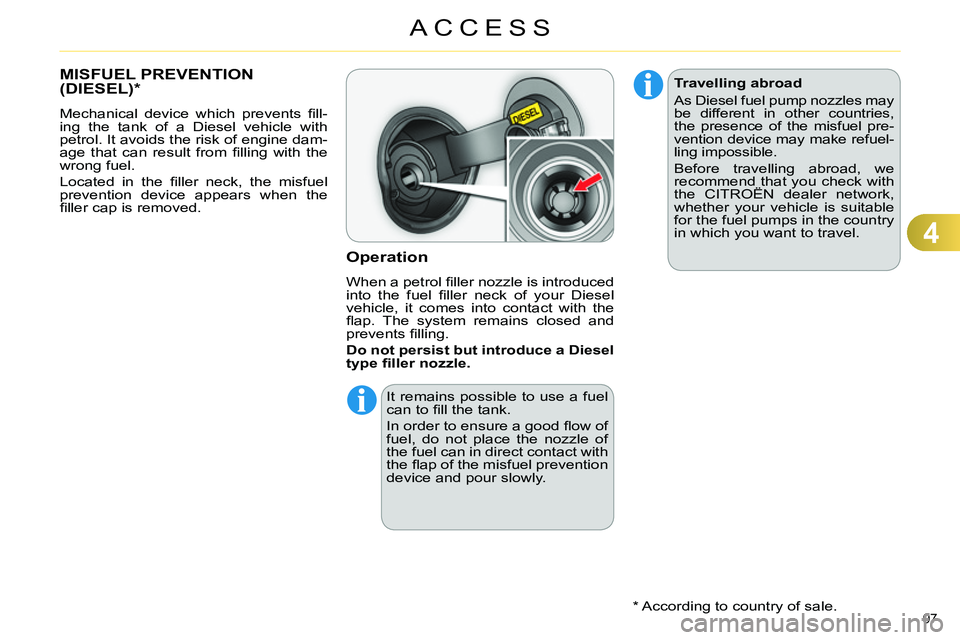
(DIESEL) *
Mechanical device which prevents fi ll-
ing the tank of a Diesel vehicle with
petrol. It avoids the risk of engine dam-
age that can result from fi lling with the
wrong fuel.
Located in the fi ller neck, the misfuel
prevention device appears when the
fi ller cap is removed.
Operation
When a petrol fi ller nozzle is introduced
into the fuel fi ller neck of your Diesel
vehicle, it comes into contact with the
fl ap. The system remains closed and
prevents fi lling.
Do not persist but introduce a Diesel
type fi ller nozzle.
It remains possible to use a fuel
can to fi ll the tank.
In order to ensure a good fl ow of
fuel, do not place the nozzle of
the fuel can in direct contact with
the fl ap of the misfuel prevention
device and pour slowly.
* According to country of sale.
Travelling abroad
As Diesel fuel pump nozzles may
be different in other countries,
the presence of the misfuel pre-
vention device may make refuel-
ling impossible.
Before travelling abroad, we
recommend that you check with
the CITROËN dealer network,
whether your vehicle is suitable
for the fuel pumps in the country
in which you want to travel.
Page 161 of 340
9
DRIVING
159
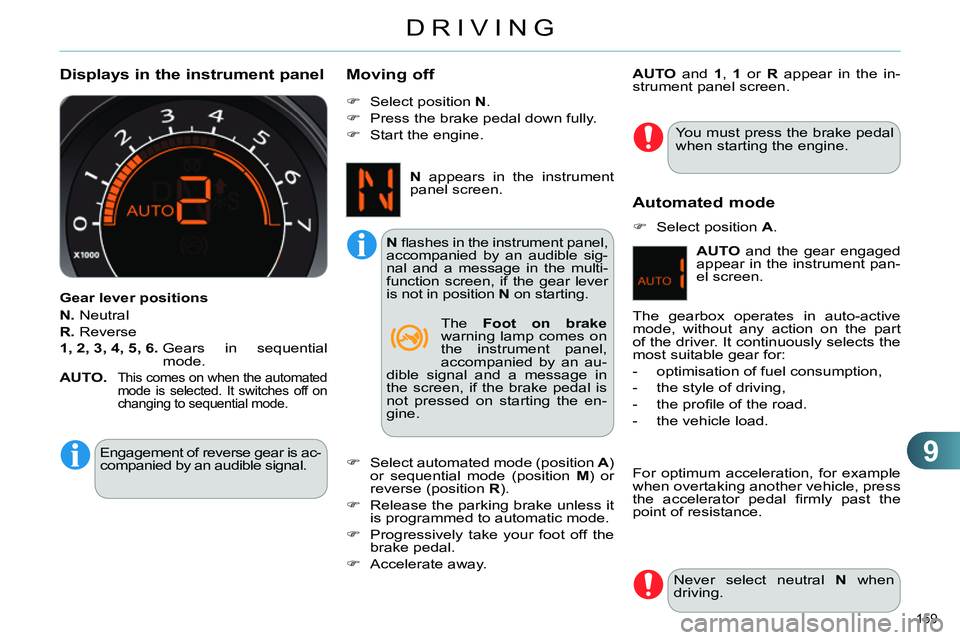
Displays in the instrument panel
Gear lever positions
N.
Neutral
R.
Reverse
1, 2, 3, 4, 5, 6.
Gears in sequential
mode.
AUTO.
This comes on when the automated
mode is selected. It switches off on
changing to sequential mode.
You must press the brake pedal
when starting the engine.
Select position N
.
Press the brake pedal down fully.
Start the engine.
Moving off
Select automated mode (position A
)
or sequential mode (position M
) or
reverse (position R
).
Release the parking brake unless it
is programmed to automatic mode.
Progressively take your foot off the
brake pedal.
Accelerate away.
Automated mode
Select position A
.
For optimum acceleration, for example
when overtaking another vehicle, press
the accelerator pedal fi rmly past the
point of resistance.
Engagement of reverse gear is ac-
companied by an audible signal.
N
fl ashes in the instrument panel,
accompanied by an audible sig-
nal and a message in the multi-
function screen, if the gear lever
is not in position N
on starting.
AUTO
and 1
, 1
or R
appear in the in-
strument panel screen.
The gearbox operates in auto-active
mode, without any action on the part
of the driver. It continuously selects the
most suitable gear for:
- optimisation of fuel consumption,
- the style of driving,
- the profi le of the road.
- the vehicle load.
N
appears in the instrument
panel screen.
The Foot on brake
warning lamp comes on
the instrument panel,
accompanied by an au-
dible signal and a message in
the screen, if the brake pedal is
not pressed on starting the en-
gine.
Never select neutral N
when
driving.
AUTO
and the gear engaged
appear in the instrument pan-
el screen.
Page 165 of 340
9
DRIVING
163
Manual operation
Select position M
for sequential
changing of the six gears.
Push the lever towards the +
sign to
change up a gear.
Pull the lever towards the -
sign to
change down a gear.
It is only possible to change from one
gear to another if the vehicle speed and
engine speed permit; otherwise, the
gearbox will operate temporarily in au-
tomatic mode.
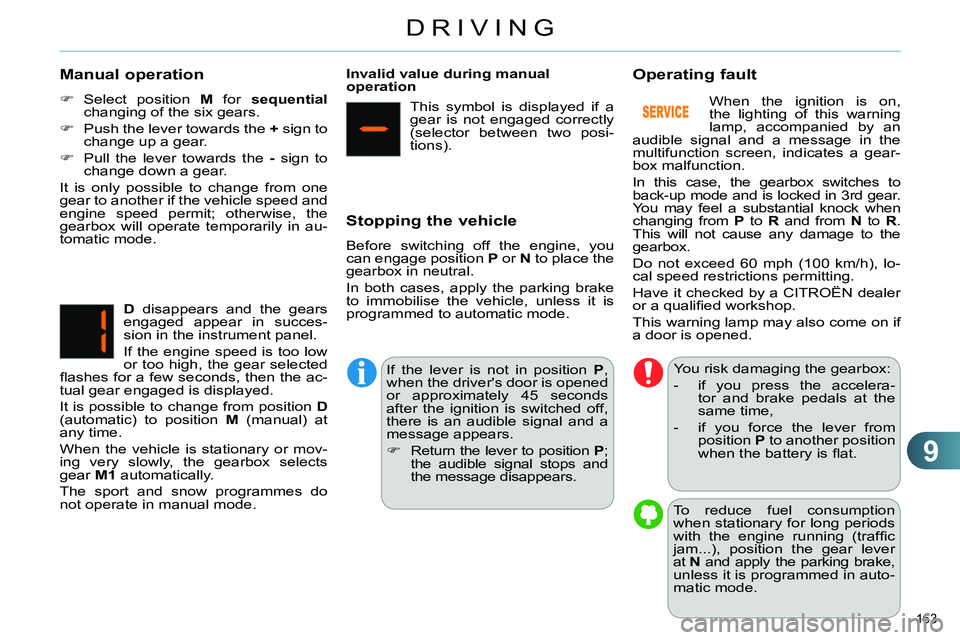
D
disappears and the gears
engaged appear in succes-
sion in the instrument panel.
If the engine speed is too low
or too high, the gear selected
fl ashes for a few seconds, then the ac-
tual gear engaged is displayed.
It is possible to change from position D
(automatic) to position M
(manual) at
any time.
When the vehicle is stationary or mov-
ing very slowly, the gearbox selects
gear M1
automatically.
The sport and snow programmes do
not operate in manual mode.
Invalid value during manual
operation
This symbol is displayed if a
gear is not engaged correctly
(selector between two posi-
tions).
Stopping the vehicle
Before switching off the engine, you
can engage position P
or N
to place the
gearbox in neutral.
In both cases, apply the parking brake
to immobilise the vehicle, unless it is
programmed to automatic mode.
If the lever is not in position P
,
when the driver's door is opened
or approximately 45 seconds
after the ignition is switched off,
there is an audible signal and a
message appears.
Return the lever to position P
;
the audible signal stops and
the message disappears.
You risk damaging the gearbox:
- if you press the accelera-
tor and brake pedals at the
same time,
- if you force the lever from
position P
to another position
when the battery is fl at. When the ignition is on,
the lighting of this warning
lamp, accompanied by an
audible signal and a message in the
multifunction screen, indicates a gear-
box malfunction.
In this case, the gearbox switches to
back-up mode and is locked in 3rd gear.
You may feel a substantial knock when
changing from P
to R
and from N
to R
.
This will not cause any damage to the
gearbox.
Do not exceed 60 mph (100 km/h), lo-
cal speed restrictions permitting.
Have it checked by a CITROËN dealer
or a qualifi ed workshop.
This warning lamp may also come on if
a door is opened.
Operating fault
To reduce fuel consumption
when stationary for long periods
with the engine running (traffi c
jam...), position the gear lever
at N
and apply the parking brake,
unless it is programmed in auto-
matic mode.
Page 167 of 340
9
DRIVING
165
GEAR SHIFT INDICATOR
System which reduces fuel consump-
tion by advising the driver to change up.
With an electronic gearbox, the system
is only active in manual mode.
Operation
Depending on the driving situation and
your vehicle's equipment, the system
may advise you to skip one (or more)
gear(s). You can follow this instruc-
tion without engaging the intermediate
gears.
The gear engagement recommenda-
tions must not be considered compulso-
ry. In fact, the confi guration of the road,
the amount of traffi c and safety remain
determining factors when choosing the
best gear. Therefore, the driver remains
responsible for deciding whether or not
to follow the advice given by the system.
This function cannot be deactivated.
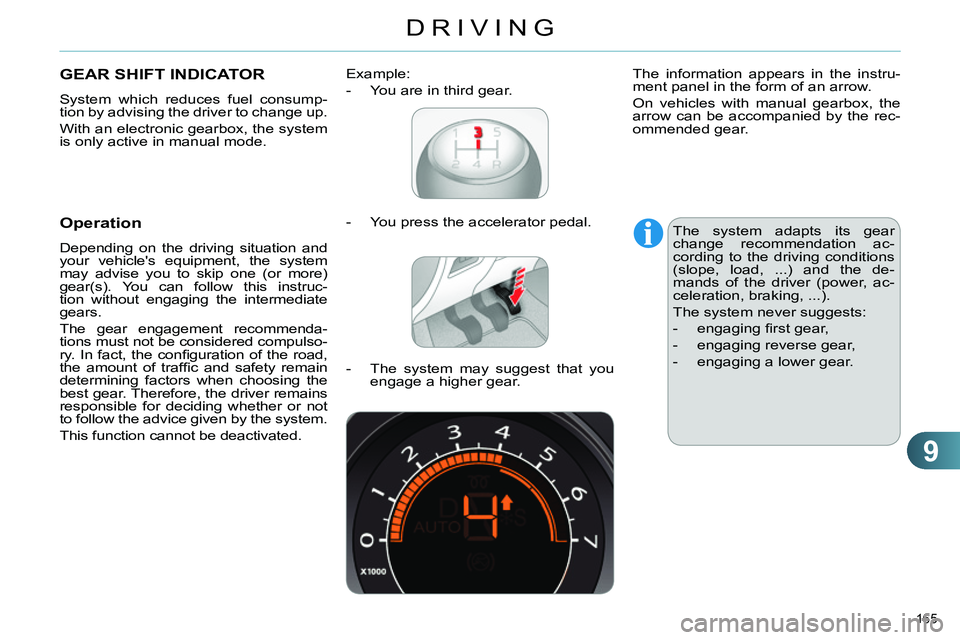
- You press the accelerator pedal.
Example:
- You are in third gear.
- The system may suggest that you
engage a higher gear.
The information appears in the instru-
ment panel in the form of an arrow.
On vehicles with manual gearbox, the
arrow can be accompanied by the rec-
ommended gear.
The system adapts its gear
change recommendation ac-
cording to the driving conditions
(slope, load, ...) and the de-
mands of the driver (power, ac-
celeration, braking, ...).
The system never suggests:
- engaging fi rst gear,
- engaging reverse gear,
- engaging a lower gear.
Page 168 of 340
9
DRIVING
166
TYRE UNDER-INFLATION
DETECTION
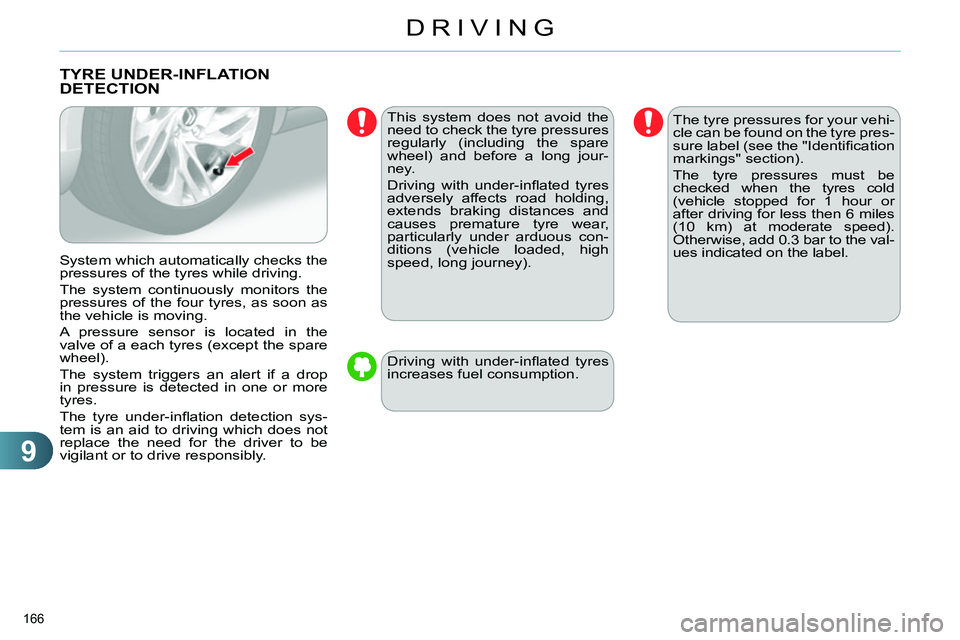
System which automatically checks the
pressures of the tyres while driving.
The system continuously monitors the
pressures of the four tyres, as soon as
the vehicle is moving.
A pressure sensor is located in the
valve of a each tyres (except the spare
wheel).
The system triggers an alert if a drop
in pressure is detected in one or more
tyres.
The tyre under-infl ation detection sys-
tem is an aid to driving which does not
replace the need for the driver to be
vigilant or to drive responsibly.
This system does not avoid the
need to check the tyre pressures
regularly (including the spare
wheel) and before a long jour-
ney.
Driving with under-infl ated tyres
adversely affects road holding,
extends braking distances and
causes premature tyre wear,
particularly under arduous con-
ditions (vehicle loaded, high
speed, long journey).
Driving with under-infl ated tyres
increases fuel consumption.
The tyre pressures for your vehi-
cle can be found on the tyre pres-
sure label (see the "Identifi cation
markings" section).
The tyre pressures must be
checked when the tyres cold
(vehicle stopped for 1 hour or
after driving for less then 6 miles
(10 km) at moderate speed).
Otherwise, add 0.3 bar to the val-
ues indicated on the label.
Page 170 of 340
9
DRIVING
168
STOP & START
The Stop & Start system puts the en-
gine temporarily into standby - STOP
mode - during stops in the traffi c (red
lights, traffi c jams, or other...). The en-
gine restarts automatically - START
mode - as soon as you want to move
off. The restart takes place instantly,
quickly and silently.
Perfect for urban use, the Stop & Start
system reduces fuel consumption and
exhaust emissions as well as the noise
level when stationary.
Operation
Going into engine STOP mode
The "ECO"
warning lamp comes on
in the instrument panel and the en-
gine goes into standby automatically:
- with a manual gearbox
, at speeds
below 12 mph (20 km/h), when you
put the gear lever into neutral and
release the clutch pedal, If your vehicle is fi tted with
the system, a time coun-
ter calculates the sum of
the periods in STOP mode
d uring a journey. It resets itself to zero
every time the ignition is switched on
with the key.
- with an electronic gearbox
, at a
speed below 5 mph (8 km/h), when
you press the brake pedal or put the
gear lever into position N
. With an electronic gearbox, for
your comfort during parking
maoeuvres, STOP mode is not
available for a few seconds after
coming out of reverse gear.
STOP mode does not affect the
functionality of the vehicle, such
as braking, power steering, for
example.
Special cases: STOP mode
unavailable
STOP mode is not invoked when:
- the driver's door is open,
- the driver's seat belt is not fastened,
- the vehicle has not exceeded 6 mph
(10 km/h) since the last engine start
using the key,
- the electric parking brake is applied
or being applied,
- the engine is needed to maintain a
comfortable temperature in the pas-
senger compartment,
- demisting is active,
- some special conditions (battery
charge, engine temperature, brak-
ing assistance, ambient tempera-
ture...) where the engine is needed
to assure control of a system.
In this case, the "ECO"
warn-
ing lamp fl ashes for a few sec-
onds, then goes off. Never refuel with the engine in
STOP mode; you must switch off
the ignition with the key.
This operation is perfectly normal.