engine CITROEN C4 DAG 2013 Repair Manual
[x] Cancel search | Manufacturer: CITROEN, Model Year: 2013, Model line: C4 DAG, Model: CITROEN C4 DAG 2013Pages: 340, PDF Size: 28.95 MB
Page 166 of 340
9
DRIVING
164
HILL START ASSIST
System which keeps your vehicle im-
mobilised temporarily (approximately
2 seconds) when starting on a gradi-
ent, the time it takes to move your foot
from the brake pedal to the accelerator
pedal.
This function is only active when:
- the vehicle is completely stationary,
with your foot on the brake pedal,
- when certain conditions of gradient
are met,
- with the driver’s door closed.
The hill start assist function cannot be
deactivated.
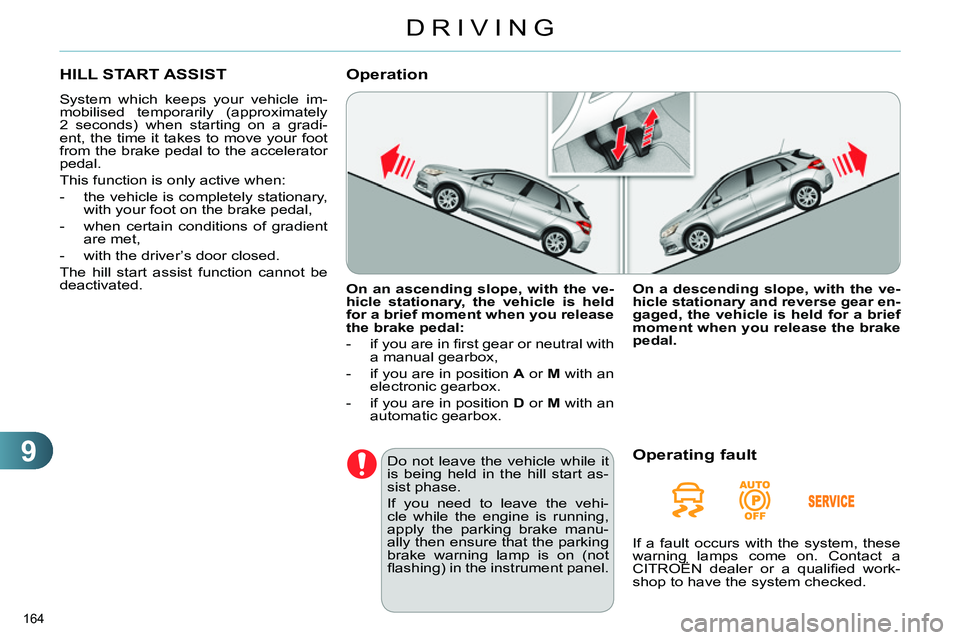
On an ascending slope, with the ve-
hicle stationary, the vehicle is held
for a brief moment when you release
the brake pedal:
- if you are in fi rst gear or neutral with
a manual gearbox,
- if you are in position A
or M
with an
electronic gearbox.
- if you are in position D
or M
with an
automatic gearbox.
Operation
Do not leave the vehicle while it
is being held in the hill start as-
sist phase.
If you need to leave the vehi-
cle while the engine is running,
apply the parking brake manu-
ally then ensure that the parking
brake warning lamp is on (not
fl ashing) in the instrument panel.
On a descending slope, with the ve-
hicle stationary and reverse gear en-
gaged, the vehicle is held for a brief
moment when you release the brake
pedal.
Operating fault
If a fault occurs with the system, these
warning lamps come on. Contact a
CITROËN dealer or a qualifi ed work-
shop to have the system checked.
Page 170 of 340
9
DRIVING
168
STOP & START
The Stop & Start system puts the en-
gine temporarily into standby - STOP
mode - during stops in the traffi c (red
lights, traffi c jams, or other...). The en-
gine restarts automatically - START
mode - as soon as you want to move
off. The restart takes place instantly,
quickly and silently.
Perfect for urban use, the Stop & Start
system reduces fuel consumption and
exhaust emissions as well as the noise
level when stationary.
Operation
Going into engine STOP mode
The "ECO"
warning lamp comes on
in the instrument panel and the en-
gine goes into standby automatically:
- with a manual gearbox
, at speeds
below 12 mph (20 km/h), when you
put the gear lever into neutral and
release the clutch pedal, If your vehicle is fi tted with
the system, a time coun-
ter calculates the sum of
the periods in STOP mode
d uring a journey. It resets itself to zero
every time the ignition is switched on
with the key.
- with an electronic gearbox
, at a
speed below 5 mph (8 km/h), when
you press the brake pedal or put the
gear lever into position N
. With an electronic gearbox, for
your comfort during parking
maoeuvres, STOP mode is not
available for a few seconds after
coming out of reverse gear.
STOP mode does not affect the
functionality of the vehicle, such
as braking, power steering, for
example.
Special cases: STOP mode
unavailable
STOP mode is not invoked when:
- the driver's door is open,
- the driver's seat belt is not fastened,
- the vehicle has not exceeded 6 mph
(10 km/h) since the last engine start
using the key,
- the electric parking brake is applied
or being applied,
- the engine is needed to maintain a
comfortable temperature in the pas-
senger compartment,
- demisting is active,
- some special conditions (battery
charge, engine temperature, brak-
ing assistance, ambient tempera-
ture...) where the engine is needed
to assure control of a system.
In this case, the "ECO"
warn-
ing lamp fl ashes for a few sec-
onds, then goes off. Never refuel with the engine in
STOP mode; you must switch off
the ignition with the key.
This operation is perfectly normal.
Page 171 of 340
9
DRIVING
169
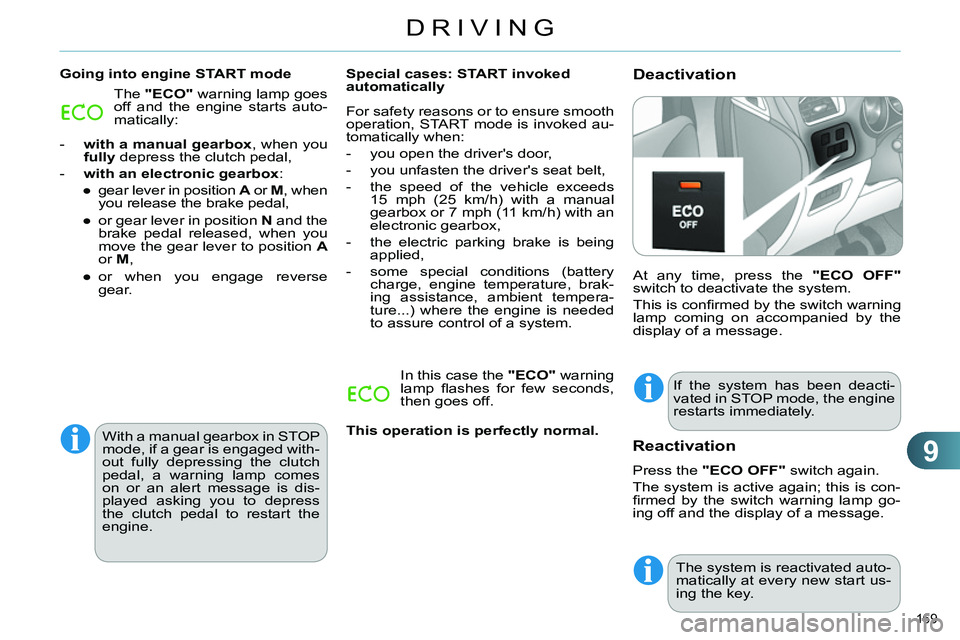
Deactivation
Going into engine START mode
At any time, press the "ECO OFF"
switch to deactivate the system.
This is confi rmed by the switch warning
lamp coming on accompanied by the
display of a message.
Special cases: START invoked
automatically
If the system has been deacti-
vated in STOP mode, the engine
restarts immediately. The "ECO"
warning lamp goes
off and the engine starts auto-
matically:
- with a manual gearbox
, when you
fully
depress the clutch pedal,
- with an electronic gearbox
:
●
gear lever in position A
or M
, when
you release the brake pedal,
●
or gear lever in position N
and the
brake pedal released, when you
move the gear lever to position A
or M
,
●
or when you engage reverse
gear.
For safety reasons or to ensure smooth
operation, START mode is invoked au-
tomatically when:
- you open the driver's door,
- you unfasten the driver's seat belt,
- the speed of the vehicle exceeds
15 mph (25 km/h) with a manual
gearbox or 7 mph (11 km/h) with an
electronic gearbox,
- the electric parking brake is being
applied,
- some special conditions (battery
charge, engine temperature, brak-
ing assistance, ambient tempera-
ture...) where the engine is needed
to assure control of a system.
In this case the "ECO"
warning
lamp fl ashes for few seconds,
then goes off.
With a manual gearbox in STOP
mode, if a gear is engaged with-
out fully depressing the clutch
pedal, a warning lamp comes
on or an alert message is dis-
played asking you to depress
the clutch pedal to restart the
engine.
Reactivation
Press the "ECO OFF"
switch again.
The system is active again; this is con-
fi rmed by the switch warning lamp go-
ing off and the display of a message.
The system is reactivated auto-
matically at every new start us-
ing the key.
This operation is perfectly normal.
Page 186 of 340
10
CHECKS
184
TOTAL & CITROËN
Partners in performance and
protecting the environment
Innovation in the search for
performance
For over 40 year, the TOTAL Research and
Development departments have developed
for CITROËN, lubricants to match the
latest technical innovations on CITROËN
vehicles, both for competition and for
everyday motoring.
For you, this is an assurance that you will
obtain of the best performance for your
engine.
Optimum protection for your
engine
By having your CITROËN vehicle
serviced with TOTAL lubricants,
you are contributing towards im-
proving the life and performances
of your engine, while also protect-
ing the environment.
prefers
Page 187 of 340
10
CHECKS
185
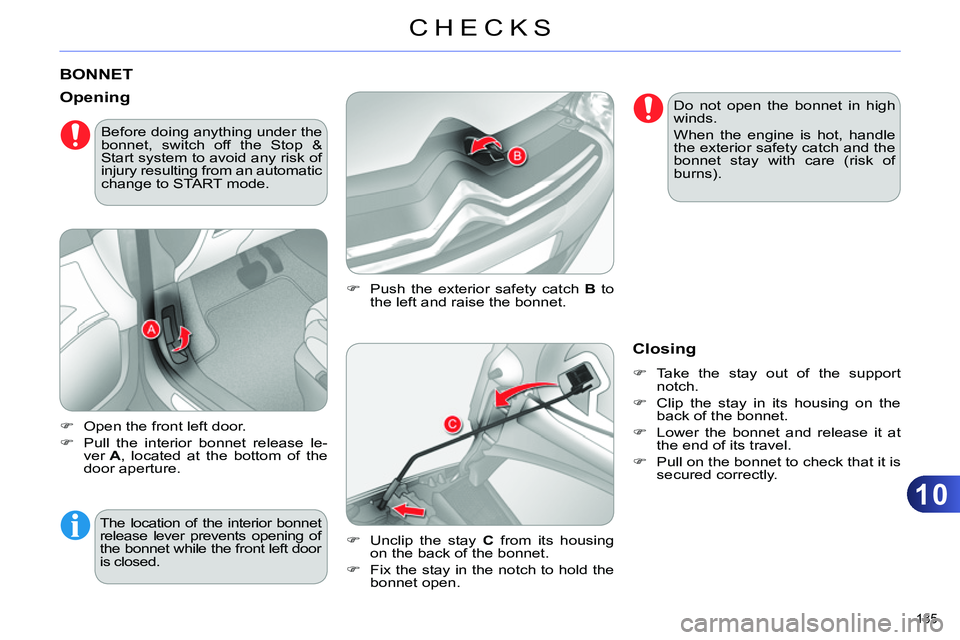
BONNET
Push the exterior safety catch B
to
the left and raise the bonnet.
Opening
Open the front left door.
Pull the interior bonnet release le-
ver A
, located at the bottom of the
door aperture.
Unclip the stay C
from its housing
on the back of the bonnet.
Fix the stay in the notch to hold the
bonnet open.
The location of the interior bonnet
release lever prevents opening of
the bonnet while the front left door
is closed.
Closing
Take the stay out of the support
notch.
Clip the stay in its housing on the
back of the bonnet.
Lower the bonnet and release it at
the end of its travel.
Pull on the bonnet to check that it is
secured correctly.
Do not open the bonnet in high
winds.
When the engine is hot, handle
the exterior safety catch and the
bonnet stay with care (risk of
burns).
Before doing anything under the
bonnet, switch off the Stop &
Start system to avoid any risk of
injury resulting from an automatic
change to START mode.
Page 188 of 340
10
CHECKS
186
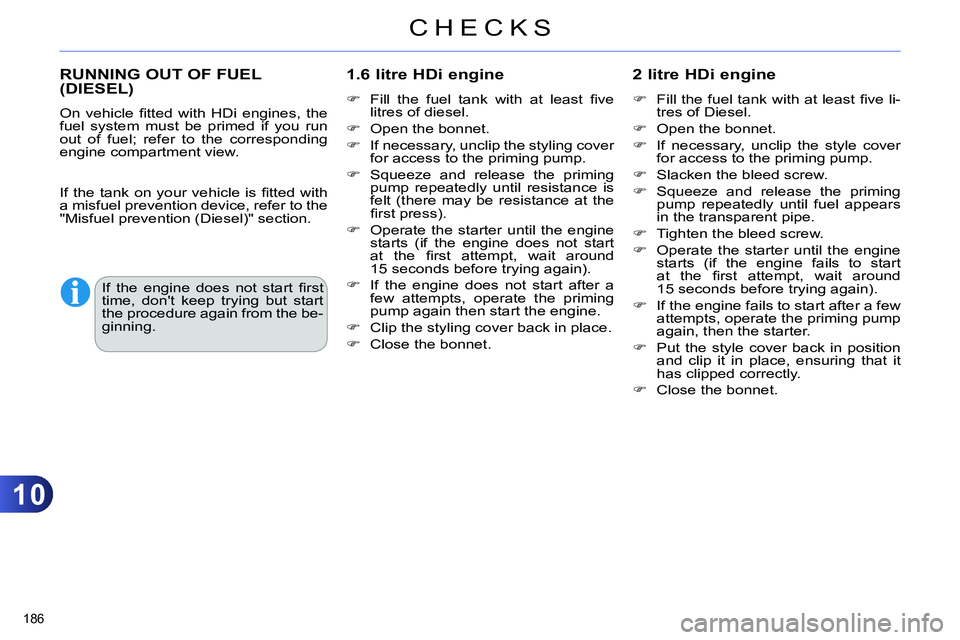
RUNNING OUT OF FUEL
(DIESEL)
1.6 litre HDi engine
Fill the fuel tank with at least fi ve
litres of diesel.
Open the bonnet.
If necessary, unclip the styling cover
for access to the priming pump.
Squeeze and release the priming
pump repeatedly until resistance is
felt (there may be resistance at the
fi rst press).
Operate the starter until the engine
starts (if the engine does not start
at the fi rst attempt, wait around
15 seconds before trying again).
If the engine does not start after a
few attempts, operate the priming
pump again then start the engine.
Clip the styling cover back in place.
Close the bonnet.
2 litre HDi engine
Fill the fuel tank with at least fi ve li-
tres of Diesel.
Open the bonnet.
If necessary, unclip the style cover
for access to the priming pump.
Slacken the bleed screw.
Squeeze and release the priming
pump repeatedly until fuel appears
in the transparent pipe.
Tighten the bleed screw.
Operate the starter until the engine
starts (if the engine fails to start
at the fi rst attempt, wait around
15 seconds before trying again).
If the engine fails to start after a few
attempts, operate the priming pump
again, then the starter.
Put the style cover back in position
and clip it in place, ensuring that it
has clipped correctly.
Close the bonnet.
If the engine does not start fi rst
time, don't keep trying but start
the procedure again from the be-
ginning.
On vehicle fi tted with HDi engines, the
fuel system must be primed if you run
out of fuel; refer to the corresponding
engine compartment view.
If the tank on your vehicle is fi tted with
a misfuel prevention device, refer to the
"Misfuel prevention (Diesel)" section.
Page 189 of 340
10
CHECKS
187
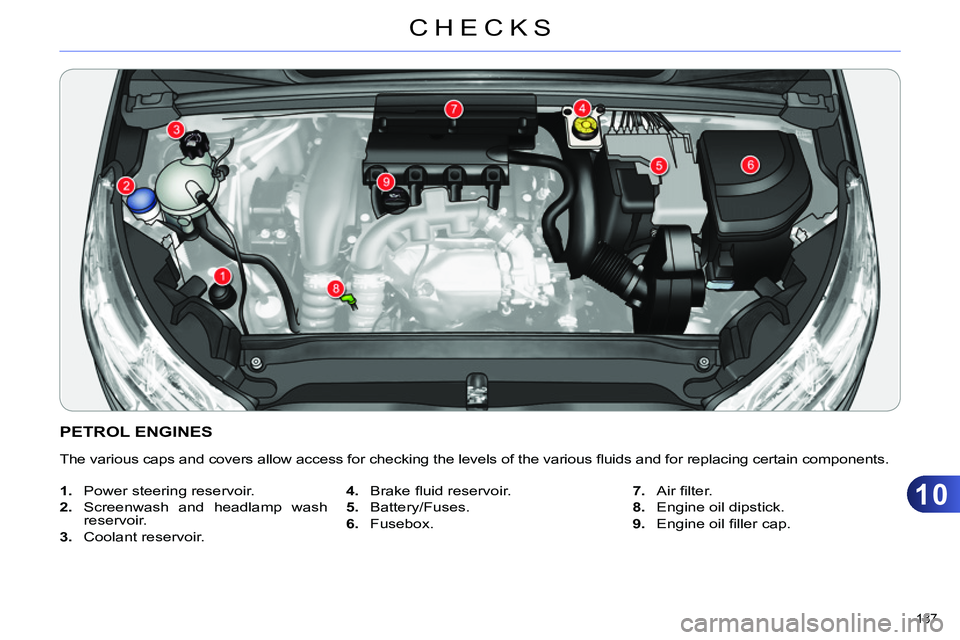
PETROL ENGINES
The various caps and covers allow access for checking the levels of the various fl uids and for replacing certain components.
1.
Power steering reservoir.
2.
Screenwash and headlamp wash
reservoir.
3.
Coolant reservoir.
4.
Brake fl uid reservoir.
5.
Battery/Fuses.
6.
Fusebox.
7.
Air fi lter.
8.
Engine oil dipstick.
9.
Engine oil fi ller cap.
Page 190 of 340
10
CHECKS
188
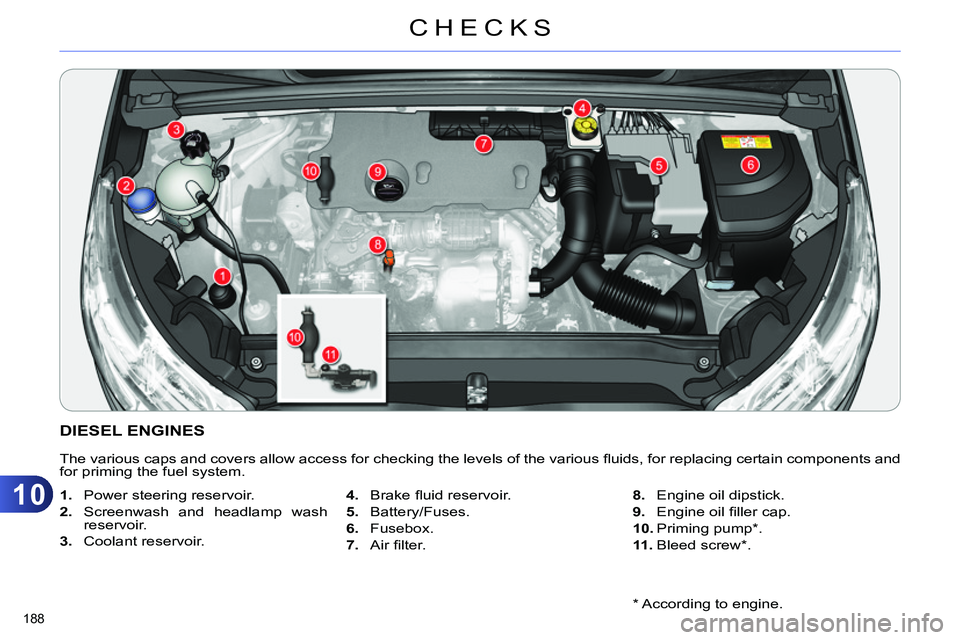
*
According to engine.
DIESEL ENGINES
The various caps and covers allow access for checking the levels of the various fl uids, for replacing certain components and
for priming the fuel system.
1.
Power steering reservoir.
2.
Screenwash and headlamp wash
reservoir.
3.
Coolant reservoir.
4.
Brake fl uid reservoir.
5.
Battery/Fuses.
6.
Fusebox.
7.
Air fi lter.
8.
Engine oil dipstick.
9.
Engine oil fi ller cap.
10.
Priming pump * .
11 .
Bleed screw * .
Page 191 of 340
10
CHECKS
189
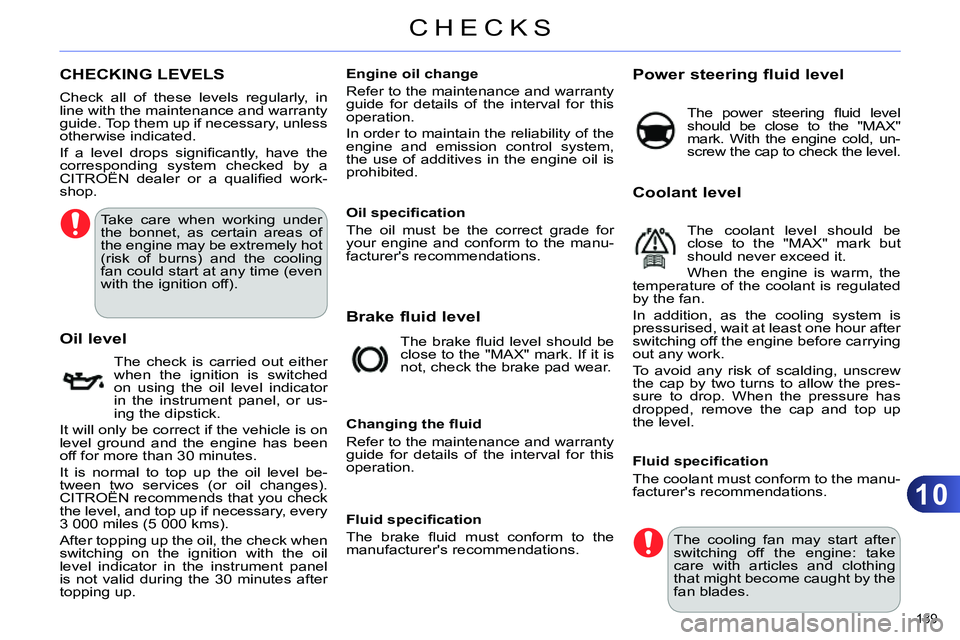
CHECKING LEVELS
Take care when working under
the bonnet, as certain areas of
the engine may be extremely hot
(risk of burns) and the cooling
fan could start at any time (even
with the ignition off).
The check is carried out either
when the ignition is switched
on using the oil level indicator
in the instrument panel, or us-
ing the dipstick.
It will only be correct if the vehicle is on
level ground and the engine has been
off for more than 30 minutes.
It is normal to top up the oil level be-
tween two services (or oil changes).
CITROËN recommends that you check
the level, and top up if necessary, every
3 000 miles (5 000 kms).
After topping up the oil, the check when
switching on the ignition with the oil
level indicator in the instrument panel
is not valid during the 30 minutes after
topping up.
Oil level
Engine oil change
Refer to the maintenance and warranty
guide for details of the interval for this
operation.
In order to maintain the reliability of the
engine and emission control system,
the use of additives in the engine oil is
prohibited.
Brake fluid level
Changing the fl uid
Refer to the maintenance and warranty
guide for details of the interval for this
operation.
Fluid specifi cation
The brake fl uid must conform to the
manufacturer's recommendations.
Power steering fluid level
The power steering fl uid level
should be close to the "MAX"
mark. With the engine cold, un-
screw the cap to check the level.
Coolant level
The coolant level should be
close to the "MAX" mark but
should never exceed it.
When the engine is warm, the
temperature of the coolant is regulated
by the fan.
In addition, as the cooling system is
pressurised, wait at least one hour after
switching off the engine before carrying
out any work.
To avoid any risk of scalding, unscrew
the cap by two turns to allow the pres-
sure to drop. When the pressure has
dropped, remove the cap and top up
the level.
Fluid specifi cation
The coolant must conform to the manu-
facturer's recommendations.
Check all of these levels regularly, in
line with the maintenance and warranty
guide. Top them up if necessary, unless
otherwise indicated.
If a level drops signifi cantly, have the
corresponding system checked by a
CITROËN dealer or a qualifi ed work-
shop.
Oil specifi cation
The oil must be the correct grade for
your engine and conform to the manu-
facturer's recommendations.
The cooling fan may start after
switching off the engine: take
care with articles and clothing
that might become caught by the
fan blades.
The brake fl uid level should be
close to the "MAX" mark. If it is
not, check the brake pad wear.
Page 192 of 340
10
CHECKS
190
Used products
Avoid prolonged contact of used
oil or fl uids with the skin.
Most of these fl uids are harmful
to health or indeed very corro-
sive.
Do not discard used oil or fl uids
into sewers or onto the ground.
Take used oil to a CITROËN
dealer or a qualifi ed workshop
(France) or to an authorised
waste disposal site.
Additive level (Diesel with
particle emissions filter)
The additive reservoir low level is indi-
cated by:
Topping up
The reservoir must be topped up with-
out delay by a CITROËN dealer or a
qualifi ed workshop.
- fi xed illumination of the par-
ticle emissions fi lter warning
lamp, accompanied by an au-
dible signal and a message
that the particle emissions
fi lter additive level is too low.
Screenwash / headlamp wash
fluid level
Specifi cation of the fl uid
To ensure optimum cleaning and to
avoid freezing, the fl uid should never be
topped up or replaced by plain water.
In wintry conditions, the use of a fl uid
with an ethyl alcohol or methanol base
is recommended.
To check the level or top up
the fl uid on vehicle fi tted with
headlamp washers, immobilise
the vehicle and switch of the
engine.
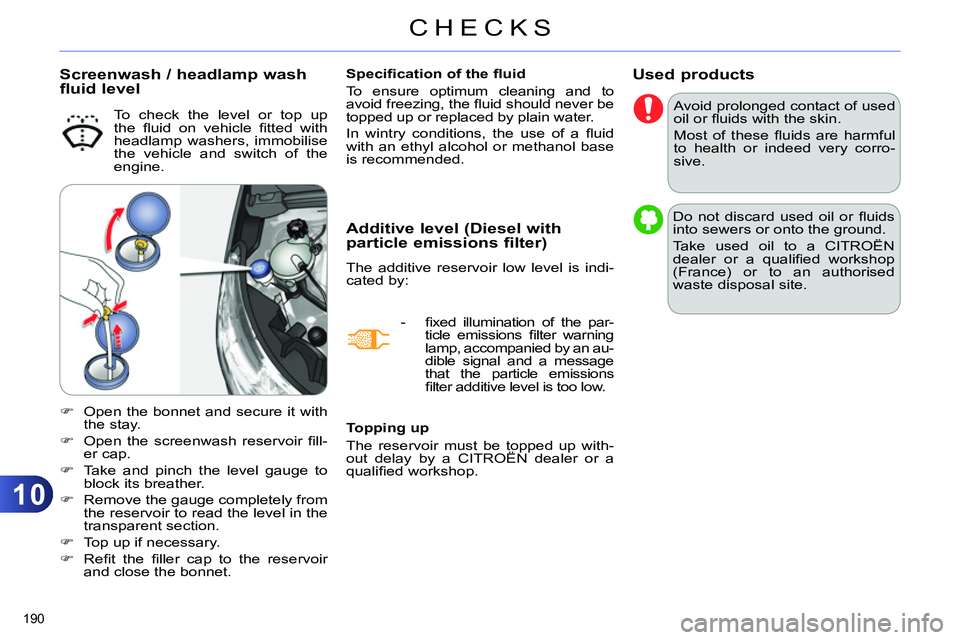
Open the bonnet and secure it with
the stay.
Open the screenwash reservoir fi ll-
er cap.
Take and pinch the level gauge to
block its breather.
Remove the gauge completely from
the reservoir to read the level in the
transparent section.
Top up if necessary.
Refi t the fi ller cap to the reservoir
and close the bonnet.