instrument panel CITROEN C4 PICASSO 2011 User Guide
[x] Cancel search | Manufacturer: CITROEN, Model Year: 2011, Model line: C4 PICASSO, Model: CITROEN C4 PICASSO 2011Pages: 352, PDF Size: 10.66 MB
Page 100 of 352
Downloaded from www.Manualslib.com manuals search engine V
98
VISIBILITY
OF XENON HEADLAMPS
This system adjusts the height of the
xenon headlamp beams automati-
cally and when stationary, according
to the load in the vehicle, so as to
avoid causing a nuisance to other
road user.
If a malfunction occurs,
this warning lamp is dis-
played in the instrument
panel, accompanied by
an audible signal and a message in
the screen.
The system then places your head-
lamps in the lowest position.
Do not touch the xenon bulbs.
Contact a CITROËN dealer or a
qualifi ed workshop.
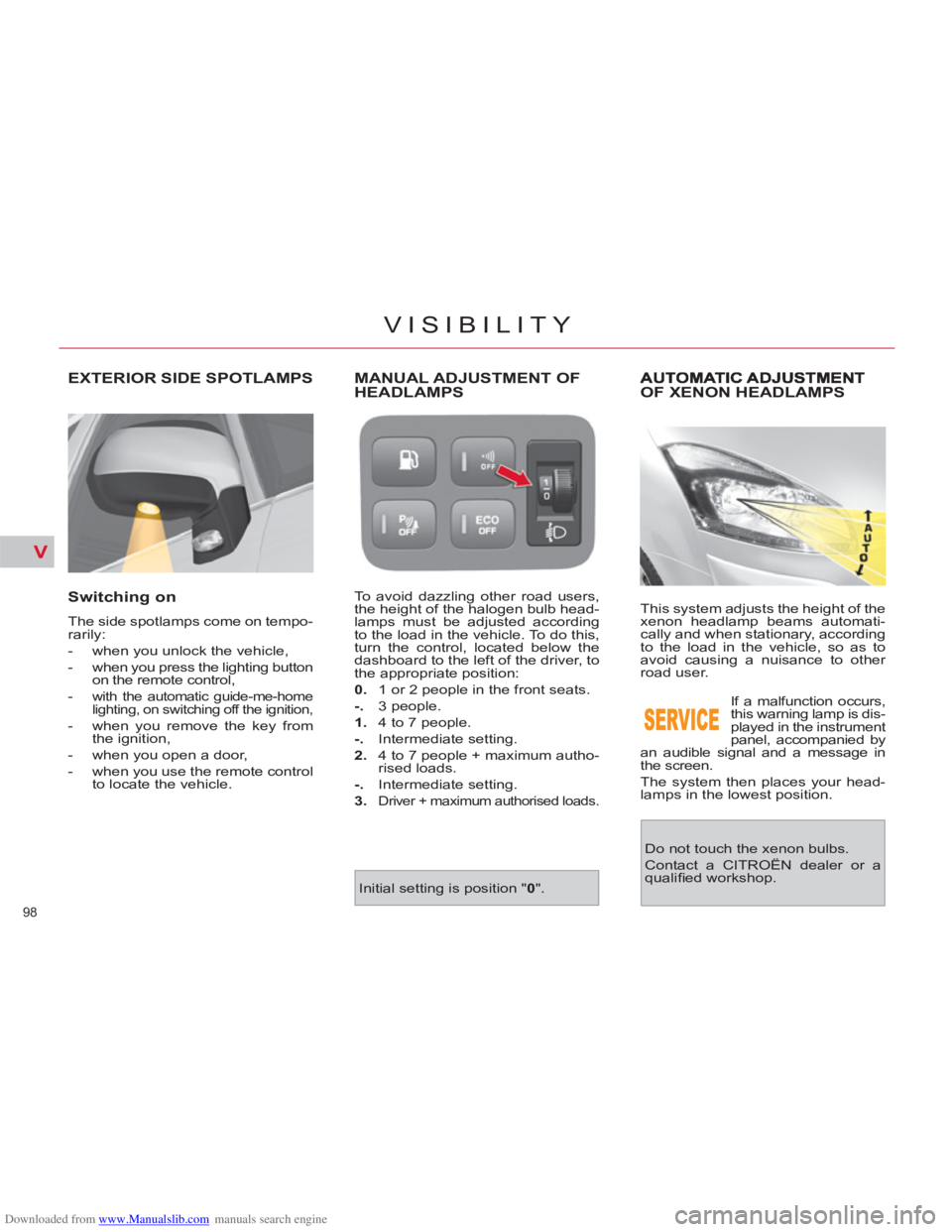
MANUAL ADJUSTMENT OFHEADLAMPS
To avoid dazzling other road users,
the height of the halogen bulb head-
lamps must be adjusted according
to the load in the vehicle. To do this,
turn the control, located below the
dashboard to the left of the driver, to
the appropriate position:
0.
1 or 2 people in the front seats.
-.
3 people.
1.
4 to 7 people.
-.
Intermediate setting.
2.
4 to 7 people + maximum autho-
rised loads.
-.
Intermediate setting.
3.
Driver + maximum authorised loads.
Initial setting is position " 0
".
EXTERIOR SIDE SPOTLAMPS
Switching on
The side spotlamps come on tempo-
rarily:
- when you unlock the vehicle,
- when you press the lighting button
on the remote control,
-
with the automatic guide-me-home
lighting, on switching off the ignition,
- when you remove the key from
the ignition,
- when you open a door,
- when you use the remote control
to locate the vehicle.
Page 101 of 352

Downloaded from www.Manualslib.com manuals search engine V
99
VISIBILITY
DIRECTIONAL LIGHTING
When the dipped or main beam
headlamps are on, this function en-
ables the light beam to follow the di-
rection of the road.
The use of this function, coupled
with the xenon headlamps only,
considerably improves the quality of
your lighting when cornering.
with directional lighting
without directional lighting
Programming
The function is activat-
ed or deactivated via
the multifunction screen
confi guration menu.
Operating fault
If a malfunction occurs, this
warning lamp fl ashes on the
instrument panel, accompa-
nied by a message on the
multifunction screen.
Contact a CITROËN dealer or a
qualifi ed workshop.
When stationary or moving at very
low speed or when reverse gear is
engaged, the system is inactive.
The status of the system remains
in the memory when the ignition is
switched off.
On vehicles fi tted with daytime run-
ning lamps, the function is activated if
the lighting stalk is in the "AUTO"
or
"Dipped/main beam headlamps"
position. In position "0"
, the function
is not activated.
Page 129 of 352

Downloaded from www.Manualslib.com manuals search engine VIII
127
SAFETY
TYRE UNDER-INFLATION DETECTION
Sensors fi tted in each valve check
the tyre pressure during driving and
trigger a warning in the event of
malfunction (speed above 12 mph
(20 km/h)).
Under-infl ated tyre The tyre under-infl ation detection
system is an aid to driving which
does not replace the vigilance or
responsibility of the driver.
Puncture
The service warning lamp
comes on in the instrument
panel, accompanied by an
audible signal and a mes-
sage on the multifunction screen lo-
cating the wheel concerned.
Check the tyre pressures as soon as
possible. This check must be carried
out when the tyres are cold. The STOP
warning lamp
comes on in the instrument
panel, accompanied by an
audible signal and a mes-
sage on the multifunction screen lo-
cating the wheel concerned.
Stop immediately, avoiding any sud-
den movement of the steering wheel
and the brakes.
Change the damaged wheel (punc-
tured or very defl ated tyre), and
have the tyre pressure checked as
soon as possible.
Sensor(s) not detected or faulty
The service warning lamp
comes on in the instrument
panel, accompanied by an
audible signal and a mes-
sage on the multifunction screen
locating the wheel or wheels which
are not detected or indicating a fault
in the system.
Have the faulty sensor(s) checked
by a CITROËN dealer or a qualifi ed
workshop. All repairs and changing of tyres
on a wheel fi tted with this system
must be carried out by a CITROËN
dealer or a qualifi ed workshop.
If, when changing a tyre, you in-
stall a wheel which is not detected
by your vehicle (example: fi tting
of snow tyres), you must have the
system reinitialised by a CITROËN
dealer or a qualifi ed workshop.
This system does not avoid the
need to have the tyre pressures
checked regularly (refer to the
"Technical data - Identifi cation
markings" section) to ensure that
the optimum dynamic performance
of the vehicle is maintained and
prevent premature wear of the
tyres, particularly in arduous driv-
ing conditions (heavy load, high
speed).
The tyre pressures must be
checked cold, at least once a
month. Remember to check the
pressure of the spare wheel.
The tyre under-infl ation detection
system may experience temporary
interference due to electro-magnetic
signals on a frequency close to that
used by the system.
This message is also displayed
when one of the wheels is away
from the vehicle (being repaired) or
when one or more wheels without a
sensor are fi tted.
The spare wheel is not fi tted with a
sensor.
Page 131 of 352

Downloaded from www.Manualslib.com manuals search engine VIII
129
SAFETY
TRAJECTORY CONTROL
SYSTEMS
Anti-slip regulation (ASR)
and electronic stability
programme (ESP)
The anti-slip regulation (also known
as Traction Control) optimises trac-
tion to prevent skidding of the wheels,
by acting on the brakes of the driving
wheels and on the engine.
The electronic stability programme acts
on the brake of one or more wheels
and on the engine to keep the vehicle
on the trajectory required by the driver,
within the limits of the laws of physics.
Deactivation
In exceptional conditions (starting a
vehicle which is bogged down, stuck
in snow, on soft ground...), it may be
advisable to deactivate the ASR and
ESP systems, so that the wheels
can move freely and regain grip.
)
Press the "ESP OFF"
button, lo-
cated in the centre of the dash-
board.
If this warning lamp comes
on in the instrument panel
and the indicator lamp on the
button comes on, this indi-
cates that the ASR and ESP
systems are deactivated. This is indicated by fl ashing
of this warning lamp in the
instrument panel.
Activation
These systems are activated auto-
matically each time the vehicle is
started.
They come into operation in the event
of a grip or trajectory problem.
Intelligent Traction Control
system *
Your vehicle has a system to help
driving on snow.
This automatic system continuously
checks for situations of diffi cult sur-
face adhesion that could make it dif-
fi cult to move off or make progress
on deep fresh snow or compacted
snow.
In these situations, the system takes
over from the ASR
system by opti-
mising the amount of wheel slip to
provide the best traction and trajec-
tory control, even without snow tyres
and with or without chains.
In extremely severe conditions (snow
on top of ice, sand, deep mud…), it
can be useful to deactivate the ESP/
ASR
systems to allow a degree of
wheel spin and so recover grip.
*
Depending on engine type.
Page 138 of 352

Downloaded from www.Manualslib.com manuals search engine VIII
136
SAFETY
Deactivation
This warning lamp comes on
in the instrument panel when
the ignition is on and until the
airbag is reactivated.
To ensure the safety of your child,
it is imperative that the passenger
airbag is deactivated when you in-
stall a "rearwards-facing" child seat
on the front passenger seat.
Otherwise, the child would risk be-
ing seriously injured or killed if the
airbag were deployed.
Activation
When you remove the child seat,
turn switch 1
to the "ON"
position to
reactivate the airbag and so ensure
the safety of your front passenger in
the event of an impact.
Operating fault
If this warning lamp comes
on on the instrument panel,
accompanied by an audible
warning and a message in
the multifunction screen, contact a
CITROËN dealer or a qualifi ed work-
shop to have the system checked. The
airbags may no longer be deployed in
the event of a serious impact. Only the front passenger's airbag
can be deactivated:
)
with the ignition off
, insert the
key in the passenger airbag de-
activation switch 1
,
)
turn it to the "OFF"
position,
)
then, remove the key keeping
the switch in this position.
If this warning lamp fl ashes,
contact a CITROËN dealer
or a qualifi ed workshop.
If both airbag warning lamps come
on continuously, do not install a
"rearwards-facing" child seat on
the front passenger seat.
Have it checked by a CITROËN
dealer or a qualifi ed workshop.
Page 139 of 352

Downloaded from www.Manualslib.com manuals search engine VIII
137
SAFETY
*
According to country.
Lateral airbags *
System which protects the driver
and front passenger in the event of
a serious side impact in order to limit
the risk of injury to the chest.
Each lateral airbag is fi tted in the
front seat back frame, on the door
side.
Operation
It is deployed unilaterally in the
event of a serious side impact ap-
plied to all or part of the side impact
zone B
, perpendicular to the longi-
tudinal centreline of the vehicle on
a horizontal plane and directed from
the outside towards the inside of the
vehicle.
The lateral airbag infl ates between
the front occupant of the vehicle and
the corresponding door trim panel.
Impact detection zones
A.
Front impact zone.
B.
Side impact zone.
Curtain airbags *
System which protects the driver
and passengers (with the exception
of the rear centre passenger) in the
event of a serious side impact in or-
der to limit the risk of head injuries.
Each curtain airbag is fi tted in the
pillars and the upper part of the pas-
senger compartment.
Operation
It is deployed at the same time as
the corresponding lateral airbag in
the event of a serious side impact
applied to all or part of the side im-
pact zone B
, perpendicular to the
longitudinal centreline of the vehicle
on a horizontal plane and directed
from the outside towards the inside
of the vehicle.
The curtain airbag infl ates between
the front or rear occupant of the ve-
hicle and the windows.
In the event of a minor impact or
bump on the side of the vehicle or
if the vehicle rolls over, the airbag
may not be deployed.
The airbag is not deployed in the
event of a rear or front collision.
If this warning lamp comes
on in the instrument panel,
accompanied by an audible
signal and a message on
the multifunction screen, contact a
CITROËN dealer or a qualifi ed work-
shop to have the system checked. The
airbags may no longer be deployed in
the event of a serious impact.
Operating fault
* According to country.
Page 141 of 352

Downloaded from www.Manualslib.com manuals search engine IX
139
DRIVING
ELECTRIC PARKING BRAKE
The electric parking brake operates
as follows:
- automatic application/release
Application is automatic when
the engine stops, release is au-
tomatic on use of the accelerator
(active by default).
- manual application/release
Manual application/release of
the parking brake is possible
by pulling control lever A
while
pressing the brake pedal.
Manual application
With the vehicle stationary, to apply
the parking brake whether the en-
gine is running or not, pull
control
lever A
.
Manual release
With the ignition on or the engine
running, to release the parking
brake, press on the brake pedal, or
the accelerator, pull then release
control lever A
.
- the warning lamp P
in con-
trol lever A
and in the in-
strument panel going off,
- the display of a message
"Parking brake off" in the multi-
function screen. The application of the parking brake
is confi rmed by:
-
the illumination of the warn-
ing lamp P
in control lever A
and in the instrument panel,
- the display of a message
"Parking brake on" in the multi-
function screen.
When the driver’s door is
opened with the engine run-
ning, a beep is heard and a
message displayed if the parking
brake has not been applied.
Before getting out of the vehicle,
check that the warning lamp P
is
on fi xed in the instrument panel
(not fl ashing). The full application of the parking
brake is confi rmed by:
If you pull control lever A
without pressing the brake
pedal, the parking brake
will not be released and
the "Foot on brake" warn-
ing lamp will come on in
the instrument panel.
Page 142 of 352

Downloaded from www.Manualslib.com manuals search engine IX
140
DRIVING
Automatic application,
engine off
With the vehicle stationary, the park-
ing brake is automatically applied
when the engine is switched off.
The application of the parking brake
is confi rmed by:
-
the illumination of warning
lamp P
in control lever A
and in the instrument panel,
Automatic release
The electric parking brake releases
automatically and progressively
when you press the accelerator:
)
Manual gearbox
(fi rst gear or
reverse gear engaged): press
down fully on the clutch pedal
then press on the accelerator
pedal and move off.
)
Automatic gearbox
: accelerate
with the selector in position D
, M
or R
.
)
Electronic gearbox
: accelerate
with the selector in position A
, M
or R
.
Full release of the parking brake is
confi rmed by:
- the warning lamp P
in con-
trol lever A
and in the in-
strument panel going off,
- the display of a message "Parking
brake off" in the multifunction
screen.
When stationary, with the engine
running, do not press the acceler-
ator pedal unnecessarily, as you
may release the parking brake.
Maximum application
If necessary, you can use maximum
application
of the parking brake. It
is obtained by means of a long pull
on control lever A
, until you see the
message "Parking brake on" and an
audible signal is heard.
Maximum application is essential:
- when towing a caravan or a trail-
er, if the automatic functions are
activated but you are applying
the parking brake manually,
- when the gradient you are parked
on is variable in its effect (e.g. on
a ferry, in a lorry, during towing),
- when towing, when loaded or
when parking on a gradient, turn
the front wheels towards the
pavement and engage a gear
when you park,
- after a maximum application, the
release time will be longer.
Before leaving the vehicle,
check that warning lamp P
in the instrument panel is
on fi xed, not fl ashing.
Never leave a child alone inside the
vehicle with the ignition on, as they
could release the parking brake.
- the display of a message
"Parking brake on" in the multi-
function screen.
The normal operating sound will con-
fi rm to you the application/release of
the electric parking brake.
Page 143 of 352

Downloaded from www.Manualslib.com manuals search engine IX
141
DRIVING
To immobilise the vehicle,
engine running
To immobilise the vehicle when sta-
tionary with the engine running, you
must apply the parking brake manu-
ally by pulling
on control lever A
.
The application of the parking brake
is confi rmed by:
- the illumination of warning
lamp P
in control A
and in
the instrument panel,
- the display of a message
"Parking brake on" in the multi-
function screen.
When the driver’s door is opened, a
beep is heard and a message dis-
played if the parking brake has not
been applied.
Before leaving the vehicle,
check that warning lamp P
in the instrument panel is
on fi xed (not fl ashing).
Particular situations
In certain situations (e.g. starting
the engine), the parking brake can
automatically alter its force. This is
normal operation.
To move your vehicle without start-
ing the engine (towing, etc...), but
with the ignition on
, press the brake
pedal and release the parking brake
by pulling
then releasing
control
lever A
.
The full release of the parking brake
is confi rmed by the warning lamp P
(red) in the instrument panel going
off and the display of a message
"Parking brake off" in the multifunc-
tion screen.
If the parking brake malfunctions
while applied or if the battery
runs
fl at, an emergency release remains
possible.
Activation/Deactivation of the
automatic functions *
The automatic application when
the engine is switched off and the
automatic release when you press
the accelerator can be deactivated.
Activation/deactivation is performed
using the confi guration menu of the
multifunction screen. To do so, se-
lect "Vehicle parameters/Comfort/
Automatic handbrake."
The deactivation of these
functions is confi rmed by the
lighting of this warning lamp
in the instrument panel.
* According to country With the automatic functions deac-
tivated, the application and release
of the parking brake are done manu-
ally.
Page 148 of 352

Downloaded from www.Manualslib.com manuals search engine IX
146
DRIVING
HILL START ASSIST
System which holds your vehicle tem-
porarily (approximately 2 seconds)
when starting on a slope, the time it
takes to move your foot from the brake
pedal to the accelerator pedal.
This function is only active when:
- the vehicle is completely station-
ary, with your foot on the brake
pedal,
- in particular conditions on a
slope,
- with the driver’s door closed.
The hill start assist cannot be deac-
tivated.
Operation
Operating fault
If a malfunction of the system oc-
curs, these warning lamps come
on. Contact a CITROËN dealer or a
qualifi ed workshop to have the sys-
tem checked.
On an ascending slope, with the
vehicle stationary, the vehicle is
held for a brief moment when you
release the brake pedal:
- provided you are in fi rst gear or
neutral on a manual gearbox,
- provided you are in position A
or M
with the electronic gearbox
system,
- provided you are in position D
or
M
on an automatic gearbox.
On a descending slope, with the
vehicle stationary and reverse
gear engaged, the vehicle is held
momentarily when you release
the brake pedal.
Do not exit the vehicle while
it is being held in the hill
start assist phase.
If you need to exit the ve-
hicle with the engine running, man-
ually apply the parking brake and
ensure that the warning lamp P
(red) in the instrument panel is on
(not fl ashing).