roof Citroen C4 PICASSO 2015 2.G Owner's Manual
[x] Cancel search | Manufacturer: CITROEN, Model Year: 2015, Model line: C4 PICASSO, Model: Citroen C4 PICASSO 2015 2.GPages: 420, PDF Size: 10.72 MB
Page 5 of 420
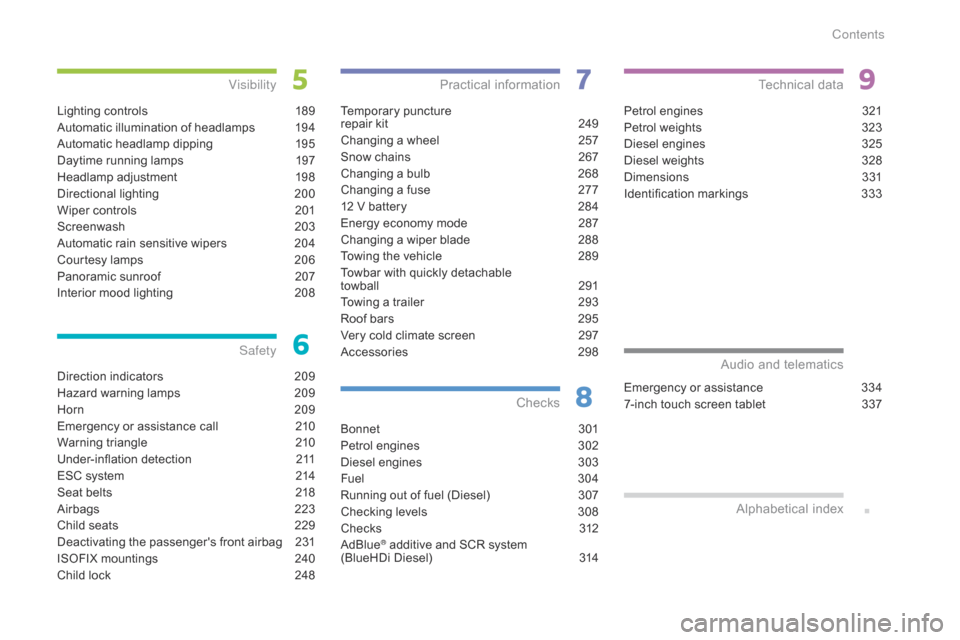
Direction indicators 209
Hazard warning lamps
2
09
Horn
2
09
Emergency
or assistance call
2
10
Warning
triangle
2
10
Under-inflation
d
etection
2
11
ESC
system
2
14
Seat
belts
2
18
Airbags
2
23
Child
seats
2
29
Deactivating
the passenger's front airbag
2
31
ISOFIX
mountings
2
40
Child
lock
2
48
Safety
Temporary puncture
r epair kit 2 49
Changing
a wheel
2
57
Snow
chains
2
67
Changing
a bulb
2
68
Changing
a fuse
2
77
12
V battery
2
84
Energy
economy mode
2
87
Changing
a wiper blade
2
88
Towing
the vehicle
2
89
Towbar
with quickly detachable
towball
2
91
Towing
a trailer
2
93
Roof
bars
2
95
Very
cold climate screen
2
97
Accessories
2
98
Practical information
Bonnet 3 01
Petrol engines
3
02
Diesel
engines
3
03
Fuel
3
0 4
Running
out of fuel (Diesel)
3
07
Checking
levels
3
08
Chec ks
3
12
AdBlue
® additive and SCR system
(
BlueHDi Diesel) 3 14
Checks
Petrol engines 3 21
Petrol weights
3
23
Diesel
engines
3
25
Diesel
weights
3
28
Dimensions
3
31
Identification
ma
rkings
3
33
Technical data
Emergency or assistance 3 34
7-inch touch screen tablet
3
37
Audio and telematics
Lighting controls 1 89
Automatic illumination of headlamps
1
94
Automatic
headlamp dipping
1
95
Daytime
running lamps
1
97
Headlamp
adj
ustment
1
98
Directional
l
ighting
2
00
Wiper
controls
2
01
Screenwash
2
03
Automatic
rain sensitive wipers
2
04
Courtesy
lamps
2
06
Panoramic
sunroof
2
07
Interior
mood lighting
2
08
Visibility
Alphabetical
in
dex
Contents
Page 6 of 420
4
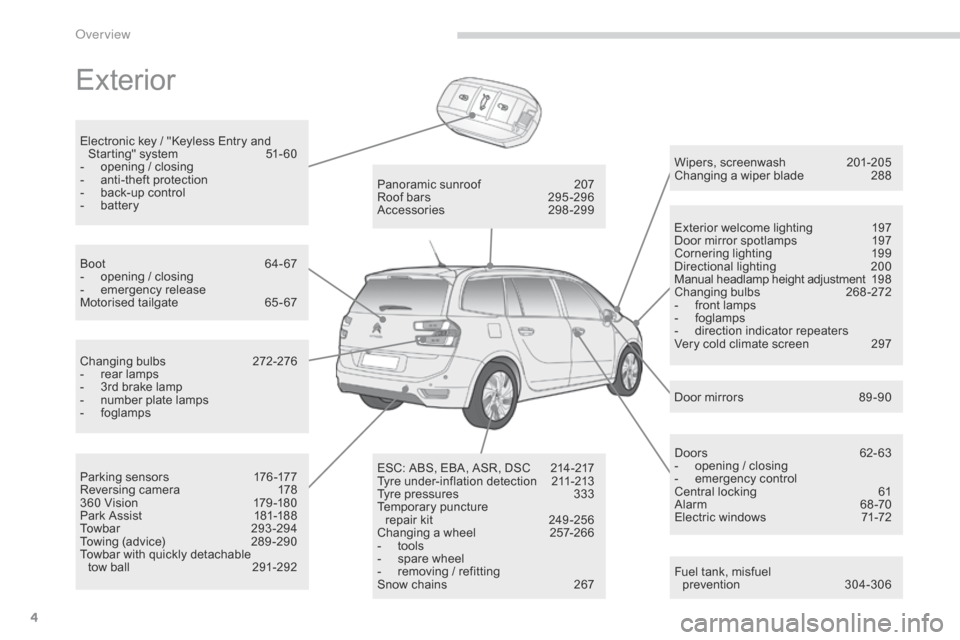
Exterior
Fuel tank, misfuel
p revention 3 04-306
Wipers,
screenwash
2
01-205
Changing a wiper blade
2
88
Exterior welcome lighting
1
97
Door mirror spotlamps
1
97
Cornering lighting
1
99
Directional
l
ighting
2
00
Manual headlamp height adjustment
19
8
Changing
bu
lbs
2
68-272
-
f
ront lamps
-
fo
glamps
-
d
irection indicator repeaters
Very cold climate screen
2
97
Door mirrors
8
9 -90
Panoramic
sunroof
2
07
Roof
bars
2
95 -296
Accessories
2
98-299
ESC:
ABS,
EBA,
ASR,
DSC
2
14-217
Tyre
under-inflation
detection
2
11-213
Tyre
pressures
3
33
Temporary
pu
ncture
r
epair
kit
2
49 -256
Changing
a
wheel
2
57-266
-
t
ools
-
s
pare
wheel
-
r
emoving
/
refitting
Snow
chains
2
67
Changing
bu
lbs
2
72-276
-
r
ear
lamps
-
3
rd
brake
lamp
-
n
umber
plate
lamps
-
fo
glamps
Parking
sensors
1
76 -177
Reversing
camera
1
78
360
Vision
1
79 -180
Park
Assist
1
81-188
Towbar
29
3-294
Towing
(advice)
2
89 -290
Towbar
with
quickly
detachable
tow
ball
2
91-292
Boot
6
4-67
-
o
pening
/
closing
-
em
ergency
r
elease
Motorised
tailgate
6
5 - 67
Electronic
key
/
"Keyless
Entry
and
S
tarting"
system
5
1- 60
-
o
pening
/
closing
-
a
nti-theft
protection
-
b
ack-up
control
-
b
attery
Doors
6
2- 63
-
o
pening / closing
-
em
ergency
c
ontrol
Central locking
6
1
Alarm
6
8-70
Electric windows
7
1-72
over view
Page 8 of 420
6
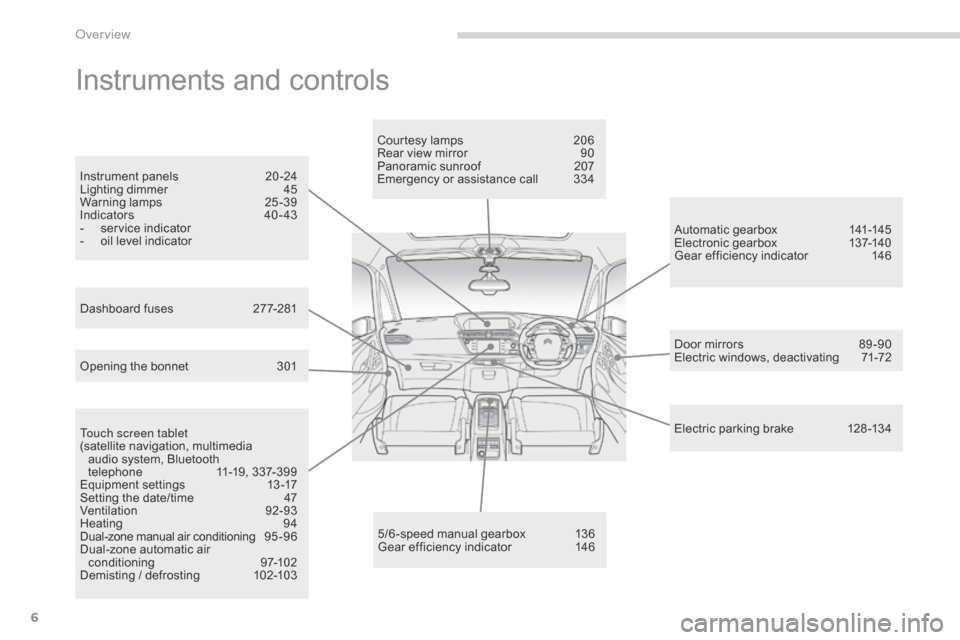
Instruments and controls
Touch screen tablet
(satellite navigation, multimedia
a
udio system, Bluetooth
t
elephone
1
1-19, 337-399
Equipment
se
ttings
1
3-17
Setting
the date/time
4
7
Ventilation
9
2-93
Heating
9
4
Dual-zone
m
anual
a
ir
c
onditioning
9
5 - 9 6
Dual-zone
automatic air
c
onditioning
9
7-102
Demisting
/ defrosting
1
02-103 Door
mirrors
8
9 -90
Electric windows, deactivating
7
1-72
5/6 -speed manual gearbox
1
36
Gear
efficiency indicator
1
46Automatic
gearbox
1
41-145
Electronic gearbox
1
37-140
Gear efficiency indicator
1
46
Opening the bonnet
3
01Courtesy lamps
2
06
Rear view mirror
9
0
Panoramic sunroof
2
07
Emergency or assistance call
3
34
Instrument panels
2
0 -24
Lighting dimmer
4
5
Warning
lam
ps
2
5-39
Indicators
4
0 - 43
-
s
ervice indicator
-
o
il level indicator
Electric parking brake 1 28 -134
Dashboard fuses
2
77-281
over view
Page 11 of 420
9
Optimise the use of your gearbox
With a manual gearbox, move off gently and change up without waiting. During acceleration change up early.
With
an automatic or electronic gearbox, give preference to automatic
m
ode and avoid pressing the accelerator pedal heavily or suddenly.
Control the use of your electrical
equipment
Before moving off, if the passenger compartment is too warm, ventilate it by opening the windows and air vents before using the air conditioning.
Above
30 mph (50 km/h), close the windows and leave the air vents
ope
n.
Remember
to
make
use
of
equipment
that
can
help
keep
the temperature
i
n the passenger compartment down (sunroof and window blinds...).
Switch
off the air conditioning, unless it has automatic regulation,
a
s soon as the desired temperature is attained.
Switch
off the demisting and defrosting controls, if not automatic.
Switch
off the heated seat as soon as possible.
Switch
off the headlamps and front foglamps when the level of light
d
oes not require their use.
Avoid
running the engine before moving off, particularly in winter; your
v
ehicle will warm up much faster while driving.
As
a passenger, if you avoid connecting your multimedia devices
(
film, music, video game...), you will contribute towards limiting the
c
onsumption of electrical energy, and so of fuel.
Disconnect
your portable devices before leaving the vehicle.
Eco-driving
Eco-driving is a range of everyday practices that allow the motorist to optimise their fuel consumption and CO2 emissions.
Drive smoothly
Maintain a safe distance between vehicles, use engine braking rather than the brake pedal, and press the accelerator progressively. These
p
ractices contribute towards a reduction in fuel consumption and
C
o
2 emissions and also helps reduce the background traffic noise.
I
f
your vehicle has cruise control, make use of the system at speeds
a
bove 25 mph (40 km/h) when the traffic is flowing well.
The
gear efficiency indicator invites you engage the most suitable gear:
a
s
soon as the indication is displayed in the instrument panel, follow it
s
traight away.
For
vehicles fitted with an electronic or automatic gearbox, this
i
ndicator appears only in manual mode.
.
Eco-driving
Page 12 of 420
10
Limit the causes of excess consumption
Spread loads throughout the vehicle; place the heaviest items in the bottom of the boot, as close as possible to the rear seats.
Limit
the loads carried in the vehicle and reduce wind resistance
(roof
bars, roof rack, bicycle carrier, trailer...). Use a roof box in
p
reference.
Remove
roof bars and roof racks after use.
At
the end of winter, remove snow tyres and refit your summer tyres.
Observe the recommendations on
maintenance
Check the tyre pressures regularly, when cold, referring to the label in the door aperture, driver's side.
Carry
out this check in particular:
-
b
efore a long journey,
-
a
t each change of season,
-
a
fter a long period out of use.
Don't
forget the spare wheel and the tyres on any trailer or caravan.
Have
your vehicle serviced regularly (engine oil, oil filter, air filter,
p
assenger compartment filter...) and observe the schedule of
o
perations recommended in the manufacturer's service schedule.
With
a BlueHDi Diesel engine, if the SCR system is faulty your vehicle
b
ecomes polluting; go to a CITROËN dealer or a qualified workshop
w
ithout delay to have the emissions of nitrous oxides brought back to
t
he legal level.
When
refuelling, do not continue after the third cut-off of the nozzle to
a
void any over flow.
At
the wheel of your new vehicle, it is only after the first 1 800 miles
(3
000 kilometres) that you will see the fuel consumption settle down to
a
consistent average.
Eco-driving
Page 209 of 420
207
Panoramic sunroof
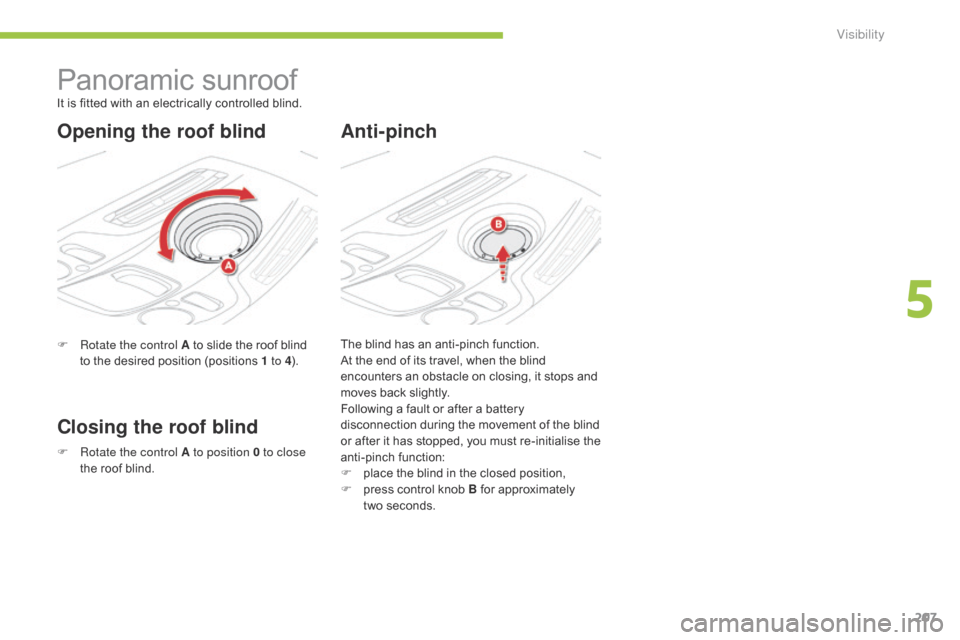
F Rotate the control A to slide the roof blind t
o the desired position (positions 1 to 4).
Closing the roof blind Anti-pinch
It is fitted with an electrically controlled blind.
Opening the roof blind
F Rotate the control A to position 0 to close
the roof blind. The
blind has an anti-pinch function.
At the end of its travel, when the blind
e
ncounters an obstacle on closing, it stops and
m
oves back slightly.
Following a fault or after a battery
d
isconnection during the movement of the blind o
r after it has stopped, you must re-initialise the an
ti-pinch f unction:
F
p
lace the blind in the closed position,
F
p
ress control knob B for approximately
t
wo seconds.
5
Visibility
Page 222 of 420
220
2nd row centre seat belt
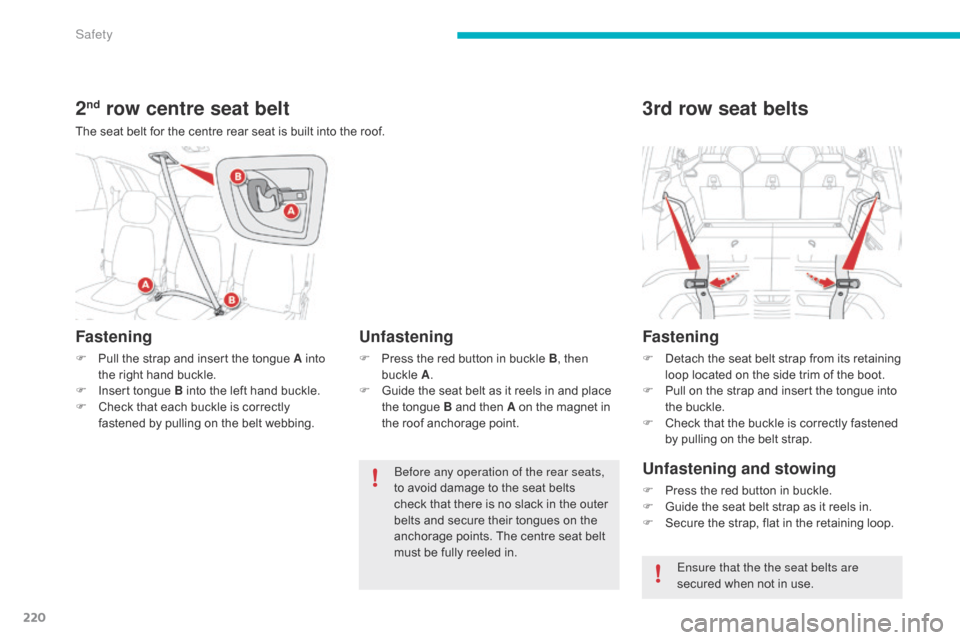
The seat belt for the centre rear seat is built into the roof.
Fastening
F Pull the strap and insert the tongue A into
the right hand buckle.
F
I
nsert tongue B into the left hand buckle.
F
C
heck that each buckle is correctly
f
astened by pulling on the belt webbing.
Unfastening
F Press the red button in buckle B, then
buckle A .
F
G
uide the seat belt as it reels in and place
t
he tongue B and then A on the magnet in
t
he roof anchorage point.
be
fore any operation of the rear seats,
to
avoid damage to the seat belts
c
heck that there is no slack in the outer
b
elts and secure their tongues on the
a
nchorage points. The centre seat belt
m
ust be fully reeled in.
3rd row seat belts
Fastening
F Detach the seat belt strap from its retaining l
oop located on the side trim of the boot.
F
P
ull on the strap and insert the tongue into
t
he buckle.
F
C
heck that the buckle is correctly fastened
b
y pulling on the belt strap.
Unfastening and stowing
F Press the red button in buckle.
F G uide the seat belt strap as it reels in.
F
S
ecure the strap, flat in the retaining loop.
Ensure that the the seat belts are
secured
when not in use.
Safety
Page 230 of 420

228
Sit in a normal upright position.
W ear a correctly adjusted seat belt.
Do
not allow anything to come between
t
he occupants and the airbags (a child, pet,
o
bject...), do not attach or fix anything near
t
o the airbags or their trajectories when
i
nflating as this could cause injuries when
t
he airbags are deployed.
Never
modify the original definition of your
v
ehicle, particularly in the area directly
a
round the airbags.
After
an accident or if the vehicle has been
s
tolen or broken into, have the airbag
s
ystems checked.
All
work on the airbag system must be
c
arried out by a CITROËN dealer or a
q
ualified
w
orkshop.
Even
if all of the precautions mentioned
a
re observed, a risk of injury or of minor
b
urns to the head, chest or arms when an
a
irbag is deployed cannot be ruled out. The
b
ag inflates almost instantly (within a few
m
illiseconds) then deflates within the same
t
ime discharging the hot gas via openings
p
rovided for this purpose.Front airbags
Do not drive holding the steering wheel by its spokes or resting your hands on the centre
p
art of the wheel.
Passengers
must not place their feet on the
das
hboard.
Do
not smoke as deployment of the airbags
c
an cause burns or the risk of injury from a
c
igarette or pipe.
Never
remove
or
pierce
the
steering
wheel
or
h
it it violently.
Do
not fit or attach anything to the steering
w
heel or dashboard, this could cause
i
njuries with deployment of the airbags.
Guidelines to follow: Lateral airbags
Use only approved covers on the seats, compatible with the deployment the lateral
a
irbags. For information on the range of seat
c
overs suitable for your vehicle, you can
contact
a CITROËN dealer.
Refer
to the "Accessories" section.
Do
not fix or attach anything to the seat
b
acks (clothing...). This could cause injury
t
o the chest or arms if the lateral airbag is
d
eployed.
Do
not sit with the upper part of the body any
n
earer to the door than necessary.
Curtain airbags
Do not fix or attach anything to the roof. This could cause injury to the head if the curtain
a
irbag is deployed.
If
fitted on your vehicle, do not remove the
g
rab handles installed on the roof, they play
a
part in securing the curtain airbags.
Safety
Page 297 of 420
295
Roof bars
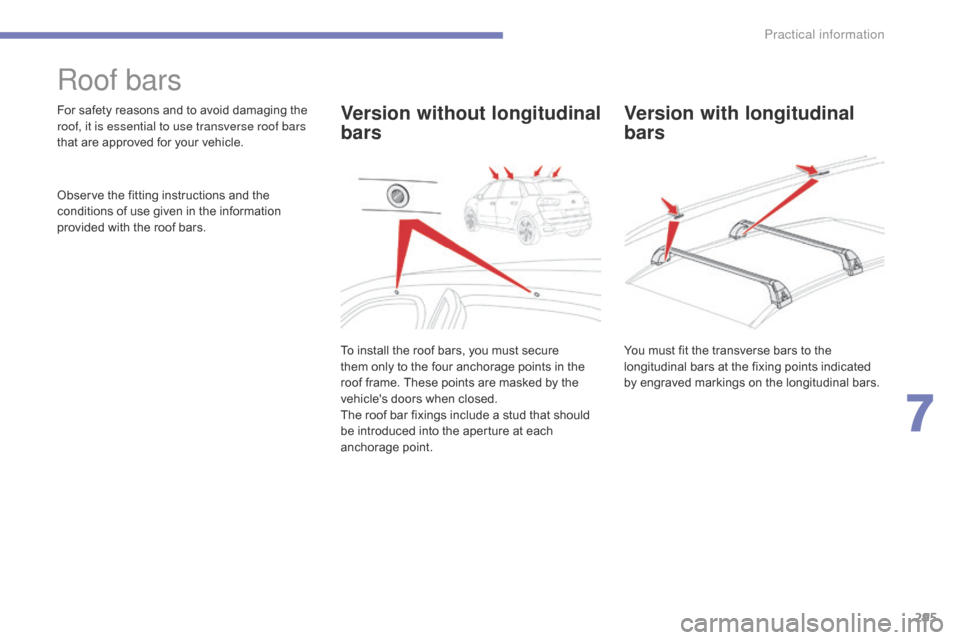
For safety reasons and to avoid damaging the roof, it is essential to use transverse roof bars
that
are approved for your vehicle.
Observe
the fitting instructions and the
c
onditions of use given in the information
p
rovided with the roof bars.Version with longitudinal
bars
To install the roof bars, you must secure them only to the four anchorage points in the
r
oof frame. These points are masked by the
v
ehicle's doors when closed.
The
roof bar fixings include a stud that should
b
e introduced into the aperture at each
anc
horage
p
oint.
Version without longitudinal
bars
You must fit the transverse bars to the longitudinal bars at the fixing points indicated
b
y engraved markings on the longitudinal bars.
7
Practical information
Page 298 of 420
296
Maximum load, distributed over the roof bars, for a loading height not exceeding
4
0 cm: 80 kg.
This
value is subject to change, please
c
heck the maximum load stated in the
i
nstructions provided with he roof bars.
If
the height exceeds 40 cm, adapt the
s
peed of the vehicle to the profile of the
r
oad to avoid damaging the roof bars
a
nd the fixings on the vehicle.
Please
refer to national legislation so as
t
o meet the requirements on carrying
o
bjects that are longer than the vehicle.
F
D
istribute
the
load
evenly,
avoiding
ov
erloading
on
one
side.
F
A
rrange
the
heaviest
part
of
the
load
as
c
lose
as
possible
to
the
roof.
F
A
nchor
the
load
securely
and
fit
a
warning
f
lag
if
part
of
it
overhangs
the
vehicle.
F
D
rive
gently,
as
the
vehicle
will
be
more
l
iable
to
the
effects
of
side
winds
(vehicle
s
tability
may
be
affected).
F
R
emove
the
roof
bars
as
soon
as
they
are
n
o
lon
ger
n
eeded.Recommendations
When carrying long objects, it is r ecommended that you deactivate the
m
otorised operation of the tailgate.
Practical information